

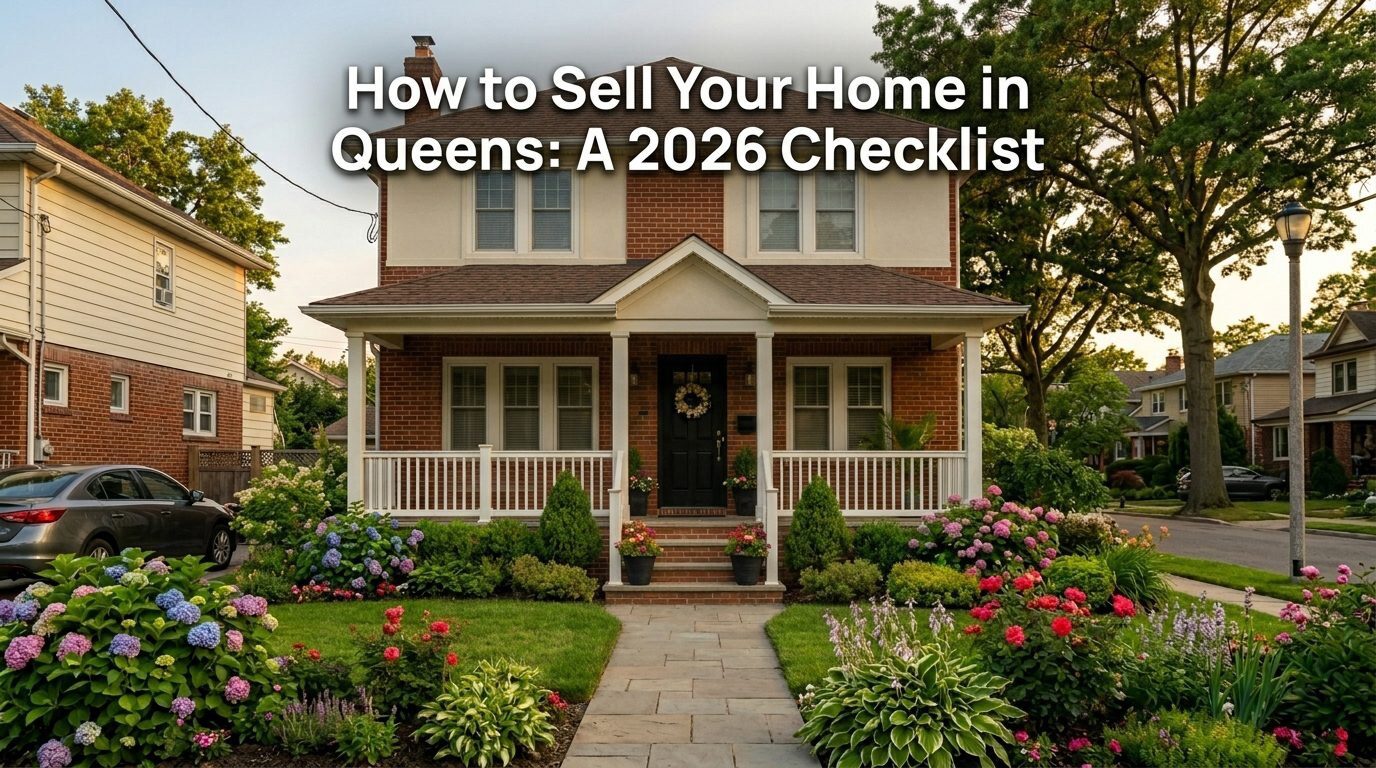
How to Sell Your Home in Queens: A 2026 Checklist
To sell your home in Queens in 2026: start with a professional valuation (CMA), prep and stage the property, price it to the current market, market it widely, handle New York’s required disclosures and attorney-led contract, then review offers and negotiate to closing. A local broker manages each step and keeps the timeline on track.
Selling a home is part strategy, part timing, and part paperwork — and in a market as layered as Queens, the details matter. Whether it’s a co-op in Rego Park, a two-family in Maspeth, or a single-family in Bayside, this guide walks you through how to sell your home in Queens, NY step by step, with the local and New York–specific rules that generic checklists leave out.
As a Licensed Associate Real Estate Broker based in Queens, I help sellers price accurately, prepare smartly, and negotiate with confidence — in English and Polish. Here’s the 2026 roadmap.
1. Start With a Real Valuation (CMA)
Before anything else, find out what your home is realistically worth today. A Comparative Market Analysis (CMA) reviews recent comparable sales, active listings, and your home’s condition to estimate a market range. A CMA is a professional opinion of value, not an appraisal or a guarantee — but it’s the foundation for every decision that follows.
Overpricing is the most common selling mistake: homes that sit too long often sell for less than if they’d been priced right from day one. Request a free valuation to anchor your plan in real numbers.
2. Prep, Repair, and Stage
First impressions drive offers. Focus on clean, bright, and well-maintained — not expensive renovations.
- Declutter and depersonalize so buyers can picture themselves there.
- Handle small repairs (leaky faucets, chipped paint, sticky doors) that signal upkeep.
- Deep-clean, maximize light, and tidy curb appeal/entryways.
- Consider light staging — even a few rooms can lift perceived value.
3. Price It Right for the 2026 Market
Pricing blends your CMA with current conditions: inventory, buyer demand, mortgage rates, and seasonality. In Queens, pricing also depends on property type — co-ops, condos, and one-to-three-family homes each attract different buyers and financing.
| Property type | Pricing note |
|---|---|
| Co-op | Buyers weigh monthly maintenance + board approval; price reflects both, not just square footage. |
| Condo | Often commands a premium over a comparable co-op due to flexibility and easier financing. |
| 1–3 family | Rental income potential can widen the buyer pool; price supported by comps and possible cash flow. |
4. Market and List Your Home
Once priced, your home needs professional exposure: quality photography, an accurate and compelling listing, and syndication to the MLS (OneKey MLS) and major portals. Strong marketing reaches more qualified buyers — which protects your price.
If you’re weighing neighborhoods or comparing notes, see how the process looks in selling in Forest Hills, Astoria, or Maspeth.
5. Handle Disclosures and the Legal Steps (New York)
New York has specific seller obligations. As of 2026, sellers generally must provide the Property Condition Disclosure Statement (recent state law removed the old option to give a $500 credit in lieu of disclosing), and all marketing must comply with Fair Housing rules. New York is an attorney state, so your real estate lawyer prepares the contract of sale and manages the closing.
You’ll also review agency relationships via the NYS Disclosure Form for Buyer and Seller. And under post-2024 settlement rules, any offer of buyer-agent compensation is negotiable — not fixed by law — and is something you decide with your agent as part of your strategy.
6. Review Offers and Negotiate
When offers arrive, look beyond price: financing strength (pre-approval, cash, co-op board odds), contingencies, deposit size, and timeline. Your agent helps you compare apples to apples and counter strategically.
Key Takeaways: What Strengthens an Offer
- Solid mortgage pre-approval or proof of funds
- Reasonable, clearly stated contingencies
- A deposit that signals commitment
- A closing timeline that fits your plans
- For co-ops: a buyer likely to pass board review
7. Close the Sale
After accepting an offer, contracts are signed, the buyer’s deposit goes into escrow, inspections and (for co-ops) board approval proceed, and the buyer finalizes financing. At closing, documents are signed, funds transfer, and ownership passes to the buyer. Your agent and attorney keep every detail aligned with the contract.
How to Sell Your Home in Queens, Step by Step (Recap)
In short: value it, prep it, price it, market it, disclose properly, negotiate well, and close cleanly. Just bought, or buying next? See the companion first-time home buyer guide for Queens, or explore buying in Forest Hills if you’re trading up.
Frequently Asked Questions
How long does it take to sell a home in Queens?
It varies with price, condition, and property type, but many Queens homes go from listing to closing in roughly 60–90 days once under contract. Accurate pricing and strong marketing up front are the biggest factors in selling faster and closer to ask.
What does it cost to sell a home in New York?
Sellers typically budget for the agreed real estate commission, attorney fees, and transfer taxes (including NY State and, in NYC, city transfer taxes), plus any co-op flip taxes or payoff costs. Your attorney and agent provide an itemized estimate before closing.
Do I need an attorney to sell my home in Queens?
Yes — New York is an attorney state, so the seller retains a lawyer to draft the contract of sale and handle closing. It’s standard in every Queens transaction and protects your interests throughout.
Should I sell before I buy my next home?
It depends on your finances and the market. Selling first gives you a known budget and a stronger offer; buying first avoids moving twice. A broker can map both timelines and contingencies so you choose with full information.
How do I know my asking price is right?
Start with a CMA based on recent comparable sales, then adjust for condition and current demand. Remember a CMA is a professional opinion of value, not an appraisal. Reviewing buyer activity in the first week also signals whether the price is landing.
Ready to Sell Your Home in Queens?
You don’t have to figure it out alone. I’ll guide you from valuation to closing — clearly, honestly, and in English or Polish. Reach out to start selling your Queens home whenever you’re ready.

About the Author — Agatha Lubas
Licensed Associate Real Estate Broker · NY License #10301213345 · Keller Williams Realty Liberty
Agatha Lubas helps buyers, sellers, and investors across Queens, Brooklyn, Nassau, and Suffolk Counties, working in both English and Polish. She’s known for accurate pricing, sharp negotiation, and patient, straightforward guidance — from first valuation through closing day.
Work with Agatha →