

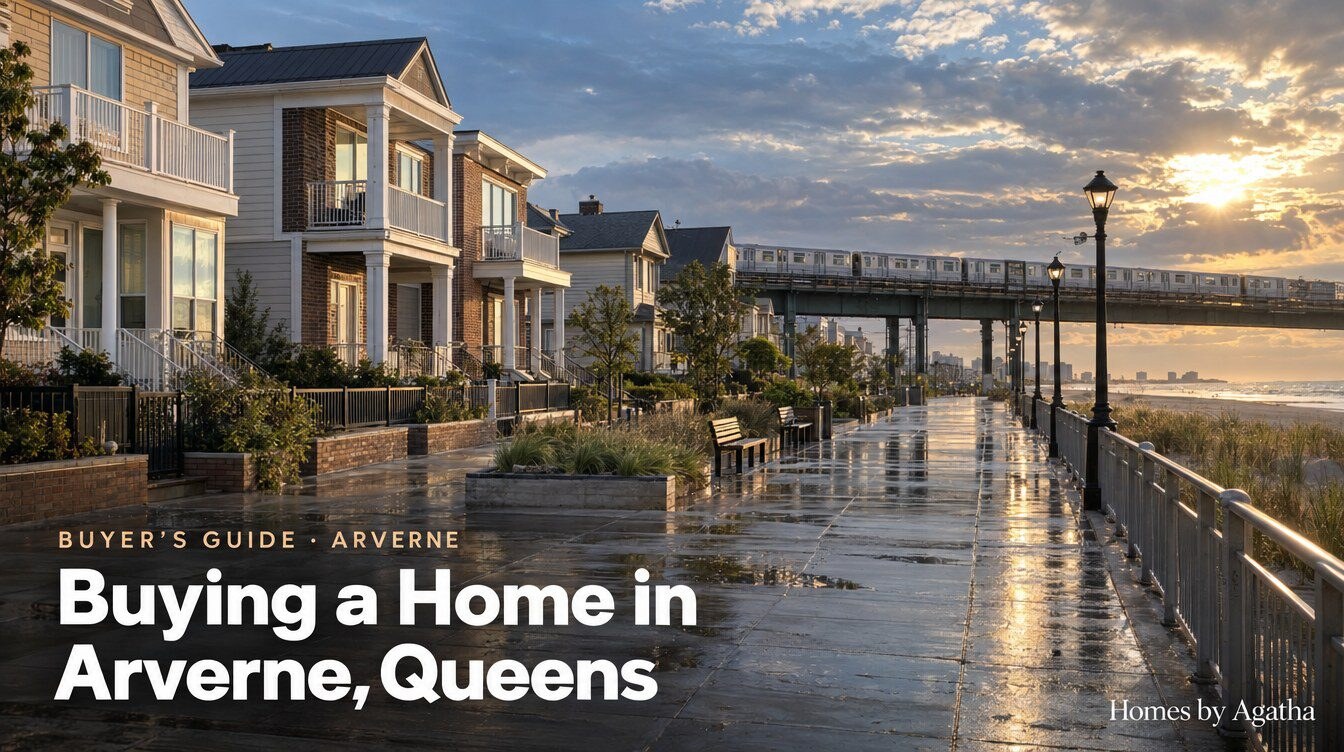
ARVERNE REAL ESTATE GUIDE
Buying a Home in Arverne, Queens: The Coastal Buyer’s Guide
Quick Answer
Buying a home in Arverne, Queens means buying on the Rockaway peninsula, between the Atlantic Ocean and Jamaica Bay. Before you offer, confirm the FEMA flood zone, get a flood insurance quote, review the Certificate of Occupancy, check any HOA or condo charges, and map your commute from the Beach 67 St or Beach 60 St A train stations.
Buying a home in Arverne is different from buying almost anywhere else in Queens. The neighborhood sits on a barrier peninsula, so the questions that decide a good purchase here include flood maps, elevation, insurance and salt air, along with the usual price, layout and commute. This guide is for buyers who are seriously researching Arverne and want to understand those questions before they tour, bid or sign anything.
You will learn how the housing stock breaks down, from early twentieth-century frame houses to the newer two-family homes and condominiums built in the 2000s and later. You will see what to budget for beyond the down payment, how financing changes when a property sits in a Special Flood Hazard Area, how the A train and the Rockaway ferry fit into a commute, and which documents to pull before the contract is signed.
As a Licensed Associate Real Estate Broker based in Ozone Park, Queens, I help buyers across the borough — in English and Polish — compare properties and plan the due diligence a coastal purchase needs. Nothing here replaces your attorney, your lender or a licensed home inspector, but it will help you ask them better questions.
Arverne at a glance
| Item | Arverne, Queens |
|---|---|
| Area | Rockaway peninsula, southern Queens; Jamaica Bay to the north, the Atlantic Ocean to the south |
| Borough / County | Queens / Queens County, New York City (Queens Community District 14) |
| Neighboring areas | Edgemere and Far Rockaway to the east; Rockaway Beach (Hammels) to the west. Exact boundary streets vary by source, so check the specific address if a boundary matters to you |
| ZIP code | 11692 (confirm the ZIP for a specific address with the USPS ZIP Code lookup) |
| Subway | A train, Far Rockaway branch: Beach 67 St and Beach 60 St in Arverne; Beach 44 St and Beach 36 St to the east in Edgemere |
| Other transit | Rockaway Park Shuttle (S) via Broad Channel; Q22 local bus along Rockaway Beach Boulevard; Q52 Select Bus Service toward Woodhaven Boulevard and Elmhurst; NYC Ferry Rockaway route from Beach 108th Street |
| Parks and landmarks | Rockaway Beach and Boardwalk; Arverne East Nature Preserve (Beach 44th Street to Beach 56th Place, opened 2024); Jamaica Bay shoreline |
| Main corridors | Rockaway Beach Boulevard, Beach Channel Drive, Rockaway Freeway (beneath the elevated A line), the Beach 67th Street area near the station |
| Typical property types | Detached and semi-detached frame houses, attached two-family homes, newer townhouse-style one- and two-family homes, condominium units, large rental complexes; co-ops are limited |
| Key local housing considerations | FEMA flood zones and flood insurance, elevation, salt-air wear, legal unit count on two-family homes, HOA or condo charges in newer developments, tax abatements on newer construction |
What does the housing stock look like in Arverne, Queens?
Arverne’s housing stock comes in three broad generations: older frame houses from the neighborhood’s seaside-resort era, a large wave of newer one- and two-family homes and condominiums built from the 2000s onward, and a current generation of new construction in the Arverne East area. Each generation raises different buyer questions about condition, flood resilience and monthly costs.
Understanding which generation a listing belongs to is the fastest way to predict what due diligence it will need. A 1920s bungalow and a 2010s two-family on the same street can carry very different flood exposure, insurance costs and repair priorities.
Older frame houses and bungalows
Arverne began as a summer resort in the late 1800s and early 1900s, and some detached and semi-detached frame houses from that period and the decades that followed remain on the side streets. These homes often sit closer to grade than newer construction, may have basements or crawl spaces, and frequently have been renovated in stages. In Arverne, many older houses were repaired, rebuilt or elevated after Hurricane Sandy in October 2012, so the permit history matters as much as the original build date.
Newer one- and two-family homes and condominiums
Large portions of Arverne were redeveloped in the 2000s and 2010s, most visibly in the area known as Arverne by the Sea near the Beach 67 St station. That redevelopment produced attached and semi-detached two-family houses, single-family townhouse-style homes and condominium buildings. Buyers here typically ask about homeowners’ or condominium association charges, whether the home still carries a property tax abatement, and how the building was designed for flood conditions. Association structure and charges differ from one development to the next, so confirm them in the offering plan or HOA documents, or with the managing agent, before you rely on them in a budget.
Arverne East and newer construction
Arverne East is a large mixed-use redevelopment of formerly vacant oceanfront land, anchored by the 35-acre Arverne East Nature Preserve that NYC Parks lists between Beach 44th Street and Beach 56th Place. Housing in new phases may be sold under offering plans or affordability programs with their own rules on income, resale and occupancy. Read the specific program or offering documents before assuming a new unit works like a standard resale. Sales phases and any income or resale rules can change, so ask the sales office for the current offering plan or program terms and have your attorney review them.
Rental complexes and co-ops
Arverne also contains large rental complexes, which matter to a buyer mainly as part of the streetscape and the local rental market for two-family owners. Co-operative apartments, which dominate many northern Queens neighborhoods, are limited on this part of the peninsula, so most Arverne buyers will be choosing among houses, townhouse-style homes and condominium units. Inventory changes, so if a co-op is what you want, ask for a current listings search before ruling the area in or out.
Is Arverne in a flood zone, and what should you know before buying a home in Arverne?
Much of Arverne lies within or near FEMA-mapped flood hazard areas because the neighborhood sits on a low barrier peninsula between the ocean and Jamaica Bay. Flood status is property-specific, so check each address on FEMA’s maps and the NYC Flood Hazard Mapper, request the seller’s flood disclosures, and get a flood insurance quote before you sign a contract.
This is the single biggest difference between buying a home in Arverne and buying in an inland Queens neighborhood such as Woodhaven or South Ozone Park. Flood status can affect your lender’s requirements, your monthly housing cost, your renovation options and your eventual resale.
Where to look up the flood zone
A Special Flood Hazard Area (SFHA) is the land FEMA maps as having a 1% or greater annual chance of flooding, often called the 100-year floodplain. FEMA publishes Flood Insurance Rate Maps (FIRMs) on its Flood Map Service Center. For New York City addresses, the NYC Department of City Planning’s Flood Hazard Mapper shows the effective and preliminary maps side by side. New York City has had both effective and preliminary FEMA maps in use for different purposes: according to the city, flood insurance rates have continued to be based on FEMA’s 2007 effective maps, while the NYC Building Code reflects the 2015 preliminary maps until new maps are issued. Ask your attorney and insurance agent which map governs the lender requirement and which governs building rules for the specific lot.
Ocean side, bay side and the middle
In Arverne, flood exposure is not only about distance to the beach. Storm surge can come from the ocean side, while tidal and bay-side flooding can affect blocks closer to Jamaica Bay and Beach Channel Drive. A home in the middle of the peninsula can still sit in a mapped zone if the ground elevation is low. That is why the elevation of the lot and the lowest floor matter more than the street address alone.
Elevation certificates
An elevation certificate is a FEMA form completed by a licensed surveyor or engineer that records a building’s elevations relative to the base flood elevation. Insurance agents and underwriters may use it to price a policy, and it documents whether the lowest floor and mechanical equipment sit above or below expected flood levels. Ask whether the seller has one. If not, budget time to order one during due diligence.
The seller’s flood disclosures
Since March 20, 2024, New York’s Property Condition Disclosure Statement (PCDS) includes questions about flood risk, including whether the property sits in a FEMA-designated floodplain, whether flood insurance is required or in place, past flood damage and claims, and whether the owner received federal disaster assistance for flood damage. The same law change removed the old option of giving a $500 credit instead of delivering the form. For an Arverne house, read those answers closely and have your attorney follow up on anything incomplete. Condominium units and co-op apartments are excluded from the disclosure law’s definition of residential real property, so condo buyers rely more heavily on their own inquiries.
| Flood document or check | Who provides it | Why it matters in Arverne |
|---|---|---|
| FEMA FIRM zone lookup | You or your agent, via FEMA Flood Map Service Center | Shows whether the lot falls in a Special Flood Hazard Area, which can trigger a lender’s flood insurance requirement |
| NYC Flood Hazard Mapper | NYC Department of City Planning | Compares effective and preliminary maps for NYC addresses |
| Elevation certificate | Seller, or a licensed surveyor/engineer you hire | Documents lowest-floor and equipment elevations used in insurance pricing and renovation planning |
| PCDS flood answers | Seller (1–4 family homes) | Discloses flood history, insurance, claims and federal assistance |
| Current flood policy declarations | Seller, on request | Shows the existing coverage and premium; some NFIP policies can be assigned to a buyer |
| Flood insurance quote for you | Your insurance agent | Converts flood risk into a monthly cost before you commit |
| DOB permit history | NYC Department of Buildings records | Shows post-2012 repairs, elevation work or rebuilding and whether they were signed off |
Renovation limits in flood zones
If you plan a major renovation, ask an architect early about flood-resistant construction rules. Under the National Flood Insurance Program, when the cost of improvements to a building in a Special Flood Hazard Area reaches the “substantial improvement” threshold — generally 50% of the structure’s market value — the building may have to be brought up to current flood-resistant standards, which can include elevation. In New York City, the NYC Building Code’s flood-resistant construction provisions apply. A renovation budget that ignores this rule can be badly wrong.
Want a flood-and-commute shortlist before you tour?
Agatha can help you narrow Arverne listings by property type, flood-zone status and walking distance to the A train, so your weekends go to homes that fit.
Should you buy a house, a townhouse-style home or a condo in Arverne?
In Arverne, the practical choice is usually between an older detached or semi-detached house, a newer townhouse-style one- or two-family home, and a condominium unit. Houses give the most control and, with a legal second unit, possible rental income; condos trade some control for shared maintenance and association rules.
The right answer depends on how much maintenance you can absorb, how you plan to finance, and how much of the flood-insurance and exterior-repair responsibility you want to carry yourself.
| Factor | Older house | Newer one- or two-family (e.g., Arverne by the Sea) | Condominium unit |
|---|---|---|---|
| What you own | Land and building | Land and building; may belong to an HOA with shared areas | Your unit plus a share of common elements |
| Flood insurance | You insure the building and, optionally, contents | You insure the building; check HOA coverage of shared areas | The association typically insures the building; you may want unit-owner coverage; ask for the master policy summary |
| Monthly extras | Taxes, insurance, utilities, repairs | Taxes, insurance, possible HOA dues, tax abatement phase-out | Common charges, taxes, unit insurance |
| Exterior and roof | Your responsibility | Usually yours; confirm HOA rules | Usually the association’s |
| Approval process | None beyond lender and attorney | Possible HOA estoppel or payoff letter | Condo right of first refusal waiver and application |
| Rental income | Only if the second unit is legal on the CO | Common in two-family layouts; confirm legal units | Subject to condo rental rules |
| Main due-diligence risk | Age, elevation, permit history | Association documents, abatement status, legal unit count | Building finances, reserve, master insurance |
The two-family question
Two-family homes are a large share of Arverne’s newer housing, and many buyers consider them for rental income from the second unit. Lenders generally evaluate rental income on a legal unit, and the Certificate of Occupancy issued by the NYC Department of Buildings is what states the legal number of dwelling units. If a listing describes a “two-family” but the CO shows one family, the second unit may not be legal. For a deeper look at how income property is evaluated, see this guide to buying a multi-family home in Queens.
Condominium buyers
A condominium unit is real property: you receive a deed, pay common charges for the building’s operation, and pay your own property taxes. Condo boards in New York typically hold a right of first refusal that they waive after reviewing an application. In a coastal building, ask for the master insurance summary, the reserve position and any planned assessments tied to storm hardening, roofs or mechanical relocation.
How much money do you need to buy a home in Arverne?
Budget for three layers: the down payment, buyer closing costs, and a higher-than-inland ongoing cost line for flood insurance and coastal maintenance. In Arverne, flood insurance can be the item that changes whether a home is affordable month to month, so price it before you bid.
Down payment requirements depend on the loan program and the property type, and only your lender can set them. Closing costs depend on price, loan amount and property type. This article does not quote neighborhood prices; for current pricing, ask for a recent sales review based on dated closed comparables from OneKey MLS.
New York City buyer closing costs
Buyers in New York City typically pay their own attorney, lender fees, title insurance and title search charges, recording fees, and the NYC mortgage recording tax if they finance a house or condo. Prepaid items such as real estate tax escrows and insurance premiums, including a flood insurance premium where required, are often collected at closing. For a fuller line-by-line explanation, see Queens closing costs explained.
| Cost | Upfront or ongoing | How it is set (official source) |
|---|---|---|
| NYC mortgage recording tax | Upfront (financed houses and condos) | Roughly 1.8% of the loan amount for loans under $500,000 and 1.925% for loans of $500,000 and above on 1–3 family homes and condos; co-op share loans are not subject to it (NYC Department of Finance / NYS) |
| “Mansion tax” | Upfront, paid by buyer | 1% of the price on residential purchases of $1 million or more; graduated above $2 million in New York City (NYS Department of Taxation and Finance) |
| Title insurance and search | Upfront | Quoted by the title company; rates in New York are regulated |
| Buyer’s attorney | Upfront | Agreed with your attorney |
| Lender fees, appraisal | Upfront | Disclosed on your Loan Estimate |
| Home inspection, elevation certificate, survey | Upfront (due diligence) | Quoted by each licensed professional |
| Flood insurance | Ongoing (first year often prepaid) | Quoted by your insurance agent; required by most lenders in a Special Flood Hazard Area |
| Property taxes | Ongoing | Assessed by the NYC Department of Finance; check for abatements and their phase-out dates |
| Common charges or HOA dues | Ongoing | Set by the condo or homeowners’ association |
Confirm current rates with the NYS Department of Taxation and Finance and NYC Department of Finance before closing.
Property tax abatements on newer homes
Some newer New York City homes were built with property tax exemptions or abatements that reduce the bill for a set number of years and then phase out. If you are buying a newer Arverne home, ask your attorney to confirm on NYC Department of Finance records whether a benefit applies, when it ends, and what the full tax would be afterward. A monthly budget based on an expiring abatement can understate your long-term cost. Benefit status is specific to each property, so rely on the Department of Finance record for the exact address rather than on a listing description.
Coastal maintenance reserve
Salt air, wind-driven rain and sand are harder on exterior materials than inland conditions. Owners near the ocean often plan for more frequent attention to metal railings, exterior HVAC units, window seals, roofing and siding. Your inspector can tell you which components show early wear, which helps you set a realistic yearly reserve.
Key Takeaways
- Flood status in Arverne is lot-specific; check FEMA maps and the NYC Flood Hazard Mapper for every address.
- Get a flood insurance quote before you bid, because the premium can change your monthly budget.
- A two-family is only an income property if the Certificate of Occupancy shows two legal units.
- Newer homes may carry tax abatements that phase out; budget for the full tax.
Turn the numbers into a real monthly payment
Before you fall for a listing, talk through down payment, closing costs, flood insurance and taxes so your pre-approval matches the homes you are touring.
How do pre-approval and financing work for an Arverne purchase?
Get a full mortgage pre-approval from an NMLS-registered loan originator before you tour seriously, and tell the lender up front that the property may be in a flood zone. For Arverne homes, the lender will typically order a flood zone determination, and if the building is in a Special Flood Hazard Area, require flood insurance before closing.
A pre-qualification is an estimate based on what you report. A pre-approval reviews your income, assets and credit documents and is far more persuasive to New York sellers and their attorneys.
Flood insurance and the loan file
Federally regulated and federally backed lenders generally require flood insurance on buildings in a Special Flood Hazard Area as a condition of the loan. The lender’s own flood zone determination controls that requirement, so bring the address to your loan officer early. Late surprises usually come from an insurance quote that arrives after the contract is signed and changes the debt-to-income math.
Appraisal on a coastal property
The appraiser will look for comparable sales with similar flood exposure, elevation and housing generation. A renovated, elevated older house and a 2010s two-family are not automatically comparable even on nearby blocks. If the appraisal comes in below the contract price, your mortgage contingency and your attorney’s negotiation matter. For a broader primer on financing your first purchase, see the first-time home buyer guide for Queens.
Condo and two-family financing details
For condominium units, the lender also reviews the building: insurance, budget, owner-occupancy and litigation questions are common. For two-family homes, lenders may count part of the projected rent from the legal second unit, depending on program rules. Ask your loan officer how rental income will be treated before you set your price range. Program eligibility, rates and down payment minimums change, and only your lender can confirm them.
How do you get around from Arverne — subway, bus, ferry and car?
Arverne is served by the A train’s Far Rockaway branch, with stations at Beach 67 St and Beach 60 St, and Beach 44 St and Beach 36 St a short distance east in Edgemere. The A runs across Jamaica Bay via Broad Channel and Howard Beach toward Brooklyn and Manhattan, and the NYC Ferry Rockaway route leaves from Beach 108th Street.
Commute time is personal: it depends on your destination, the time of day and how far your block is from a station. Test the trip you would actually make, at the hour you would make it, before you commit.
The A train and the Rockaway Park Shuttle
The A train’s Far Rockaway branch is the backbone of Arverne transit. From the Arverne stations, trains cross Jamaica Bay to Broad Channel, where the Rockaway Park Shuttle (S) connects to the western peninsula, and continue to Howard Beach–JFK Airport, which links to AirTrain JFK, then into Brooklyn and Manhattan. The line runs on an elevated structure above Rockaway Freeway through Arverne, so walking distance to Beach 67 St or Beach 60 St is a useful filter on any listing.
Buses
The Q22 runs along Rockaway Beach Boulevard and connects communities across the peninsula. The Q52 Select Bus Service links the Arverne area with Woodhaven Boulevard and Elmhurst, which helps for trips into central Queens neighborhoods such as Woodhaven. Routes and stops in Queens were revised under the MTA’s Queens Bus Network Redesign, so confirm current routing before relying on a particular bus. The MTA also runs weekday express bus service between the Rockaways and Midtown Manhattan; check the current express bus map and schedules for stops near the block you are considering.
NYC Ferry and the LIRR
The NYC Ferry Rockaway route runs from the Beach 108th Street landing in Rockaway Park to the Brooklyn Army Terminal in Sunset Park and Wall Street/Pier 11 in Manhattan. From Arverne, the landing is a bus or car ride west, so it suits some commuters better than others. To the east, the Long Island Rail Road’s Far Rockaway station on the Far Rockaway Branch is another option some residents weigh for trips toward Jamaica.
Driving and bridges
Drivers leave the peninsula by bridge: the Cross Bay Veterans Memorial Bridge toward Broad Channel, Howard Beach and Cross Bay Boulevard, or the Marine Parkway–Gil Hodges Memorial Bridge toward Brooklyn. Both are tolled crossings operated by MTA Bridges and Tunnels. MTA Bridges and Tunnels runs resident programs: E-ZPass NY customers with vehicles registered to a Rockaway or Broad Channel ZIP code, including Arverne’s 11692, can enroll in a plan that rebates the Cross Bay Bridge toll and discounts the Marine Parkway Bridge toll. Eligibility and amounts can change, so check the MTA’s resident programs page before you count on the savings. Cross Bay Boulevard leads to Howard Beach and onward toward South Ozone Park, which some buyers compare against Arverne when weighing a coastal versus inland purchase.
Comparing Arverne with an inland option?
Agatha can line up Arverne, Howard Beach and South Ozone Park listings side by side, with property type, flood status and commute in one view.
What should you check on an Arverne property before you sign?
Before signing a contract on an Arverne home, verify the Certificate of Occupancy and legal unit count, review NYC Department of Buildings permits and violations, confirm flood zone and elevation, and have a licensed inspector evaluate the systems most exposed to coastal conditions. Your attorney performs legal due diligence; you arrange the physical inspections.
Certificate of Occupancy and legal units
A Certificate of Occupancy (CO) is the NYC Department of Buildings document that states a building’s legal use and number of dwelling units. In Arverne, compare the CO with what you see: a finished ground floor, a basement apartment or a converted attic may not be legal. According to the NYC Department of Buildings, buildings built before 1938 are not required to have a CO unless later alterations changed their use, egress or occupancy. For those older houses, the Department’s borough office can issue a Letter of No Objection confirming legal use, and your attorney may request it along with other records.
Permits, sign-offs and post-Sandy work
Many Arverne homes were repaired, rebuilt or elevated after Hurricane Sandy. The DOB record should show permits for structural, plumbing and electrical work and whether each job was signed off. Open permits or unresolved violations can delay a closing or become your problem after it. Your attorney typically orders municipal searches, and your agent can help you pull the public record early.
Coastal and older-home systems
Ask your inspector to focus on the systems where location matters most. In Arverne that list usually includes:
- Mechanical placement: whether the boiler or furnace, water heater, electrical panel and meters sit above the expected flood level, or were relocated after 2012.
- Foundation and structure: signs of past water entry, settling, or corrosion on any piles, posts or steel elements under elevated homes.
- Building envelope: roof, flashing, siding and windows exposed to wind-driven rain and salt air.
- Exterior metals and HVAC: corrosion on railings, fasteners, condenser units and exterior lighting.
- Drainage: grading, sump pumps and backflow prevention where applicable.
- Older-home items: wiring age, plumbing materials, heating-oil tanks (above or below ground), and lead-based paint in homes built before 1978.
| Due-diligence item | Who handles it | When |
|---|---|---|
| Certificate of Occupancy and DOB records | Buyer’s attorney; agent can pull public records | Before contract |
| FEMA zone, NYC Flood Hazard Mapper | Buyer and agent | Before offer |
| Flood insurance quote | Buyer’s insurance agent | Before offer or contract |
| Home inspection (coastal focus) | Licensed home inspector | After accepted offer, before contract |
| Elevation certificate | Seller copy or licensed surveyor | Before contract |
| HOA or condo documents, budget, insurance | Buyer’s attorney | Before contract |
| Tax and abatement status | Buyer’s attorney (NYC DOF records) | Before contract |
| Title search and survey | Title company | After contract |
How do offers and contracts work when buying in Arverne?
New York is an attorney state: once a seller accepts your offer, the buyer’s and seller’s attorneys negotiate and prepare the contract of sale, and nothing is binding until both sides sign it. An accepted offer in Arverne is a starting point, not a deal.
From accepted offer to signed contract
After an accepted offer, the seller’s attorney usually sends a draft contract. Your attorney reviews it, the title and municipal picture, and any HOA or condo documents, while you complete your inspection. In Arverne, that review window is when the flood questions should be resolved: the insurance quote, the elevation certificate and the PCDS answers. Once you sign and deliver the contract deposit, backing out becomes much harder and usually depends on the contingencies written into the contract.
Writing a stronger offer without overreaching
A strong offer in Arverne is usually a clean, well-documented one: a full pre-approval, a realistic closing date, proof of funds, and an attorney ready to move. Because flood insurance and appraisal can both affect financing, avoid promising terms you cannot keep, such as waiving a mortgage contingency, unless your attorney and lender agree the risk is acceptable.
Contingencies to discuss with your attorney
The most common protection is the mortgage commitment contingency. Ask your attorney how the contract handles a low appraisal, a lender’s flood insurance requirement, open permits or violations discovered later, and, for condos, the board’s waiver of its right of first refusal.
Found the one? Shape the offer before you send it
Get a second set of eyes on price, terms and timing so your Arverne offer is competitive and still leaves room for flood and inspection due diligence.
How does buyer representation work in New York in 2026?
In 2026, buyer-agent compensation in New York is negotiable, is not set by law and is not automatically paid by the seller. Buyers typically sign a written buyer representation agreement before touring homes with an agent, and the agreement states the services and how compensation will be handled.
These rules follow the 2024 National Association of Realtors settlement and the practice changes that came with it. A seller may agree to contribute toward your agent’s compensation, but that is a point of negotiation, not a guarantee. Read the agreement carefully and ask questions before you sign.
The NYS Disclosure Form for Buyer and Seller
New York requires real estate licensees to provide the NYS Disclosure Form for Buyer and Seller at the first substantive contact. The form explains the different agency relationships — seller’s agent, buyer’s agent, broker’s agent and dual agency — so you understand whose interests the agent represents.
What a buyer’s agent does in Arverne
For an Arverne purchase, a buyer’s agent can help you separate housing generations, pull flood and DOB information early, coordinate with your attorney and lender, and compare offers against recent closed sales. For a full explanation of the relationship, see working with a buyer’s agent in NY. When you are ready to see how this applies to current listings, the Arverne home buying services page outlines how Agatha works with buyers on the peninsula.
What is the timeline from offer to closing in Arverne?
A financed Arverne purchase commonly runs several weeks to a few months from accepted offer to closing, depending on attorney review, mortgage underwriting, flood insurance, title work and, for condos, board review. Cash purchases can move faster; condos with association review can take longer.
| Stage | What happens | Arverne-specific detail |
|---|---|---|
| 1. Preparation | Pre-approval, buyer agreement, NYS agency disclosure | Tell the lender the property may be in a flood zone |
| 2. Search and shortlist | Tours, comparisons, early record checks | Check flood zone and walking distance to Beach 67 St / Beach 60 St |
| 3. Offer accepted | Price and terms agreed in principle | Request elevation certificate, PCDS and current flood policy |
| 4. Inspection and attorney review | Inspection, contract negotiation, document review | Coastal-focused inspection; HOA or condo documents; abatement check |
| 5. Contract signed | Contract deposit paid, contingencies begin | Insurance quote should already be in hand |
| 6. Underwriting and appraisal | Lender reviews file and orders appraisal | Lender flood zone determination; flood policy bound before closing if required |
| 7. Board or HOA steps | Condo waiver or HOA letters | Timing depends on the managing agent |
| 8. Clear to close and closing | Final walk-through, closing, deed recorded | Bring proof of flood insurance and homeowners coverage |
Timing is never guaranteed. Schedules vary with each lender, each attorney, each board and each seller’s situation, so treat any estimate as a planning range.
What mistakes do buyers make in Arverne, and what should be on your checklist?
The most common mistakes when buying a home in Arverne are pricing flood insurance too late, trusting a listing’s unit count without reading the Certificate of Occupancy, and budgeting on an expiring tax abatement. Each one is avoidable with a few early documents.
Mistakes to avoid
- Treating the beach as the only flood factor. Bay-side and low-elevation blocks can be mapped flood zones too.
- Getting the insurance quote after the contract. By then, a high premium is a budget problem, not a negotiating point.
- Assuming “two-family” means legal. The CO decides, and lenders follow it.
- Ignoring post-Sandy permits. Unsigned-off work can delay closing or affect insurance.
- Overlooking association documents. HOA or condo rules can limit rentals, renovations and exterior changes.
- Planning a big renovation without the substantial-improvement rule in mind. Crossing the threshold can trigger elevation or flood-proofing requirements.
- Testing the commute only on a weekend. Ride the A or the ferry at the hour you would actually travel.
Arverne buyer checklist
- Receive and read the NYS Disclosure Form for Buyer and Seller; sign a written buyer representation agreement that states compensation.
- Get a full pre-approval and tell the lender about possible flood-zone requirements.
- Decide on property type: older house, newer one- or two-family, or condo.
- For each serious listing, check the FEMA flood zone and the NYC Flood Hazard Mapper.
- Request a flood insurance quote and add it to your monthly payment estimate.
- Pull the Certificate of Occupancy and DOB permit history.
- Ask for the elevation certificate, PCDS and current flood policy declarations.
- Confirm tax abatement status and any HOA or common charges.
- Schedule a coastal-focused home inspection.
- Let your attorney review the contract, title and association documents before you sign.
- Bind flood and homeowners insurance before closing, and keep copies for your lender.
Key Takeaways
- In New York, an accepted offer is not a contract; attorneys negotiate and prepare the contract of sale.
- Resolve flood insurance, elevation and CO questions before signing, not after.
- Buyer-agent compensation is negotiable and set in a written agreement before touring.
- Walking distance to the A train and the age of the building are two of the most useful filters in Arverne.
Ready to start your Arverne search with a plan?
Book a no-pressure conversation with Agatha about property types, flood due diligence and timing, in English or Polish, and leave with clear next steps.
Frequently asked questions about buying a home in Arverne
Is all of Arverne in a flood zone?
Not every lot in Arverne, Queens, is in a Special Flood Hazard Area, but much of the Rockaway peninsula sits in or near FEMA-mapped flood zones. Flood status is property-specific, so check each address on FEMA’s Flood Map Service Center and the NYC Flood Hazard Mapper, and confirm with your lender’s flood zone determination.
Do I need flood insurance to buy a house in Arverne?
If the building is in a Special Flood Hazard Area and you use a federally regulated or federally backed mortgage, your lender will generally require flood insurance before closing. Cash buyers are not required to carry it by a lender, but many still buy coverage because of Arverne’s coastal location.
Which subway stations serve Arverne?
The A train’s Far Rockaway branch serves Arverne at Beach 67 St and Beach 60 St, with Beach 44 St and Beach 36 St a short distance east in Edgemere. The line crosses Jamaica Bay through Broad Channel, where the Rockaway Park Shuttle connects, and continues through Howard Beach toward Brooklyn and Manhattan.
Is there a ferry from the Rockaways to Manhattan?
Yes. The NYC Ferry Rockaway route runs from the Beach 108th Street landing in Rockaway Park to the Brooklyn Army Terminal in Sunset Park and Wall Street/Pier 11 in Manhattan. From Arverne, the landing is west along the peninsula, so most riders reach it by bus, bike or car.
What is an elevation certificate and why does it matter in Arverne?
An elevation certificate is a FEMA form completed by a licensed surveyor or engineer that records a building’s elevations relative to the base flood elevation. In Arverne, it helps insurance agents price flood coverage and shows whether living space and equipment sit above expected flood levels, which affects cost and renovation planning.
Are there co-ops for sale in Arverne?
Co-ops are limited in Arverne compared with northern Queens neighborhoods. Most purchases here involve detached or attached houses, newer townhouse-style one- and two-family homes, or condominium units. Condo buyers receive a deed and pay common charges, while co-op buyers would buy shares and need board approval.
How do I know if a two-family home in Arverne is legal?
Check the Certificate of Occupancy on NYC Department of Buildings records. The CO states the legal use and number of dwelling units. If the listing says two-family but the CO shows one family, the second unit may not be legal, which can affect financing, insurance and rental income.
What closing costs does a buyer pay in Arverne?
Arverne buyers typically pay their attorney, lender fees, title insurance, recording charges and, when financing a house or condo, the NYC mortgage recording tax. Purchases of $1 million or more also carry the New York State mansion tax. Prepaid taxes and insurance, including any required flood insurance premium, are often collected at closing.
Does the seller pay my buyer’s agent in New York?
Not automatically. In 2026, buyer-agent compensation in New York is negotiable and not set by law. You sign a written buyer representation agreement before touring that states how your agent is paid. A seller may agree to contribute, but that is negotiated in each transaction rather than assumed.
Can I renovate an older Arverne house however I want?
Not always. In a Special Flood Hazard Area, improvements that reach the substantial-improvement threshold, generally 50% of the structure’s market value, can require bringing the building up to flood-resistant standards, sometimes including elevation. Ask an architect and the NYC Department of Buildings rules before budgeting a major renovation.
Next steps for your Arverne purchase
Arverne rewards buyers who do their coastal homework early. Separate the housing generations, price flood insurance before you bid, read the Certificate of Occupancy and DOB history, and let your attorney review association and abatement documents before you sign. When you are ready to put this into practice on current listings, visit the page to buy your home in Arverne with Agatha. If you already own on the peninsula and are thinking about a move, the companion guide for selling your Arverne home covers the other side of the transaction.
This article is for general informational purposes only and reflects conditions that may change. It is not legal, tax, or financial advice, an appraisal, or a guarantee of price or outcome; consult a licensed New York attorney, a CPA, and an NMLS-registered mortgage loan originator as appropriate. A CMA is an opinion of value, not an appraisal. Real estate brokerage services are offered by Agatha Lubas, Licensed Associate Real Estate Broker, NY License #10301213345, Keller Williams Realty Liberty, 96-10 101st Avenue, Ozone Park, NY 11416. The NYS Disclosure Form for Buyer and Seller, the NYS Housing and Anti-Discrimination Disclosure / Fair Housing Notice, and the brokerage’s Standard Operating Procedures are available on request. Equal Housing Opportunity.

Agatha Lubas helps buyers, sellers and investors across Queens, Brooklyn, Nassau County and Suffolk County plan and complete residential transactions. She works in English and Polish, so clients can discuss every step in the language they are most comfortable with.
Work with Agatha