

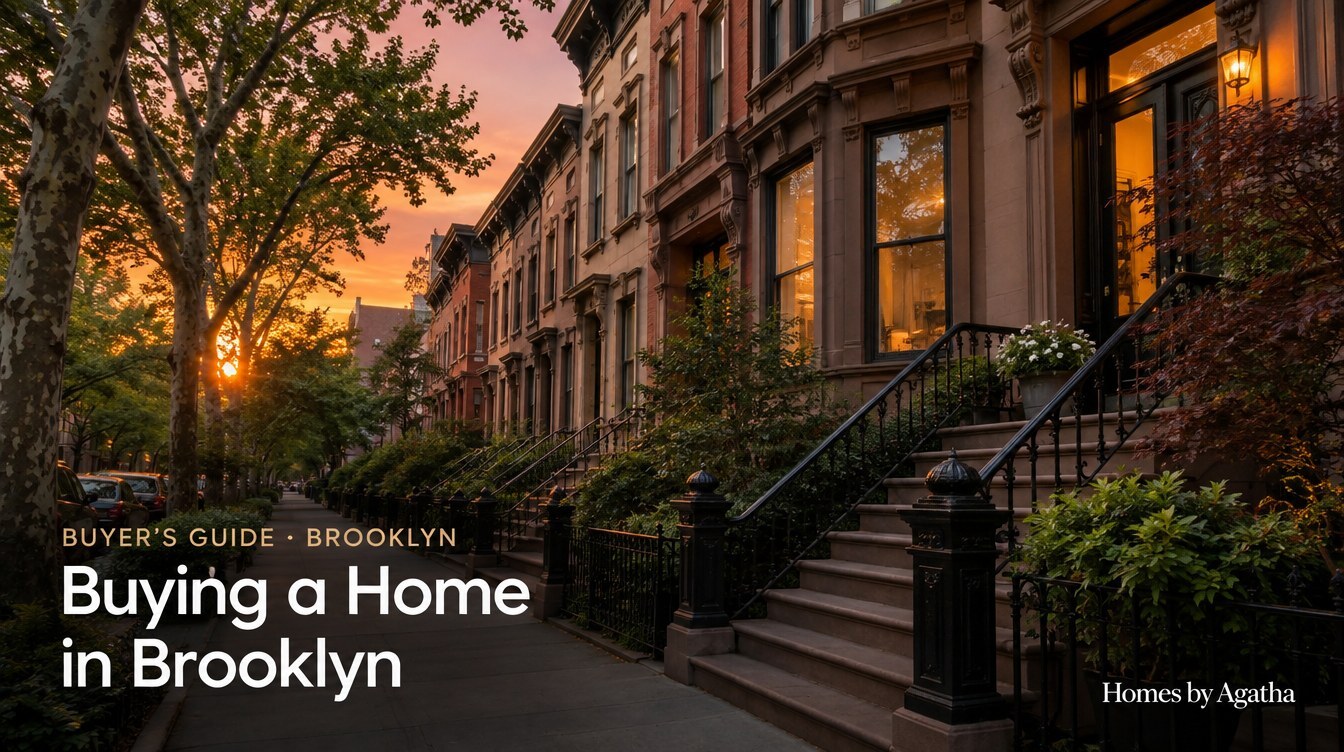
BROOKLYN REAL ESTATE GUIDE
Buying a Home in Brooklyn: A Guide by Property Type, Cost and Process
Quick Answer
Buying a home in Brooklyn (Kings County, New York City) starts with choosing a housing type: brownstone or row house, co-op, condo, two-to-four-family home, or detached house. Each type changes your financing, monthly costs, approval process and due diligence. Budget for NYC buyer taxes, verify the Certificate of Occupancy and flood zone, and expect attorney-negotiated contracts.
Buying a home in Brooklyn is less about picking a single “Brooklyn market” and more about understanding which kind of property you are actually buying. A parlor-floor brownstone in a landmark district, a co-op apartment on Ocean Parkway, a new condo near Downtown Brooklyn and a two-family brick house in southern Brooklyn are four different transactions, with different lenders, different monthly costs, different approval steps and different documents to check.
This guide is for buyers who want to understand those differences before they start touring. It walks through the housing stock that exists across Kings County, the costs New York City adds at closing, how financing changes by property type, what to check on an older Brooklyn building, and how offers and contracts work in New York, which is an attorney state.
As a Licensed Associate Real Estate Broker with Keller Williams Realty Liberty, I work with buyers in Brooklyn and Queens, in English and Polish, and much of that work is helping people understand what a specific property type will require before they commit to it. Where you buy is always your decision; my role is to make the trade-offs clear. If you already know you want to start a search, the Brooklyn home buyer services page explains how we would work together.
Brooklyn at a glance
| Item | Details |
|---|---|
| Area | Brooklyn, one of the five boroughs of New York City; the borough and Kings County share the same boundaries |
| Borough / County | Brooklyn / Kings County, New York State |
| ZIP codes | Brooklyn addresses use ZIP codes in the 112xx range (for example, 11201 for Brooklyn Heights and Downtown Brooklyn); confirm the exact ZIP for each address with USPS |
| Subway | 2, 3, 4, 5, A, C, B, D, F, G, J, L, M, N, Q and R lines plus the Franklin Avenue Shuttle; service patterns vary by line and time of day, so check mta.info for current schedules |
| Rail | Long Island Rail Road Atlantic Branch stations at Atlantic Terminal, Nostrand Avenue and East New York |
| Ferry | NYC Ferry landings along the waterfront, including Greenpoint, Williamsburg, DUMBO/Fulton Ferry, Atlantic Avenue/Pier 6, Red Hook, Sunset Park/Brooklyn Army Terminal and Bay Ridge; routes changed in December 2025, so check ferry.nyc for which route serves each landing |
| Major roads | Brooklyn-Queens Expressway (I-278), Gowanus Expressway, Prospect Expressway, Belt Parkway; Brooklyn, Manhattan and Williamsburg bridges; Hugh L. Carey Tunnel; Verrazzano-Narrows Bridge |
| Parks and landmarks | Prospect Park, Brooklyn Bridge Park, Marine Park, McCarren Park, Brooklyn Botanic Garden, Grand Army Plaza, the Coney Island boardwalk, the Brooklyn Bridge, Barclays Center |
| Commercial corridors | Fulton Street in Downtown Brooklyn, Atlantic Avenue, Flatbush Avenue, Nostrand Avenue, Kings Highway, Pitkin Avenue, 86th Street, Fifth Avenue |
| Typical property types | Brownstone, limestone, brick and wood-frame row houses; two-to-four-family homes; co-op apartments; condominiums; detached and semi-detached houses in parts of southern and central Brooklyn |
| Local housing considerations | Historic districts regulated by the NYC Landmarks Preservation Commission; many pre-1938 buildings without a Certificate of Occupancy; coastal and canal-side flood zones; co-op board approval; Class 1 versus Class 2 property tax treatment |
What kinds of homes can you buy in Brooklyn?
Brooklyn’s for-sale housing falls into five broad groups: row houses (including brownstones), two-to-four-family homes, co-op apartments, condominiums, and detached or semi-detached houses. Most of the borough’s houses are attached or semi-attached, and much of the building stock is older than World War II, which shapes inspections, financing and paperwork.
Brownstones and other row houses
A brownstone is a row house faced with brown sandstone, built mostly in the second half of the nineteenth century. In Brooklyn, brownstone rows are closely associated with Brooklyn Heights, Cobble Hill, Carroll Gardens, Boerum Hill, Park Slope, Fort Greene, Clinton Hill, Bedford-Stuyvesant and Crown Heights. The typical layout has a garden level at or slightly below the street, a parlor floor reached by a stoop, and two or more upper floors.
Not every Brooklyn row house is a brownstone. Limestone row houses appear in Bedford-Stuyvesant, Crown Heights and Park Slope; brick row houses are common in Sunset Park, Bay Ridge and much of central Brooklyn; and wood-frame row houses, often covered in later siding, appear in Greenpoint, Williamsburg and Bushwick. The facade material matters to a buyer because it affects maintenance, insurance questions and, inside a historic district, what exterior changes need approval.
Many row houses have been converted over the decades. A building sold as a “one-family brownstone” may legally be a two- or three-family house, or the reverse. A common configuration is an owner’s duplex on the lower floors with one or more rental units above. That is why the Certificate of Occupancy discussion later in this guide matters so much for row houses.
Two-to-four-family homes
Two-family and three-family houses are found across Brooklyn, from the brick attached homes of Bensonhurst, Dyker Heights, Canarsie and Flatlands to the frame and brick houses of Bushwick, Cypress Hills and East New York. Agatha’s own Brooklyn work includes Bedford-Stuyvesant, Brownsville and East New York, where attached and semi-attached multi-unit houses are a regular part of the housing stock.
The number of units changes the rules. A house with one to four residential units can typically be financed with a standard residential mortgage. A building with three or more units is a “multiple dwelling” under New York law and must register with the NYC Department of Housing Preservation and Development (HPD). A building with four or more residential units moves from property tax Class 1 to Class 2, which is assessed differently by the NYC Department of Finance. A three-family and a four-family house can look identical from the sidewalk and still be very different purchases.
Co-op apartments
A co-op apartment is not real property in the usual sense. The buyer purchases shares in a cooperative corporation that owns the building and receives a proprietary lease for a specific unit. Brooklyn has a large co-op stock, including prewar elevator buildings along Ocean Parkway, Eastern Parkway, Prospect Park West and Shore Road, and many mid-century buildings in Flatbush, Midwood, Kensington, Bay Ridge and Brooklyn Heights.
Some Brooklyn co-ops operate under affordability programs, such as Mitchell-Lama or Housing Development Fund Corporation (HDFC) structures, which can include income limits and resale restrictions. Those rules are set by the program and by each building’s documents, so they must be confirmed building by building, including any income limits and resale restrictions.
Condominiums
A condominium unit is real property: the buyer receives a deed to the unit and a share of the common elements. Newer condo buildings are concentrated in areas such as Downtown Brooklyn, DUMBO, Williamsburg, Greenpoint, Prospect Heights and Gowanus, while small condo buildings, often a converted row house split into two or three units, appear in many brownstone areas. New-development condos are sold by a sponsor under an offering plan filed with the New York State Attorney General.
Detached and semi-detached houses
Freestanding houses are a smaller share of Brooklyn’s stock, but they exist. Victorian detached homes with yards are a defining feature of Prospect Park South and Ditmas Park. Dyker Heights, Manhattan Beach, Mill Basin and Bergen Beach have detached houses, and Marine Park mixes attached and semi-detached homes. Several of these southern areas sit near Jamaica Bay, Sheepshead Bay or the Atlantic shore, so flood zone review is part of the purchase.
Brownstone, co-op, condo or multi-family: which Brooklyn property type fits your plan?
The right Brooklyn property type depends on four things: how much control you want over the building, how much cash you will have after closing, whether you want rental income, and how much approval process you can tolerate. The table below compares the main options side by side.
| Factor | Row house / one-family | Two-to-four-family | Co-op apartment | Condo unit |
|---|---|---|---|---|
| What you own | Land and building (deed) | Land and building (deed) | Shares plus a proprietary lease | The unit plus a share of common elements (deed) |
| Approval needed | None beyond lender and contract | None beyond lender and contract; tenants’ leases transfer with the building | Board application package and usually an interview | Usually a board right of first refusal, typically waived |
| Monthly building cost | You pay taxes, insurance, water/sewer and all repairs directly | Same as a house, offset by any legal rental income | Maintenance, which typically includes a share of building taxes and the underlying mortgage | Common charges plus a separate property tax bill |
| Financing | Residential mortgage | Residential mortgage (one to four units); lender rules on rental income | Share loan; financing limits set by each building | Mortgage; lender reviews the building’s condition and finances |
| NYC mortgage recording tax | Applies | Applies (confirm treatment of four-unit buildings with your attorney) | Does not apply (share loan) | Applies |
| Title | Title insurance | Title insurance | Lien search instead of title insurance | Title insurance |
| Biggest due-diligence item | Legal use (CO), systems, facade, landmark rules | Legal unit count, tenants and leases, HPD and DOB records | Building finances, rules and underlying mortgage | Building finances, reserves, tax abatements |
| Renovation freedom | High, subject to DOB permits and LPC rules in historic districts | High, but work in occupied units must respect tenants’ rights | Limited by alteration agreement and board | Moderate, subject to bylaws and board |
How co-op and condo math compares in Brooklyn
A co-op asking price is not directly comparable with a condo asking price. Co-op maintenance usually includes a share of the building’s property taxes and the payments on the building’s underlying mortgage, while a condo owner pays common charges and a separate tax bill. Two apartments with similar asking prices can produce very different monthly obligations, so compare the full monthly cost, not the price alone.
Co-ops also tend to set their own financial requirements. A building may limit how much of the price you can finance, require a certain amount of cash left over after closing (often called post-closing liquidity), or cap your debt-to-income ratio. These are building-specific, not citywide rules, so check the financing and down-payment requirements in each co-op’s purchase application.
Why the house-versus-apartment decision is bigger in Brooklyn
Owning a Brooklyn row house means owning a nineteenth- or early-twentieth-century structure that shares walls with neighbors. You are responsible for the roof, the facade, the stoop, the boiler, the plumbing and the sidewalk in front. Owning a co-op or condo spreads many of those costs across the building, but places major decisions in the hands of a board. Neither is better in general; one will fit your budget, time and tolerance for repairs better than the other.
Key Takeaways
- A Brooklyn property type determines your financing, monthly costs, approvals and closing taxes before the neighborhood does.
- Co-ops are shares plus a lease, carry no NYC mortgage recording tax, and require board approval.
- Three-unit buildings are multiple dwellings registered with HPD; four-unit buildings also move into property tax Class 2.
- Compare co-ops and condos on total monthly cost, not asking price.
Not sure which Brooklyn property type fits your budget?
Agatha can walk you through brownstones, co-ops, condos and multi-family homes side by side, using your own numbers, before you spend weekends at open houses.
What does buying a home in Brooklyn cost beyond the purchase price?
Beyond the down payment, buying a home in Brooklyn involves New York City and New York State taxes, attorney and lender fees, title or lien-search costs, and, for co-ops and condos, building fees. Which costs apply depends mostly on the property type and the price.
Taxes a Brooklyn buyer may pay
The New York State “mansion tax” is 1% of the price on residential purchases of $1 million or more, and it is paid by the buyer. Within New York City, which includes every Brooklyn address, the rate is graduated above $2 million. Below $1 million, the mansion tax does not apply.
The New York City mortgage recording tax applies when you finance a house or a condo. According to the NYC Department of Finance and New York State rules, it is roughly 1.8% of the loan amount for loans under $500,000 and 1.925% for loans of $500,000 and above on one-to-three-family homes and condo units. Co-op loans are not subject to mortgage recording tax because they are share loans, not mortgages on real property.
The NYS real estate transfer tax and the NYC Real Property Transfer Tax are customarily paid by the seller in a resale. In some new-development condo sales, however, the sponsor’s contract or offering plan shifts those transfer taxes to the buyer, so read the offering plan and the contract closely to see who pays.
| Cost | House / two-to-four-family | Condo | Co-op | Source / note |
|---|---|---|---|---|
| NYS “mansion tax” (1% at $1M+, graduated above $2M in NYC) | Yes, if price is $1M+ | Yes, if price is $1M+ | Yes, if price is $1M+ | NYS Department of Taxation and Finance |
| NYC mortgage recording tax (about 1.8% under $500K loan; 1.925% at $500K+) | Yes, if financed | Yes, if financed | No | NYC Department of Finance / NYS |
| Title insurance | Yes | Yes | No; lien search instead | Quoted by title company |
| Buyer’s attorney | Yes | Yes | Yes | Fee set by the attorney |
| Lender fees, appraisal, escrow deposits | Yes, if financed | Yes, if financed | Yes, if financed | Shown on your Loan Estimate |
| Building application, move-in or processing fees | No | Sometimes | Usually | Set by the building / managing agent |
| Seller-side transfer taxes | No (resale) | Sometimes, in sponsor sales | No (resale) | Read the contract / offering plan |
Confirm current rates with the NYS Department of Taxation and Finance and NYC Department of Finance before closing. For a fuller explanation of how these line items add up at an NYC closing, our guide to New York City closing costs explained for Queens buyers covers the same city and state taxes that apply in Brooklyn.
Ongoing costs that differ by property type
Ongoing costs are where Brooklyn property types diverge most. A house owner receives a Department of Finance property tax bill, a water and sewer bill from the NYC Department of Environmental Protection, and pays for homeowner’s insurance and every repair. A condo owner pays common charges, a separate tax bill and a unit-owner insurance policy. A co-op owner pays maintenance, which typically covers a share of the building’s taxes, its underlying mortgage, staff and operations, plus a unit-owner policy.
Newer Brooklyn condos sometimes carry a property tax abatement, such as the former 421-a program, that phases out over time. When an abatement phases out, the tax bill rises. Ask for the abatement’s remaining term and check it against Department of Finance records for that building.
Older co-op and condo buildings face citywide compliance costs that can lead to assessments. Buildings taller than six stories must file a facade inspection report every five years under the Facade Inspection Safety Program, and buildings over 25,000 gross square feet (or two or more buildings on one tax lot that together exceed 50,000 square feet) face emissions limits under Local Law 97, with most covered buildings subject to limits since 2024. A building’s plan for these obligations belongs in your review.
How do you get pre-approved and finance a Brooklyn purchase?
Get a full pre-approval, not a quick pre-qualification, from a lender who regularly closes the property type you want in New York City. Brooklyn co-ops, condos, multi-family houses and older row houses each raise lender-specific questions, and a pre-approval that ignores them can fail later.
Financing a co-op versus a condo
A co-op purchase is financed with a share loan secured by the shares and the proprietary lease, and the lender must also be willing to lend in that particular building. Condo lenders review the building itself, including owner-occupancy levels, pending litigation and reserves, sometimes through a condo questionnaire completed by the managing agent. Some government-backed loan programs only lend in approved condo projects, so check each building’s status on the HUD and VA condo lookup tools or with your loan originator.
Financing a two-to-four-family Brooklyn house
When you buy a two-to-four-family house to live in, many lenders will count part of the expected rental income toward qualifying, but only for units that are legal and documented. A lender may ask for existing leases, an appraiser’s rent schedule, or both. If the Certificate of Occupancy says two families and the listing advertises three units, the third unit may not count, and it may create an underwriting problem. Our guide to buying a multi-family home in Queens explains the lender side in more detail; the same New York City rules on legal units apply in Brooklyn.
Appraisals on unusual Brooklyn houses
Brownstones and detached Victorian houses can be difficult to appraise because truly similar recent sales are scarce. A house with an intact interior, a legal two-family configuration and a renovated kitchen may have very few direct comparables on the same block. Ask your attorney how your contract handles a lower-than-expected appraisal, and keep part of your cash as a cushion rather than committing all of it to the down payment.
Renovation financing for older homes
If you are considering a row house that needs work, ask lenders about renovation loan products, which can combine purchase and improvement costs. In Brooklyn, those plans often depend on Department of Buildings permits and, in historic districts, Landmarks Preservation Commission approval, so the approvals timeline can affect the loan timeline.
Line up financing that matches the building, not just the price
Agatha can help you prepare questions for your lender about share loans, condo approvals and rental income before you make an offer.
How does transit shape a Brooklyn home search?
In Brooklyn, the subway line, ferry landing or highway nearest a property often matters more to daily life than the neighborhood name. Map your commute from each specific address, at the hours you will actually travel, before you shortlist.
Subway hubs and lines
Brooklyn is served by most of the city’s subway lines. Atlantic Av-Barclays Ctr is the largest hub, with the 2, 3, 4, 5, B, D, N, Q and R lines and a connection to the Long Island Rail Road at Atlantic Terminal. Jay St-MetroTech in Downtown Brooklyn connects the A, C, F and R. Broadway Junction in East New York links the A, C, J and L. Coney Island-Stillwell Av is the southern terminal for the D, F, N and Q. The G line runs between Brooklyn and Queens without entering Manhattan, which matters if your commute is to Long Island City rather than Midtown.
Rail, ferry and bus options
The Long Island Rail Road’s Atlantic Branch stops at Atlantic Terminal, Nostrand Avenue and East New York, which can be useful for trips to Jamaica and Long Island. NYC Ferry serves waterfront landings from Greenpoint to Bay Ridge, a meaningful option for addresses near the East River or the Upper Bay. MTA Select Bus Service runs on several Brooklyn corridors, such as the B44 on Nostrand Avenue and the B46 on Utica Avenue; check the current MTA bus map for stops near a specific address.
Driving and parking
Buyers who drive should look at access to the Belt Parkway, the Brooklyn-Queens Expressway, the Prospect Expressway and the river crossings. Driving into Manhattan’s Central Business District below 60th Street is subject to congestion pricing tolls that began on January 5, 2025, for the zone at or below 60th Street; check mta.info for the current toll schedule. A private driveway or garage is a real feature in Brooklyn; shared driveways, common in some attached and semi-detached blocks, should be reviewed on the survey and in the deed.
Transit access is a location fact, not a promise about future service. MTA routes and schedules change, so confirm service on the MTA website before relying on a specific line.
What should you check before buying a Brooklyn property?
Before signing a contract on a Brooklyn property, confirm its legal use, its open violations and permits, whether it sits in a historic district or flood zone, and the condition of its older systems. For co-ops and condos, add the building’s finances and rules. Your attorney handles the legal searches; you and your inspector handle the physical review.
Certificate of Occupancy and legal units
A Certificate of Occupancy (CO) is a NYC Department of Buildings document stating a building’s legal use and number of units. According to the NYC Department of Buildings, buildings built before 1938 are not required to have a CO unless later alterations changed their use, egress or occupancy. Because a large share of Brooklyn’s row houses predate 1938, many have no CO at all; the Department of Buildings can issue a Letter of No Objection to confirm a legal use in some of those cases.
The practical question is whether the way the building is used today matches its legal use. A “legal three-family” listing should be supported by a CO, a Letter of No Objection, or other Department of Buildings records. An apartment in a cellar is a particular risk: under New York City rules, a cellar is a level more than half below the curb, and cellar spaces generally cannot be legally occupied as living space. New York City’s 2024 “City of Yes for Housing Opportunity” zoning changes created some new paths for accessory units, but eligibility depends on the property, and some areas, such as places prone to flooding, are excluded from certain types of units. Confirm the current rules for a specific property with NYC DOB and the NYC Department of City Planning.
Violations, permits and records
Your attorney or title company will typically search Department of Buildings and Environmental Control Board violations, open permits, HPD violations for multiple dwellings, and liens. You can review much of the public record yourself: deeds and mortgages on the city’s ACRIS system, permits and complaints in Department of Buildings records, and tax information through the Department of Finance. An open permit for old work can delay a closing until it is signed off.
Historic districts and landmark rules
Brooklyn contains many historic districts designated by the NYC Landmarks Preservation Commission (LPC). The Brooklyn Heights Historic District, designated in 1965, was the first in New York City, and districts now cover large parts of Park Slope, Fort Greene, Clinton Hill, Cobble Hill, Bedford-Stuyvesant’s Stuyvesant Heights and other areas. Inside a district, exterior work such as window replacement, stoop and facade repair, or a rooftop or rear addition generally needs an LPC permit. If you plan to renovate, check the property on the Landmarks Preservation Commission website first.
Flood zones along Brooklyn’s waterfront
Brooklyn has a long coastline on New York Harbor, Jamaica Bay, Sheepshead Bay and the Atlantic, plus canals and creeks. Areas such as Coney Island, Gerritsen Beach and Red Hook flooded during Hurricane Sandy in 2012, and low-lying land near Canarsie, Mill Basin, Manhattan Beach, the Gowanus Canal and parts of the Greenpoint and Williamsburg waterfront deserves the same review. Check each address on the FEMA Flood Map Service Center and the NYC Department of City Planning’s Flood Hazard Mapper. If a property is in a Special Flood Hazard Area, a lender may require flood insurance, which belongs in your monthly budget.
Some former industrial areas carry environmental history as well. The Gowanus Canal and Newtown Creek, on the Brooklyn-Queens border, are federal Superfund sites under the U.S. Environmental Protection Agency. If you are buying near former industrial land, ask your attorney whether an environmental review makes sense.
Older-building systems
A typical Brooklyn row house inspection focuses on the roof and parapets, the facade and stoop, the shared party walls, the boiler or furnace, the electrical service and any remaining older wiring, the plumbing and water service line, and signs of water entry in the cellar. Many older houses were built before 1978, so lead-based paint may be present. Wood-frame houses deserve a careful look at framing and siding. Ask the inspector to describe which issues are typical aging and which are urgent.
| What to check | Where to look | Why it matters in Brooklyn |
|---|---|---|
| Legal use and unit count | DOB CO or Letter of No Objection; attorney search | Converted row houses and cellar units are common; financing and rental income depend on legal units |
| Open violations and permits | DOB, ECB/OATH and HPD records | Old work without sign-off can delay closing or require repairs |
| Historic district status | Landmarks Preservation Commission maps | Exterior changes need LPC approval inside a district |
| Flood zone | FEMA Flood Map Service Center; NYC Flood Hazard Mapper | Coastal and canal-side addresses may need flood insurance |
| Deed, mortgages, easements | ACRIS; title report | Shared driveways and old easements affect use |
| Building finances (co-op/condo) | Financial statements, minutes, offering plan | Facade work, Local Law 97 and reserves can lead to assessments |
| Tenants and leases (multi-family) | Leases, rent records, estoppel letters | Existing tenants and their rights transfer with the building |
Buying a building with tenants
If you buy an occupied two-to-four-family house, the tenants generally stay under their leases and New York law. Rent stabilization generally applies to buildings with six or more units built before 1974, so most small Brooklyn multi-family houses fall outside it, but each unit’s status should be confirmed with NYS Homes and Community Renewal records and your attorney. Ask for copies of every lease and confirmation of security deposits.
Key Takeaways
- Many Brooklyn row houses predate 1938 and have no Certificate of Occupancy; confirm legal use through DOB records or a Letter of No Objection.
- Cellar apartments are a frequent legal-unit problem in Brooklyn listings.
- Historic districts, starting with Brooklyn Heights in 1965, require LPC approval for most exterior work.
- Check FEMA and NYC flood maps for coastal, bay-side and canal-side addresses.
- For co-ops and condos, read the financials and minutes for facade and emissions-related costs.
Found a Brooklyn property and want a second set of eyes?
Share the listing with Agatha and she will help you build a due-diligence list for your attorney and inspector, from the CO to the flood map.
How do offers and contracts work when buying a home in Brooklyn?
When buying a home in Brooklyn, an accepted offer is not a binding deal. New York is an attorney state: after the price and terms are agreed, the buyer’s attorney and the seller’s attorney negotiate and prepare the contract of sale, and the purchase becomes binding only when both sides sign it.
What happens between the accepted offer and the signed contract
Once an offer is accepted, the seller’s attorney typically sends a draft contract to the buyer’s attorney. The buyer’s attorney reviews it, orders or reviews searches, and, for co-ops and condos, reviews the building’s financial statements, minutes and governing documents. In New York City practice, the buyer usually completes the home inspection during this window, because the standard contract offers limited protection after signing. At signing, the buyer customarily delivers a down payment of about 10% of the price, held in escrow, typically by the seller’s attorney.
Until both parties sign, either side can still walk away, and the seller may keep receiving offers. That is why Brooklyn buyers are often asked about their attorney, lender and readiness to move quickly when they submit an offer.
Contingencies that matter by property type
- Mortgage contingency. Common in financed purchases; it allows the buyer to cancel within set terms if a loan commitment is not issued.
- Co-op board approval. Co-op contracts customarily make the sale contingent on board approval of the buyer.
- Condo right of first refusal. The condo board typically has a right to buy the unit on the same terms and usually waives it.
- Sponsor terms. New-development condo contracts follow the offering plan, which may limit contingencies and specify closing timing.
Making a clear Brooklyn offer
A strong offer is a clear one. Include your price, down payment amount, financing type, pre-approval letter, attorney contact and desired timing. For a co-op, a buyer who has reviewed the building’s financial requirements and can show the board the right liquidity is a more credible buyer. When a listing receives several offers, the listing agent may ask for “highest and best” offers; you are never obligated to raise your price, and terms such as a flexible closing date can matter as much as price.
How does buyer representation work in Brooklyn after the 2024 settlement?
In 2026, a Brooklyn buyer who works with an agent typically signs a written buyer agreement before touring homes together. The agreement states the services and the compensation. Buyer-agent compensation is negotiable, is not set by law, and is not automatically paid by the seller.
These practices follow the 2024 National Association of Realtors settlement and related rule changes, which remain in effect in 2026. A seller may agree to contribute toward the buyer’s agent compensation, or a buyer may ask for a concession in the offer, but nothing about that is automatic. Discuss it at the start so it does not surprise you at the offer stage.
New York also requires the NYS Disclosure Form for Buyer and Seller, issued by the New York State Department of State, at the first substantive contact. It explains whether the agent represents you, the seller or, with written consent, both. For a fuller explanation of what a buyer’s agent does in New York, read our guide to working with a buyer’s agent in NY.
For Brooklyn specifically, representation matters because the housing types differ so much. A buyer’s agent who regularly handles co-op board packages, condo offering plans and multi-family leases can help you anticipate questions before your attorney raises them.
Want a clear offer plan before you bid?
Talk with Agatha about offer terms, contingencies and how to present your financing for a Brooklyn co-op, condo or house, with compensation explained in writing up front.
What is the timeline from search to closing in Brooklyn?
A Brooklyn purchase moves through the same core phases for every property type: preparation, search, offer, attorney review and contract, financing and approvals, and closing. The co-op board step usually adds the most time, and a sponsor’s construction schedule controls timing in new development. The table shows what drives each phase rather than fixed durations, because timing varies by building, lender and season.
| Phase | House / two-to-four-family | Condo | Co-op |
|---|---|---|---|
| 1. Preparation | Pre-approval; buyer agreement; NYS Disclosure Form | Same, plus lender’s view on condo approvals | Same, plus co-op-ready financial documents |
| 2. Search and shortlist | Check CO, flood zone, LPC status early | Compare common charges, taxes, abatements | Compare maintenance, financing limits, sublet rules |
| 3. Offer accepted | Inspection scheduled immediately | Inspection of unit; building docs requested | Inspection of unit; building docs requested |
| 4. Attorney review and contract | Title and municipal searches; contract signed; down payment in escrow | Review of offering plan, financials, minutes | Review of financials, minutes, proprietary lease |
| 5. Financing and approvals | Appraisal; loan commitment | Appraisal; condo questionnaire; right-of-first-refusal waiver | Appraisal; board package; interview; board decision |
| 6. Closing | Deed recorded; mortgage recording tax paid | Deed recorded; mortgage recording tax paid | Stock and lease transferred; no mortgage recording tax |
The biggest variable in Brooklyn co-op timing is how quickly the board reviews the package and schedules an interview. The biggest variable for older houses is often paperwork: an open permit or a CO question discovered late can push a closing back.
What mistakes do Brooklyn buyers make most often?
The most common mistakes when buying a home in Brooklyn come from treating very different property types as interchangeable and from discovering legal or building issues after the contract is signed. Each one below is avoidable with early questions.
- Trusting the advertised unit count. A “three-family” listing may be a legal two-family with an extra cellar or attic unit. Verify legal use before relying on rental income.
- Comparing co-op and condo prices without monthly costs. Maintenance and common charges plus taxes can change the real cost of two similarly priced apartments.
- Ignoring landmark rules when planning renovations. Inside a historic district, replacing windows or altering a facade or rear wall generally needs LPC approval.
- Overlooking a co-op’s post-closing liquidity rules. A buyer who can afford the down payment may still fail the board’s cash-reserve requirement.
- Skipping the flood map because the house is “not on the beach.” Canals, creeks and bays reach far inland in parts of Brooklyn.
- Treating an accepted offer as a done deal. In New York, nothing is binding until the contract is signed by both parties.
- Underestimating older systems. Roofs, boilers, party walls and wiring in a nineteenth-century row house deserve a budget line.
- Not testing the commute. Two addresses ten minutes apart on foot can have very different subway access.
- Overlooking a tax abatement phase-out. A newer condo’s low tax bill may rise as an abatement expires.
What belongs on a Brooklyn home buyer checklist?
A practical Brooklyn buyer checklist covers money, property type, the specific building and the transaction team. Work through it in this order so each answer informs the next.
- Get a full pre-approval from a lender experienced with the property type you want in New York City.
- Decide between a house, a two-to-four-family home, a co-op and a condo, using total monthly cost and renovation plans.
- Sign a written buyer agreement and review the NYS Disclosure Form for Buyer and Seller.
- Map commutes from each shortlisted address using MTA subway, LIRR, NYC Ferry and bus options.
- For each serious candidate, check the CO or Letter of No Objection, the flood zone and LPC status.
- For co-ops, request the building’s financial requirements, sublet policy and flip tax terms early.
- For condos, request common charges, the tax bill and any abatement schedule.
- For multi-family houses, request leases, rent records and security deposit details.
- Choose a New York real estate attorney before you make an offer.
- Schedule the home inspection immediately after your offer is accepted.
- Budget for the mansion tax (at $1 million or more), mortgage recording tax (if not a co-op), title or lien search, attorney fees and building fees.
- Prepare a co-op board package early if you are buying a co-op.
Buyers comparing Brooklyn with nearby parts of Queens often look at buying in Howard Beach, just across the borough line from East New York, buying in Woodhaven, next to Cypress Hills, and buying in Maspeth, across Newtown Creek from Greenpoint and East Williamsburg. For the citywide picture, see buying a home across New York City. If you also own a home you need to sell first, the Brooklyn home selling services page explains that side.
Ready to turn this checklist into a Brooklyn search plan?
Book a no-pressure conversation with Agatha, in English or Polish, to set your budget, property type and shortlist criteria.
Frequently asked questions about buying a home in Brooklyn
Is a brownstone in Brooklyn the same as a row house?
A brownstone is a type of row house faced with brown sandstone, mostly built in the late nineteenth century. Brooklyn also has limestone, brick and wood-frame row houses. All are attached homes sharing party walls, but facade material affects maintenance and, inside historic districts, which exterior changes need Landmarks Preservation Commission approval.
Do co-op buyers in Brooklyn pay the mortgage recording tax?
No. Co-op purchases in Brooklyn are financed with share loans, not mortgages on real property, so the New York City mortgage recording tax does not apply. Buyers of houses and condo units who finance their purchase do pay it, at roughly 1.8% or 1.925% of the loan amount depending on loan size.
When does the mansion tax apply to a Brooklyn purchase?
The New York State mansion tax applies when a Brooklyn residential purchase price is $1 million or more. It is 1% of the price, paid by the buyer, and within New York City the rate is graduated above $2 million. It applies to houses, condos and co-ops alike.
What if a Brooklyn row house has no Certificate of Occupancy?
Many Brooklyn row houses were built before 1938, when a Certificate of Occupancy was not required. The NYC Department of Buildings can issue a Letter of No Objection confirming legal use in some cases. Your attorney should confirm that the current use and unit count match the building’s legal records.
How long does Brooklyn co-op board approval take?
Brooklyn co-op board approval timing depends on each building’s board and managing agent. After the contract is signed and the loan commitment arrives, the buyer submits a board package, the board reviews it, and an interview is usually scheduled. Ask the managing agent about the building’s typical review schedule early.
Can rental income help me qualify for a Brooklyn two-family home?
Often, yes. Many lenders count part of the expected rent from a legal second unit toward qualifying for an owner-occupied two-to-four-family Brooklyn home. The unit must be legal under the building’s records, and lenders may require leases or an appraiser’s rent schedule. Confirm the exact rules with your lender.
Which Brooklyn areas should I check for flood risk?
Check every Brooklyn address on FEMA and NYC flood maps, but give particular attention to low-lying coastal and canal-side areas, such as Coney Island, Gerritsen Beach, Red Hook, Canarsie, Mill Basin, Manhattan Beach and land near the Gowanus Canal. Lenders may require flood insurance in Special Flood Hazard Areas.
Do I need a lawyer to buy a home in Brooklyn?
In practice, yes. New York is an attorney state, so the buyer’s and seller’s attorneys customarily negotiate and prepare the contract of sale. In Brooklyn, the buyer’s attorney also reviews title or lien searches, building documents for co-ops and condos, and municipal records before the buyer signs and pays the down payment.
Who pays the buyer’s agent when buying in Brooklyn?
Buyer-agent compensation in Brooklyn is negotiable and is not set by law. Under the rules in effect in 2026, it is agreed in a written buyer agreement before touring. A seller may agree to contribute, or a buyer may request a concession in the offer, but seller payment is never automatic.
Can I renovate a brownstone in a Brooklyn historic district?
Yes, but exterior work in a Brooklyn historic district, such as windows, stoops, facades, rooftop or rear additions, generally needs a permit from the NYC Landmarks Preservation Commission, along with any Department of Buildings permits. Interior work usually needs only Department of Buildings permits where required. Check landmark status before you make an offer.
Next steps for your Brooklyn purchase
The most useful decision you can make early is the property type, because it sets your financing path, monthly cost, approval process and closing taxes. From there, verify each building’s legal use, flood zone and landmark status before you commit, and remember that nothing is binding until both attorneys have finalized the contract. When you are ready to put this into practice, the Brooklyn buyer representation page outlines how Agatha helps buyers move from shortlist to closing.
This article is for general informational purposes only and reflects conditions that may change. It is not legal, tax, or financial advice, an appraisal, or a guarantee of price or outcome; consult a licensed New York attorney, a CPA, and an NMLS-registered mortgage loan originator as appropriate. A CMA is an opinion of value, not an appraisal. Real estate brokerage services are offered by Agatha Lubas, Licensed Associate Real Estate Broker, NY License #10301213345, Keller Williams Realty Liberty, 96-10 101st Avenue, Ozone Park, NY 11416. The NYS Disclosure Form for Buyer and Seller, the NYS Housing and Anti-Discrimination Disclosure / Fair Housing Notice, and the brokerage’s Standard Operating Procedures are available on request. Equal Housing Opportunity.

Agatha Lubas helps buyers, sellers and investors across Queens, Brooklyn, Nassau County and Suffolk County understand each property type and each step of a New York transaction. She works in English and Polish, so clients can discuss every detail in the language they are most comfortable with.
Work with Agatha