

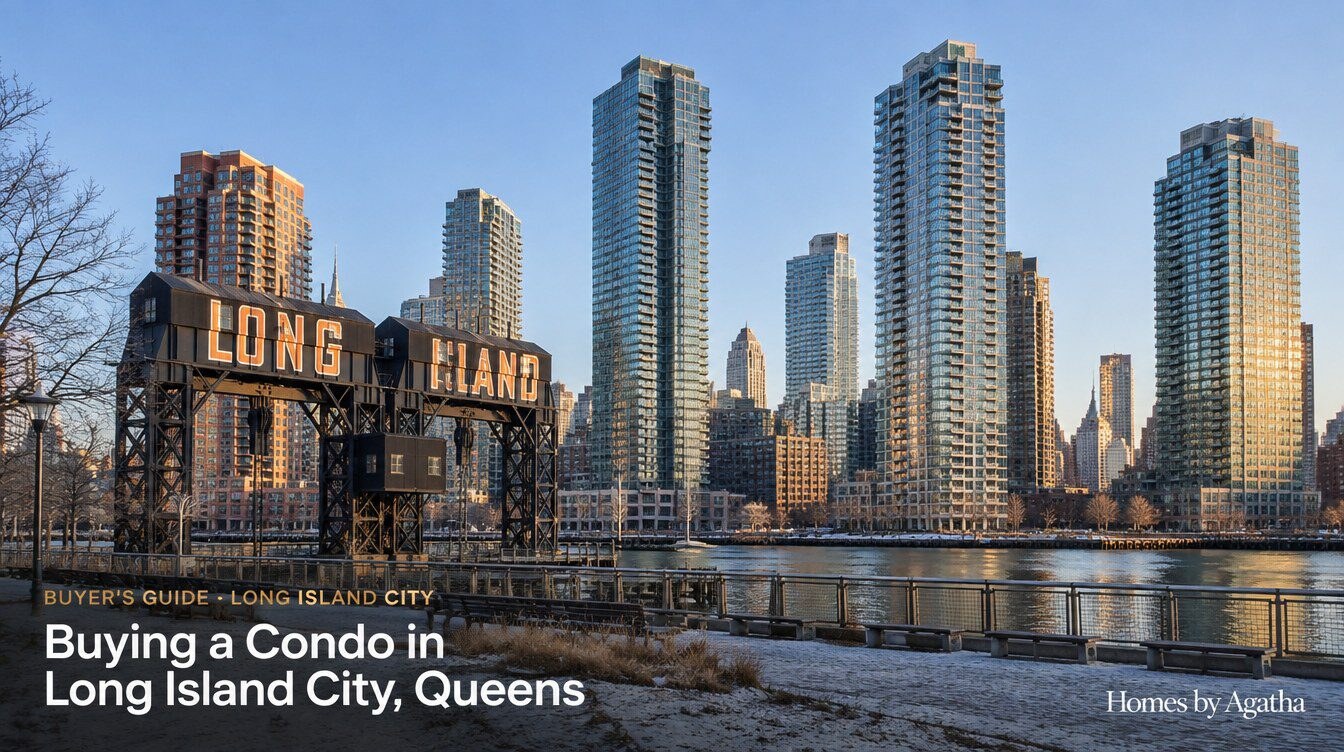
LONG ISLAND CITY REAL ESTATE GUIDE
Buying a Condo in Long Island City, Queens: New Development vs Resale, Abatements and What to Verify
Quick Answer
Buying a condo in Long Island City, Queens means choosing between a sponsor unit in a new development and a resale unit in an established tower. Compare the offering plan or bylaws, common charges, the property-tax abatement phase-out, the building’s reserves and flood exposure, then match the unit to your 7, E/M, G or ferry commute.
Buying a condo in Long Island City is a different exercise from buying a house elsewhere in Queens. Most of what comes to market here sits inside high-rise and mid-rise condominium buildings in Hunters Point, Queens West, Court Square and Queens Plaza, many of them built in recent decades. The decisions that matter most are about the building, its paperwork and its future costs, not only the apartment.
This guide is for buyers seriously considering Long Island City, Queens. You will learn how sponsor and resale purchases differ, how to read an offering plan, what a right of first refusal waiver is, how common charges and 421-a tax abatements change your monthly cost over time, how lenders review condo buildings, and which flood checks matter on the waterfront.
As a Licensed Associate Real Estate Broker serving Queens and the surrounding New York markets, I help buyers evaluate both the unit and the building behind it, in English or Polish, whichever is more comfortable. I will not quote prices or market statistics here; instead, you will see the mechanics that make two similar-looking Long Island City condos very different purchases.
Long Island City at a glance
| Item | Long Island City, Queens |
|---|---|
| Area | Western Queens on the East River, facing Midtown Manhattan; next to Astoria, Sunnyside and, across Newtown Creek, Greenpoint, Brooklyn |
| Borough / County | Queens / Queens County, New York City |
| ZIP codes | 11101, 11109, and part of 11106; confirm the ZIP code for a specific address with USPS |
| Sections buyers ask about | Hunters Point and Hunters Point South, Queens West (Center Boulevard waterfront), Court Square, Queens Plaza, Dutch Kills, Ravenswood |
| Subway lines | 7, E, M, R, G, N, W and F |
| Subway stations | Vernon Blvd–Jackson Av, Hunters Point Av, Court Sq and Queensboro Plaza (7); Court Sq–23 St (E, M); Queens Plaza (E, M, R); Court Sq and 21 St (G); Queensboro Plaza and 39 Av–Dutch Kills (N, W); 21 St–Queensbridge (F) |
| Rail and ferry | LIRR Hunterspoint Avenue and Long Island City stations (weekday rush-hour, peak-direction service); NYC Ferry Hunters Point South landing (East River route) and Long Island City landing at 46th Avenue and Center Boulevard (Astoria route) |
| Main parks and landmarks | Gantry Plaza State Park, Hunters Point South Park, Queensbridge Park, the Pepsi-Cola sign, MoMA PS1, Silvercup Studios, Queensboro Bridge |
| Commercial corridors | Vernon Boulevard, Jackson Avenue, Center Boulevard, Queens Plaza, Northern Boulevard, 21st Street |
| Typical property types | High-rise and mid-rise condominiums (sponsor and resale), a smaller number of co-op buildings, 19th-century row houses in Hunters Point, small mixed-use and multifamily buildings |
| Local housing considerations | Offering plans, right of first refusal waivers, 421-a phase-outs, waterfront flood maps, landmark rules in the historic district |
What kinds of homes can you buy in Long Island City, Queens?
Long Island City’s for-sale housing is mostly condominium units in high-rise and mid-rise buildings in Hunters Point, Queens West, Court Square and Queens Plaza. Co-ops, historic row houses and mixed-use buildings exist, but buyers here usually choose between condo buildings rather than property types.
Waterfront towers in Queens West and Hunters Point South
The East River waterfront along Center Boulevard and south toward Hunters Point South Park is lined with residential towers built under large planned developments. Buildings here typically offer doorman service, gyms and roof decks, and units differ sharply by floor, exposure and Manhattan view. Those differences drive resale comparisons, and amenity-heavy buildings carry common charges that reflect staff and equipment.
Court Square and Queens Plaza high-rises
Inland, Court Square, Jackson Avenue and Queens Plaza have their own cluster of tall residential buildings beside the neighborhood’s largest subway hubs. Buildings here trade waterfront views for the shortest walk to several train lines.
Mid-rise condos in Hunters Point, Dutch Kills and Ravenswood
Smaller condo buildings appear on side streets in Hunters Point, Dutch Kills and parts of Ravenswood, often on former industrial or low-rise lots. With fewer units, each owner carries a larger share of any repair, reserve shortfall or legal cost, so small-building finances deserve extra attention.
Row houses and the Hunters Point Historic District
Long Island City also has older housing. The Hunters Point Historic District, designated by the NYC Landmarks Preservation Commission in 1968, covers 19th-century row houses on 45th Avenue between 21st and 23rd Streets. Owners of landmarked houses generally need Commission approval for exterior changes. Other older row houses and small multifamily buildings sit on nearby Hunters Point side streets. These homes come to market far less often than condos, and they follow the house-buying process: Certificate of Occupancy, legal units, inspections and no board.
Co-op apartments
A smaller co-op stock exists in and around Long Island City; confirm the ownership type and rules of any specific building with the listing agent or managing agent. A co-op is a corporation that owns the building; buyers purchase shares, receive a proprietary lease, go through a board interview and pay maintenance that typically includes a share of building taxes and any underlying mortgage. Nearby Sunnyside and Astoria usually offer more co-op choice.
These are descriptions of buildings and streets, not of who lives in them. Where you buy is always your decision; my role is to help you understand the property and the process.
Sorting LIC towers by what matters to you?
Tell me your budget, monthly target and daily commute. I will help you narrow Long Island City buildings by station, carrying cost and paperwork before you tour a single model unit.
New development or resale: which Long Island City condo should you buy?
A sponsor unit in a new Long Island City development is bought from the developer under an offering plan, often with newer finishes and sometimes with buyer-paid closing costs. A resale unit is bought from an individual owner in an established building, with a track record of budgets and operations and usually a right of first refusal waiver. Neither is automatically better; each shifts risk differently.
What a sponsor sale is
In New York, the sponsor is the developer or entity that creates the condominium and sells the first units. Sponsors market new developments under an offering plan, a disclosure document that must be filed with the New York State Attorney General before units are offered for sale. The offering plan describes the building, the units, the projected budget, the common charges, the tax-abatement status and the terms of the purchase agreement. Changes are made through amendments, and buyers should read the amendments as carefully as the original plan.
What a resale purchase is
A resale purchase is any sale by an individual owner after the sponsor’s first sale. The building has an operating history: actual budgets, audited financials, board minutes and reserve balances. Resale contracts are negotiated between attorneys, and the board’s right of first refusal must be waived or allowed to lapse before closing.
Sponsor vs resale in one table
| Factor | Sponsor (new development) unit | Resale unit |
|---|---|---|
| Governing documents | Offering plan and amendments filed with the NYS Attorney General; projected first-year budget | Declaration, bylaws, house rules, actual budgets and audited financial statements |
| Contract terms | Sponsor’s standard purchase agreement; limited negotiation in many cases | Negotiated between buyer’s and seller’s attorneys |
| Approval step | Usually no right of first refusal on the sponsor’s first sale | Board waiver of the right of first refusal |
| Closing costs | Contract may shift the NYC RPT, NYS transfer tax and sponsor attorney fee to the buyer, plus a working-capital contribution | Transfer taxes customarily paid by the seller; buyer pays usual buyer costs |
| Timing | May depend on construction completion and a Temporary Certificate of Occupancy | Set by attorneys, lender and board waiver |
| Main risk | Budget is a projection; construction issues may surface later; sponsor may still control the board | Older finishes; abatement may be further into its phase-out; past assessments |
| Main advantage | New systems, warranties described in the plan, possible sponsor concessions | Real operating history; you see what you buy; often faster occupancy |
The sponsor closing-cost shift
In many New York City sponsor sales, the purchase agreement makes the buyer pay costs a seller customarily pays in a resale: the New York City Real Property Transfer Tax, the New York State real estate transfer tax and the sponsor’s attorney fee. Some sponsors negotiate or offer credits. Read the offering plan’s closing-cost section with your attorney before comparing a sponsor price with a resale price.
When the building is still being finished
Some Long Island City sponsor sales happen before construction is complete. Closings on new units commonly require at least a Temporary Certificate of Occupancy, or TCO, from the NYC Department of Buildings, so a delayed building moves your closing. Ask what the offering plan says about outside closing dates, delay rights and how your deposit is held; these provisions differ from one offering plan to the next.
What does buying a condo in Long Island City cost upfront and every month?
Buying a condo in Long Island City involves upfront New York City closing costs, including the NYC mortgage recording tax if you finance, the New York State “mansion tax” at $1 million or more, title insurance, attorney and lender fees, and in sponsor sales often the transfer taxes. Every month, you then pay your mortgage, common charges, a separate property tax bill and HO-6 insurance.
Buyer closing costs: sponsor vs resale
| Cost item | Sponsor unit | Resale unit | Official source / note |
|---|---|---|---|
| NYC mortgage recording tax | About 1.8% of the loan for loans under $500,000; 1.925% for loans of $500,000 and above | Same | NYC Department of Finance / NYS |
| “Mansion tax” | 1% of the price if $1 million or more; graduated above $2 million in New York City | Same | NYS Department of Taxation and Finance |
| NYC Real Property Transfer Tax | Often shifted to the buyer by the purchase agreement (1% at $500,000 or less; 1.425% above $500,000) | Customarily paid by the seller | NYC Department of Finance |
| NYS real estate transfer tax | Often shifted to the buyer ($2 per $500 of consideration, 0.4%) | Customarily paid by the seller | NYS Department of Taxation and Finance |
| Title insurance and recording | Owner’s and lender’s title policies; deed and mortgage recording fees | Same | Title company quote |
| Attorney fees | Your attorney; often the sponsor’s attorney fee as well | Your attorney only | Fee set by each attorney |
| Building charges | Working-capital contribution set in the offering plan | Board application, managing agent and move-in fees; some buildings set a contribution on resale | Offering plan or bylaws |
Confirm current rates with the NYS Department of Taxation and Finance and NYC Department of Finance before closing.
For a line-by-line walk-through of how these items add up across the borough, see Queens closing costs explained.
Common charges: what they pay for in a Long Island City tower
Common charges are the monthly fees each condo owner pays the condominium association for building operations. In a full-service Long Island City tower, they typically fund staff, building insurance, common utilities, elevator and amenity upkeep, management and reserves. Each unit’s share follows its percentage of common interest, listed in the offering plan or declaration, which also sets its share of future assessments.
Property taxes are a separate bill
Unlike a co-op, where taxes are bundled into maintenance, a condo unit has its own tax lot and its own bill from the NYC Department of Finance. In many Long Island City condos, that bill is currently reduced by a tax abatement or exemption, which is why the next section matters.
Insurance and amenity fees
The master policy covers the structure and common areas; owners usually carry an HO-6 policy for the unit interior and liability. Ask also about fees outside common charges, such as storage, bike rooms or parking, which some towers sell or lease separately.
How do 421-a tax abatements affect a Long Island City condo’s real cost?
Many Long Island City condo buildings were built with 421-a tax benefits, a New York City program that reduced property taxes on new residential construction for a set number of years. When the benefit phases out, the owner’s property tax bill rises in steps until it reaches full taxes. The schedule is building-specific, so every buyer should confirm it before signing.
What 421-a is, in plain terms
421-a is a New York City property-tax exemption for new multiple-dwelling construction, administered with the NYC Department of Housing Preservation and Development and applied to tax bills by the NYC Department of Finance. A building commonly received a period of full exemption on the new construction value, then a phase-out in which the exemption shrinks in steps; the benefit length and phase-out schedule differ by building. The program closed to new projects that did not begin construction by its 2022 deadline, and HPD now administers its successor for new construction, the 485-x program (Affordable Neighborhoods for New Yorkers).
Why the phase-out changes your monthly budget
If a building is early in its benefit period, your tax bill may be low today and rise later in planned steps; if it is late in its phase-out, most of the increase may be behind it. Two units with the same price and common charges can therefore have very different five- and ten-year costs, and the next buyer will run the same math when you resell.
How to verify an abatement before you sign
- Ask the listing agent or sponsor for the exemption type, start year and phase-out schedule in writing.
- Compare it with the offering plan’s description of the expected tax treatment.
- Have your attorney review the unit’s NYC Department of Finance records, including the Notice of Property Value and tax bills, which list exemptions on the lot.
Then build two monthly budgets: one on the current tax bill and one on estimated full taxes. If the second number works, the abatement is a bonus rather than a dependency.
Key Takeaways
- Most Long Island City buyers are choosing between condo buildings, so the building’s paperwork and future costs deserve as much attention as the unit.
- Sponsor sales often shift the NYC and NYS transfer taxes and the sponsor’s attorney fee to the buyer; compare total costs, not prices.
- A 421-a phase-out can raise your property tax bill in steps; budget on full taxes as well as today’s bill.
See the five-year cost, not just the price
I can help you set two or three Long Island City condos side by side — closing costs, common charges, current and full-tax budgets — so the real difference is clear before you commit.
How do you finance a condo purchase in Long Island City?
Get a written pre-approval from an NMLS-registered mortgage loan originator, and ask early whether the lender will finance units in the specific Long Island City building you want. For condos, the lender reviews both you and the building, and new developments can face extra review until enough units are sold.
The building review
Lenders typically send the managing agent a building questionnaire covering owner-occupancy, common-charge delinquencies, reserves, insurance, commercial space and litigation. In a new development, some loan programs also look at how many units have closed and whether one owner, including the sponsor, holds many units; your NMLS-registered loan originator can explain the current project guidelines for your loan type. Learn this before contract deadlines start running.
Questions to ask your loan officer about an LIC condo
- Have you financed units in this building recently, and is it approved for my loan type?
- How will you treat the abated tax bill versus full taxes in my debt-to-income ratio?
- If closing depends on a TCO, how long will my rate lock and approval last?
- Can your loan estimate include the NYC mortgage recording tax and any transfer taxes the sponsor contract shifts to me?
If you plan to rent the unit later
Condos are generally more flexible than co-ops about leasing, but each building’s bylaws set minimum lease lengths, application fees and short-term rental limits, and New York City rules also restrict short-term rentals: under Local Law 18, short-term rental hosts must register with the Mayor’s Office of Special Enforcement. Tell your lender whether the unit will be a primary residence, second home or investment, because that changes the loan.
How do commutes work from Long Island City?
Long Island City is served by the 7, E, M, R, G, N, W and F subway lines, two LIRR stations with rush-hour service, two NYC Ferry landings, and the Queensboro Bridge and Queens-Midtown Tunnel. The station nearest a building usually shapes daily life more than its amenities.
The 7 train along Jackson Avenue and the waterfront edge
The 7 stops at Vernon Blvd–Jackson Av, Hunters Point Av, Court Sq and Queensboro Plaza before crossing into Manhattan toward Grand Central and Times Square. Vernon Blvd–Jackson Av, the 7’s last Queens stop, is the closest station for many Hunters Point and Queens West buildings. Check current service on the MTA website.
Court Square and Queens Plaza hubs
The Court Sq–23 St complex links the E, M, G and 7 with in-station transfers. Queens Plaza serves the E, M and R, and Queensboro Plaza nearby serves the 7, N and W. The G at Court Sq and 21 St runs directly to Brooklyn. Not every line runs at all hours or on every day, so check current service hours on the MTA website.
Farther north, the N and W stop at 39 Av–Dutch Kills and the F stops at 21 St–Queensbridge, which matters for buildings in Dutch Kills and Ravenswood.
LIRR and NYC Ferry
The Long Island Rail Road serves Hunterspoint Avenue and Long Island City stations only with limited weekday rush-hour trains in the peak direction; check the current LIRR timetable for both stations before relying on them. NYC Ferry stops at Hunters Point South (54th Avenue and 2nd Street) on the East River route; when that route splits into A and B services at weekday rush hours and on non-winter weekends, Hunters Point South is on East River (A). The Long Island City landing (46th Avenue and Center Boulevard) is on the NYC Ferry Astoria route, which runs on weekdays and weekends. Check current schedules on the NYC Ferry website.
Commute comparison
| If you mostly travel to… | Look at buildings near | Why |
|---|---|---|
| Grand Central, Times Square, Hudson Yards | Vernon Blvd–Jackson Av, Hunters Point Av or Court Sq (7) | Direct 7 line across 42nd Street |
| Midtown East, 53rd Street, Lexington Avenue | Court Sq–23 St or Queens Plaza (E, M) | Direct ride under 53rd Street |
| Brooklyn (Williamsburg, Downtown Brooklyn) | Court Sq or 21 St (G); Pulaski Bridge on foot or bike | G line runs to Brooklyn without Manhattan |
| Broadway, Lower Manhattan via the N/W | Queensboro Plaza or 39 Av–Dutch Kills | N and W on the Astoria Line |
| East Side waterfront, Navy Yard, Wall Street | Hunters Point South or the Long Island City ferry landing | NYC Ferry routes |
| Long Island (peak hours) | Hunterspoint Avenue or Long Island City LIRR stations | Weekday rush-hour, peak-direction trains |
Driving and noise
Drivers use the Queensboro Bridge, the Queens-Midtown Tunnel, the Long Island Expressway and the Pulaski Bridge to Greenpoint, Brooklyn; condo parking is usually in building or commercial garages, sold or leased separately. Units near the elevated structure at Queensboro Plaza, the tunnel approaches or the bridge ramps can hear trains and traffic, so visit at rush hour and in the evening.
Match the building to your train
Share where you travel most days. I will map Long Island City buildings to the stations, ferry landings and walking times that fit your routine.
What should you check in a Long Island City condo building before you sign?
Before buying a condo in Long Island City, review the building’s governing documents and finances, its abatement schedule, its flood exposure and construction history, and its leasing and renovation rules. In a sponsor building, also confirm who controls the board.
Documents your attorney should review
- Offering plan and amendments (sponsor units) or declaration, bylaws and house rules (resale).
- Current budget and audited financial statements, including reserves, common-charge arrears and any planned increase.
- Board minutes from recent years, which reveal leaks, façade work, elevator problems, insurance claims and disputes before they reach a budget.
- Assessments, current or proposed, and how they are allocated by percentage of common interest.
- Litigation, including any construction-defect claims against the sponsor.
- Abatement documentation and the unit’s NYC Department of Finance records.
Sponsor control and construction issues
In newer Long Island City buildings, the sponsor may still own unsold units and control the board until a point set in the offering plan. Ask how common charges on unsold units are paid, whether an engineering report exists, and whether owners have raised construction-defect claims, because the owner-elected board inherits whatever issues remain.
Waterfront flood exposure
Long Island City sits on low ground along the East River and Newtown Creek, and parts of Hunters Point, Queens West and the Dutch Kills basin should be checked carefully. Look up the address on the FEMA Flood Map Service Center and on New York City’s flood-hazard tools. In a Special Flood Hazard Area, a lender may require flood insurance. For a condo, also ask where the building’s boilers, electrical switchgear and elevator equipment sit, whether flood barriers or other protections exist, and whether the master policy includes flood coverage; the managing agent can answer these questions for the specific building.
Local Law 97 and façade inspections
Most New York City buildings over 25,000 square feet must meet building-emissions limits under Local Law 97, a size range that covers most Long Island City towers. Ask whether the building expects to meet its limits and whether upgrades or penalties are budgeted. Buildings taller than six stories also go through the city’s periodic façade inspection program.
If you are buying a Hunters Point row house instead
A row house follows a different list. Pull the Certificate of Occupancy, the record of legal use and number of units kept by the NYC Department of Buildings; buildings from before 1938 may instead rely on a Letter of No Objection. Compare the legal unit count with what you see, check violations and permits, and inspect the roof, party walls, brick and boiler. Inside the Hunters Point Historic District, confirm any exterior work had Landmarks Preservation Commission approval.
How do offers, board waivers and contracts work in Long Island City?
New York is an attorney state: after an offer is accepted, the buyer’s and seller’s attorneys negotiate and prepare the contract of sale, and nothing is binding until the contract is signed and the deposit delivered. For a resale condo, the board must then waive its right of first refusal; for a sponsor unit, you sign the sponsor’s purchase agreement.
Making an offer on a resale unit
A credible offer on a Long Island City resale condo includes price, down payment, pre-approval or proof of funds, attorney contact and proposed timeline. Mention whether your lender has already reviewed the building; sellers value offers unlikely to stall at the questionnaire stage.
Signing a sponsor purchase agreement
In a sponsor sale, you usually make an offer to the sales office, then your attorney reviews the offering plan and the sponsor’s purchase agreement. Some terms may be negotiable, such as closing-cost credits, storage or parking, but the core agreement is often standard for every buyer in the building. Contract deposits in new developments are commonly around 10% of the price and sometimes more, held in escrow as the offering plan describes; each plan sets its own deposit amount and escrow terms. Some sponsor agreements do not include a mortgage contingency, which means your deposit may be at risk if financing fails. Ask your attorney directly what the specific agreement says.
The right of first refusal waiver
Most New York condominium bylaws give the board a right of first refusal: the board may buy or lease a unit on the same terms before it is sold. Boards usually waive it after reviewing a purchase application with the contract, your financial information and managing-agent fees. It is not a co-op interview, but it is a required step with a timeline set by the bylaws; the waiver period and application requirements vary by building.
Working with a buyer’s agent in 2026
In 2026, a buyer’s agent in New York works under a written buyer agreement signed before touring, and compensation is negotiable, not set by law and not automatically paid by the seller or sponsor. Agents provide the NYS Disclosure Form for Buyer and Seller at the first substantive contact. Some sponsor sales offices ask that a buyer’s agent register the buyer at the first visit, so ask about the sales office’s registration policy before you go. See our guide to working with a buyer’s agent in NY.
Key Takeaways
- An accepted offer is not a contract in New York; attorneys draft and negotiate it, and a sponsor agreement deserves the same review.
- Ask whether a sponsor purchase agreement includes a mortgage contingency before you put down a deposit.
- A resale condo needs the board’s right of first refusal waiver; prepare the application while the contract is being negotiated.
Reviewing an offering plan or resale offer?
Before you bid or sign, let’s walk through the building’s documents, the contract terms and the questions to raise with your attorney and lender.
What is the timeline for buying a condo in Long Island City?
A financed resale condo purchase in Long Island City commonly takes about two to three months from accepted offer to closing, including the board’s waiver. A sponsor unit in a completed building can move on a similar schedule, while a unit in a building still under construction closes only when the building is ready. These ranges are typical, not guaranteed.
| Stage | Resale condo | Sponsor unit, building complete | Sponsor unit, under construction |
|---|---|---|---|
| Accepted offer → signed contract | Commonly 1–3 weeks | Commonly 1–3 weeks (offering plan review) | Commonly 1–3 weeks (offering plan review) |
| Mortgage commitment | Commonly 3–6 weeks after contract | Commonly 3–6 weeks after contract | Timed to the expected closing date |
| Building step | Right of first refusal waiver | Usually none on the sponsor’s first sale | Usually none; closing depends on a TCO |
| Closing | Title, final walk-through, closing | Punch-list walk-through, closing | When the building and unit are ready, per the offering plan |
If a resale unit is rented, the contract should state whether it is delivered vacant. Towers also usually require a service-elevator reservation and a mover’s certificate of insurance before move-in.
What mistakes do buyers make in Long Island City, and how do you avoid them?
The most common mistakes when buying a condo in Long Island City are budgeting on an abated tax bill alone, comparing sponsor and resale prices without adjusting for shifted closing costs, and skipping the building’s documents and flood check.
- Budgeting on today’s taxes only. A 421-a phase-out can change your monthly cost in planned steps. Build the full-tax budget too.
- Comparing prices instead of total costs. A sponsor unit with shifted transfer taxes and a working-capital contribution may cost more at closing than a resale unit at a similar price.
- Treating the offering plan as marketing. It is a legal disclosure document; amendments, budgets and contingencies live there.
- Assuming the lender will accept the building. Ask before contract deadlines start.
- Skipping the flood check. Waterfront views and flood-map status often come together along the East River and Newtown Creek.
Comparing Long Island City with nearby options
Many buyers test Long Island City against neighboring areas with different housing mixes. Homes for sale in Astoria include two-family houses, co-ops and condos along the N/W and M/R lines; buying in Sunnyside centers on co-ops and attached houses along the 7; and Woodside homes add a full-service LIRR station. If you are new to the borough, our guide to moving to Queens adds borough-wide context.
Buyer checklist for buying a condo in Long Island City
Use this checklist in order; it turns the steps above into a sequence for buying a condo in Long Island City.
- Decide whether you are targeting sponsor units, resale units or both, and whether a row house or co-op is also on your list.
- Get a written pre-approval from an NMLS-registered loan originator and ask about building approval.
- Set a monthly budget that includes common charges, the current tax bill, the full-tax estimate, HO-6 insurance and any parking or storage fees.
- Sign a written buyer agreement and receive the NYS Disclosure Form for Buyer and Seller.
- Shortlist buildings by station: 7 at Vernon Blvd–Jackson Av or Hunters Point Av, the Court Square hub, Queens Plaza, or a ferry landing.
- Retain a New York real estate attorney before your offer is accepted.
- For sponsor units, read the offering plan, amendments, closing-cost section and contingency terms.
- For resale units, request budgets, audited financials, minutes, house rules and the right of first refusal application.
- Confirm the abatement schedule in writing and check NYC Department of Finance records.
- Check FEMA flood maps and ask about the building’s flood protections and master policy.
- Ask about Local Law 97 compliance, façade work and planned assessments, and inspect the unit.
- Submit the waiver application or meet the sponsor’s closing requirements; arrange HO-6 (and flood, if needed) insurance; complete the final walk-through and close.
When you are ready to move from research to listings, the Long Island City home buying page is the place to start a focused search. If you already own a Long Island City unit and plan to sell before buying, the Long Island City seller page explains how a sale and purchase can be coordinated.
Ready to tour Long Island City with a plan?
Book a short buyer consultation. We will confirm your budget at full taxes, your station shortlist and the documents to request, so every LIC tour has a purpose.
Frequently asked questions about buying a condo in Long Island City
Is Long Island City mostly condos?
Yes, most homes for sale in Long Island City, Queens are condominium units in high-rise and mid-rise buildings in Hunters Point, Queens West, Court Square and Queens Plaza. The neighborhood also has a smaller co-op stock, 19th-century row houses in the Hunters Point Historic District and small mixed-use buildings, but these come to market less often.
What is the difference between a sponsor unit and a resale unit in Long Island City?
A sponsor unit is sold by the developer under an offering plan filed with the New York State Attorney General, often with standard contract terms and buyer-paid transfer taxes. A resale unit is sold by an individual owner in an established building with real budgets and history, and the condo board must waive its right of first refusal.
What is a 421-a tax abatement on a Long Island City condo?
421-a is a New York City property-tax exemption that reduced taxes on many newer residential buildings, including Long Island City condos, for a set period. Benefits typically phase out in steps, raising the owner’s tax bill until full taxes apply. The schedule is building-specific, so confirm it with the offering plan and NYC Department of Finance records.
Do buyers pay transfer taxes on new-development condos in Long Island City?
Often, yes. In many New York City sponsor sales, the purchase agreement shifts the NYC Real Property Transfer Tax and the New York State transfer tax, which sellers customarily pay in resales, to the buyer, along with the sponsor’s attorney fee. Some sponsors negotiate or offer credits. Your attorney should confirm the terms in the offering plan.
What is a condo right of first refusal in New York?
A right of first refusal lets a New York condo board buy or lease a unit on the terms a buyer offered before the sale proceeds. Boards usually waive it after reviewing a purchase application. It is a required step on most resale condo purchases in Long Island City, with timing set by the bylaws.
Which subway lines serve Long Island City, Queens?
Long Island City is served by the 7, E, M, R, G, N, W and F lines. Key stations include Vernon Blvd–Jackson Av and Hunters Point Av on the 7, the Court Sq–23 St complex linking the E, M, G and 7, Queens Plaza on the E, M and R, and Queensboro Plaza on the 7, N and W.
Does Long Island City have LIRR and ferry service?
Yes. The Long Island Rail Road stops at Hunterspoint Avenue and Long Island City stations during weekday rush hours in the peak direction. NYC Ferry serves Hunters Point South on the East River route and the Long Island City landing at 46th Avenue and Center Boulevard on the Astoria route. Check current schedules before relying on either.
Are Long Island City condos in a flood zone?
Some are. Long Island City lies along the East River and Newtown Creek, so waterfront addresses in Hunters Point, Queens West and the Dutch Kills area should be checked on FEMA flood maps and New York City’s flood tools. Buyers should also ask about the building’s flood protections and whether the master insurance policy includes flood coverage.
How long does it take to buy a condo in Long Island City?
A financed resale condo purchase in Long Island City commonly takes about two to three months from accepted offer to closing, including the board’s right of first refusal waiver. A sponsor unit in a finished building can be similar, but a unit in a building under construction closes only when the building is ready under a Temporary Certificate of Occupancy.
Who pays the buyer’s agent on a Long Island City condo purchase in 2026?
Buyer-agent compensation is negotiable and not set by law. Buyers sign a written agreement with their agent before touring, stating services and compensation. A seller or sponsor may agree to contribute, but that is never automatic. Some new-development sales offices also ask that the buyer’s agent register the buyer at the first visit.
The short version: buy the building, then the unit
In Long Island City, the apartment is only half of the purchase. A sponsor unit asks you to read the offering plan, budget for shifted closing costs and plan around construction timing. A resale unit asks you to study real budgets, minutes and the waiver process. Both ask you to model the abatement through its phase-out, check the flood picture and pick the station you will actually use. Then start a focused search through the guide to buying your home in Long Island City and request a consultation.
This article is for general informational purposes only and reflects conditions that may change. It is not legal, tax, or financial advice, an appraisal, or a guarantee of price or outcome; consult a licensed New York attorney, a CPA, and an NMLS-registered mortgage loan originator as appropriate. A CMA is an opinion of value, not an appraisal. Real estate brokerage services are offered by Agatha Lubas, Licensed Associate Real Estate Broker, NY License #10301213345, Keller Williams Realty Liberty, 96-10 101st Avenue, Ozone Park, NY 11416. The NYS Disclosure Form for Buyer and Seller, the NYS Housing and Anti-Discrimination Disclosure / Fair Housing Notice, and the brokerage’s Standard Operating Procedures are available on request. Equal Housing Opportunity.

Agatha Lubas helps buyers, sellers and investors across Queens, Brooklyn, Nassau County and Suffolk County understand both the property and the paperwork before they commit. She works in English and Polish, so clients can discuss each step in the language they find most comfortable.
Work with Agatha