
HOLLIS REAL ESTATE GUIDE
Buying a House in Hollis Queens: Lots, Basements, Zoning and the Commute, Checked Before You Offer
Quick Answer
Buying a house in Hollis, Queens usually means choosing a detached or semi-detached one- or two-family home. Before you offer, confirm the legal unit count with NYC Department of Buildings records, check the zoning and any shared driveway, have the basement inspected for water, budget NYC closing costs, and test your commute from the LIRR Hollis station.
This guide is for people who are seriously considering buying a house in Hollis Queens and want to understand the property itself before they get attached to a listing photo. Hollis sits in southeast Queens between Jamaica to the west and Queens Village to the east, and most of its blocks are lined with free-standing and semi-detached houses rather than apartment buildings. That simple fact shapes almost every step of the purchase.
As a Licensed Associate Real Estate Broker serving Queens, I help buyers look past the staging and evaluate the house, the block and the transaction, in English or Polish, whichever is more comfortable. Below you will find how Hollis housing is organized, what the 2007 St. Albans/Hollis rezoning means for additions, why basement water deserves its own inspection line, what closing costs look like for a New York City house, how the LIRR and the Jamaica transit hub fit into a commute, and a checklist. When you want to start touring, the companion page on how to buy your home in Hollis with a local buyer’s agent explains how we would work together.
Hollis at a glance
| Topic | What to know |
|---|---|
| Area | Southeast Queens, between Jamaica (west) and Queens Village (east); commonly described as bounded by Hillside Avenue to the north, Francis Lewis Boulevard to the east, Murdock Avenue to the south and roughly 181st Street to the west (neighborhood edges are informal, and city community district maps show district lines rather than neighborhood names, so confirm where a specific address falls) |
| Borough / County | Queens (Queens County), New York City; Queens Community District 12 |
| ZIP code(s) | 11423 for most of Hollis; some southern blocks use 11412, which is shared with St. Albans; confirm the ZIP code for a specific address with the USPS ZIP Code lookup |
| Rail | Long Island Rail Road Hollis station at 193rd Street and Woodhull Avenue, served by Hempstead Branch trains; Jamaica station, the LIRR hub, is a short ride west |
| Subway (nearby) | F at Jamaica–179 St on Hillside Avenue; E, J and Z at Jamaica Center–Parsons/Archer in downtown Jamaica, reached by bus |
| Buses | Q2 and Q3 link Hollis Avenue, at the west end of Hollis station, with the 165 St Bus Terminal in Jamaica; Q110 runs along Jamaica Avenue; other routes use Hillside Avenue. The 2025 Queens Bus Network Redesign changed stops on several routes, so check the current MTA bus map |
| Parks and landmarks | Hollis Playground on Hollis Avenue between 204th and 205th Streets; the nearby corner co-named Run-DMC JMJ Way at 205th Street and Hollis Avenue; Cunningham Park and Alley Pond Park are a drive north |
| Commercial corridors | Jamaica Avenue, Hollis Avenue, Hillside Avenue on the northern edge, Francis Lewis Boulevard on the eastern edge |
| Typical property types | Detached and semi-detached one- and two-family houses (frame, brick and stucco; Colonial, Tudor and Cape Cod styles are common), some attached houses, and apartments over stores on the commercial avenues; condo and co-op units are limited, and what is available changes, so check current listings |
| Key buyer considerations | Legal unit count and Certificate of Occupancy, contextual zoning since 2007, shared driveways and easements, basement water and groundwater history, older heating and electrical systems, oil tanks, LIRR station proximity |
One naming note before going further. Holliswood, on the hill north of Hillside Avenue, and Hollis Hills, farther north near Cunningham Park, are separate neighborhoods with their own housing patterns and their own guides. Everything in this article refers to Hollis proper, south of Hillside Avenue.
What kinds of houses will you find when buying a house in Hollis Queens?
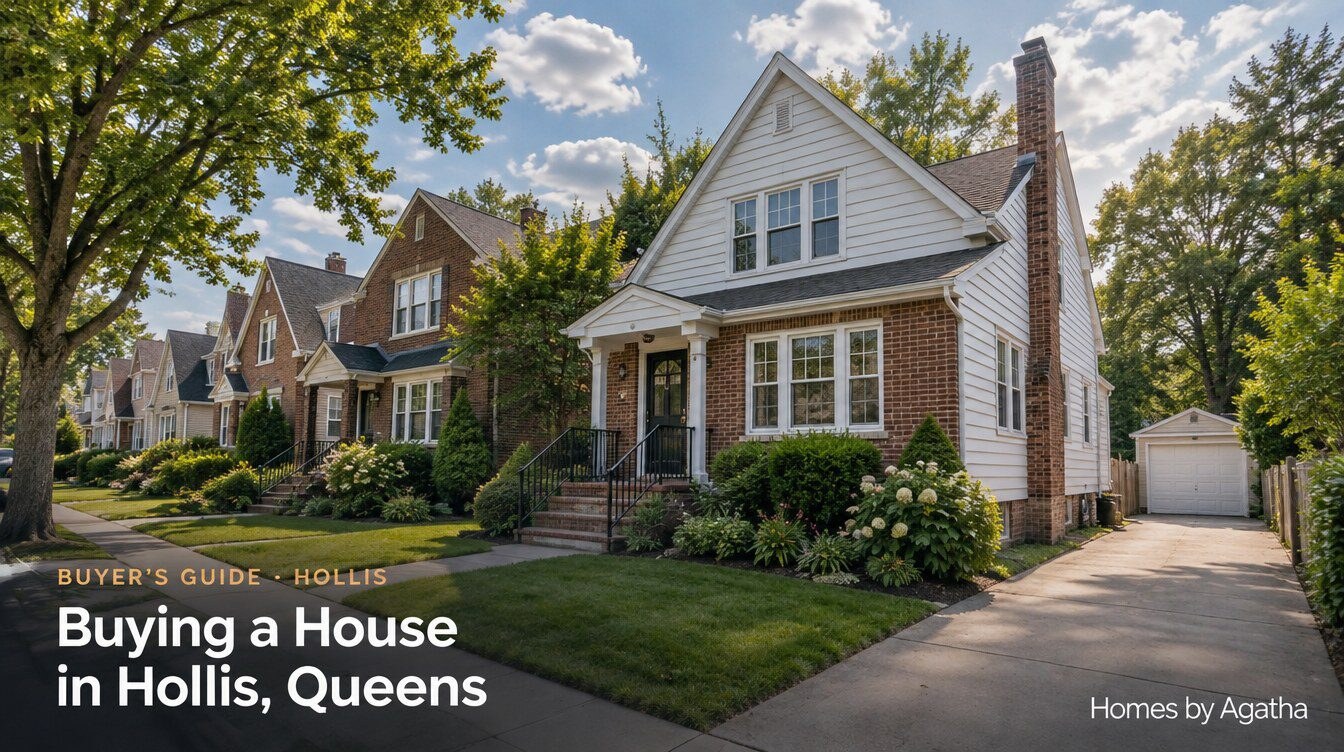
Most homes for sale in Hollis, Queens are detached or semi-detached houses built for one or two families, many on individual lots with front yards, side driveways and rear yards. Attached houses, mixed-use buildings and small apartment buildings appear mainly near Jamaica Avenue and Hollis Avenue. Condo and co-op units are a small share of what buyers typically see here.
Hollis is a long-established residential neighborhood, and many of its houses are decades old. The year a specific house was built appears in NYC Department of Finance property records, and the NYC Department of Buildings file shows later alterations. That history is why so many blocks have individual houses, individual roofs and individual boilers, each with its own maintenance record.
Detached one-family houses
A detached house stands alone on its lot with open space on all sides. In Hollis these are often frame houses with wood or vinyl siding, brick-and-stucco Tudors, or Cape Cods with dormers. The buyer controls the whole structure and pays for every repair. Room for future projects exists only within the limits of the zoning, covered in the next section.
Semi-detached houses and shared driveways
A semi-detached house shares one side wall with a neighbor. In Hollis, the open side frequently holds a driveway, sometimes shared with the house next door. A shared driveway is usually governed by an easement, a recorded right that lets each owner cross part of the other’s land. Your attorney and title company should confirm the easement exists in writing, who maintains the pavement and whether the rear garage can actually be reached by car.
Two-family houses
Two-family houses are a large part of the Hollis market. Some were built that way; others were converted. A legal two-family house has NYC Department of Buildings records showing two dwelling units. A house marketed as “two-family” without that record may have an illegal unit, which affects financing, insurance and your liability as a landlord. The broader topic of buying a multi-family home in Queens is covered in a separate article.
Apartments, condos and co-ops
Apartment buyers will find a narrow selection in Hollis. A condo buyer receives a deed and pays common charges plus separate property taxes; a co-op buyer purchases shares, signs a proprietary lease, pays maintenance and goes through a board application and interview, under financing rules set by each building. Because those rules vary, ask the managing agent for the building’s current requirements before you apply.
| Property type in Hollis | What you own | Monthly costs beyond the mortgage | Main due-diligence focus |
|---|---|---|---|
| Detached one-family house | The land and the entire building | Property tax, homeowner’s insurance, utilities, all maintenance | Roof, foundation, basement water, boiler, electrical, oil tank, zoning limits on additions |
| Semi-detached house | The land and your half of the structure | Same as a detached house, plus coordination on the party wall | Shared wall and roof line, driveway easement, drainage between houses |
| Two-family house | The land and a building with two units | Same as a house, offset by rent if the second unit is legal and leased | Legal unit count, existing leases and deposits, separate meters, rental-income financing rules |
| Condo unit (where available) | The unit by deed plus a share of common elements | Common charges and separate property tax | Building budget, reserves, assessments, rules on renting |
| Co-op unit (where available) | Shares and a proprietary lease | Maintenance, which typically includes a share of building taxes and the underlying mortgage | Board approval, building finances, financing rules, which vary by building |
Weighing a Hollis one-family against a two-family?
Tell me how you want to live, whether you plan to rent a unit and how you expect to finance, and I will help you narrow the property types worth touring.
How does zoning affect what you can do with a Hollis house?
Zoning controls what can be built or added on a Hollis lot, and since 2007 most of Hollis has been mapped with lower-density, contextual zoning districts. Before you buy a house planning to add a floor, extend the rear or create another unit, check the lot’s zoning district and talk to an architect about what the rules allow.
In 2007 the New York City Council adopted the St. Albans/Hollis rezoning proposed by the NYC Department of City Planning. The rezoning replaced broad R3-2 and R4 districts across more than 300 blocks with lower-density or contextual districts such as R2, R3A, R3X, R4-1, R4A and R4B. According to the Department of City Planning’s description of the plan, a key purpose was to reinforce the existing pattern of one- and two-family detached, semi-detached and attached houses and to prevent new garden apartments and row-house developments out of character with the area. You can read the planning summary in the NYC Department of City Planning St. Albans/Hollis rezoning document.
What contextual zoning means for a buyer
A contextual zoning district keeps new construction similar in form to the houses already on the block, including height, yards and building type. Some districts permit only detached one- and two-family houses; others also allow semi-detached or attached forms. For a Hollis buyer, a large lot does not automatically mean room for a bigger house or more apartments. Look up any lot on ZoLa, the NYC Department of City Planning’s zoning map tool, and ask an architect to explain the limits before you pay for “expansion potential.”
Certificates of Occupancy and older houses
A Certificate of Occupancy, or CO, is the NYC Department of Buildings document that states a building’s legal use and number of dwelling units. Buildings constructed before 1938 generally were not required to have a CO unless later altered in a way that required one, so for many older Hollis houses the legal use is shown through other Department of Buildings records or a Letter of No Objection. The question is simple: does the paper match the house? If the listing says two-family and the records show one family, your lender, insurer and attorney will treat it as a one-family with an unapproved apartment.
Basements, cellars and attic rooms
Under NYC rules, a basement is partly below grade but at least half above curb level, while a cellar is more than half below; a cellar generally cannot be a legal apartment. Finished attics may be limited by egress and fire-code rules. Treat finished below-grade or attic space as bonus room until the records confirm its legal status.
Key Takeaways
- Most Hollis lots were rezoned in 2007 to contextual districts that reinforce one- and two-family housing; check the district on ZoLa before planning additions.
- A big lot is not a promise of extra units; zoning, floor area and yard rules decide.
- The legal unit count comes from NYC Department of Buildings records, not from the listing description.
- Finished cellars and attics are living space only when the records and code allow it.
Why should Hollis buyers investigate basement water before making an offer?
Basement water deserves its own line on a Hollis inspection because parts of southeast Queens have a documented history of high groundwater and stormwater flooding. A buyer should ask direct questions about past water, review the seller’s Property Condition Disclosure Statement and have the inspector look closely at the foundation, floor drains and any sump pump.
The background matters. For decades, a private company, the Jamaica Water Supply Company, pumped groundwater from wells in southeast Queens for drinking water. The NYC Department of Environmental Protection acquired that system in 1996, reduced its use and has not used it for drinking water since 2007. A 2013 New York State Senate bill calling for a city study of the problem described groundwater levels in Jamaica rising sharply after the pumping was discontinued, with homes and businesses across southeast Queens running basement pumps. The City has also been upgrading storm and sanitary sewers in parts of southeast Queens. To learn whether work is planned or under way on a specific street, check NYC DEP and NYC Department of Design and Construction project information, and ask your attorney to review the municipal searches.
Groundwater exposure varies from block to block and house to house, so a general statement about the neighborhood never substitutes for checking the specific house.
How to check a specific Hollis house for water risk
- Read the Property Condition Disclosure Statement. Since March 20, 2024, sellers of most one-to-four-family homes in New York must deliver the PCDS; the option of a $500 credit instead was eliminated. The form includes questions about flooding and water problems.
- Look for physical evidence. White mineral deposits (efflorescence) on foundation walls, fresh paint only on the lower part of a wall, or a dehumidifier running constantly all deserve questions.
- Ask about equipment. A sump pump, interior drainage channel or backwater valve suggests past water management. Ask when it was installed and whether there are invoices or warranties.
- Check official flood maps. Search the address on the FEMA Flood Map Service Center and the NYC Stormwater Flood Maps. Hollis is inland, so stormwater and groundwater, not coastal surge, are the usual questions, but map status is set address by address, so check the exact property.
- Price insurance early. Standard homeowner’s policies typically exclude flood damage; ask about flood coverage and sewer-backup endorsements before signing.
A basement history does not make a Hollis house a bad purchase. It means the cost of managing water belongs in your price and plan, not in a surprise after closing.
Want a due-diligence plan for a specific Hollis house?
Send me the address you are watching, and we can list the records, inspection points and basement questions to cover before you make an offer.
How much money do you need for buying a house in Hollis Queens?
You need three pools of money for buying a house in Hollis Queens: the down payment, the closing costs and a cash reserve for the first repairs an older house will ask for. Because Hollis is in New York City, the buyer’s closing costs include the NYC mortgage recording tax on a financed purchase, plus title, attorney and lender charges.
The minimum down payment depends on the loan program, the property type and the lender. A larger down payment lowers the loan amount and therefore the mortgage recording tax, so ask your lender to model two or three options side by side.
New York City buyer closing costs
Closing costs are the taxes and fees paid at or around closing, separate from the down payment. Rates below are stated as published by the official sources.
| Buyer cost (Hollis house) | How it works | Source / note |
|---|---|---|
| NYC mortgage recording tax | Roughly 1.8% of the loan amount for loans under $500,000 and 1.925% for loans of $500,000 and above on one-to-three-family homes; applies only when you finance | NYC Department of Finance / NYS |
| NYS “mansion tax” | 1% of the price on residential purchases of $1 million or more, paid by the buyer; graduated above $2 million in New York City | NYS Department of Taxation and Finance |
| Title insurance and title search | Owner’s and lender’s policies plus search and recording charges | Set by title insurer rates; request a quote |
| Buyer’s attorney | Contract review, title review, closing representation | Negotiated with the attorney |
| Lender fees and appraisal | Origination, underwriting, appraisal and credit charges | See your Loan Estimate |
| Prepaids and escrow | Initial deposits for property taxes and homeowner’s insurance, plus prorated interest | Depends on closing date and tax bills |
| Inspections | Home inspection, plus specialist checks (sewer camera, oil tank sweep, chimney) when needed | Paid before or during the contract period |
Confirm current rates with the NYS Department of Taxation and Finance and NYC Department of Finance before closing.
The seller customarily pays the NYS real estate transfer tax and the NYC Real Property Transfer Tax, so a Hollis buyer usually does not see those on the closing statement unless the contract says otherwise. For a fuller walk-through, see Queens closing costs explained.
Ongoing costs of owning a Hollis house
One- to three-family houses in New York City are in property tax Class 1, administered by the NYC Department of Finance, and annual increases in their assessed value are capped by state law. Pull the current tax bill from the Department of Finance rather than relying on a listing estimate. A detached house also has four exterior walls, a full roof and often a garage, all of which age on your account.
Key Takeaways
- Hollis is in New York City, so a financed purchase carries the NYC mortgage recording tax, calculated on the loan amount.
- Sellers customarily pay the NYS transfer tax and NYC Real Property Transfer Tax.
- Class 1 property taxes vary by assessment and exemptions; pull the actual bill from the NYC Department of Finance.
- Keep a cash reserve for the first year of repairs on an older detached house.
How do you get pre-approved for a one- or two-family house in Hollis?
Get pre-approved by a lender who has reviewed your income, assets and credit, and tell the lender up front whether you are buying a one-family or a two-family house. A two-family house can change the loan program, the down payment and whether projected rent can count toward your qualifying income.
A pre-approval is based on documents the lender has actually reviewed, such as pay stubs, tax returns and bank statements, unlike a pre-qualification, which is an estimate. Sellers generally take a documented pre-approval more seriously.
Rental income from the second unit
Many Hollis buyers plan to live in one unit of a two-family house and rent the other. Lenders may count part of the rent toward qualifying income under their program rules, generally only when the second unit is legal. If the house is a one-family with an unapproved apartment, a lender will usually ignore that rent.
Appraisal on a detached house
The appraiser compares the Hollis house with recent nearby sales, weighing lot size, living area, legal units, garage and condition. A price that relies on unpermitted improvements or an illegal basement apartment is more likely to appraise low, so plan for that possibility.
If you are buying your first home, the separate guide for a first-time home buyer in Queens explains pre-approval documents and timing in more detail.
Line up financing before you fall for a Hollis house
We can talk through how a one-family versus a two-family purchase changes your pre-approval conversation, so the homes you tour match the loan you can close.
How do you commute from Hollis to Jamaica and Manhattan?
Hollis commuters usually use the Long Island Rail Road Hollis station, a bus to the Jamaica transit hub, or the F train at Jamaica–179 St on Hillside Avenue. Which option fits depends on how far your block is from 193rd Street and Woodhull Avenue, from Hillside Avenue, and from the bus stops on Hollis and Jamaica Avenues.
The LIRR Hollis station
Hollis station sits at 193rd Street and Woodhull Avenue on the LIRR Main Line, and only Hempstead Branch trains stop there. Westbound trains reach Jamaica station, where riders can change for other LIRR terminals. Check the current LIRR timetable for train frequency, terminals and fares at the hours you travel. For blocks within walking distance of the station, the LIRR can be the most direct link to Jamaica and beyond.
Hollis station is also under construction. According to the MTA, from March 24, 2025, through 2027, it is building an elevator to the eastbound platform and a ramp to the westbound platform and replacing the four-car wooden platforms with eight-car concrete ones. During the work, on some weekdays between the morning rush and about 3 p.m., and on some weeknight overnights, trains do not stop at Hollis in one direction, and the MTA has said LIRR tickets are accepted on MTA buses during those changes. Check mta.info for the hours you would actually travel.
Buses to the Jamaica hub
Downtown Jamaica is the main transit anchor for Hollis. The Q2 and Q3 buses connect Hollis Avenue, at the west end of Hollis station, with the bus terminal in downtown Jamaica, and the Q110 runs along Jamaica Avenue. From downtown Jamaica, riders reach the E, J and Z trains at Jamaica Center–Parsons/Archer, the LIRR at Jamaica station and the AirTrain to JFK Airport. The MTA’s Queens Bus Network Redesign, which took effect in 2025, removed some stops and changed several routes, so check the current MTA bus map and the stops nearest the address.
The F train and driving
The F train’s eastern terminal, Jamaica–179 St, is on Hillside Avenue near the western edge of Hollis, practical mainly for northern and western blocks. Drivers use the Grand Central Parkway to the north and the Cross Island Parkway to the east; if you drive daily, confirm that a house’s driveway is legal, has a curb cut and fits a car.
| Where your block is | Option many commuters consider | What to test before buying |
|---|---|---|
| Near 193rd Street and Woodhull Avenue | LIRR Hollis station (Hempstead Branch) | Train frequency at your hours, construction service changes, walk time |
| Near Hillside Avenue, west side | F train at Jamaica–179 St, by walk or bus | Walk time, bus frequency on Hillside Avenue |
| Near Hollis Avenue | Q2 or Q3 bus to the 165 St Bus Terminal | Rush-hour travel time to Jamaica, transfer to the subway or LIRR |
| Near Jamaica Avenue | Q110 bus along Jamaica Avenue | Travel time to Parsons Boulevard and the E, J, Z trains |
| Driving households | Grand Central Parkway, Cross Island Parkway | Driveway legality, garage access, rush-hour drive time |
Ride the trip yourself from the actual address at your travel hours. Nearby neighborhoods share some of these connections, so buyers often also compare homes for sale in Jamaica, Queens, houses in Saint Albans to the south, and Jamaica Estates to the northwest.
What should a home inspection cover in an older Hollis house?
A Hollis home inspection should focus on the systems that age fastest in early-twentieth-century houses: the roof, the foundation and basement, the heating plant, the electrical service, the plumbing and the sewer line to the street. Add specialist checks for an oil tank, the chimney and, in a two-family house, the separation of utilities between units.
Roof, gutters and exterior
Ask the inspector about the age and layers of the roof, flashing around chimneys and dormers, and whether gutters and downspouts carry water away from the foundation, one of the simplest causes of a wet basement. On frame houses, check siding, trim and porches for rot; on brick and stucco, look for cracks and failed mortar.
Heating, oil tanks and chimneys
Many older Queens houses were heated with oil, and some have converted to gas. If the house converted, ask whether the old tank was removed or abandoned properly, because a leaking buried tank can be expensive to clean up. An oil tank sweep, a scan for a buried tank, is a common add-on, along with a chimney check where the chimney serves the boiler.
Electrical, plumbing and lead paint
Ask the inspector to identify the electrical service size, panel type and any outdated wiring. A sewer camera inspection shows the condition of the line from the house to the city sewer, which the owner maintains on private property. For homes built before 1978, federal law requires the seller to provide a lead-based paint disclosure and gives the buyer an opportunity to test.
Sidewalks and two-family specifics
NYC property owners are generally responsible for the sidewalk in front of their property, so ask your attorney to check for open sidewalk violations. In a two-family house, confirm separate meters, shared or separate heat, smoke and carbon monoxide detectors and egress in each unit. If a tenant is in place, request leases, rent records and deposit details, and ask your attorney which New York tenant protections, including the 2024 Good Cause Eviction law, apply to that specific building.
Reading an inspection report on a Hollis house?
We can sort the findings into urgent repairs, negotiation items and normal aging, so you know what is worth raising with the seller and what is simply part of owning an older home.
How do offers and contracts work when buying a house in Hollis?
In New York, an accepted offer on a Hollis house is not a binding contract. The buyer’s and seller’s attorneys negotiate and prepare the contract of sale, and the deal becomes binding only when both parties sign it and the seller’s attorney receives the buyer’s contract deposit.
From accepted offer to signed contract
After your offer is accepted, the seller’s attorney sends a draft contract to your attorney, who reviews it, checks title and municipal searches for open violations and permits, and negotiates riders, which are additions to the standard contract. Inspection usually happens before you sign, because the standard contract generally does not include an inspection contingency.
The contract deposit
At signing, the buyer typically pays a deposit, often around 10% of the price in New York City practice, held in escrow by the seller’s attorney. The amount is negotiated, so confirm it with your attorney before signing. Backing out without a contractual right can put it at risk.
Contingencies that matter in Hollis
- Mortgage contingency: lets you cancel and recover your deposit if your loan is not approved in time, under the contract’s terms.
- Title and survey: shared driveways, fences over lot lines and old easements surface here.
- Legal use and tenants: riders can address unit-count discrepancies, leases, deposits and whether any unit is delivered vacant.
Pricing your offer
An offer on a Hollis house should rest on comparable sales adjusted for what matters here: detached versus semi-detached, lot size, legal unit count, driveway, basement condition and distance to the LIRR. A house with documented waterproofing and a recent roof is not the same as a similar-looking house that needs both.
How does working with a buyer’s agent in Hollis work in 2026?
In 2026, buyers sign a written agreement with their agent before touring homes together, and buyer-agent compensation is negotiable, not set by law and not automatically paid by the seller. The agreement states the services, the compensation and how it will be paid.
The agency disclosure
At the first substantive contact, a New York real estate licensee provides the NYS Disclosure Form for Buyer and Seller, which explains buyer’s agency, seller’s agency and dual agency so you understand whose interests the agent represents.
Compensation after the 2024 settlement
Since the 2024 NAR settlement, buyer-agent compensation is negotiated in writing between the buyer and the buyer’s agent. A seller may choose to contribute, and a buyer may ask for that in an offer, but it is not automatic, so make it part of your budget from the start. The guide to working with a buyer’s agent in NY explains the agreement in more detail.
Fair housing and your choice of neighborhood
The federal Fair Housing Act and the New York State and New York City Human Rights Laws protect every buyer. A buyer’s agent describes properties by housing, transit, parks and transaction details, never by who lives on a block, and where you buy is always your choice. I work in English and Polish so clients can talk in the language most comfortable for them; that is about communication only.
Preparing to write an offer on a Hollis house?
Before you name a number, we can compare recent sales, the legal unit count, the basement and the inspection results so your offer and contract terms fit the house.
What is the timeline from pre-approval to closing on a Hollis house?
A financed purchase of a Hollis house typically moves through six stages: pre-approval, search, accepted offer, inspection and contract, mortgage commitment, and closing. The overall time depends on the lender, the attorneys, the title work and whether a tenant or a legal-use question needs to be resolved.
| Stage | What happens | Hollis-specific checkpoint |
|---|---|---|
| 1. Pre-approval | Lender reviews income, assets and credit | Tell the lender whether you are buying a one-family or a two-family house |
| 2. Search and tours | Buyer agreement signed; homes toured and compared | Check zoning on ZoLa and walk the commute from each address |
| 3. Accepted offer | Price and key terms agreed; attorneys exchange information | Ask for the PCDS, the CO or other legal-use records and any leases |
| 4. Inspection and contract | Inspection, title report, contract negotiation, deposit paid at signing | Basement water review, oil tank sweep, sewer camera, driveway easement on the survey |
| 5. Mortgage commitment | Appraisal and underwriting completed | Appraisal reflects legal unit count and condition |
| 6. Closing | Final walk-through, funds transferred, deed recorded | Confirm tenant deposits and keys for every unit, and that agreed repairs were made |
Title issues on older lots, an unclear legal unit count or appraisal questions can each add weeks, so build extra time into your lease end date or moving plans.
What mistakes do Hollis buyers make, and what should your checklist include?
The most common mistakes when buying a house in Hollis Queens are trusting the listing’s unit count, treating a dry-looking basement as proof of no water history, assuming a large lot can hold an addition, and skipping specialist inspections on an older house. Each one is avoidable with a few records and the right questions.
Mistakes to avoid
- Pricing a house as a two-family before checking the records. If the NYC Department of Buildings shows one family, the rent may not count for your loan and the extra unit may need to be removed or legalized.
- Ignoring the basement because it was freshly finished. New drywall and flooring can hide past water. Ask, inspect and read the PCDS.
- Assuming you can expand. The 2007 contextual rezoning limits what many lots can hold. Check the district before paying for “potential.”
- Overlooking the driveway. A shared driveway without a recorded easement, or a driveway without a legal curb cut, can turn into a dispute.
- Skipping the oil tank and sewer checks. Both are small costs before purchase and potentially large costs after.
- Choosing a block without testing the commute. Distance to the LIRR station, Hillside Avenue or a Jamaica bus shapes daily life more than a listing suggests.
Hollis buyer checklist
- Get a documented pre-approval that reflects the property type you plan to buy.
- Sign a written buyer agreement and review the NYS Disclosure Form for Buyer and Seller.
- For each house, look up the zoning district on ZoLa and the NYC Department of Buildings records, and confirm the legal unit count.
- Ride the commute from the address to the LIRR Hollis station, Hillside Avenue or your Jamaica bus.
- Request the PCDS and ask the seller directly about basement water and remediation.
- Order a home inspection plus an oil tank sweep, sewer camera and chimney check where relevant.
- Have your attorney review title, survey, driveway easements, open permits, violations and any leases.
- Price homeowner’s, flood and sewer-backup coverage before signing the contract.
- Do a final walk-through of every unit, the basement and the garage before closing.
Building a Hollis shortlist that fits your commute and budget?
Share your budget, the property type you need and where you travel each day, and I will help you compare Hollis houses address by address.
Frequently asked questions about buying a house in Hollis, Queens
What types of houses are most common in Hollis, Queens?
Hollis, Queens is mostly detached and semi-detached one- and two-family houses, many with front yards, side driveways and rear garages. Frame, brick and stucco houses in Colonial, Tudor and Cape Cod styles are common. Attached houses, apartments over stores and small buildings appear mainly near Jamaica Avenue and Hollis Avenue.
Is Hollis the same neighborhood as Holliswood or Hollis Hills?
No. Hollis lies south of Hillside Avenue, between Jamaica and Queens Village. Holliswood sits on the hill north of Hillside Avenue, and Hollis Hills is farther north near Cunningham Park. Each has different housing patterns, records and commute options, so compare listings using the correct neighborhood and the exact address.
Which LIRR station serves Hollis, Queens?
The Long Island Rail Road Hollis station is at 193rd Street and Woodhull Avenue, and only Hempstead Branch trains stop there. Westbound trains connect to Jamaica station. Accessibility and platform work at Hollis continues through 2027, with some service changes, so check the current schedule on the MTA website before relying on it.
How do I get from Hollis to the subway?
The closest subway terminal is Jamaica–179 St on Hillside Avenue, served by the F train. Buses such as the Q2 and Q3 connect Hollis Avenue with the 165 St Bus Terminal in Jamaica, and the Q110 runs along Jamaica Avenue toward the E, J and Z trains at Jamaica Center–Parsons/Archer.
How do I check if a Hollis two-family house is legal?
Search the address in NYC Department of Buildings records for a Certificate of Occupancy showing two dwelling units, or for other records if the house predates 1938. Ask the seller for documents and have your attorney confirm the legal use. A listing description alone does not establish that a second unit is legal.
Can I add a floor or an extra apartment to a Hollis house?
Only if the zoning allows it. In 2007, most of Hollis was rezoned to lower-density, contextual districts that reinforce one- and two-family housing. Look up the lot on the NYC Department of City Planning’s ZoLa map and ask an architect to confirm height, floor area, yard and unit limits before buying.
Do Hollis houses have basement water problems?
Some do. Parts of southeast Queens have a history of high groundwater and stormwater flooding, and conditions vary by block and house. Read the seller’s Property Condition Disclosure Statement, look for signs of past water, ask about sump pumps or waterproofing, and have your inspector examine the foundation and floor drains carefully.
What closing costs does a buyer pay on a Hollis house?
A Hollis buyer who finances typically pays the NYC mortgage recording tax on the loan, plus title insurance, attorney fees, lender and appraisal charges, and prepaid taxes and insurance. Purchases of $1 million or more also carry the NYS mansion tax. Sellers customarily pay the NYS and NYC transfer taxes.
Is an accepted offer on a Hollis house a binding contract?
No. In New York, the buyer’s and seller’s attorneys negotiate and prepare the contract of sale after an offer is accepted. The purchase becomes binding when both parties sign the contract and the buyer’s deposit is delivered. Until then, either side can still walk away or renegotiate terms.
Do I need a buyer’s agent agreement to tour houses in Hollis?
Yes. Under the rules in effect in 2026, buyers sign a written agreement with their agent before touring homes together. The agreement states the agent’s services and compensation, which is negotiable, not set by law and not automatically paid by the seller. You also receive the NYS Disclosure Form for Buyer and Seller.
Your next step in Hollis
Buying a house in Hollis Queens rewards buyers who read the lot and the records as carefully as the floor plan: confirm the legal unit count, check the zoning before paying for expansion, inspect the basement on its own terms and test the commute. When you are ready to tour, the page on how to buy a home in Hollis, Queens with Agatha explains the search process. If you must sell a current home first, see selling your home in Hollis; to weigh houses north of Hillside Avenue, compare buying in Holliswood as a separate neighborhood.
Start your Hollis house search with a plan
A short conversation about your budget, the property type you need and your daily route can save weeks of touring the wrong houses. Reach out in English or Polish.
This article is for general informational purposes only and reflects conditions that may change. It is not legal, tax, or financial advice, an appraisal, or a guarantee of price or outcome; consult a licensed New York attorney, a CPA, and an NMLS-registered mortgage loan originator as appropriate. A CMA is an opinion of value, not an appraisal. Real estate brokerage services are offered by Agatha Lubas, Licensed Associate Real Estate Broker, NY License #10301213345, Keller Williams Realty Liberty, 96-10 101st Avenue, Ozone Park, NY 11416. The NYS Disclosure Form for Buyer and Seller, the NYS Housing and Anti-Discrimination Disclosure / Fair Housing Notice, and the brokerage’s Standard Operating Procedures are available on request. Equal Housing Opportunity.

Agatha Lubas helps buyers, sellers and investors across Queens, Brooklyn, Nassau County and Suffolk County evaluate homes and transactions with care, from the first records search to the closing table. She works in English and Polish, so clients can discuss every detail in the language most comfortable for them.
Work with Agatha