
JACKSON HEIGHTS REAL ESTATE GUIDE
Buying a Co-op in Jackson Heights, Queens: Garden Co-ops, Board Approval and Landmark Rules
Quick Answer
Buying a co-op in Jackson Heights, Queens means buying shares and a proprietary lease in a building, often a 1910s–1920s garden co-op, that sets its own down payment, financing and board rules. Inside the Jackson Heights Historic District, exterior changes need Landmarks Preservation Commission approval. Compare maintenance, building finances and the walk to the Roosevelt Avenue subway hub.
Buying a co-op in Jackson Heights is a purchase of three things at once: an apartment, a share of a corporation that owns an older building, and, often, a place inside a designated New York City historic district. The apartment is what you tour. The corporation and the landmark rules are what decide your monthly cost, what you may change, and whether you are approved at all.
This guide is for buyers comparing apartments in Jackson Heights, Queens — especially the garden co-ops built around private interior gardens between Roosevelt Avenue and 34th Avenue — and for buyers deciding between one of those co-ops and an attached house on a nearby block. You will learn what a garden co-op is, how landmark rules, board approval and share loans work, which closing costs apply, and what to check before you offer.
As a Licensed Associate Real Estate Broker based in Queens, I help buyers evaluate the building, the paperwork and the commute, not only the apartment — in English and Polish. When you want to turn this research into a search, the Jackson Heights buyer services page explains how we would work together.
Jackson Heights at a glance
| Item | Jackson Heights, Queens |
|---|---|
| Borough / county | Queens (Queens County), New York City; Queens Community Board 3 |
| ZIP code | 11372 for the core of the neighborhood; confirm the ZIP code for a specific address with USPS, because blocks near the edges may use a different one |
| Commonly described boundaries | Northern Boulevard (north), Roosevelt Avenue (south), the Brooklyn–Queens Expressway area (west), Junction Boulevard (east) — informal and described differently by different sources |
| Subway hub | 74 St–Broadway (7) and Jackson Hts–Roosevelt Av (E, F, M, R), one connected station complex at Roosevelt Avenue, Broadway and 74th Street |
| Other subway stations | 69 St, 82 St–Jackson Hts, 90 St–Elmhurst Av and Junction Blvd on the elevated 7 line above Roosevelt Avenue |
| Airport link | Q70 Select Bus Service (LaGuardia Link) from the Roosevelt Avenue hub to LaGuardia Airport; check the MTA for current stops and fare |
| Historic district | Jackson Heights Historic District, designated by the NYC Landmarks Preservation Commission on October 19, 1993; roughly Roosevelt Avenue to 34th Avenue between about 76th and 88th Streets, with irregular edges; check a specific lot on the LPC map |
| Parks and public space | Travers Park (34th Avenue between 77th and 78th Streets); the 34th Avenue Open Street, which NYC DOT is turning into a permanent open street between 69th and 96th Streets |
| Commercial corridors | 37th Avenue, 74th Street, 82nd Street, Roosevelt Avenue, Northern Boulevard, Junction Boulevard |
| Typical property types | Garden co-ops and other prewar co-op apartment buildings; attached and semi-detached one- and two-family houses; a smaller number of condominiums; rental buildings |
| Key purchase considerations | Co-op board approval and building-set financing rules; age of building systems; LPC approval for exterior work in the historic district; Certificate of Occupancy and legal-unit checks for houses |
What kinds of homes can you buy in Jackson Heights?
Jackson Heights housing is mostly apartment buildings — many of them prewar co-ops — along with attached and semi-detached houses and a smaller number of condominium units. The planned core of the neighborhood, between Roosevelt Avenue and Northern Boulevard, was largely developed in the 1910s and 1920s with apartment buildings arranged around interior gardens and rows of attached houses.
In practice, you are usually choosing among buildings, not just among apartments.
Garden co-ops
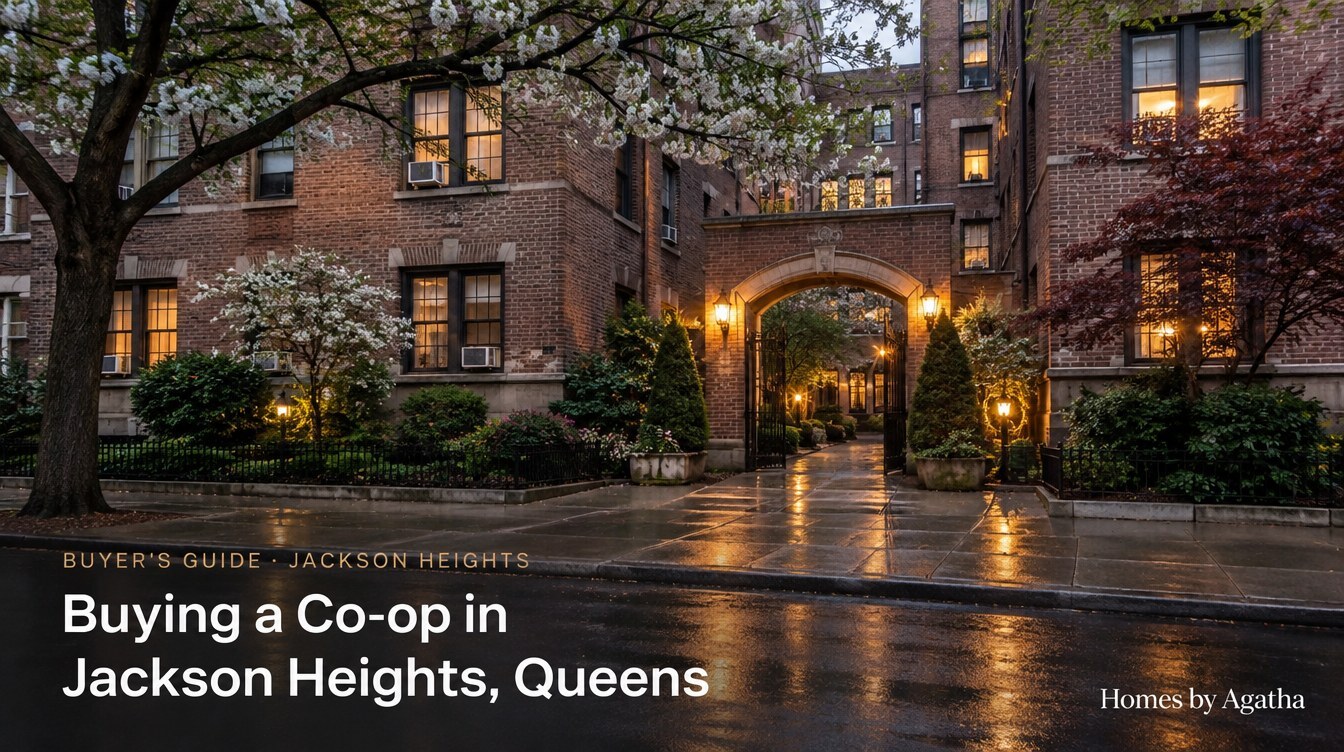
A garden co-op in Jackson Heights is a cooperative apartment building — or a group of connected buildings — set around the edge of a block with a private, landscaped garden in the middle. The Queensboro Corporation, which LPC’s building records list as the developer of a large share of the historic district’s buildings, built many of these complexes from the 1910s through the 1920s. Heights vary by complex, and some buildings have elevators while others are walk-ups, so confirm both for each building you consider.
Other apartment buildings, houses and condos
Outside the garden complexes, prewar and mid-century apartment buildings line avenues such as 34th, 35th and 37th Avenues; some are co-ops, some are rentals, and the legal form is confirmed in the documents, not on the sidewalk. Blocks of attached and semi-detached one- and two-family houses, many in Tudor-revival and Colonial-revival styles, date from the same era, some inside the historic district and some outside it, so check each address on the LPC map. Condominium supply is smaller and mostly in newer or converted buildings.
Co-op, condo or attached house: which fits a Jackson Heights purchase?
A co-op gives you shares and a proprietary lease; a condo gives you a deed to a unit; an attached house gives you a deed to land and a building that shares walls with its neighbors. In Jackson Heights, co-ops are the most common apartment form, condos are scarcer, and houses compete for buyers who want more space and control.
A proprietary lease is the long-term lease a co-op corporation gives each shareholder for a specific apartment. The number of shares attached to the apartment sets its portion of the building’s costs, which is why two apartments that look alike can carry different maintenance.
| Factor | Garden or prewar co-op | Condo unit | Attached one- or two-family house |
|---|---|---|---|
| What you own | Shares in the co-op corporation plus a proprietary lease | Deeded unit plus a share of common elements | Deeded land and building, with shared party walls |
| Approval | Board package and interview; the board may decline | Usually a right of first refusal rather than full approval | No third-party approval beyond your lender |
| Financing | Share loan within the financing limit each building sets | Mortgage; the lender reviews the condo project | Mortgage on the property |
| Monthly costs | Maintenance, including a share of building taxes and any underlying mortgage | Common charges plus the unit’s own property tax | Property tax, insurance, utilities and every repair |
| Garden or outdoor space | Shared interior garden under the co-op’s rules | Varies by building | Private yard where the lot has one |
| Landmark rules (inside the district) | Exterior work is coordinated by the co-op with LPC | Exterior work through the condo board with LPC | The owner applies to LPC directly for exterior work |
| NYC mortgage recording tax | Not charged on co-op share loans | Charged on the mortgage | Charged on the mortgage |
| Renting it out later | Only as the sublet policy allows | Usually more flexible; check the bylaws | Only units legal under the Certificate of Occupancy |
A garden co-op tends to suit a buyer who wants prewar space, a shared garden without yard work, and a short walk to Roosevelt Avenue, and who plans to live in the apartment rather than rent it out. An attached house suits a buyer who wants a private yard and control over renovations and has budgeted for every repair — though inside the historic district that control stops at the facade. Buyers weighing a two-family house should read about buying a multi-family home in Queens before relying on rental income.
Not sure whether a co-op or an attached house fits your plan?
I can help you compare monthly cost, approval steps and renovation limits for each option in Jackson Heights before you spend weekends touring.
What makes a Jackson Heights garden co-op different from other Queens co-ops?
A Jackson Heights garden co-op differs from a typical Queens co-op in three ways: it surrounds a private interior garden the co-op maintains, the structure is roughly a century old, and many such buildings sit inside a landmark district. Each adds due-diligence questions and budget items.
The interior garden is part of the building
The garden at the center of the block is generally private space for the residents of the surrounding building or buildings, not a public park. Who may use it, when, and for what — quiet use, events, pets, gardening plots — is set by the co-op’s house rules. On some blocks the garden is shared by more than one building, which can mean a shared-use agreement and shared costs. Ask the managing agent how the garden is owned, insured, maintained and budgeted.
Orientation matters too: garden-facing rooms get different light and noise than street-facing rooms, and ground-floor apartments trade direct access for less privacy.
A century-old structure means capital planning
Buildings from the 1910s and 1920s have replaced roofs, boilers, pipes and wiring more than once. In a well-run co-op that shows up as a capital plan and reserves; in a less prepared one, as a special assessment after you move in. Ask about:
- Heating plant: ask the boiler’s age, the fuel type and whether conversion or replacement is planned.
- Plumbing risers: older risers are a common capital project in prewar buildings; ask when they were last replaced.
- Electrical service: ask whether the building has upgraded service to apartments, because older capacity can limit air conditioners and appliances.
- Roof, parapets and masonry: ask about the last roof replacement and pointing work, which in the historic district must follow LPC rules.
- Windows: ask who owns and replaces windows and whether an LPC-approved design is already on file.
In a garden co-op inside the historic district, the board — not the individual shareholder — usually coordinates this exterior work with the Landmarks Preservation Commission, which can make projects slower and costlier than in an undesignated building.
How does the Jackson Heights Historic District affect what you can change?
Inside the Jackson Heights Historic District, most changes to a building’s exterior — windows, doors, masonry, storefronts, rooftop additions and similar work — require a permit from the NYC Landmarks Preservation Commission before the work begins. Interior work that needs a Department of Buildings permit also needs an LPC sign-off. The district was designated in October 1993 and covers more than 200 buildings.
The Landmarks Preservation Commission (LPC) is the New York City agency that designates landmarks and historic districts and regulates work on designated properties. Designation does not stop improvements; it requires the right permit first.
The three main LPC permit types
| LPC permit | When it is used | What it means for a buyer |
|---|---|---|
| Certificate of No Effect (CNE) | The work needs a DOB permit but does not affect protected architectural features — often interior renovations | A kitchen or bath renovation with a DOB permit typically needs this staff-level LPC sign-off as well |
| Permit for Minor Work (PMW) | Exterior work that does not need a DOB permit and is restorative or appropriate, such as window or door replacement in existing openings | Window replacement is regulated even though it may not need a DOB permit |
| Certificate of Appropriateness (C of A) | Work that affects significant protected features and does not conform to LPC rules | Requires a public hearing and community board presentation, so it takes longer |
LPC states that most of its permit approvals are issued at staff level, and that complete CNE and PMW applications can often be approved within about ten business days. Larger or unusual projects take longer. Source: NYC Landmarks Preservation Commission permit guidance.
Master plans and building-wide standards
Some buildings in historic districts have an LPC-approved master plan — a pre-approved standard for recurring items such as replacement windows or air-conditioner openings — so individual shareholders can follow one design. Ask the managing agent whether your building has one.
Landmark violations follow the building
According to the LPC, an uncorrected violation can cause problems when an owner sells or refinances. Your attorney should ask whether the building or house has open LPC violations or unresolved warning letters. LPC’s Landmark Violation Search tool shows violation status, but the agency notes it is not a substitute for a title search or other legal review.
Landmark rules focus on the exterior and on work that needs a DOB permit; painting, flooring or new appliances inside an apartment generally do not need LPC review, though the co-op’s alteration agreement still applies; confirm with the co-op and LPC before any specific project. Blocks outside the district are not subject to historic district review at all.
Key Takeaways
- A Jackson Heights garden co-op is shares plus a proprietary lease in an older building arranged around a private interior garden.
- Inside the Jackson Heights Historic District, exterior work needs an LPC permit, and interior work with a DOB permit needs an LPC sign-off.
- Window ownership, master plans and open LPC violations are building-level questions to settle before you sign.
- Garden use, garden costs and apartment orientation belong in your comparison, not just square footage.
Planning a renovation after you buy?
Before you offer, I can help you list the co-op and landmark approvals your plans would need, so your budget and timeline start from the real rules.
How does buying a co-op in Jackson Heights work from offer to closing?
Buying a co-op in Jackson Heights follows a fixed order: price and terms are agreed, the attorneys negotiate the contract, you sign and pay a deposit, your lender issues a commitment, you submit the board package, you interview with the board, and you close by taking assignment of the shares and lease. The board’s decision is the step you control least.
From accepted offer to signed contract
New York is an attorney state for residential sales. An accepted offer is not a signed contract: the buyer’s and seller’s attorneys negotiate and prepare the contract of sale, and either side can still step away until both have signed. While the contract is being drafted, your attorney reviews the offering plan, proprietary lease, house rules, recent financial statements and board minutes.
After signing, the buyer pays a contract deposit, customarily held in escrow by the seller’s attorney. A co-op contract normally includes a board-approval contingency and, if you are borrowing, a financing contingency, with deadlines your attorney will explain.
Sellers of Jackson Heights co-ops weigh certainty as heavily as price. A well-prepared offer states the loan amount and down payment, shows that the financing fits the building’s limits, attaches a pre-approval letter and proof of funds, names your attorney, and proposes a closing window that leaves room for the board’s schedule.
The board package
A board package is the application a co-op’s board reviews before approving a buyer. The managing agent supplies the building’s checklist; requirements and fees differ from building to building. A typical Jackson Heights package asks for:
- the purchase application, fees, signed contract and lender’s commitment letter;
- tax returns, W-2s or 1099s, pay stubs, and bank, brokerage and retirement statements;
- an employment letter, references and a credit-check authorization;
- signed acknowledgments of the house rules, the alteration agreement and any garden, pet or sublet policies.
Completeness is the part of the timeline a buyer controls; a missing page sends the file back before the board sees it.
The board interview
Most boards meet the buyer before voting to confirm the package and review the house rules; keep any plans you mention within those rules. A board may decline without stating a reason, but it may not discriminate on any basis protected by the federal Fair Housing Act, the New York State Human Rights Law or the New York City Human Rights Law.
The co-op closing
At a co-op closing, no deed is recorded. The seller’s stock certificate and proprietary lease are assigned to you, and new ones are issued in your name. If you finance, your lender, the co-op and you sign a recognition agreement, which is the co-op’s acknowledgment of the lender’s interest in your shares. A lien (UCC) search replaces the title search used for houses.
What does maintenance cover in a Jackson Heights co-op, and how do you judge it?
Maintenance is your monthly share of the co-op’s operating budget. In a Jackson Heights garden co-op it typically covers staff, heat, insurance, repairs, garden upkeep, reserves, a share of the building’s property taxes and its underlying mortgage. Judge it by what it includes and the finances behind it.
Ask for the breakdown
Request a maintenance breakdown for every apartment you consider. Heat is commonly included in Queens co-ops, while electricity and cooking gas may be billed separately; confirm what your building’s maintenance includes. Add separate charges such as storage, laundry or air-conditioner sleeves before comparing two apartments.
Read the financial statements
A co-op’s audited financial statements predict future maintenance better than any listing. Your attorney and, ideally, an accountant should review:
- The underlying mortgage: balance, interest rate and maturity date; a refinance at a higher rate can raise maintenance.
- Reserves: the money set aside for capital work; thin reserves in a century-old building make an assessment more likely.
- Operating results and arrears: surplus or deficit, and how much shareholders owe in unpaid maintenance.
- Commercial income: buildings with stores on 37th Avenue, 82nd Street or another corridor may collect commercial rent that supports the budget.
City rules that can drive capital costs
Two New York City laws come up often in co-op reviews. Local Law 97 sets greenhouse-gas emissions limits for most buildings larger than 25,000 square feet, beginning in 2024, with stricter limits starting in 2030; ask whether the building you are considering is covered. Local Law 11, the Facade Inspection & Safety Program, requires periodic facade inspections of taller buildings; ask whether the building is covered and when its next facade report is due. Ask the board how it plans for each rule that applies.
On the tax side, co-ops usually report a deductible share of maintenance each year (ask a CPA how it applies to you), and the NYC Department of Finance administers the Cooperative and Condominium Property Tax Abatement for eligible owners whose unit is their primary residence; the board applies on behalf of the building.
Comparing two buildings on maintenance?
I can help you line up maintenance breakdowns, reserve questions and capital-plan notes side by side, so the comparison is about real monthly cost.
How much cash and what financing do you need when buying a co-op in Jackson Heights?
Plan for three amounts — the down payment the building requires, the closing costs, and the cash reserves the board may want to see after closing — and a share loan from a lender that will lend in that building. Co-op share loans are not subject to the NYC mortgage recording tax, but the mansion tax applies at $1 million and above.
Down payment and post-closing liquidity
Each co-op sets its own minimum down payment and maximum financing. Many boards also review post-closing liquidity: the savings you will still hold after paying the down payment and closing costs, sometimes stated as a number of months of maintenance and loan payments. Get these rules in writing before you tour.
Closing costs compared
The table compares common buyer costs for a Jackson Heights co-op with a condo or attached house, using the rules published by the New York State Department of Taxation and Finance and the NYC Department of Finance. Confirm current rates with the NYS Department of Taxation and Finance and NYC Department of Finance before closing.
| Cost item | Co-op in Jackson Heights | Condo or attached house in Jackson Heights | Source / who sets it |
|---|---|---|---|
| “Mansion tax” | 1% of the price at $1 million or more; graduated above $2 million in New York City; paid by the buyer | Same rule | NYS Department of Taxation and Finance |
| NYC mortgage recording tax | Not charged; co-op loans are share loans | Roughly 1.8% of the loan under $500,000 and 1.925% at $500,000 and above (1–3 family homes and condos) | NYC Department of Finance / New York State |
| Title or lien search | Lien (UCC) search; optional co-op lien coverage | Title search and title insurance | Title company / attorney |
| Buyer’s attorney | Fee agreed with the attorney | Fee agreed with the attorney | Your attorney |
| Lender costs | Origination, appraisal, credit report, building questionnaire | Origination, appraisal, credit report | Your lender |
| Building fees | Application, credit-check and processing fees; possible move-in deposit | Condo: application fees; house: none | Managing agent |
| Adjustments | Maintenance prorated to the closing date | Property taxes and common charges prorated | Contract / attorneys |
| Flip tax | Only if the co-op’s documents impose one; who pays depends on those documents and the contract | Not applicable to houses; uncommon for condos | The co-op’s own documents |
The NYS real estate transfer tax and the NYC Real Property Transfer Tax are customarily paid by the seller in a resale, so they rarely appear on a buyer’s statement. For a full walk-through of the buyer side, see the guide to Queens closing costs.
Budget for the landmark premium on future work
Exterior projects in the historic district — windows, masonry, roofing details — often require approved materials and designs, which can cost more than standard replacements, so get contractor estimates for any planned work. In a co-op, that cost flows through maintenance or assessments; in an attached house, it is yours directly. Add a line for it when you compare buildings.
Share-loan financing and pre-approval
A co-op share loan is secured by your shares and proprietary lease rather than by a mortgage on real property. Get pre-approved by a lender that actively makes co-op loans in Queens, then confirm that it will lend in the specific building. Co-op lenders also underwrite the building through a questionnaire on owner-occupancy, reserves, arrears and litigation, so an older building with thin reserves can fall outside a lender’s guidelines even when the buyer qualifies.
The board then reviews your finances under its own standards, which can be stricter than the lender’s, so plan your down payment and reserves for the stricter of the two. Ask an NMLS-registered loan originator whether any government-backed loan program can be used for a specific co-op. First-time buyers can find preparation steps in the first-time home buyer guide for Queens.
Key Takeaways
- Confirm each building’s down payment, financing limit and liquidity rule before touring, not after the contract.
- Co-op share loans are not subject to the NYC mortgage recording tax; the mansion tax still applies at $1 million and above.
- The lender reviews the building, so an older co-op’s reserves, arrears and litigation can affect your loan.
- Landmark-compliant exterior work can cost more; budget for it in maintenance or, for a house, directly.
Getting your pre-approval ready?
Let’s match your down payment, reserves and lender to the Jackson Heights buildings you are considering, so your approval fits how those co-ops actually lend.
How do you get around from Jackson Heights?
Jackson Heights is served by a major Queens transfer point: the 74 St–Broadway / Jackson Hts–Roosevelt Av station complex, where the 7 meets the E, F, M and R. The elevated 7 line also stops at 69 St, 82 St–Jackson Hts, 90 St–Elmhurst Av and Junction Blvd above Roosevelt Avenue, and the Q70 bus links the hub to LaGuardia Airport.
The Roosevelt Avenue hub
At the hub, the 7 runs on the elevated structure (74 St–Broadway) and the E, F, M and R run below ground on the Queens Boulevard Line (Jackson Hts–Roosevelt Av). The E and F stop here as express trains, the R stops here as a local, and the M also stops here as a local but does not run at all hours, so check the MTA’s current schedule for M and late-night service. MTA station data lists the complex as accessible, but elevators can be out of service, so check current elevator status before relying on it.
The 7 line along Roosevelt Avenue
From west to east, the 7 stops at 69 St (toward Woodside), 74 St–Broadway, 82 St–Jackson Hts (near the 82nd Street corridor and the eastern part of the historic district), 90 St–Elmhurst Av and Junction Blvd; the rush-hour, peak-direction express 7 skips 74 St–Broadway, 82 St and 90 St and stops at Junction Blvd, then at 61 St–Woodside to the west.
Buses, the airport and driving
Bus routes serving the area around the hub include the Q32, Q33, Q47, Q49, Q53 Select Bus Service and Q70 Select Bus Service; the Queens Bus Network Redesign changed several Queens routes in 2025, so check the current MTA bus map for stops. The Q70 LaGuardia Link makes LaGuardia Airport a short bus ride. Drivers use the Brooklyn–Queens Expressway, the Grand Central Parkway and Northern Boulevard; garden co-ops often lack on-site parking, so ask rather than assume.
How transit should shape your co-op choice
Walk the route at the hours you would travel. Apartments close to the elevated 7 trade a shorter walk for more train noise, so note which way the rooms face. Buyers comparing commutes can also look at nearby options: buying in Woodside to the west, Elmhurst to the south, or Corona to the east, each with its own mix of housing and stations on the 7 or the Queens Boulevard Line.
What should you check before you offer on a Jackson Heights home?
Check the building, the landmark status and the public records first, then the apartment or house itself. In Jackson Heights that includes confirming whether the property is inside the historic district and searching LPC records as well as DOB and HPD records.
| What to check | Where to find it | Why it matters in Jackson Heights |
|---|---|---|
| Offering plan and amendments | Managing agent / seller’s attorney | Confirms the building is a co-op and how shares were allocated |
| Proprietary lease, house rules and alteration agreement | Managing agent | Sets repair responsibilities, renovation rules and garden-use rules |
| Audited financial statements and budget | Managing agent | Shows the underlying mortgage, reserves and arrears behind maintenance |
| Board minutes | Managing agent, through your attorney | Reveals planned roof, riser, boiler, masonry or window projects and LPC applications |
| Historic district status | LPC’s Discover NYC Landmarks map | Determines whether exterior work needs LPC permits |
| Landmark violations | LPC Landmark Violation Search | Uncorrected violations can complicate a sale or refinance |
| Building violations and complaints | NYC DOB and NYC HPD online records | Open violations can signal deferred maintenance or upcoming costs |
| Certificate of Occupancy (houses) | NYC DOB records | Confirms the legal use and number of units in an attached house |
| Flood and stormwater information | FEMA Flood Insurance Rate Maps; NYC Flood Hazard Mapper; NYC DEP stormwater flood maps | Jackson Heights is inland, but heavy-rain and basement water risk is address-specific |
Inside a co-op apartment
Hire an inspector familiar with prewar co-ops. Focus on what the proprietary lease makes your responsibility: the electrical panel and outlets, plumbing fixtures and visible pipes, radiators and valves, kitchen and bath condition, and windows where shareholders own them. Ask whether earlier renovations had board approval and, where needed, DOB permits and LPC sign-off.
Inside an attached house
An attached-house purchase adds checks a co-op does not need. The Certificate of Occupancy issued by the NYC Department of Buildings states the legal use and number of dwelling units; a house sold as a two-family must be legal as a two-family to be financed and insured that way, and a basement apartment without a matching Certificate of Occupancy and permits is a common problem across Queens. Houses from the 1920s may have older wiring, galvanized pipes, an aging sewer line or an old oil tank, so consider a sewer-line camera inspection alongside the full inspection. Because attached houses share party walls and sometimes rear driveways or garages, ask your attorney to review any shared-driveway or access arrangements in the title.
For flood and stormwater risk, use the maps listed in the table for the exact address, then ask a co-op whether it has had basement or boiler-room water, or look in a house for staining and backflow protection.
Want a second set of eyes on a building’s records?
I can help you gather the DOB, HPD and LPC records and the questions your attorney will need answered before you commit to a Jackson Heights apartment or house.
How long does it take to go from offer to keys in Jackson Heights?
A Jackson Heights purchase moves through preparation, accepted offer, attorney review and contract, loan commitment, approval and closing; a co-op adds the board stage, while an attached house adds the inspection, title and Certificate of Occupancy work. The managing agent’s document delivery and the board’s meeting schedule usually set the pace for a co-op.
For an attached house, the inspection is usually completed before the contract is signed, because many New York contracts do not include an inspection contingency; ask your attorney how your contract will handle it.
| Stage | Co-op | Attached house | What controls the timing |
|---|---|---|---|
| 1. Preparation | Pre-approval; collect each building’s financing and liquidity rules | Pre-approval; confirm Certificate of Occupancy for target houses | Your document readiness |
| 2. Offer accepted | Terms agreed; attorneys exchange information | Terms agreed; inspection scheduled | Negotiation |
| 3. Due diligence and contract | Review of financials, minutes, lease; contract signed; deposit in escrow | Inspection, title order, contract signed; deposit in escrow | Document delivery and attorney review |
| 4. Loan commitment | Appraisal and building questionnaire | Appraisal and underwriting | Lender |
| 5. Approval | Board package, interview and decision | No board; title clearance | Board meeting schedule / title issues |
| 6. Closing | Shares and lease assigned; recognition agreement; maintenance prorated | Deed recorded; taxes prorated; mortgage recording tax paid | Coordination among attorneys, lender and managing agent |
Build the board and document steps into your rate lock and moving plans instead of assuming a fixed number of days.
How does working with a buyer’s agent work in 2026?
In 2026, you sign a written buyer agreement before touring homes with an agent, and the agent’s compensation is negotiable: it is not set by law and is not automatically paid by the seller. You also receive the New York State Disclosure Form for Buyer and Seller at the first substantive contact, explaining whom the agent represents.
These practices follow the 2024 NAR settlement. The written agreement states the services, the compensation and how it will be paid — by the buyer, through a seller contribution, or as negotiated within the offer. The guide to working with a buyer’s agent in NY explains these documents in more detail.
For a Jackson Heights co-op search, an agent’s value lies in the work around the apartment: obtaining financing and liquidity policies early, coordinating with managing agents, helping assemble a complete board package, and keeping the lender, attorneys and board timeline aligned. I work in English and Polish; that is about clear communication and comfort, and where you choose to buy is always your decision.
Ready to build a Jackson Heights shortlist?
Share your budget, commute and must-haves, and we can narrow the neighborhood’s co-ops and blocks to the buildings whose rules fit your plans.
What mistakes should Jackson Heights co-op buyers avoid?
The costliest mistakes when buying a co-op in Jackson Heights come from skipping building-level and landmark-level questions, not from the apartment itself. Avoid these:
- Touring before checking financing rules. An apartment in a building whose down payment or liquidity rule you cannot meet is not a real option.
- Comparing prices instead of monthly costs. A lower price with higher maintenance can cost more each month than a higher price with lower maintenance.
- Assuming you can change the windows or facade. Inside the historic district, exterior work needs LPC approval and usually goes through the co-op board.
- Skipping the minutes. Riser, roof, masonry and window projects often appear in the minutes before they appear as assessments.
- Treating the garden as a private yard. The interior garden is governed by house rules and may be shared with other buildings.
- Buying a “two-family” house without checking the Certificate of Occupancy. Legal unit count affects financing, insurance and resale.
Your Jackson Heights buyer checklist
- Choose between a co-op, a condo and an attached house using total monthly cost and renovation freedom.
- Get pre-approved by a lender that makes co-op share loans in Queens; sign a written buyer agreement.
- Collect each building’s financing limit, liquidity rule, sublet policy and garden rules.
- Confirm on the LPC map whether the property is inside the Jackson Heights Historic District.
- Walk to the Roosevelt Avenue hub or your nearest 7 station at real travel times.
- Compare maintenance breakdowns, the underlying mortgage and reserves.
- Have your attorney review the offering plan, proprietary lease, financials and minutes.
- Search DOB, HPD and LPC records; for a house, confirm the Certificate of Occupancy.
- Inspect electrical, plumbing, heating and windows, plus the sewer line for a house.
- Prepare the board package early and plan the closing around the board’s schedule.
If you already own in Jackson Heights and plan to sell before you buy again, the companion guide to selling your home in Jackson Heights covers the seller side of that move.
Begin your Jackson Heights search with a clear plan
From screening buildings to preparing the board package, I can guide each step so your time goes to apartments and houses you can actually buy.
Frequently asked questions about buying a co-op in Jackson Heights
What is a garden co-op in Jackson Heights?
A garden co-op in Jackson Heights is a cooperative apartment building, or group of connected buildings, arranged around a private landscaped garden in the middle of the block. Many were built in the 1910s and 1920s. Shareholders use the garden under the co-op’s house rules, and its upkeep is part of the building’s budget.
Do I need landmark approval to renovate a Jackson Heights co-op?
Inside the Jackson Heights Historic District, exterior work such as window replacement needs a Landmarks Preservation Commission permit, usually coordinated by the co-op. Interior work that requires a Department of Buildings permit also needs an LPC sign-off, often a Certificate of No Effect. Your co-op’s alteration agreement applies to every renovation, too.
Which subway lines serve Jackson Heights?
Jackson Heights is served by the 74 St–Broadway / Jackson Hts–Roosevelt Av station complex, where the 7 connects with the E, F, M and R. The elevated 7 also stops at 69 St, 82 St–Jackson Hts, 90 St–Elmhurst Av and Junction Blvd along Roosevelt Avenue. Check MTA schedules for current M service.
Do co-op buyers in Jackson Heights pay the NYC mortgage recording tax?
No. Co-op purchases are financed with share loans secured by shares and a proprietary lease, and co-op loans are not subject to the NYC mortgage recording tax. Condo and house buyers who take a mortgage do pay it. The New York State mansion tax still applies to any purchase priced at $1 million or more.
How long does co-op board approval take in Jackson Heights?
There is no fixed timeline. The managing agent checks that your board package is complete, forwards it to the board, and the board schedules an interview at its next meeting. A complete package, an early loan commitment and a closing date that allows for the board’s schedule are the most reliable ways to reduce delays.
Can I use the interior garden whenever I want?
Use of a Jackson Heights garden co-op’s interior garden is set by that co-op’s house rules. Rules can cover hours, guests, events, pets and gardening, and on some blocks the garden is shared with neighboring buildings under an agreement. Ask the managing agent for the garden rules before you sign a contract.
Are there condos in Jackson Heights, or only co-ops?
Jackson Heights has condominiums, but co-ops are the more common form of apartment ownership, especially in the prewar and garden buildings. Condo supply is smaller and often in newer or converted buildings. Buyers who need deeded ownership or flexible subletting may also compare condos in Woodside, Elmhurst and other nearby Queens neighborhoods.
What should I check before buying an attached house in Jackson Heights?
Check the Certificate of Occupancy for the legal number of units, open DOB and LPC violations, whether the house is inside the historic district, shared-wall and driveway arrangements, and the age of the roof, boiler, wiring, plumbing and sewer line. A full inspection before signing the contract is standard practice in New York.
Who pays the buyer’s agent when buying in Jackson Heights?
Buyer-agent compensation is negotiable and not set by law. Since the 2024 NAR settlement, it is not automatically paid by the seller. You and your agent sign a written agreement before touring that states the compensation and how it is paid, whether by you, through a seller contribution, or as negotiated in your offer.
Is Jackson Heights in a flood zone?
Jackson Heights is an inland Queens neighborhood, but flood status is decided address by address. Check the FEMA Flood Insurance Rate Map and the NYC Flood Hazard Mapper for the exact property, and review NYC DEP stormwater flood maps for heavy-rain risk. Lenders may require flood insurance in Special Flood Hazard Areas.
Next steps for buying in Jackson Heights
A good Jackson Heights purchase is decided before the first showing. Know each building’s financing and liquidity rules, judge maintenance by its contents and the finances behind it, confirm whether the property sits inside the historic district, and price future exterior work at landmark standards. Weigh every garden co-op against the neighborhood’s attached houses on total monthly cost and renovation freedom, and test your walk to the Roosevelt Avenue hub at real travel times. When you are ready to move from research to a search, start on the Jackson Heights home buying page, where we can match your plan to the buildings and blocks that fit it.
This article is for general informational purposes only and reflects conditions that may change. It is not legal, tax, or financial advice, an appraisal, or a guarantee of price or outcome; consult a licensed New York attorney, a CPA, and an NMLS-registered mortgage loan originator as appropriate. A CMA is an opinion of value, not an appraisal. Real estate brokerage services are offered by Agatha Lubas, Licensed Associate Real Estate Broker, NY License #10301213345, Keller Williams Realty Liberty, 96-10 101st Avenue, Ozone Park, NY 11416. The NYS Disclosure Form for Buyer and Seller, the NYS Housing and Anti-Discrimination Disclosure / Fair Housing Notice, and the brokerage’s Standard Operating Procedures are available on request. Equal Housing Opportunity.

Agatha Lubas helps buyers, sellers and investors across Queens, Brooklyn, Nassau County and Suffolk County, including co-op purchases that involve board review and building documents. She works with clients in English and Polish, so each step of the process stays clear and comfortable.
Work with Agatha