

JAMAICA ESTATES REAL ESTATE GUIDE
Buying a House in Jamaica Estates, Queens: Zoning, Lots and the Checks That Protect You
Quick Answer
Buying a house in Jamaica Estates, Queens usually means buying a detached one-family home on a landscaped lot in a low-density R1-2 zoning district. Before signing, confirm the legal use and permits, inspect the lot as closely as the house, budget for carrying costs and closing taxes, and test the walk to the F train.
Buying a house in Jamaica Estates is a different exercise from buying in most of Queens. Instead of attached row houses and two-family homes on a straight grid, Jamaica Estates offers detached houses set on curving streets that follow the hills, many of them on lots with lawns, mature trees and driveways. That shape changes the questions a buyer should ask.
The house is only half of the purchase. The lot, the trees, the slope, the sewer line and the zoning that governs what you may add later all come with it. And because the neighborhood’s southern edge is Hillside Avenue, with apartment buildings and the F train, some buyers also weigh a co-op against a house.
This guide explains the housing stock, what one-family zoning means in practice, the paperwork to check, the inspection items that matter on these lots, closing costs, financing, the commute and the New York contract process. As a Licensed Associate Real Estate Broker serving Queens and the surrounding New York markets, I help buyers evaluate both the property and the transaction, in English or Polish, whichever is more comfortable. Where you decide to buy is always your choice; my role is to make the facts behind that choice clear.
Jamaica Estates at a glance
| Topic | What to know |
|---|---|
| Area | East-central Queens, north of downtown Jamaica; commonly described as bounded by Union Turnpike (north), Hillside Avenue (south), Utopia Parkway and Homelawn Street (west) and 188th Street (east); boundary lines vary by source, so confirm where a specific address falls on a map |
| Borough / County | Queens / Queens County, New York City; Queens Community District 8 |
| ZIP code | Mostly 11432; confirm the ZIP code for a specific address with the USPS, especially near the eastern edge |
| Subway | F train along Hillside Avenue at 169 Street and Jamaica–179 Street (the F line’s eastern terminal); check the current MTA timetable for any other services that use these stations |
| Rail | No LIRR station inside the neighborhood; the Long Island Rail Road’s Jamaica station is in downtown Jamaica to the south |
| Buses | Hillside Avenue and Union Turnpike are bus corridors; check the current MTA bus map for local and express routes and stops |
| Main roads | Hillside Avenue, Union Turnpike, Midland Parkway (the neighborhood’s central boulevard), 188th Street, Utopia Parkway; the Grand Central Parkway lies to the north, and the nearest ramps depend on the specific address |
| Street pattern | Curving streets that follow the topography rather than the Queens grid, laid out when the Jamaica Estates Corporation began developing the area in 1907 |
| Commercial corridor | Hillside Avenue along the southern edge; shops and services also on Union Turnpike and 188th Street |
| Zoning | Most residential blocks are zoned R1-2, a one-family detached residence district (NYC Department of City Planning); Hillside Avenue frontage carries different, higher-density zoning; check the zoning of a specific lot on ZoLa |
| Typical property types | Detached one-family houses in Tudor, Craftsman, Colonial, Cape Cod and Mediterranean styles, plus later and rebuilt homes; apartment and co-op buildings near Hillside Avenue; current listings show what is actually available at any given time |
| Key buyer considerations | One-family zoning limits; legal use and permits for additions and basements; lot drainage, trees and retaining walls; older-house systems; carrying costs; $1 million mansion-tax threshold |
What kinds of homes will you find when buying a house in Jamaica Estates?
Jamaica Estates, Queens is primarily a neighborhood of detached one-family houses on individual lots, set along curving, tree-lined streets. Near its southern edge on Hillside Avenue, the housing changes to apartment buildings, some of them co-ops, which gives buyers a second and very different way to own in the area.
The detached-house core
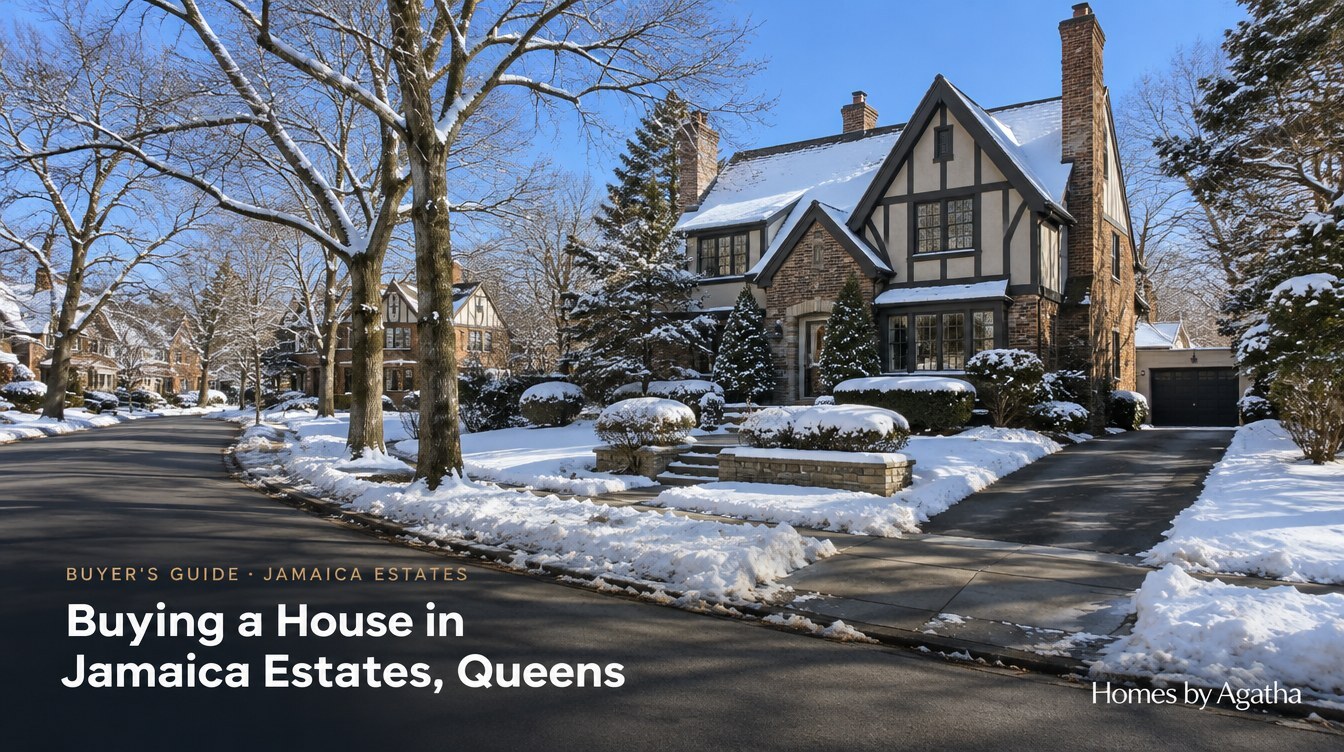
The Jamaica Estates Corporation began developing the neighborhood in 1907 as a planned residential area, and the street plan still shows it. Midland Parkway, the main boulevard, runs through the middle with landscaped center malls, and side streets bend with the land rather than meeting at right angles. Houses sit back from the street behind lawns and plantings, and most have a driveway and a garage, either attached or detached.
Architecturally, the stock is varied. Buyers see early twentieth-century Tudor and Craftsman houses, Colonials, Cape Cods, Mediterranean-style homes with stucco and tile roofs, mid-century houses, and a number of later homes that replaced or substantially expanded earlier ones. That variety is the first reason no two listings compare neatly: a 1920s Tudor with original systems and a recently rebuilt house on the next block are, for due-diligence purposes, two different products.
Lots, slopes and landscaping
Lots in Jamaica Estates are generally larger than the narrow lots of attached-house neighborhoods in Queens, and many are not flat: some houses sit above the street behind steps and retaining walls, others below it with sloping driveways. Trees, hedges and planted beds come with the purchase, and each has a maintenance cost covered in the inspection section below.
The Hillside Avenue edge
Hillside Avenue forms the neighborhood’s southern boundary and has a different character from the interior blocks. It is a busy commercial and transit corridor with the F train running beneath it, and it is lined in part by apartment buildings, some of which are co-ops. Ownership differs from building to building, so confirm whether a specific building is a co-op, a condo or a rental, and which side of the avenue it sits on, before you plan around it. For a buyer who wants to be in or next to Jamaica Estates but does not want to maintain a house and lot, these buildings are the realistic alternative.
Jamaica Estates, Jamaica, Jamaica Hills: check the map
Listings sometimes use neighborhood names loosely. Jamaica Estates is a distinct neighborhood north of Hillside Avenue; downtown Jamaica, with its LIRR hub and dense commercial center, lies to the south and has a very different housing stock. If your search extends there, the guide to buying your home in Jamaica, Queens covers that market separately. To the east, Holliswood has its own hilly, detached-house streets, and to the west, Jamaica Hills and Briarwood mix houses with apartment buildings. Always confirm the exact address on a map and on the city’s zoning map rather than relying on the name in the listing.
What does R1-2 zoning mean for a Jamaica Estates house?
R1-2 is a New York City zoning district designated by the Department of City Planning for one-family detached houses. For a buyer, it means a house in most of Jamaica Estates is legally a single-family home, with limits on how much floor area you can add and no as-of-right path to converting it into a two-family house.
What R1-2 allows and what it does not
Zoning districts in New York City set the permitted use of a lot and the size and placement of buildings. R1 districts are the city’s lowest-density residence districts, mapped for detached one-family homes with yards on all sides. In R1-2, new lots must meet minimum width and area requirements, and the amount of building allowed is controlled by floor-area and open-space rules. The current figures are set out in the NYC Zoning Resolution and summarized on the Department of City Planning’s R1 district page; an architect should apply them to the specific lot, including any changes made by later zoning amendments.
In practical terms, three consequences matter most to buyers:
- Use: a house in an R1-2 district is a one-family house. If your plan depends on rental income from a second legal unit, a Jamaica Estates house is generally the wrong tool; a two-family house in a district that permits it is a different purchase, explained in the guide to buying a multi-family home in Queens.
- Size: a house that already uses most of its permitted floor area may have little room for an addition, regardless of how large the lot looks. An architect can calculate the remaining buildable area for a specific lot.
- Existing conditions: some older houses were built or expanded before current rules, so they may not match today’s limits. Legally existing non-complying conditions can often remain, but changing them may trigger current requirements. Ask an architect before you rely on rebuilding or enlarging an existing wing.
The accessory-unit question
In December 2024, New York City adopted the City of Yes for Housing Opportunity zoning amendments, which, among other changes, created a path for accessory dwelling units on one- and two-family lots in low-density districts, with restrictions on certain types of units in certain areas. Whether a specific Jamaica Estates lot qualifies, and under what size, building-code and owner conditions, is a technical question that must be answered by an architect or zoning attorney for that lot, using the current Department of City Planning and Department of Buildings guidance. Do not assume that an existing basement or garage apartment is legal because the rules have changed.
Why the Hillside Avenue edge is zoned differently
In 2007, the New York City Council adopted the Department of City Planning’s Jamaica Plan, a large rezoning covering downtown Jamaica and portions of surrounding neighborhoods. The plan rezoned frontage along Hillside Avenue for mid-rise, mixed-use buildings, while the Jamaica Estates interior kept its R1-2 one-family zoning. The plan as approved also limits the height of new buildings close to lower-density districts. The exact districts now mapped on any stretch of Hillside Avenue are shown on the city’s zoning map.
For a buyer, the takeaway is concrete. A house on an interior street is governed by one-family rules. A house whose rear yard backs onto Hillside Avenue frontage may have a neighbor zoned for a larger building. Check the zoning of adjoining lots, not only the lot you are buying, on the Department of City Planning’s ZoLa zoning map.
Key Takeaways
- Most of Jamaica Estates is zoned R1-2, a one-family detached district; a house there is legally a single-family home.
- Rental income from a second unit is generally not a plan you can build a Jamaica Estates purchase around.
- Remaining buildable floor area, not lot size alone, decides whether an addition is possible.
- The Hillside Avenue frontage was rezoned in 2007 for larger buildings, so check the zoning next door as well.
Planning to expand or renovate after you buy?
Tell me what you want the house to become. I will help you line up the questions for an architect before you make an offer, so your plans and the zoning point in the same direction.
House or Hillside Avenue co-op: which fits your plans?
In and around Jamaica Estates, the realistic choice is between a detached house on its own lot and a co-op apartment in a building near Hillside Avenue. A house gives you land, privacy and control, with full responsibility for every system; a co-op gives you a lower entry point, shared building costs and transit at the door, in exchange for board approval and building rules.
A co-operative apartment, or co-op, is a form of ownership in which you buy shares in a corporation that owns the building and receive a proprietary lease for your unit. A detached house is real property: you own the land and the building, and you answer directly to the city’s zoning, building and tax rules. That legal difference shapes everything in the comparison below.
| Factor | Detached house, interior street | House near Hillside Avenue | Co-op apartment near Hillside Avenue |
|---|---|---|---|
| What you own | Land and house (real property) | Land and house (real property) | Shares in a corporation plus a proprietary lease |
| Approval to buy | Seller and lender only | Seller and lender only | Board application package and usually an interview |
| Monthly costs | Mortgage, NYC property tax, insurance, utilities, landscaping, upkeep | Same as interior house | Share loan payment plus maintenance, which typically includes a share of the building’s property taxes and underlying mortgage |
| Zoning context | R1-2 one-family rules | R1-2 on the lot; check adjoining frontage zoning | Building’s own zoning; alterations governed by the co-op |
| F train access | Walk depends on distance and hills to Hillside Avenue | Shorter walk to 169 Street or Jamaica–179 Street | Usually the shortest walk |
| NYC mortgage recording tax | Applies | Applies | Does not apply to co-op share loans |
| Main timing risk | Inspection findings, permits, appraisal | Inspection findings, permits, appraisal | Board review and building paperwork |
How the co-op board process works
A co-op board package is the application a buyer submits to the co-op’s board of directors, usually through the building’s managing agent. It commonly includes tax returns, bank and investment statements, employment verification, reference letters and the signed contract. Many boards then interview the buyer before deciding. Each building sets its own rules for the minimum down payment, whether financing is permitted and how much money the buyer must have left after closing, so ask the managing agent for the current requirements of the specific building.
For Hillside Avenue co-ops, ask early about parking (assigned, rented or waitlisted), storage, pet rules, subletting policy, laundry, and any planned capital work, such as façade, roof or boiler projects, that could lead to an assessment. Ask whether the co-op’s documents impose a flip tax on sales, since that affects you when you eventually sell.
Why the house decision is really a lifestyle-and-maintenance decision
A Jamaica Estates house asks its owner to manage a property, not only live in it: roof and gutter cycles, a heating system sized for a large house, tree and lawn care, and the sidewalk in front of the lot, which New York City makes the property owner’s responsibility to maintain and clear of snow. Price that ownership honestly before choosing between a house and an apartment.
What does it cost to buy and own a house in Jamaica Estates?
Plan for the down payment, New York City closing costs and the ongoing cost of running a larger detached house. Two closing items deserve early attention in Jamaica Estates: the NYS “mansion tax,” which applies to residential purchases of $1 million or more, and the NYC mortgage recording tax, which applies to house loans but not to co-op share loans.
The table lists the main buyer-side costs as published by the official sources. Your attorney and lender will provide exact figures for your transaction. For a borough-wide explanation of each line, see Queens closing costs explained.
| Buyer cost | Detached house | Co-op apartment | Notes and source |
|---|---|---|---|
| Down payment | Set by your loan program | Set by the building’s rules and your lender | Co-op minimums vary by building |
| NYS “mansion tax” | 1% of the price if $1 million or more | 1% of the price if $1 million or more | Paid by the buyer; graduated above $2 million in New York City (NYS Department of Taxation and Finance) |
| NYC mortgage recording tax | Roughly 1.8% of the loan under $500,000; 1.925% at $500,000 and above (1–3 family homes) | Not applicable to co-op share loans | NYC Department of Finance / NYS |
| Title insurance and title search | Yes | No (lien search instead) | Quoted by the title company |
| Buyer’s attorney | Yes | Yes | Fee agreed with your attorney |
| Inspection, survey and specialist reports | Inspection, survey, sewer camera, oil-tank sweep, tree or wall assessment as needed | Inspection optional but useful | Larger lots and older systems justify specialist reports |
| Board and managing-agent fees | Not applicable | Application, credit check, move-in deposit | Set by each building |
| Prepaid taxes, insurance, adjustments | Property tax and insurance escrows | Maintenance adjustment | Prorated at closing |
Confirm current rates with the NYS Department of Taxation and Finance and the NYC Department of Finance before closing.
The $1 million line
The NYS mansion tax is 1% of the full purchase price once the price reaches $1 million, paid by the buyer, and it is graduated above $2 million in New York City. Because it applies to the entire price rather than only the amount above the threshold, a purchase at or just over $1 million carries a noticeably larger closing bill than one just under it. When you set your budget for a detached house in Jamaica Estates, run the numbers on both sides of that line and make sure the cash for the tax is set aside, since it is generally paid at closing. Ask your loan originator how the tax fits into your cash-to-close figure for the loan you are considering.
Carrying costs of a larger detached house
Monthly costs on a Jamaica Estates house go beyond the mortgage. NYC property taxes are billed by the NYC Department of Finance; check the current bill in the Department’s property records rather than estimating. Heating a large older house, insuring it, maintaining roofs and boilers and caring for large trees all add up. Ask the seller for twelve months of utility bills and any service contracts, and get an insurance quote before you sign the contract.
See the true monthly cost before you fall for a house
I can help you put purchase costs, closing taxes and the carrying costs of a specific Jamaica Estates house on one page, so the decision is based on numbers rather than curb appeal.
How should you prepare financing for a Jamaica Estates purchase?
Get a full mortgage pre-approval from an NMLS-registered loan originator before touring seriously, and tell the lender whether you are looking at houses, co-ops or both. In Jamaica Estates, financing questions usually turn on loan size, appraisals for one-of-a-kind houses, renovation plans and, for co-ops, whether the lender works with the specific building.
Loan size and loan type
Detached houses can require loans above the conforming loan limit set each year by the Federal Housing Finance Agency, which places them in the jumbo category with its own down payment, reserve and documentation requirements. The limit changes every year, so check the current figure for Queens County on the FHFA website. Ask your loan originator early which category your target price falls into, because it changes how much cash you need and how long underwriting takes.
Appraisals on distinctive houses
A house that is architecturally distinctive, sits on an unusual or sloping lot, or has been heavily rebuilt can leave an appraiser with few close comparable sales. If the appraisal comes in below the contract price, you may need to bring more cash, renegotiate or rely on the mortgage contingency in your contract. Discuss that scenario with your attorney before you sign and keep reserves if you are stretching.
Renovation plans and co-op share loans
If you plan to renovate with a renovation loan, align the loan’s draw schedule with realistic Department of Buildings permit timing. For a co-op, the purchase is financed with a share loan secured by your shares and proprietary lease. Not every lender makes co-op loans, and some lend only in buildings they have reviewed, so ask the managing agent for the building’s financing rules and confirm that your lender will work with it.
How do you get around from Jamaica Estates?
The F train is the main subway option, with stations under Hillside Avenue at 169 Street and at Jamaica–179 Street, the F line’s eastern terminal. Buses run along Hillside Avenue and Union Turnpike, the Long Island Rail Road’s Jamaica station is to the south, and most residents of the detached-house blocks also drive.
The F train along Hillside Avenue
The F train runs from Jamaica–179 Street along Hillside Avenue and Queens Boulevard toward Manhattan. The E train’s Queens terminal is Jamaica Center–Parsons/Archer, to the south in downtown Jamaica; check the current MTA timetable for the service pattern at the hours you would ride. Because Jamaica–179 Street is a terminal, riders boarding there start at the beginning of the line, which some commuters value at rush hour.
The practical question for a buyer is distance. The stations are on the neighborhood’s southern edge, and the interior streets curve and climb, so the walk from a house near Union Turnpike can be meaningfully longer and steeper than the map suggests. Walk the route from a specific house to the station at the hour you would commute before deciding that a block is “near the train.”
Buses, the LIRR and the airport connection
Hillside Avenue is a major bus corridor, and Union Turnpike also carries local buses. Routes and stops change over time, so check the current MTA bus map for local and express service from a specific block. The Long Island Rail Road’s Jamaica station, in downtown Jamaica, is a major transfer point on the LIRR and connects to AirTrain JFK; check how you would reach it from a specific block, whether by bus, subway or car.
Driving and parking
Drivers use Hillside Avenue, Union Turnpike, Utopia Parkway and 188th Street to reach the Grand Central Parkway, the Van Wyck Expressway and the Long Island Expressway; the nearest ramps depend on the specific address. Most detached houses have driveways and garages. Check the condition and slope of the driveway, whether the garage is usable for a modern car, and whether the curb cut is legal; in co-op buildings, ask how parking is allocated.
Line up the loan and the commute together
The right house is the one that works with your financing and your daily route. I can help you prepare a pre-approval plan and test commutes from the blocks you are considering.
What should you inspect on a Jamaica Estates house and lot?
Inspect the lot as carefully as the house. On Jamaica Estates properties, the usual problem areas are legal use and permits for past additions and basements, drainage on sloping lots, retaining walls, large trees, the private sewer line, oil-tank history and the systems of older houses. In New York, most of this work happens before the contract is signed.
Certificate of Occupancy, permits and legal use
A Certificate of Occupancy, or CO, is the NYC Department of Buildings document that states a building’s legal use and number of dwelling units. Some Jamaica Estates houses date from before 1938. According to the Department of Buildings, buildings built before 1938 are not required to have a CO unless later alterations changed their use, egress or occupancy, so an older house may have no CO at all, or a later CO tied to an alteration. For a building that is exempt, the DOB can issue a Letter of No Objection confirming its legal use. Your attorney should confirm what the Department of Buildings records show and whether the house as it exists matches them.
In a one-family district, the most common red flags are a finished basement used as a separate apartment, an attic or garage converted to living space without permits, and rear or side additions with no permit history. These conditions can create problems with insurance, financing, future sales and city violations. Ask the seller for permits and sign-offs for every addition and major renovation, and have your attorney check for open DOB and Environmental Control Board violations.
Slopes, drainage and retaining walls
Jamaica Estates sits on hilly terrain, so water management matters. Look at where the downspouts discharge, whether the driveway slopes toward the garage or house, whether the basement shows staining, efflorescence or a sump pump, and how the yard drains after rain. Retaining walls deserve their own look: leaning, cracking or bulging walls can be expensive to rebuild. Under Department of Buildings rules, a retaining wall that faces a public right-of-way, such as a sidewalk or street, and has any portion ten feet or higher must be inspected every five years by a Qualified Retaining Wall Inspector, so ask whether the property has such a wall and for its latest report.
Jamaica Estates is not a coastal neighborhood, but flood risk is not only about the shoreline. Check the address on the FEMA Flood Map Service Center and on New York City’s flood and stormwater maps, and read the flood questions on the seller’s Property Condition Disclosure Statement. Map status is address-specific, so check the exact property rather than assuming a whole block is in or out of a mapped area.
Trees, roots and the sewer line
Mature trees are part of the appeal of Jamaica Estates and part of the inspection. Street trees are under NYC Parks jurisdiction, and work on or near them requires a Parks tree work permit. NYC Parks is not responsible for trees on private property, so trees inside the lot are the owner’s responsibility, including pruning and removal. Roots can lift walkways and driveways and invade sewer pipes. In New York City, the owner is responsible for the private sewer and water service lines running to the street, so a sewer-line camera inspection is worth the modest cost on an older house with large trees.
Older-house systems
- Roofs: slate, clay tile and older asphalt roofs have different lifespans and repair costs; check flashing, chimneys and gutters.
- Exterior walls: stucco, half-timbering, brick and wood siding can hide water intrusion, particularly on Mediterranean and Tudor houses.
- Heating: ask whether the house uses or ever used heating oil, and get documentation that any tank, above ground or buried, was properly removed or abandoned; consider a tank sweep.
- Electrical: older wiring, ungrounded circuits and undersized service affect insurance and renovation budgets, especially in large houses with added rooms.
- Lead-based paint: sellers of most housing built before 1978 must provide the federal lead-based paint disclosure, and buyers are generally given an opportunity to test.
| Check | Where to look | Why it matters in Jamaica Estates |
|---|---|---|
| Zoning of the lot and neighbors | ZoLa (NYC Department of City Planning) | Confirms R1-2 limits and any higher-density zoning next to Hillside Avenue |
| CO, permits and violations | NYC Department of Buildings records, attorney searches | Flags unpermitted basements, attics, garages and additions in a one-family district |
| Drainage and grading | Inspector, rain-day visit, seller disclosure | Sloping lots move water toward or away from the house |
| Retaining walls | Inspector or engineer, DOB records | Walls on hilly lots can be costly to repair |
| Trees | Arborist, NYC Parks for street trees | Roots affect sewer lines, walkways and foundations |
| Sewer line | Camera inspection | The owner pays for repairs to the street |
| Oil-tank history | Seller records, tank sweep | Older houses were often heated with oil |
| Survey and lot lines | Survey, title report | Curving streets and irregular lots make boundaries, fences and driveways worth confirming |
Key Takeaways
- In a one-family district, unpermitted basement apartments and additions are the most important legal-use risks.
- On hilly Jamaica Estates lots, check drainage, grading and retaining walls, not just the house.
- Large trees are an asset and a responsibility; a sewer-line camera inspection is a sensible precaution.
- Do inspections and record checks before the contract is signed, because New York contracts rarely include an inspection contingency.
How do offers and contracts work when buying in Jamaica Estates?
New York is an attorney state: after a seller accepts your offer, the buyer’s and seller’s attorneys negotiate and prepare the contract of sale, and the deal is not binding until both sides sign and the deposit is delivered. Your inspections and document checks should be completed during that window.
From accepted offer to signed contract
The seller’s attorney usually drafts the contract and sends it to your attorney, who reviews it, orders title and municipal searches and negotiates terms such as the closing date, the mortgage contingency and how open violations or unpermitted work will be handled. When the terms are agreed, you sign and send the contract deposit, which is held in escrow; its amount is negotiated and written into the contract. Until the seller signs, another buyer can still make an offer.
What a clear offer looks like
A clear offer on a Jamaica Estates house states the price, the down payment, the financing type and amount, the proposed closing timing and your attorney’s contact information. Because detached houses here tend to need more specialist checks, it helps to have your inspector, and if needed a sewer-line contractor or engineer, lined up before you bid. For a Hillside Avenue co-op, include a financial summary that shows you can meet the building’s requirements.
If a house has unpermitted work, decide before signing how you want it handled: a price adjustment, a seller obligation to legalize or remove the work, or walking away. Your attorney can explain which approach is enforceable and realistic.
Want your offer and due diligence to move together?
I can help you structure an offer on a Jamaica Estates house or Hillside Avenue co-op, coordinate inspections with your attorney’s review and keep the contract stage on schedule.
How does buyer representation work in New York in 2026?
In New York in 2026, you sign a written buyer agreement before touring homes with an agent, and the agent’s compensation is negotiable, not set by law and not automatically paid by the seller. These practices follow the 2024 NAR settlement and apply in Jamaica Estates as everywhere else in Queens.
Disclosure, the written agreement and who pays
At the first substantive contact, a New York real estate licensee provides the NYS Disclosure Form for Buyer and Seller, which explains the agency relationships. The written buyer agreement then describes the services and how compensation is handled, and its terms are negotiable. A seller may offer to contribute, a buyer may request a seller concession as part of the offer, or the buyer may pay directly under the agreement. None of these is automatic. Your attorney and agent should make sure the arrangement is reflected correctly in the offer and the contract. The guide to working with a buyer’s agent in NY covers the options in detail.
What local representation adds in Jamaica Estates
In Jamaica Estates, useful local work includes separating comparable sales by condition and lot rather than by street name alone, pulling Department of Buildings history before you bid, flagging zoning issues near Hillside Avenue, coordinating specialist inspections on older houses and preparing co-op board packages for Hillside Avenue buildings. The page on how to buy your Jamaica Estates home with Agatha explains how that support is organized.
What is the step-by-step timeline for buying in Jamaica Estates?
A typical Jamaica Estates purchase moves through preparation, search, offer, due diligence and attorney review, contract signing, financing and appraisal, any co-op board approval, final walkthrough and closing. Detached houses often add time for specialist inspections; co-ops add the board stage.
| Stage | What happens | Jamaica Estates note |
|---|---|---|
| 1. Preparation | Pre-approval, budget, NYS disclosure form, buyer agreement | Decide house, co-op or both; check whether your price range crosses $1 million |
| 2. Search and showings | Tour homes, compare condition and lots | Walk to the F train from each house you like |
| 3. Offer | Written offer with price, financing, timing, attorney | Line up specialist inspectors before bidding |
| 4. Due diligence and attorney review | Inspection, title and municipal searches, contract negotiation | DOB records, zoning, drainage, sewer, oil tank, trees |
| 5. Contract signed | Both sides sign; deposit held in escrow | The deal becomes binding here |
| 6. Financing and appraisal | Underwriting, appraisal, loan commitment | Distinctive houses may have few close comparables |
| 7. Board approval (co-ops) | Package, interview, decision | Timing follows each board’s schedule |
| 8. Walkthrough and closing | Confirm condition, sign, fund, receive keys | Confirm homeowners insurance and transfer of utilities and service contracts |
Coordinating a sale, a lease or a move?
If you need to sell another property or time a move around a lease, I can help you sequence pre-approval, showings and closing so the dates work in real life.
What mistakes do buyers make in Jamaica Estates, and what belongs on your checklist?
The most common mistakes when buying a house in Jamaica Estates are treating a one-family house as a future income property, overlooking the lot and its trees, walls and drainage, and underestimating the cost of running a large older home. Each one is avoidable with early questions and the right documents.
Mistakes to avoid
- Counting on a basement apartment. In an R1-2 district, a separate basement unit is generally not legal as a second dwelling, and relying on its rent can undermine your budget and your financing.
- Assuming you can add on. A large lot does not guarantee remaining floor area. Have an architect check before you pay for the potential.
- Inspecting only the house. Drainage, retaining walls, trees and the sewer line are where many lot-related costs hide.
- Ignoring the zoning next door. Near Hillside Avenue, an adjoining lot may be zoned for a larger building.
- Guessing at carrying costs. Ask for the tax bill and utility history and get an insurance quote before contract.
- Judging the commute on a map. Curving, hilly streets make some walks to the F train longer than they look.
Jamaica Estates buyer checklist
- Get a full pre-approval and confirm your loan category and, for co-ops, the lender’s approval of the building.
- Confirm the zoning of the lot and its neighbors on ZoLa.
- Check the CO, permits and open violations with your attorney through Department of Buildings records.
- Schedule a thorough inspection plus sewer-line, oil-tank and, where needed, tree or retaining-wall assessments.
- Check FEMA and NYC flood and stormwater maps and get an insurance quote.
- Collect the property tax bill, utility history and service records.
- Estimate closing costs, including the mansion tax at $1 million or more and the mortgage recording tax for house loans.
- Walk the route to 169 Street or Jamaica–179 Street at commuting time.
Start a Jamaica Estates search with the right questions
Share your budget, timing and must-haves. We will set up a search plan that compares houses by condition, lot and legal use, with the Hillside Avenue co-ops included if they fit.
If Jamaica Estates is one of several neighborhoods on your list, compare it with buying your home in Holliswood, its hilly detached-house neighbor to the east, and buying your home in Briarwood, to the west, where houses and apartment buildings mix near the Van Wyck Expressway. Owners in the neighborhood who are planning their own move can read about selling your home in Jamaica Estates.
Frequently asked questions about buying a house in Jamaica Estates
Is Jamaica Estates the same neighborhood as Jamaica, Queens?
No. Jamaica Estates is a separate neighborhood north of Hillside Avenue, made up mostly of detached one-family houses on curving streets. Downtown Jamaica, to the south, is a dense commercial and transit center with a different housing stock. Listings sometimes blur the names, so confirm the exact address and its zoning before you compare prices.
What zoning covers most of Jamaica Estates?
Most residential blocks in Jamaica Estates, Queens are zoned R1-2, a New York City residence district for one-family detached houses. It limits use to a single family and controls how much floor area can be built. Frontage along Hillside Avenue carries different, higher-density zoning, so check each lot and its neighbors on ZoLa.
Can I buy a two-family house in Jamaica Estates?
Generally not within the R1-2 blocks, which are mapped for one-family detached homes. A house marketed with a rentable basement or second unit there needs careful review, because the extra unit may not be legal. Buyers who need rental income usually look at two-family houses in districts that permit them.
Which subway stations serve Jamaica Estates?
The F train stops under Hillside Avenue at 169 Street and at Jamaica–179 Street, the line’s eastern terminal, along the neighborhood’s southern edge. Check the current MTA timetable for any other services at these stations. Walking times from interior streets vary because the streets curve and climb, so test the route from each house.
Are there co-op apartments in Jamaica Estates?
Yes, mainly in apartment buildings near Hillside Avenue rather than on the interior detached-house streets. Buying a co-op means purchasing shares and a proprietary lease, submitting a board package and usually attending an interview. Down payment and financing rules are set by each building, so request them before making an offer.
Will I pay the mansion tax when buying a house in Jamaica Estates?
Only if the purchase price is $1 million or more. The New York State mansion tax is 1% of the full price, paid by the buyer, and it is graduated above $2 million in New York City. It applies to houses, co-ops and condos alike, so check your price range against the threshold early.
Do I need flood insurance for a house in Jamaica Estates?
It depends on the address. Jamaica Estates is not coastal, but lenders require flood insurance for properties in a FEMA Special Flood Hazard Area, and stormwater can still affect basements on sloping lots. Check the FEMA Flood Map Service Center and New York City’s flood maps, then decide on coverage with your insurer.
What should I inspect on an older Jamaica Estates house?
Check the roof, exterior walls, heating system and any current or former oil tank, electrical service and plumbing. On the lot, review drainage, retaining walls, large trees and the private sewer line to the street. Also confirm that additions, attics and basements match Department of Buildings records and the Certificate of Occupancy.
When does a Jamaica Estates purchase become binding?
A purchase becomes binding when both buyer and seller sign the contract of sale and the buyer’s deposit is delivered. New York is an attorney state, so an accepted offer only starts attorney review and due diligence. Until signing, either side can withdraw, and the seller may still receive other offers.
Who pays the buyer’s agent when buying in Jamaica Estates?
Buyer-agent compensation is negotiable and is not set by law or automatically paid by the seller. You sign a written buyer agreement before touring, under practices in effect since the 2024 NAR settlement. A seller may contribute, you may request a concession in your offer, or you may pay your agent directly.
Your next step in Jamaica Estates
Buying a house in Jamaica Estates rewards buyers who evaluate three things at once: the house, the lot and the rules. Confirm that the legal use matches how the house is set up, check what the R1-2 zoning leaves room for, inspect drainage, walls, trees and the sewer line, and build a budget that covers both closing taxes and the real cost of running a larger home. If a house does not fit, the Hillside Avenue co-ops offer a different trade-off near the F train. When you are ready to look at specific properties, learn how we can buy your home in Jamaica Estates together, from the first showing to the closing table.
This article is for general informational purposes only and reflects conditions that may change. It is not legal, tax, or financial advice, an appraisal, or a guarantee of price or outcome; consult a licensed New York attorney, a CPA, and an NMLS-registered mortgage loan originator as appropriate. A CMA is an opinion of value, not an appraisal. Real estate brokerage services are offered by Agatha Lubas, Licensed Associate Real Estate Broker, NY License #10301213345, Keller Williams Realty Liberty, 96-10 101st Avenue, Ozone Park, NY 11416. The NYS Disclosure Form for Buyer and Seller, the NYS Housing and Anti-Discrimination Disclosure / Fair Housing Notice, and the brokerage’s Standard Operating Procedures are available on request. Equal Housing Opportunity.

Agatha Lubas helps buyers, sellers and investors across Queens, Brooklyn, Nassau County and Suffolk County understand the property, the paperwork and the process before they commit. She works in English and Polish, so clients can communicate in whichever language they find more comfortable.
Work with Agatha