

JAMAICA REAL ESTATE GUIDE
Buying a Home in Jamaica Queens: The Transit Hub, the Zoning Map and the Checks That Protect You
Quick Answer
Buying a home in Jamaica, Queens means choosing between apartment buildings near the Jamaica LIRR, AirTrain JFK and E, J, Z and F transit hub and one-to-three-family houses on the surrounding blocks. Before offering, confirm the legal unit count, check zoning on ZoLa, review groundwater and flood exposure, and budget New York City closing costs.
This guide is for anyone seriously weighing buying a home in Jamaica Queens and wanting to understand the neighborhood as a set of real decisions rather than a set of listing photos. Jamaica is one of the largest transit hubs in New York City. The Long Island Rail Road, AirTrain JFK and several subway lines meet within a few blocks of each other, and that single fact shapes almost everything a buyer will compare: commute time, street activity, rental demand and what may be built on the next lot.
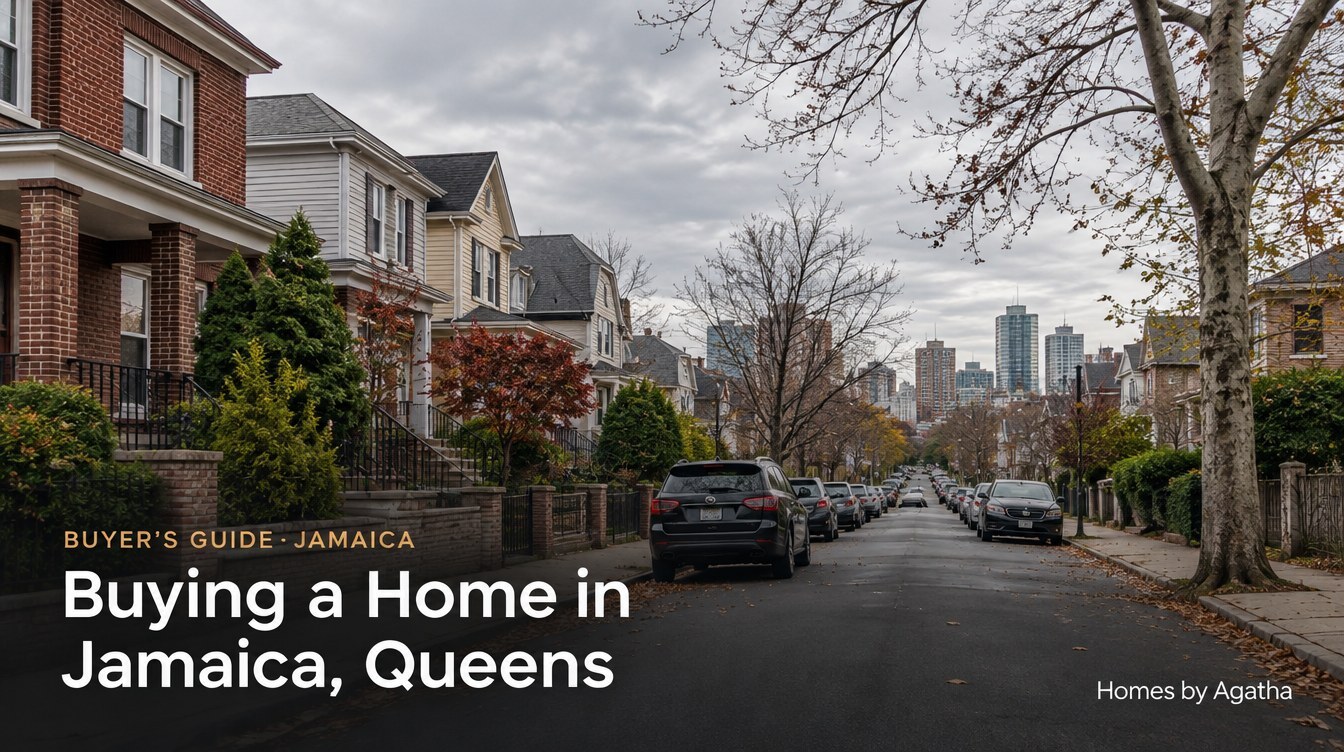
Jamaica is also two housing environments at once. Downtown, near Jamaica Avenue, Archer Avenue and Sutphin Boulevard, you find government buildings, retail streets and newer mid-rise and high-rise apartment buildings. A few blocks away, the streets turn residential, with detached frame houses, semi-attached and attached brick houses, and two-family and three-family homes.
As a Licensed Associate Real Estate Broker serving Queens, I help buyers evaluate both the property and the transaction, in English or Polish, whichever is more comfortable. Below you will find how Jamaica’s housing stock is organized, how each station affects the search, what the 2007 and 2025 rezonings mean for a buyer, how to verify legal units, why Southeast Queens groundwater deserves its own inspection question, and a checklist from pre-approval to closing. When you are ready to tour, the page on how to buy your home in Jamaica with a local buyer’s agent explains how we would work together.
Jamaica at a glance
| Topic | What to know |
|---|---|
| Area | Southeast-central Queens; generally bordered by Jamaica Estates and Jamaica Hills to the north, Hollis and St. Albans to the east, South Jamaica toward the south, and Briarwood, Richmond Hill and South Ozone Park toward the west (neighborhood edges are informal) |
| Borough / County | Queens (Queens County), New York City; Queens Community Boards 8 and 12 cover parts of the area |
| ZIP code(s) | Commonly 11432, 11433, 11434, 11435 and 11436, depending on the block; confirm the ZIP code with the USPS and the community district on the NYC Planning map for each specific address |
| Rail | Jamaica station on the Long Island Rail Road, where most LIRR branches meet; trains to Penn Station and Grand Central Madison, and a shuttle to Atlantic Terminal in Brooklyn |
| Airport link | AirTrain JFK, from its Jamaica station above the LIRR platforms |
| Subway | E, J and Z at Sutphin Blvd–Archer Av–JFK Airport and Jamaica Center–Parsons/Archer; E at Jamaica–Van Wyck; F along Hillside Avenue at Sutphin Blvd, Parsons Blvd, 169 St and Jamaica–179 St |
| Buses | A major bus hub around Jamaica Center and the 165th Street area; routes and stops change over time, so check the current MTA bus map, and the NICE map for Nassau County service, for a specific block |
| Parks and landmarks | Rufus King Park and King Manor Museum (150-03 Jamaica Avenue), Jamaica Performing Arts Center (153-10 Jamaica Avenue), Jamaica Center for Arts and Learning (161-04 Jamaica Avenue), Queens civil and Surrogate’s courthouse at 88-11 Sutphin Boulevard |
| Commercial corridors | Jamaica Avenue and the 165th Street pedestrian mall, Sutphin Boulevard, Parsons Boulevard, Archer Avenue, Hillside Avenue, Merrick Boulevard, Guy R. Brewer Boulevard, Liberty Avenue |
| Typical property types | Detached and semi-attached frame houses, attached brick row houses, two- and three-family houses, mixed-use buildings on commercial streets, prewar and postwar apartment buildings (some co-ops), newer rental and condo buildings downtown |
| Key buyer considerations | Distance to the hub, zoning on and around the lot, legal unit count, basement vs. cellar use, groundwater and stormwater exposure, older building systems, condo tax abatements and building financials |
What does buying a home in Jamaica Queens actually involve?
Buying a home in Jamaica Queens usually means deciding first between two very different products: an apartment in a downtown or near-downtown building, or a house with one, two or three units on a residential block. The search, the financing and the due diligence are different for each, so the first decision is the property type, not the address.
Downtown apartment buildings
Downtown Jamaica, the area around Jamaica Avenue, Archer Avenue, Sutphin Boulevard and Parsons Boulevard, has seen a wave of new mid-rise and high-rise construction since the 2007 rezoning described below. A buyer should know one thing before getting excited about the skyline: many of the newer buildings near the station are rental buildings, not condominiums, so their apartments are not for sale. Before you plan around a specific new building, confirm its ownership structure through its offering plan or its filing with the NYS Attorney General. The for-sale apartment inventory therefore tends to be a mix of condo units, older co-op apartments and a limited number of newer condos.
Houses on the residential blocks
Away from the commercial core, Jamaica’s housing is mostly small residential buildings. Many residential blocks are lined with older houses: detached and semi-detached frame houses, often with front porches and narrow side driveways. Other blocks have attached brick houses built in rows, where neighbors share walls and often roof lines.
Two-family and three-family houses are common throughout. A two-family house is a building legally approved for two separate dwelling units, each with its own kitchen and bathroom; a three-family house is approved for three. These properties attract buyers who want to live in one unit and rent another, and investors who rent all of them. Our broader guide to buying a multi-family home in Queens explains owner-occupied rentals across the borough; this article focuses on what is specific to Jamaica.
Mixed-use buildings on the commercial streets
A mixed-use building combines a ground-floor commercial space with apartments above. In Jamaica these line Jamaica Avenue, Hillside Avenue, Merrick Boulevard, Sutphin Boulevard, Liberty Avenue and parts of Guy R. Brewer Boulevard. Mixed-use buildings can qualify for residential mortgages only in certain configurations; many need commercial lending, larger down payments and an appraisal focused on income.
How the property types compare
| Property type in Jamaica | What you own | Monthly costs beyond the mortgage | First thing to verify | Typical financing path |
|---|---|---|---|---|
| One-family house | Land and building (deed) | Property tax, insurance, water/sewer, all repairs | CO or other DOB records show one unit; basement use is legal | Standard residential mortgage |
| Two- or three-family house | Land and building (deed) | Property tax, insurance, water/sewer for the building, repairs for every unit | Legal unit count, existing leases, separate meters | Residential mortgage for 1–4 units; rental income may be partly counted |
| Mixed-use building | Land and building (deed) | Commercial insurance, tax, repairs, possible store vacancy | CO covering both commercial and residential use; store lease terms | Often commercial lending; varies by configuration |
| Condo unit (older or new building) | Unit plus share of common elements (deed) | Common charges plus separately billed property tax | Offering plan, budget, reserves, tax abatement schedule, sponsor-owned units | Residential mortgage; the building must meet lender requirements |
| Co-op apartment | Shares and a proprietary lease | Maintenance (usually includes a share of building tax and underlying mortgage) | Board rules, financials, sublet and financing policies | Share loan; the board sets the minimum down payment |
Because Jamaica sits next to several distinct neighborhoods, it is normal to compare across lines. Buyers who want larger detached houses often also look at homes in Hollis to the east, while buyers focused on apartment buildings near the E and F lines may compare buying in Briarwood to the west. Jamaica Estates, north of Hillside Avenue, is a separate neighborhood with its own housing pattern and should be researched on its own terms.
House, co-op or condo near the hub?
Tell me how you commute, how much space you need and whether rental income is part of the plan, and I will help you narrow Jamaica to the property types that fit.
How does the Jamaica transit hub affect where you should buy?
Distance to the hub is the main location variable in Jamaica: blocks near Jamaica station and the Archer Avenue subway stations offer the fastest access to the Long Island Rail Road, AirTrain JFK and the E, J and Z trains, while blocks farther out trade some walking time for quieter residential streets. The right balance depends on which line you will actually ride and when.
Station by station
| Station | Service | Location | What it means for a buyer |
|---|---|---|---|
| Jamaica (LIRR) | Most LIRR branches; trains to Penn Station and Grand Central Madison; shuttle to Atlantic Terminal, Brooklyn | Sutphin Boulevard and Archer Avenue area | Fastest rail option toward Manhattan and Long Island; frequent trains but fares are higher than the subway; check current LIRR fares, including CityTicket and monthly tickets, on the MTA site |
| AirTrain JFK | Airport people mover to JFK terminals | Concourse above the LIRR platforms | Relevant for airport workers and frequent travelers; brings visitor traffic to the station area |
| Sutphin Blvd–Archer Av–JFK Airport | E and J at all times; Z in rush hours, peak direction | Directly below Jamaica station | Subway-to-LIRR-to-AirTrain transfers in one complex |
| Jamaica Center–Parsons/Archer | E, J and Z (terminal) | Parsons Boulevard and Archer Avenue | Terminal station, so trains start here; close to Jamaica Avenue retail |
| Jamaica–Van Wyck | E | Near the Van Wyck Expressway on the western edge | Serves western blocks toward Briarwood and Richmond Hill |
| Sutphin Blvd, Parsons Blvd, 169 St, Jamaica–179 St | F (Jamaica–179 St is the terminal) | Under Hillside Avenue | Serves the northern side of Jamaica along Hillside Avenue; check current service patterns on the MTA site |
Rail versus subway: two different commutes
The Long Island Rail Road from Jamaica station is usually the faster ride to Midtown Manhattan, and it reaches both Penn Station and Grand Central Madison. The subway is slower but cheaper and runs to more destinations. Since February 2023, most LIRR service between Jamaica and Atlantic Terminal in Brooklyn has run as a shuttle, so Brooklyn commuters typically board at Jamaica rather than on a through train from farther east. If your household has two commuters headed in different directions, test both trips at the hours you would actually travel.
Living close to the hub: the trade-offs
Blocks within a few minutes’ walk of Jamaica station and the Archer Avenue stations save time every day. They also experience more of what a regional hub brings: bus layovers, taxi and ride-share pickups, delivery traffic, construction cranes on development sites, and crowds at rush hour. None of this is a judgment about the neighborhood; it is simply how a major transfer point works. Visit at 8 a.m. on a weekday and again in the evening before deciding how close you want to live.
Driving, parking and the airport
The Van Wyck Expressway runs along Jamaica’s western side and the Grand Central Parkway lies to the north, giving drivers access toward JFK Airport, LaGuardia and the Long Island highways. Jamaica is close to JFK, which matters to airport employees but also means some blocks hear aircraft at certain times; check flight patterns during your visits. On commercial streets, on-street parking is limited, so a legal driveway or garage is a real advantage. Whether a side strip is a legal driveway, a shared easement or just a walkway is a question for the survey, the deed and DOB records, not the listing description.
Parks and landmarks that anchor daily life
Rufus King Park, on Jamaica Avenue around 150th to 153rd Street, surrounds King Manor Museum, the former home of Rufus King, a signer of the U.S. Constitution. Along Jamaica Avenue, the Jamaica Performing Arts Center and the Jamaica Center for Arts and Learning are cultural anchors near the downtown retail stretch. The Queens courthouse at 88-11 Sutphin Boulevard, which houses Queens County Surrogate’s Court, is a daily destination for attorneys and the public. For larger open space, buyers often look at parks in neighboring areas, so check walking distances from each specific address.
Key Takeaways
- Decide the property type first; Jamaica’s apartment inventory and house inventory are bought and financed differently.
- Many new downtown buildings are rentals, so for-sale apartments are a narrower pool than the skyline suggests.
- Jamaica station, AirTrain JFK and the E, J, Z and F stations make distance to the hub the key location variable.
- Visit candidate blocks at rush hour; hub activity feels different at 8 a.m. than on a weekend afternoon.
What do the 2007 and 2025 rezonings mean for a Jamaica buyer?
Jamaica has been rezoned twice in less than twenty years, and both rezonings change what can be built near the transit hub. For a buyer, the practical result is simple: before you buy, check the zoning of your lot and of the lots around it, because a vacant site or a low building next door may be allowed to become something much larger.
The 2007 Jamaica Plan and the Special Downtown Jamaica District
On September 10, 2007, the New York City Council adopted the Jamaica Plan proposed by the NYC Department of City Planning. It created the Special Downtown Jamaica District and rezoned 368 blocks in Queens Community Boards 8 and 12. The plan’s stated goal was mixed-use, transit-oriented development around the hub, replacing zoning that had largely not been updated since 1961. Much of the newer residential construction near Jamaica station followed from that rezoning.
The 2025 Jamaica Neighborhood Plan
On October 29, 2025, the City Council approved the Jamaica Neighborhood Plan, a city-led rezoning of roughly 230 blocks that includes a large Mandatory Inclusionary Housing area, meaning new residential developments in the mapped area must include permanently income-restricted units; the city describes it as the largest Mandatory Inclusionary Housing area to date. The plan aims to allow more housing and commercial space near transit while keeping some industrial areas.
How to read zoning before you make an offer
The NYC Department of City Planning’s free Zoning and Land Use map (ZoLa) shows the zoning district, any special district and recent rezonings for every tax lot. A buyer should look up three things: the zoning of the house or building being purchased, the zoning of adjacent and facing lots, and any open development sites on the block. A commercial or higher-density residential district next to a low-rise house means the street could look different in a few years.
That can cut both ways. New buildings can bring construction noise, shadows and parking pressure; they can also bring new retail and services. What a rezoning does not do is guarantee that any particular house will rise in value. Development potential is only worth something if a developer can actually use it, and that depends on lot size, shape, existing tenants and the economics of building.
Zoning questions to add to your due diligence
- Is the property inside the Special Downtown Jamaica District or the 2025 rezoning area, and what does the district allow on this lot?
- Are there active DOB permits or new-building filings on adjacent lots?
- Does the house conform to current zoning, or is it a legal non-conforming use that could be hard to rebuild after damage? Ask your attorney.
- For a mixed-use purchase, does the zoning allow the current commercial use?
Want to know what could rise next door?
Before you shortlist a Jamaica house, we can review the zoning map, nearby permits and development sites together so there are no surprises after closing.
Co-op, condo or house in Jamaica: which ownership type fits?
A house gives you full control and full responsibility; a condo gives you a deed with shared building costs; a co-op gives you shares and a proprietary lease, with board approval and building-set financing rules. In Jamaica the choice is also a location choice, because apartments cluster near the hub and Hillside Avenue while houses dominate the residential blocks.
Condos, including newer buildings
A condominium unit is real property: you receive a deed, pay monthly common charges to the condo association and pay your own property taxes to the NYC Department of Finance. In newer Jamaica condo buildings, ask three questions. First, does the unit carry a temporary property-tax exemption or abatement, and when does it phase out? Your monthly cost may rise as it ends, so confirm any abatement and its schedule for the specific unit on the NYC Department of Finance property record. Second, how many units does the sponsor still own? Third, does the building’s budget include adequate reserves? The offering plan and its amendments answer most of these.
Co-ops
A cooperative apartment is a share of a corporation that owns the building. Your monthly maintenance usually includes a share of the building’s property taxes and any underlying mortgage. Co-op purchases require a board application package and usually an interview, and each building sets its own rules on minimum down payment, debt-to-income limits, subletting and pets, so get the current rules from the managing agent. Some co-ops are tied to government affordability programs with income limits or resale restrictions; ask whether the building participates in any such program before you plan your budget, and confirm its status with NYC HPD or NYS Homes and Community Renewal.
Houses
A house buyer in Jamaica takes on the roof, boiler, plumbing, sidewalk and any tenants. In return, there are no board approvals and no common charges, and a legal second or third unit can produce rental income. Because many Jamaica houses are older and some have been altered over the decades, the house buyer’s diligence is heavier, as the next sections explain.
| Decision factor | House | Condo | Co-op |
|---|---|---|---|
| Approval needed beyond the lender | None | Usually a right of first refusal waiver | Board application and interview |
| Monthly building costs | None; you pay every repair | Common charges plus your own tax bill | Maintenance, typically including tax and underlying mortgage share |
| Mortgage recording tax | Yes, on the loan | Yes, on the loan | No (share loans are exempt) |
| Rental flexibility | Legal units may be rented | Depends on bylaws | Depends on sublet policy, often restricted |
| Biggest Jamaica-specific question | Legal unit count and groundwater in the basement | Tax abatement phase-out and sponsor units | Program status, financials and board rules |
How do you verify legal units and the Certificate of Occupancy on a Jamaica house?
You verify legal units by checking the Certificate of Occupancy (CO) or other NYC Department of Buildings records for the address and comparing them with what physically exists inside the house. In Jamaica, where many houses are decades old and some have been converted, the listing description is never proof of how many apartments are legal.
What the Certificate of Occupancy shows
A Certificate of Occupancy is the NYC Department of Buildings document that states a building’s legal use and occupancy, including how many dwelling units it may contain and how each floor may be used. If the CO says two families and you count three kitchens, at least one apartment is not legal. CO records can be searched in the DOB’s public systems (BIS and DOB NOW).
Older houses without a CO
The NYC Department of Buildings generally did not require Certificates of Occupancy for buildings constructed before January 1, 1938, unless later alterations changed their use, exits or occupancy. Many early-twentieth-century Jamaica houses fall into that category. For those buildings, the DOB may issue a Letter of No Objection confirming that the existing use is acceptable, as explained on the DOB’s Certificate of Occupancy page. If neither exists, your attorney will review other records, such as the DOF building class and historical DOB filings.
Basement or cellar?
Under New York City building rules, a basement has at least half of its height above curb level, while a cellar has more than half below. A cellar generally cannot be a legal apartment, and a basement can be habitable only if it meets strict rules for ceiling height, light, ventilation and exits. In Southeast Queens this question is sharpened by groundwater, covered in the next section: a below-grade space that floods or seeps is a poor place for anyone to live, whatever the paperwork says. New York has taken steps toward legalizing certain basement apartments, but an existing unpermitted unit is not legal simply because a program exists. Check the current status and eligible areas of any legalization program with NYC HPD and the Department of Buildings, and ask your attorney how it would apply to the specific house.
Records to cross-check
| Record | Where to find it | What it shows | Red flag for a Jamaica buyer |
|---|---|---|---|
| Certificate of Occupancy / Letter of No Objection | NYC Department of Buildings (BIS, DOB NOW) | Legal use and number of units | More kitchens, entrances or meters than legal units |
| DOB permits, complaints and violations | NYC Department of Buildings | Work filed, signed off or done without a permit | Open “work without a permit” violations; permits never closed |
| OATH / ECB penalties | NYC Office of Administrative Trials and Hearings | Penalties tied to building or sanitation violations | Unpaid penalties that must be resolved at closing |
| Tax class and building class | NYC Department of Finance | Class 1 covers most one-to-three-family homes | Building class that does not match the unit count marketed |
| Deeds, mortgages, easements | ACRIS (NYC Department of Finance) | Ownership chain, recorded mortgages, driveway agreements | Unreleased mortgages; recorded easements over a shared driveway |
| Zoning | NYC Department of City Planning (ZoLa) | Zoning district, special district, rezonings | Commercial or high-density district on adjacent lots you did not expect |
Key Takeaways
- The CO or Letter of No Objection, not the listing, defines how many legal units a Jamaica house has.
- Pre-1938 houses may lawfully have no CO; ask which DOB records establish their use.
- A cellar generally cannot be a legal apartment, and an unpermitted basement unit is a liability, not income.
- Add ZoLa to the usual DOB, OATH, Finance and ACRIS checks in Jamaica.
Why should Jamaica buyers ask about groundwater, flooding and sewers?
Jamaica buyers should ask because parts of Southeast Queens have a documented history of high groundwater and stormwater flooding, which can affect basements even on blocks far from any coastline. The answer for each house comes from its own records and inspection, not from the neighborhood’s reputation.
The Southeast Queens groundwater history
Parts of Southeast Queens have a long history of high groundwater, and some property owners have dealt with persistent basement seepage. Which blocks are affected today is a question for the specific house, its records and its inspection; NYC DEP can answer questions about local conditions. In some buildings, sump pumps run frequently to keep below-grade space dry. This is not true of every block, but it is a reason to ask direct questions about every Jamaica basement.
Storm sewers and the city’s Southeast Queens program
Separate from groundwater, heavy rain can overwhelm drainage on streets that lack full storm-sewer coverage. The NYC Department of Environmental Protection runs a long-term, multi-billion-dollar Southeast Queens program to build out storm and sanitary sewers in the area. Construction proceeds project by project, so check the current schedule for a specific block. A block with completed sewer work may perform differently from one still waiting, so ask your attorney or the DEP whether work is planned or finished on the street.
How to check a specific address
- FEMA Flood Insurance Rate Map. Look up the address on the FEMA Flood Map Service Center. Federally regulated lenders generally require flood insurance in a Special Flood Hazard Area.
- NYC Stormwater Flood Maps. These model flooding from intense rainfall, which is the more relevant risk for most inland Jamaica blocks.
- The seller’s Property Condition Disclosure Statement. Sellers of most one-to-four-family homes must deliver it, and it includes questions about flood history and flood insurance.
- The inspection. Ask the inspector to look for efflorescence (white mineral deposits), water lines on walls, recently painted foundation walls, sump pits and the age and discharge point of any pump.
- Insurance quote. Get a flood insurance quote before contract, even outside a mapped flood zone, so you understand the cost of optional coverage. Check FEMA and NYC Stormwater Flood Maps for the specific address; do not assume any block is in or out of a flood zone.
Other inspection priorities in older Jamaica houses
Beyond water, focus on the systems that serve every unit. Ask whether an oil-fired house converted to gas and whether the old oil tank was removed or properly abandoned. Count electric meters against the legal unit count. Have older electrical service evaluated for modern loads. Consider a sewer camera inspection of the line from the house to the street, since the owner is generally responsible for that connection, and a backwater valve can matter on low-lying blocks. For homes built before 1978, federal law requires the seller to disclose known lead-based paint hazards and give you an opportunity to test.
Planning the inspection on a Jamaica house?
Let’s build a due-diligence list for the specific address, covering records, flood maps, the basement and the questions your inspector and attorney should answer.
How much cash do you need when buying a home in Jamaica Queens?
You need the down payment, buyer closing costs that in New York City include the mortgage recording tax, title insurance, attorney and lender fees, plus reserves for the property itself. In Jamaica, add a realistic cushion for basement water management and older systems on a house, or for abatement phase-outs and assessments on a condo.
Taxes a Jamaica buyer may pay at closing
Jamaica is in New York City, so city and state transaction taxes both apply. Under the rates published by the NYC Department of Finance and New York State, the mortgage recording tax on one-to-three-family homes and condos is roughly 1.8% of the loan amount for loans under $500,000 and 1.925% for loans of $500,000 and above. Co-op loans are share loans and are not subject to mortgage recording tax. Four-family and mixed-use buildings can be taxed at different rates, so ask your attorney which mortgage recording tax and transfer-tax rates apply to the specific building.
The New York State “mansion tax” is 1% of the price on residential purchases of $1 million or more and is paid by the buyer; within New York City, the rate is graduated above $2 million. The NYS real estate transfer tax and the NYC Real Property Transfer Tax are customarily paid by the seller, though contract terms can shift costs, so read the draft contract carefully. Confirm current rates with the NYS Department of Taxation and Finance and the NYC Department of Finance before closing.
Upfront and ongoing costs
| Cost | Upfront or ongoing | How it applies in Jamaica |
|---|---|---|
| Contract deposit | Upfront, at contract signing | Commonly held in escrow by the seller’s attorney and credited at closing |
| Mortgage recording tax | Upfront | Based on the loan amount; not charged on co-op share loans |
| Mansion tax | Upfront | Only if the price is $1 million or more |
| Title insurance and searches | Upfront | Municipal searches surface DOB, ECB and other open items |
| Buyer’s attorney and lender fees | Upfront | Multi-unit appraisals may include a rent analysis |
| Property tax | Ongoing | Billed by NYC DOF; check for abatements that phase out on newer condos |
| Common charges or maintenance | Ongoing | Condo and co-op only; review the budget and any assessments |
| Water and sewer | Ongoing | Billed to the building by NYC DEP; owners of rental units often pay for all units |
| Insurance, including flood | Ongoing | Landlord coverage for rented units; flood coverage is separate |
| Basement and systems reserve | Ongoing | Sump pump replacement, waterproofing, boiler, roof and electrical |
For a line-by-line explanation of buyer and seller costs across the borough, read Queens closing costs explained. Ask your attorney and lender for a written estimate for your specific purchase before you sign a contract.
Pre-approval matched to Jamaica’s property types
Pre-approval is a lender’s conditional commitment based on verified income, assets and credit. In Jamaica, a useful pre-approval names the property type. A letter for a one-family house says little about whether you can close on a three-family house, a mixed-use building or a co-op with a strict board. Rental income from a legal second or third unit can often help you qualify, but lenders count only documented or appraised rent from legal units, and usually only a portion of it; ask an NMLS-registered loan originator for the current percentages and reserve requirements of your loan program. Rent from an illegal basement unit is not counted.
For condos, ask your loan originator whether the building meets the lender’s project requirements; newer buildings with many sponsor-owned units or older buildings with litigation can be harder to finance. For co-ops, the board’s own minimum down payment may be stricter than the lender’s. First-time buyers can find the paperwork lenders request in our first-time home buyer guide for Queens.
Key Takeaways
- Jamaica purchases carry NYC and NYS closing taxes; buyers typically pay the mortgage recording tax, and the mansion tax at $1 million or more.
- Co-op share loans are not subject to mortgage recording tax; four-family and mixed-use buildings can carry different rates.
- On newer condos, check whether a tax abatement will phase out and raise your monthly cost.
- A pre-approval should name the property type and state how rental income was treated.
How do offers, contracts and buyer representation work in New York?
In New York, an accepted offer is not a binding contract. After the seller accepts, the buyer’s and seller’s attorneys negotiate and prepare the contract of sale, and the deal becomes binding only when both parties sign and the deposit is delivered. Your buyer’s agent, under a written agreement, guides the search and the offer; your attorney handles the contract.
Why New York buyers inspect before signing
New York is an attorney state for residential sales. Many New York City contracts give the buyer limited rights to cancel for physical condition once signed, so buyers usually complete the inspection, review the CO, violations, zoning and leases, and read the condo or co-op documents before signing. In Jamaica, that window is when groundwater, legal-unit and zoning questions must be answered.
What makes a Jamaica offer strong
Sellers compare more than price: financing type, down payment, proof of funds, appraisal risk, the closing date and flexibility on tenants. A seller of a tenant-occupied two-family house may prefer a buyer who accepts the tenant in place; a seller of a vacant house may value a quick, clean closing. If you need a unit delivered vacant, say so in the offer and let your attorney assess whether it is achievable under New York tenant law. The rules that apply depend on the specific tenancy, including any rent regulation status, which a New York attorney or NYS Homes and Community Renewal can confirm.
Contingencies to discuss with your attorney
A mortgage contingency lets you cancel if your loan is not approved within a set period, on the contract’s terms. Other protections an attorney may negotiate include the seller’s obligation to cure specific violations, to deliver units vacant, to transfer tenant security deposits and to deliver the building in its represented legal status. Each is a negotiation point, not an automatic right.
Buyer representation and compensation in 2026
Under the rules in effect in 2026, following the 2024 NAR settlement, you sign a written buyer agreement with your agent before touring homes. Buyer-agent compensation is negotiable, not set by law and not automatically paid by the seller; the agreement states the amount and how it will be paid. At the first substantive contact, a New York licensee must give you the NYS Disclosure Form for Buyer and Seller, which explains whom the licensee represents. For details, see working with a buyer’s agent in NY.
In Jamaica, a buyer’s agent’s work includes pulling DOB and zoning records before showings, flagging listings whose descriptions do not match those records, coordinating with your attorney and lender, and keeping the timeline moving. I work with buyers in English or Polish; that choice is about communication and comfort, and where you decide to buy is always your choice.
Getting ready to make an offer?
Before you write a number on a Jamaica property, let’s review the records, the financing fit and the terms that matter most to this particular seller.
What is the timeline from pre-approval to closing in Jamaica?
A Jamaica purchase moves through six stages: pre-approval, search and records review, offer, inspection and contract, mortgage and title, and closing. The stages most likely to slow down are records review and title, because older houses, converted units and newer condo buildings all generate documents and questions.
| Stage | What happens | Who leads | Jamaica-specific delay risk |
|---|---|---|---|
| 1. Pre-approval | Lender reviews income, assets and credit | Buyer and loan originator | Approval not matched to multi-unit, mixed-use or co-op property |
| 2. Search and records review | Showings plus CO, DOB, OATH, Finance and ZoLa checks | Buyer and buyer’s agent | Listings advertising more units than the CO allows |
| 3. Offer and acceptance | Price and terms agreed in principle; not yet binding | Buyer’s agent and seller’s agent | Tenant, vacancy and closing-date terms left vague |
| 4. Inspection, attorney review and contract | Inspection, document review, contract negotiation, deposit | Buyer’s attorney and inspector | Basement water, oil tank or violation findings reopening terms |
| 5. Mortgage commitment and title | Appraisal, underwriting, title and municipal searches; board approval for co-ops | Lender, title company, attorneys, board | Appraisal counting fewer legal units; condo project review; board timing |
| 6. Closing | Final walkthrough, funds, deed or stock transfer, recording | Attorneys, lender, title closer | Lease and deposit transfers; possession of vacant units |
Exact timing depends on the lender, the building’s records, any board and both parties’ schedules. A cash purchase of a clean one-family house can move faster; a three-family house with open violations can move slower no matter how motivated everyone is.
What mistakes do Jamaica buyers make, and what belongs on your checklist?
The most expensive mistakes are paying for units that are not legal, ignoring what zoning allows next door, and treating a dry basement on a sunny showing day as proof that it stays dry. Each can be avoided with records and questions before contract.
Mistakes to avoid
- Counting rent from an illegal unit. If the basement apartment is not on the CO, it should not be in your budget or your lender’s.
- Skipping ZoLa. A parking lot or one-story building beside the house may be zoned for much more.
- Judging the basement once. Ask about sump pumps, water history and flood insurance, and read the disclosure carefully.
- Assuming a new condo’s tax bill is permanent. Abatements can phase out.
- Testing only one commute. LIRR, E, F and bus trips from the same block can differ a lot.
- Overlooking neighboring options. If Jamaica’s inventory does not fit, nearby homes in Saint Albans, Hollis and Briarwood offer different mixes of houses and apartments.
Jamaica buyer checklist
- Get a written pre-approval that names the property type (one-family, two- or three-family, mixed-use, condo or co-op).
- Sign a written buyer agreement and review the NYS Disclosure Form for Buyer and Seller.
- Choose your main commute and time it from each shortlisted block.
- Look up the lot and its neighbors on ZoLa and check DOB filings on adjacent lots.
- Pull the CO or Letter of No Objection, DOB and OATH records, tax class and ACRIS documents.
- Count kitchens, entrances and electric meters, and compare them with the legal unit count.
- Check FEMA and NYC Stormwater Flood Maps; ask about sump pumps, water history and DEP sewer work on the street.
- For condos, read the offering plan, budget and tax abatement status; for co-ops, the financials and board rules.
- Hire an inspector; consider a sewer camera inspection and an oil-tank sweep.
- Have your attorney review title, records, leases and building documents before you sign.
- Confirm the mortgage commitment terms, including any rental income treatment.
- At the final walkthrough, check the basement, unit condition, vacancy terms and meter readings.
If you already own a home in the area and are weighing a sale first, the companion guide on how to sell your home in Jamaica explains the seller side of the same market.
Have a Jamaica address in mind?
Send it over, and we can check its building records, zoning and flood maps before you book an inspection or spend a weekend at open houses.
Frequently asked questions about buying a home in Jamaica, Queens
What types of homes can you buy in Jamaica, Queens?
Jamaica, Queens offers detached and semi-attached frame houses, attached brick row houses, two- and three-family houses, and mixed-use buildings on streets such as Jamaica Avenue and Hillside Avenue. Apartment buyers find older co-ops and condos plus some newer condos near the hub, although many new downtown buildings are rentals rather than for sale.
Which trains serve Jamaica, Queens?
Jamaica station on the Long Island Rail Road connects to Penn Station, Grand Central Madison and Atlantic Terminal. AirTrain JFK leaves from the same complex. The E, J and Z stop at Sutphin Blvd–Archer Av–JFK Airport and Jamaica Center–Parsons/Archer, the E at Jamaica–Van Wyck, and the F along Hillside Avenue to Jamaica–179 St.
How do I check zoning before buying a house in Jamaica?
Look up the address on ZoLa, the NYC Department of City Planning zoning map. It shows the zoning district, the Special Downtown Jamaica District and recent rezonings, including the 2025 Jamaica Neighborhood Plan area. Check adjacent lots and DOB permits too, since neighboring sites may be allowed to build larger buildings.
How do I confirm how many legal units a Jamaica house has?
Search the property in NYC Department of Buildings records for its Certificate of Occupancy or, for many pre-1938 houses, a Letter of No Objection. Compare the legal unit count with the kitchens, entrances and electric meters you see. Your attorney should also review DOB violations, permits and the Department of Finance building class.
Do Jamaica homes have basement water problems?
Some do. Parts of Southeast Queens have a history of high groundwater and stormwater flooding, so every Jamaica basement deserves direct questions. Review the seller’s disclosure, ask about sump pumps and water history, check FEMA and NYC Stormwater Flood Maps, and have the inspector look for staining, mineral deposits and fresh paint on foundation walls.
What closing costs does a buyer pay in Jamaica, Queens?
Buyers in Jamaica typically pay the NYC mortgage recording tax on their loan, title insurance, attorney and lender fees, and escrow deposits. The New York State mansion tax of 1% applies at $1 million or more. Co-op share loans are not subject to mortgage recording tax. Confirm current rates with NYC DOF and NYS DTF.
Can rental income from a Jamaica two-family house help me qualify?
Often yes, if the rented unit is legal and its rent can be documented or supported by the appraisal. Lenders usually count only part of the expected rent and apply program-specific rules. Rent from an illegal basement unit is not counted. Ask your NMLS-registered loan originator how rental income affects your pre-approval before you shop.
What should I check before buying a new condo in downtown Jamaica?
Read the offering plan and amendments, the building budget and reserves, and how many units the sponsor still owns. Check the NYC Department of Finance record for any tax abatement and when it phases out, since monthly costs may rise. Ask your lender whether the building meets its condo project requirements.
Is Jamaica the same as Jamaica Estates?
No. Jamaica and Jamaica Estates are separate Queens neighborhoods with different housing patterns. Jamaica includes the downtown transit hub around Jamaica station and surrounding residential blocks, while Jamaica Estates lies to the north across Hillside Avenue. Research listings, records and commute options for each neighborhood separately rather than assuming they are interchangeable.
Do I need a buyer agreement before touring homes in Jamaica?
Yes. Under the rules in effect in 2026, buyers sign a written agreement with their agent before touring. It states the agent’s compensation, which is negotiable, not set by law and not automatically paid by the seller. You should also receive the NYS Disclosure Form for Buyer and Seller at the first substantive contact.
Your next step in Jamaica
Buying a home in Jamaica Queens comes down to a few disciplined decisions. Pick the property type before the address, measure every block by its distance to the line you will actually ride, read the zoning around the lot, and verify legal units and basement conditions before you trust any rent estimate or any dry floor. Budget New York City closing taxes and the building’s real carrying costs. When your criteria are set, the page on how to buy your home in Jamaica, Queens with Agatha explains how we can search, review records and negotiate together.
Start your Jamaica search with a shortlist that fits
One focused conversation about budget, commute and property type can save weeks of showings. English or Polish, whichever you prefer.
This article is for general informational purposes only and reflects conditions that may change. It is not legal, tax, or financial advice, an appraisal, or a guarantee of price or outcome; consult a licensed New York attorney, a CPA, and an NMLS-registered mortgage loan originator as appropriate. A CMA is an opinion of value, not an appraisal. Real estate brokerage services are offered by Agatha Lubas, Licensed Associate Real Estate Broker, NY License #10301213345, Keller Williams Realty Liberty, 96-10 101st Avenue, Ozone Park, NY 11416. The NYS Disclosure Form for Buyer and Seller, the NYS Housing and Anti-Discrimination Disclosure / Fair Housing Notice, and the brokerage’s Standard Operating Procedures are available on request. Equal Housing Opportunity.

Agatha Lubas helps buyers, sellers and investors across Queens, Brooklyn, Nassau County and Suffolk County make decisions grounded in records, numbers and a clear transaction plan. She works in English and Polish so clients can communicate in whichever language they find most comfortable.
Work with Agatha