

LAURELTON REAL ESTATE GUIDE
Buying a House in Laurelton, Queens: Zoning, Stormwater, the LIRR and the City-Line Question
Quick Answer
Buying a house in Laurelton, Queens, usually means buying a detached or attached one- or two-family home in a low-density zoning district adopted in 2008. Before making an offer, confirm the lot’s zoning and legal unit count, review stormwater and basement history, plan around the Laurelton LIRR station or local buses, and budget for New York City closing costs.
This guide is for anyone researching buying a house in Laurelton, the low-rise neighborhood in southeast Queens that runs from Springfield Boulevard east to the Laurelton Parkway, right at the edge of Nassau County. Laurelton is a house market. Most of what you will see for sale is a one- or two-family home on its own lot, so the real work is evaluating land, a building and its paper trail — not preparing a co-op board package.
Below you will learn how the 2008 rezoning shapes each lot, why a Laurelton purchase differs from one a few minutes east in Nassau County, what Southeast Queens stormwater history means for your inspection, how commuters use the Laurelton LIRR station, and how the New York contract process works.
As a Licensed Associate Real Estate Broker based in Queens, I help buyers evaluate both the property and the transaction, in English and Polish. Language is about communication and comfort; where you decide to buy is always your choice. If Laurelton is already on your list, my Laurelton home buyer services page explains how I work with buyers in this neighborhood.
Laurelton at a glance
| Item | Laurelton, Queens |
|---|---|
| Area | Southeast Queens, New York City; Queens Community District 13 |
| Borough / County | Queens / Queens County — New York City taxes, records and rules apply |
| ZIP code | 11413 for most addresses; confirm the ZIP code for each address with USPS |
| General boundaries (NYC Department of City Planning 2008 rezoning area) | Montefiore Cemetery and 121st Avenue (north); Laurelton Parkway (east); South Conduit Avenue and the Belt Parkway (south); Springfield Boulevard (west) |
| Rail | LIRR Laurelton station (Far Rockaway Branch), near 225th Street and 141st Road, accessible by elevator; Locust Manor and Rosedale stations nearby. No subway station. |
| Buses | MTA local buses along Merrick Boulevard and other corridors toward downtown Jamaica, plus express bus service in parts of southeast Queens; check the current MTA bus map for routes and stops after the 2025 Queens Bus Network Redesign |
| Highways | Belt Parkway and Conduit Avenue on the south; Laurelton Parkway (part of the Belt Parkway system, connecting to the Cross Island Parkway) on the east |
| Parks / landmarks | Montbellier Park (Springfield Boulevard at 139th Avenue, Springfield Gardens side); Montefiore Cemetery on the northern edge |
| Commercial corridors | Merrick Boulevard (main corridor) and Springfield Boulevard, including R5D mixed-use frontage mapped in 2008 |
| Typical property types | Detached one- and two-family houses, many in Tudor and Colonial styles; semi-detached and attached houses on some blocks; small apartment and mixed-use buildings on the boulevards; limited co-op and condo inventory |
| Key housing considerations | 2008 contextual zoning; legal unit count; stormwater and basement history; older heating systems; the NYC–Nassau County line |
What kinds of houses will you see when buying a house in Laurelton?
Mostly one- and two-family houses. When the NYC Department of City Planning (DCP) prepared its 2008 rezoning of Laurelton, it described the neighborhood as characterized by one- and two-family detached housing, with apartment and mixed-use buildings concentrated along Merrick and Springfield Boulevards.
So the typical Laurelton purchase is a fee-simple house: you own land and building, pay taxes and insurance directly, and face no board. The city also chose to keep most blocks at this scale, which limits what you can add later.
Detached Tudor- and Colonial-style houses
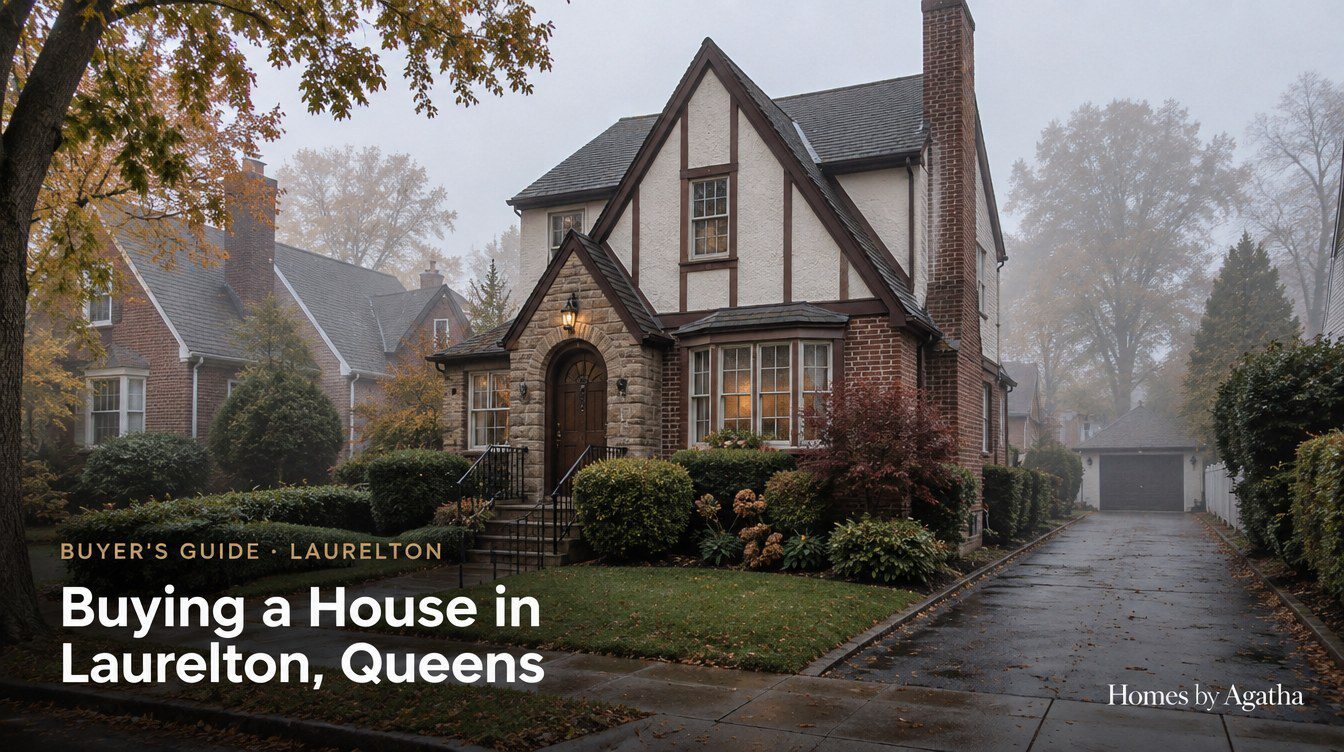
On many Laurelton blocks you will see detached brick-and-stucco houses with steep front gables, half-timber accents and arched doorways, alongside Colonial-style houses with symmetrical fronts and Cape Cods with dormers. Year of construction varies from block to block, and the NYC Department of Finance property record lists it for each house, so check it rather than relying on the style.
A detached Laurelton house often has a side driveway leading to a rear garage. Ask whether the driveway is entirely on this lot, whether the garage is sound, and whether any garage conversion had permits. The survey and Department of Buildings records answer those questions; the listing usually does not.
Semi-detached and attached houses
Some Laurelton blocks have semi-detached houses (two houses sharing one wall) and groups of attached houses; the lot’s zoning district and the survey show which form a particular house takes. Shared walls bring shared elements — a party wall, a joined roof line and sometimes a common driveway — so ask your attorney to confirm a recorded easement for any shared driveway or rear access.
Two-family houses and the basement question
Some Laurelton houses are legal two-family homes; others are one-family houses with a finished basement or second kitchen described as a unit. The legal unit count comes from the Certificate of Occupancy (CO) or, for older houses without one, Department of Buildings records — not from current use. If rental income is part of your plan, read the guide to buying a multi-family home in Queens before you make an offer.
Apartments and mixed-use buildings on the boulevards
Along parts of Merrick and Springfield Boulevards, the 2008 rezoning mapped R5D, which permits apartment buildings of about three or four stories, often with ground-floor stores. Co-op and condo units are a small share of what trades in Laurelton; ask your agent for a current OneKey MLS search if an apartment is what you want. The table below compares what you actually buy with each Laurelton property type.
| Laurelton property type | What you own | Who maintains what | What to verify first |
|---|---|---|---|
| Detached one-family house | Land and building (fee simple) | You maintain everything, including the sewer line to the street and the sidewalk | Zoning district, survey, garage and driveway, roof and heating age |
| Semi-detached or attached house | Land and building, with a shared wall | You maintain your side; shared elements depend on easements and neighbor cooperation | Party-wall condition, recorded driveway easement, roof joint |
| Two-family house | Land and building with two legal units | You are also a landlord for the second unit | CO or DOB records confirming two units; existing leases; separate meters |
| Condo unit on a boulevard | Your unit plus a share of common elements | The condo association maintains common elements; you pay common charges | Bylaws, budget, reserve fund, rental rules |
| Co-op apartment | Shares in a corporation plus a proprietary lease | The co-op maintains building systems; you pay monthly maintenance | Board package requirements, financing rules, maintenance history; each building sets its own board, financing and down-payment rules |
Which zoning district is a Laurelton lot in, and why does it matter?
Every residential lot in Laurelton sits in one of several low-density districts adopted by the New York City Council on September 4, 2008: R2, R2A, R3A, R3X, R3-1 or R4B, with R5D along parts of Merrick and Springfield Boulevards. The district controls whether a house may be detached, semi-detached or attached, whether a second unit is allowed, and how much floor area you can add.
The rezoning came from the neighborhood: residents approached DCP in 2002 because the 1961 zoning allowed attached, semi-detached and multifamily buildings out of character with existing houses. DCP proposed lower-density, contextual districts for more than 200 blocks. “Contextual” means height, setback and yard rules are tied to the houses already on the block.
| District mapped in Laurelton (2008) | What it generally allows | The buyer’s question |
|---|---|---|
| R2 | One-family detached houses only | Is anyone marketing a “second unit” that the district does not permit? |
| R2A | One-family detached houses, with floor-area rules that limit oversized additions and attic build-outs | Does a planned dormer or extension fit the remaining floor area? |
| R3A | One- and two-family detached houses on relatively narrow lots | Does the CO match the unit count the seller describes? |
| R3X | One- and two-family detached houses with larger lot-width and side-yard requirements | Do side yards and driveway placement meet the rules if you expand? |
| R3-1 | One- and two-family detached and semi-detached houses | For a semi-detached house, are shared-wall and yard conditions documented? |
| R4B | Low-rise one- and two-family houses, including attached houses | How do parking, rear-yard depth and the shared roof line work? |
| R5D (parts of Merrick and Springfield Boulevards) | All residential building types up to a maximum floor area ratio of 2.0 and a maximum height of 40 feet, with commercial overlays on corridor frontage | Is a ground-floor store or office legal and shown on the CO? |
These are general descriptions. Zoning text has changed since 2008, including the City of Yes for Housing Opportunity amendments of December 2024, which created accessory-unit rules for many low-density districts, with limits in some flood-prone areas. An architect or land-use attorney can confirm how the current rules apply to a specific lot. Before you assign value to any expansion idea, look up the lot on ZoLa, the NYC Department of City Planning zoning map.
Zoning also affects value: an appraiser treats a detached house on a wide R2 or R3X lot differently from an attached R4B house a few blocks away, so compare asking prices within the same zoning and building category.
Key Takeaways
- Most Laurelton purchases are fee-simple houses with no board approval, so the buyer carries every repair.
- The 2008 rezoning placed each lot in R2, R2A, R3A, R3X, R3-1, R4B or, on the boulevards, R5D.
- R2 and R2A lots permit one-family detached houses only; a “second unit” there needs serious scrutiny.
- Compare prices within the same zoning district and house type, not across the whole neighborhood.
Not sure what a listing legally is?
Send me the Laurelton addresses you are watching, and I will help you sort zoning and legal-use questions before you pay for inspections.
Is buying a house in Laurelton different from buying across the Nassau County line?
Yes. Laurelton is inside New York City, so NYC property tax rules, NYC mortgage recording tax rates, the NYC Real Property Transfer Tax and NYC Department of Buildings records apply. A similar-looking house a few minutes east in Valley Stream or Elmont is in Nassau County, where taxes, records and transfer costs follow different rules.
| Factor | Laurelton (Queens, New York City) | Nearby Nassau County communities (for example, Valley Stream or Elmont) |
|---|---|---|
| Property tax assessment | NYC Department of Finance; one- to three-family houses are generally in tax Class 1 | Nassau County Department of Assessment; several separate taxing jurisdictions levy on the same property, so review the actual tax bills for the address |
| Mortgage recording tax (buyer, financed purchase) | Roughly 1.8% of the loan for loans under $500,000 and 1.925% for $500,000 and above on 1–3 family homes | 1.05% in total in Nassau County; on homes with up to six units the lender pays 0.25% of it (the special additional tax), so the borrower’s share is roughly 0.8% |
| Transfer taxes (customarily seller) | NYS transfer tax of $2 per $500 (0.4%) plus the NYC Real Property Transfer Tax of 1% up to $500,000 and 1.425% above | NYS transfer tax of 0.4%; no NYC Real Property Transfer Tax |
| “Mansion tax” (buyer) | 1% at $1 million or more, graduated above $2 million in New York City | 1% at $1 million or more |
| Building records and CO | NYC Department of Buildings | Town of Hempstead or the incorporated village’s building department, depending on the address; ask your attorney which municipal searches apply |
| Water and sewer billing | NYC Department of Environmental Protection | Local water district, village or private water company, depending on the address; confirm the provider for the specific property |
| LIRR | Laurelton station (Far Rockaway Branch), in a New York City fare zone where CityTicket can be used for trips to Zone 1 stations such as Penn Station and Atlantic Terminal | Nassau stations such as Valley Stream, in a different fare zone; check current fares on the MTA website |
Confirm current rates with the NYS Department of Taxation and Finance and NYC Department of Finance before closing.
Compare by building one monthly number for each house — mortgage, property tax, insurance, water and sewer, heating and commuting — then add one-time closing costs, which differ mainly through the mortgage recording tax. If you are weighing both sides of the line seriously, my overview of buying a home in Nassau County covers the Long Island side of the decision.
What does it cost to close on a Laurelton house, and what will you pay each month?
Plan for three layers: the down payment, buyer closing costs at the closing table, and reserves you keep afterward. On a financed Laurelton house, the largest buyer-side closing items are usually the NYC mortgage recording tax, title insurance, attorney fees and lender charges.
| Buyer cost | When it applies to a Laurelton purchase | How to estimate it early |
|---|---|---|
| NYC mortgage recording tax | Any mortgage on a 1–3 family house or condo: roughly 1.8% of the loan under $500,000 and 1.925% at $500,000 and above (NYC Department of Finance / New York State) | Multiply your planned loan amount by the applicable rate; co-op share loans are not subject to it |
| NYS “mansion tax” | Purchases of $1 million or more: 1% of the price, paid by the buyer, graduated above $2 million in New York City (NYS Department of Taxation and Finance) | Check whether your price crosses the $1 million threshold |
| Title insurance, attorney | Every fee-simple purchase | Written quotes from your attorney before offering |
| Lender fees and escrow reserves | Financed purchases; tax, insurance and any flood-insurance reserves | Your lender’s Loan Estimate |
| Inspections | Home inspection, sewer camera, oil-tank sweep, roof or masonry specialist | Collect quotes before your offer is accepted |
Confirm current rates with the NYS Department of Taxation and Finance and NYC Department of Finance before closing.
Two taxes are customarily the seller’s: the NYS real estate transfer tax and the NYC Real Property Transfer Tax. A contract can shift costs, so confirm with your attorney. For a line-by-line breakdown, see the Queens closing costs guide.
The monthly bills of a Laurelton homeowner
A house has no common charges, so the monthly budget is a set of separate bills: mortgage, NYC property taxes (Department of Finance), homeowner’s insurance, water and sewer (NYC Department of Environmental Protection), heating, electricity, a maintenance reserve and, where required or chosen, flood insurance.
Two owner responsibilities surprise new New York City homeowners: the sewer line from the house to the street belongs to the owner, and owners are generally responsible for the sidewalk in front of their lot. Mature street trees on older Laurelton blocks can lift sidewalk slabs, so walk the sidewalk as carefully as the house. NYC Parks’ Trees and Sidewalks program can repair severe sidewalk damage from street-tree roots next to owner-occupied one- to three-family homes after an inspection, so ask the seller whether a request has been filed.
Put real numbers on both sides of the line
I can lay out closing and monthly costs for a Laurelton house next to a comparable Nassau option.
How should you approach pre-approval and financing for a Laurelton home?
Get a written pre-approval from an NMLS-registered mortgage loan originator before you tour seriously. A pre-approval is a lender’s conditional commitment after reviewing income, assets and credit; a pre-qualification is only an estimate. Laurelton sellers weigh financing strength alongside price.
The appraisal and Laurelton’s mix of house types
Appraisers compare a house with recent sales of similar houses. With detached, semi-detached and attached houses spread across seven zoning districts, a good Laurelton comparable matches building type, lot size, unit count and condition — not just the street. If you offer above what similar sales support, a low appraisal may leave a gap to cover with cash or renegotiation.
Two-family income and legal units
Lenders generally count projected rent only from a legal unit. A basement apartment missing from the CO or DOB records usually will not help you qualify. Ask your loan officer how they treat two-family purchases and existing leases.
Condition, flood insurance and the deposit
Some loan programs set property-condition standards, so a failing roof or hazardous heating system can trigger repairs before closing. In a FEMA Special Flood Hazard Area the lender will usually require flood insurance, and the premium counts in your debt-to-income ratio, so get a quote early.
At contract signing, the buyer typically pays a negotiable deposit, often around 10% of the price, held in escrow by the seller’s attorney until closing. Keep it liquid and documented. First-time buyers can review the full sequence in the first-time home buyer guide for Queens.
How do you commute from Laurelton by LIRR, bus or car?
Laurelton has its own Long Island Rail Road station on the Far Rockaway Branch, but no subway station. Local buses connect to downtown Jamaica for the E, J and Z lines, and drivers use the Belt, Laurelton and Cross Island Parkways.
The station sits near 225th Street and 141st Road. The MTA’s announcement of the upgraded Laurelton station describes a renovation that added an elevator and a new street-access tunnel. Trains run through Jamaica, but direct service and transfers vary by hour, so check the current Far Rockaway Branch timetable for the terminal you need and whether a change at Jamaica is required at your travel times. Locust Manor to the west and Rosedale to the south are on the same branch and may be closer for some blocks, so map the walk from each address to all three.
| Commute option | How it works from Laurelton | What to test before you buy |
|---|---|---|
| LIRR from Laurelton station | Walk, bike or get dropped off near 225th Street and 141st Road; Far Rockaway Branch trains via Jamaica | Walk time from the specific house; peak frequency; whether your train runs direct or needs a change |
| Bus to the subway in Jamaica | Local buses on Merrick Boulevard and other corridors to downtown Jamaica, then the E, J or Z | Walk to the nearest stop; rush-hour ride time to Jamaica |
| Express bus to Manhattan | MTA express buses serve parts of southeast Queens; check the current MTA bus map for express stops near the address | Nearest express stop; morning and evening schedule |
| Car | Belt Parkway and Conduit Avenue to the south; Laurelton Parkway on the east, connecting to the Cross Island Parkway; John F. Kennedy International Airport about two miles to the south | Driveway or garage; peak-hour drive time; parking near Merrick Boulevard |
Location inside Laurelton changes the routine: a house near the station is rail-first, while one near 121st Avenue may be closer to bus corridors. With John F. Kennedy International Airport about two miles south, also listen for aircraft noise at different hours. Ride your real commute once, at your travel hour, before making an offer.
To compare transit trade-offs nearby, see the guides to buying in Cambria Heights, just north of Montefiore Cemetery, and buying in Springfield Gardens, across Springfield Boulevard to the west. Buyers who want to be closer to the Jamaica hub can also look at buying in Saint Albans.
Key Takeaways
- Laurelton has an accessible LIRR station on the Far Rockaway Branch but no subway station.
- Locust Manor and Rosedale stations are alternatives for blocks at the western and southern edges.
- Buses link Laurelton to the E, J and Z subway lines in downtown Jamaica.
- Drivers have direct access to the Belt, Laurelton and Cross Island Parkways; test peak-hour times.
Match the block to your daily route
Tell me where you travel each day, and I will help you focus on the Laurelton blocks that fit that routine.
Does stormwater affect Laurelton houses, and how do you check flood risk?
For most Laurelton buyers, the water question is stormwater and basement water, not coastal flooding. Parts of southeast Queens have long dealt with street ponding and wet basements, and the City has been adding storm sewers and catch basins in Laurelton through its Southeast Queens drainage program. Check each address on flood maps and inspect the basement closely.
Why southeast Queens has a drainage history
According to the NYC Department of Environmental Protection, post-World War II development in southeast Queens outpaced the extension of the City’s sewer system. DEP and the NYC Department of Design and Construction have run projects in Laurelton that added catch basins, sewer lines and water mains, including a DEP-funded project that added 142 catch basins and nearly four miles of new sewer lines. Work has reached different blocks at different times, so ask the seller and check DDC project information for the specific block. New pipes on a block are useful context, but they do not tell you how a particular basement has behaved.
How to check a specific address
- FEMA flood maps. Look up the address on the FEMA Flood Map Service Center; in a Special Flood Hazard Area, lenders usually require flood insurance.
- NYC flood tools. The NYC Stormwater Flood Maps, released by the City with the Department of Environmental Protection, show where heavy rainfall is likely to cause flooding, block by block, under several rainfall scenarios.
- The seller’s disclosure. Since March 20, 2024, sellers of most one- to four-family houses must deliver the Property Condition Disclosure Statement, which includes flood-related questions, such as whether the property is in a FEMA floodplain, whether flood insurance is required and the property’s flood-insurance claims history.
- Insurance history. Ask about past water or flood claims.
What to look for in the basement
Look for white mineral deposits (efflorescence), a sump pump, fresh paint low on the walls, warped flooring and a musty odor. Ask whether the house has a backwater valve, a sewer-line device that helps stop sewage backing up into the basement in heavy storms. Outside, check that the ground and downspouts send water away from the foundation. A basement that takes on water is also a poor candidate for living space.
What should an inspection cover in an older Laurelton house?
In older Laurelton houses, the findings that most often change a deal involve heating and oil tanks, electrical service, the sewer line, Tudor-style roofs and stucco, and basement water.
Heating systems and oil tanks
Many older Queens houses were built with oil heat. If the house still burns oil, ask for the tank’s location, age and test records; if it converted to gas, ask whether the old tank was removed or abandoned in place, with paperwork. A tank sweep costs little compared with remediating a leaking buried tank after closing.
Electrical service, sewer line and roofs
Original wiring may be undersized for central air or vehicle charging; upgrades need a licensed electrician and a permit. A sewer camera shows roots, cracks or sags in older lines to the street. On Tudor-style houses, steep roofs, specialty shingles, stucco and half-timbering need specialist repair, and chimneys deserve their own check. Rear garages and driveways are often older than the house’s recent renovations.
Lead paint and asbestos
Federal law requires sellers of most housing built before 1978 to disclose known lead-based paint hazards and give buyers a chance to test, so expect it to apply to most Laurelton houses. Ask the inspector to flag possible asbestos, such as old pipe insulation or floor tiles.
How do you confirm the Certificate of Occupancy and legal units on a Laurelton house?
Confirm legal use through NYC Department of Buildings (DOB) records before you sign the contract. The Certificate of Occupancy states a building’s legal use and number of units; your attorney should match the CO, or the DOB records that substitute for it, to how the house is actually used.
New York City buildings constructed before 1938 were not required to have a CO unless later work required one, so an older Laurelton house may rely on a later CO, a DOB letter or filed plans. Cross-check the NYC Department of Finance building class: classes beginning with “A” describe one-family dwellings and “B” two-family dwellings. A “two-family” classed as a one-family is a signal to dig deeper.
Also search DOB records for open permits and violations. Unpermitted basements, attics, enclosed porches and garage conversions are common findings; unresolved, they can delay closing or pass to you, so your attorney may seek a fix, credit or escrow.
| Due-diligence item | Where to check | Why it matters in Laurelton |
|---|---|---|
| Zoning district | NYC DCP ZoLa | Seven districts mapped in 2008; R2 and R2A permit one-family detached houses only |
| Certificate of Occupancy and legal units | NYC Department of Buildings records | Confirms whether a “two-family” is legal; affects financing, insurance and rental plans |
| DOF building class | NYC Department of Finance property records | A quick cross-check of one-family (“A”) versus two-family (“B”) status |
| Open permits and violations | DOB and OATH/ECB records, through your attorney | Unpermitted basements, attics, porches and garage conversions are common in older houses |
| Flood and stormwater | FEMA Flood Map Service Center; NYC flood maps; seller’s PCDS | Determines lender flood-insurance requirements and basement risk |
| Oil tank, sewer line, backwater valve | Tank sweep; sewer camera; plumber | Buried tanks are costly; the owner is responsible for the sewer line to the street |
| Survey, easements and driveways | Survey and title report | Shared driveways and party walls on semi-detached and attached blocks |
Line up your due-diligence window
I can help you sequence inspectors, records searches and attorney questions so nothing is checked too late.
How do offers, attorney review and buyer representation work in New York?
New York is an attorney state for residential sales: after a seller accepts your offer, the buyer’s and seller’s attorneys negotiate and prepare the contract of sale, and nothing is binding until both sides sign. An accepted offer is not a signed contract, so either party can still walk away until the contract is fully executed.
From accepted offer to signed contract
After acceptance, the seller’s attorney sends a draft contract to your attorney, who reviews title and DOB records and negotiates riders — a mortgage contingency, what happens if a violation turns up, or how a tenant in a two-family house is handled. Your inspection usually happens in this window, because after you sign and deliver the deposit, you can cancel only as the contract allows.
Writing a clear offer on a Laurelton house
Sellers compare price, financing type, down payment, pre-approval strength, contingencies and closing date. On an older Laurelton house, proposing a credit for inspection findings rather than a long repair list can be easier to accept. Base the price on sales of genuinely similar houses: same building type, lot, legal unit count and condition.
Buyer-agent agreements after the 2024 settlement
Under the rules in effect in 2026 following the 2024 NAR settlement, you sign a written buyer agreement before touring homes with an agent, and it states how the agent is compensated. Buyer-agent compensation is negotiable, is not set by law and is not automatically paid by the seller; a seller may agree to contribute as part of the negotiation.
At your first substantive contact with an agent you also receive the NYS Disclosure Form for Buyer and Seller, which explains whom the agent represents. For more detail, read about working with a buyer’s agent in New York.
Have your offer terms ready before the right house appears
We can work out price logic, financing terms and inspection strategy for an older Laurelton house now, so you can act calmly when it counts.
What is the timeline, and which mistakes should Laurelton buyers avoid?
A financed Laurelton house purchase commonly takes about two to three months from accepted offer to closing. Most avoidable delays come from paperwork — open permits, violations or unit-count questions — rather than the house itself.
| Stage | What happens on a Laurelton purchase | Common range (varies) |
|---|---|---|
| Preparation | Pre-approval, written buyer agreement, budget, NYC-versus-Nassau comparison, commute test | 1–4 weeks |
| Search and offer | Tours, zoning look-ups on ZoLa, comparable-sales review, offer accepted | Varies with inventory and criteria |
| Due diligence and contract | Inspection, sewer camera, tank sweep, flood check, DOB and title review, contract signed with deposit | Often 1–3 weeks |
| Mortgage commitment | Appraisal, underwriting, flood determination, conditions cleared | Often 3–6 weeks after contract |
| Clear to close | Title cleared, homeowner’s (and any flood) insurance bound, closing scheduled | Often 1–2 weeks |
| Walk-through and closing | Confirm condition and agreed credits; sign; pay closing costs; receive keys | Closing day |
Mistakes to avoid
- Pricing a basement unit as income. Valuing an apartment that is not on the CO, especially in an R2 or R2A district where a second unit is not permitted.
- Comparing across the city line by price alone. Ignoring differences in mortgage recording tax, annual taxes and LIRR fares between Laurelton and Nassau County.
- Skipping the basement history. Not asking about water entry, flood claims and a backwater valve in a part of Queens with a known drainage history.
- Assuming you can expand. Planning a dormer, extension or extra unit without checking the lot’s zoning district.
- Testing the commute on a weekend. Rush-hour train and bus patterns differ from off-peak trips.
Laurelton buyer checklist
- Get a written pre-approval covering two-family income, older-home condition and flood insurance.
- Sign a written buyer agreement and review the NYS Disclosure Form for Buyer and Seller.
- Decide which house type you want — detached, semi-detached or attached — and whether a legal two-family is essential.
- If you are also looking in Nassau County, build one all-in monthly and closing-cost comparison for each candidate.
- Test your commute from the specific blocks you like, by LIRR, bus or car, at your real travel hour.
- Look up each serious property’s zoning district on ZoLa and its building class with the Department of Finance.
- Once your offer is accepted, engage your attorney and book the inspection, sewer camera and tank sweep.
- Check flood maps, read the PCDS and ask about past water entry and claims.
- Have your attorney review the CO or DOB records, permits, violations, survey and title.
- Sign the contract and deliver the deposit only after due diligence is complete.
- Do a final walk-through and close with a repair reserve still in the bank.
If you already own a home in the neighborhood and need to sell before you buy, the companion page on how I help owners sell a home in Laurelton explains the selling side of the move.
Ready to turn research into a Laurelton search plan?
One conversation can turn your budget, house type and commute into a focused plan for this neighborhood.
Frequently asked questions about buying a house in Laurelton
What types of houses are common in Laurelton, Queens?
Laurelton is mainly one- and two-family houses. The NYC Department of City Planning described the neighborhood in its 2008 rezoning as characterized by one- and two-family detached housing. Tudor-style, Colonial-style and Cape Cod houses are common, with semi-detached and attached houses on some blocks and small apartment buildings along Merrick and Springfield Boulevards.
Which LIRR branch serves the Laurelton station?
The Laurelton station is on the Long Island Rail Road’s Far Rockaway Branch, near 225th Street and 141st Road. The MTA renovated it and added an elevator for accessibility. Trains run through Jamaica, but direct service and transfers vary by hour, so check the current Far Rockaway Branch timetable for your trip.
What zoning districts apply in Laurelton?
The City Council adopted the Laurelton rezoning on September 4, 2008. Residential blocks were mapped R2, R2A, R3A, R3X, R3-1 or R4B, which keep houses low in scale, and parts of Merrick and Springfield Boulevards were mapped R5D. Confirm each lot’s district and current rules on NYC Planning’s ZoLa map.
Is Laurelton in a flood zone?
Flood status depends on the exact address, so check each property on the FEMA Flood Map Service Center and NYC’s flood maps. For most Laurelton houses, stormwater and basement water are the bigger questions. Ask about past water entry, insurance claims and a backwater valve, and read the seller’s Property Condition Disclosure Statement.
What closing costs does a buyer pay on a Laurelton house?
Buyers usually pay the NYC mortgage recording tax on financed purchases, title insurance, attorney fees, lender fees and escrow deposits for taxes and insurance. Purchases of $1 million or more also carry the NYS mansion tax paid by the buyer. The NYS transfer tax and NYC Real Property Transfer Tax are customarily the seller’s.
How is buying in Laurelton different from buying in Valley Stream or Elmont?
Laurelton is in New York City, so NYC property taxes, NYC mortgage recording tax rates, the NYC Real Property Transfer Tax and Department of Buildings records apply. Valley Stream and Elmont are in Nassau County, with county assessment, town or village building records, a different mortgage recording tax rate and no NYC transfer tax.
How can I tell if a Laurelton two-family house is legal?
Check the Certificate of Occupancy and NYC Department of Buildings records, and cross-check the Department of Finance building class, where “B” classes describe two-family dwellings. Houses built before 1938 may lack a CO, so your attorney may review other DOB records. Lenders generally count rental income only from legal units.
Who pays the buyer’s agent when buying in Laurelton?
Buyer-agent compensation is negotiable and not set by law. Under the rules in effect in 2026, you sign a written buyer agreement before touring that states how your agent is paid. A seller is not automatically required to cover it, although a seller may agree to contribute as part of the negotiated deal.
Can I add an apartment to a Laurelton house?
It depends on the lot’s zoning district and the building code. R2 and R2A districts permit one-family detached houses, and City of Yes rules adopted in December 2024 changed accessory-unit options in some areas, with limits in flood-prone locations. Have an architect review the specific lot before paying for expansion potential.
How long does it take to buy a house in Laurelton?
A financed Laurelton house purchase often takes about two to three months from accepted offer to closing. The contract stage usually takes one to three weeks, and the mortgage commitment often follows three to six weeks later. Open permits, violations or unit-count questions in older houses are the most common causes of delay.
Summary and your next step
Buying a house in Laurelton is a lot-by-lot decision. The zoning district on your lot determines what the house legally is and what it can become; the CO confirms the unit count; the basement and sewer line show how the house handles stormwater; and the city line to the east changes taxes, records and closing costs. Settle those four questions early and match the block to a realistic commute. When you are ready to move from research to touring, the Laurelton buyer representation page explains how we can work together on your search.
This article is for general informational purposes only and reflects conditions that may change. It is not legal, tax, or financial advice, an appraisal, or a guarantee of price or outcome; consult a licensed New York attorney, a CPA, and an NMLS-registered mortgage loan originator as appropriate. A CMA is an opinion of value, not an appraisal. Real estate brokerage services are offered by Agatha Lubas, Licensed Associate Real Estate Broker, NY License #10301213345, Keller Williams Realty Liberty, 96-10 101st Avenue, Ozone Park, NY 11416. The NYS Disclosure Form for Buyer and Seller, the NYS Housing and Anti-Discrimination Disclosure / Fair Housing Notice, and the brokerage’s Standard Operating Procedures are available on request. Equal Housing Opportunity.

Agatha Lubas helps buyers, sellers and investors across Queens, Brooklyn, Nassau County and Suffolk County, from first research through the New York attorney-based closing process. She works in English and Polish so each client can communicate in the language that feels most comfortable.
Work with Agatha