
NASSAU COUNTY REAL ESTATE GUIDE
Buying a House in Nassau County, Long Island: What to Check Before You Commit
Quick Answer
Buying a house in Nassau County, Long Island, means checking local layers New York City buyers rarely face: which town, city or village governs the address, what the full county, town, school and special-district tax bill is, whether permits and the Certificate of Occupancy match the house, sewer versus cesspool, flood zone and the nearest LIRR branch.
This guide is for people seriously considering buying a house in Nassau County: renters ready to own, homeowners moving east from Queens or Brooklyn, and buyers comparing Long Island with the city. Nassau County sits directly east of Queens, and its streets can look like a continuation of eastern Queens. The rules behind them are different.
Inside New York City, one government taxes the house, one Department of Buildings holds its records and one zoning resolution applies. In Nassau County, each of those answers depends on the town, city or incorporated village the house sits in, plus the special districts on its tax bill. That layered structure is the biggest adjustment for buyers coming from the city.
As a Licensed Associate Real Estate Broker serving Queens, Brooklyn, Nassau County and Suffolk County, I help buyers evaluate both the property and the transaction process, in English and Polish. Below you will find how the county is organized, how the tax bill and closing costs work, how to plan financing and commuting, and what to check before signing. None of it replaces your attorney, lender or inspector; it is meant to help you ask them sharper questions.
Nassau County at a glance
| Item | Nassau County, New York |
|---|---|
| Area | Western Long Island, between Queens and Suffolk County, from Long Island Sound to the Atlantic Ocean |
| County seat | Mineola (where the Nassau County Clerk records deeds and mortgages) |
| Local government | Three towns (Hempstead, North Hempstead, Oyster Bay), two cities (Glen Cove, Long Beach), 64 incorporated villages and over 100 unincorporated areas, according to Nassau County |
| ZIP codes | Dozens of ZIP codes; postal place names often differ from municipal boundaries, so confirm the ZIP code with USPS and the municipality with the Nassau County Department of Assessment for each address |
| Major transit | Long Island Rail Road (nine branches with Nassau stations); Nassau Inter-County Express (NICE) buses |
| Main highways | Long Island Expressway (I-495), Northern State Parkway, Southern State Parkway, Meadowbrook and Wantagh State Parkways, Seaford–Oyster Bay Expressway, Cross Island Parkway at the Queens line |
| Main parks / landmarks | Eisenhower Park, Jones Beach State Park, Hempstead Lake State Park, Bethpage State Park, Planting Fields Arboretum State Historic Park, Sands Point Preserve, Nickerson Beach Park |
| Commercial corridors | Hempstead Turnpike, Jericho Turnpike, Old Country Road, Sunrise Highway, Merrick Road, Northern Boulevard, plus village downtowns near LIRR stations |
| Typical property types | Mostly detached one-family houses (Cape Cods, ranches, split-levels, high-ranches, colonials); some two-family houses; co-ops and condos in several village downtowns and in Long Beach |
| Relevant local housing considerations | Governing municipality; full tax bill and grievance; local permits and COs; sewer vs. cesspool; South Shore flood zones |
How is Nassau County organized, and why does it matter when buying a house in Nassau County?
Nassau County is divided into three towns (Hempstead, North Hempstead and Oyster Bay) and two cities (Glen Cove and Long Beach). Inside the towns are 64 incorporated villages, each with its own government, and many unincorporated hamlets governed directly by their town. When buying a house in Nassau County, the municipality decides who issues permits, which zoning code applies and which taxes appear on the bill.
A hamlet is a community name without its own government; Levittown, Elmont, East Meadow and Hicksville are examples. A house in a hamlet follows its town’s permits and zoning. An incorporated village, such as Garden City, Rockville Centre, Mineola or Great Neck Plaza, has its own building department, zoning code and village tax. The cities of Glen Cove and Long Beach sit outside the towns and run their own departments.
How to confirm the governing municipality
A listing’s place name is often a post-office name, and one ZIP code can cover part of a village and part of a hamlet. Confirm the municipality with documents instead.
- Read the tax bill. It lists the town, the school district and each special district; village taxes come on a separate village bill.
- Use the section, block and lot. Nassau County Department of Assessment records identify every parcel this way.
- Ask which building department holds the file. A village keeps its own permits; for a hamlet, the town does.
- Let the title report confirm it. Municipal searches ordered from the correct town, village or city confirm the jurisdiction in writing.
| Layer | Examples | What it controls for a buyer |
|---|---|---|
| Nassau County | Department of Assessment; Assessment Review Commission; County Clerk | Assessed value, grievances, deed and mortgage recording, county tax line |
| Town | Hempstead, North Hempstead, Oyster Bay | Tax collection through the Receiver of Taxes; permits, zoning and COs for unincorporated hamlets; town tax line |
| City | Glen Cove, Long Beach | Their own building departments, zoning and city tax line |
| Incorporated village | Garden City, Rockville Centre, Mineola, Great Neck Plaza and others | Village building department, village zoning, village tax bill, local rules such as parking or rental permits |
| School district | Boundaries that do not always match town or village lines | A separate school tax line on the property tax bill |
| Special districts | Fire, water, sanitation, sewer, library, park and lighting districts | Additional lines on the tax bill that vary from street to street |
Once you know the governing municipality, every other step in this guide becomes concrete. If you are also weighing houses across the city line, the Bellerose, Queens buying page shows how a purchase works on the New York City side of the same border.
What kinds of houses will you find in Nassau County?
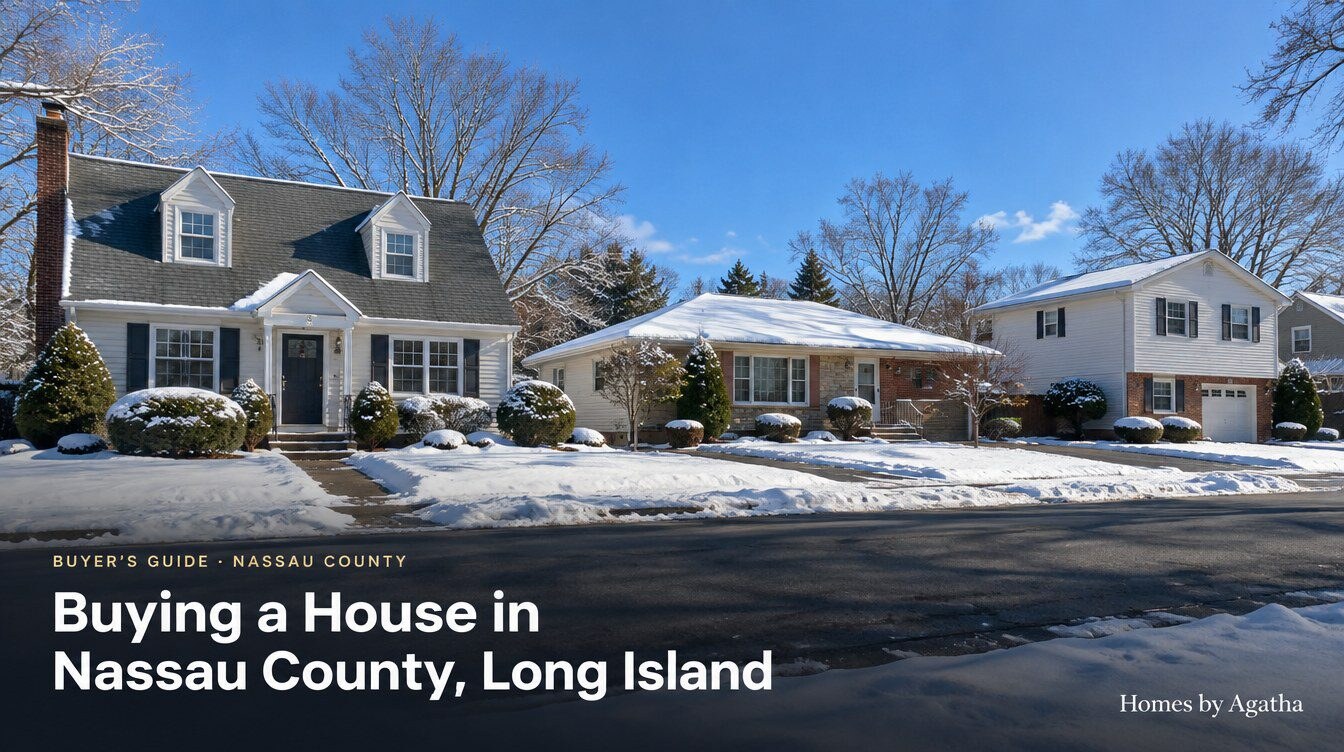
Most of Nassau County’s housing is detached one-family houses on individual lots. Postwar Cape Cods, ranches, split-levels, high-ranches and colonials make up much of the stock, with older houses near village centers and larger properties on parts of the North Shore. Co-ops and condos are concentrated in certain village downtowns and in Long Beach.
A typical Nassau buyer therefore takes on land and a structure, including the roof, heating system, sewer connection or cesspool, and every expansion a past owner made.
Housing patterns buyers commonly see
- Postwar developments. Levittown, in the Town of Hempstead with a portion in the Town of Oyster Bay, is a widely known example of mass-produced postwar Cape Cods and ranches, many since expanded with dormers, rear extensions or second stories. Each change should have a permit.
- Split-levels and high-ranches. The lower level is often finished living space; its legal status, and whether it counts as a bedroom or a separate unit, needs checking.
- Village-center houses. Older houses near LIRR stations in villages such as Rockville Centre, Garden City, Floral Park or Sea Cliff can predate modern codes, with older electrical, plumbing and drainage systems.
- Waterfront and canal-front houses. South Shore communities such as Freeport, Baldwin, Oceanside, Island Park, Massapequa and the City of Long Beach include houses on canals and bays, many elevated or rebuilt after Superstorm Sandy in 2012.
- Larger North Shore properties. Parts of the North Shore have larger lots and areas without public sewers, which adds cesspool or septic review to the inspection.
Co-ops, condos and two-family houses
A co-op, short for cooperative, is a building owned by a corporation; buyers purchase shares and receive a proprietary lease rather than a deed. Co-op and condo buildings are found in places such as Great Neck, Mineola, Garden City, Rockville Centre and Long Beach, and each building sets its own rules. Ask the managing agent for the building’s current financing limits, down payment requirement, sublet policy and any flip tax before you make an offer.
Two-family houses exist in Nassau County, but the legal status of a second unit is decided locally, as explained in the due-diligence section below. If rental income matters to you, the framework in buying a multi-family home in Queens is a useful comparison, with local permit rules replacing the NYC Department of Buildings.
| Factor | One-family house | Two-family or house with accessory apartment | Co-op | Condo |
|---|---|---|---|---|
| What you own | Land and building, by deed | Land and building, by deed | Shares plus a proprietary lease | A unit by deed, plus a share of common elements |
| Approvals | Lender only | Lender; local permit status of the second unit | Lender and co-op board (package and interview) | Lender; board may hold a right of first refusal |
| Monthly costs | Mortgage, full property tax bill, insurance, all repairs | Same as one-family, partly offset by legal rent | Mortgage plus maintenance, which typically includes a share of the building’s taxes and underlying mortgage | Mortgage, unit property tax, common charges |
| Mortgage recording tax | Applies | Applies | Does not apply (share loan) | Applies |
| Key Nassau check | Town or village permits for every addition; sewer or cesspool | Accessory apartment or rental permit; CO showing the use | Building financials, rules and fees | Offering plan, budget, reserves |
Comparing towns, villages and property types?
Tell me what matters to you, from commute to lot size, and I will help you map which Nassau County municipalities and housing types actually fit before you spend weekends at open houses.
How does the property tax bill work on a Nassau County house?
A Nassau County property tax bill combines several taxing authorities. The Nassau County Department of Assessment sets the assessed value, and the bill applies county, town, school district and special-district tax rates to it. Village taxes, where they apply, come on a separate village bill. Because school and special-district lines change from street to street, two similar houses a few blocks apart can carry noticeably different bills.
For buyers coming from New York City, this is the line item that most changes the monthly payment. It deserves the same attention as the interest rate.
Who bills and collects
In the three towns, each town’s Receiver of Taxes collects property taxes. General taxes (county, town and special districts) and school taxes are billed in halves on different schedules; school halves are typically payable without penalty through November 10 and May 10, and general halves through February 10 and August 10. Confirm the current dates with the Receiver of Taxes for the specific address. Your attorney adjusts each one between buyer and seller at closing.
Exemptions belong to the owner, not the house
The current bill may reflect STAR, veterans or senior exemptions the seller qualifies for, and those generally do not transfer. A new owner applies for their own benefits; new homeowners register for STAR with the NYS Department of Taxation and Finance once the house becomes their primary residence and receive it as a credit.
The grievance system and the Assessment Review Commission
A property tax grievance is a formal challenge to the assessed value. In Nassau County, grievances are filed with the Assessment Review Commission, known as ARC, after the tentative assessment roll is published early in the year. The statutory deadline is March 1, and ARC has extended it in recent years, so check the current filing window on the ARC website each January. A homeowner who disagrees with ARC’s determination can pursue Small Claims Assessment Review.
Nassau’s grievance calendar runs ahead of the bills it affects: a grievance filed in early 2026 concerns the 2027/28 tax year. For a buyer, that raises two questions. Has the seller filed a grievance that is still pending, and who receives any refund? And should you plan to file once you own the house? Your attorney can address the first in the contract.
What does it cost to close on a house in Nassau County?
Budget for the down payment plus buyer closing costs. For a financed Nassau County house, the largest buyer items are usually the mortgage recording tax, title insurance, attorney fees, lender charges and tax escrows, plus the New York State “mansion tax” if the price is $1 million or more. The NYC Real Property Transfer Tax does not apply in Nassau County.
Two rates differ from New York City: the Nassau mortgage recording tax is 1.05% of the loan, compared with roughly 1.8% to 1.925% in the city, and the mansion tax stays a flat 1% rather than becoming graduated above $2 million as it does in the city.
Main buyer closing costs for a Nassau County house
| Cost | Who sets it | How it works in Nassau County |
|---|---|---|
| Mortgage recording tax | New York State (NYS DTF) | 1.05% of the loan amount. By law, the lender pays the 0.25% special additional tax portion on residential buildings with up to six units, which includes one- and two-family homes. Co-op share loans are not subject to it. |
| “Mansion tax” | New York State | 1% of the price on residential purchases of $1 million or more, paid by the buyer. Outside New York City it is not graduated. |
| Title insurance and searches | Title company (rates regulated in New York) | Owner’s and lender’s policies, plus municipal searches from the correct town, village or city. |
| County recording-related fees | Nassau County Clerk and Department of Assessment | Recording fees and the county’s tax map verification fee for each recorded deed and mortgage. Your title company or attorney quotes the current amounts. |
| Buyer’s attorney | Negotiated with the attorney | Contract negotiation, title review and closing. |
| Lender charges | Your lender | Application, appraisal, origination or points, credit report. |
| Tax escrow and adjustments | Lender and the Nassau billing calendar | A cushion for upcoming school and general tax halves, plus prorations with the seller. |
| Flood insurance (if required) | Insurer; lender requirement in Special Flood Hazard Areas | First-year premium is often collected at or before closing. |
Confirm current rates with the NYS Department of Taxation and Finance before closing.
The NYS real estate transfer tax, $2 for each $500 of consideration (0.4%), is customarily paid by the seller, though a contract can allocate costs differently. If you are comparing a Nassau budget with a city purchase, the line-by-line breakdown in Queens closing costs explained shows how the NYC side differs.
Key Takeaways
- Nassau County has three towns, two cities, 64 incorporated villages and many hamlets; the governing municipality decides permits, zoning and some taxes.
- The property tax bill combines county, town, school district and special-district lines, with village taxes billed separately; read the actual bill.
- Seller exemptions such as STAR do not carry over; budget your own bill.
- Nassau buyers pay a 1.05% mortgage recording tax and a flat 1% mansion tax at $1 million or more; the NYC Real Property Transfer Tax does not apply.
See your real monthly number before you bid
I can help you collect the actual tax bills for houses you like and line them up with your lender’s estimate, so the comparison reflects what you would really pay.
How should you plan pre-approval and financing for a Nassau County purchase?
Get a full pre-approval from an NMLS-registered mortgage loan originator before touring seriously. A pre-approval means the lender has reviewed your income, assets and credit and issued a conditional commitment amount. In Nassau County, ask the lender to use the actual property tax bill for each house you consider, because taxes can move the qualifying payment as much as a change in price.
Questions to ask your lender before you shop
- Which tax figure are you underwriting? Model taxes from the current Nassau bill without the seller’s exemptions, plus any village tax.
- How will the appraiser treat additions? Unpermitted extensions or finished lower levels may be noted, and some loan programs require them resolved before closing.
- What if the house is in a flood zone? Flood insurance is required in FEMA Special Flood Hazard Areas; get a quote before signing.
- How is rental income counted? Accessory apartment income generally needs proof of legal status before a lender considers it.
Cash reserves for Nassau-specific surprises
Down payment rules depend on the loan program, not the county. What is local is the repair that can surface in year one: a failing cesspool on an unsewered lot, an aging bulkhead on a canal, an abandoned oil tank, or a permit that must be closed out with a village. Many buyers keep a reserve rather than putting every dollar into the down payment.
First purchase? The first-time home buyer guide covers pre-approval steps that apply on Long Island too.
How do you commute from Nassau County?
Most Nassau commuters use the Long Island Rail Road, the parkway and expressway network, or both. The LIRR serves Nassau County through nine branches, most passing through Jamaica toward Penn Station, Grand Central Madison and Atlantic Terminal. Nassau Inter-County Express (NICE) buses serve local corridors. Commuting here depends on which branch serves the nearest station and how you reach it.
| LIRR branch | Examples of Nassau stations |
|---|---|
| Port Washington Branch (runs through Queens without stopping at Jamaica) | Great Neck, Manhasset, Plandome, Port Washington |
| Hempstead Branch | Bellerose, Floral Park, Stewart Manor, Nassau Boulevard, Garden City, Country Life Press, Hempstead |
| Main Line (Ronkonkoma and Port Jefferson branches) | New Hyde Park, Merillon Avenue, Mineola, Carle Place, Westbury, Hicksville, Bethpage, Syosset |
| Oyster Bay Branch | East Williston, Albertson, Roslyn, Greenvale, Glen Head, Sea Cliff, Glen Street, Glen Cove, Locust Valley, Oyster Bay |
| West Hempstead Branch | Westwood, Malverne, Lakeview, Hempstead Gardens, West Hempstead |
| Babylon Branch | Valley Stream, Lynbrook, Rockville Centre, Baldwin, Freeport, Merrick, Bellmore, Wantagh, Seaford, Massapequa, Massapequa Park |
| Long Beach Branch | Centre Avenue, East Rockaway, Oceanside, Island Park, Long Beach |
| Far Rockaway Branch | Gibson, Hewlett, Woodmere, Cedarhurst, Lawrence, Inwood |
Service patterns, peak and off-peak frequency and transfers at Jamaica change with each timetable, so check the current LIRR timetable on mta.info for the station you are considering before you commit to an area.
Fares, parking and station access
LIRR fares are priced by zone, and trips from Nassau stations cost more than trips starting inside New York City; check current fares and monthly ticket prices on mta.info. Station parking is commonly controlled by the town or village that owns the lot, and some lots require resident permits, so ask the town or village about the specific lot. A house near a station is only convenient if you can park there.
Driving and buses
Drivers rely on the Long Island Expressway, the Northern State and Southern State Parkways and the north–south parkways. NICE buses run along major local corridors, and some routes reach subway connections in Queens; check the current NICE route map at nicebus.com for the address you are considering. For many households a car is part of daily life here, so budget for it.
Pick one or two branches first, time the full trip at your real travel hour, then compare municipalities along those lines.
Start with the train, then find the house
If your commute is fixed, let’s work backward from the LIRR branch and station that fit your schedule and focus your search on the municipalities around it.
What should you check on a Nassau County house before you sign?
Before signing, confirm that the permits and Certificate of Occupancy on file with the town, village or city match the house as it stands, find out whether it is on public sewer or a cesspool, check for oil tanks, and have a licensed inspector examine the structure and systems.
Permits and Certificates of Occupancy are kept locally
A Certificate of Occupancy, or CO, confirms that a building, or work on it, complies with approved plans and may be used as described. In Nassau County, COs and permits come from the town, village or city building department, not the NYC Department of Buildings; the three towns and every incorporated village keep their own files. Ask the specific building department how to request the file and what it charges, since the process differs from one municipality to the next.
Nassau houses often grew over time. A finished basement, a dormer, a rear extension, a deck, a pool, central air or a detached garage may each have needed a permit and a final sign-off. Ask for the building file, compare it with the house you toured, and ask your attorney to address anything that does not match.
Accessory apartments and rentals
A separate apartment in a basement, attic or garage is legal only if the local building department has approved it. Several Nassau municipalities have accessory apartment programs or rental permit laws, and the rules differ, so ask the building department of the specific town, village or city what applies to the house. Relying on an unapproved apartment for income risks fines, financing problems and insurance trouble.
Sewer or cesspool
Most of Nassau County is connected to public sewers, but parts of the North Shore are not, and many homes there rely on cesspools or septic systems. Confirm the sewer status of the specific address with the town, village or Nassau County Department of Public Works. A cesspool is an underground structure that receives household wastewater and lets it seep into the ground. If the house is not sewered, schedule a cesspool or septic inspection and ask for pumping records. On sewered houses, a camera inspection of the line to the street is worthwhile on older properties.
Oil tanks, older systems and lead paint
- Oil tanks. Many Long Island houses were heated with oil. Ask whether a buried or basement tank exists or was removed or abandoned, and ask for the removal or abandonment paperwork. Your inspector and attorney can tell you which agency’s sign-off to look for.
- Electrical, plumbing and roof. Older houses may have undersized service, older panels, galvanized supply lines or several roof layers that inspectors and insurers flag.
- Lead-based paint. For homes built before 1978, federal rules require the seller to disclose known lead-based paint hazards and give the buyer an opportunity to inspect.
The Property Condition Disclosure Statement
Since March 20, 2024, sellers of most one-to-four-family homes in New York must deliver the Property Condition Disclosure Statement, or PCDS, with no $500 credit option, and the form now includes flood questions. It reflects the seller’s knowledge; it is not a warranty or a substitute for inspection. Condo units and co-op apartments are excluded from the law’s definition of residential real property, so the PCDS requirement does not apply to them.
How do flood zones affect buying a house in Nassau County’s South Shore?
Flood risk in Nassau County is concentrated along the South Shore bays, canals and barrier island, and some North Shore harbors. Check FEMA’s Flood Insurance Rate Maps, read the PCDS flood answers and get an insurance quote before signing; lenders require flood insurance in Special Flood Hazard Areas.
A Special Flood Hazard Area, or SFHA, is the area FEMA maps as having a 1% annual chance of flooding, sometimes called the 100-year floodplain. Being outside it lowers the mapped risk but does not eliminate it. Superstorm Sandy in 2012 flooded many South Shore communities, and many houses there were later repaired, elevated or rebuilt.
Documents to ask for on a waterfront or low-lying house
- Elevation Certificate. A FEMA form, prepared by a licensed surveyor or engineer, recording the building’s elevation relative to the base flood elevation; it can affect insurance pricing.
- Elevation or rebuild permits. If the house was raised or rebuilt, the local building department should have the approvals.
- Flood insurance history. Beyond the PCDS answers, ask for the current policy declarations.
- Bulkhead and dock records. Bulkheads hold back the water on canal lots. Their condition is a major expense, and work on them may require local and state permits. Ask for any permits and repair records, and ask your attorney which approvals should be in the file.
Also ask whether the boiler, electrical panel and water heater sit above the flood elevation. The FEMA Flood Map Service Center lets you look up the current flood map for any address. Inland houses in central Nassau can still have basement water issues from drainage, so ask about water history everywhere, not only near the shore.
Found a house? Let’s review its paper trail
Before you sign, I can help you organize the permit file, flood documents, cesspool or sewer questions and tax bill for that specific Nassau County property.
How do offers and contracts work when buying a house in Nassau County?
New York is an attorney state: after a seller accepts your offer, the buyer’s and seller’s attorneys negotiate and prepare the contract of sale, and nothing is binding until both parties sign and the deposit is delivered. That process is the same in Nassau County as in the city, but the documents the attorneys review come from towns, villages and the county instead of New York City agencies.
In practice, your agent submits the offer with your pre-approval, the agents circulate a deal sheet to both attorneys, you inspect, the seller’s attorney drafts the contract, your attorney negotiates riders such as the mortgage contingency, and you sign and deliver a deposit that is customarily held in escrow by the seller’s attorney.
Nassau-specific contract points
- Permits and COs. If the building file does not match the house, the contract can require the seller to obtain approvals before closing or provide a credit.
- Pending tax grievances. The contract can state who receives any refund from a grievance or tax certiorari proceeding the seller filed.
- Village requirements. Some villages have their own pre-sale or occupancy requirements. Your attorney checks with the specific village early, so any required inspection or certificate does not delay the closing.
Offer strategy that fits Nassau houses
Comparable sales should share the municipality and, ideally, a similar tax bill, sewer status and flood-zone status; a cesspool house and a sewered house nearby are not equivalent comparisons. Strong offers pair realistic pricing with clean financing, a sensible closing date and a measured response to inspection findings.
Typical offer-to-closing timeline
| Stage | What happens | Typical range (varies by deal) | Nassau-specific watch point |
|---|---|---|---|
| 1. Offer accepted | Deal sheet to attorneys | Same day to a few days | Confirm section-block-lot and the governing municipality |
| 2. Inspection | General inspection and specialist tests | About one week | Cesspool or sewer line, oil tank, bulkhead, flood elevation |
| 3. Contract negotiation and signing | Attorney review, riders, deposit | About one to three weeks | Permit and CO discrepancies; grievance refund clause |
| 4. Mortgage commitment | Appraisal and underwriting | Several weeks | Flood insurance; appraiser notes on unpermitted space |
| 5. Title and municipal searches | Liens, permits, violations, survey | Runs alongside stage 4 | Searches from the correct town, village or city |
| 6. Clear to close and walk-through | Scheduling and final review | About one week | Confirm any required approvals were obtained |
| 7. Closing | Funds, deed and mortgage recorded with the Nassau County Clerk | One meeting | Mortgage recording tax and tax adjustments paid |
These ranges are general. Confirm the expected timeframe for each stage with your attorney and lender for the specific deal.
Co-op purchases add a board package and interview, and their timing depends on the building. Cash purchases skip the mortgage commitment and can move faster.
How does working with a buyer’s agent work in Nassau County in 2026?
Under the rules that followed the 2024 NAR settlement, still in effect in 2026, a buyer signs a written agreement with their agent before touring homes together. Buyer-agent compensation is negotiable, is not set by law and is not automatically paid by the seller. The agreement states how your agent will be paid.
A seller may still agree to contribute toward your agent’s compensation, you may request it in your offer, or you may pay it directly. Read your agreement before the first showing.
Agency disclosure and the MLS
The New York State Disclosure Form for Buyer and Seller explains the agency relationships a licensee can have and is presented at the first substantive contact. Most Nassau County listings appear on OneKey MLS, the multiple listing service used across Long Island and much of the New York metro area.
On a Nassau purchase, a buyer’s agent should identify the governing municipality, pull the actual tax bill, flag permit, sewer and flood questions early, choose comparable sales carefully and say plainly when a house does not fit your plan. For more on agreements and compensation, read working with a buyer’s agent in NY. I work in English and Polish; some clients simply prefer contract-stage conversations in their first language. Where you choose to buy is always your decision. If you are also looking farther east, the Suffolk County buying page covers the next county along the Island, and across the western border, buying in Little Neck, Queens shows the city side next to Great Neck.
Know the terms before the first showing
Let’s go through how buyer representation works, what it costs and what you can expect from me, before we tour a single Nassau County house.
What mistakes should you avoid when buying a house in Nassau County, and what belongs on your checklist?
The costliest mistakes come from city assumptions carried east: that the tax bill resembles a city bill, that a finished extension is legal, that every house is on sewer, and that “near the LIRR” means an easy commute. Each can be checked before you sign.
Mistakes to avoid
- Budgeting from a listing’s tax estimate. Use the actual bill, including any village bill, without the seller’s exemptions.
- Ignoring the building file. Unpermitted additions are common on expanded houses and can delay financing or closing.
- Pricing flood insurance after signing. On the South Shore, get the quote first.
- Treating hamlet names as municipalities. A hamlet follows town rules; a village has its own.
Nassau County buyer checklist
- Get a full pre-approval with taxes modeled from actual Nassau bills.
- Sign a written buyer agreement and review the NYS Disclosure Form for Buyer and Seller.
- Identify the town, city or village and the special districts for each house.
- Compare the building file with the house as built.
- Confirm sewer or cesspool and check for oil tanks.
- Check the FEMA map, the PCDS flood answers and an insurance quote.
- Test the commute from the actual station, including parking.
- Choose a New York real estate attorney before your offer is accepted.
Key Takeaways
- In Nassau County, permits and Certificates of Occupancy live with the town, village or city, not the NYC Department of Buildings.
- Parts of the North Shore are unsewered; confirm sewer or cesspool on every house.
- South Shore and harbor-front houses need a FEMA map check, flood answers on the PCDS and an insurance quote before contract.
- Choose the LIRR branch first, then the municipality, then the house.
Ready to turn this checklist into a plan?
Share your budget, timing and commute, and I will help you build a focused Nassau County search and an offer approach that fits the houses you actually want.
Frequently asked questions about buying a house in Nassau County
What is the difference between a town, a village and a hamlet in Nassau County?
Nassau County has three towns, two cities and 64 incorporated villages. A village has its own government, building department, zoning and village tax. A hamlet, such as Levittown or Elmont, has no separate government and follows its town’s rules. The governing municipality decides where permits, zoning and some tax lines come from.
Does the NYC Real Property Transfer Tax apply in Nassau County?
No. The NYC Real Property Transfer Tax applies only to New York City properties. A Nassau County sale is subject to the New York State real estate transfer tax of 0.4%, customarily paid by the seller. Buyers in Nassau pay a 1.05% mortgage recording tax on financed purchases and a 1% mansion tax at $1 million or more.
Why do property taxes differ so much between nearby Nassau County houses?
A Nassau County tax bill combines county, town, school district and special-district lines such as fire, water, sanitation, sewer and library districts, plus a separate village bill where applicable. Those districts change from street to street, so similar houses can carry different bills. Always budget from the actual bill, without the seller’s exemptions.
Can I grieve my property taxes after buying a house in Nassau County?
Yes. Owners can file a grievance with the Nassau County Assessment Review Commission after the tentative assessment roll is published early in the year. The statutory deadline is March 1, and ARC has extended it in recent years. A grievance filed in early 2026, for example, affects the 2027/28 tax year.
Who issues the Certificate of Occupancy for a Nassau County house?
The local building department does. For a house in an unincorporated hamlet, that is the Town of Hempstead, Town of North Hempstead or Town of Oyster Bay. Incorporated villages and the cities of Glen Cove and Long Beach keep their own files. Compare permits and COs with the house before signing a contract.
Are all Nassau County houses connected to public sewers?
No. Most of Nassau County is sewered, but parts of the North Shore are not, and many homes there use cesspools or septic systems. Ask whether the specific house is connected to a public sewer. If it is not, schedule a cesspool or septic inspection and request pumping and repair records before you sign.
Do I need flood insurance for a house on Nassau County’s South Shore?
Lenders require flood insurance for houses in FEMA Special Flood Hazard Areas, which include many South Shore bay, canal and barrier-island locations. Check the address on FEMA’s Flood Map Service Center, read the seller’s PCDS flood answers, ask for an Elevation Certificate and get an insurance quote before signing the contract.
Which LIRR branches serve Nassau County?
Nassau County is served by the Port Washington, Hempstead, West Hempstead, Oyster Bay, Babylon, Long Beach, Far Rockaway, Port Jefferson and Ronkonkoma branches. Most connect through Jamaica toward Penn Station, Grand Central Madison and Atlantic Terminal. The Port Washington Branch runs through Queens without stopping at Jamaica. Check current timetables.
Is an accessory apartment in a Nassau County house legal?
Only if the local building department has approved it. Several Nassau towns and villages have their own accessory apartment programs and rental permit laws, and the rules differ by municipality. An apartment without approval is generally not a legal unit, so lenders, insurers and local inspectors may treat it as a violation.
Who pays the buyer’s agent when buying a house in Nassau County?
Buyer-agent compensation is negotiable and not set by law. Since the 2024 NAR settlement, buyers sign a written agreement with their agent before touring, and the agreement states the compensation. A seller may agree to contribute, a buyer may request it in the offer, or the buyer may pay directly.
Your next step for buying a house in Nassau County
Nassau County rewards buyers who check the local layer before the asking price: the municipality behind the address, the real tax bill, the building file, sewer or cesspool, the flood map and the commute from the actual station. With those answers, contract review and mortgage commitment become routine. When you are ready to see what is available and how a purchase could come together, start with the Nassau County home buying page. If you already own a home here and plan to move, the companion page on selling your Nassau County home covers the seller side, and you can always explore Nassau County purchase options with Homes by Agatha when you want a second opinion on a specific house.
This article is for general informational purposes only and reflects conditions that may change. It is not legal, tax, or financial advice, an appraisal, or a guarantee of price or outcome; consult a licensed New York attorney, a CPA, and an NMLS-registered mortgage loan originator as appropriate. A CMA is an opinion of value, not an appraisal. Real estate brokerage services are offered by Agatha Lubas, Licensed Associate Real Estate Broker, NY License #10301213345, Keller Williams Realty Liberty, 96-10 101st Avenue, Ozone Park, NY 11416. The NYS Disclosure Form for Buyer and Seller, the NYS Housing and Anti-Discrimination Disclosure / Fair Housing Notice, and the brokerage’s Standard Operating Procedures are available on request. Equal Housing Opportunity.

Agatha Lubas helps buyers, sellers and investors across Queens, Brooklyn, Nassau County and Suffolk County understand both the property and the New York transaction process. She works with clients in English and Polish, so every conversation can happen in the language that feels most comfortable.
Work with Agatha