

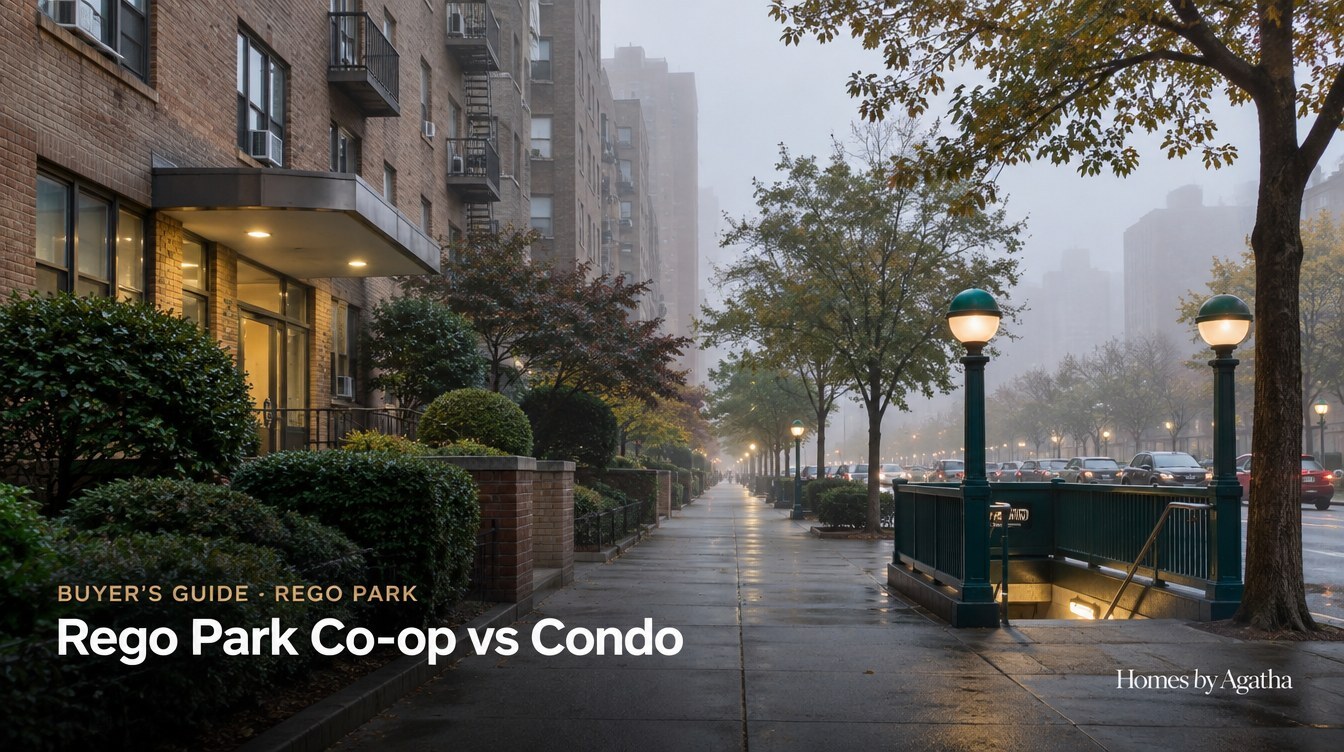
REGO PARK REAL ESTATE GUIDE
Rego Park Co-op vs Condo: How to Choose an Apartment Along Queens Boulevard
Quick Answer
The Rego Park co-op vs condo choice comes down to ownership, approval and monthly cost. A co-op in Rego Park, Queens means shares, board approval and maintenance that includes building taxes; a condo means a deed, lighter approval, common charges plus a separate tax bill, and usually more flexible renting rules. Compare total monthly cost, not price.
Most apartment buyers in Rego Park end up asking the same question: should I buy a co-op or a condo? The Rego Park co-op vs condo decision matters more here than in many Queens neighborhoods because the two products sit side by side. Mid-century co-op buildings line Queens Boulevard, 63rd Drive and the side streets around them, while condominium buildings — many of them newer — appear along the same corridor. Two apartments a block apart can look alike in photos and still differ in who approves you, how you finance, what you pay every month and what you can do with the apartment later.
This guide is for buyers who have already put Rego Park, Queens on their list and want to choose the right form of ownership before they choose a listing. You will learn how each option works, how to compare monthly costs line by line, which closing costs apply to which product, how financing and approval differ, and how the attached and detached houses of the Crescents fit in as a third option. As a Licensed Associate Real Estate Broker based in Queens, I help buyers compare buildings and documents, not just floor plans — in English and Polish. When you want to turn the comparison into a search, the Rego Park home buying page explains how we can work together.
Rego Park at a glance
| Item | Rego Park, Queens |
|---|---|
| Borough / county | Queens (Queens County), New York City; Queens Community Board 6, which covers Forest Hills and Rego Park |
| ZIP code | 11374; confirm the ZIP code and mailing name of any specific address with the USPS |
| Commonly described boundaries | Roughly the Long Island Expressway to the north, Woodhaven Boulevard to the west, Forest Hills (around Yellowstone Boulevard) to the east and the Long Island Rail Road Main Line to the south — informal, not official city lines, and sources draw them differently |
| Subway | 63rd Drive–Rego Park and 67th Avenue local stations on the IND Queens Boulevard Line, served by M and R trains; Woodhaven Boulevard local station at the western edge; Forest Hills–71st Avenue express station to the east. Service hours vary by line, so check current MTA schedules |
| Rail | No LIRR station inside Rego Park; nearest is Forest Hills station on the LIRR Main Line |
| Major roads | Queens Boulevard, Woodhaven Boulevard, Long Island Expressway (I-495), Junction Boulevard, 63rd Drive, Yellowstone Boulevard |
| Parks and landmarks | Lost Battalion Hall Recreation Center (93-29 Queens Boulevard; built 1939 by the Works Progress Administration); Real Good Playground (62nd Avenue between 99th and 102nd Streets); the Crescents house area near Woodhaven Boulevard; Flushing Meadows Corona Park and Forest Park within reach |
| Commercial corridors | Queens Boulevard, 63rd Drive, Woodhaven Boulevard, Junction Boulevard; the Rego Center shopping complex near Queens Boulevard and the Long Island Expressway |
| Typical property types | Mid-century elevator co-op and rental buildings; condominium buildings, several of them newer; attached and detached one-family houses in the Crescents and southern blocks; some two-family houses |
What kinds of homes can you buy in Rego Park, Queens?
Rego Park’s for-sale housing falls into three groups: co-op apartments in mid-century buildings, condominium units, and one- or two-family houses, many of them in the Crescents south of Queens Boulevard. Many buyers here start with apartments, which is why the co-op versus condo question usually comes first; the mix of what is for sale changes week to week, so check current OneKey MLS listings.
The apartment corridor: Queens Boulevard and 63rd Drive
The apartment buildings of Rego Park are concentrated along and near Queens Boulevard, 63rd Drive and the numbered streets that cross them, roughly from Woodhaven Boulevard east toward Forest Hills. Many are six-story or taller elevator buildings from the middle of the 20th century; some operate as rentals and others as co-ops. Construction and conversion dates differ building by building, and your attorney can confirm them from the offering plan, NYC Department of Buildings records and ACRIS. The ground floors along Queens Boulevard and 63rd Drive often hold stores, which matters to a co-op buyer because commercial rent can feed the building’s budget.
Condominium buildings sit in the same corridor, several of them newer construction with modern systems and in-unit laundry, while the older co-op buildings tend to offer established operating histories. Features differ by building, so confirm them in each listing and offering document.
The Crescents and the southern blocks
The Crescents is a group of curving streets near Alderton Street, between Woodhaven Boulevard and the Long Island Rail Road. The Real Good Construction Company — the developer whose “Real Good Homes” slogan gave Rego Park its name — developed houses in this part of the neighborhood, including attached brick houses on crescent-shaped lots. The streets carry names such as Asquith, Boelsen, Cromwell, Dieterle and Ellwell Crescents. Construction dates and styles vary from house to house, so check the Department of Buildings records for any specific address. Some sources place the Crescents in western Forest Hills, so listings may use either name.
Detached and semi-detached houses also appear on other southern blocks; for an apartment buyer, they are the alternative when no co-op or condo fits.
How to tell a co-op from a condo before you fall for a listing
A New York City condominium unit has its own tax lot and its own property tax bill, while a co-op building is a single tax lot owned by the cooperative corporation. ACRIS, the city’s online register of recorded documents, shows a deed for a condo unit but not for a co-op apartment. Your attorney confirms the form of ownership through the offering plan, the proprietary lease or the condominium declaration.
Rego Park co-op vs condo: what is the actual difference?
A co-op buyer purchases shares in a corporation that owns the building and receives a proprietary lease for one apartment; a condo buyer receives a deed to the unit plus a share of the common elements. In the Rego Park co-op vs condo comparison, that legal difference drives everything else: approval, financing, monthly costs, renting rules and closing costs.
A proprietary lease is the long-term lease the co-op corporation grants to each shareholder. The number of shares assigned to the apartment sets its portion of building costs, which is why two similar apartments in the same Rego Park building can carry different maintenance. A condominium declaration and bylaws do the equivalent job in a condo: they assign each unit a percentage of common interest that sets its common charges.
| Factor | Co-op apartment | Condo unit | House (e.g., the Crescents) |
|---|---|---|---|
| What you own | Shares in the co-op corporation plus a proprietary lease | Deeded unit plus a percentage of common elements | Deeded land and building |
| Approval | Board application and, usually, an interview; the board can decline | Usually a right of first refusal that the board waives, not a full approval | None beyond your lender |
| Financing | Share loan; each building sets the maximum it allows | Mortgage; the lender also reviews the condo project | Mortgage on the property |
| Monthly costs | Maintenance, which includes a share of the building’s property taxes and any underlying mortgage | Common charges plus the unit’s own property tax bill | Property tax, insurance, utilities, every repair |
| NYC mortgage recording tax | Not charged on co-op share loans | Charged on the mortgage | Charged on the mortgage |
| Renting the home later | Only as the sublet policy allows; often limited | Usually more flexible; read the bylaws and any leasing rules | Only units that are legal under the Certificate of Occupancy |
| Key documents | Offering plan, proprietary lease, house rules, financial statements, minutes | Declaration, bylaws, budget, financial statements, minutes | Deed, survey, Certificate of Occupancy, permits |
Which buyer each option tends to fit
A co-op tends to fit a buyer who plans to live in the apartment, values a long operating history and is comfortable sharing financial documents with a board. A condo tends to fit a buyer who wants a deed, may rent the apartment out later or wants newer systems, and who accepts a separate tax bill and, in many newer buildings, higher carrying costs; compare the actual figures building by building. Neither is better across Rego Park; a well-run co-op can beat a condo with a thin budget, and the reverse is equally true. If you already own in Rego Park and need to sell first, the companion guide to selling your home in Rego Park covers that side of the move.
Not sure whether a co-op or a condo suits your plans?
I can walk you through ownership, approval and renting rules for the Rego Park buildings on your list, so you decide on the product before you tour the apartments.
How do monthly costs compare: maintenance versus common charges plus taxes?
Co-op maintenance in Rego Park bundles the apartment’s share of building operations, the building’s property taxes and any underlying mortgage into one payment. Condo owners pay common charges for building operations and receive their own property tax bill on top. To compare fairly, add the condo’s common charges and monthly property tax together and set that total against the co-op’s maintenance.
What co-op maintenance usually covers
Maintenance is the shareholder’s monthly share of the co-op’s operating budget. It typically covers staff, heat and hot water, building insurance, repairs, reserves, a share of the building’s property taxes and payments on the building’s underlying mortgage. In many Queens co-ops, electricity and cooking gas are billed separately, and parking, storage or air-conditioner sleeve fees may be extra. Ask the managing agent for a written list of what your maintenance covers.
The underlying mortgage is the building’s own loan; when it matures or is refinanced, maintenance can change for everyone, so ask when it matures.
What condo owners pay each month
Condo common charges cover operating costs, staff, common-element insurance and reserves; the unit’s real estate taxes are billed separately by the NYC Department of Finance. In newer condos, heat and cooling are often in-unit systems paid by the owner; the condo budget and the listing show which applies.
Tax abatements on newer condos
Some newer condominium buildings in New York City received property tax benefits, such as the 421-a exemption, that lower the unit’s tax bill for a set period and then phase out. A condo whose monthly cost looks low today may carry a rising tax bill as an abatement steps down. Ask the seller’s attorney which benefit applies, when it started and how the phase-out works, and check the unit’s tax records on the NYC Department of Finance website, since benefit status is set unit by unit.
Co-op and condo owners who use the apartment as a primary residence may also benefit from the Cooperative and Condominium Property Tax Abatement administered by the NYC Department of Finance. The board applies on behalf of the whole development, and owners may hold no more than three residential units in it. Developments receiving certain other benefits, such as 421-a or J-51, are not eligible, so a condo with a 421-a exemption does not also receive this abatement. In a co-op, the benefit is usually reflected in maintenance.
A line-by-line monthly comparison
| Monthly line item | Rego Park co-op | Rego Park condo | What to ask |
|---|---|---|---|
| Building operations | Inside maintenance | Common charges | What exactly is included, and when was the last increase? |
| Real estate taxes | Inside maintenance (building’s share) | Separate NYC DOF bill for the unit | Is any abatement or exemption scheduled to change? |
| Building mortgage | Inside maintenance, if the co-op has an underlying mortgage | Not applicable | Interest rate and maturity date of the underlying mortgage |
| Your own loan | Share loan payment | Mortgage payment | Rate, term, and how much the building allows you to borrow |
| Heat and hot water | Usually included; confirm for each building | Often paid by the owner in newer buildings | Who pays, and how is it metered? |
| Electricity and gas | Often separate | Usually separate | Average bills for the unit |
| Assessments | Possible for capital projects | Possible for capital projects | Any current or planned assessment, and for what? |
| Parking, storage, extras | Often separate and wait-listed | May be deeded, licensed or rented | Availability, cost and transferability |
| Insurance | Shareholder’s apartment policy | Unit owner’s policy | What the master policy covers versus yours |
Assessments in older buildings
Many of Rego Park’s apartment buildings are several decades old, so capital work shows up in both co-ops and condos. Three New York City laws often drive it: Local Law 11 (periodic façade inspections for buildings taller than six stories), Local Law 97 (emission limits for most buildings larger than 25,000 square feet, which began in 2024) and Local Law 152 (periodic gas piping inspections for most buildings other than one- and two-family houses). Applicability depends on each building’s height, size and classification, so check the building’s NYC Department of Buildings records and ask the managing agent where it stands on each law.
What does each option cost at closing in Rego Park?
Closing costs differ by product. Condo and house buyers who borrow pay the NYC mortgage recording tax and buy title insurance; co-op buyers do not pay mortgage recording tax on a share loan and rely on a lien search instead of a title policy, but they pay board application and managing-agent fees. The mansion tax applies to any of the three at $1 million or more.
The table below follows the rules published by the New York State Department of Taxation and Finance and the NYC Department of Finance. Confirm current rates with the NYS Department of Taxation and Finance and NYC Department of Finance before closing.
| Cost item | Co-op | Condo | Source / who sets it |
|---|---|---|---|
| “Mansion tax” | 1% of the price at $1 million or more; graduated above $2 million in New York City; paid by the buyer | Same rule | NYS Department of Taxation and Finance |
| NYC mortgage recording tax | Not charged — co-op loans are share loans | Roughly 1.8% of the loan under $500,000; 1.925% at $500,000 and above | NYC Department of Finance / New York State |
| Title or lien coverage | Lien (UCC) search; optional co-op lien coverage | Title search and title insurance | Title company / attorney |
| Buyer’s attorney | Fee negotiated with the attorney | Fee negotiated with the attorney | Your attorney |
| Lender costs | Origination, appraisal, credit report, building questionnaire | Origination, appraisal, credit report, condo questionnaire | Your lender |
| Building fees | Application, credit-check and processing fees; possible move-in deposit | Application or processing fee; possible move-in deposit | Managing agent |
| Adjustments at closing | Maintenance prorated to the closing date | Common charges and property taxes prorated | Contract / attorneys |
| Flip tax | Only if the co-op’s documents impose one; who pays follows the documents and the contract | Uncommon in condos | The building’s own documents |
On a resale, the NYS real estate transfer tax and the NYC Real Property Transfer Tax are customarily paid by the seller. In a sponsor sale — the first sale of a unit by a developer in a new condominium — the contract may shift those transfer taxes to the buyer, so have your attorney review the purchase agreement closely before you sign. The guide to Queens closing costs walks through each line in more detail.
Key Takeaways
- A Rego Park co-op is shares plus a proprietary lease; a condo is a deeded unit. That legal difference shapes approval, financing and renting rules.
- Compare co-op maintenance against condo common charges plus the unit’s own tax bill, not against common charges alone.
- Ask whether a newer condo’s tax benefit is phasing out, and when the co-op’s underlying mortgage matures.
- Co-op share loans avoid the NYC mortgage recording tax; condo mortgages do not.
Want the monthly numbers side by side?
Send me the co-op and condo listings you are weighing, and we can build a clean comparison of maintenance, common charges, taxes and closing costs before you make a decision.
How does financing differ for a Rego Park co-op and a Rego Park condo?
A co-op is financed with a share loan secured by your shares and proprietary lease, and the building sets how much you may borrow. A condo is financed with a conventional mortgage on real property, and the lender reviews the condo project as well as you. Get pre-approved by a lender experienced in both, and confirm building-level rules before you tour.
Co-op financing limits and post-closing liquidity
Each co-op sets its own minimum down payment and maximum financing, and the figures differ from building to building. Many boards also look at post-closing liquidity — the savings you will still hold after the down payment and closing costs — and some state that requirement as a number of months of maintenance and loan payments. Ask for both rules in writing before you tour.
Condo project review
A condo lender reviews the building through a questionnaire covering owner-occupancy, how many units a single owner holds, commercial space, insurance, reserves and litigation. Newer buildings that are still selling sponsor units may face additional lender requirements. Guidelines change, so ask an NMLS-registered mortgage loan originator how a specific building fits the lender’s current rules.
Pre-approval, commitment and the second review
A pre-approval letter shows a seller that a lender has reviewed your credit, income and assets; the commitment letter comes after the contract, appraisal and building review, and co-op boards usually want it in the board package. A co-op board then reviews your finances under its own standards, which can be stricter than the lender’s, while a condo buyer faces only the lender. Government-backed loan programs have their own eligibility rules for co-ops and condos, so if you plan to use one, ask an NMLS-registered mortgage loan originator early whether the building qualifies. First-time buyers can find preparation steps in the first-time home buyer guide for Queens.
How do board approval and the condo right of first refusal change the timeline?
A co-op purchase in Rego Park cannot close until the board approves you, which adds a board package, a managing-agent review and usually an interview. A condo purchase typically requires only that the condo board waive its right of first refusal, which is usually a shorter administrative step. That difference shapes your rate lock, your moving date and your negotiating position.
The co-op board package
The board package is the application a co-op board reviews before approving a sale: typically the signed contract and loan commitment, tax returns and income evidence, bank statements, reference letters and a credit-check authorization, in the format the managing agent requires. A missing page usually sends the file back.
The interview and the decision
Most co-op boards meet buyers before voting. A co-op board may decline without giving a reason, but it may not discriminate on any basis protected by the federal Fair Housing Act, the New York State Human Rights Law or the New York City Human Rights Law.
The condo right of first refusal
A right of first refusal gives a condominium board the option to buy a unit on the same terms the seller accepted from you. Boards usually issue a waiver after a short application, within a deadline set by the bylaws; ask the managing agent for that deadline before you set a closing date.
Offer-to-closing sequence for each product
| Stage | Co-op | Condo | What controls the timing |
|---|---|---|---|
| 1. Screening and offer | Confirm financing limit, liquidity rule, sublet and pet policies | Confirm leasing rules, budget, tax benefits | How quickly the managing agent answers |
| 2. Due diligence and contract | Attorney reviews offering plan, lease, financials, minutes; contract signed; deposit into escrow | Attorney reviews declaration, bylaws, budget, minutes; title ordered; contract signed; deposit into escrow | Document delivery |
| 3. Loan commitment | Appraisal plus building questionnaire | Appraisal plus condo project review | Lender and managing agent |
| 4. Approval step | Board package, managing-agent review, interview, decision | Right-of-first-refusal application and waiver | Board meeting schedule (co-op) or bylaw deadline (condo) |
| 5. Closing | Shares and lease assigned; recognition agreement signed; lien search cleared | Deed and mortgage recorded; title insurance issued | Coordinating attorneys, lender and managing agent |
A recognition agreement is the document in which the co-op corporation acknowledges your lender’s security interest in your shares. It replaces the recorded mortgage that a condo or house purchase would use.
Planning financing around a board timeline?
Let’s align your pre-approval, rate lock and moving date with how the specific Rego Park buildings on your list handle approval, so nothing expires while you wait.
Should you look at the houses in the Crescents and southern Rego Park instead?
A house in Rego Park makes sense when you want land, full control over renovations and no board, and you have the budget for every repair a co-op or condo would share. The Crescents’ attached and detached one-family houses are the most distinctive option, but they come with the responsibilities of an older house.
Landmark status in the Crescents
In a designated New York City historic district, exterior changes need Landmarks Preservation Commission review. Before planning façade, window or roof changes to any Rego Park house, look up the address on the Landmarks Preservation Commission’s online map of designated properties and ask your attorney or architect to confirm whether any designation applies.
What to check on an older Rego Park house
- Certificate of Occupancy: the NYC Department of Buildings document stating the legal use and number of dwelling units. A house described as having a rentable basement apartment must be legal as a two-family to be financed and insured that way. Some older houses predate Certificates of Occupancy, so your attorney may rely on other DOB records; which situation applies is specific to each address.
- Attached-house issues: shared walls, shared roof lines and drainage between neighbors, and any shared driveway or easement shown on the survey.
- Systems of the era: older wiring, galvanized supply pipes, aging sewer laterals, older boilers and possibly a buried or abandoned oil tank. A full inspection and, where appropriate, a sewer-line camera inspection are worth their cost.
- Seller disclosure: since March 20, 2024, sellers of most one-to-four-family houses must deliver the Property Condition Disclosure Statement; the former $500 credit alternative was removed. Co-op and condo units are outside this requirement, because the law’s definition of residential real property excludes condominium units and cooperative apartments.
How a house changes the cost picture
A house buyer pays the mortgage recording tax, buys title insurance and pays property taxes directly; there is no maintenance, but also no reserve fund. Buyers weighing a two-family house for rental income should read about buying a multi-family home in Queens first. If the right house is not available here, nearby options include buying in Middle Village to the west and Forest Hills to the east.
How does the commute from Rego Park affect which building you choose?
Rego Park is served by two local stations on the IND Queens Boulevard Line — 63rd Drive–Rego Park and 67th Avenue — where M and R trains stop. Express riders usually transfer at Forest Hills–71st Avenue. Service hours differ by line and change over time, so check current MTA schedules for the hours you travel.
The two local stations
63rd Drive–Rego Park station sits at 63rd Drive and Queens Boulevard, at the center of the apartment corridor; 67th Avenue station sits at 67th Avenue and Queens Boulevard, where Rego Park meets Forest Hills. Both opened on December 31, 1936. If you need step-free access, check the MTA’s station accessibility information for the current elevator status of each station before choosing a building, because accessibility projects are planned across the system.
Woodhaven Boulevard station, at Queens Boulevard and Woodhaven Boulevard on the western edge, is another local stop that serves buildings near the Elmhurst border.
Express trains and the LIRR
The E and F run express past Rego Park’s stations during most hours, so riders often transfer at Forest Hills–71st Avenue or Jackson Heights–Roosevelt Avenue. The LIRR Main Line runs along Rego Park’s southern edge without stopping; the nearest station is Forest Hills.
Buses and driving
Local buses run along Queens Boulevard, 63rd Drive and Woodhaven Boulevard, and express buses toward Manhattan serve the corridor. The 2025 Queens Bus Network Redesign changed many routes and stops across the borough, so check the current MTA bus map for the routes and stops nearest a specific building.
Turning transit into a building decision
Distance to 63rd Drive–Rego Park or 67th Avenue station is a real convenience and pricing factor, but apartments facing Queens Boulevard or Woodhaven Boulevard may hear more traffic than those facing side streets or courtyards. If you drive, ask whether the building has a garage or lot, whether spaces are assigned or wait-listed, and whether a condo parking space is deeded, licensed or rented. Buyers comparing commutes across the corridor can also look at buying in Elmhurst, where Woodhaven Boulevard and Grand Avenue stations offer a different mix.
Key Takeaways
- Rego Park’s two stations are local stops served by the M and R — plan express trips around a transfer at Forest Hills–71st Avenue and check current MTA hours.
- Crescents houses offer land and control but bring Certificate of Occupancy, attached-wall and older-system checks.
- Board approval adds time to a co-op purchase; a condo’s right of first refusal is usually a shorter step.
- Face, floor and street exposure matter as much as distance to the station in the Queens Boulevard corridor.
Building a Rego Park shortlist?
Tell me your commute, budget and whether you may rent the apartment out later, and we can narrow the buildings on Queens Boulevard and 63rd Drive to the ones whose rules fit.
What should you check before making an offer in a Rego Park building?
Check the building first and the apartment second. For a co-op or condo in Rego Park, that means reading the governing documents and financial statements, confirming the rules that affect your plans, searching public violation records, and inspecting what the documents make your responsibility.
| What to check | Co-op | Condo | Why it matters in Rego Park |
|---|---|---|---|
| Governing documents | Offering plan, proprietary lease, bylaws, house rules | Declaration, bylaws, rules | Confirms ownership type and who repairs what |
| Financial statements | Underlying mortgage, reserves, operating results, arrears | Reserves, operating results, arrears, common-charge collection | Predicts future maintenance or common charges |
| Board minutes | Planned assessments, façade and boiler work, disputes | Same | Mid-century buildings often face large capital projects |
| Renting and occupancy rules | Sublet policy, approval and fees | Leasing rules, minimum terms | Decides whether a future rental plan is possible |
| Sponsor or investor ownership | Units still held by the sponsor or an investor | Unsold sponsor units; single-owner concentration | Affects lender approval and building stability |
| Public records | NYC DOB and HPD violations and complaints | Same, plus ACRIS for the unit | Open violations can signal upcoming costs |
| Local Law 11, 97 and 152 status | DOB records and minutes | DOB records and minutes | Compliance work can lead to assessments |
| Flood information | FEMA Flood Insurance Rate Map; NYC Flood Hazard Mapper; NYC DEP stormwater maps | Same | Rego Park is inland, but basement and garage water risk is address-specific |
Inside the apartment
Have an inspector focus on what the proprietary lease or bylaws make your responsibility: electrical capacity for air conditioners, plumbing fixtures, heating equipment, windows (in some buildings the owner pays for windows; the proprietary lease or bylaws say which) and earlier renovations, including whether they had board approval and any required DOB permits.
How do offers, contracts and buyer representation work in New York?
In New York, an accepted offer is not a contract. The buyer’s and seller’s attorneys negotiate and prepare the contract of sale, and either side can walk away until both have signed. Your buyer’s agent works under a written agreement signed before touring, and the agent’s compensation is negotiable rather than set by law.
Strong offers, contingencies and deposits
A strong co-op or condo offer shows that the financing fits the building’s limits, attaches a pre-approval letter and proof of funds, and proposes a closing window that respects the approval step. Once both parties sign, the contract deposit is customarily held in escrow by the seller’s attorney; co-op contracts typically include a board-approval contingency, and financed purchases a financing contingency with a deadline.
Buyer representation in 2026
Under the practice changes that followed the 2024 NAR settlement, you sign a written buyer agreement before touring with an agent. Buyer-agent compensation is negotiable, not set by law and not automatically paid by the seller; the agreement states the amount and how it will be paid, whether by you, through a seller contribution or as negotiated in the offer. You also receive the New York State Disclosure Form for Buyer and Seller at the first substantive contact, explaining whom the agent represents. The guide to working with a buyer’s agent in NY explains these documents.
In a Rego Park apartment search, much of a buyer’s agent’s work happens around the apartment: requesting building policies early, collecting financial statements and keeping the lender, attorneys and board schedule aligned. I work in English and Polish; that is about clear communication and comfort, and where you choose to buy is always your decision.
Ready to make an offer on a Rego Park apartment?
I can help you present financing, proof of funds and an approval-aware closing date in a way that answers a seller’s questions before they ask.
What mistakes do Rego Park apartment buyers make, and what should your checklist include?
Most costly mistakes in the Rego Park co-op vs condo decision come from comparing listing prices instead of total ownership cost and from skipping building documents. Avoid these:
- Comparing maintenance to common charges alone. Add the condo’s property tax bill before you compare.
- Touring before learning the financing limit. A co-op whose down payment or liquidity rule you cannot meet wastes weeks.
- Assuming you can rent the apartment later. Co-op sublet policies and condo leasing rules vary by building.
- Planning on an express train at 63rd Drive. The E and F usually pass through; plan for a transfer.
Your Rego Park co-op vs condo buyer checklist
- Decide on co-op, condo or house by total monthly cost, approval steps and renting needs.
- Get pre-approved by a lender that makes both co-op share loans and condo mortgages in Queens.
- Collect each building’s financing limit, liquidity rule, sublet or leasing rules and pet policy.
- For condos, confirm any tax benefit and its phase-out with NYC Department of Finance records.
- Walk the route to 63rd Drive–Rego Park or 67th Avenue at your real commuting hours.
- Compare maintenance with common charges plus taxes, line by line.
- Make an offer that documents financing, proof of funds and a realistic approval window.
- Have your attorney review the governing documents, financial statements and minutes.
- Check NYC DOB and HPD records and Local Law 11, 97 and 152 status.
- Prepare the board package or right-of-first-refusal application early.
Turn your comparison into a purchase plan
From the first building screen to the closing table, I can guide each step of your Rego Park purchase so your time goes to apartments that fit your rules and your budget.
Frequently asked questions about Rego Park co-ops and condos
Is a co-op or a condo cheaper to own in Rego Park?
Neither is cheaper across Rego Park as a whole. Co-ops often cost less to buy, but maintenance includes the building’s taxes and any underlying mortgage. Condos usually cost more to buy and carry common charges plus a separate tax bill. Compare the full monthly total and closing costs for each specific building before deciding.
What is the main legal difference between a co-op and a condo in New York?
A co-op buyer purchases shares in a corporation that owns the building and receives a proprietary lease for one apartment. A condo buyer receives a deed to the unit plus a percentage interest in the common elements. That difference shapes board approval, financing, closing costs and the rules for renting the apartment.
Do condo buyers in Rego Park pay the NYC mortgage recording tax?
Yes. Condo buyers in Rego Park who take a mortgage pay the NYC mortgage recording tax, roughly 1.8% of loans under $500,000 and 1.925% at $500,000 and above. Co-op buyers do not pay it, because co-op purchases are financed with share loans. Confirm current rates with the NYC Department of Finance.
Which subway stations serve Rego Park, Queens?
Rego Park is served by 63rd Drive–Rego Park and 67th Avenue stations on the IND Queens Boulevard Line. Both are local stops where M and R trains stop, and express riders usually transfer at Forest Hills–71st Avenue. Service hours differ by line, so check current MTA schedules for the times you travel.
Can I rent out my Rego Park apartment after buying it?
It depends on the building’s documents. Co-op sublet policies in Rego Park are often limited and usually require board approval, fees or minimum ownership periods. Condo bylaws are generally more flexible but can set leasing rules. Read the proprietary lease, house rules or condo bylaws before buying if rental income matters to you.
What are the Crescents in Rego Park?
The Crescents are curving streets near Alderton Street, between Woodhaven Boulevard and the Long Island Rail Road, associated with the Real Good Construction Company, whose slogan gave Rego Park its name. The area has attached and detached one-family houses on crescent-shaped blocks. Some sources label it western Forest Hills, so listings may use either name.
How long does co-op board approval take in Rego Park?
There is no fixed timeline. The managing agent first checks that the board package is complete, then forwards it to the board, which schedules an interview at a convenient meeting. A complete, organized package and a closing date that allows for the board’s schedule reduce delays. Condo waivers of first refusal are usually quicker.
Why do some newer Rego Park condos have low property taxes?
Some newer New York City condominium buildings received property tax benefits, such as the 421-a exemption, that reduce a unit’s tax bill for a limited period and then phase out. A low tax bill today can rise on a set schedule. Check the unit’s benefit and phase-out dates in NYC Department of Finance records.
Who pays the buyer’s agent when buying in Rego Park?
Buyer-agent compensation is negotiable and not set by law, and since the 2024 NAR settlement it is not automatically paid by the seller. Before touring, you and your agent sign a written agreement stating the compensation and how it will be paid, whether by you, through a seller contribution, or as negotiated in your offer.
Is Rego Park in a flood zone?
Rego Park is an inland Queens neighborhood, but flood status is decided address by address. Check the FEMA Flood Insurance Rate Map and the NYC Flood Hazard Mapper for the exact building, and review NYC DEP stormwater flood maps for heavy-rain risk. Ask co-op and condo boards whether basements or garages have taken water.
Choosing your Rego Park apartment: the next step
The right answer to the co-op or condo question in Rego Park is found in each building’s documents: the financing limit and liquidity rule, the true monthly total, the underlying mortgage or tax-benefit schedule, the renting rules and the capital projects in the minutes. Set those against your commute from 63rd Drive–Rego Park or 67th Avenue and your plans for the next several years, and keep a Crescents house in view if an apartment stops fitting. When you are ready to apply that framework to real listings, visit the Rego Park buyer services page and we can start with the buildings that match your plan.
This article is for general informational purposes only and reflects conditions that may change. It is not legal, tax, or financial advice, an appraisal, or a guarantee of price or outcome; consult a licensed New York attorney, a CPA, and an NMLS-registered mortgage loan originator as appropriate. A CMA is an opinion of value, not an appraisal. Real estate brokerage services are offered by Agatha Lubas, Licensed Associate Real Estate Broker, NY License #10301213345, Keller Williams Realty Liberty, 96-10 101st Avenue, Ozone Park, NY 11416. The NYS Disclosure Form for Buyer and Seller, the NYS Housing and Anti-Discrimination Disclosure / Fair Housing Notice, and the brokerage’s Standard Operating Procedures are available on request. Equal Housing Opportunity.

Agatha Lubas helps buyers, sellers and investors across Queens, Brooklyn, Nassau County and Suffolk County, including co-op and condominium purchases along the Queens Boulevard corridor. She works with clients in English and Polish so that every document and decision is clear and comfortable.
Work with Agatha