

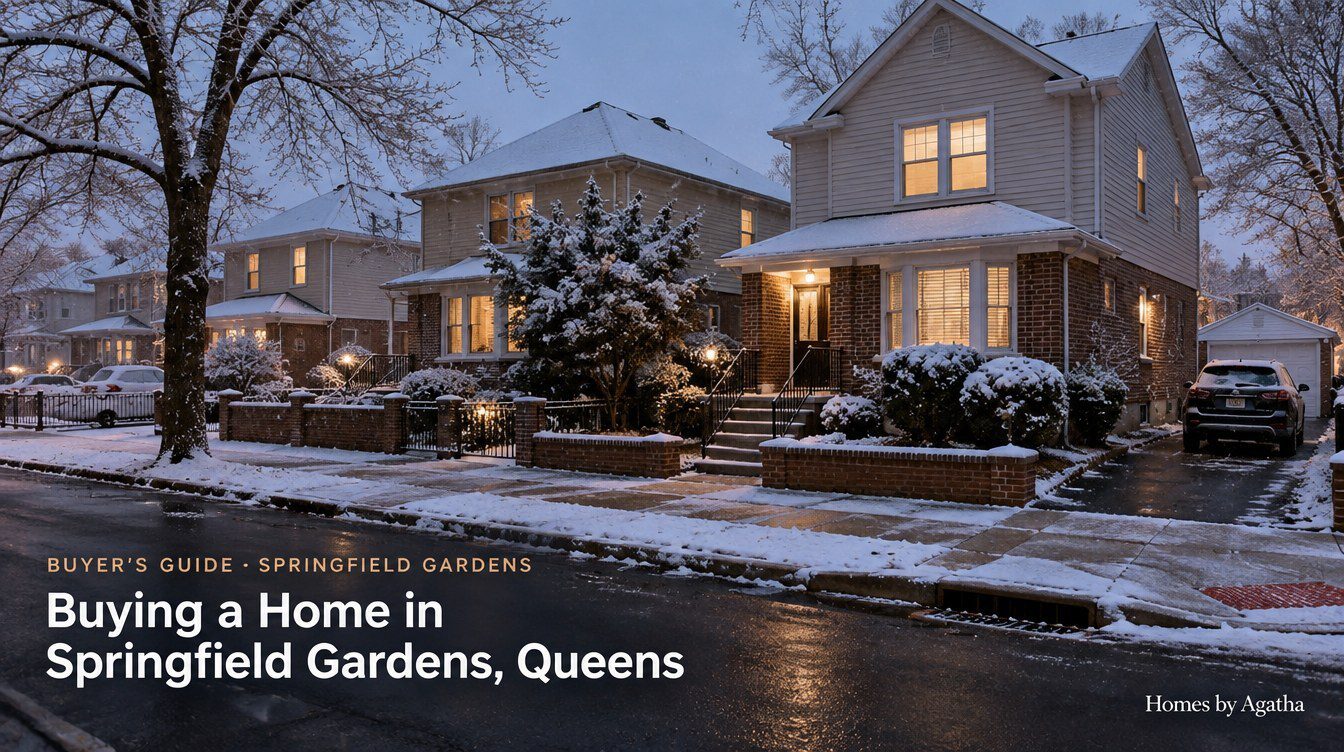
SPRINGFIELD GARDENS REAL ESTATE GUIDE
Buying a Home in Springfield Gardens, Queens: Drainage, Zoning, Airport Noise and the Paper Trail
Quick Answer
Buying a home in Springfield Gardens, Queens, usually means choosing a one- or two-family house. Before signing, research the block’s stormwater and basement-water history, confirm the zoning and legal unit count with NYC records, check FEMA flood maps and JFK noise maps, test the LIRR or bus commute, and budget for New York City closing costs.
This guide is for buyers who are seriously considering buying a home in Springfield Gardens, the low-lying southeast Queens neighborhood that sits just north of John F. Kennedy International Airport, between St. Albans to the north and Laurelton and Rosedale to the east. Almost everything for sale here is a house on its own lot, so the deciding questions concern the land, the building records and the location — not a co-op board.
Three local issues deserve more attention here than in a typical Queens purchase: water (a long history of street and basement flooding, and years of city sewer rebuilding), zoning (a 2005 rezoning of the western blocks), and the airport next door. None is a reason to rule the neighborhood in or out; each is a reason to check specific addresses carefully.
As a Licensed Associate Real Estate Broker based in Queens, I help buyers look past the listing photos to the records, the block and the transaction itself — in English or Polish, whichever is more comfortable. Where you buy is always your decision. If you already want to start a search, my Springfield Gardens buyer representation page explains how I work with buyers in this part of Queens.
Springfield Gardens at a glance
| Item | Springfield Gardens, Queens |
|---|---|
| Area | Southeast Queens, New York City; bordered by St. Albans (north), Laurelton and Rosedale (east), JFK Airport (south) and the Jamaica / Locust Manor area around Farmers Boulevard (west); boundaries vary by source, and the area falls within Queens Community Districts 12 and 13 |
| Borough / County | Queens / Queens County — New York City taxes and rules apply |
| ZIP codes | Mainly 11413 and 11434; confirm the ZIP code of a specific address with the USPS ZIP Code lookup |
| Rail | LIRR Locust Manor station (Farmers Boulevard and Bedell Street) on the western edge; Laurelton and Rosedale stations to the east; Jamaica station by bus. No subway station in the neighborhood. |
| Main roads | Belt Parkway and North / South Conduit Avenues along the southern side; Nassau Expressway to the southwest; Farmers, Merrick, Springfield, Rockaway, Baisley and Guy R. Brewer Boulevards |
| Parks | Springfield Park with Springfield Lake (Springfield Boulevard between 145th Road and 147th Avenue); Brookville Park on the Rosedale edge; Baisley Pond Park to the northwest |
| Commercial corridors | Merrick Boulevard, Springfield Boulevard, Farmers Boulevard and Rockaway Boulevard segments |
| Typical property types | Detached and semi-detached one- and two-family houses, many built in the mid-1900s; some newer attached and semi-attached homes; very limited co-op and condo inventory |
| Key housing considerations | Stormwater and groundwater history; 2005 R3X / R3-1 rezoning on 68 western blocks; legal unit count and basement use; proximity to JFK flight paths |
Which house types will you compare when buying a home in Springfield Gardens?
Most buyers in Springfield Gardens compare three kinds of houses: older detached one- and two-family homes, semi-detached houses, and newer attached homes built where an older house once stood. Each raises different maintenance, financing and resale questions.
When the NYC Department of City Planning studied the western blocks for its 2005 rezoning, it described the vast majority of homes there as one- and two-family detached and semi-detached houses built in the mid-1900s — low-rise, driveway-and-yard housing.
Mid-century detached houses
The detached houses you will tour are typically two-story frame or brick homes with a driveway, a rear yard and a basement. Many have been renovated more than once, so two houses that look alike from the street can differ greatly inside — one with a new roof and gas heat, the next with an original boiler and wiring. A detached two-family here is usually stacked, one unit per floor; whether the second unit is legal is a records question covered later.
Semi-detached houses
Semi-detached houses share one party wall and usually have their own driveway on the open side. The shared wall, roof line and drainage at the property line need attention during the inspection, and your attorney should check the survey for encroachments or driveway easements.
Newer attached and semi-attached homes
Before 2005, much of western Springfield Gardens was zoned R3-2, which allowed attached row houses and small multifamily buildings. DCP’s rezoning materials explain that the local civic association had raised concerns about older detached houses being torn down and replaced with attached and multi-unit buildings. Hence the short runs of newer attached homes beside older detached houses on some blocks.
These newer homes often have more modern systems and a recent Certificate of Occupancy. The trade-offs are smaller lots, shared walls and driveways, and — because the 2005 zoning no longer allows that form on many blocks — questions about rebuilding after a fire or other damage. The Zoning Resolution has specific rules for buildings that no longer comply with current zoning, so ask a land-use attorney how they would apply to the house you are considering. Comparable sales for attached homes should come from other attached homes, not from detached houses on the same street.
Co-ops and condos
Because the housing stock is mainly one- and two-family houses, co-op and condo choices inside Springfield Gardens are limited; a current OneKey MLS search shows what is actually available. Unlike a co-op purchase elsewhere in Queens, a house here needs no board approval: you own land and building outright and pay every bill directly.
What did the 2005 rezoning change, and why does it matter to a buyer today?
On April 12, 2005, the City Council adopted a Department of City Planning rezoning of all or parts of 68 blocks in western Springfield Gardens, replacing R3-2 zoning with R3X and R3-1 districts. Both new districts limit new residential construction to one- and two-family houses, so a buyer should not expect to add units or build attached housing on most of these blocks.
According to DCP’s Springfield Gardens rezoning summary, the rezoning area is bounded roughly by Baisley Boulevard to the northwest, Guy R. Brewer Boulevard to the east and North Conduit Avenue to the south.
| District (2005 rezoning) | Where (per DCP) | What it allows | Lot rules DCP lists | Buyer question |
|---|---|---|---|---|
| R3X | 26 full blocks and parts of 10 blocks, roughly bounded by Guy R. Brewer Boulevard, Baisley Boulevard, 153rd Street and 134th Avenue | One- and two-family detached houses only; maximum FAR 0.6 | Minimum lot width 35 feet; minimum lot area 3,325 sq ft | Does the planned extension fit within the floor-area limit? |
| R3-1 | The rest of the rezoning area, roughly between 134th Avenue, Guy R. Brewer Boulevard, North Conduit Avenue, Baisley Boulevard and 153rd Street | One- and two-family detached and semi-detached houses; maximum FAR 0.6 | Detached: 40-foot width, 3,800 sq ft; semi-detached: 1,700 sq ft | Is the existing house semi-detached legally, and does the lot meet current minimums? |
| C2-2 overlay (unchanged) | Along Rockaway Boulevard and North Conduit Avenue | Local commercial uses in the overlay area | Commercial rules apply in addition to the residential district | For mixed-use or corner property, is the commercial use legal and documented? |
| Blocks outside the 2005 area | Eastern Springfield Gardens and other edges | Depends on the mapped district | Check the lot individually | What district is the lot in today? Look it up on ZoLa. |
FAR, or floor area ratio, is a building’s total floor area divided by its lot area. A maximum FAR of 0.6 on a 4,000-square-foot lot means roughly 2,400 square feet of zoning floor area, subject to the Zoning Resolution’s detailed rules — so “room to expand” in a listing deserves a professional check.
Citywide zoning has also changed since 2005; the City of Yes for Housing Opportunity amendments, adopted by the City Council on December 5, 2024, revised some low-density rules, including accessory dwelling units (ADUs) in some circumstances. According to the Department of City Planning’s ADU guide, basement and cellar ADUs are not allowed in coastal and inland flood hazard areas, and basement and detached ADUs are not allowed in the city’s expanded future flood areas — a meaningful limit in a low-lying neighborhood. How these rules apply depends on the exact lot. Look up the exact lot on ZoLa, the NYC Department of City Planning zoning map, and have an architect or land-use attorney confirm any plan to add space or a unit.
Key Takeaways
- Springfield Gardens is primarily detached and semi-detached one- and two-family housing, with some newer attached homes from before 2005.
- The 2005 rezoning mapped R3X and R3-1 on 68 western blocks; both allow only one- and two-family houses and a maximum FAR of 0.6.
- Pull comparable sales by house type: attached, semi-detached and detached homes are different products.
- Confirm the lot’s current zoning on ZoLa before paying for “expansion potential.”
Not sure which house type fits your plans?
Tell me how you plan to use the house — one family, a rental unit, future expansion — and I will help you focus on Springfield Gardens listings whose zoning and layout support it.
How do you research stormwater and groundwater risk on a Springfield Gardens block?
Research water risk address by address, using official maps, the street’s sewer history and the house’s own evidence. In Springfield Gardens, flooding has historically come less from the ocean than from heavy rain, an incomplete storm sewer network and high groundwater, so a FEMA flood map alone does not tell the whole story.
Why water is a local issue here
Springfield Gardens is low-lying ground; according to NYC Parks, 17th-century settlers named the area “Spring Field” because the low-lying ground once had many springs. Many streets were built without a complete storm sewer system, and in October 2012 the NYC Department of Environmental Protection stated that heavy rain in Springfield Gardens had for years meant flooded roads and damaged homes.
Groundwater is a separate factor. According to NYC DEP, the privately owned Jamaica Water Supply Company operated wells serving southeast Queens from 1887 to 1996; the city then bought the Queens portion of the system, which supplied a limited part of Queens until 2007 and has not operated since. High groundwater has been a recurring concern in parts of southeast Queens, and conditions differ from block to block. Rain-driven street flooding and groundwater seepage need different fixes, so it helps to know which one a house has experienced.
What the city has built
NYC DEP describes a comprehensive $175 million, multi-phase upgrade of sewer and water infrastructure in Springfield Gardens. Its fourth phase, a $69 million project announced in 2012 for the area between South Conduit Avenue, 149th Avenue, Springfield Boulevard and 225th Street, included 84 catch basins, about 2.8 miles of new sewer lines and nearly 3 miles of water mains. A 2014 DEP update said the full upgrade would bring nine miles of storm sewers and eight miles of sanitary sewers to the area.
The same project created a Bluebelt — DEP’s term for a natural drainage system that stores and filters stormwater — at Springfield Lake in Springfield Park. More broadly, the city has described a $1.9 billion program to build out drainage across southeast Queens, delivered as many separate projects. To learn whether a specific street has completed, active or planned sewer work, check the NYC Department of Design and Construction’s project pages or ask Community Board 12 or 13.
New sewers on one street do not mean every nearby street has them, and street sewers do not lower groundwater under a basement. Ask when the block’s sewer work was finished and whether the house’s water history changed afterward.
Which maps and records to check
| Source | What it tells you | What it does not tell you |
|---|---|---|
| FEMA Flood Insurance Rate Map (FEMA Flood Map Service Center) | Whether the lot is in a Special Flood Hazard Area, which can trigger a lender’s flood-insurance requirement | Rain-driven street flooding or groundwater seepage outside mapped zones |
| NYC Stormwater Flood Maps (NYC DEP) | Modeled street flooding under moderate and extreme rainfall scenarios; available through the city’s flood maps site at nyc.gov/floodmaps | Conditions inside a specific basement |
| NYC DEP / DDC project records | Whether the street received new storm sewers and when | How the house itself performed before and after |
| Property Condition Disclosure Statement (PCDS) | The seller’s answers about water, drainage and flood history, for most 1–4 family sales | Problems the seller did not know about |
| Home inspection and specialists | Visible signs of water entry, sump pumps, backwater valves, grading and gutters | Future storm behavior |
Look up every serious address on the FEMA Flood Map Service Center and get a flood-insurance quote even if coverage is optional; it turns an abstract risk into a monthly number you can compare between houses.
How close is JFK, and how do you evaluate aircraft noise for a specific house?
JFK International Airport borders Springfield Gardens to the south, and some blocks lie under or near arrival and departure paths depending on which runways are in use. Aircraft noise varies by block, wind direction and time of day, so evaluate it for the specific address rather than for the neighborhood as a whole.
The Port Authority of New York and New Jersey, which operates JFK, completed a federal Part 150 noise study for the airport, including Noise Exposure Maps of modeled average noise levels. The maps and related documents are published on the Port Authority’s aircraft noise compatibility study page. Compare the specific block with the mapped contours there; whether a given address falls inside a contour is a map check, not a neighborhood-wide answer.
Noise contours describe averages, not individual flights. Visit the house at least twice — a weekday morning and an evening — and listen from the bedroom and the yard. Ask the seller about window upgrades or past sound-insulation work. The FAA approved JFK’s Noise Compatibility Program in March 2023, and its approved measures include sound insulation for eligible dwellings inside the mapped noise contours; ask the Port Authority whether a particular address is eligible and how the program is being rolled out. Treat traffic sound near the Belt Parkway, the Nassau Expressway or a busy boulevard as part of the same evaluation. The goal is not to label a house good or bad, but to price it against truly comparable homes on similar blocks.
Want help reading the block, not just the house?
I can help you pull together flood maps, sewer-project history and airport-noise maps for the addresses you are considering, so you compare houses on the same facts.
How do you get to Manhattan and around Queens from Springfield Gardens?
Springfield Gardens has no subway station; most rail commuters use the Long Island Rail Road, and most bus riders connect to the subway in downtown Jamaica. Drivers use the Belt Parkway along the southern edge and the major boulevards that run north toward Jamaica.
LIRR: Locust Manor, Laurelton and Rosedale
The Locust Manor station sits at Farmers Boulevard and Bedell Street on the western side of the neighborhood, on the LIRR’s Atlantic Branch. To the east, Laurelton and Rosedale stations serve the same line. Trains on this corridor run toward Jamaica, where riders can change for other LIRR trains, the E, J and Z subway lines and the AirTrain to JFK. Which trains stop at each station, how often they run at peak hours and which terminal they reach without a transfer change with each timetable, so check the current LIRR schedule on mta.info for your station and travel time.
Buses and the subway connection
Local buses run along the major north–south boulevards toward downtown Jamaica and its subway and LIRR stations. Route numbers, routings and stops can change, so check the current MTA bus map for the routes nearest a specific house, and ask whether any express bus to Manhattan stops within walking distance.
| Commute option | How it typically works from Springfield Gardens | What to test before you buy |
|---|---|---|
| LIRR from Locust Manor | Walk, bus or drive to Farmers Boulevard and Bedell Street; ride toward Jamaica and beyond | Walking time from the house; peak-hour train times; parking or drop-off |
| LIRR from Laurelton or Rosedale | Better fit for eastern blocks near Springfield Boulevard and the Rosedale edge | Which station is truly closest by foot; train frequency at your hours |
| Bus to Jamaica, then subway | Local bus along a north–south boulevard to downtown Jamaica, then the E, J or Z | Rush-hour bus time to Jamaica; transfer walk |
| Car | Belt Parkway east toward Long Island and west toward Brooklyn; Nassau Expressway; boulevards north to Jamaica | Driveway or garage; peak drive time; parkway access point nearest the block |
A house a few blocks from Locust Manor offers a different rail commute than one near Brookville Park, so ride your real commute once, at your actual travel hour, before making an offer.
If you are weighing several nearby areas, the guides to buying a home in Laurelton and buying in Saint Albans cover the neighborhoods directly east and north, and buying a home in Jamaica, Queens covers the transit hub most Springfield Gardens commuters pass through.
What will a Springfield Gardens purchase cost at closing and every month?
Plan for three layers: the down payment, closing costs paid at the closing table, and the monthly cost of owning a house that you maintain yourself. On a financed one- or two-family house in Queens, the largest buyer-side closing items are usually the NYC mortgage recording tax, title insurance, attorney fees and lender charges.
| Cost item | How it applies to a Springfield Gardens house | Source / who sets it |
|---|---|---|
| NYC mortgage recording tax | Roughly 1.8% of the loan amount for loans under $500,000 and 1.925% for $500,000 and above on 1–3 family homes and condos (co-op share loans are not subject to it) | NYC Department of Finance / New York State |
| NYS “mansion tax” | 1% of the price on residential purchases of $1 million or more, paid by the buyer; graduated above $2 million in New York City | NYS Department of Taxation and Finance |
| Title search and title insurance | Owner’s and lender’s policies on a fee-simple house | Title insurer rates |
| Buyer’s attorney | Required in practice for every New York purchase; fee quoted by the attorney | Negotiated with your attorney |
| Lender charges and appraisal | Financed purchases | Your lender’s Loan Estimate |
| Inspections | Home inspection plus sewer camera, oil-tank sweep, water-intrusion or drainage specialist as needed | Independent inspectors |
Confirm current rates with the NYS Department of Taxation and Finance and the NYC Department of Finance before closing.
The NYS real estate transfer tax and the NYC Real Property Transfer Tax are customarily paid by the seller, not the buyer, but contracts can shift costs. A line-by-line explanation of these items is in the Queens closing costs guide.
The monthly picture for a house here
A Springfield Gardens homeowner pays NYC property taxes (billed by the NYC Department of Finance), homeowner’s insurance, NYC DEP water and sewer charges, utilities and every repair. Two lines deserve extra attention here: flood insurance, which a lender may require for a house in a Special Flood Hazard Area with a federally backed mortgage, and a water-management reserve for sump pumps, backwater valves, regrading or waterproofing.
Pre-approval and financing questions specific to this area
Get a written pre-approval from an NMLS-registered mortgage loan originator before you tour seriously; a pre-qualification is only an estimate. Then raise three local issues early. Flood insurance, if required, becomes part of your monthly housing cost and can reduce how much you qualify for. Lenders generally count rent only from a legal unit, so a basement apartment not on the Certificate of Occupancy usually will not help you qualify. And attached, semi-detached and detached houses need matching comparables, because an appraisal below the contract price leaves a gap to cover in cash or renegotiate. First-time buyers can see the broader sequence in the first-time home buyer guide for Queens.
Key Takeaways
- Check every address on FEMA’s flood map and get a flood-insurance quote before making an offer.
- New street sewers reduce street flooding but do not change groundwater under a basement; ask about both.
- Use the Port Authority’s JFK noise maps and visit the house at different hours.
- Budget for the NYC mortgage recording tax and a reserve for water-management equipment.
Run the numbers before you fall for a house
We can outline closing costs, flood-insurance quotes and monthly carrying costs, so your pre-approval matches the houses you tour.
Which records prove what you are actually buying?
NYC Department of Buildings records prove a house’s legal use; the listing does not. Before you sign a contract, your attorney should compare the Certificate of Occupancy, permits and violations with how the house is actually built and used.
Certificate of Occupancy and legal units
A Certificate of Occupancy (CO) is the DOB document that states a building’s legal use and number of dwelling units. NYC buildings constructed before 1938 were generally not required to have one unless later altered. Because DCP describes most homes in western Springfield Gardens as mid-1900s construction, many will have a CO on file, but your attorney should confirm the record for the specific building. On newer attached homes, check that later changes, such as a finished basement or converted garage, were permitted.
Basement apartments in a low-lying neighborhood
Basement and cellar spaces are where the legal question and the water question meet. An unapproved basement apartment can create financing, insurance and violation problems, and it puts occupants at risk during heavy rain. After the remnants of Hurricane Ida flooded basements across Queens in September 2021, city agencies have paid renewed attention to basement occupancy and flood risk. Local Law 126 of 2024 created a pilot program, run by the Department of Buildings and HPD, to legalize certain existing basement and cellar apartments in one- and two-family homes, but only in designated community districts, and properties in flood-prone areas are not eligible. Ask your attorney whether any current program could apply to a specific house, and value a basement for what it legally is today.
If rental income is part of your plan, read the guide to buying a multi-family home in Queens before you make an offer on any two-family.
| Record or check | Where it comes from | Why it matters in Springfield Gardens |
|---|---|---|
| Certificate of Occupancy / legal units | NYC Department of Buildings | Confirms whether a “two-family” or basement unit is legal; affects loan approval and rental plans |
| Open permits, violations and completed jobs | DOB records; OATH/ECB records via your attorney | Finished basements, rear extensions and drainage work are common alterations |
| Zoning district | NYC DCP ZoLa | R3X and R3-1 lots allow one- and two-family houses only; attached homes may be non-complying |
| Flood zone and flood-insurance quote | FEMA Flood Map Service Center; insurer | Determines lender requirements and real monthly cost |
| Survey and title report | Your attorney and title company | Shared driveways, party walls and easements on semi-detached and attached homes |
What should a home inspection focus on in Springfield Gardens?
A licensed New York home inspector should cover the whole house, but in Springfield Gardens the findings that most often change a deal involve the basement and drainage, the sewer line, the heating system and any oil tank, and shared elements on attached homes. Add specialists when the general inspection points to a problem.
Basement water and site drainage
Ask the inspector to look for efflorescence (white mineral deposits on masonry), water lines, rust at the base of the boiler, fresh paint low on basement walls and musty odors. Outside, check that the ground and downspouts direct water away from the foundation and that the driveway does not channel water toward a basement door. If there is a sump pump, ask where it discharges and how often it runs.
Sewer line and backwater valve
In New York City, the property owner is responsible for the sewer service line from the house to the connection at the street. A sewer camera inspection shows roots, cracks, sags or blockages. Ask whether the house has a backwater valve — a device that helps prevent sewage from backing up into the house when the street sewer is overloaded — and whether it was installed with the required plumbing permit. A licensed master plumber can confirm the valve’s condition and explain the current permit requirements.
Heating, oil tanks, wiring and shared walls
Many mid-century Queens houses were built with oil heat and later converted to gas; ask whether an old tank was removed or abandoned in place, and order a tank sweep if records are missing. Have the inspector report the electrical service size, and on attached or semi-detached homes check the party wall, shared roof line and flashing. For houses built before 1978, federal law requires sellers to disclose known lead-based paint hazards and offer buyers an opportunity to test.
Plan your due-diligence window
Let’s line up the inspector, sewer camera, tank sweep and records review in the right order, so you have answers before the contract and deposit are on the table.
How do offers, attorneys and buyer-agent agreements work in a New York purchase?
In New York, an accepted offer is not a binding deal: after the seller accepts, the buyer’s and seller’s attorneys negotiate the contract of sale, and the purchase becomes binding only when both sides sign and the buyer delivers the contract deposit. That gap between acceptance and contract is when most due diligence happens.
From accepted offer to signed contract
The seller’s attorney usually drafts the contract; your attorney reviews it, examines title and building records, and negotiates riders such as a mortgage contingency or how an open permit will be handled. The contract deposit, often around 10% of the price, is typically held in escrow by the seller’s attorney. Once you sign, you can cancel only as the contract allows, so finish the inspection, sewer camera and records review first.
Structuring an offer on a Springfield Gardens house
Sellers compare price, financing type, down payment, pre-approval strength, contingencies and closing date. Base your price on recent sales of truly similar houses — same building type, unit count and condition. If inspection findings involve water, a specific credit tied to a contractor’s estimate is often easier to negotiate than a long repair list.
Buyer representation under the post-2024 rules
A buyer’s agent represents your interests in the search, evaluation and negotiation. Under the rules in effect in 2026 following the 2024 NAR settlement, you sign a written buyer agreement before touring homes with an agent, and that agreement states how the agent is paid. Buyer-agent compensation is negotiable, is not set by law and is not automatically paid by the seller; a seller may agree to contribute as part of the deal.
You will also receive the NYS Disclosure Form for Buyer and Seller at your first substantive contact with an agent; it explains agency relationships so you know whom each agent represents. For details, see working with a buyer’s agent in New York.
Shape your offer before the right house appears
We can decide in advance how you will handle price, financing terms and water-related inspection findings, so your offer on a Springfield Gardens house is clear and quick.
How long does buying take, and which mistakes are most common here?
A financed house purchase in Springfield Gardens commonly takes about two to three months from accepted offer to closing. The hardest delays usually involve legal-use questions, open permits or insurance, not the house itself.
| Stage | What happens | Springfield Gardens focus | Common range (varies) |
|---|---|---|---|
| Preparation | Pre-approval, buyer agreement, budget | Ask the lender about flood insurance and two-family income | 1–4 weeks |
| Search and offer | Tours, comparable-sales review, offer accepted | Compare by house type; check FEMA and noise maps per address | Varies |
| Due diligence and contract | Inspection, specialists, DOB records, title, contract signing with deposit | Basement water, sewer camera, CO and legal units | Often 1–3 weeks |
| Mortgage commitment | Appraisal and underwriting | Matching comparables; flood insurance bound if required | Often 3–6 weeks after contract |
| Clear to close | Title cleared, insurance in place, closing scheduled | Violations or unpaid charges resolved | Often 1–2 weeks |
| Walk-through and closing | Confirm condition; sign; pay; receive keys | Check the basement after any recent heavy rain | Closing day |
Mistakes to avoid
- Relying on the FEMA map alone. In Springfield Gardens, rain-driven flooding and groundwater can matter even outside a mapped flood zone.
- Assuming the street’s new sewers solved the basement. Ask what changed after the work was finished.
- Paying for an unverified unit. Confirm legal units through DOB records before valuing rental income.
- Pricing an attached home off detached sales. Use comparables of the same building type.
- Draining reserves at closing. A sump pump, backwater valve or regrading job in year one is easier with a cushion.
Springfield Gardens buyer checklist
Use these steps in order, from first conversation to closing day.
- Get a written pre-approval and ask how flood insurance and two-family rental income affect your numbers.
- Sign a written buyer agreement and review the NYS Disclosure Form for Buyer and Seller.
- Decide which house type you want — detached, semi-detached or attached — and whether a legal two-family is essential.
- Test your commute from Locust Manor, Laurelton or Rosedale station, or by bus to Jamaica, at your real travel time.
- For each serious address, check zoning on ZoLa, the FEMA flood map and the Port Authority’s JFK noise maps.
- Ask the listing agent whether the street received new sewers and when, and request the seller’s PCDS.
- Review comparable sales of the same house type before setting your offer price.
- After acceptance, schedule the inspection, sewer camera and tank sweep, and have your attorney review the CO, permits, violations, survey and title.
- Get homeowner’s and flood-insurance quotes, and bind coverage before closing.
- Sign the contract and pay the deposit only when due diligence is complete.
- Do the final walk-through, check the basement, and close with a reserve still in place.
Many buyers compare Springfield Gardens with the neighborhoods around it; the guide to buying a home in Cambria Heights covers a nearby area with different zoning and transit. If you own a house here and need to sell before buying your next home, the page on how I help owners sell a home in Springfield Gardens explains the seller side.
Start your Springfield Gardens search with a plan
A short conversation can connect your budget, commute and house type to the right blocks, and set up the checks that protect you before contract.
Frequently asked questions about buying a home in Springfield Gardens
What types of homes are for sale in Springfield Gardens, Queens?
Most homes in Springfield Gardens are detached or semi-detached one- and two-family houses, many built in the mid-1900s according to NYC Department of City Planning rezoning materials. Some blocks also have newer attached homes built before the 2005 rezoning. Co-op and condo listings are uncommon inside the neighborhood itself.
Does Springfield Gardens have flooding problems?
Parts of Springfield Gardens have a documented history of street and basement flooding from heavy rain and high groundwater. NYC DEP has carried out a $175 million phased sewer and water upgrade there, including a Bluebelt at Springfield Lake. Buyers should still research each address, its street’s sewer history and the house’s own water record.
Is Springfield Gardens in a FEMA flood zone?
Flood-zone status depends on the specific lot, so check each address on the FEMA Flood Map Service Center. If a house is in a Special Flood Hazard Area and has a federally backed mortgage, the lender may require flood insurance. Remember that rain-driven flooding and groundwater can occur outside mapped flood zones.
How noisy is it living near JFK in Springfield Gardens?
Aircraft noise varies by block, runway use, wind and time of day. The Port Authority’s Part 150 noise study for JFK publishes Noise Exposure Maps showing modeled average noise levels. Check the specific address on those maps, visit the house at different hours, and ask the seller about window upgrades or past sound-insulation work.
Which LIRR station serves Springfield Gardens?
Locust Manor station, at Farmers Boulevard and Bedell Street, serves the western side of Springfield Gardens on the LIRR’s Atlantic Branch. Laurelton and Rosedale stations are closer to the eastern blocks. Trains run toward Jamaica for connections; confirm branch service, frequency and Manhattan terminals on the current MTA LIRR timetable.
What zoning applies to houses in Springfield Gardens?
In 2005 the City Council rezoned 68 western blocks from R3-2 to R3X and R3-1. R3X allows one- and two-family detached houses; R3-1 also allows semi-detached houses. Both have a maximum floor area ratio of 0.6. Eastern blocks have other mappings, so check each lot on NYC Planning’s ZoLa map.
How can I tell if a Springfield Gardens two-family is legal?
Check the Certificate of Occupancy and NYC Department of Buildings records rather than the listing or the number of kitchens. Your attorney should confirm the legal unit count, open permits and violations before contract. Lenders usually count rental income only from legal units, and illegal basement units can block financing and put occupants at risk in floods.
What closing costs do buyers pay in Springfield Gardens?
Buyers usually pay the NYC mortgage recording tax on financed purchases, title insurance, attorney fees, lender charges and escrow deposits. Purchases of $1 million or more add the NYS mansion tax. The NYS transfer tax and NYC Real Property Transfer Tax are customarily the seller’s costs, although contracts can allocate costs differently.
Should I get a sewer camera inspection on a Springfield Gardens house?
Yes, it is a sensible add-on. New York City owners are responsible for the sewer line from the house to the street, and a camera inspection reveals roots, cracks, sags or blockages. Ask also whether the house has a permitted backwater valve, which helps prevent sewage backups when street sewers are overloaded.
Do I have to pay my buyer’s agent when buying in Springfield Gardens?
Buyer-agent compensation is negotiable and not set by law. Under the rules in effect in 2026, you sign a written buyer agreement before touring that states how your agent is paid. The seller is not automatically required to pay it, though a seller may agree to contribute as part of negotiations.
Summary and your next step
Buying a home in Springfield Gardens rewards buyers who research the address, not just the house: confirm zoning and legal units, read the block’s water history alongside the FEMA map, check the JFK noise maps, and price against the right house type. When you are ready to turn this research into tours and an offer, the Springfield Gardens home buying services page explains how we can work together.
This article is for general informational purposes only and reflects conditions that may change. It is not legal, tax, or financial advice, an appraisal, or a guarantee of price or outcome; consult a licensed New York attorney, a CPA, and an NMLS-registered mortgage loan originator as appropriate. A CMA is an opinion of value, not an appraisal. Real estate brokerage services are offered by Agatha Lubas, Licensed Associate Real Estate Broker, NY License #10301213345, Keller Williams Realty Liberty, 96-10 101st Avenue, Ozone Park, NY 11416. The NYS Disclosure Form for Buyer and Seller, the NYS Housing and Anti-Discrimination Disclosure / Fair Housing Notice, and the brokerage’s Standard Operating Procedures are available on request. Equal Housing Opportunity.

Agatha Lubas helps buyers, sellers and investors across Queens, Brooklyn, Nassau County and Suffolk County, with a focus on careful due diligence and the New York attorney-based transaction process. She works in English and Polish so clients can communicate in the language they find most comfortable.
Work with Agatha