
SUFFOLK COUNTY REAL ESTATE GUIDE
Buying a House in Suffolk County: Septic, Water, Taxes and Town Rules Explained
Quick Answer
Buying a house in Suffolk County, Long Island, means checking what sits under and around the house: its cesspool, septic or I/A system under county health rules, public water or a private well, town or village permits, FEMA flood maps, the LIRR branch, and, in the five East End towns, a buyer-paid 2% Peconic Bay transfer tax.
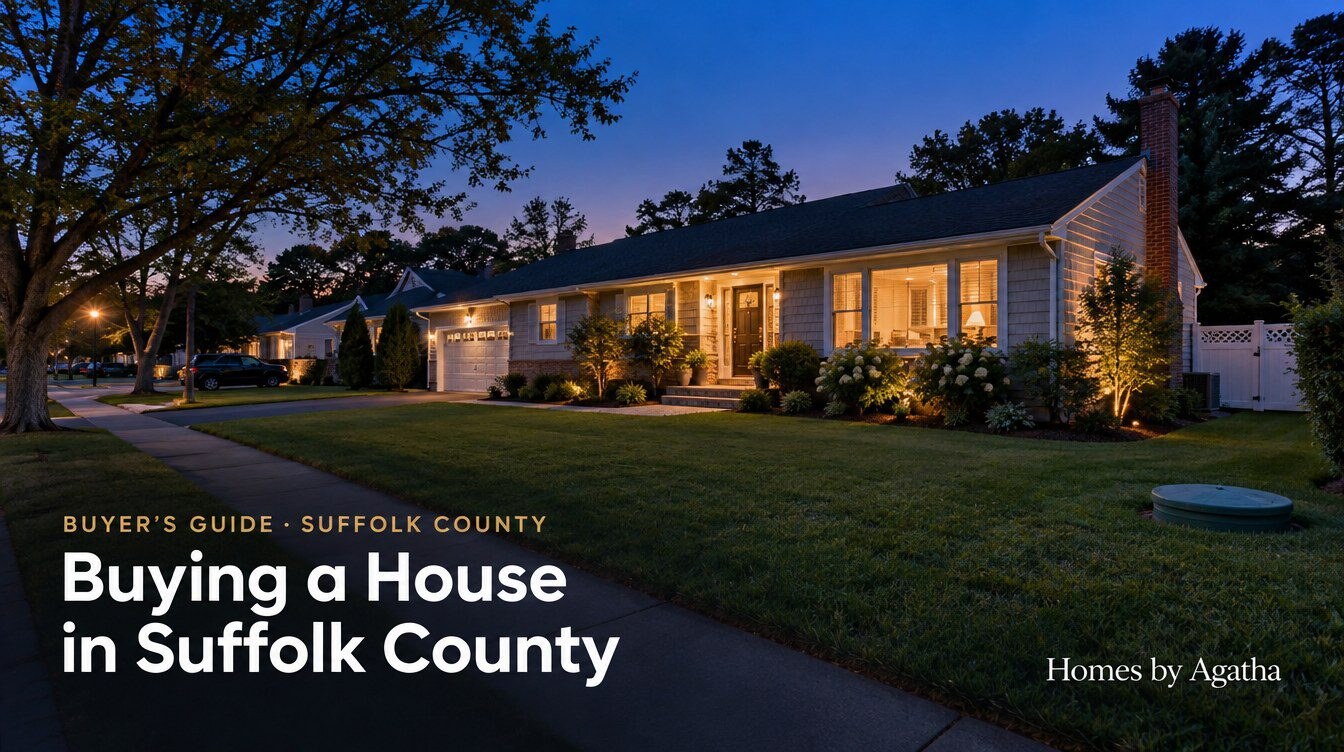
This guide is for anyone researching buying a house in Suffolk County: people moving out from Queens or Brooklyn, Nassau County owners heading east, and buyers weighing a year-round house on the North Shore against one on the North Fork or South Fork.
Suffolk County is the eastern half of Long Island, running from the Nassau County line to Montauk Point and Orient Point. It is divided into ten towns, dozens of incorporated villages and many unincorporated hamlets. Much of the county is not on public sewers, a meaningful number of homes draw water from private wells, and the East End towns add a transfer tax that the buyer pays at closing. Those three facts change the budget, the inspection plan and the contract.
As a Licensed Associate Real Estate Broker serving Queens, Brooklyn, Nassau County and Suffolk County, I help buyers evaluate both the property and the transaction process, in English and Polish. Below are the records, systems, costs and commute facts to check, plus a checklist for any Suffolk address.
Suffolk County at a glance
| Item | What applies in Suffolk County |
|---|---|
| Area | Eastern Long Island, from the Nassau County line to Montauk Point (South Fork) and Orient Point (North Fork), including Shelter Island and most of Fire Island; county seat in Riverhead |
| Towns (10) | Babylon, Brookhaven, East Hampton, Huntington, Islip, Riverhead, Shelter Island, Smithtown, Southampton, Southold |
| ZIP codes | Dozens; a postal address does not always match the town, village or taxing district, so confirm with the tax bill and the Suffolk County Tax Map number |
| Rail and other transit | LIRR Babylon, Montauk, Ronkonkoma and Port Jefferson branches (check current timetables on mta.info); Suffolk County Transit buses; ferries to Shelter Island, Fire Island and Connecticut |
| Main parks / landmarks | Fire Island National Seashore, Robert Moses State Park, Sunken Meadow State Park, Caleb Smith State Park Preserve, the Central Pine Barrens, Montauk Point State Park |
| Typical property types | Detached ranches, Cape Cods, colonials, split-levels and high-ranches; canal-front and bay-front houses; East End farmhouses, cottages and new construction; condominium and townhouse communities; limited co-op stock |
| Sewage and water | Mostly on-site systems (cesspool, septic or I/A) regulated by the Suffolk County Department of Health Services; public water mainly from the Suffolk County Water Authority and local districts; private wells in some areas |
| Buyer-side transfer taxes | NYS mansion tax (1% at $1 million and up); mortgage recording tax; Peconic Bay Region CPF tax (2%) in the five East End towns; no NYC Real Property Transfer Tax |
How is Suffolk County organized, and who holds a house’s records?
Suffolk County is divided into ten towns. Each town assesses property, collects taxes through its Receiver of Taxes and, outside incorporated villages, issues building permits and Certificates of Occupancy. Incorporated villages, such as Amityville, Patchogue, Port Jefferson, Northport, Greenport and Sag Harbor, run their own building departments. Deeds and mortgages are recorded with the Suffolk County Clerk, and sanitary and private-well rules come from the Suffolk County Department of Health Services (SCDHS).
The office that holds a record depends on the exact address. A house in an unincorporated hamlet of the Town of Brookhaven has its permits at Brookhaven Town Hall; a house inside the Village of Patchogue, also in Brookhaven, has its permits at the village.
The Suffolk County Tax Map number
Every Suffolk County parcel has a Suffolk County Tax Map number, shown as District, Section, Block and Lot. It is the most reliable way to identify a property, because hamlet and postal names often cross town and village lines. Ask for it early and use it to request the tax bill, survey and permit history.
How the Suffolk property tax bill works
The town assessor values the property, and the town Receiver of Taxes collects one combined bill for county, town and local district levies. The tax year runs from December 1 to November 30; the first half is due by January 10 and the second half by May 31, after which unpaid taxes become delinquent and are payable to the Suffolk County Comptroller. Incorporated villages generally bill village taxes separately, on their own schedule, so ask the village clerk or treasurer for the due dates.
This differs from Nassau County, where one county department assesses property. Because each Suffolk town sets assessments on its own basis, compare actual tax bills, not assessed values, when you compare houses in different towns. An owner who believes an assessment is too high can file a grievance with the town’s Board of Assessment Review; the filing window is short, so ask the town assessor for the current grievance date.
What kinds of houses are for sale in Suffolk County?
Most homes for sale in Suffolk County are detached single-family houses on their own lots: post-war ranches and Cape Cods, colonials, split-levels and high-ranches. The county also has canal-front and bay-front houses on the South Shore, harbor and bluff properties on the North Shore, seasonal cottages and new construction on the East End, and condominium and townhouse communities. Co-ops exist but are far less common than in Queens.
Western and central Suffolk
Babylon, Huntington, Islip, Smithtown and much of Brookhaven contain large areas of mid-twentieth-century subdivisions, with colonials and newer infill among them. Many of these houses have been expanded with dormers, extensions, decks and finished basements, which is why the permit history matters. Parts of the Babylon and Islip South Shore are served by public sewers, while much of the rest of western Suffolk relies on on-site systems. Sewer availability is an address-level question: the tax bill, the seller and the Suffolk County Department of Public Works can confirm it.
The East End and Fire Island
East of the Pine Barrens, the county splits into the North Fork (Riverhead and Southold) and the South Fork (Southampton and East Hampton), with Shelter Island between them. The housing stock includes farmhouses, older village homes, seasonal cottages and new construction, with a large share of second homes. East End purchases bring two Suffolk-specific items into the budget: the Peconic Bay transfer tax and, in some areas, private wells. Fire Island communities, in the towns of Islip and Brookhaven, are reached mainly by ferry and have limited vehicle access, so utilities, logistics and flood insurance need separate checks.
House vs. condo vs. co-op in Suffolk County
| Factor | Detached house | Condo or townhouse community | Co-op (less common) |
|---|---|---|---|
| What you own | Land and building | Your unit plus a share of common elements | Shares in a corporation plus a proprietary lease |
| Sanitary system and water | Yours to inspect and maintain | Often a shared system or sewer run by the association — ask | Managed by the corporation |
| Monthly costs beyond the mortgage | Property taxes, insurance, maintenance | Common charges plus your own taxes and insurance | Maintenance, typically including a share of building taxes and any underlying mortgage |
| Approval | Lender and attorneys only | Association documents; usually no interview | Board application and, usually, an interview; rules vary by building, so ask the managing agent |
| Main due-diligence focus | Permits and CO, sanitary system, water, flood zone, survey | Budget, reserves, rules, shared systems | Financials, underlying mortgage, sublet rules |
Not sure which part of Suffolk fits your plans?
Tell me how you commute, what kind of house you want and your budget, and I will help you build a shortlist of towns and property types to compare on facts.
What does a cesspool, septic or I/A system mean when buying a house in Suffolk County?
When buying a house in Suffolk County, the sanitary system is one of the largest items you can inherit, because most homes are not on public sewers. A house may have an older cesspool, a septic tank with leaching pools, or a newer nitrogen-reducing I/A system. Each carries a different inspection plan, maintenance cost and future obligation.
The three systems, defined
- Cesspool. A buried structure that receives household wastewater and lets it seep into the ground without a separate settling tank. Many older Suffolk houses were built with cesspools.
- Septic system. A septic tank, where solids settle, followed by leaching pools that disperse the liquid into the soil.
- I/A OWTS. An innovative and alternative onsite wastewater treatment system adds treatment that reduces nitrogen before effluent reaches the ground. SCDHS approves specific technologies under Article 19 of the Suffolk County Sanitary Code.
The county rules a buyer should know
Article 6 of the Suffolk County Sanitary Code changed in two steps. Since July 1, 2019, replacing or retrofitting a system requires SCDHS approval, and the new system must meet current standards, which call for at least a septic tank ahead of a leaching structure; an old cesspool is no longer simply swapped for a new one. Since July 1, 2021, an I/A system is required for new single-family construction and for major renovations or expansions that trigger health department review, such as adding bedrooms. The exact thresholds and definitions are set by SCDHS, so ask the department or a design professional how they apply to your plans.
For a buyer, the meaning is practical: if you plan to add bedrooms, rebuild or substantially expand, an I/A system may be part of the project, and that cost belongs in your budget before you set your offer. Some towns and villages, especially on the East End, may add their own wastewater rules, so ask the town or village building department what applies to the address. Rules in this area have been changing, so before you sign, ask SCDHS and the town or village whether any inspection or upgrade is required when a house is sold.
How to inspect the sanitary system
A general home inspection rarely evaluates a buried system in depth. Many Suffolk buyers hire a separate septic contractor to locate the covers, pump the system, inspect the structures and run a flow or dye test or a camera. Ask the seller for pumping records and any SCDHS approvals. For an I/A system, ask for the maintenance contract and service history, because these systems need ongoing professional maintenance. Ask your attorney and the service provider how the maintenance contract and any SCDHS registration pass to a new owner.
Sewers and upgrade grants
Some houses are on sewers, including parts of Babylon and Islip served by the county’s Southwest Sewer District and some villages and other districts; the tax bill often shows a sewer district charge. In November 2024, Suffolk voters approved a proposition under the Suffolk County Water Quality Restoration Act adding a one-eighth-percent sales tax to fund sewer projects and grants for replacing cesspools and septic systems with nitrogen-reducing systems. If you plan an upgrade, ask about the county’s Septic Improvement Program and any town rebate before budgeting the full cost yourself. Grant amounts and eligibility change, so confirm them with the county program and the town before you count on them.
How do you check the water supply on a Suffolk County house?
A Suffolk County house is served either by public water, mostly from the Suffolk County Water Authority or a local water district, or by a private well. Public water is tested by the supplier; a private well is the owner’s responsibility, so it needs its own testing before you sign a contract.
According to SCDHS, an estimated 40,000 to 45,000 private wells serve households in Suffolk County, and they are more common on the East End and in areas without public mains. Whether a specific address has public water is a question for the Suffolk County Water Authority or the local water district. The SCDHS Private Well Water Testing Program analyzes drinking water for microbiological quality, inorganic chemicals, volatile organic compounds, petroleum products and certain pesticides, for a fee.
What to check on a well
- Water quality. A recent laboratory test covering more than bacteria.
- Equipment. Pump, pressure tank and any treatment system, with age and service records.
- Location. Distance from the sanitary system, fuel tanks and property line, shown on the survey; SCDHS sets the separation standards, and a well contractor can tell you whether the layout meets them.
- Lender rules. Some loan programs require a water test or minimum separation distances; ask your lender which requirements apply to your loan type.
Key Takeaways
- Most Suffolk County houses rely on on-site sanitary systems, so a separate septic or cesspool inspection is normal due diligence.
- Since July 2021, new homes and major expansions that trigger health department review generally need a nitrogen-reducing I/A system.
- Tens of thousands of Suffolk households use private wells; test the water before you commit.
Want a due-diligence plan before you tour?
I can help you list which inspections, tests and records to request for each Suffolk house on your shortlist, so nothing important waits until after contract.
What are the closing costs of buying a house in Suffolk County?
A Suffolk County buyer typically pays the mortgage recording tax on a financed purchase, the NYS mansion tax at $1 million or more, the Peconic Bay CPF tax on East End purchases above the town’s exemption, title insurance, recording fees, attorney and lender fees, escrow deposits and inspections, including a separate septic inspection and any well test. The NYC Real Property Transfer Tax does not apply in Suffolk.
| Buyer cost | Source | How it applies in Suffolk County |
|---|---|---|
| Mortgage recording tax | NYS Department of Taxation and Finance; collected by the Suffolk County Clerk | Generally 1.05% of the mortgage amount outside New York City; how the total is divided between borrower and lender on one- and two-family homes follows the County Clerk’s published formula |
| “Mansion tax” | NYS Department of Taxation and Finance | 1% of the full price on residential purchases of $1 million or more; not graduated outside New York City |
| Peconic Bay Region CPF tax | Town law, five East End towns | 2% on the portion of the price above the town’s exemption; East Hampton, Riverhead, Shelter Island, Southampton and Southold only |
| Community Housing Fund tax | Town law where approved | An added 0.5% in towns that have established a Peconic Bay Community Housing Fund (East Hampton, Shelter Island, Southampton and Southold); paid by the buyer like the CPF tax |
| NYC Real Property Transfer Tax | NYC Department of Finance | Does not apply in Suffolk County |
| Title insurance and searches | Title insurer | Includes municipal searches, usually with a town or village CO and permit search |
| Tax adjustments and escrow | Contract; lender | Driven by Suffolk’s December–November tax year and its January 10 / May 31 due dates |
Confirm current rates with the NYS Department of Taxation and Finance and the Suffolk County Clerk before closing.
The Suffolk County Clerk publishes the mortgage tax formula it applies at recording. If you are comparing with a purchase in the city, Queens closing costs explained shows how New York City’s taxes differ.
An illustration of the arithmetic
This arithmetic uses a hypothetical $700,000 price with a $560,000 mortgage on a one-family house, for illustration only; it is not an estimate of any Suffolk home’s value. The mortgage recording tax at 1.05% would come to about $5,880 before the borrower–lender split and any small adjustment the County Clerk’s formula applies. No mansion tax applies below $1 million. In the Town of Riverhead, where state law sets a $200,000 exemption for improved property sold for $2,000,000 or less, the CPF tax would be 2% of $500,000, or $10,000. Your attorney and title company will calculate the exact figures.
How does the Peconic Bay CPF tax work for East End buyers?
The Peconic Bay Region Community Preservation Fund (CPF) tax is a 2% real estate transfer tax paid by the buyer in the towns of East Hampton, Riverhead, Shelter Island, Southampton and Southold. It applies to the part of the price above each town’s exemption, and the towns use the revenue for land preservation and related purposes.
Exemption thresholds
The Town of Southampton’s published guidance states that the first $400,000 of consideration is exempt for improved residential property and the first $100,000 for vacant residential land, and that the improved-property exemption applies only when the consideration is $2,000,000 or less. State Tax Law section 1449-ee sets the same $400,000 improved and $100,000 unimproved exemptions for East Hampton and Shelter Island, and $200,000 improved and $75,000 unimproved exemptions for Riverhead and Southold; in every town, the residential exemption applies only where the consideration is $2,000,000 or less. Confirm the figures with the town’s CPF office for your closing date.
The Community Housing Fund tax
In November 2022, voters in East Hampton, Shelter Island, Southampton and Southold approved a separate 0.5% transfer tax for a Peconic Bay Community Housing Fund; Riverhead did not adopt it. Where it applies, it comes on top of the 2% CPF tax; the Town of Southampton’s guidance, for example, describes a 2.5% total that includes the 0.5% housing fund tax. State law makes the grantee — the buyer — responsible for paying the Peconic Bay transfer taxes. Ask the town’s CPF office how exemptions apply to the housing fund portion.
First-time buyer exemption and filing
State law provides a first-time homebuyer exemption from the CPF tax in East Hampton, Shelter Island, Southampton and Southold for a primary residence, subject to purchase-price and household-income limits tied to State of New York Mortgage Agency program limits for Suffolk County. Ask the town’s CPF office for the current limits and application steps. The application generally has to be approved before closing, so raise it with your attorney as soon as an offer is accepted. At closing, the title closer typically collects the tax.
Plan to pay the CPF tax from your own funds at closing; an East End purchase at $1 million or more can carry both the CPF tax and the mansion tax. The Town of Southampton’s CPF tax FAQ explains its exemptions and filing; the other East End towns publish similar guidance.
Comparing an East End house with one farther west?
Let’s line up the full cash-to-close for each option, including the CPF tax, the mansion tax and the mortgage recording tax, before you decide where to make an offer.
How should you plan pre-approval and financing for a Suffolk County purchase?
Get a full pre-approval from an NMLS-registered mortgage loan originator before touring seriously, and tell the lender early about Suffolk-specific features: a private well, an older cesspool, a flood zone, waterfront structures or a second-home purchase. These features change the documents, inspections, insurance and timing a lender requires.
Property features that affect financing
- Wells and on-site systems. Government-backed loans in particular can require water tests and separation distances.
- Flood zones. In a FEMA Special Flood Hazard Area, a federally regulated or insured lender will generally require flood insurance.
- Second homes. A seasonal East End or Fire Island house is underwritten as a second home or investment property depending on your intended use.
Build your monthly budget from the actual Suffolk tax bill, homeowners and any flood insurance, septic pumping or I/A maintenance, well upkeep, heating fuel and, for condos, common charges. Two houses at the same price can carry very different monthly costs.
How do you commute from Suffolk County by LIRR, road or ferry?
Suffolk commuters rely on four Long Island Rail Road branches, the highway network and, in some places, ferries. Commute time depends mostly on which branch serves your station, whether the line is electrified there, and how far you drive to the station.
| LIRR branch | Suffolk area it serves | Commuter notes |
|---|---|---|
| Babylon Branch | Town of Babylon South Shore: Amityville, Copiague, Lindenhurst, Babylon | Electrified; Babylon is the transfer point for Montauk Branch trains |
| Montauk Branch | South Shore of Islip and Brookhaven, then the South Fork to Montauk | Diesel east of Babylon; less frequent service farther east |
| Ronkonkoma Branch (Main Line) | Central Suffolk to Ronkonkoma, continuing to Riverhead and Greenport | Electrified to Ronkonkoma; limited diesel service beyond |
| Port Jefferson Branch | North Shore: Huntington, Northport, Smithtown, Stony Brook, Port Jefferson | Electrified to Huntington; diesel beyond |
Trains from Suffolk head west through Jamaica toward Manhattan and Brooklyn terminals; whether your train runs through or requires a change depends on the station, branch and hour, so check the current timetable on mta.info. Ride the trip at the hour you would commute, and ask the town that runs the station lot whether parking requires a permit and who can get one.
By road, the Long Island Expressway (I-495) runs east to Riverhead, joined by the Northern State and Southern State parkways and Sunrise Highway (NY 27); Suffolk County Transit runs buses across the county. Ferries matter for specific addresses: the North and South ferries serve Shelter Island, passenger ferries serve Fire Island, and the Port Jefferson–Bridgeport and Orient Point–New London ferries link Suffolk with Connecticut.
If you are also considering a home closer to the city, the guides to buying a home in Nassau County and buying a home in New York City cover those markets.
Want to test the commute before you commit?
I can help you map each house on your list to its station, branch and parking options, so you compare commutes on real information rather than distance alone.
What should you check on a Suffolk County house before you sign?
Before signing a contract, confirm that the Certificate of Occupancy and permits cover every part of the house you are paying for, that any rental unit is legal under town rules, and that the flood zone, wetlands, survey, fuel tanks and sanitary system have been checked. In New York, these checks normally happen before the contract is signed.
Certificate of Occupancy and permits
A Certificate of Occupancy, or CO, is the document a town or village building department issues to confirm that a structure or addition was approved for its use. Suffolk buyers often find that a deck, pool, dormer, garage conversion, finished basement or extension lacks a permit or a final CO. Ask your attorney to compare the CO search with what you see in the house. Houses built before a town required COs may have a pre-existing CO or a similar town letter; the cutoff date and process differ by town or village, so ask the building department.
Unpermitted work does not always stop a sale, but it shifts cost and risk: legalizing it can require plans, inspections and, if bedrooms were added, a health department review of the sanitary system. The contract should say who resolves open items before closing.
Accessory apartments and rentals
Accessory apartments in Suffolk generally need a town or village permit, which may be tied to the owner living in the house, and a seller’s permit may not transfer to you; ask the town about its current rules and transferability. Seasonal rentals can also require a town permit or registration, especially on the East End. Confirm the rules before counting on rental income.
Flood zones, wetlands and coastal rules
Large parts of the South Shore along the Great South Bay, Fire Island, the Peconic bays and other low-lying waterfront areas fall within FEMA flood zones. Look up the address on the FEMA Flood Map Service Center, ask for any elevation certificate and get a flood insurance quote before you sign. Work near tidal wetlands, bulkheads and docks can require permits from the NYS Department of Environmental Conservation, the town and, in some towns, the elected Board of Town Trustees; ask the town which boards have jurisdiction over the shoreline. Bluff and dune parcels may lie within a NYS Coastal Erosion Hazard Area, which limits construction; NYS DEC’s Coastal Erosion Hazard Area maps show whether a parcel is included.
The Central Pine Barrens
The Central Pine Barrens covers parts of the towns of Brookhaven, Riverhead and Southampton and is overseen by the Central Pine Barrens Joint Planning and Policy Commission. Parcels in its Core Preservation Area or Compatible Growth Area face added limits on clearing and development, so confirm the status early if you plan to expand or build.
Older-house systems and the survey
Inspect the roof, heating plant, electrical panel, plumbing and windows, and ask for permits for past upgrades. Many Suffolk houses heat with oil or propane; ask whether any abandoned buried oil tank was properly removed or closed, with paperwork, and order a tank sweep if records are missing. SCDHS can explain which county storage-tank rules apply to a residential heating-oil tank. For houses built before 1978, the seller must provide the federal lead-based paint disclosure. Review a current survey, which shows fences, sheds, pools and docks against property lines and setbacks, and the location of the well and sanitary system.
How do offers, contracts and buyer representation work in Suffolk County?
Suffolk County follows the New York attorney-state process: an accepted offer is not a binding contract, the buyer usually inspects before signing, the seller’s attorney drafts the contract, and the deal binds only when both parties sign and the buyer’s deposit is delivered. Buyer-agent compensation is negotiable and agreed in writing before touring.
Your attorney reviews the draft contract, title report and municipal searches and negotiates riders. In Suffolk, riders often address the sanitary system, a well test, open permits, oil tanks, flood insurance and, on the East End, the CPF filing and any existing summer rental agreements. Until both sides sign, either party can still walk away.
Offer strategy that fits Suffolk houses
- Price your plans. If you will add bedrooms, budget for a possible I/A system and permits before deciding your number.
- Watch the thresholds. The $1 million mansion tax line and East End CPF exemptions can make a small price change cost more than it seems.
- Mind the season. East End homes with summer rental bookings may come with occupancy commitments that affect the closing date.
Working with a buyer’s agent under the 2024 settlement rules
Under the rules that followed the 2024 National Association of Realtors settlement, in effect in 2026, buyers sign a written agreement with their agent before touring together. The agreement states the agent’s compensation, which is negotiable and not set by law. A seller is not automatically required to pay the buyer’s agent; a buyer may ask the seller to contribute as part of an offer. At the first substantive contact, you also receive the New York State Disclosure Form for Buyer and Seller, which explains whom the licensee represents. For more detail, see working with a buyer’s agent in NY.
Ready to talk about an offer?
Bring me the house you are considering and I will help you think through price, inspection timing, Suffolk-specific contract items and the costs that come with your number.
What is the timeline, and what should a Suffolk County buyer’s checklist include?
A typical financed Suffolk County purchase moves from pre-approval and search to an accepted offer, inspections, contract, mortgage commitment, title clearance and closing. Suffolk-specific steps, such as septic and well testing, CO searches and East End CPF filings, fit inside that sequence and should start early.
| Stage | Suffolk-specific items | Typical range (varies by deal) |
|---|---|---|
| 1. Preparation: pre-approval, buyer agreement | Choose towns and LIRR branches; budget for CPF if looking on the East End | One to a few weeks |
| 2. Search and offer | Request tax map number, tax bill, sanitary and water details on serious candidates | Varies with the market |
| 3. Due diligence | Septic inspection, well test, oil-tank check, flood quote, CO search | About one to two weeks |
| 4. Contract | Riders on permits, sanitary system, well, CPF filing, rentals | About one to three weeks |
| 5. Mortgage and appraisal | Well and septic conditions for some loans; flood insurance where required | Several weeks |
| 6. Title clearance | Open town or village permits; CPF first-time buyer exemption if eligible | Alongside stage 5 |
| 7. Closing | CPF and mansion tax paid; deed and mortgage recorded with the Suffolk County Clerk | One meeting |
These ranges are general; your attorney and lender can give you realistic timeframes for your specific deal.
Mistakes to avoid
- Skipping the sanitary inspection. A general inspection does not replace a septic evaluation.
- Assuming public water. Confirm the water source and test any well.
- Pricing expansion plans without the I/A rule. Added bedrooms can trigger an I/A requirement.
- Forgetting East End taxes. The CPF tax, and in four towns the housing fund tax, are cash costs at closing.
Suffolk County buyer checklist
- Get a full pre-approval and disclose wells, sanitary systems, flood zones or second-home use to the lender.
- Sign a written buyer agreement with negotiated compensation and review the NYS Disclosure Form for Buyer and Seller.
- Get the Suffolk County Tax Map number, current tax bill and permit-issuing town or village for each candidate.
- Confirm sewer or on-site system type, request records and schedule a separate sanitary inspection.
- Confirm public water or private well; test any well.
- Check the FEMA flood zone and get an insurance quote.
- Have your attorney compare the CO and permit search with the house.
- Confirm accessory apartment and rental rules if income is part of your plan.
- On the East End, calculate the CPF tax and any housing fund tax, and ask about the first-time buyer exemption.
- Ride the commute at your real travel time and confirm station parking rules.
Key Takeaways
- Buying a house in Suffolk County adds septic, well, permit and East End tax checks to the usual New York purchase process.
- The buyer pays the mortgage recording tax, the 1% mansion tax at $1 million and up, and the 2% CPF tax above the exemption in East End towns.
- An accepted offer is not a contract; finish inspections and attorney review before you sign.
- Buyer-agent compensation is negotiable, set in a written agreement and not automatically paid by the seller.
Starting your Suffolk County search?
Let’s set up a step-by-step purchase plan, from pre-approval and town shortlist to inspections and closing, built around your timeline and the way you want to live.
Frequently asked questions about buying a house in Suffolk County
Do buyers pay the Peconic Bay CPF tax in Suffolk County?
Yes, in the five East End towns only: East Hampton, Riverhead, Shelter Island, Southampton and Southold. The buyer pays 2% of the price above the town’s exemption amount at closing. Four of those towns also add a 0.5% Community Housing Fund tax. Purchases in western and central Suffolk towns do not carry this tax.
Do I need a septic inspection when buying a house in Suffolk County?
It is strongly advisable, because most Suffolk County houses use a cesspool, septic system or I/A system instead of public sewers. A general home inspection rarely evaluates buried systems in depth. A septic contractor can pump, inspect and test the system, and the results should be in hand before you sign a contract.
What is an I/A septic system in Suffolk County?
An I/A OWTS, or innovative and alternative onsite wastewater treatment system, is a sanitary system that reduces nitrogen before wastewater reaches the ground. The Suffolk County Department of Health Services approves these systems under the Sanitary Code, and since July 2021 they are generally required for new homes and major expansions.
How do I know if a Suffolk County house has a private well?
Ask the seller and check whether the Suffolk County Water Authority or a local water district serves the street. The tax bill, the survey and the Property Condition Disclosure Statement can also help. If the house has a well, arrange a laboratory water test, which the Suffolk County Department of Health Services offers for a fee.
Is there a transfer tax for buyers in Suffolk County?
Suffolk County has no NYC Real Property Transfer Tax. Buyers pay the NYS mansion tax of 1% on residential purchases of $1 million or more, the mortgage recording tax on financed purchases, and, in the five East End towns, the 2% Peconic Bay CPF tax above the exemption. The NYS transfer tax is customarily paid by the seller.
What is the mortgage recording tax in Suffolk County?
The mortgage recording tax on a Suffolk County home loan is generally 1.05% of the mortgage amount and is collected when the mortgage is recorded with the Suffolk County Clerk. On one- and two-family homes, the total is divided between borrower and lender under the Clerk’s published formula. Confirm current rates with your attorney before closing.
Who issues Certificates of Occupancy in Suffolk County?
The building department of the town, or of the incorporated village where the house sits, issues Certificates of Occupancy and building permits. Suffolk County itself does not. Your attorney’s municipal search shows what the town or village has approved, so you can compare it with decks, pools, dormers and finished basements you see in the house.
Which LIRR branches serve Suffolk County?
Four Long Island Rail Road branches serve Suffolk County: the Babylon Branch on the western South Shore, the Montauk Branch to the South Fork, the Ronkonkoma Branch through central Suffolk toward Greenport, and the Port Jefferson Branch along the North Shore. Electrified service ends at Babylon, Ronkonkoma and Huntington, with diesel trains beyond.
When are property taxes due on a Suffolk County house?
Suffolk County property taxes are collected by each town’s Receiver of Taxes for a tax year running December 1 through November 30. The first half is due by January 10 and the second half by May 31. Incorporated villages usually bill village taxes separately, and your attorney adjusts taxes between buyer and seller at closing.
Can I rent out part of a house I buy in Suffolk County?
Only if the town or village allows it and you obtain the required permit. Several Suffolk towns permit accessory apartments only with a permit tied to owner occupancy, and a seller’s permit may not transfer to a new owner. East End towns also regulate seasonal rentals. Confirm current rules with the town before counting on rental income.
Your next step toward a Suffolk County home
A sound Suffolk County purchase is decided as much by what you verify as by what you see on a tour. Confirm the records, inspect the sanitary system and water supply, read the flood map, and build the CPF and mansion taxes into your cash-to-close where they apply. When you are ready to look at specific homes, visit the Suffolk County home buying page, or start your Suffolk County home search with Homes by Agatha. If you also have a home to sell, the companion page on selling a home in Suffolk County covers that side, and Nassau owners can see how a Nassau County sale works.
This article is for general informational purposes only and reflects conditions that may change. It is not legal, tax, or financial advice, an appraisal, or a guarantee of price or outcome; consult a licensed New York attorney, a CPA, and an NMLS-registered mortgage loan originator as appropriate. A CMA is an opinion of value, not an appraisal. Real estate brokerage services are offered by Agatha Lubas, Licensed Associate Real Estate Broker, NY License #10301213345, Keller Williams Realty Liberty, 96-10 101st Avenue, Ozone Park, NY 11416. The NYS Disclosure Form for Buyer and Seller, the NYS Housing and Anti-Discrimination Disclosure / Fair Housing Notice, and the brokerage’s Standard Operating Procedures are available on request. Equal Housing Opportunity.

Agatha Lubas helps buyers, sellers and investors across Queens, Brooklyn, Nassau County and Suffolk County understand both the property and the New York transaction process. She works in English and Polish, so clients can discuss every step in the language they find most comfortable.
Work with Agatha