

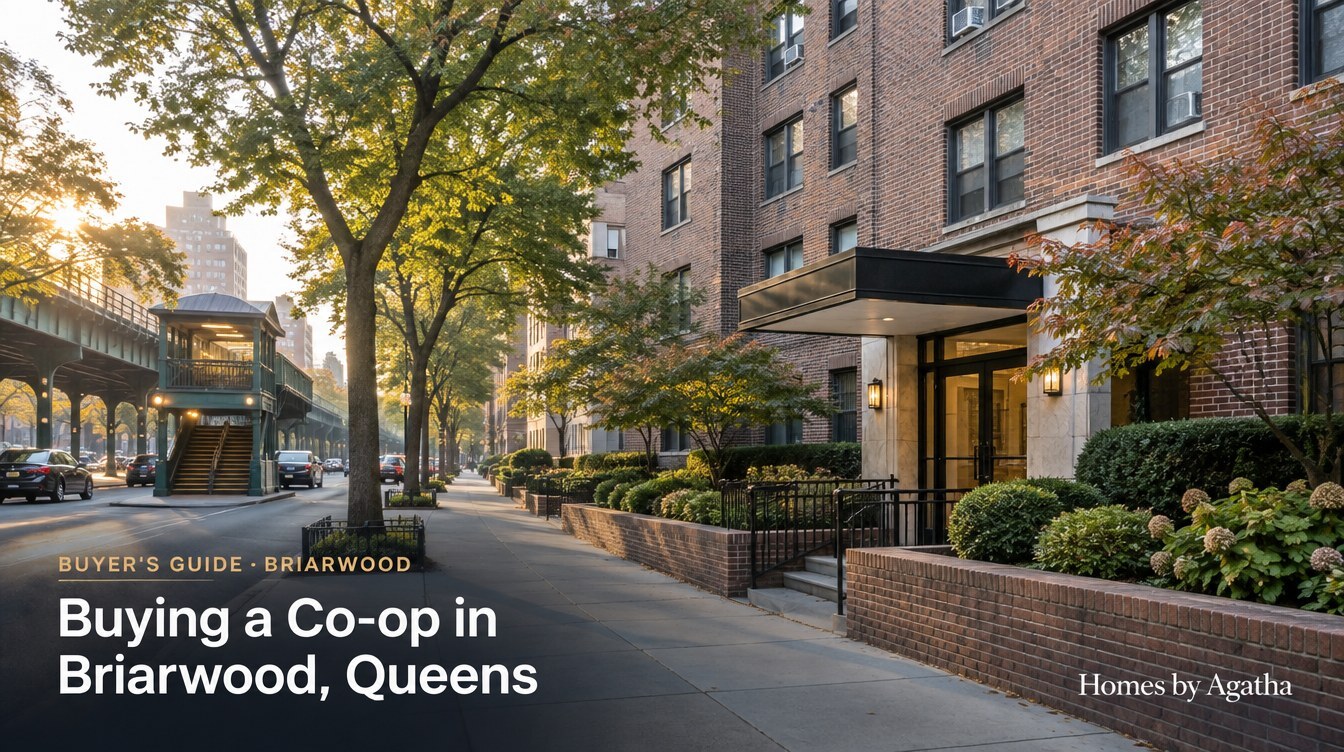
BRIARWOOD REAL ESTATE GUIDE
Buying a Co-op in Briarwood, Queens: How the Process, Costs and Board Review Really Work
Quick Answer
Buying a co-op in Briarwood, Queens means buying shares in a cooperative corporation plus a proprietary lease, not a deed. Each building sets its own down payment, financing limits and board review. Before offering, compare monthly maintenance, the building’s finances and rules, and the walk to the F (and part-time E) at Briarwood station.
Buying a co-op in Briarwood is a different project from buying a house two blocks away. A co-op buyer is approved by a board, financed under the building’s rules, and pays monthly maintenance that bundles a share of the building’s costs into one number. This guide is for buyers weighing an apartment in Briarwood, Queens — in an elevator building near Queens Boulevard and Main Street, or in a garden-style complex such as Parkway Village — who want to understand the process before they tour.
You will learn how the local housing stock is organized, how co-op ownership differs from a condo or a one- or two-family house, what maintenance pays for, which closing costs apply and which do not, how share loans and board approval interact, and what to check before you make an offer. As a Licensed Associate Real Estate Broker based in Queens, I help buyers compare buildings and paperwork, not only apartments — in English and Polish. When you are ready to move from research to a search plan, the Briarwood home buying page explains how we can work together.
Briarwood at a glance
| Item | Briarwood, Queens |
|---|---|
| Borough / county | Queens (Queens County), New York City; Queens Community Board 8 |
| ZIP code | 11435 for most addresses; confirm the ZIP for a specific address with USPS, because blocks near the neighborhood edges can differ |
| Commonly described boundaries | Van Wyck Expressway (west), Parsons Boulevard (east), Union Turnpike (north), Hillside Avenue (south) — informal, not official city lines |
| Subway | Briarwood station (IND Queens Boulevard Line) at Queens Boulevard and Main Street: F at all times; the E stops here only at certain times, so check the current MTA timetable before relying on it. Nearby: Kew Gardens–Union Turnpike (E, F); Sutphin Boulevard and Parsons Boulevard (F) on Hillside Avenue |
| Rail and airport link | Long Island Rail Road at Jamaica station and Kew Gardens station; AirTrain JFK from Jamaica |
| Major roads | Van Wyck Expressway (I-678), Grand Central Parkway, Queens Boulevard, Main Street, Hillside Avenue, Union Turnpike |
| Parks and landmarks | Hoover–Manton Playgrounds (Main Street, Manton Street and 83rd Avenue); Briarwood Promenade greenstreet on Queens Boulevard (84th Drive to 87th Avenue); Parkway Village (National Register of Historic Places, 2012); Captain Tilly Park in adjacent Jamaica Hills; Queens Borough Hall in adjacent Kew Gardens |
| Commercial corridors | Main Street, Queens Boulevard, Hillside Avenue, Parsons Boulevard |
| Typical property types | Co-op and rental apartment buildings; a garden-apartment co-op complex; detached and semi-detached one- and two-family houses |
| Key purchase considerations | Co-op board approval and building-set financing rules; maintenance and building finances; Certificate of Occupancy and legal-unit checks for houses; age-related building systems |
What does Briarwood’s housing stock look like?
Briarwood mixes apartment buildings — a large share of them co-ops — with blocks of detached and semi-detached houses. Apartment buildings are concentrated near the main roads, especially Queens Boulevard, Main Street, Hillside Avenue and the area around Briarwood station, while houses fill many of the interior blocks. The pattern changes block by block, so check the zoning and lot details for a specific address on NYC ZoLa and walk the street before you decide.
That split shapes every co-op search here. The apartment you like and the house down the street are not just different sizes; they are different legal products with different approval steps, different financing and different monthly costs.
Apartment buildings near Queens Boulevard and Main Street
The apartment buildings in Briarwood are largely mid-20th-century construction: elevator buildings along and near Queens Boulevard and Main Street, and smaller walk-up buildings on nearby streets. Some are co-ops, some are rentals, and a smaller number may be condominiums. The form of ownership is a legal fact you confirm in the documents, not something you can see from the sidewalk.
One practical test helps. In New York City, a condominium unit has its own tax lot, while a co-op building is one tax lot owned by the corporation. If a listing describes an apartment as a “co-op,” your attorney will confirm it through the offering plan, the proprietary lease and the stock certificate, not through the listing text.
Parkway Village: a garden-apartment co-op
Parkway Village is a garden-apartment complex built in 1947 to house employees of the newly formed United Nations, designed by Leonard Schultze and Associates. It became a co-op in 1983 and was listed on the National Register of Historic Places in 2012. It sits near Union Turnpike and Main Street, at the edge where Briarwood meets Kew Gardens Hills, so listings and maps may place it under either neighborhood name.
For a buyer, Parkway Village shows how varied “co-op” can be in Briarwood. Low-rise buildings around landscaped grounds operate differently from a single elevator building: questions about grounds upkeep, parking, alterations and exterior work belong in your due diligence. A National Register listing is not the same thing as a New York City landmark designation, and it does not by itself bring Landmarks Preservation Commission review. Ask the managing agent which approvals the complex requires for exterior changes, and check the Landmarks Preservation Commission’s online maps if you want to confirm that no city designation applies.
Houses on the interior blocks
Briarwood’s house stock includes Colonial and Tudor-style homes along with other detached and semi-detached one- and two-family houses. Ages vary from block to block, so check the year built for a specific house in NYC Department of Finance or Department of Buildings records rather than relying on the style. Houses bring a deed, a lot and full control — and also the full responsibility for a roof, a boiler, a sewer line and the Certificate of Occupancy.
Why the mix matters to a co-op buyer
Because co-ops and houses sit side by side, buyers in Briarwood often compare them directly. That comparison is useful only when you compare total monthly cost and total risk, not just the purchase price. A co-op’s lower entry price comes with maintenance, board rules and a building you share; a house’s higher entry price comes with property taxes, insurance and every repair. If you already own in Briarwood and plan to sell before you buy, the companion guide to selling your home in Briarwood covers the other side of that move.
Co-op, condo or house: which ownership type fits a Briarwood purchase?
A co-op gives you shares in a corporation and a proprietary lease; a condo gives you a deed to a unit; a house gives you a deed to land and building. In Briarwood, co-ops are a common form of apartment ownership in the older buildings and houses fill many of the interior blocks. The mix of co-op and condo listings changes over time, so look at what is actually for sale when you start your search.
A proprietary lease is the long-term lease that a co-op corporation grants to each shareholder for a specific apartment. The number of shares allocated to the apartment determines its share of the building’s costs, which is why two similar-looking apartments in the same building can carry different maintenance.
| Factor | Co-op apartment | Condo unit | One- or two-family house |
|---|---|---|---|
| What you own | Shares in the co-op corporation plus a proprietary lease | Deeded real property: the unit plus a share of common elements | Deeded land and building |
| Approval | Board package and interview; the board can decline | Usually a right of first refusal, not a full approval | No third-party approval beyond your lender |
| Financing | Share loan; the building sets financing limits, which you confirm per building | Mortgage; lender reviews the condo project | Mortgage on the property |
| Monthly costs | Maintenance (includes a share of building taxes and any underlying mortgage) | Common charges plus the unit’s own property tax | Property tax, insurance, utilities, all repairs |
| NYC mortgage recording tax | Not charged on co-op share loans | Charged on the mortgage | Charged on the mortgage |
| Renting it out later | Only as the sublet policy allows | Usually more flexible; check the bylaws | Only units legal under the Certificate of Occupancy |
| Key documents | Offering plan, proprietary lease, house rules, financials, minutes | Declaration, bylaws, budget, financials | Deed, survey, Certificate of Occupancy, permits |
When a co-op fits
A co-op tends to fit a buyer who wants an apartment close to Briarwood station or Queens Boulevard, prefers predictable shared upkeep to managing a whole building, and plans to live in the apartment rather than rent it out. It also fits buyers who are comfortable sharing financial documents with a board.
When a condo fits
A condo fits a buyer who wants deeded ownership, more flexible renting rules and lighter approval, and who accepts that condo inventory in Briarwood may be limited. If the right condo is not available here, nearby neighborhoods along the Queens Boulevard corridor may have more of them.
When a house fits
A house fits a buyer who wants land, a driveway or garage where the lot has one, and full control over renovations — and who has the budget for repairs that a co-op would otherwise share. Buyers considering a two-family house should read about buying a multi-family home in Queens before counting on rental income.
Weighing a Briarwood co-op against a house?
I can help you compare total monthly cost, approval steps and commute for each option, so you choose a property type before you choose a listing.
How does buying a co-op in Briarwood work, step by step?
Buying a co-op in Briarwood follows this order: you agree on price, attorneys negotiate a co-op contract, you sign and pay the contract deposit, your lender issues a loan commitment, you submit a board package, you interview, and you close at a meeting where the shares and lease transfer to you. Board approval is the step most buyers underestimate.
The accepted offer and the contract
New York is an attorney state for residential sales. An accepted offer is not a signed contract: the buyer’s attorney and the seller’s attorney negotiate and prepare the contract of sale, and either side can still walk away until both have signed. During this window your attorney reviews the co-op’s financial statements, board minutes, proprietary lease and house rules.
Once both sides sign, the buyer pays a contract deposit, customarily held in escrow by the seller’s attorney. The contract typically includes a board-approval contingency and, if you are financing, a financing contingency. The exact wording is negotiated by the attorneys and matters more than any verbal promise.
The board package
The board package is the application that a co-op’s board of directors reviews before approving a sale. The managing agent publishes the building’s requirements. Expect requests such as these:
- the building’s application form and purchase application fees;
- the signed contract of sale and the lender’s commitment letter;
- recent federal tax returns, W-2s or 1099s, and pay stubs;
- bank, brokerage and retirement statements;
- an employment verification letter;
- personal and professional reference letters;
- authorization for a credit check;
- signed acknowledgments of the house rules and any sublet, pet or renovation policies.
A complete, well-organized package moves faster. A missing page usually means the managing agent returns the file, and the clock restarts.
The board interview
Most co-op boards meet buyers before voting. The interview typically confirms what is in the package and introduces the building’s rules. Keep answers short and factual, and do not volunteer renovation or subletting plans that the rules do not allow. A co-op board may decline an application without giving a reason, but it may not discriminate on a basis protected by the federal Fair Housing Act, the New York State Human Rights Law or the New York City Human Rights Law.
Closing a co-op
A co-op closing does not transfer a deed. Instead, the seller’s stock certificate and proprietary lease are assigned to you, and new ones are issued in your name. If you borrow, your lender, the co-op and you sign a recognition agreement — a document in which the co-op recognizes the lender’s security interest in your shares. Instead of a title search, a co-op purchase relies on a lien search (often called a UCC search) to confirm there are no recorded liens against the shares. The managing agent or its representative usually attends, and maintenance is adjusted between buyer and seller as of the closing date.
Why board timing matters
Boards meet on their own schedules and are staffed by volunteer shareholders. The managing agent first checks the package, then sends it to the board, then the board schedules an interview. Build that sequence into your rate lock and your moving plans rather than assuming a fixed number of days.
What does Briarwood co-op maintenance pay for, and how do you judge it?
Maintenance is your monthly share of the co-op’s operating budget. It typically covers staff, heat and hot water, insurance, repairs, reserves, a share of the building’s property taxes and the building’s underlying mortgage. A higher maintenance figure is not automatically worse; what matters is what it includes and whether the budget behind it is realistic.
What is inside the number
Ask the listing agent or managing agent for a breakdown. In many Queens co-ops heat is included in maintenance, while electricity and cooking gas may be billed separately; confirm what each building includes. Some buildings add separate charges for parking, storage, bike rooms or air-conditioner sleeves. Two apartments with the same maintenance can therefore have different true monthly costs.
Reading the financial statements
A co-op’s audited financial statements tell you more about your future maintenance than the listing does. Your attorney and accountant should look at these points:
- Underlying mortgage: the building’s own loan, its interest rate and when it matures. A refinance at a higher rate can push maintenance up.
- Reserve fund: money set aside for capital work. A thin reserve makes a special assessment more likely.
- Operating results: whether the building ran a surplus or a deficit, and why.
- Arrears: how much shareholders owe in unpaid maintenance.
- Sponsor or investor units: apartments still held by the original converting sponsor or an investor. Lenders and buyers watch concentration because it affects building stability.
- Commercial income: buildings with ground-floor stores along Queens Boulevard or Main Street may collect commercial rent, which can support the budget; the financial statements show whether a given building has such income.
Assessments and capital projects
Many of Briarwood’s apartment buildings are now several decades old, so capital work is part of ownership. Ask what the board has done and plans to do on roofs, boilers, elevators, windows, façades, pointing and plumbing risers. Two New York City laws often come up:
- Local Law 11 (Façade Inspection & Safety Program): buildings taller than six stories need periodic façade inspections by a qualified professional through the NYC Department of Buildings, and repairs that follow can be costly.
- Local Law 97: most buildings larger than 25,000 square feet face greenhouse-gas emissions limits that began in 2024, with stricter limits later. Ask how the building plans to comply.
Whether either law applies depends on the specific building, so check the building’s filings in NYC Department of Buildings records and the city’s Local Law 97 covered buildings list. The board minutes are where you often find the real story behind these projects.
The tax side of maintenance
Because part of maintenance pays the building’s property taxes and mortgage interest, the co-op may report a deductible portion to shareholders each year. Whether that helps you depends on your own return, so ask a CPA. New York City also offers a Cooperative and Condominium Property Tax Abatement, administered by the NYC Department of Finance, for eligible owners who use the apartment as their primary residence. Eligibility has additional conditions — for example, limits on how many units one owner holds in the same development, and exclusions for some buildings with other tax benefits — so check the Department of Finance’s current rules.
Key Takeaways
- A Briarwood co-op is shares plus a proprietary lease; the number of shares sets your portion of building costs.
- Maintenance bundles building costs, a share of property taxes and the underlying mortgage — compare what it includes, not just the figure.
- The financial statements, reserve fund and board minutes predict future maintenance better than the listing does.
- Board approval is a real decision point; a complete package and a realistic timeline protect your rate lock.
Want help reading a building before you commit?
I can help you organize the questions about maintenance, reserves and capital work that your attorney, lender and accountant will need answered.
How much cash do you need to buy a co-op in Briarwood?
Plan for three pools of money: the down payment the building allows, closing costs, and the cash reserves a co-op board may want to see after closing. Co-op buyers do not pay the NYC mortgage recording tax on a share loan, but they still pay attorney, lender and application costs, and the mansion tax applies if the price is $1 million or more.
The down payment
Each co-op sets its own minimum down payment and maximum financing in its policies. A buyer who could put a small amount down on a house may need a much larger amount for a particular co-op. Ask for the financing policy in writing before you fall in love with an apartment.
Closing costs for a Briarwood co-op
A co-op closing has a different cost list than a condo or house closing. The table below compares them, using the rules published by the New York State Department of Taxation and Finance and the NYC Department of Finance. Confirm current rates with the NYS Department of Taxation and Finance and NYC Department of Finance before closing.
| Cost item | Co-op in Briarwood | Condo or house in Briarwood (for comparison) | Source / who sets it |
|---|---|---|---|
| “Mansion tax” | 1% of the price if $1 million or more; graduated above $2 million in New York City; paid by the buyer | Same rule | NYS Department of Taxation and Finance |
| NYC mortgage recording tax | Not charged — co-op loans are share loans | Roughly 1.8% of the loan under $500,000; 1.925% at $500,000 and above (1–3 family homes and condos) | NYC Department of Finance / New York State |
| Title insurance / lien search | Lien (UCC) search; optional co-op lien coverage | Title search and title insurance | Title company / attorney |
| Buyer’s attorney | Yes — fee negotiated with the attorney | Yes | Your attorney |
| Lender costs | Origination, appraisal, credit report; building review | Origination, appraisal, credit report | Your lender |
| Board and managing-agent fees | Application, credit-check and processing fees; possible move-in deposit | Condo: usually smaller application fees | The building’s managing agent |
| Adjustments | Maintenance prorated to the closing date | Property taxes and common charges prorated | Contract / attorneys |
| Flip tax | Only if the co-op’s documents impose one; who pays depends on those documents and the contract | Not applicable to houses; condos usually do not have one | The co-op’s own documents |
The NYS real estate transfer tax and the NYC Real Property Transfer Tax are customarily paid by the seller, so they rarely appear on a buyer’s list in a resale. For a fuller walk-through, see the guide to Queens closing costs.
Cash left over after closing
Many co-op boards look at post-closing liquidity: the savings you will still have after the down payment and closing costs. Some state a requirement in months of maintenance and mortgage payments; others decide case by case, so ask each building for its rule. Retirement accounts may or may not count. Find out early, because this rule — not the purchase price — is what stops many otherwise qualified buyers.
How do pre-approval and financing work for a Briarwood co-op?
A co-op purchase is financed with a share loan, which is secured by your shares and proprietary lease rather than by a mortgage on real property. Get pre-approved by a lender that actively makes co-op share loans, then confirm that the lender will lend in that specific building and that your loan fits the board’s financing limit.
The lender reviews the building, too
A co-op lender underwrites two things: you and the building. The lender may send the managing agent a questionnaire about owner-occupancy, sponsor-held units, commercial space, insurance, litigation and reserves. A building that does not meet the lender’s guidelines can derail a loan even when the buyer is strong, which is why a list of lenders that have recently closed loans in the building is useful.
Two reviews of your finances
Your lender checks debt-to-income ratio, credit and assets under its own rules. The co-op board then applies its own standards, which can be stricter than the lender’s. Passing the lender’s review does not guarantee passing the board’s. Planning for both from the start avoids a surprise after the contract is signed.
Pre-approval letter versus commitment letter
A pre-approval letter shows a seller that a lender has reviewed your credit and income. A commitment letter comes later, after the lender reviews the contract, the appraisal and the building, and it is usually required in the board package. Treat the pre-approval as your entry ticket and the commitment as the real milestone.
Government-backed loans and all-cash buildings
Availability of government-backed loan programs for co-op purchases is limited and depends on the program and the building. Ask an NMLS-registered loan originator which programs currently lend on co-ops and whether a specific building qualifies. A few co-ops require all-cash purchases or very low financing. Ask before touring so you can focus on buildings where your plan works. First-time buyers can find more preparation steps in the first-time home buyer guide for Queens.
Lining up financing before you tour?
Let’s map your down payment, reserves and lender options against the buildings you are considering, so your pre-approval matches how Briarwood co-ops actually lend.
How do you get around from Briarwood?
Briarwood’s subway stop is Briarwood station on the IND Queens Boulevard Line, at Queens Boulevard and Main Street, served by the F at all times and the E at certain times. The Long Island Rail Road at Jamaica station and the AirTrain JFK connection are a short trip away, and the Van Wyck Expressway and Grand Central Parkway frame the neighborhood for drivers.
Briarwood station
Briarwood station opened in 1937 as Van Wyck Boulevard, was later renamed Briarwood–Van Wyck Boulevard, and has been called simply Briarwood since 2015. It is a local stop: the F stops at all hours, while the E stops here only at certain times and runs express past the station at others, so check the current MTA timetable for the hours you would travel. The main exit leads to Main Street and Queens Boulevard. An elevator serves the mezzanine, and MTA New York City Transit has announced ADA accessibility upgrades at Briarwood station, with work presented to Queens Community Board 8 as starting in summer 2026 and expected to run until about August 2028. Station access and nearby streets may be affected during construction, so check the MTA’s service and accessibility updates before you rely on the station.
Other nearby stations
- Kew Gardens–Union Turnpike (E, F): an express stop just west of Briarwood along Queens Boulevard, near Queens Borough Hall.
- Sutphin Boulevard and Parsons Boulevard (F): stations on Hillside Avenue, along Briarwood’s southern edge.
- Jamaica–Van Wyck (E) and Sutphin Boulevard–Archer Avenue–JFK Airport (E, J, Z): south of Hillside Avenue in Jamaica; Sutphin Boulevard–Archer Avenue connects to the LIRR and AirTrain JFK at Jamaica station.
Long Island Rail Road and the airport
Jamaica station is the LIRR’s central transfer hub, and AirTrain JFK runs from Jamaica to John F. Kennedy International Airport. Kew Gardens station on the LIRR is another option west of Briarwood. Check current LIRR schedules for the trips you would actually make, because service at smaller stations differs from Jamaica.
Buses and driving
Local and express buses run along Briarwood’s main roads, including Main Street, Queens Boulevard and Hillside Avenue. Routes in Queens changed under the Queens Bus Network Redesign, so check the current MTA bus map for the routes and stops near a specific address. Drivers use the Van Wyck Expressway (I-678), the Grand Central Parkway, Queens Boulevard and Union Turnpike.
How transit should shape your co-op choice
Proximity to Briarwood station is a real price and convenience factor for apartments, but walk the route at the hours you commute instead of reading a map. Buildings close to the Van Wyck Expressway or Queens Boulevard trade convenience for traffic noise, so look at which way the apartment faces and how the windows perform. If you drive, ask whether the co-op has a garage or lot, whether spaces are assigned or wait-listed, and what they cost. Buyers who want to compare commutes from neighboring areas can look at buying in Kew Gardens, Jamaica Estates or Jamaica, each with a different mix of subway, LIRR and housing types.
What should you check before making an offer on a Briarwood co-op?
Check the building first, then the apartment. In Briarwood that means reading the co-op’s documents and finances, confirming the rules that affect your plans, looking up public violation records, and inspecting the apartment’s systems — and, if you are also considering a house, confirming its Certificate of Occupancy and legal units.
| What to check | Where to find it | Why it matters in Briarwood |
|---|---|---|
| Offering plan and amendments | Managing agent / seller’s attorney | Confirms the building is a co-op and how shares were allocated |
| Proprietary lease and house rules | Managing agent | Sets who repairs what inside the apartment, plus move-in and renovation rules |
| Audited financial statements | Managing agent | Shows the underlying mortgage, reserves and operating results that drive maintenance |
| Board minutes | Managing agent, via your attorney | Reveals planned assessments, façade or boiler work, and disputes |
| Sublet, pet, washer-dryer and renovation policies | House rules / board policies | Determines whether your plans for the apartment are allowed |
| Flip tax provisions | Proprietary lease / bylaws | Affects your cost when you eventually sell |
| Building violations and complaints | NYC Department of Buildings (DOB) and NYC Department of Housing Preservation and Development (HPD) online records | Open violations can signal maintenance issues or upcoming costs |
| Local Law 11 and Local Law 97 status | NYC DOB records; board minutes | Large capital projects in older buildings can lead to assessments |
| Electrical capacity and windows | Inspection; managing agent | Mid-century wiring can limit air conditioners and appliances |
| Flood information | FEMA Flood Insurance Rate Maps; NYC Flood Hazard Mapper; NYC DEP stormwater flood maps | Briarwood is inland, but flood maps and stormwater risk are address-specific |
The apartment itself
Hire an inspector who knows co-ops even though the building, not you, maintains the structure. Inside the apartment, focus on what the proprietary lease makes your responsibility: electrical panels and outlets, plumbing fixtures, radiators or heating covers, kitchen and bath condition, windows (in some buildings the shareholder pays for windows, so check the lease), and any prior renovations. Ask whether past renovations had board approval and, where needed, DOB permits.
If you are also considering a Briarwood house
A house purchase adds checks that a co-op does not need. The Certificate of Occupancy, issued by the NYC Department of Buildings, states the legal use and number of dwelling units; a house sold as a “two-family” must be legal as a two-family to be financed and insured that way. Basement apartments without a matching Certificate of Occupancy and permits are a common problem across Queens. Houses from the 1930s may also carry older wiring, galvanized supply pipes, an aging sewer line or a buried oil tank, so a full inspection and, where appropriate, a sewer-line camera inspection are worth their cost.
Flood and stormwater
Briarwood is an inland neighborhood, not a coastal one, but flood exposure is determined address by address. Check the FEMA Flood Insurance Rate Map and the NYC Flood Hazard Mapper for the specific address, and look at the NYC Department of Environmental Protection’s stormwater flood maps for heavy-rain risk. For a co-op, ask whether the building has had basement or boiler-room water; for a house, look for water staining and ask about sewer backflow protection.
Key Takeaways
- Confirm the building’s financing limit and post-closing liquidity rule before you tour, not after the contract.
- Co-op share loans are not subject to the NYC mortgage recording tax; the mansion tax still applies at $1 million and above.
- Briarwood station is served by the F at all times; confirm the current E pattern before you rely on it.
- Public DOB and HPD records, board minutes and Local Law 11/97 status reveal costs a showing never will.
Ready to write an offer on a Briarwood apartment?
An offer that shows clean financing, a realistic board timeline and a complete package plan reads differently to a seller. I can help you structure yours.
How do offers, contracts and board approval fit together in New York?
In New York, your offer starts a negotiation, the attorneys turn it into a contract, and the board’s approval decides whether the co-op sale can close. Because New York is an attorney state, nothing is binding until both buyer and seller have signed the contract of sale prepared by their attorneys.
What a strong co-op offer includes
A seller of a Briarwood co-op weighs more than price. A strong offer typically states the price, the loan amount and down payment, confirms that the financing fits the building’s limits, attaches a pre-approval letter and proof of funds, names your attorney, and suggests a realistic closing window that allows for board review. Showing that you have already read the building’s financing and liquidity rules tells the seller your package is likely to be approved.
Contingencies that matter for co-ops
The board-approval contingency protects you if the board declines your application. The financing contingency protects you if the lender does not issue a commitment by the agreed date, subject to the contract’s terms. Your attorney will explain exactly how each contingency works and what deadlines you must meet to keep your deposit protected.
From offer to keys: the sequence
| Stage | What happens | What controls the timing |
|---|---|---|
| 1. Pre-approval and building screening | Lender pre-approval; you confirm each building’s financing and liquidity rules | Your document readiness |
| 2. Offer accepted | Price and terms agreed; attorneys exchange information | Negotiation |
| 3. Attorney due diligence and contract | Review of financials, minutes, lease; contract negotiated and signed; deposit paid into escrow | Speed of document delivery from the managing agent |
| 4. Loan commitment | Appraisal, building review, final underwriting | Lender and the building questionnaire |
| 5. Board package submitted | Managing agent checks completeness and forwards to the board | Completeness of your package |
| 6. Board interview and decision | Interview; written approval or decline | Board meeting schedule |
| 7. Closing | Shares and lease assigned; recognition agreement; adjustments; keys | Coordinating attorneys, lender and managing agent |
How does working with a buyer’s agent work in 2026?
In 2026, you sign a written buyer agreement with your agent before touring homes together, and the agent’s compensation is negotiable — it is not set by law and is not automatically paid by the seller. You also receive the New York State Disclosure Form for Buyer and Seller at the first substantive contact, explaining whom the agent represents.
These rules follow the 2024 NAR settlement and the practice changes that came with it. The written agreement states the services, the compensation and how it will be paid. In some transactions a seller agrees to contribute toward the buyer’s agent compensation; in others the buyer pays it directly or the terms are negotiated within the offer. Your agreement should say what happens in each case. The guide to working with a buyer’s agent in NY explains these documents in more detail.
For a co-op search, a buyer’s agent’s value lies in the work around the apartment: obtaining building financing policies early, coordinating document requests with managing agents, helping you assemble the board package, and keeping the lender, attorneys and board timeline aligned. I work in English and Polish; that is about clear communication and comfort, and where you choose to buy is always your decision.
Building a Briarwood shortlist?
Tell me your budget, commute and must-haves, and we can narrow Briarwood’s buildings and blocks to the ones whose rules fit your plans.
What mistakes should Briarwood co-op buyers avoid?
The most expensive mistakes when buying a co-op in Briarwood come from skipping the building’s rules and finances, not from the apartment itself. Avoid these:
- Touring before checking financing rules. Falling for an apartment in a building whose financing limit or liquidity rule you cannot meet wastes weeks.
- Comparing listing prices instead of monthly costs. A lower price with higher maintenance can cost more each month than a higher price with lower maintenance.
- Ignoring the underlying mortgage. A building loan that matures soon can change maintenance after you buy.
- Skipping the minutes. Planned façade, boiler or window projects often appear in the minutes before they appear as assessments.
- Assuming you can sublet. Many co-ops limit subletting; read the policy before counting on future rental income.
- Relying on the E for a weekday commute without checking. Confirm the current service pattern at Briarwood station for your actual travel times.
- Treating an accepted offer as a deal. In New York, nothing is binding until the contract is signed.
- Submitting an incomplete board package. Missing documents send the file back and delay closing.
Your Briarwood co-op buyer checklist
- Decide between co-op, condo and house using total monthly cost, not price alone.
- Get pre-approved by a lender that makes co-op share loans in Queens.
- Sign a written buyer agreement and review the NYS Disclosure Form for Buyer and Seller.
- Collect each target building’s financing limit, down payment rule, liquidity rule, sublet policy and pet policy.
- Walk your commute to Briarwood station, Kew Gardens–Union Turnpike or Hillside Avenue at real travel times.
- Compare maintenance breakdowns, including what is and is not included.
- Make an offer that documents financing, proof of funds and a board-aware closing window.
- Have your attorney review the offering plan, proprietary lease, financial statements and minutes.
- Check NYC DOB and HPD records and Local Law 11/97 status for the building.
- Inspect the apartment’s electrical, plumbing, heating and windows.
- Confirm flood and stormwater information for the address.
- Prepare the board package early and practice for the interview.
- Coordinate the loan commitment, recognition agreement and closing date with all parties.
Start your Briarwood co-op search with a plan
From building screening to the board interview, I can guide each step so you spend your time on apartments you can actually buy.
Frequently asked questions about buying a co-op in Briarwood
Is Briarwood, Queens mostly co-ops or houses?
Briarwood, Queens has both. Apartment buildings, many of them co-ops, are concentrated near Queens Boulevard, Main Street and Hillside Avenue, while detached and semi-detached one- and two-family houses fill many interior blocks. Buyers often compare the two directly, so compare total monthly cost and approval steps, not just purchase price.
Which subway lines stop at Briarwood station?
Briarwood station, on the IND Queens Boulevard Line at Queens Boulevard and Main Street, is served by the F at all times and by the E at certain times. Check current MTA schedules for the E. Kew Gardens–Union Turnpike (E, F) and the Hillside Avenue F stations are nearby alternatives.
Do co-op buyers in Briarwood pay the NYC mortgage recording tax?
No. Co-op purchases are financed with share loans secured by shares and a proprietary lease, and co-op loans are not subject to the NYC mortgage recording tax. Condo and house buyers in Briarwood who take a mortgage do pay it. The New York State mansion tax still applies to co-ops priced at $1 million or more.
How long does co-op board approval take in Briarwood?
There is no fixed timeline. The managing agent first checks that your board package is complete, then forwards it to the board, which schedules an interview at its next convenient meeting. A complete, well-organized package and a closing date that leaves room for the board’s schedule reduce the risk of delays.
What does co-op maintenance include?
Co-op maintenance is your monthly share of the building’s operating budget. It typically covers staff, heat, insurance, repairs, reserves, a portion of the building’s property taxes and the building’s underlying mortgage. Electricity, cooking gas, parking and storage may be billed separately, so request a breakdown for each Briarwood building you consider.
Can I rent out a Briarwood co-op apartment later?
Only if the co-op’s sublet policy allows it. Each Briarwood co-op sets its own rules on whether, when and how often shareholders may sublet, often with board approval and fees. Read the proprietary lease and house rules before buying if future rental income matters to your plan, because policies vary widely between buildings.
What is Parkway Village in Briarwood?
Parkway Village is a garden-apartment complex built in 1947 to house United Nations employees, near Union Turnpike and Main Street at the Briarwood–Kew Gardens Hills edge. It converted to a co-op in 1983 and was listed on the National Register of Historic Places in 2012. Buyers go through its own board process.
Do I need a lawyer to buy a co-op in New York?
In practice, yes. New York is an attorney state: the buyer’s and seller’s attorneys negotiate and prepare the contract of sale, and an accepted offer is not binding until both sides sign. For a co-op, your attorney also reviews the financial statements, board minutes, proprietary lease and house rules before you commit.
Who pays the buyer’s agent when buying in Briarwood?
Buyer-agent compensation is negotiable and not set by law. Since the 2024 NAR settlement, it is not automatically paid by the seller. You and your agent sign a written agreement before touring that states the compensation and how it is paid, whether by you, through a seller contribution, or as negotiated in the offer.
Is Briarwood in a flood zone?
Briarwood is an inland Queens neighborhood, but flood status is determined address by address. Check the FEMA Flood Insurance Rate Map and the NYC Flood Hazard Mapper for the exact property, and review NYC DEP stormwater flood maps for heavy-rain risk. Lenders may require flood insurance in Special Flood Hazard Areas.
Next steps for a Briarwood co-op purchase
A successful Briarwood co-op purchase is decided before the first showing: know the building’s financing and liquidity rules, judge maintenance by what it covers and by the financials behind it, and plan a closing date around the board’s schedule. Weigh each apartment against a Briarwood house on total monthly cost and risk, and test your commute to Briarwood station in real time. When you are ready to turn this research into a search, start with the Briarwood buyer services page, where we can match your plan to the buildings and blocks that fit it.
This article is for general informational purposes only and reflects conditions that may change. It is not legal, tax, or financial advice, an appraisal, or a guarantee of price or outcome; consult a licensed New York attorney, a CPA, and an NMLS-registered mortgage loan originator as appropriate. A CMA is an opinion of value, not an appraisal. Real estate brokerage services are offered by Agatha Lubas, Licensed Associate Real Estate Broker, NY License #10301213345, Keller Williams Realty Liberty, 96-10 101st Avenue, Ozone Park, NY 11416. The NYS Disclosure Form for Buyer and Seller, the NYS Housing and Anti-Discrimination Disclosure / Fair Housing Notice, and the brokerage’s Standard Operating Procedures are available on request. Equal Housing Opportunity.

Agatha Lubas helps buyers, sellers and investors across Queens, Brooklyn, Nassau County and Suffolk County, with particular attention to co-op, condo and multi-family transactions. She works with clients in English and Polish, so every step of the process is clear and comfortable.
Work with Agatha