

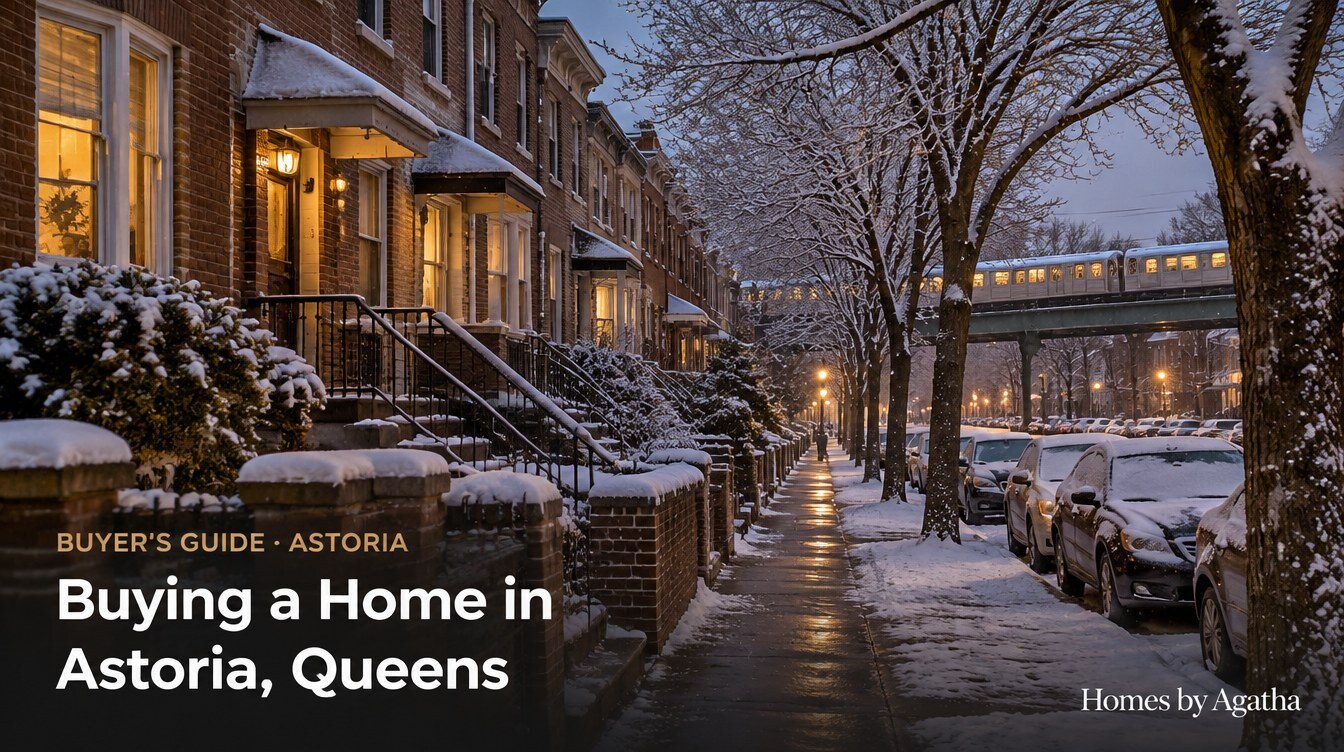
ASTORIA REAL ESTATE GUIDE
Buying a Home in Astoria, Queens: How to Choose Between Houses, Co-ops and Condos
Quick Answer
Buying a home in Astoria, Queens starts with choosing a property lane: an attached or semi-attached one- or two-family house, a co-op, or a condo. Each lane changes your down payment, closing costs, approval process and monthly carrying cost. Then check the Certificate of Occupancy, legal unit count, building finances and your walk to the N/W or M/R trains.
Buying a home in Astoria means choosing among very different kinds of property that often sit on the same block. A brick two-family house with a rental floor, an apartment in a six-story co-op and a unit in a newer condo building can all be within a few minutes of the same subway station, yet each one is bought, financed, approved and owned in a different way.
This guide is for buyers who are seriously considering Astoria, Queens and want to understand the process before they start bidding. You will learn what the local housing stock looks like, how co-ops, condos and houses compare here, what a purchase costs beyond the price, how the N, W, M and R lines and the NYC Ferry shape daily routines, which documents deserve a close look, and how offers and contracts work in New York.
As a Licensed Associate Real Estate Broker serving Queens and the surrounding New York markets, I help buyers evaluate both the property and the transaction process, in English or Polish, whichever is more comfortable. The decisions below are the ones that most often separate a smooth Astoria purchase from a stressful one. Where a fact depends on a specific building or a current rule, I say so and point you to the official source.
Astoria at a glance
| Item | Astoria, Queens |
|---|---|
| Area | Northwestern Queens, along the East River, north of Long Island City and west of East Elmhurst and Jackson Heights |
| Borough / County | Queens / Queens County, New York City |
| ZIP codes | 11102, 11103, 11105, 11106 (11106 is shared with parts of Long Island City); confirm the ZIP for a specific address with the USPS ZIP Code lookup |
| Subway lines | N and W (elevated Astoria Line above 31st Street); M and R (underground along Broadway at Steinway St and 46 St) |
| Subway stations | Astoria–Ditmars Blvd, Astoria Blvd, 30 Av, Broadway, 36 Av, 39 Av–Dutch Kills (N/W); Steinway St, 46 St (M/R) |
| Ferry | NYC Ferry Astoria route, “Astoria” landing at 3-10 Astoria Boulevard near Hallets Point |
| Main parks and landmarks | Astoria Park and Astoria Pool, RFK (Triborough) Bridge, Hell Gate Bridge, Athens Square Park, Rainey Park, Socrates Sculpture Park, Museum of the Moving Image, Kaufman Astoria Studios, Steinway & Sons factory |
| Commercial corridors | Steinway Street, 30th Avenue, Broadway, Ditmars Boulevard, 31st Street, 36th Avenue |
| Typical property types | Attached and semi-attached brick one- and two-family houses, older frame houses, detached houses in some sections, walk-up and elevator co-ops, newer condo buildings |
| Local housing considerations | Legal unit count vs actual use, pre-1938 buildings without a CO, co-op board approval, condo tax-abatement schedules, flood-map checks near the East River |
What kinds of homes can you buy in Astoria, Queens?
Astoria offers three main kinds of homes: attached and semi-attached one- and two-family houses, apartments in co-op buildings, and units in condo buildings. A smaller number of detached houses and older frame houses appear in some sections. Which lane you shop in matters more than any single listing, because it sets your financing, approvals and monthly costs.
Attached and semi-attached houses
Much of Astoria’s side-street housing is made of brick houses built in rows or in pairs, many of them configured as two-family homes. A common layout places one unit on each floor, sometimes with a finished basement and a finished attic. Attached houses share party walls with their neighbors, and some rows share a rear or side driveway. A shared driveway is usually governed by an easement or a recorded agreement, so the title report matters as much as the floor plan.
For buyers, the two-family house is the lane with the most moving parts. You are buying a building, a rental business and a set of legal records at the same time. The upside is flexibility: owner occupancy with a rental unit, or space for relatives living as a separate household. The work is in confirming that the house is legally what the listing says it is.
Co-op apartments
Astoria has a large stock of apartment buildings, including pre-war walk-ups and six-story elevator buildings, plus post-war buildings. Many of these are co-ops. A co-op, or housing cooperative, is a corporation that owns the building; buyers purchase shares in that corporation and receive a proprietary lease for a specific apartment. Co-op buyers go through a board application and interview, and the monthly maintenance covers building costs, typically including a share of the building’s property taxes and any underlying mortgage.
Condominium units
Newer residential buildings in Astoria, many of them mid-rise buildings along or near the main avenues, are often condos. A condominium unit is real property: you receive a deed, pay your own property tax bill and pay monthly common charges to the condo association. Condo purchases generally involve a lighter approval process than co-ops, though most condos still hold a right of first refusal that must be waived before closing.
How the housing stock differs across Astoria
Astoria is large, and its sections feel different on the ground. The blocks near Ditmars Boulevard and the Steinway area to the north include many one- and two-family houses, some detached or semi-detached. Old Astoria, near Hallets Point and Astoria Park along the East River, mixes older frame houses, apartment buildings and newer development. The central area between 30th Avenue and Broadway, along the elevated line on 31st Street and the Steinway Street corridor, has the densest mix of apartment buildings and two-family rows. Astoria Heights, to the east near the Grand Central Parkway, is farther from the subway and leans toward houses. The southern edge near 36th Avenue and Dutch Kills blends into Long Island City.
These are descriptions of buildings and streets, not of who lives there. Where you buy is always your decision. My job is to help you understand the property and the process.
Not sure which Astoria lane fits your budget?
Share your price range, monthly target and commute, and I will help you compare houses, co-ops and condos in Astoria before you tour.
Co-op, condo or house: which Astoria property type fits your plan?
In Astoria, a co-op usually suits a buyer who wants a lower purchase price for an apartment and accepts board rules; a condo suits a buyer who wants more flexibility in financing, renting and resale; a house suits a buyer who wants land, space or rental income and is ready to manage a building. The right answer depends on your down payment, your plans for renting, and how much maintenance you want to own.
The core differences in one table
| Factor | Co-op | Condo | One- or two-family house |
|---|---|---|---|
| What you own | Shares in a corporation plus a proprietary lease | Deeded real property plus a share of common elements | Deeded land and building |
| Approval | Board package and interview; board can decline | Usually a waiver of the right of first refusal | No board; lender and title approval only |
| Monthly costs | Maintenance (includes a share of property taxes and the building’s underlying mortgage, if any) | Common charges plus a separate property tax bill | Property tax, insurance, utilities, repairs, reserves you set yourself |
| Financing | Share loan; minimum down payment and debt-to-income limits set by each building; ask for them before you bid | Mortgage; lender must accept the building | Mortgage; rental income from a second unit may be considered under lender guidelines |
| Mortgage recording tax | Not applicable (share loan) | Applies | Applies |
| Renting it out | Sublet rules set by the building; often restricted | Generally more flexible, subject to bylaws | Your decision, subject to law and the legal unit count |
| Main Astoria due diligence | Building financials, reserves, upcoming projects, sublet and flip tax rules | Abatement schedule, reserves, owner-occupancy, litigation | Certificate of Occupancy, legal units, violations, systems, roof and party walls |
When an Astoria co-op makes sense
A co-op can be a good fit if you plan to live in the apartment yourself for several years, have a solid down payment and stable income, and value a building with a managing agent and a super. Astoria’s co-op stock includes many six-story elevator buildings and walk-ups, so ask early whether the building has an elevator, laundry, storage and a bike room, and whether those come with fees or waiting lists. The board decides who buys, and its rules on subletting, pets, renovations and gifting funds are binding.
When an Astoria condo makes sense
A condo can make sense if you want flexibility to rent the unit later, plan to finance with a smaller down payment where the lender allows it, or prefer a newer building with modern systems. The tradeoff is often a higher purchase price compared with a similar co-op apartment, plus common charges and a separate tax bill. In newer Astoria condos, ask whether the building receives a property-tax abatement and when it phases out, because rising taxes change your monthly cost over time.
When an Astoria house makes sense
A house, and especially a two-family house, can make sense if you want outdoor space, a garage or driveway, rental income, or room for relatives in a separate unit. It also means you are responsible for the roof, boiler, plumbing, façade, sidewalk and every repair a building needs. If you are weighing this lane, our guide to buying a multi-family home in Queens walks through the landlord side in more depth.
What does buying a home in Astoria cost beyond the purchase price?
Beyond the price, buying a home in Astoria involves New York City closing costs that depend on the property type and loan: attorney fees, lender fees, title insurance for houses and condos, the NYC mortgage recording tax on mortgages for houses and condos, and the New York State “mansion tax” if the price is $1 million or more. Co-op buyers skip the mortgage recording tax but pay co-op specific fees.
Buyer closing costs by property type
| Cost item | House or condo | Co-op | Official source / note |
|---|---|---|---|
| NYC mortgage recording tax | About 1.8% of the loan for loans under $500,000; 1.925% for loans of $500,000 and above (1–3 family homes and condos) | Not applicable — co-op loans are share loans | NYC Department of Finance / NYS |
| “Mansion tax” | 1% of the price if $1 million or more; graduated above $2 million in New York City | Same rule applies to co-op purchases of $1 million or more | NYS Department of Taxation and Finance |
| Title insurance and title fees | Yes — owner’s and lender’s policies | No title policy; a lien search is ordered instead | Title company quote |
| Buyer’s attorney | Yes | Yes | Fee set by the attorney |
| Lender fees, appraisal | If financing | If financing; plus recognition agreement fee | Loan estimate from your lender |
| Building-specific fees | Condo: application/processing fees, possible working-capital contribution | Application, managing agent and move-in fees; possible flip tax if the contract shifts it | Building documents |
| Prepaid items | Property tax and insurance escrows, adjustments | Maintenance adjustment | Closing statement |
Confirm current rates with the NYS Department of Taxation and Finance and NYC Department of Finance before closing.
Two Astoria-specific budget points
First, new-development condos are sold under an offering plan, and in many sponsor sales the contract shifts costs that a seller would normally pay, such as transfer taxes, onto the buyer. Read the offering plan and its amendments with your attorney before you sign. Second, a two-family purchase often needs a larger repair reserve than a similar-size apartment, because the buyer inherits two kitchens, two bathrooms or more, one roof, one boiler and the building’s façade.
For a line-by-line walk-through of how these items add up across the borough, see Queens closing costs explained.
Monthly carrying cost is the number that matters
When comparing Astoria options, convert every candidate into one monthly figure: mortgage payment, plus maintenance or common charges and property taxes, plus insurance, plus a repair reserve, minus any legal rental income you can realistically expect. A co-op with a lower price but high maintenance can cost more each month than a condo with a higher price. A two-family with a tenant can carry better than a one-family, but only if the rental unit is legal and the rent is reliable.
Key Takeaways
- Choose your lane in Astoria — house, co-op or condo — before you choose a listing; each one has different approvals and costs.
- Co-op loans in New York City are not subject to the mortgage recording tax, but co-op buyers face board approval and building-set financing rules.
- New-development condos can shift seller costs to the buyer through the offering plan; read it with your attorney.
- Compare options by total monthly carrying cost, not by list price alone.
Want a side-by-side cost comparison?
I can help you lay two or three Astoria options next to each other — closing costs, monthly carrying costs and approval steps — so the numbers are clear before you make an offer.
How should you get pre-approved and finance an Astoria purchase?
Get a written pre-approval from an NMLS-registered mortgage loan originator before you tour seriously, and make sure the lender knows which Astoria lane you are shopping. Co-op, condo and two-family loans are underwritten differently, and a pre-approval for one does not automatically fit the others.
Pre-qualification vs pre-approval
A pre-qualification is a quick estimate based on what you tell the lender. A pre-approval is based on documents the lender has actually reviewed, such as pay records, tax returns, bank statements and a credit report. Sellers and their agents in Astoria will usually ask for a pre-approval letter with an offer, and co-op boards will look at your full financial picture again in the board package.
Financing a co-op
Co-op financing is a share loan secured by your shares and proprietary lease. The building sets its own requirements, which commonly include a minimum down payment, a maximum debt-to-income ratio and a minimum amount of cash left after closing (often called post-closing liquidity). These rules differ from building to building, and they can change when a board updates its policies. Ask the listing agent for the building’s financing requirements before you bid, because an offer the board will not accept is not a real offer.
Financing a condo
For a condo, the lender reviews both you and the building. A lender may ask about owner-occupancy levels, reserves, insurance and pending litigation. Some newer buildings are already approved by many lenders; others need more review. Ask your loan officer early whether the specific Astoria building is acceptable for your loan type.
Financing a two-family house
For a two-family house, lenders may consider part of the expected rental income from the second unit when qualifying you, under their own guidelines. Rental-income treatment varies by loan program and lender, so ask your loan officer how it applies to your file. They will usually want a legal two-family Certificate of Occupancy, or equivalent proof of legal use, plus leases or a rent estimate from the appraiser. A basement apartment that is not legal generally will not count, and it can complicate the appraisal.
A practical pre-approval checklist for Astoria
- Tell the lender the property type you are targeting: co-op, condo, one-family or two-family.
- Ask for a pre-approval amount and an estimated monthly payment at that amount.
- For co-ops, keep enough cash after closing to meet typical building liquidity requirements.
- For two-families, ask how projected rent is treated and which documents prove it.
- Ask the lender for a loan estimate that includes the NYC mortgage recording tax if you are buying a house or condo.
How do you get around from Astoria?
Most of Astoria relies on two subway corridors: the elevated N and W along 31st Street, and the M and R under Broadway at Steinway St and 46 St. The NYC Ferry Astoria route, bus lines and the RFK Bridge and Grand Central Parkway fill in the rest. Your walk to a specific station, not the neighborhood name, decides your real commute.
The N and W on the Astoria Line
The N and W run on the elevated Astoria Line above 31st Street, with stations at Astoria–Ditmars Blvd, Astoria Blvd, 30 Av, Broadway, 36 Av and 39 Av–Dutch Kills, then continue through Queensboro Plaza into Manhattan. According to the MTA, the W runs on weekdays only and makes local stops to Whitehall St in Lower Manhattan; the N runs at all times. Astoria–Ditmars Blvd is the northern terminal, which some riders value because trains start there. Check current service on the MTA website for the station you would actually use.
The M and R on Broadway
The M and R stop at Steinway St and 46 St, both under Broadway in Astoria, on the IND Queens Boulevard Line. These trains serve Queens Boulevard toward Jackson Heights and Forest Hills in one direction and Midtown Manhattan in the other. Service patterns differ by time of day and on weekends; the MTA lists the R, for example, as running in Queens at all times except late nights, so check the current schedule for the hours you would actually travel. If your work is in Midtown East or along Queens Boulevard, an apartment closer to Broadway and Steinway Street may suit you better than one near Ditmars.
NYC Ferry and buses
The NYC Ferry Astoria route uses a landing named “Astoria” at 3-10 Astoria Boulevard, near Hallets Point. As listed on the NYC Ferry Astoria route page, the route also serves East 90th Street, Roosevelt Island, Long Island City, East 34th Street, Brooklyn Navy Yard and Wall Street/Pier 11. Buses cover gaps between the train lines; the M60 Select Bus Service runs along Astoria Boulevard, connecting Astoria with LaGuardia Airport in one direction and, via 125th Street, with Manhattan’s Upper West Side in the other. Check the current MTA bus map for stops near a specific home. Astoria Heights, farther from the subway, tends to depend more on buses and cars.
Driving and nearby rail
Astoria sits next to the RFK (Triborough) Bridge, the Grand Central Parkway and the Brooklyn-Queens Expressway, with LaGuardia Airport just to the east. There is no Long Island Rail Road station in Astoria itself; the nearest LIRR stops are in neighboring Woodside and Long Island City. If you will drive daily, ask whether a house includes a legal garage or driveway, and test street parking at the hours you would come home.
Commute comparison
| If you mostly travel to… | Look at homes near | Why |
|---|---|---|
| Midtown, Times Square, Lower Manhattan (Broadway corridor) | N/W stations on 31st Street | Direct one-seat ride on the Astoria Line |
| Queens Boulevard, Jackson Heights, Forest Hills | Steinway St or 46 St (M/R) | Direct ride along the Queens Boulevard Line |
| East Side waterfront, Roosevelt Island, Navy Yard | Near the Astoria ferry landing | NYC Ferry Astoria route |
| LaGuardia Airport, the Bronx, Long Island by car | Near Astoria Boulevard and highway access | Grand Central Parkway, RFK Bridge, BQE |
Also notice what sits near a home: an elevated train is convenient, but blocks directly beside the 31st Street structure hear it. Homes near LaGuardia’s approach paths or the parkway may hear aircraft and traffic. Visit at rush hour and in the evening before you decide.
Build a shortlist around your commute
Tell me where you travel most days. I will help you narrow Astoria to the blocks and stations that fit your routine, then match listings to them.
What should you check before buying an Astoria house, co-op or condo?
Before buying in Astoria, confirm the property’s legal status and condition: the Certificate of Occupancy or proof of legal use for houses, open violations, the actual vs legal unit count, flood-map status near the waterfront, and the age and condition of major systems. For co-ops and condos, the building’s finances and rules deserve the same attention as the apartment itself.
Certificate of Occupancy and legal unit count
A Certificate of Occupancy, or CO, is the NYC Department of Buildings document that states a building’s legal use and number of units. According to the NYC Department of Buildings, buildings built before 1938 are not required to have a CO unless later alterations changed their use, egress or occupancy. For those older buildings, the Department may issue a Letter of No Objection to confirm legal use. Many Astoria houses are old enough that this question comes up.
The practical check is simple: compare what the records say with what you see. If the CO says two families and the house has three kitchens, the third unit is a legal and financial problem, not a bonus. Lenders, appraisers and insurers rely on the legal count, and an illegal unit can affect your loan, your insurance and your liability.
Basements, attics and conversions
Finished basements and attics are common in Astoria two-families. A finished space is not automatically a legal bedroom or a legal apartment. Ceiling height, light, ventilation and a second way out all matter under the building code. Ask your attorney to review DOB records, permits and sign-offs for any visible renovation, and ask your inspector whether the work looks professionally done.
Violations and open permits
Open Department of Buildings violations, older Environmental Control Board penalties and unfinished permits can follow the property to the new owner or delay a closing. Your attorney or title company can search for them. For rental units, also ask whether there are open violations with the NYC Department of Housing Preservation and Development.
Flood zones near the East River
Astoria’s western edge meets the East River, around Hallets Point, Old Astoria and the shoreline along Astoria Park. If a home is near the waterfront or on low ground, check its address on the FEMA Flood Map Service Center and on New York City’s flood-zone tools. In a Special Flood Hazard Area, a lender may require flood insurance, which changes your monthly cost. Inland blocks on higher ground are less likely to raise this issue, but a quick check costs nothing.
Older-building systems in Astoria houses
Because much of Astoria’s house stock is older, inspections tend to focus on the same systems:
- Heating: the boiler’s age, whether it burns gas or oil, and whether an oil tank exists or was removed, including any buried tank.
- Electrical: service capacity, panel type and whether older wiring remains, which matters if you plan to add appliances or air conditioning.
- Plumbing: pipe materials, water pressure on upper floors and the condition of the sewer line to the street.
- Roof and parapets: flat roofs on attached rows, flashing at shared walls and drainage.
- Façade and party walls: brick pointing, lintels and cracks shared with the attached neighbor.
- Lead paint: federal law requires a lead-based paint disclosure for most housing built before 1978.
Also look at the sidewalk in front of the house. Mature street trees can lift sidewalk flags, and repairing a sidewalk is generally the owner’s responsibility in New York City.
Co-op and condo building review
For an Astoria co-op, ask your attorney to review the latest financial statements, the reserve fund, the underlying mortgage, any planned assessments, board minutes and the house rules. Larger buildings may face costs under New York City’s building-emissions law, Local Law 97, which applies to most buildings over 25,000 square feet; ask how the building plans to comply. Buildings taller than six stories also go through the city’s periodic façade inspection program.
For an Astoria condo, review the offering plan or bylaws, the budget, reserves, owner-occupancy, pending litigation and the status of any tax abatement. If the building has an abatement, ask when it phases out and what your taxes are projected to become. Abatement status and schedules are building-specific, so have your attorney confirm them on NYC Department of Finance records rather than relying on marketing materials.
How do offers and contracts work when buying a home in Astoria?
New York is an attorney state: after a seller accepts your offer, the buyer’s and seller’s attorneys negotiate and prepare the contract of sale. An accepted offer is not a signed contract, and either side can still walk away until the contract is fully signed and the deposit delivered.
Writing a strong Astoria offer
A strong offer is clear and complete, not just high. Include your price, how much you are putting down, your pre-approval, your proposed closing timeline, your attorney’s contact details and any requests, such as items to stay with the house. In a co-op, show the seller you already meet the building’s financial requirements. In a two-family, say whether you need the rental unit delivered vacant or will take it with the tenant in place.
From accepted offer to signed contract
- The seller accepts your offer and the agents circulate a memorandum of terms, sometimes called a deal sheet.
- Your attorney requests the contract draft and reviews title, building records or co-op/condo documents.
- You complete a home inspection for a house, or building due diligence for a co-op or condo.
- The attorneys negotiate the contract, including contingencies.
- You sign and deliver a contract deposit, often around 10% of the price, held in escrow, usually by the seller’s attorney.
- The seller signs and the contract is fully executed.
Contingencies to understand
A mortgage contingency lets you cancel and recover your deposit if your loan is not approved within a set period, on the terms written in the contract. A co-op purchase contract typically includes a board-approval contingency. Some buyers also negotiate an appraisal clause. Each contingency is a negotiation point, and your attorney is the right person to explain how it protects you.
Key Takeaways
- In New York, an accepted offer is not a contract; attorneys draft and negotiate the contract of sale.
- For Astoria houses, compare the CO or Letter of No Objection with the unit count you actually see.
- Check FEMA flood maps for homes near the East River waterfront before you sign.
- For co-ops and condos, the building’s finances, rules and abatement schedule are part of what you buy.
Preparing to make an offer?
Before you bid, let’s review the property type, the building or house records and the terms that make an Astoria offer credible to a seller.
How does working with a buyer’s agent work in 2026?
In 2026, a buyer’s agent in New York works under a written buyer agreement signed before touring, and the agent’s compensation is negotiable, not set by law and not automatically paid by the seller. You and your agent agree on the terms in writing, and any compensation the seller offers becomes part of the negotiation.
What changed after the 2024 settlement
Following the 2024 NAR settlement, the industry-wide settlement that changed how buyer-agent compensation is handled, buyers sign a written agreement with their agent before touring homes. The agreement states the services and the compensation, which is negotiable. A seller may offer to contribute toward the buyer’s agent compensation, or a buyer may ask for it in the offer, but neither is automatic. Read our guide to working with a buyer’s agent in NY for the full picture.
The NYS Disclosure Form for Buyer and Seller
New York requires agents to give the NYS Disclosure Form for Buyer and Seller at the first substantive contact. The form explains the different agency relationships, such as buyer’s agent, seller’s agent and dual agency, so you know whom the agent represents. Signing it acknowledges receipt; it is not a contract.
What a buyer’s agent does in an Astoria purchase
In Astoria, much of the practical value lies in the lane-specific work: comparing co-op financing rules before you bid, flagging a two-family whose layout does not match its records, explaining how a condo’s abatement affects future taxes, and structuring an offer the seller can trust. A buyer’s agent does not replace your attorney, inspector or lender; the agent coordinates the process so nothing falls between them.
What is the timeline for buying a home in Astoria?
From accepted offer to closing, a financed purchase of an Astoria house or condo commonly takes about two to three months, while a co-op often takes longer because of the board package and interview. These are typical ranges, not guarantees; the lender, the attorneys, the building and the seller’s situation all affect timing.
| Stage | House or condo | Co-op |
|---|---|---|
| Pre-approval and search | Varies with the buyer | Varies; confirm building financing rules early |
| Accepted offer → signed contract | Commonly 1–3 weeks | Commonly 1–3 weeks |
| Mortgage commitment | Commonly 3–6 weeks after contract | Commonly 3–6 weeks after contract |
| Board package and interview | Condo: right-of-first-refusal waiver, usually shorter | Often several weeks from submission to decision |
| Title, final walk-through, closing | Title report, final walk-through, closing at an attorney’s or title office | Lien search, recognition agreement, final walk-through, closing often at the managing agent’s or an attorney’s office |
Two Astoria-specific timing factors are worth planning for. A tenant-occupied two-family may need extra time if you require the unit vacant at closing, and that decision should be written into the contract. A co-op board that meets monthly can add weeks if your package arrives just after a meeting, so assemble documents while the contract is being negotiated.
Plan your purchase calendar
If you have a lease ending or a move date in mind, we can work backward from it and set realistic milestones for your Astoria purchase.
What mistakes do buyers make in Astoria?
The most common Astoria buying mistakes are shopping across all three property lanes without a plan, trusting a listing’s unit count without checking the records, underestimating a co-op’s financial requirements, and judging a commute by the neighborhood name instead of the actual walk to a station.
Mistakes to avoid
- Counting rent from an illegal unit. If a basement or attic apartment is not legal, its rent may not count with the lender, and it can create liability. Base your budget on the legal configuration.
- Getting pre-approved for the wrong lane. A pre-approval sized for a condo may not reflect a co-op’s liquidity requirement or a two-family’s underwriting.
- Skipping the building documents. In a co-op or condo, the building’s reserves, planned projects and abatement schedule can matter more than the kitchen finishes.
- Ignoring the waterfront flood check. Near Hallets Point and the East River, a flood-insurance requirement can change your monthly cost.
- Treating an accepted offer as a done deal. In New York, nothing is binding until the contract is signed; keep your lender and attorney moving.
- Overlooking the sidewalk, roof and party walls on attached houses. Shared elements mean shared problems; inspect them carefully.
- Choosing a block without visiting at rush hour. Proximity to the elevated line, the parkway or LaGuardia’s flight paths is easier to judge in person.
Comparing Astoria with nearby options
Many buyers look at Astoria alongside neighboring areas with different housing mixes. Buying in Long Island City leans heavily toward newer condo towers, while homes in Sunnyside include co-ops and attached houses along the 7 line, and Woodside homes add access to an LIRR station. Comparing these side by side helps you test whether Astoria’s mix is the right fit.
Buyer checklist for buying a home in Astoria
Use this checklist in order. It turns everything above into concrete steps for buying a home in Astoria, from choosing a property lane to the final walk-through.
- Decide your lane: co-op, condo, one-family or two-family house.
- Get a written pre-approval matched to that lane from an NMLS-registered loan originator.
- Set a monthly carrying-cost target that includes maintenance or common charges, taxes, insurance and repairs.
- Sign a written buyer agreement and receive the NYS Disclosure Form for Buyer and Seller.
- Choose the stations that fit your commute: N/W on 31st Street, M/R on Broadway, or the Astoria ferry landing.
- Retain a New York real estate attorney before your offer is accepted.
- For houses, pull the CO or Letter of No Objection and compare it with the actual unit count.
- Check DOB violations, open permits and, for rentals, HPD records.
- Check FEMA flood maps if the home is near the East River or on low ground.
- Order a home inspection that covers the boiler, electrical, plumbing, roof, façade and any oil tank.
- For co-ops, collect board-package documents early; for condos, confirm the abatement schedule and the right-of-first-refusal process.
- Review the contract’s mortgage, board-approval and vacancy terms with your attorney before you sign.
- Lock your rate, arrange homeowner’s or HO-6 insurance (and flood insurance if needed).
- Complete the final walk-through and confirm the property is in the condition the contract requires.
When you are ready to move from research to listings, the Astoria home buying page is the place to start a focused search. If you also own a home you plan to sell first, the Astoria seller page explains how a sale and purchase can be coordinated.
Ready to start your Astoria search?
Book a short buyer consultation. We will confirm your lane, your budget and your must-check items, so every Astoria tour has a purpose.
Frequently asked questions about buying a home in Astoria
Is Astoria mostly co-ops, condos or houses?
Astoria, Queens has all three. Side streets carry many attached and semi-attached one- and two-family brick houses, apartment buildings include many pre-war and post-war co-ops, and newer mid-rise buildings are often condos. The mix changes by section, so buyers usually choose a property type first and then focus on the blocks where that type is common.
Which subway lines serve Astoria, Queens?
The N and W run on the elevated Astoria Line above 31st Street, stopping at Astoria–Ditmars Blvd, Astoria Blvd, 30 Av, Broadway, 36 Av and 39 Av–Dutch Kills. The M and R stop at Steinway St and 46 St under Broadway. The W runs on weekdays only, so check MTA service for your station.
Do co-op buyers in Astoria pay the NYC mortgage recording tax?
No. Co-op loans in New York City are share loans, not mortgages on real property, so they are not subject to the mortgage recording tax. Buyers of Astoria houses and condos who finance do pay it, at roughly 1.8% of the loan under $500,000 and 1.925% at $500,000 and above, per NYC Department of Finance rules.
What is a Certificate of Occupancy and why does it matter in Astoria?
A Certificate of Occupancy is the NYC Department of Buildings record of a building’s legal use and number of units. Many Astoria houses are older, and buildings from before 1938 may instead rely on a Letter of No Objection. Comparing these records with the actual layout reveals illegal units that can affect financing and insurance.
Can I count rent from a basement apartment when buying an Astoria two-family?
Only legal units should be part of your plan. Lenders generally consider rental income only from units that appear on the Certificate of Occupancy or equivalent proof of legal use. An illegal basement apartment in an Astoria two-family may not count toward qualifying and can create building-code, insurance and legal liability for the new owner.
Does Astoria have flood zones?
Some Astoria addresses near the East River, such as around Hallets Point and the Astoria Park shoreline, should be checked on FEMA Flood Insurance Rate Maps and New York City’s flood tools. If a home sits in a Special Flood Hazard Area, a lender may require flood insurance. Inland blocks on higher ground are less likely to be affected.
How long does it take to buy a co-op in Astoria?
An Astoria co-op purchase often takes longer than a condo or house because the board must review a detailed application and usually interviews the buyer. Contract, mortgage commitment and board approval commonly stretch the process to about three months or more. Boards that meet monthly can add time, so prepare documents early.
Who pays the buyer’s agent when buying in Astoria in 2026?
Buyer-agent compensation is negotiable and not set by law. Since the 2024 settlement, buyers sign a written agreement with their agent before touring, stating the services and compensation. A seller may agree to contribute, often as part of the offer negotiation, but that is never automatic. The terms are settled in writing, case by case.
Is there an LIRR station in Astoria?
No. Astoria does not have a Long Island Rail Road station. Residents who use the LIRR typically connect at stations in nearby Woodside or Long Island City. Within Astoria, daily transit relies on the N and W, the M and R, the NYC Ferry Astoria route and local and Select Bus Service routes.
What should I check in a newer Astoria condo before buying?
Review the offering plan or bylaws, the budget and reserves, owner-occupancy levels, pending litigation and any property-tax abatement. If the building has an abatement, ask when it phases out and how your taxes will change. In sponsor sales, also check whether the contract shifts transfer taxes or other seller costs to you.
The short version: choose your lane, then verify everything
Astoria rewards buyers who decide early what they are buying. A two-family house asks you to verify legal units, systems and rental assumptions. A co-op asks you to meet the board’s financial rules and understand the building’s finances. A condo asks you to read the offering plan and plan for future taxes. Match each option to the station you will actually use, compare monthly carrying costs rather than list prices, and keep your attorney and lender involved from the first offer. When you are ready to see homes that fit that plan, start with the guide to buying your home in Astoria and request a consultation.
This article is for general informational purposes only and reflects conditions that may change. It is not legal, tax, or financial advice, an appraisal, or a guarantee of price or outcome; consult a licensed New York attorney, a CPA, and an NMLS-registered mortgage loan originator as appropriate. A CMA is an opinion of value, not an appraisal. Real estate brokerage services are offered by Agatha Lubas, Licensed Associate Real Estate Broker, NY License #10301213345, Keller Williams Realty Liberty, 96-10 101st Avenue, Ozone Park, NY 11416. The NYS Disclosure Form for Buyer and Seller, the NYS Housing and Anti-Discrimination Disclosure / Fair Housing Notice, and the brokerage’s Standard Operating Procedures are available on request. Equal Housing Opportunity.

Agatha Lubas helps buyers, sellers and investors across Queens, Brooklyn, Nassau County and Suffolk County understand the property and the process before they commit. She works in English and Polish, so clients can discuss every step in the language they find most comfortable.
Work with Agatha