
CAMBRIA HEIGHTS REAL ESTATE GUIDE
Buying a Home in Cambria Heights, Queens: A Block-by-Block Due Diligence Guide
Quick Answer
Buying a home in Cambria Heights, Queens, usually means buying a one- or two-family house, often an older brick Tudor-style or Cape Cod home, rather than an apartment. Confirm the lot’s zoning and legal use, check historic-district rules, inspect heating and drainage systems, plan a bus-to-subway or LIRR commute, and budget for New York City closing costs.
This guide is for anyone researching buying a home in Cambria Heights, the low-density neighborhood at the southeastern edge of Queens where New York City meets Nassau County. Most of what you will see for sale here is a house on its own lot — not a co-op or a condo — and that changes the questions you need to ask before you sign anything.
In the sections below you will learn what the housing stock actually looks like, how the 2005 rezoning limits what can be built or added on each block, what changes inside the two landmarked historic districts, which systems tend to need attention in pre-war houses, how people get to the subway and the Long Island Rail Road without a station in the neighborhood, and how the New York contract and closing process works from offer to keys.
As a Licensed Associate Real Estate Broker based in Queens, I help buyers evaluate both the house and the transaction — in English and Polish. Language is about communication and comfort; where you choose to buy is always your decision. If you already know Cambria Heights is on your list, my Cambria Heights buyer services page explains how I work with buyers here.
Cambria Heights at a glance
| Item | Cambria Heights, Queens |
|---|---|
| Area | Southeast Queens, New York City; Queens Community District 13 |
| Borough / County | Queens / Queens County (NYC rules and taxes apply) |
| ZIP code | 11411 (confirm the ZIP for any specific address with the USPS ZIP Code lookup) |
| General boundaries (NYC Department of City Planning rezoning area) | Murdock Avenue (north); Cross Island Parkway and the Nassau County line (east); 121st Avenue and Montefiore Cemetery (south); Springfield and Francis Lewis Boulevards (west) |
| Major transit | MTA local buses including the Q4 (Linden Boulevard), Q83 (Murdock Avenue) and Q84 to Jamaica, and the Q27 (Springfield Boulevard) to Flushing, as kept in the 2025 Queens Bus Network Redesign; check current MTA bus maps for stops |
| Rail / subway | No subway station in the neighborhood. Nearby LIRR stations: Queens Village, St. Albans, Laurelton; Elmont–UBS Arena across the Nassau line. Subway access by bus to downtown Jamaica (E, J, Z). |
| Parks / landmarks | Cambria Playground (Francis Lewis Boulevard and 121st Avenue); Cambria Heights–222nd Street and Cambria Heights–227th Street Historic Districts (designated 2022); Belmont Park and UBS Arena just east in Elmont, Nassau County |
| Commercial corridors | Linden Boulevard (main corridor); retail segments of Springfield Boulevard and Francis Lewis Boulevard |
| Typical property types | Detached one- and two-family houses; row houses and semi-detached houses mainly in the northern and western sections; limited co-op and condo inventory |
| Key housing considerations | Contextual zoning adopted in 2005 (R2A, R3A, R3-1, R4B); LPC permits for exterior work in the two historic districts; pre-war heating, wiring and drainage; Certificate of Occupancy and legal unit count |
What kind of houses will you find when buying a home in Cambria Heights?
Cambria Heights is overwhelmingly a neighborhood of one- and two-family houses. When the NYC Department of City Planning studied the area for its 2005 rezoning, it reported that one- and two-family detached homes made up 78.5% of the housing stock, with row houses and semi-detached homes scattered through the northern and western sections.
That single fact shapes the whole buying process. A house purchase in Cambria Heights is a fee-simple purchase: you buy the land and the building, you pay the property taxes and insurance directly, and no board approves you. The trade-off is that every system — roof, boiler, sewer line, driveway — becomes your responsibility on day one.
Detached houses on the eastern and central blocks
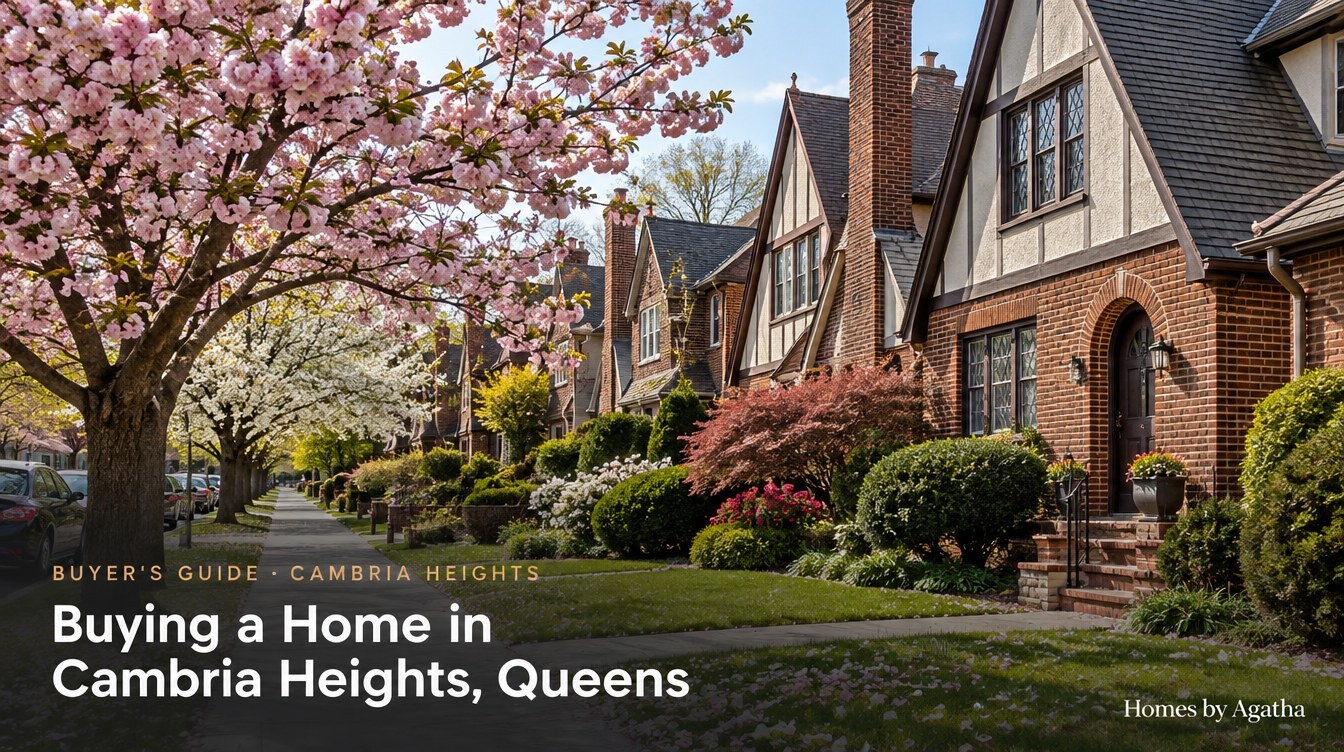
Most of the neighborhood east of roughly 219th Street, running toward the Cross Island Parkway, was zoned for one-family detached homes before 2005 and is now mapped R2A. On these blocks you will typically find brick and stucco Tudor-style houses with steep front gables, Cape Cods with dormers, and Colonial-style houses, many with a driveway leading to a detached rear garage. The age of the houses varies block by block. The two landmarked rows described below date from 1931, but other houses were built in different years, so look up the recorded year built for each address in NYC Department of Finance property records and use it to plan your inspection.
For a buyer, detached status matters because it affects privacy from neighbors, the cost of maintaining four exterior walls, and the options for future additions. It also matters at resale: a detached house on an R2A lot is a different product from an attached row house a few blocks west, and an appraiser will treat it that way.
Row houses and semi-detached houses in the north and west
Closer to Springfield Boulevard, Francis Lewis Boulevard and the northern edge, you will find attached and semi-detached houses, including groups of rows built as a single development. These can cost less to heat per square foot because of shared walls, but they come with shared elements that need attention: party walls, shared or easement driveways, and roofs that meet the neighbor’s roof at a common line.
When you look at an attached house, ask how the driveway is legally shared, whether a written easement exists, and who maintains a common rear alley or sewer connection. Those answers live in the title report and survey, not in the listing description.
The two landmarked Storybook blocks
In 2022 the NYC Landmarks Preservation Commission (LPC) designated the neighborhood’s first two historic districts. The LPC’s designation announcement describes the Cambria Heights–222nd Street Historic District (46 row houses between 115th Road and 116th Avenue) and the Cambria Heights–227th Street Historic District (50 row houses between 116th Avenue and Linden Boulevard), both built in 1931 in a Storybook style with Tudor elements — half-timbering, diamond-pane windows, stucco with brick and stone accents, and colorful slate or terra-cotta roofs.
Buying inside one of these districts means future exterior work — windows, roofing, masonry, porches, fences visible from the street — generally requires an LPC permit before you start. That is not a reason to avoid these blocks; it is a reason to budget for specialist materials and to factor permit time into renovation plans.
What “two-family” really means here
A house that looks like a two-family is not necessarily a legal two-family. In Cambria Heights, as in much of southeast Queens, some one-family houses have finished basements or second-floor layouts that a seller may describe as an “extra unit.” The legal unit count is set by the building’s Certificate of Occupancy or, for older buildings without one, by Department of Buildings records — not by the number of kitchens. If rental income is part of your plan, read the guide to buying a multi-family home in Queens before you make an offer.
How does zoning shape what you can do with a Cambria Heights house?
Zoning in Cambria Heights is deliberately low-density. In 2005 the City Council adopted a Department of City Planning rezoning of almost 200 blocks that replaced older R2, R3-2 and R4 districts with contextual districts — R2A, R3A, R3-1 and R4B — designed to keep new construction in scale with existing one- and two-family houses.
The rezoning was requested by the Cambria Heights Civic Association, Community Board 13 and local elected officials because the 1961 zoning would have allowed development out of scale with the surrounding houses. For a buyer, this history explains why you rarely see new multifamily buildings on residential blocks here, and why “teardown and build bigger” plans need a zoning check before anything else.
| Zoning district (2005 rezoning) | What it generally allows | What a buyer should check |
|---|---|---|
| R2A (most of the neighborhood) | One-family detached homes only, with floor-area, front-yard and height rules tied to the existing scale | Whether a planned extension, dormer or attic conversion fits the floor-area limit; whether an accessory dwelling unit is allowed on that lot under the 2024 rules |
| R3A | One- and two-family detached homes | Legal unit count on the CO; side-yard and lot-width requirements before adding space |
| R3-1 | One- and two-family detached or semi-detached homes | Shared-wall and side-yard conditions for semi-detached houses |
| R4B | Low-rise row-house district, one- and two-family | Party walls, shared driveways, rear-yard depth and parking rules |
| C1-3 / C2-3 overlays on Linden and Springfield Boulevards | Local retail and service uses on the ground floor along the corridors | Whether a mixed-use or corner property’s commercial use is legal and documented |
Zoning text has changed citywide since 2005. The City Council adopted the City of Yes for Housing Opportunity amendments in December 2024. Among other changes, they allow accessory dwelling units (ADUs) — small homes of 800 square feet or less on the same lot as a one- or two-family house — with limits: according to NYC Planning, detached ADUs are not allowed in historic districts or in R2A and R3A districts outside the Greater Transit Zone, basement and detached ADUs are not allowed in the expanded 2050 and 2080 flood areas, and the homeowner must live on the property. Rules for legalizing an existing unit are different from the rules for building a new one. Before you rely on any expansion idea, look up the exact lot on ZoLa, the NYC Department of City Planning’s zoning map, and ask a professional to read the rules for that lot.
A practical rule of thumb: buy the house for what it legally is today, not for what a listing says it could become. Any value you attach to a future addition, basement conversion or second unit should be backed by a zoning and building-code review, ideally during the due-diligence window before the contract is signed.
Key Takeaways
- Cambria Heights is mostly one- and two-family houses; a typical purchase is fee-simple, with no board review.
- Most blocks are zoned R2A, which permits one-family detached homes only.
- Two 1931 Storybook row-house blocks are LPC historic districts, so exterior changes there need LPC approval.
- Treat any “extra unit” as unverified until the Certificate of Occupancy or DOB records confirm it.
Want a second opinion on a specific block?
Send me the addresses you are considering and I will help you sort out house type, zoning and legal-use questions before you spend money on inspections.
House, co-op or condo: which ownership types exist in Cambria Heights?
In Cambria Heights the realistic choice is usually between a detached house, a semi-detached house and a row house — not between a co-op and a condo. Because the housing stock is mostly houses, a buyer who prefers a co-op or condo should check current listings to see what is available in and around the neighborhood at the time of the search.
Understanding the three ownership types still matters, because many buyers compare Cambria Heights houses against apartments in other parts of Queens before deciding. The comparison below explains how the monthly picture and the approval process differ.
| Factor | House (fee simple) — typical in Cambria Heights | Condo unit | Co-op apartment |
|---|---|---|---|
| What you own | Land and building | Your unit plus a share of common elements | Shares in a corporation plus a proprietary lease |
| Approval | No board; lender and title approval only | Usually no board interview; some buildings have a right of first refusal | Board application package and interview |
| Monthly costs | Mortgage, property tax, homeowner’s insurance, water/sewer, all repairs | Mortgage, common charges, unit property tax, unit insurance | Share loan, maintenance (typically includes a share of building property taxes and underlying mortgage) |
| Mortgage recording tax | Applies | Applies | Does not apply (share loan) |
| Renting out | Allowed within legal unit count and law | Per condo bylaws | Per co-op rules; often restricted |
| Repairs | Owner pays everything | Association handles common elements | Co-op handles building systems |
The monthly costs a house buyer pays directly
Because there are no common charges, a Cambria Heights house buyer must build the monthly budget from separate bills. The main lines are the mortgage payment, NYC property taxes (billed by the NYC Department of Finance), homeowner’s insurance, water and sewer charges billed by the NYC Department of Environmental Protection, heating fuel, electricity and a maintenance reserve.
The heating line deserves special attention. Older houses in this part of Queens may still heat with oil, while others have converted to natural gas. Ask for the last 12 months of fuel and utility bills, the boiler or furnace age, and — for oil — whether the tank is in the basement or buried in the yard. A buried tank that was abandoned without documentation is a cost you want to discover before contract, not after closing.
Why a maintenance reserve matters more here
In a co-op, a slate roof or a failing sewer line is a building expense spread across many owners. In a Cambria Heights house, it is yours. Specialty roofing on Tudor and Storybook houses, masonry repointing, and sewer service lines from the house to the street are all owner responsibilities in New York City. Setting aside a monthly reserve, sized to the age and condition the inspector reports, keeps one repair from becoming a financial emergency.
How much should you budget for buying a home in Cambria Heights beyond the price?
Budget for three layers: the down payment, closing costs paid at the closing table, and reserves you keep afterward. For a financed one- or two-family house in Queens, the largest buyer-side closing items are usually the NYC mortgage recording tax, title insurance, attorney fees and lender fees.
The tax items below are set by law and are the same for every Queens address, but which ones apply depends on the price, the loan amount and the property type. For a deeper line-by-line explanation, see the Queens closing costs guide.
| Cost item | When it applies to a Cambria Heights purchase | Source / who sets it |
|---|---|---|
| NYC mortgage recording tax | Roughly 1.8% of the loan amount for loans under $500,000 and 1.925% for loans of $500,000 and above on 1–3 family homes and condos; co-op share loans are exempt | NYC Department of Finance / New York State |
| NYS “mansion tax” | 1% of the price on residential purchases of $1 million or more, paid by the buyer (graduated above $2 million in New York City) | NYS Department of Taxation and Finance |
| Title insurance and title search | Owner’s and lender’s policies on fee-simple houses | Title insurer rates |
| Buyer’s attorney fee | Every New York purchase; quoted by the attorney | Negotiated with your attorney |
| Lender fees, appraisal, credit report | Financed purchases | Your lender’s Loan Estimate |
| Escrow deposits and prepaid items | Property tax and insurance reserves at closing | Lender requirements |
| Inspections and specialist checks | Home inspection, sewer camera, oil-tank sweep, termite, roof specialist as needed | Independent inspectors |
Confirm current rates with the NYS Department of Taxation and Finance and NYC Department of Finance before closing.
Two taxes are normally the seller’s, not yours: the NYS real estate transfer tax and the NYC Real Property Transfer Tax. Contracts can shift costs, so read your contract with your attorney rather than assuming.
After closing, plan for the ongoing layer: property tax installments, insurance renewals, water and sewer bills, and the reserve discussed above. Buyers who stretch to the maximum loan and leave no reserve are the most exposed when an older house needs a boiler, a roof section or a sewer repair in the first year.
Build a realistic all-in budget first
I can walk you through the cost categories for a Cambria Heights house so your lender, attorney and inspector conversations start from the same numbers.
How do pre-approval and financing work for a Cambria Heights house?
Get a written pre-approval from an NMLS-registered mortgage loan originator before you tour seriously. A pre-approval is a lender’s conditional commitment after reviewing your income, assets and credit; a pre-qualification is only an estimate. In a neighborhood of individual houses, sellers and their attorneys compare offers partly on how solid the financing looks.
Financing questions specific to this housing stock
Three issues come up often with Cambria Heights houses. First, the appraisal: older Tudor, Storybook and Cape Cod houses vary in size, condition and lot shape, so appraisers may have fewer close comparables, and a low appraisal can create a gap you must cover with cash or renegotiation.
Second, rental income from a second unit: lenders generally count projected rent only when the unit is legal, so a basement apartment that is not on the Certificate of Occupancy usually will not help you qualify. Ask your loan officer how they treat two-family properties before you rely on rental income.
Third, condition: some loan programs have property-condition standards, and an older house with a failing roof, peeling paint or an unsafe heating system can trigger repair requirements before closing. If you are buying a house that needs work, discuss renovation-loan options with your lender early. First-time buyers can also review the first-time home buyer guide for Queens to understand the overall sequence.
Down payment and the contract deposit
In New York, the buyer typically pays a contract deposit when the contract of sale is signed, held in escrow — usually by the seller’s attorney — until closing. The amount is negotiated and is often around 10% of the price. Make sure those funds are liquid and documented, because your lender will want to source them.
How do you commute from Cambria Heights without a subway station?
Cambria Heights has no subway station, so most transit commutes start with a local bus. The Q4, Q83 and Q84 buses connect the neighborhood with downtown Jamaica, where riders transfer to the E, J and Z subway lines or the LIRR’s Jamaica station, and the Q27 runs north on Springfield Boulevard toward Flushing. The MTA’s 2025 Queens Bus Network Redesign kept these routes serving Cambria Heights but changed some stop spacing and service details — for example, the Q4 Limited was discontinued — so check the current MTA bus map for the stops nearest a specific house.
The Long Island Rail Road is the main rail alternative. Three LIRR stations sit within a short bus ride or drive: Queens Village on Springfield Boulevard to the north, St. Albans on Linden Boulevard to the west, and Laurelton to the south. Across the city line in Nassau County, the Elmont–UBS Arena station is also nearby. Branch, frequency and Manhattan terminal differ from station to station, so check the current LIRR timetable for the station you would actually use and the hours you would travel.
| Commute option | How it works from Cambria Heights | What to test before you buy |
|---|---|---|
| Bus to the subway in Jamaica | Q4 (Linden Boulevard), Q83 (Murdock Avenue) or Q84 to downtown Jamaica, then E, J or Z | Walk time from the house to the nearest stop; rush-hour ride time to Jamaica |
| LIRR | Bus, drive or walk to Queens Village, St. Albans or Laurelton station | Which station is closest to the specific block; parking or drop-off options; train frequency at your hours |
| Express bus to Manhattan | MTA express routes to Midtown run through parts of southeast Queens; check the current MTA express bus map for stops near the block | Nearest express stop and schedule; fare differences |
| Bus north to Flushing | Q27 along Springfield Boulevard | Transfer points for northeast Queens destinations |
| Car | Cross Island Parkway on the eastern edge connects to the Belt Parkway, Southern State Parkway and Long Island destinations; Linden Boulevard runs east–west | Driveway or garage availability; peak-hour drive time; street-parking rules near the corridor |
Transit convenience varies a lot inside Cambria Heights. A house a short walk from Linden Boulevard has a different bus experience from a house near the Cross Island Parkway, and a buyer commuting by LIRR may prefer the western blocks closer to St. Albans or the northern blocks closer to Queens Village. Before making an offer, ride your actual commute once at the hour you would travel.
If you are comparing transit trade-offs across southeast Queens, the neighboring guides for buying in Saint Albans and buying in Laurelton cover areas that sit closer to LIRR stations. Buyers who are also weighing the Nassau side of the line can compare with buying in Nassau County, where the tax and transfer rules differ from New York City.
Key Takeaways
- No subway station: plan on a bus to Jamaica or an LIRR station for most transit commutes.
- Queens Village, St. Albans and Laurelton LIRR stations are the nearest rail options; the right one depends on the block.
- The Cross Island Parkway gives drivers direct access to Long Island and the Belt Parkway.
- Test your real commute at rush hour before you make an offer.
Match the block to your commute
Tell me where you travel each day and I will help you focus on the parts of Cambria Heights that fit that route.
What should you inspect in an older Cambria Heights house?
Hire a licensed New York home inspector and add specialists where the house calls for them. In older Cambria Heights houses, the items that most often change the deal are the heating system and any oil tank, the electrical service, the sewer line to the street, roofs on Tudor and Storybook houses, and basement water.
Heating systems and oil tanks
Many pre-war Queens houses were built with oil heat. If the house still uses oil, ask for the tank location, age and any testing records. If it converted to gas, ask whether the old tank was removed or abandoned in place and whether there is paperwork. A tank sweep — a scan of the yard and basement for buried tanks — is an inexpensive check compared with the cost of removing a leaking tank later.
Electrical service
Original wiring in older houses may be undersized for modern loads such as central air, electric ranges or EV charging. The inspector should report the service size, panel type and any visible older wiring. Upgrades usually require a licensed electrician and a filed permit.
Sewer line and basement water
In New York City, the property owner is responsible for the sewer service line from the house to the city sewer connection in the street. A sewer camera inspection shows roots, cracks or sags in older clay or cast-iron lines. Basement water is a separate question: parts of southeast Queens have had stormwater and groundwater issues, and the NYC Department of Environmental Protection is carrying out a multi-decade program to build out a storm sewer network across southeast Queens. Projects are completed, under construction or in design on different streets at different times, so ask the seller and check DEP project information about work near the block. Look for efflorescence, sump pumps, fresh paint on lower walls and musty odors, and ask the seller about past water entry.
Roofs, stucco and decorative details
Steep Tudor roofs, slate shingles, terra-cotta tile, stucco walls and half-timbering are part of what makes these houses attractive, but they require specialist repair. A general inspector may recommend a roofer or mason who works with these materials. Inside the two historic districts, replacement materials must meet LPC requirements, which can affect cost.
Lead paint and other older-home items
Federal law requires sellers of most housing built before 1978 to disclose known lead-based paint hazards and give buyers an opportunity to test. Because much of Cambria Heights predates 1978, assume that rule applies and decide whether to use your testing period. Ask the inspector to note possible asbestos-containing materials, such as old pipe insulation, so you can plan for professional assessment.
How do you confirm the Certificate of Occupancy, legal units and flood risk?
Confirm legal use through NYC Department of Buildings records before you sign the contract. The Certificate of Occupancy (CO) states a building’s legal use and number of units; your attorney and your own research should match the CO — or the DOB records that substitute for it — to how the house is actually being used.
Older houses and the CO
New York City buildings constructed before 1938 were not required to have a CO unless they were later altered in a way that required one. For a pre-1938 Cambria Heights house, the record may be a later CO, a letter from DOB, or simply the property’s tax classification and filed plans. Your attorney can advise whether additional documentation is needed for your lender and title company.
Permits, violations and alterations
Search the property on DOB’s public records for open permits, open violations and completed jobs. Common findings in older houses include a finished basement or attic without a permit, an enclosed porch, a rear extension or a converted garage. An open permit or unresolved violation can delay a closing or become your problem after it.
Landmark permits and flood maps
For houses inside the Cambria Heights–222nd Street or –227th Street Historic Districts, ask whether past exterior work received LPC approval; unapproved work can carry obligations to a future owner. Cambria Heights is inland, but flood risk should still be checked address by address on the FEMA Flood Map Service Center and NYC’s flood-hazard tools. If a property is in a Special Flood Hazard Area, a lender may require flood insurance.
| Due-diligence item | Where to check | Why it matters in Cambria Heights |
|---|---|---|
| Zoning district | NYC DCP ZoLa | R2A blocks allow one-family detached homes only; expansion plans depend on the lot |
| Certificate of Occupancy / legal units | NYC Department of Buildings records | Confirms whether a “two-family” is legal; affects financing and rental plans |
| Open permits and violations | DOB and OATH/ECB records via your attorney | Unpermitted basements, attics and extensions are common in older houses |
| Historic-district status | LPC designation maps and permit history | Exterior work on the two 1931 Storybook blocks needs LPC approval |
| Oil tank | Seller records; tank sweep | Buried or abandoned tanks can be costly to remediate |
| Sewer line | Sewer camera inspection | Owner is responsible for the line to the street |
| Flood zone | FEMA Flood Map Service Center; NYC flood-hazard tools | Determines lender flood-insurance requirements |
| Survey and driveways | Survey, title report | Shared driveways and easements are common on attached and semi-detached blocks |
Organize your due-diligence window
I can help you line up inspectors, records searches and questions for your attorney so nothing important is checked too late.
How do offers, contracts and buyer representation work in New York?
New York is an attorney state for residential closings: after a seller accepts your offer, the buyer’s and seller’s attorneys negotiate and prepare the contract of sale, and the deal is not binding until both sides sign. An accepted offer is not a signed contract, so either side can still walk away until the contract is fully executed.
From accepted offer to signed contract
Once your offer is accepted, the seller’s attorney typically sends a draft contract to your attorney. Your attorney reviews it, orders or reviews the title search, examines the building records and negotiates riders — for example, a mortgage contingency, the condition of appliances, or what happens if a violation is found. Your inspection usually happens during this period, because once you sign the contract and deliver the deposit, your options to walk away become limited to whatever the contract allows.
Writing a strong offer on a Cambria Heights house
A strong offer is clear, not just high. Sellers and their attorneys look at the price, the financing type and down payment, the strength of the pre-approval, the requested contingencies and the proposed closing date. On older houses, an offer that explains how you will handle inspection findings — for example, asking for a credit rather than a long repair list — can be easier for a seller to accept. Your agent should base the price on recent comparable sales of similar houses, matching detached versus attached, lot size and condition.
Working with a buyer’s agent after the 2024 settlement rules
A buyer’s agent represents your interests in finding, evaluating and negotiating for a home. Under the rules in effect in 2026 following the 2024 NAR settlement, you sign a written buyer agreement before touring homes with an agent. That agreement states how the agent is compensated. Buyer-agent compensation is negotiable, is not set by law, and is not automatically paid by the seller; a seller may agree to contribute, but that is part of the negotiation.
You will also receive the NYS Disclosure Form for Buyer and Seller at your first substantive contact with an agent. The form explains the different agency relationships so you know whom the agent represents. For more detail, read working with a buyer’s agent in New York.
Prepare your offer before you need it
Let’s review how to structure price, financing and contingencies for an older Cambria Heights house so you can move quickly when the right one appears.
What is the timeline, and which mistakes cost Cambria Heights buyers the most?
A financed house purchase in Cambria Heights commonly takes about two to three months from accepted offer to closing, although the range varies with the lender, title issues and the condition of the building records. Most avoidable delays come from paperwork — permits, violations or legal-use questions — rather than from the house itself.
| Stage | What happens | Common range (varies) |
|---|---|---|
| Preparation | Pre-approval, buyer agreement, budget, commute testing | 1–4 weeks |
| Search and offer | Tours, comparable-sales review, offer submitted and accepted | Varies with inventory and criteria |
| Due diligence and contract | Inspection, specialist checks, DOB/LPC records, title search, contract negotiation and signing with deposit | Often 1–3 weeks |
| Mortgage commitment | Appraisal, underwriting, conditions satisfied | Often 3–6 weeks after contract |
| Clear to close | Title clearance, homeowner’s insurance bound, closing scheduled | Often 1–2 weeks |
| Final walk-through and closing | Confirm condition; sign documents; pay closing costs; receive keys | Closing day |
Mistakes to avoid
- Paying for an illegal unit. Valuing a basement apartment as rental income before confirming the CO and DOB records.
- Skipping the sewer camera and tank sweep. Both are inexpensive compared with the repairs they can reveal in older houses.
- Ignoring the zoning. Assuming an R2A house can be expanded or converted without checking the lot’s limits.
- Overlooking landmark rules. Planning window or roof replacements on the 222nd or 227th Street blocks without budgeting for LPC-compliant work.
- Testing the commute on a weekend. Bus and LIRR travel times at rush hour can differ sharply from off-peak trips.
- Treating an accepted offer as a done deal. Until the contract is signed, the property can still go to another buyer.
- Draining reserves at closing. Older houses need a cushion for the first year’s surprises.
Cambria Heights buyer checklist
Use this checklist in order. It turns the points above into a sequence you can follow from your first conversation to closing day.
- Get a written pre-approval from an NMLS-registered loan originator and ask how the lender treats two-family income and older-home condition.
- Sign a written buyer agreement and review the NYS Disclosure Form for Buyer and Seller.
- Decide which house type fits you — detached, semi-detached or row house — and whether a legal two-family is essential.
- Test your commute from the specific blocks you like, by bus, LIRR or car, at your real travel time.
- For each serious property, look up the zoning on ZoLa and check whether it sits inside an LPC historic district.
- Review comparable sales of truly similar houses before setting your offer price.
- Once your offer is accepted, hire your attorney immediately and schedule the inspection, sewer camera and tank sweep.
- Have your attorney review the CO or DOB records, open permits, violations, survey and title report.
- Check the FEMA and NYC flood maps for the address and get homeowner’s insurance quotes early.
- Sign the contract and deliver the deposit only after your due diligence is complete.
- Keep documents flowing to your lender until you receive the mortgage commitment.
- Do a final walk-through, confirm agreed repairs or credits, and close with a reserve still in the bank.
If Cambria Heights is one of several southeast Queens neighborhoods on your list, compare it with buying in Springfield Gardens, which also borders Springfield Boulevard. And if you currently own a house here and need to sell before you buy, the companion page on how I help owners sell a home in Cambria Heights explains the selling side.
Ready to start your Cambria Heights search?
A short conversation now can save weeks later. We can map your budget, house type and commute into a focused plan for this neighborhood.
Frequently asked questions about buying a home in Cambria Heights
What types of homes are common in Cambria Heights, Queens?
Cambria Heights is mostly one- and two-family houses. The NYC Department of City Planning reported in 2005 that detached one- and two-family homes made up 78.5% of the housing stock. Brick Tudor-style, Cape Cod and Colonial houses are common, with row and semi-detached houses mainly in the northern and western sections.
Is there a subway station in Cambria Heights?
No. Cambria Heights has no subway station. Most transit riders take a local bus, such as the Q4, Q83 or Q84, to downtown Jamaica for the E, J and Z trains, or use nearby Long Island Rail Road stations at Queens Village, St. Albans or Laurelton. Confirm current routes on MTA maps.
What is R2A zoning in Cambria Heights?
R2A is a low-density zoning district that permits only one-family detached homes, with floor-area, front-yard and height rules designed to match existing houses. The City Council mapped R2A across most of Cambria Heights in 2005. Buyers should confirm any lot’s current zoning on NYC Planning’s ZoLa map before planning additions.
Are there historic districts in Cambria Heights?
Yes. In 2022 the NYC Landmarks Preservation Commission designated the Cambria Heights–222nd Street and Cambria Heights–227th Street Historic Districts, two groups of 1931 Storybook-style row houses with Tudor details. Exterior changes to houses in these districts generally require an LPC permit, so buyers should budget for compliant materials.
How do I know if a Cambria Heights house is a legal two-family?
Check the Certificate of Occupancy and NYC Department of Buildings records, not the listing or the number of kitchens. Houses built before 1938 may lack a CO, so your attorney may review other DOB records. Lenders usually count rental income only from legal units, which directly affects how much you can borrow.
What closing costs does a buyer pay in Cambria Heights?
Buyers typically pay the NYC mortgage recording tax on financed purchases, title insurance, attorney fees, lender fees and escrow deposits. Purchases of $1 million or more also carry the NYS mansion tax paid by the buyer. The NYS transfer tax and NYC Real Property Transfer Tax are customarily the seller’s costs.
Do I need a flood insurance check for a Cambria Heights home?
Check every address, even though Cambria Heights is inland. Look up the property on the FEMA Flood Map Service Center and NYC’s flood-hazard tools. If the house sits in a Special Flood Hazard Area, a lender may require flood insurance. Separately, ask about basement water history and drainage.
Who pays the buyer’s agent when buying in Cambria Heights?
Buyer-agent compensation is negotiable and not set by law. Under rules in effect in 2026, you sign a written buyer agreement before touring that states the agent’s compensation. Sellers are not automatically required to pay it, although a seller may agree to contribute as part of the negotiated deal.
Which LIRR stations are closest to Cambria Heights?
The closest Long Island Rail Road stations are Queens Village on Springfield Boulevard, St. Albans on Linden Boulevard and Laurelton to the south, with Elmont–UBS Arena just across the Nassau County line. The most convenient station depends on your block, so compare walking, bus and drop-off options before buying.
Is an accepted offer binding in New York?
No. In New York an accepted offer is not a signed contract. The buyer’s and seller’s attorneys negotiate the contract of sale, and the deal becomes binding only when both parties sign and the buyer delivers the contract deposit. Until then, either side can still withdraw without penalty.
Summary and your next step
Buying a home in Cambria Heights is a house-buying decision first: you are evaluating a specific lot, a specific zoning district and a specific pre-war building, not a building-wide budget run by a board. The buyers who do well here confirm legal use and zoning early, budget for older systems and landmark-quality materials where they apply, and choose blocks that match a realistic bus or LIRR commute. When you are ready to move from research to touring, the Cambria Heights home buying services page outlines how we can work together on your search.
This article is for general informational purposes only and reflects conditions that may change. It is not legal, tax, or financial advice, an appraisal, or a guarantee of price or outcome; consult a licensed New York attorney, a CPA, and an NMLS-registered mortgage loan originator as appropriate. A CMA is an opinion of value, not an appraisal. Real estate brokerage services are offered by Agatha Lubas, Licensed Associate Real Estate Broker, NY License #10301213345, Keller Williams Realty Liberty, 96-10 101st Avenue, Ozone Park, NY 11416. The NYS Disclosure Form for Buyer and Seller, the NYS Housing and Anti-Discrimination Disclosure / Fair Housing Notice, and the brokerage’s Standard Operating Procedures are available on request. Equal Housing Opportunity.

Agatha Lubas helps buyers, sellers and investors across Queens, Brooklyn, Nassau County and Suffolk County, guiding them through pricing, due diligence and the New York attorney-based closing process. She works in English and Polish so clients can communicate in the language they are most comfortable with.
Work with Agatha