

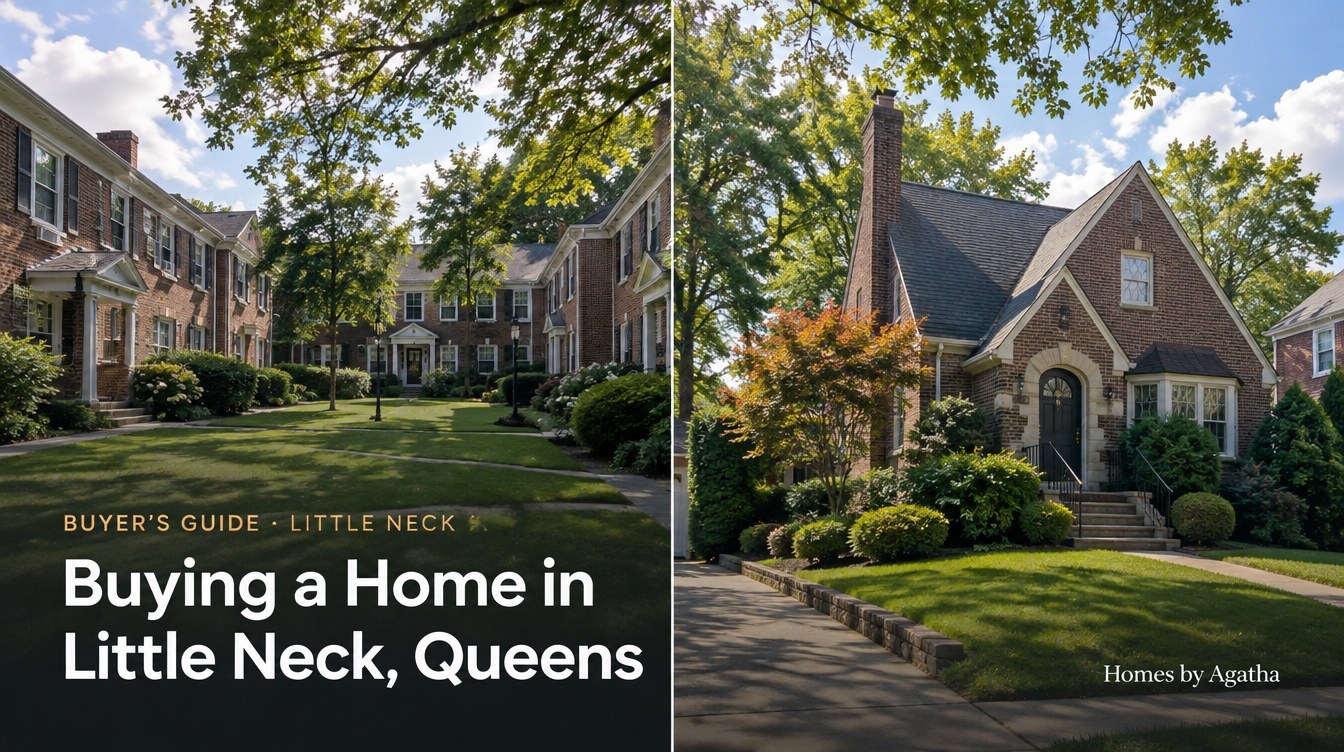
LITTLE NECK REAL ESTATE GUIDE
Buying a Home in Little Neck, Queens: Garden Co-op or Detached House, and Which Side of the City Line?
Quick Answer
Buying a home in Little Neck, Queens usually means choosing between a garden-apartment co-op, with board approval and monthly maintenance, and a detached house, with full upkeep and city property taxes. Confirm the address is on the Queens side of the Nassau County line, get pre-approved, check the Certificate of Occupancy and flood maps, and budget for closing costs.
Buying a home in Little Neck starts with a decision most buyers do not expect to make so early: are you shopping for a garden-apartment co-op or a detached house? In Little Neck, Queens, those are two separate markets with different approval processes, different monthly costs and different paperwork, even when the two homes are a ten-minute walk apart.
The second early question is geographic. Little Neck is the easternmost neighborhood in Queens, and its eastern edge is the New York City line. A few blocks away, Great Neck and Lake Success sit in Nassau County, where property taxes, transfer taxes and municipal records follow different rules. Many buyers search both sides at once, so it pays to understand what changes when you cross the line.
This guide covers the housing stock, how garden co-ops actually work, the cash you need at closing, financing, the Long Island Rail Road commute, the property checks that matter on mid-century houses, the New York contract process and a step-by-step timeline. As a Licensed Associate Real Estate Broker serving Queens and the surrounding New York markets, I help buyers compare property types and transaction rules side by side, in English or Polish, whichever is more comfortable. Where you buy is always your choice; my role is to make the facts behind it clear.
Little Neck at a glance
| Topic | What to know |
|---|---|
| Area | Northeast Queens, at the New York City–Nassau County line; Little Neck Bay and Udalls Cove to the north, Douglaston to the west, Glen Oaks to the south, the Great Neck area of Nassau County to the east |
| Borough / County | Queens / Queens County, New York City; Queens Community District 11 |
| ZIP codes | 11362 and 11363 (shared with Douglaston); Nassau addresses across the line use Great Neck ZIP codes such as 11020 and 11021. Confirm the ZIP code and the municipality for each specific address with USPS and NYC Department of Finance records |
| Rail | Long Island Rail Road (LIRR) Little Neck station at Little Neck Parkway and 39th Road, Port Washington Branch; the easternmost Port Washington Branch station inside New York City |
| Subway | No subway station in the neighborhood |
| Buses | Q12 along Northern Boulevard between Little Neck and Flushing; Q36 to Little Neck station. Routes changed under the Queens Bus Network Redesign, so check the current MTA bus map for routes, stops and express options toward Manhattan |
| Main roads | Northern Boulevard (NY 25A), Little Neck Parkway, Marathon Parkway, Long Island Expressway (I-495), Cross Island Parkway, Grand Central Parkway |
| Parks and open space | Udalls Cove Park Preserve, Little Neck Bay shoreline, Alley Pond Park to the west |
| Commercial corridors | Northern Boulevard, especially near Little Neck Parkway; neighborhood shops along Little Neck Parkway near the station |
| Typical property types | Detached single-family houses (Cape Cod, Tudor Revival, Colonial and ranch styles, mostly built from the 1920s to the 1960s) and garden-apartment co-op complexes such as Deepdale Gardens; smaller numbers of two-family houses, apartment co-ops and condos; current OneKey MLS listings show what is actually on the market |
| Key buyer considerations | Queens versus Nassau jurisdiction for addresses near the line; co-op board approval and maintenance; legal use of basements and attics; flood-map checks near Little Neck Bay and Udalls Cove |
Where exactly is Little Neck, and why does the city line matter when you buy?
Little Neck sits at the far northeastern corner of Queens, and its eastern edge is the boundary between New York City and Nassau County. That line matters because the same style of house on either side of it is taxed, recorded and regulated by different governments, which changes your closing costs and your yearly carrying costs.
The neighborhood is commonly described as the area east of Marathon Parkway, running north to Little Neck Bay and south toward the Grand Central Parkway, with Douglaston to the west. Those boundaries are informal; the NYC Department of City Planning’s Community District 11 map shows the official district lines. Locally, buyers may also hear informal names for smaller sections of the neighborhood. Such names help describe a location, but they are not legal boundaries and do not change any rule.
Queens side versus Nassau side: what actually changes
A home in Little Neck, Queens is inside New York City. Its property tax bill comes from the NYC Department of Finance, its building records sit with the NYC Department of Buildings, and its deed or co-op transfer is subject to the NYC Real Property Transfer Tax, which is customarily paid by the seller. A home across the line in the Great Neck area or Lake Success is in Nassau County and the Town of North Hempstead, with property taxes levied by the county, the town, any incorporated village and special districts, and building records held by the town or the village.
For a buyer, the practical differences show up in three places: the mortgage recording tax rate, the way the “mansion tax” is applied above $2 million, and the size and structure of the annual property tax bill. The cost table later in this guide puts these side by side.
Do not rely on the listing name or the ZIP code alone
Listings near the line sometimes describe a home loosely, and the address alone is not proof of jurisdiction. Before you make an offer, confirm the borough, block and lot through NYC Department of Finance property records, or the section, block and lot in Nassau County records, so you know which set of costs applies before you set your price.
If your search also includes the Nassau side, the guide to buying your home in Nassau County explains how purchases there are structured.
What kinds of homes can you buy in Little Neck, Queens?
Little Neck’s housing falls into two main groups: detached single-family houses on residential side streets, and garden-apartment co-op complexes, where a buyer purchases shares for one apartment in a group of low-rise buildings around shared grounds. Two-family houses, apartment-building co-ops and condos exist in smaller numbers.
Detached houses
Most of Little Neck’s houses are detached single-family homes built between the 1920s and the 1960s. Buyers will see brick and frame Cape Cods, Tudor Revival houses with steep gables, center-hall Colonials, and mid-century ranches and high-ranches. Many have a driveway, a detached or attached garage and a private yard. North of Northern Boulevard, some streets slope toward Little Neck Bay and Udalls Cove; south of Northern Boulevard and toward the Long Island Expressway, the street grid is more regular.
Because many of these houses have been expanded over the decades, the version you tour may include a finished basement, a dormered attic, an extension at the back or a converted garage. Those changes are often where legal questions hide, which the due-diligence section below covers in detail.
Garden-apartment co-ops
A garden-apartment co-op is a complex of low-rise residential buildings, usually two stories, arranged around lawns, courtyards and walkways, owned by a cooperative corporation. In Little Neck, the most widely known example is Deepdale Gardens, a large garden co-op complex near Marathon Parkway; the managing agent can confirm the complex’s boundaries, number of buildings and year of construction. Apartments in garden complexes are often described as “upper” or “lower” units: a lower unit is on the ground floor with direct entry, and an upper unit is reached by an interior or exterior stair.
Glen Oaks Village, another well-known garden co-op, is frequently searched together with Little Neck but sits in the neighboring Glen Oaks neighborhood to the south, with Glen Oaks addresses in ZIP code 11004. The ownership mechanics are similar, but each complex has its own board, rules and finances, so never assume one complex’s policies apply to another.
Two-family houses, apartment co-ops and condos
Two-family houses, apartment-building co-ops and condos exist in smaller numbers, often near Northern Boulevard and the major roads; current listings show how many are actually available. A two-family house offers rental income only if the Certificate of Occupancy permits two units; a single-family house with a basement apartment is not the same thing. The guide to buying a multi-family home in Queens covers that property type.
No landmark district to plan around in most of Little Neck
Unlike neighboring Douglaston, where two New York City historic districts shape exterior renovations, most of Little Neck is not inside a Landmarks Preservation Commission historic district; still, check the LPC’s Discover NYC Landmarks map for any specific address. That generally leaves exterior work subject to the NYC Department of Buildings and the zoning rules rather than to landmark review. If you are comparing the two neighborhoods, the guide to buying your home in Douglaston covers the landmark side of the market.
Key Takeaways
- Little Neck’s eastern edge is the New York City–Nassau County line, and taxes and records change at that line.
- Confirm borough, block and lot for every address near the line before setting your offer price.
- The market splits into detached mid-century houses and garden-apartment co-ops such as Deepdale Gardens.
- Glen Oaks Village is often searched with Little Neck but is in neighboring Glen Oaks, with its own board and rules.
Searching both sides of the city line?
Tell me your budget, commute and the type of home you want. I will help you compare Little Neck co-ops and houses with nearby Nassau options on the same cost basis, so the numbers are not apples to oranges.
Garden co-op or detached house: which fits your plans in Little Neck?
A garden co-op in Little Neck usually means a lower purchase price, shared exterior upkeep and a board approval step; a detached house means owning the land, controlling changes and paying for every repair yourself. The right choice depends on your budget, how much maintenance you want to manage and how much independence you need over the property.
A co-operative apartment, or co-op, is a form of ownership in which you buy shares in a corporation that owns the buildings and receive a proprietary lease for your apartment. A detached house is real property: you own the land and the structure outright, subject to your mortgage. That legal difference drives nearly every row in the table below.
| Factor | Garden-apartment co-op | Detached house |
|---|---|---|
| What you own | Shares in the cooperative corporation plus a proprietary lease | The land and the house |
| Approval to buy | Board application package and usually an interview | No approval beyond the seller and your lender |
| Monthly costs | Share loan payment plus maintenance, which typically includes a share of the property’s real estate taxes and any underlying mortgage; some complexes include certain utilities, so check each complex’s breakdown | Mortgage, NYC property taxes, homeowners insurance, all utilities, all repairs |
| Exterior and grounds | Maintained by the corporation and funded through maintenance and any assessments | Owner’s responsibility, including roof, driveway, trees on the lot and the sewer line to the street |
| Renovations | Alteration agreement and board or managing-agent approval; rules on washers, dryers and air-conditioning are set by each complex | DOB permits where required; zoning limits on additions |
| Parking | Set by the complex: lots, waitlists or street parking; ask the managing agent | Usually a driveway and often a garage |
| Renting out | Subletting governed by the co-op’s rules, often restricted | Permitted within the legal use on the Certificate of Occupancy |
| NYC mortgage recording tax | Not applicable to co-op share loans | Applies to the mortgage amount |
| Main timing risk | Board review and building paperwork | Inspection findings, legal-use questions, appraisal |
Which buyer each option tends to suit
A garden co-op tends to suit buyers who want a lower entry price, prefer not to manage a roof, boiler or lawn, and are comfortable with shared rules; it also differs from a high-rise co-op, with ground-level or one-flight entry, shared green space and, in many complexes, no elevator or lobby staff. A detached house suits buyers who want land, a driveway, room to expand or control over their own repairs, and who can budget for upkeep on systems that may be several decades old.
How does buying a garden co-op in Little Neck actually work?
Buying a garden co-op in Little Neck follows the standard New York co-op process: an accepted offer, a contract negotiated by attorneys, a board application package, usually an interview, and then closing. What is specific to garden complexes is the scale: one corporation may govern many buildings, so its finances, rules and capital projects affect a large number of owners at once.
The board package
A co-op board package is the application a buyer submits to the co-op’s board of directors, usually through the managing agent. It commonly includes tax returns, bank and brokerage statements, an employment letter, reference letters, the signed contract and, if you are financing, the loan commitment. Each complex sets its own requirements, including the minimum down payment, the maximum you can finance and how much cash it expects you to keep after closing, so get the current requirements from the managing agent. Some boards interview every applicant; others do not.
What to ask about the complex before you sign
- Maintenance: what the monthly charge covers. Some garden complexes include heat or other utilities, which changes how you compare maintenance between complexes.
- Assessments and capital projects: roofs, boilers, sidewalks, parking lots and pipes across many buildings are expensive; ask what is planned and how it will be paid for.
- Underlying mortgage: the corporation’s own mortgage, its balance and when it matures or must be refinanced.
- Reserves: how much the corporation keeps set aside for repairs.
- Rules: washer and dryer policy, air-conditioning units, pets, subletting, renovations and the use of yards or patios by lower units.
- Parking: whether spaces are assigned, rented or waitlisted, and how long the list is.
- Flip tax: any transfer fee set by the co-op’s own documents. There is no city-wide flip tax; each co-op decides whether it has one and who pays it.
Upper unit or lower unit?
In a garden complex, the choice between an upper and a lower apartment is practical, not cosmetic. A lower unit offers step-free or near step-free entry and sometimes access to a patio or yard area, depending on the complex’s rules. An upper unit has no one living above it and often has more light, but it means carrying groceries and furniture up a flight of stairs. Ask about each option’s history of leaks, sound transmission and storage before you choose.
Want a second pair of eyes on a co-op’s paperwork?
Before you commit to a Little Neck garden co-op, I can help you organize the questions for the managing agent and coordinate with your attorney so you understand the complex’s rules and finances.
What does it cost to close when buying a home in Little Neck?
When buying a home in Little Neck, plan for the down payment plus New York City closing costs, which differ for a co-op and a house. Co-op buyers avoid the mortgage recording tax and title insurance but pay board and managing-agent fees; house buyers pay the mortgage recording tax and title insurance; anyone paying $1 million or more pays the NYS mansion tax.
The table below lists the main buyer-side costs, plus a column showing how a comparable purchase across the line in Nassau County differs. Tax rules are stated as published by the official sources; your attorney and lender will give you the exact figures for your transaction. For a borough-wide breakdown, see Queens closing costs explained.
| Buyer cost | Little Neck house (Queens) | Little Neck co-op (Queens) | House across the line (Nassau County) |
|---|---|---|---|
| Down payment | Set by your loan program | Set by the co-op’s rules and your lender | Set by your loan program |
| NYS “mansion tax” (NYS Department of Taxation and Finance) | 1% of the price if $1 million or more; graduated above $2 million in New York City | 1% of the price if $1 million or more; graduated above $2 million in New York City | 1% of the price if $1 million or more |
| Mortgage recording tax | Roughly 1.8% of the loan under $500,000; 1.925% at $500,000 and above (NYC DOF / NYS, 1–3 family homes) | Not applicable to co-op share loans | 1.05% of the loan in Nassau County (NYS Department of Taxation and Finance) |
| Title insurance and title search | Yes | No; a lien search is used instead | Yes |
| Buyer’s attorney | Yes | Yes | Yes |
| Lender fees and appraisal | If financing | If financing | If financing |
| Inspection and specialist reports | Inspection, sewer-line camera, oil-tank check where relevant | Inspection of the apartment is optional but useful | Similar to Queens |
| Board and managing-agent fees | Not applicable | Application, credit check, move-in deposit, set by the complex | Not applicable |
| Prepaid items and adjustments | Property tax and insurance escrows; NYC tax adjustment | Maintenance adjustment | County, town, village and special-district tax adjustments |
Confirm current rates with the NYS Department of Taxation and Finance and NYC Department of Finance before closing.
Two transfer taxes the buyer usually does not pay
The NYS real estate transfer tax and, on the Queens side, the NYC Real Property Transfer Tax are customarily paid by the seller. They still matter to you as a buyer, because a seller in Little Neck, Queens nets less from the same price than a seller across the line in Nassau County, where the NYC tax does not apply. That difference can shape how flexible each seller is during negotiation.
Carrying costs: compare the year, not just the closing
When comparing a Little Neck house with a Great Neck-area house, compare the full annual cost and ask for each seller’s actual tax bills, because New York City and Nassau County calculate property taxes differently. For co-ops, compare maintenance together with what it includes; a higher charge that covers heat may cost less overall than a lower one that does not.
How should you prepare financing for a Little Neck co-op or house?
Get a full pre-approval from an NMLS-registered mortgage loan originator before you tour seriously, and tell the lender whether you are buying a co-op, a house or both. In Little Neck, the main financing questions are whether the lender will finance a particular garden complex, how the co-op’s down-payment rules compare with your plan, and whether the house you choose matches its legal use.
Pre-approval versus pre-qualification
A pre-qualification is an estimate based on what you tell a lender; a pre-approval means the lender has reviewed your income, assets and credit documents. Sellers give more weight to a pre-approval, and co-op boards ask for much of the same paperwork, so organizing it once saves time twice.
Co-op share loans in garden complexes
A co-op purchase is financed with a share loan secured by your shares and proprietary lease, not by a mortgage on real property. Not every lender makes co-op loans, and lenders that do may review the co-op corporation itself, including its finances and owner-occupancy, before agreeing to lend there. Ask your loan originator early whether they lend in the specific Little Neck complex, and ask the managing agent for the complex’s current financing limits.
Get your pre-approval aligned with the right property type
A co-op loan and a house mortgage are underwritten differently. I can help you map out which documents and which lenders fit the Little Neck homes you are considering.
How do you get from Little Neck to Manhattan and around Queens?
Most Little Neck commuters to Manhattan use the Long Island Rail Road’s Port Washington Branch from Little Neck station, at Little Neck Parkway and 39th Road. There is no subway in Little Neck, so the train, local and express buses and driving cover daily trips, and the block you choose decides which option is realistic.
Little Neck station and the Port Washington Branch
Little Neck station is the easternmost Port Washington Branch stop inside New York City; the next stop east, Great Neck, is in Nassau County. Westbound, the branch serves Douglaston, Bayside, Auburndale, Broadway, Murray Hill, Flushing–Main Street and Woodside on the way to Manhattan; Mets–Willets Point is served only for special events. The branch does not run through Jamaica, so riders do not change trains there. The Port Washington Branch serves both Penn Station and Grand Central Madison; check the current LIRR timetable for which trains go to each terminal, peak frequency and travel times.
LIRR fares from stations inside New York City can differ from fares from Nassau County stations, so a buyer comparing a Little Neck home with one near Great Neck station should price the monthly ticket for each; Little Neck and Great Neck are in different LIRR fare zones, and the MTA lists current fares and in-city ticket options on its website. Riders who need the subway can transfer at Woodside for the 7 train.
The Little Neck Parkway grade crossing
At Little Neck station, Little Neck Parkway crosses the tracks at street level, so traffic stops when the gates come down. If you plan to drive to the station or across the tracks at rush hour, test the trip at the time you would actually make it. Buyers whose homes sit north of the tracks near the bay should also check how the crossing affects trips toward Northern Boulevard.
Buses and driving
The Q12 runs along Northern Boulevard between Little Neck and Flushing, and the Q36 serves Little Neck station. Routes changed under the Queens Bus Network Redesign, so check the current MTA bus map for local routes and express options toward Manhattan. Drivers use Northern Boulevard, the Long Island Expressway, the Cross Island Parkway and the Grand Central Parkway, which connect to the rest of Queens, the bridges to the Bronx and Nassau County. Most detached houses have driveways; in garden co-ops, parking rules vary by complex.
Walking distance depends on where you buy
Homes near Little Neck Parkway and Northern Boulevard are closest to the station; garden complexes near Marathon Parkway and homes south of the Long Island Expressway are generally a bus ride or drive away. Test the route at commuting time before you make an offer.
What should you check on a Little Neck property before signing a contract?
Before signing a contract in Little Neck, confirm the property’s jurisdiction and legal use, review the Certificate of Occupancy and permit history, check flood maps for homes near Little Neck Bay and Udalls Cove, and inspect the systems typical of mid-century houses. In New York, this work usually happens before the contract is signed, because standard contracts generally do not include an inspection contingency.
Certificate of Occupancy and legal use
A Certificate of Occupancy, or CO, is the NYC Department of Buildings document that states a building’s legal use, occupancy and number of dwelling units. Many Little Neck houses were built before the city required a CO for every one- or two-family house, so a house may have no CO, or a later CO tied to an alteration. Your attorney should confirm what the DOB records show and whether today’s layout matches. The most common gaps in mid-century Queens houses are basement apartments with a separate entrance, attic bedrooms without proper egress, enclosed porches and garages converted into living space.
An illegal unit is not a minor detail. It can affect your insurance, your financing, your ability to collect rent and your exposure to code violations. If the layout depends on unpermitted space, factor the cost and feasibility of legalization, or removal, into your offer.
Zoning and expansion plans
Much of Little Neck is mapped in low-density residential zoning districts, many of them set by the City’s 2006 Douglaston–Little Neck rezoning, which limit building size, height and the number of units. Check the zoning district for each lot on the NYC Department of City Planning’s ZoLa map. If you plan to add a dormer, extend the back of the house or build a larger home, ask an architect to review the zoning and the DOB records during due diligence, before your deposit is at risk.
Flood maps near Little Neck Bay and Udalls Cove
Homes on the northern streets near Little Neck Bay and the Udalls Cove Park Preserve deserve a flood check, while most inland blocks are less likely to be affected. Look up the address on the FEMA Flood Map Service Center and on New York City’s flood-zone tools, ask the seller for any elevation certificate, and read the flood questions in the Property Condition Disclosure Statement. Lenders generally require flood insurance for properties in a Special Flood Hazard Area, so confirm the flood-zone status of each specific address rather than relying on its street or block.
Mid-century systems to inspect
- Heating and oil tanks: ask whether the house uses or once used heating oil, and whether any tank, above or below ground, was removed or abandoned with documentation.
- Electrical service: older panels, undersized service and ungrounded circuits are common in houses of this age and can affect insurance and renovation budgets.
- Plumbing and sewer line: in New York City the owner is responsible for the private sewer and water service lines to the street; a sewer-line camera inspection is worth considering, especially with mature trees nearby.
- Roof, chimney and masonry: brick Cape Cods and Tudors need tuck-pointing and flashing checks; steep Tudor roofs are costly to replace.
- Basement moisture: sloped streets near the bay and older foundations can show water intrusion; look for staining, efflorescence and sump pumps.
- Lead-based paint: houses built before 1978 may contain lead-based paint, and sellers must give buyers the federal lead disclosure and information pamphlet.
For a co-op, your attorney typically reviews the proprietary lease, house rules, recent financial statements and, where available, board minutes, along with the managing agent’s questionnaire.
| Check | Where to look | Why it matters in Little Neck |
|---|---|---|
| Jurisdiction (Queens or Nassau) | NYC DOF property records or Nassau County records; title search | Decides which taxes, records and building department apply |
| Certificate of Occupancy and permits | NYC Department of Buildings records | Basements, attics, porches and garages are often altered in mid-century houses |
| Zoning | NYC Department of City Planning ZoLa | Limits on additions and number of units |
| Flood zone | FEMA Flood Map Service Center and NYC flood tools | Insurance and lender requirements near Little Neck Bay and Udalls Cove |
| Oil tank and heating history | Seller records, inspector, tank sweep | Many houses of this era were heated with oil |
| Sewer line | Camera inspection | The owner pays to repair the line to the street |
| Co-op finances and rules | Financial statements, minutes, managing agent questionnaire | One corporation may cover many garden buildings and their capital needs |
| Parking and storage | Managing agent, house rules | Garden complexes handle parking differently from houses with driveways |
Key Takeaways
- Do the inspection and document review before signing; New York contracts usually do not include an inspection contingency.
- Compare the house’s layout with its Certificate of Occupancy; basement and attic space is where legal-use gaps tend to appear.
- Run a flood check on homes near Little Neck Bay and Udalls Cove and get an insurance quote early.
- For a garden co-op, the corporation’s finances, rules and parking policy matter as much as the apartment.
Build your due-diligence list before you fall for a house
I can help you line up the inspector, the records checks and the questions for the seller’s side so that you go into attorney review knowing what you are buying in Little Neck.
How do offers, contracts and buyer agreements work in New York?
New York is an attorney state: after a seller accepts your offer, the buyer’s and seller’s attorneys negotiate and prepare the contract of sale, and the deal binds both sides only once the contract is signed and the deposit is delivered. Before you tour homes with an agent, you also sign a written buyer agreement, and the agent’s compensation is negotiable.
From accepted offer to signed contract
An accepted offer in Little Neck, as anywhere in New York, is a starting point. The seller’s attorney typically drafts the contract and sends it to your attorney, who reviews it, checks title and municipal records, and negotiates terms such as the closing date, the mortgage contingency and how problems are handled. Your inspection usually happens in this window. When terms are agreed, you sign and send the contract deposit, which is held in escrow; the amount is negotiated and written into the contract.
What makes an offer clear
A clear offer states the price, down payment, financing, timing and your attorney’s contact details. For a garden co-op, add a short summary showing you meet the complex’s financial requirements, because sellers weigh board-approval risk. Until the contract is signed, another buyer can still make an offer, so have your attorney and inspector ready.
Buyer agreements and compensation in 2026
At the first substantive contact, a New York real estate licensee gives you the NYS Disclosure Form for Buyer and Seller, which explains agency relationships. Under the rules in effect since the 2024 NAR settlement, you sign a written buyer agreement before touring homes with an agent. Buyer-agent compensation is negotiable, not set by law and not automatically paid by the seller: a seller may offer to contribute, you may request a concession in your offer, or you may pay directly under the agreement. The guide to working with a buyer’s agent in NY explains the options.
What local representation covers in Little Neck
Local work in Little Neck includes separating comparable sales by property type and complex, confirming jurisdiction on addresses near the city line, pulling DOB records early on houses with finished basements or attics, preparing co-op board packages and keeping the attorney, lender, inspector and managing agent on one timeline. The page on how to buy your home in Little Neck with Agatha describes how that support is organized.
What is the step-by-step timeline for a Little Neck purchase?
A Little Neck purchase moves from preparation and pre-approval to search, offer, due diligence and attorney review, a signed contract, financing and, for co-ops, board approval, then the final walkthrough and closing. Co-op purchases add the board stage, which runs on the board’s schedule, not the buyer’s.
| Stage | House | Garden co-op |
|---|---|---|
| 1. Preparation | Pre-approval, budget, buyer agreement, NYS disclosure form | Same, plus confirming your lender finances co-ops and gathering board-package documents early |
| 2. Search and showings | Compare blocks, legal use and condition; test the commute | Compare complexes, maintenance inclusions, upper versus lower units, parking |
| 3. Offer | Price, financing, timing, attorney | Same, plus a financial summary that matches the complex’s requirements |
| 4. Due diligence and attorney review | Inspection, sewer and oil-tank checks, DOB and CO review, title, flood check | Apartment inspection, financial statements, house rules, managing agent questionnaire, lien search |
| 5. Contract signed | Deposit held in escrow; binding from this point | Deposit held in escrow; board approval is normally a condition of the contract |
| 6. Financing | Appraisal, underwriting, loan commitment | Share-loan underwriting, which may include review of the co-op corporation |
| 7. Approval | Not applicable | Board package, possible interview, board decision |
| 8. Walkthrough and closing | Confirm condition and insurance; sign and record documents | Confirm condition; stock and lease transferred at a closing attended by the managing agent’s representative |
Timing depends on the lender, the attorneys, the co-op board and the time of year, so treat any schedule as a plan rather than a promise.
Sequence your move around real dates
Selling another home, ending a lease or relocating from outside New York? I can help you line up pre-approval, showings, board timing and closing so the dates fit your life.
What mistakes do Little Neck buyers make, and what belongs on your checklist?
The most common mistakes when buying in Little Neck are mixing up Queens and Nassau costs, treating a garden co-op like a house, trusting a listing’s room count without checking the Certificate of Occupancy, and choosing a commute from a map. Each one is avoidable with early questions and the right records.
Mistakes to avoid
- Comparing across the city line on price alone. A Little Neck home and a Great Neck-area home at the same price can carry different recording taxes, property taxes and LIRR fares.
- Assuming every garden complex works the same way. Deepdale Gardens, Glen Oaks Village and other complexes each have their own board, rules, maintenance inclusions and financing limits.
- Counting rooms that are not legal. A basement apartment or attic bedroom that is not on the CO can change financing, insurance and rental plans.
- Skipping the sewer and oil-tank checks. These are common, expensive surprises in houses of this era.
- Ignoring the flood map near the water. Homes near Little Neck Bay and Udalls Cove deserve a flood check even if they look well above the shoreline.
- Forgetting the grade crossing. Driving to Little Neck station at rush hour can take longer than the distance suggests.
Little Neck buyer checklist
- Get a full pre-approval and confirm whether your lender finances co-ops in the complexes you like.
- Decide whether you are shopping for a garden co-op, a detached house or both, and set a separate budget for each.
- For each address near the line, confirm borough, block and lot, and which property tax system applies.
- For houses, compare the layout with DOB records and the CO, and check the zoning if you plan to expand.
- For co-ops, request financial statements, house rules, parking policy and any flip tax terms.
- Run FEMA and NYC flood checks for homes near Little Neck Bay and Udalls Cove.
- Schedule an inspection plus sewer-line and oil-tank checks where relevant.
- Confirm closing-cost estimates with your attorney and lender, including the mansion tax at $1 million or more and the mortgage recording tax for houses.
- Test the commute from the specific block to Little Neck station or your preferred route.
Start your Little Neck search with a plan
Share your timing, budget and must-haves, and we will set up a search that sorts co-ops from houses and Queens from Nassau before you spend a weekend touring.
If you are weighing several Northeast Queens neighborhoods, compare Little Neck with buying your home in Oakland Gardens, on the other side of Alley Pond Park, which also has a large garden co-op supply. Little Neck owners planning their own move can read about selling your home in Little Neck.
Frequently asked questions about buying a home in Little Neck
Is Little Neck in Queens or Nassau County?
Little Neck is in Queens, New York City, at the borough’s northeastern edge. The Nassau County line runs along its eastern side, and the Great Neck area and Lake Success sit just beyond it. Because taxes and records differ across that line, confirm the borough, block and lot for any address before making an offer.
What types of homes are for sale in Little Neck?
Little Neck, Queens is mainly detached single-family houses, such as Cape Cods, Tudors, Colonials and ranches built from the 1920s to the 1960s, plus garden-apartment co-op complexes like Deepdale Gardens. Two-family houses, apartment-building co-ops and condos exist in smaller numbers, so most buyers end up choosing between a co-op and a house.
What is a garden co-op?
A garden co-op is a complex of low-rise residential buildings, usually two stories, set around shared lawns and walkways and owned by a cooperative corporation. Buyers purchase shares and receive a proprietary lease for one apartment. The board approves buyers, and monthly maintenance funds the buildings, grounds, a share of taxes and often other costs.
Is Glen Oaks Village in Little Neck?
No. Glen Oaks Village is a garden-apartment co-op in the neighboring Glen Oaks neighborhood, south of Little Neck, although buyers often search the two areas together. Each garden complex has its own board, financial statements, maintenance inclusions and rules, so review the specific complex’s documents rather than assuming policies carry over from a nearby one.
How do you commute from Little Neck to Manhattan?
Most commuters take the Long Island Rail Road Port Washington Branch from Little Neck station, at Little Neck Parkway and 39th Road, toward Penn Station or Grand Central Madison. There is no subway in Little Neck. Local buses, express buses and driving via the Long Island Expressway are alternatives; check current MTA schedules first.
Do Little Neck co-op buyers pay mortgage recording tax?
No. Co-op purchases are financed with share loans, which are not subject to the New York City mortgage recording tax. Little Neck co-op buyers still pay attorney fees, lender fees, a lien search, board application and managing-agent fees and, if the price is $1 million or more, the NYS mansion tax.
Are closing costs different in Great Neck than in Little Neck?
Yes. Great Neck-area homes are in Nassau County, so the NYC Real Property Transfer Tax does not apply and the mortgage recording tax rate is lower than New York City’s. Property taxes are levied by the county, town, village and special districts. Your attorney can estimate both sides for a specific purchase.
Can I buy a Little Neck house with a basement apartment?
You can, but check the Certificate of Occupancy and NYC Department of Buildings records first. If the basement unit is not legal, it may affect your financing, insurance, rental income and liability. Factor the cost and feasibility of legalizing or removing the unit into your offer, and have your attorney review it.
Do I need flood insurance in Little Neck?
It depends on the address. Homes on streets near Little Neck Bay and Udalls Cove may fall within a FEMA Special Flood Hazard Area, where lenders generally require flood insurance, while most inland blocks are less likely to. Check the FEMA Flood Map Service Center and NYC flood maps, then request an insurance quote during due diligence.
Who pays the buyer’s agent when buying in Little Neck?
Buyer-agent compensation is negotiable and is not set by law or automatically paid by the seller. Under rules in effect since the 2024 NAR settlement, you sign a written buyer agreement before touring. A seller may agree to contribute, you may request a concession in your offer, or you may pay your agent directly.
Your next step in Little Neck
Buying a home in Little Neck goes more smoothly when you make two decisions before you tour: garden co-op or detached house, and Queens only or both sides of the Nassau line. Those choices decide your approval process, your closing costs and your monthly budget. From there, the checks that matter most here are legal use on mid-century houses, flood maps near the bay, a co-op’s finances and rules, and a commute tested at rush hour. When you are ready to look at specific homes, the page on how to buy a Little Neck home with local guidance explains how we can work together from the first showing to the closing table.
This article is for general informational purposes only and reflects conditions that may change. It is not legal, tax, or financial advice, an appraisal, or a guarantee of price or outcome; consult a licensed New York attorney, a CPA, and an NMLS-registered mortgage loan originator as appropriate. A CMA is an opinion of value, not an appraisal. Real estate brokerage services are offered by Agatha Lubas, Licensed Associate Real Estate Broker, NY License #10301213345, Keller Williams Realty Liberty, 96-10 101st Avenue, Ozone Park, NY 11416. The NYS Disclosure Form for Buyer and Seller, the NYS Housing and Anti-Discrimination Disclosure / Fair Housing Notice, and the brokerage’s Standard Operating Procedures are available on request. Equal Housing Opportunity.

Agatha Lubas helps buyers, sellers and investors across Queens, Brooklyn, Nassau County and Suffolk County compare property types and transaction rules before they commit. She works in English and Polish, so clients can communicate in whichever language they find more comfortable.
Work with Agatha