

WHITESTONE REAL ESTATE GUIDE
Buying a Home in Whitestone, Queens: Inland Houses, Waterfront Blocks and Beechhurst Co-ops
Quick Answer
Buying a home in Whitestone, Queens (ZIP 11357) usually means choosing between a detached house on the inland grid, a waterfront or near-water house in areas such as Malba, and a co-op or condo in Beechhurst. Plan a car-and-bus commute, check flood maps and bulkheads, confirm legal records and budget New York closing costs.
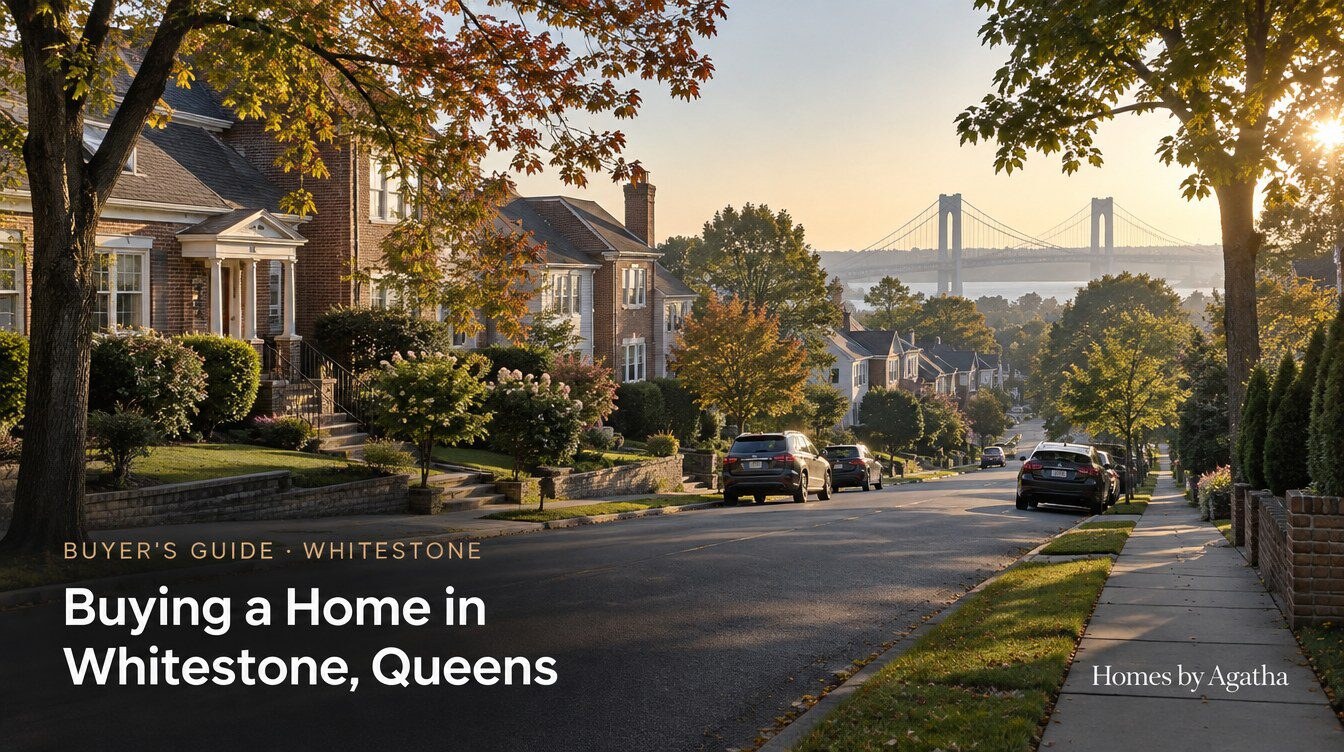
Buying a home in Whitestone is mostly a decision about land, water and logistics. Whitestone sits on the northern shore of Queens, where the East River opens toward Little Bay, with College Point to the west and Bayside to the east. Two bridges — the Bronx–Whitestone Bridge and the Throgs Neck Bridge — touch down at its edges, the Cross Island Parkway runs along its shoreline, and no subway line reaches it.
This guide is for buyers seriously researching Whitestone, Queens, including the sub-areas of Malba and Beechhurst. It compares the three main housing environments — inland detached houses, houses on or near the water, and co-op or condo apartments — and what each means for your mortgage, insurance, documents and daily travel, followed by New York’s contract process, closing costs and a pre-offer checklist.
As a Licensed Associate Real Estate Broker serving Queens and the surrounding New York markets, I help buyers compare specific properties and understand the transaction before they commit — in English or Polish, whichever makes the conversation easier. Where you buy is always your own choice; the purpose of this guide is to put the facts in front of you.
Whitestone at a glance
| Topic | Whitestone, Queens |
|---|---|
| Area | Northeastern Queens shoreline, New York City; Queens Community Board 7 |
| Borough / county | Queens (Queens County), New York City |
| ZIP code | 11357 (also used by Malba and Beechhurst) |
| Sub-areas | Malba (northwest, by Powell’s Cove); central Whitestone; Beechhurst (northeast, along the East River and Little Bay) |
| Neighbors | College Point to the west; Flushing and Auburndale to the south; Bay Terrace and Bayside to the east |
| Local buses | MTA Q15 (Flushing–Whitestone; changed in the Queens Bus Network Redesign on June 29, 2025) and Q61 (Beechhurst–Flushing via Willets Point Boulevard); check mta.info for current routes and stops |
| Express buses | Premium-fare express buses to Midtown Manhattan serve parts of Whitestone and Beechhurst; check mta.info for current routes and stops |
| Subway / rail | No subway in Whitestone. Nearest subway: the 7 train at Flushing–Main Street. Nearest LIRR: Port Washington Branch stations such as Flushing–Main Street, Murray Hill, Broadway, Auburndale and Bayside, reached by bus or car |
| Highways and bridges | Cross Island Parkway; Whitestone Expressway (I-678) to the Bronx–Whitestone Bridge; Clearview Expressway (I-295) to the Throgs Neck Bridge |
| Parks and landmarks | Francis Lewis Park, at the Queens base of the Bronx–Whitestone Bridge on the East River; Little Bay Park near the Throgs Neck Bridge; Powell’s Cove Park near Malba; Fort Totten Park nearby in Bayside |
| Commercial corridors | Local shopping streets within Whitestone; the Bay Terrace Shopping Center is nearby in Bayside |
| Typical property types | Mostly detached one-family houses; some semi-detached and two-family houses; co-op and condo buildings concentrated in Beechhurst, including the Le Havre co-op complex (current co-op and condo listings appear on OneKey MLS) |
| Local housing considerations | Flood zones and bulkheads on shoreline lots; lower-density zoning; older-house systems; co-op board approval in Beechhurst |
How do Whitestone, Malba and Beechhurst differ for a buyer?
Whitestone, Malba and Beechhurst share one ZIP code, and listings often call all three “Whitestone,” but they offer three different purchases. Inland Whitestone is mainly detached houses on a street grid, Malba is a small area of larger detached houses near Powell’s Cove and the East River, and Beechhurst combines houses with the neighborhood’s main concentration of co-op and condo buildings.
Inland Whitestone: the detached-house grid
Most of Whitestone, Queens is a grid of residential streets south of the Cross Island Parkway, running toward Flushing and Auburndale. The dominant property type is the detached one-family house with a driveway, a garage or both. Styles span decades, from older frame houses, Tudors and Colonials to postwar Capes, ranches and high-ranches, plus newer houses built where an older one was taken down.
Because of that range, two homes on the same block can be very different purchases: one with original systems, the next a recent rebuild. Lot width, depth and the house’s position on the lot also vary, and those dimensions matter for parking, yard space and any future expansion.
Malba and the shoreline blocks
Malba occupies the northwest corner of Whitestone, between Powell’s Cove and the Whitestone Expressway approach to the Bronx–Whitestone Bridge. It is a compact area of detached houses, many on larger lots, some facing the East River. Some Malba and shoreline lots may carry recorded covenants, easements or association obligations, and only the title report shows whether any of them run with a specific lot.
For a buyer, that is a due-diligence item. Your attorney and title company should confirm what the deed includes, whether covenants, easements or association obligations apply, and who owns and maintains the land between the house and the water. The same questions apply to other shoreline blocks in Whitestone and Beechhurst.
Beechhurst: houses plus co-op and condo buildings
Beechhurst is the northeastern part of the Whitestone area, along the East River and Little Bay, ending at the approach to the Throgs Neck Bridge. It has detached houses, but it is also where most of Whitestone’s apartment buildings stand, including the large Le Havre co-op complex; building details such as size, age and finances come from the cooperative’s own offering plan and financial statements. Other co-op and condo buildings stand in Beechhurst as well, and each one has its own rules, finances and approval process.
Once you know which environment fits, our Whitestone home buying page explains how a search there is organized, from the first tour through the closing.
Is a detached house, a co-op or a condo the better fit in Whitestone?
A detached house gives you land, parking and control, with full responsibility for upkeep and insurance. A Beechhurst co-op usually offers the lowest entry cost into a Whitestone address but adds board approval and building rules. A condo sits in between: a deeded unit with common charges and fewer approval hurdles than a co-op.
What you own in each structure
- A house (fee simple). Fee-simple ownership means you own the land and the building, subject to any mortgage, easements and recorded covenants. In Whitestone, that usually includes a driveway, a yard and, on some lots, a stretch of shoreline with its own maintenance obligations.
- A co-op. A cooperative apartment is a purchase of shares in the corporation that owns the building, plus a proprietary lease for your unit. The board approves buyers, and monthly maintenance covers operating costs and typically a share of the building’s property taxes and any underlying mortgage.
- A condo. A condominium unit is real property with its own deed and tax lot. Owners pay common charges plus property taxes on their own unit. Condo boards generally cannot reject a buyer the way a co-op board can, though many by-laws include a right of first refusal.
Space and off-street parking are the clearest advantages of a Whitestone house, in a neighborhood where many errands and commutes involve a car. The trade-off is that every system — roof, boiler, sewer line, sidewalk and, on the water, a bulkhead — is yours to maintain. Beechhurst apartments shift that responsibility to the building, so the key question becomes how well funded the building is and what projects it plans.
Co-op vs. condo vs. house: a side-by-side view
| Factor | Detached house | Co-op apartment | Condo unit |
|---|---|---|---|
| Ownership | Land and building (fee simple) | Shares plus proprietary lease | Deeded unit plus share of common elements |
| Approval | Lender only | Board package and interview | Usually a right-of-first-refusal waiver |
| Monthly costs beyond the loan | Property tax, insurance, all upkeep | Maintenance (often includes the building’s taxes and underlying mortgage share) | Common charges, unit property tax, unit insurance |
| Financing | Standard mortgage | Share loan; each building sets its own down payment and financial rules | Mortgage with a review of the condominium project |
| NYC mortgage recording tax | Yes | No (share loan) | Yes |
| Whitestone-specific watch-out | Flood zone and bulkhead on shoreline lots; zoning limits on additions | Waterfront building’s capital plans and reserves | Building flood coverage and reserves |
Key Takeaways
- Whitestone, Malba and Beechhurst share ZIP 11357 but represent different purchases; identify the sub-area before comparing listings.
- Detached houses dominate inland Whitestone; most co-op and condo inventory is in Beechhurst.
- Shoreline houses add flood, bulkhead and deed-boundary questions that inland houses usually do not have.
Torn between a Whitestone house and a Beechhurst apartment?
Tell me how you live, travel and plan to use the space. I will help you weigh the house-versus-apartment trade-offs on real listings before you commit your weekends to tours.
What does buying a co-op in Beechhurst involve?
Buying a co-op in Beechhurst involves two approvals: your lender’s and the co-op board’s. After your offer is accepted and the contract is signed, you submit a board package with detailed financial and personal documentation, the board reviews it and usually interviews you, and the closing can happen only after the board approves.
The board package
A board package is the application a co-op requires from every purchaser: typically tax returns, bank and investment statements, employment verification, reference letters, the signed contract and, if financing, the loan commitment. Each building sets its own list and format, so ask the managing agent for the current requirements.
Boards also set financial standards, such as a minimum down payment, a maximum debt-to-income ratio and liquid savings left after closing. These come from each building’s own policies, not public law, and they vary from building to building. Ask before you offer, because a contract that satisfies the seller can still fail at the board stage.
Reading the building, not just the apartment
For a waterfront co-op complex, the building’s finances are part of the purchase. Your attorney typically reviews the financial statements, minutes and proprietary lease. Pay particular attention to:
- Capital projects. Roofs, facades, garages, boilers and any waterfront structures can require large projects funded through reserves, loans or assessments.
- Assessments. An assessment is a charge added to maintenance for a specific cost. Ask whether one is in place or planned.
- Flood and storm coverage. Ask how the building insures against flood and wind, and whether any part of the property sits in a mapped flood zone.
Flip tax and closing costs on a co-op
A flip tax is a transfer fee that some co-ops charge on sales. It is set by each co-op’s own documents; there is no citywide rate. Co-op buyers do not pay the NYC mortgage recording tax, because a co-op loan is a share loan rather than a mortgage on real property; they pay a lien search, attorney fees and building application fees instead.
Our guide for first-time home buyers in Queens covers the co-op approval sequence in general terms.
Can you live in Whitestone without a car?
Living in Whitestone without a car is possible but requires planning. The neighborhood has no subway; residents use MTA local buses to reach Flushing–Main Street for the 7 train and the LIRR, or express buses to Manhattan. Many households also rely on a car.
Local buses after the Queens Bus Network Redesign
The MTA’s Queens Bus Network Redesign changed northern Queens routes in mid-2025. According to the MTA’s published plan, the Q15, changed on June 29, 2025, runs between Flushing and Whitestone and was shortened to end at Clintonville Street and 7th Avenue, and a new Q61 connects Beechhurst with Flushing along Willets Point Boulevard. Routes, stops and frequencies can still change, so confirm them on mta.info for the specific address you are considering.
For a buyer, this means two houses a mile apart can have very different bus access. A house near Willets Point Boulevard or the Q15 corridor has a different routine than one deep in Malba. Check the walk to the nearest stop from the exact address.
Rail, express buses and driving
The 7 train’s eastern terminal, Flushing–Main Street, is the closest subway to Whitestone. The LIRR Port Washington Branch stops there and at Murray Hill, Broadway, Auburndale and Bayside, which some residents reach by car or bus. Premium-fare express buses run from Whitestone and Beechhurst stops to Midtown Manhattan; check the current schedule on mta.info before relying on one.
For drivers, the Cross Island Parkway follows the shoreline from the Bronx–Whitestone Bridge east toward Fort Totten and Bayside. The Whitestone Expressway (I-678) links that bridge with the Van Wyck Expressway and the airports, and the Clearview Expressway (I-295) leads to the Throgs Neck Bridge; both bridges are tolled MTA Bridges and Tunnels crossings. Some blocks sit near ramps or bridge approaches, so visit at rush hour to judge traffic and noise.
A commute test before you offer
- Leave from the exact address at your real weekday travel time.
- Time the walk, the bus, the transfer at Flushing–Main Street and the train.
- Repeat the trip by car, including the parkway or expressway approach.
- Note noise from roads, bridge approaches and overhead flights at different hours.
Want a shortlist built around your actual commute?
Share where you travel and when. I will help you focus on the Whitestone blocks, bus corridors and property types that fit your routine.
Which flood and waterfront questions matter on a Whitestone property?
Flood status in Whitestone has to be checked by address. Some waterfront and low-lying blocks along the East River, Powell’s Cove and Little Bay may fall within or near a FEMA Special Flood Hazard Area, and inland blocks have their own stormwater questions; check both the effective and the preliminary FEMA maps for each specific address. Shoreline lots add a second question: the condition of the bulkhead or seawall.
Flood maps, insurance and lenders
A Special Flood Hazard Area (SFHA) is the zone FEMA maps as having at least a 1% chance of flooding in any given year. When a property in an SFHA is bought with a federally backed or federally regulated mortgage, the lender generally requires flood insurance, so price it before you offer.
- FEMA Flood Map Service Center. Search the address on the FEMA Flood Map Service Center for the effective Flood Insurance Rate Map and zone.
- NYC Flood Hazard Mapper. The NYC Department of City Planning’s mapper adds preliminary maps and future-conditions layers.
- Seller disclosure. For most one-to-four-family houses, New York’s Property Condition Disclosure Statement asks about flood history, flood insurance and flood claims.
- Elevation certificate and NFIP policy. An elevation certificate is a surveyor’s record of a building’s elevation relative to expected flood levels and can affect pricing. An existing National Flood Insurance Program policy can generally be assigned to a buyer, but get your own quote too.
Bulkheads, seawalls and the edge of the lot
A bulkhead is a retaining wall at the water’s edge that holds the land against tides and waves. On a Whitestone or Malba waterfront lot it is usually the owner’s responsibility, and replacing one is a major project. Shoreline work can require permits from the NYS Department of Environmental Conservation under the state’s tidal wetlands rules and from the U.S. Army Corps of Engineers, and possibly city approvals; confirm the permits a specific project needs with those agencies before budgeting.
Before you sign a contract on a shoreline house, ask for the bulkhead’s age, material and repair records; past permits for shoreline work, docks or piers; a survey showing the property line relative to the water; and an inspection by a marine-structure professional, separate from the standard home inspection. Waterfront lots are also subject to special waterfront provisions in the NYC Zoning Resolution; look up the specific lot on ZoLa and ask an architect how they apply.
Basements and storm drainage inland
Flood risk is not limited to the shoreline. During intense rain, water can enter basements through floor drains, window wells or sewer backups far from the river. Look for staining, sump pumps and backwater valves, and ask whether the basement has ever taken water.
Key Takeaways
- Check every Whitestone address on the FEMA Flood Map Service Center and the NYC Flood Hazard Mapper before offering.
- In a Special Flood Hazard Area, a lender will generally require flood insurance; get a quote early.
- On waterfront lots, the bulkhead or seawall is a major owner responsibility; inspect it separately.
What should you verify on an older Whitestone house?
On an older Whitestone house, verify the legal use, the permit history, the major systems and the zoning that governs future changes. In New York City, most of this happens after the offer is accepted and before the contract is signed, because the contract usually gives the buyer few exits once it is signed.
Certificate of Occupancy and legal use
A Certificate of Occupancy (CO) is the NYC Department of Buildings document that states a building’s legal use and number of dwelling units. Many older one- and two-family houses in Whitestone predate CO requirements for that building type, so some have no CO on file and rely on other records, which your attorney and title company review.
If a house shows a second kitchen, a separate entrance or a basement apartment, compare it with the legal records. An undocumented unit affects your lender, your insurer and your exposure to violations, and most lenders will not count rent from it.
Permits, extensions and rebuilds
Many Whitestone houses have been extended with dormers, rear additions, enclosed porches and finished basements, and some have been fully rebuilt. Each change may have required a permit. Open permits, Department of Buildings violations and Environmental Control Board penalties can delay a closing or become the buyer’s problem. For a rebuilt house, ask whether the work was signed off and whether a new or amended CO was issued; a new-looking house is not proof of completed paperwork.
Zoning, lot size and what you can build
Much of Whitestone carries lower-density residential zoning for detached or semi-detached houses, which limits building size relative to the lot and how close a house can sit to property lines; the zoning district for a specific lot is shown on the Department of City Planning’s ZoLa map. If you plan a second story, an extension or a rebuild, look up the lot on ZoLa and consult an architect before signing.
Older-house systems
- Heating and oil tanks. Ask whether an oil tank remains, above or below ground, and whether an abandoned tank was properly closed with documentation.
- Electrical service. Older service may not support central air or a vehicle charger without an upgrade.
- Sewer line. The line from the house to the street is the owner’s responsibility; a camera inspection can reveal roots or collapsed sections.
- Exterior and sidewalk. Shoreline exposure is hard on roofs and masonry, and NYC owners are generally responsible for the adjacent sidewalk, where mature street-tree roots can lift slabs.
- Lead paint. Homes built before 1978 may contain lead-based paint, and federal rules require sellers to disclose known lead hazards.
Due-diligence checklist for a Whitestone house
| What to check | Where | Why it matters in Whitestone |
|---|---|---|
| Flood zone and insurance cost | FEMA Flood Map Service Center; NYC Flood Hazard Mapper; insurance quote | Shoreline and low-lying blocks may require flood coverage |
| Bulkhead or seawall condition | Marine-structure inspection; permit records; survey | Replacement is a major owner cost on waterfront lots |
| Legal use and units | NYC Department of Buildings records; attorney and title review | Basement apartments and extensions must match records |
| Open permits and violations | Department of Buildings; OATH/ECB records; title report | Older and rebuilt houses often have open items |
| Zoning and expansion limits | NYC Department of City Planning ZoLa | Lower-density zoning limits additions and rebuilds |
| Deed, easements, association terms | Title report; deed; attorney review | Malba and shoreline lots may carry historical covenants or obligations |
| Physical condition | Licensed home inspector; sewer camera; oil-tank sweep | Decades-old systems drive first-year costs |
Looking at a Whitestone house with an extension or a waterfront edge?
I can help you organize the records and questions — permits, flood status, bulkhead and zoning — so your attorney and inspectors start in the right place.
What does buying a home in Whitestone cost beyond the price?
Beyond the purchase price, buying a home in Whitestone means paying New York closing costs and then carrying costs that depend on the property type. Buyers most often underestimate flood insurance and bulkhead upkeep on shoreline lots and assessments in co-op buildings.
Closing costs a buyer typically pays in New York City
- NYC mortgage recording tax. For houses and condo units, roughly 1.8% of the loan amount for loans under $500,000 and 1.925% for loans of $500,000 or more on one-to-three-family homes and condos, per the NYC Department of Finance and NYS rules. Co-op loans are share loans and are not subject to mortgage recording tax.
- “Mansion tax.” New York State charges the buyer 1% of the price on residential purchases of $1 million or more; within New York City the rate is graduated above $2 million.
- Title, attorney and lender costs. Title insurance for houses and condos (a lien search for co-ops), your attorney and usually the lender’s attorney, the appraisal, origination charges and escrow deposits.
- Inspections. Home inspection, sewer camera, oil-tank sweep and, on waterfront lots, a marine-structure inspection.
Our guide to Queens closing costs explained goes through each line item in more detail.
Upfront and ongoing costs by property type
| Cost | Inland house | Waterfront house | Beechhurst co-op | Condo unit |
|---|---|---|---|---|
| NYC mortgage recording tax | Yes, on loan amount | Yes, on loan amount | No | Yes, on loan amount |
| NYS mansion tax ($1M or more) | Yes, if price is $1M or more | Yes, if price is $1M or more | Yes, if price is $1M or more | Yes, if price is $1M or more |
| Title insurance | Yes | Yes | No; lien search | Yes |
| Ongoing: property tax | Paid directly or via escrow | Paid directly or via escrow | Included in maintenance | Paid on the unit |
| Ongoing: shared costs | None | None, unless association dues apply | Maintenance and any assessments | Common charges and any assessments |
| Ongoing: flood insurance | Only if mapped or chosen | Often required by the lender in an SFHA | Building’s master policy | Building policy plus unit coverage |
Confirm current rates with the NYS Department of Taxation and Finance and NYC Department of Finance before closing.
How should you finance a Whitestone purchase?
Get a written pre-approval from an NMLS-registered mortgage loan originator before touring seriously, and tell the lender which property type you are considering. A detached house, a waterfront house in a flood zone and a Beechhurst co-op are underwritten differently.
Houses: appraisal and comparable sales
A lender’s appraiser values a Whitestone house against recent sales of similar houses nearby. Because the stock varies so much — original ranches next to rebuilds, inland lots next to waterfront lots — appraisals can be harder to match to the contract price than in areas of identical row houses. If your offer is well above recent comparable sales, ask your loan originator how a shortfall would be handled.
Larger loans may exceed conforming limits and be treated as jumbo loans, with different down-payment and reserve rules; ask your loan originator for the current FHFA conforming loan limit for Queens County.
Co-ops, renovations and flood insurance
For a Beechhurst co-op, the lender reviews the building as well as you, and not every lender works in every building, so ask your loan originator early which Beechhurst buildings it will lend in. If you plan major work on an older house, ask about renovation loans that combine purchase and repair financing; a full rebuild usually requires a separate construction loan. If the house is in an SFHA, start flood quotes during underwriting, because the premium affects your debt-to-income ratio.
Preparing for pre-approval on a Whitestone purchase?
Let’s go over which property types fit your numbers and which questions to bring to your loan originator — flood insurance, co-op rules and appraisal risk included.
How do offers, attorneys and buyer agents work in Whitestone?
New York is an attorney state for residential sales. In Whitestone, as elsewhere in New York City, an accepted offer is not a binding agreement; the deal becomes binding when buyer and seller sign a contract of sale negotiated by their attorneys.
From accepted offer to signed contract
- Offer and memorandum of sale. After acceptance, the agents send a deal sheet summarizing the terms to both attorneys; it is not the contract.
- Due diligence. Inspection, flood and bulkhead review, Department of Buildings records, title and, for co-ops, the building’s financials.
- Contract and deposit. The seller’s attorney drafts, your attorney negotiates, and at signing your deposit goes into escrow, usually with the seller’s attorney.
- Commitment, board approval and closing. The lender commits, a co-op board approves, title clears and you close.
Shaping an offer on a Whitestone property
A strong Whitestone offer is one the seller can trust to close: a recent written pre-approval, a realistic down payment, clear terms on what conveys and a workable closing timeline. On shoreline houses, say up front that you need a satisfactory flood and bulkhead review before contract; on co-ops, show you meet the building’s financial requirements.
Buyer agreements and compensation in 2026
At the first substantive contact, a New York real estate licensee gives you the NYS Disclosure Form for Buyer and Seller, which explains the possible agency relationships. Under the practice rules that followed the 2024 NAR settlement, buyers sign a written agreement with their agent before touring homes, and that agreement states the services and compensation.
Buyer-agent compensation is negotiable. It is not set by law, and it is not automatically paid by the seller. A seller may agree to contribute in a particular transaction, but that is a negotiated term, not a default. Our article on working with a buyer’s agent in NY explains the agreement in plain language.
What is the timeline from pre-approval to closing in Whitestone?
A financed Whitestone purchase moves through preparation, search, accepted offer, due diligence, contract, mortgage commitment and closing. Co-op purchases add a board package and interview. Waterfront houses add flood-insurance and bulkhead reviews, and older houses can add time to clear open permits or violations.
| Stage | What happens | What can slow it in Whitestone |
|---|---|---|
| 1. Preparation | Pre-approval, buyer agreement, budget, commute test | Undecided between a house and a co-op, which need different preparation |
| 2. Search and tours | Touring, reviewing records and flood maps | Limited inventory of a specific type, such as waterfront houses |
| 3. Offer and acceptance | Offer, negotiation, memorandum of sale | Competing offers on move-in-ready detached houses |
| 4. Due diligence | Inspection, DOB records, title, flood check, building financials | Bulkhead questions, open permits on extensions, missing elevation certificates |
| 5. Contract signing | Attorneys finalize; deposit delivered | Negotiating credits after inspection findings |
| 6. Commitment and board | Underwriting, appraisal, co-op board package and interview | Appraisal gaps on unique houses; board scheduling |
| 7. Title and closing | Title clearance, final walk-through, closing | Violations that must be cured; flood-insurance proof |
Cash purchases skip the mortgage commitment but still go through due diligence, the contract and title.
Comparing Whitestone with nearby areas
College Point, directly to the west, has its own mix of older houses and newer shoreline townhouses; see our page on buying a home in College Point. Auburndale, to the south, sits on the LIRR Port Washington Branch; see our Auburndale buyer page. Douglaston, farther east, offers another detached-house market with its own LIRR station; see our Douglaston buyer page.
Which mistakes should buyers avoid, and what belongs on a Whitestone checklist?
The costliest mistakes when buying a home in Whitestone come from treating the ZIP code as one market. Each one below is avoidable with address-level research before you sign.
Common mistakes
- Skipping the bulkhead. A standard home inspection may not evaluate a seawall; waterfront lots need a separate review.
- Assuming “new” means “legal.” Rebuilt or extended houses still need sign-offs and, where applicable, an amended CO.
- Reading the apartment, not the building. In a Beechhurst co-op, reserves, assessments and capital plans shape your future costs.
- Missing deed details. Covenants, easements and association obligations on Malba and shoreline lots appear in the title report, not the listing.
Whitestone buyer checklist
- Choose your target: inland house, shoreline house, co-op or condo.
- Get a written pre-approval that reflects that property type.
- Read the NYS Disclosure Form for Buyer and Seller and sign a buyer agreement before touring.
- Test the commute by bus, train and car from each serious address.
- Check each address on the FEMA and NYC flood maps and get insurance quotes.
- On waterfront lots, arrange a bulkhead inspection and request permit records.
- Compare the layout with Department of Buildings records; have your attorney search permits, violations, covenants and easements.
- For co-ops, get the board’s financial requirements and review the building’s financials.
- Sign the contract only after your attorney confirms due diligence is complete.
If you already own in Whitestone and are planning a move, the same records matter on the other side of the deal; our Whitestone seller page explains how they come into play when you sell.
Ready to weigh specific Whitestone listings side by side?
Send me the homes you are considering. I will help you compare them by sub-area, property type, flood status, records and commute, so your offer rests on the full picture.
Frequently asked questions about buying a home in Whitestone
Is there a subway station in Whitestone, Queens?
No. Whitestone, Queens has no subway station. Residents take MTA local buses such as the Q15 or the Q61 to Flushing–Main Street for the 7 train and the LIRR Port Washington Branch, use express buses to Midtown Manhattan, or drive. Confirm current routes on mta.info, because the 2025 Queens Bus Network Redesign changed several of them.
Are Malba and Beechhurst part of Whitestone?
Malba and Beechhurst are distinct sub-areas within the larger Whitestone area of northeastern Queens, and all three share ZIP code 11357. Malba sits in the northwest near Powell’s Cove; Beechhurst sits in the northeast along the East River and Little Bay. Listings often label all three as Whitestone, so check the exact location.
What types of homes can I buy in Whitestone?
Whitestone is mostly detached one-family houses with driveways or garages, built across many decades, plus some semi-detached and two-family houses. Co-op and condo buildings are concentrated in Beechhurst, including the large Le Havre co-op complex. Each property type has different financing, closing costs, approvals and due diligence, so choose a type before touring.
How do I check whether a Whitestone home is in a flood zone?
Search the exact address on the FEMA Flood Map Service Center and on the NYC Flood Hazard Mapper, which also shows preliminary maps. Ask the seller about flood history, any elevation certificate and any existing NFIP policy. Get a flood insurance quote early, because lenders generally require coverage in a Special Flood Hazard Area.
Who is responsible for the bulkhead on a Whitestone waterfront house?
On a privately owned waterfront lot, the bulkhead or seawall is generally the owner’s responsibility, subject to the deed and any recorded agreements. Repairs or replacement can require permits from the NYS Department of Environmental Conservation and the U.S. Army Corps of Engineers. Have the structure inspected separately and ask your attorney to confirm ownership.
How does buying a co-op in Beechhurst work?
After your accepted offer and signed contract, you submit a board package with financial records, references and your loan commitment. The co-op board reviews it and usually interviews you before approving the sale. Each building sets its own down-payment and financial requirements, so ask the managing agent before making an offer on a Beechhurst co-op.
Do I pay mortgage recording tax when buying in Whitestone?
Yes, if you finance a house or condo. The NYC mortgage recording tax is roughly 1.8% of the loan for loans under $500,000 and 1.925% for loans of $500,000 or more on one-to-three-family homes and condos. Co-op loans are share loans and are exempt. Confirm current rates with the NYC Department of Finance.
Can I expand or rebuild a house in Whitestone?
Possibly, but zoning decides. Much of Whitestone has lower-density residential zoning that limits building size, height and setbacks relative to the lot. Look up the lot on the NYC Department of City Planning’s ZoLa map and consult an architect before signing a contract if an addition or rebuild is central to your plans.
Is the home inspection done before or after the contract in New York?
In New York City, buyers usually complete the home inspection after the offer is accepted and before signing the contract of sale, because contracts typically offer few inspection exits. In Whitestone, pair the general inspection with a sewer camera, an oil-tank check and, on waterfront lots, a separate bulkhead or seawall inspection.
Does the seller pay the buyer’s agent in New York in 2026?
Not automatically. Since the 2024 settlement rules, buyer-agent compensation is negotiable, not set by law and written into a buyer agreement signed before touring. A seller may agree to contribute in a particular deal, but that is a negotiated term. Read the agreement and the NYS Disclosure Form for Buyer and Seller carefully.
Next steps for Whitestone buyers
Whitestone rewards buyers who decide early which purchase they are making, because an inland house, a shoreline house and a Beechhurst co-op or condo each carry their own financing, insurance and document review. Check flood status and the bulkhead before you offer, compare the house with its legal records, read the building’s finances if you choose a co-op, and test your real commute. When you are ready to look at current options and plan a search, visit our page to buy your home in Whitestone with Agatha’s support.
This article is for general informational purposes only and reflects conditions that may change. It is not legal, tax, or financial advice, an appraisal, or a guarantee of price or outcome; consult a licensed New York attorney, a CPA, and an NMLS-registered mortgage loan originator as appropriate. A CMA is an opinion of value, not an appraisal. Real estate brokerage services are offered by Agatha Lubas, Licensed Associate Real Estate Broker, NY License #10301213345, Keller Williams Realty Liberty, 96-10 101st Avenue, Ozone Park, NY 11416. The NYS Disclosure Form for Buyer and Seller, the NYS Housing and Anti-Discrimination Disclosure / Fair Housing Notice, and the brokerage’s Standard Operating Procedures are available on request. Equal Housing Opportunity.

Agatha Lubas helps buyers, sellers and investors across Queens, Brooklyn, Nassau County and Suffolk County compare properties and understand each step of the New York transaction. She works in English and Polish, so clients can talk through every decision in the language they find most comfortable.
Work with Agatha