

WOODSIDE REAL ESTATE GUIDE
Buying a Home in Woodside, Queens: Pick Your Station, Then Verify Your Units
Quick Answer
Buying a home in Woodside, Queens usually means choosing between an attached two- or three-family house and a co-op apartment near the 7 train and the LIRR at 61 St–Woodside. Start with the station that fits your commute, get pre-approved for that property type, then verify the Certificate of Occupancy, the legal unit count and any HPD registration.
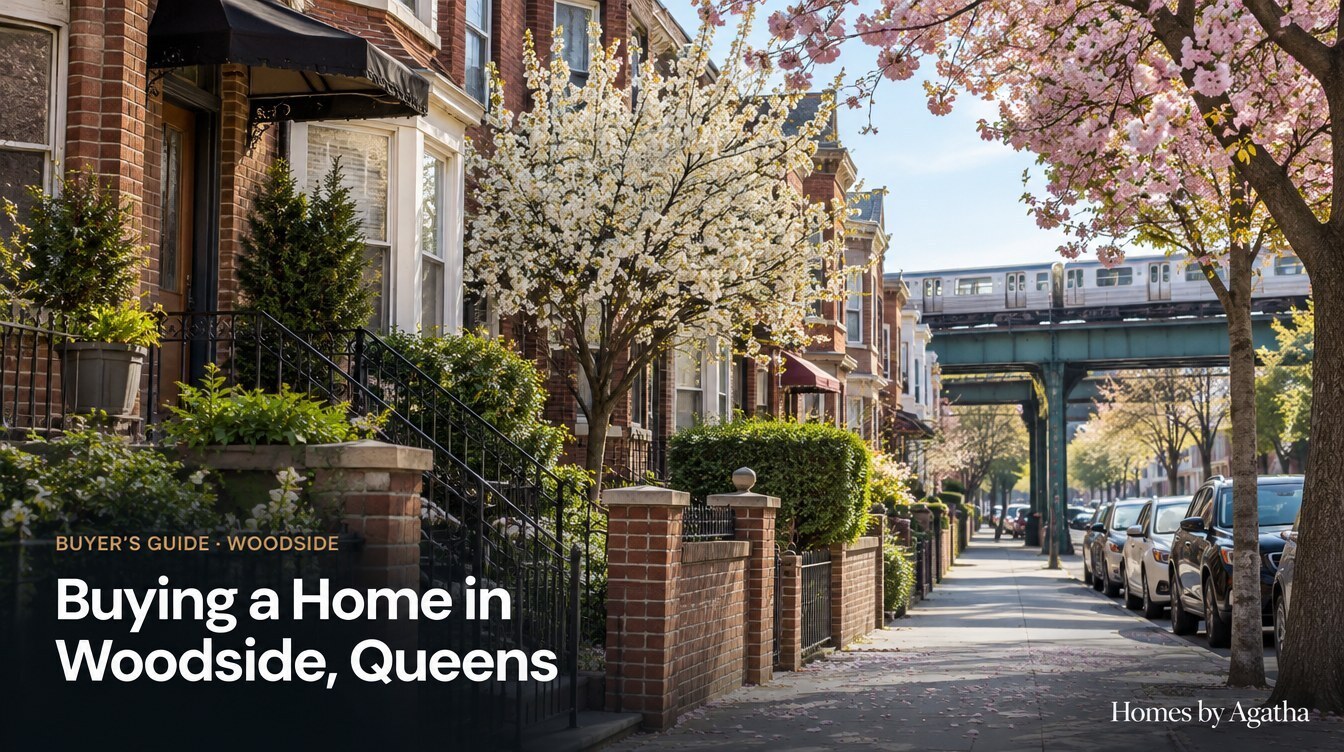
Buying a home in Woodside starts with geography that few Queens neighborhoods share. The 61 St–Woodside station stacks the elevated 7 train above a Long Island Rail Road station, so one corner of Roosevelt Avenue connects to Midtown by subway and to Penn Station, Grand Central Madison and Long Island by commuter rail. Around that hub, most side streets are lined with attached brick houses built for two or three families, while apartment buildings, many of them co-ops, sit closer to Queens Boulevard and the larger avenues.
This guide is for buyers seriously considering Woodside, Queens. You will learn what the housing stock looks like, how two-family houses, three-family houses and co-ops compare, which stations serve which blocks, what a purchase costs beyond the price, and which records to check before you sign.
As a Licensed Associate Real Estate Broker serving Queens and the surrounding New York markets, I help buyers evaluate both the property and the transaction, in English or Polish, whichever is more comfortable. In Woodside, the questions that most often change a buyer’s plan are about legal units and commuting, so this guide puts both up front.
Woodside at a glance
| Item | Woodside, Queens |
|---|---|
| Area | Western Queens, generally between Sunnyside to the west, Astoria to the north, Jackson Heights and Elmhurst to the east, and Maspeth to the south (neighborhood boundaries are informal) |
| Borough / County | Queens / Queens County, New York City; Queens Community District 2 |
| ZIP code | 11377 (some edge addresses may carry a neighboring ZIP, so confirm a specific address with USPS) |
| Subway | 7 train on the elevated Flushing Line above Roosevelt Avenue: 52 St, 61 St–Woodside, 69 St. M and R on Broadway: 65 St and Northern Blvd |
| Commuter rail | LIRR Woodside station at 61st Street and Roosevelt Avenue, on the Port Washington Branch and the Main Line, with service toward Penn Station and Grand Central Madison |
| Parks and landmarks | Doughboy Park on Woodside Avenue (World War I memorial), Windmuller Park on 39th Drive, the elevated 7 structure over Roosevelt Avenue, Sunnyside Yard on the western edge |
| Commercial corridors | Roosevelt Avenue, Woodside Avenue, Northern Boulevard, Broadway, Queens Boulevard, 61st Street |
| Typical property types | Attached and semi-attached brick two- and three-family houses, some one-family and frame houses, co-op apartment buildings, mixed-use buildings with apartments over stores, a smaller number of condos |
| Local housing considerations | Legal unit count vs actual use, three-family houses as multiple dwellings (HPD registration), pre-1938 buildings without a CO, Mitchell-Lama co-op rules, train and highway noise near the hub and the BQE |
What kinds of homes can you buy in Woodside, Queens?
Woodside’s for-sale housing is mostly attached and semi-attached brick houses configured as two- or three-family homes, plus co-op apartments in walk-up and elevator buildings. Mixed-use buildings with apartments above stores line Roosevelt Avenue, Woodside Avenue and Northern Boulevard, and condos are less common than in Long Island City.
Attached two- and three-family houses
The typical Woodside side street is a row of attached or semi-attached brick houses with a stoop and a rear yard. Many were built with one apartment per floor, which is why two- and three-family configurations are common. Some rows share a rear driveway, usually governed by an easement or recorded agreement your attorney should read.
The difference between two and three families is more than one extra kitchen. Under New York law, a building with three or more apartments is a multiple dwelling, which brings its own set of rules, inspections and registration duties. A two-family house is a private dwelling. That legal line affects your paperwork, your insurance and your obligations as an owner, and it is covered in detail in the due-diligence section below.
One-family and frame houses
Some blocks include one-family houses and older wood-frame houses. They appear less often than the brick multi-family rows, so one-family buyers should expect a smaller pool. Frame houses also need closer attention to siding, roofs and foundations.
Co-op apartment buildings
Woodside’s apartment buildings include pre-war and post-war walk-ups and elevator buildings, many organized as co-ops. A co-op, or housing cooperative, is a corporation that owns the building; buyers purchase shares and receive a proprietary lease for a specific apartment. The board reviews each buyer, and the monthly maintenance typically includes a share of the building’s property taxes and any underlying mortgage.
Woodside also contains city-supervised Mitchell-Lama co-ops, including Big Six Towers on Queens Boulevard. Mitchell-Lama apartments are sold through supervised waiting lists or housing lotteries with income limits and resale rules, not as ordinary open-market listings. Check the current application rules with NYC HPD or on NYC Housing Connect before you plan around one. If an apartment is part of a Mitchell-Lama development, the buying process is completely different from a market-rate co-op.
Mixed-use buildings on the avenues
Along Roosevelt Avenue under the 7 line, and on Woodside Avenue and Northern Boulevard, many buildings have a store on the ground floor and apartments above. These are a separate lane, with commercial leases, lending and insurance, even when listed next to two-family houses.
These descriptions are about buildings and streets, not about the people who live there. Where you buy is always your decision; my role is to help you understand the property and the process.
Two-family, three-family or co-op: which Woodside property fits your plan?
A Woodside two-family usually fits a buyer who wants to live in one unit and rent the other; a three-family fits a buyer ready to manage a small multiple dwelling; and a co-op fits a buyer who wants an apartment and accepts board rules. Your down payment, landlord appetite and commute should decide.
The lanes side by side
| Factor | Two-family house | Three-family house | Co-op apartment |
|---|---|---|---|
| Legal status | Private dwelling | Multiple dwelling under New York law | Shares plus a proprietary lease |
| HPD registration | Required only if neither the owner nor the owner’s immediate family lives there | Required every year, even if the owner lives there | Handled by the building |
| Approval | Lender and title only | Lender and title only | Board package and interview |
| Monthly costs | Mortgage, property tax, insurance, utilities, repairs | Same, plus more units to maintain and more compliance items | Mortgage plus maintenance |
| Rental income | One rental unit if owner-occupied | Two rental units if owner-occupied | Subletting set by building rules, often limited |
| Mortgage recording tax | Applies | Applies (1–3 family category) | Not applicable (share loan) |
| Key Woodside check | CO or Letter of No Objection matches two units | CO shows three legal units; HPD registration and violations | Building finances; whether it is Mitchell-Lama |
When a two-family makes sense
A two-family house suits a buyer who wants the space of a house and help with the mortgage from legal rental income. The tradeoff is responsibility: you are the landlord, the super and the repair budget. Our guide to buying a multi-family home in Queens explains the landlord side across the borough; this article focuses on what is specific to Woodside.
When a three-family makes sense
A three-family house can produce more rental income, but it moves you into multiple-dwelling rules. That means annual registration with the NYC Department of Housing Preservation and Development, HPD inspections in response to tenant complaints, and more apartments to keep code-compliant. Buyers who do not want to run a small rental building should look hard at a two-family instead.
When a Woodside co-op makes sense
A co-op suits a buyer who wants to live near the hub without owning a building. The tradeoffs are board approval, building-set financing rules and sublet limits. Ask early about elevators, laundry, planned assessments, and whether the building is market-rate or Mitchell-Lama.
Two-family, three-family or co-op?
Tell me your budget, your commute and how much landlord work you want. I will help you choose the Woodside lane that fits before you spend weekends touring.
How does the 61 St–Woodside rail hub affect where you buy?
The 61 St–Woodside hub gives Woodside both the 7 subway and the LIRR in one station, which is the neighborhood’s main transportation advantage. Homes within walking distance of it reach Midtown by subway and Penn Station or Grand Central Madison by commuter rail, while other blocks rely on 52 St, 69 St, or the M and R on Broadway.
The 7 train on Roosevelt Avenue
The 7 runs on the elevated Flushing Line above Roosevelt Avenue, with Woodside stations at 52 St, 61 St–Woodside and 69 St. Westbound, it continues through Sunnyside and Long Island City into Manhattan at Grand Central and Times Square, ending at 34 St–Hudson Yards. 61 St–Woodside is also a stop for the 7 express, which runs in the peak direction during rush hours, while 52 St and 69 St are local stops. Station work has at times changed this pattern, so confirm current service before you rely on the express. Check service on the MTA website for the station you would actually use.
The LIRR at Woodside
The Long Island Rail Road’s Woodside station sits directly beneath the 7 platforms at 61st Street and Roosevelt Avenue. It serves the Port Washington Branch and the Main Line, with trains toward Penn Station and Grand Central Madison in one direction and toward Jamaica and Long Island in the other. It is also the station where riders transfer between the Port Washington Branch and other branches without going into Manhattan. Not every Main Line train stops at Woodside, so check the current LIRR timetable for the trains you would ride.
The M and R on Broadway
The northern part of Woodside, around Broadway and Northern Boulevard, is served by the M and R on the Queens Boulevard Line at 65 St and Northern Blvd. These trains run toward Midtown in one direction and toward Jackson Heights and Forest Hills in the other. Service differs by time of day and on weekends, with the M running on weekdays, roughly from early morning to late evening, and the R running most hours. Confirm current hours on the MTA website, especially for late nights and weekends.
Buses, airport access and driving
Bus routes serving the 61 St–Woodside area include the Q32, the Q18 and the Q53 Select Bus Service, and the Q70 LaGuardia Link connects the hub with LaGuardia Airport. These routes continued under the Queens Bus Network Redesign, which adjusted some stops, so check the current MTA bus map for exact stop locations. For drivers, the Brooklyn-Queens Expressway runs through Woodside, with Northern Boulevard, Queens Boulevard and the Long Island Expressway nearby. If you drive daily, ask whether a house has a legal garage or curb cut, and test street parking at the hours you would come home.
Matching your commute to a station
| If you mostly travel to… | Look at homes near | Why |
|---|---|---|
| Grand Central, Times Square, Hudson Yards | 61 St–Woodside, 52 St or 69 St | One-seat ride on the 7; express stop at 61 St when the express runs |
| Penn Station or Grand Central Madison by rail | Walking distance of 61st Street and Roosevelt Avenue | LIRR Woodside station under the 7 |
| Nassau or Suffolk County jobs | The 61 St hub | LIRR toward Jamaica and the Port Washington Branch |
| Queens Boulevard, Forest Hills, Midtown East via the M/R | Broadway near 65 St or Northern Blvd | Queens Boulevard Line stations in north Woodside |
| LaGuardia Airport or travel by car | Near the hub (Q70) or near BQE access | Airport bus link; highway access |
The hub’s tradeoffs
Proximity has a cost. Blocks beside the elevated 7 structure hear the trains, the LIRR right-of-way and Sunnyside Yard add rail activity, and homes near the BQE hear traffic. Visit a shortlisted house at rush hour and in the evening before deciding.
What does buying a home in Woodside cost beyond the price?
Beyond the price, buying a home in Woodside involves New York City closing costs: attorney fees, lender fees, title insurance for houses, the NYC mortgage recording tax on mortgages for one- to three-family houses and condos, and the New York State “mansion tax” if the price is $1 million or more. Co-op buyers skip the mortgage recording tax but pay building fees.
Buyer closing costs by property type
| Cost item | Two- or three-family house | Co-op | Official source / note |
|---|---|---|---|
| NYC mortgage recording tax | About 1.8% of the loan for loans under $500,000; 1.925% for loans of $500,000 and above (1–3 family homes) | Not applicable — co-op loans are share loans | NYC Department of Finance / NYS |
| “Mansion tax” | 1% of the price if $1 million or more; graduated above $2 million in New York City | Same rule for co-op purchases of $1 million or more | NYS Department of Taxation and Finance |
| Title insurance and title fees | Owner’s and lender’s policies | No title policy; lien search instead | Title company quote |
| Buyer’s attorney | Yes | Yes | Fee set by the attorney |
| Lender fees and appraisal | If financing; appraisal reviews the legal unit count and rents | If financing; plus recognition agreement fee | Your loan estimate |
| Building and transfer items | Prorated taxes, water and sewer charges; tenant security deposits transfer to you | Application, managing agent and move-in fees | Contract and closing statement |
Confirm current rates with the NYS Department of Taxation and Finance and NYC Department of Finance before closing.
Why the unit count matters for taxes and loans
The NYC mortgage recording tax rates above apply to one- to three-family homes. A four-family building falls outside the one- to three-family residential category for both the mortgage recording tax and the NYC transfer tax, a mixed-use building with a store may as well, and its loan is usually a commercial or investment loan. Your closing attorney confirms the category for the specific building. That is one more reason to confirm the legal unit count before you plan your budget. For a line-by-line view of how closing costs add up across the borough, see Queens closing costs explained.
Do the monthly math the Woodside way
Turn every option into one monthly number: mortgage, plus property tax or maintenance, plus insurance and a repair reserve, minus realistic legal rental income. In a Woodside two-family, a tenant’s rent can bring the monthly cost close to a co-op’s; a three-family earns more but carries more compliance and repairs. Rent from a unit that is not legal never belongs in this math.
Key Takeaways
- Woodside’s main buying lanes are attached two-family houses, three-family houses and co-op apartments, and each is owned and financed differently.
- A three-family house is a multiple dwelling under New York law and must be registered with HPD every year, even when the owner lives there.
- The 61 St–Woodside station combines the 7 and the LIRR; choose a home by its walk to the station you will actually use.
- Compare options by monthly carrying cost, counting rent only from legal units.
Run the monthly numbers before you bid
Bring two or three Woodside listings. I will help you line up their carrying costs, closing costs and rental assumptions so you can see which one truly fits.
How do you get pre-approved for a Woodside multi-family house or co-op?
Get a written pre-approval from an NMLS-registered mortgage loan originator and tell the lender exactly what you are shopping for: a two-family, a three-family or a co-op. Lenders underwrite each one differently, and a pre-approval for one lane may not cover the others.
Financing a two- or three-family house
Owner-occupied homes with two to four units are financed as residential mortgages, but lenders apply their own rules to multi-unit properties, such as down payment, reserve and rental-income requirements that can differ between two-unit and three-unit buildings. Confirm the current guidelines for your loan program with an NMLS-registered mortgage loan originator. Lenders may count part of the expected rent from legal units when qualifying you, usually supported by existing leases or the appraiser’s rent estimate. The appraisal will look at the legal unit count, so an illegal basement apartment will not help you qualify and can complicate the loan.
Financing a co-op
A co-op loan is a share loan secured by your shares and proprietary lease. Each building sets its own rules, often including a minimum down payment, a maximum debt-to-income ratio and a minimum amount of cash remaining after closing, and these figures differ from building to building. Ask the listing agent for these requirements before you bid. Mitchell-Lama co-ops follow program rules, including income limits, that replace the usual open-market process.
A Woodside pre-approval checklist
- Name the lane: one-family, two-family, three-family, market-rate co-op or Mitchell-Lama co-op.
- Ask how the lender treats projected rent from legal units, and which documents prove it.
- Ask whether a three-family changes your down payment or reserve requirements.
- For co-ops, keep enough cash after closing for typical building liquidity rules.
- Ask for a loan estimate that includes the NYC mortgage recording tax if you are buying a house.
What should you verify before buying a house or co-op in Woodside?
Before buying in Woodside, verify the property’s legal status: the Certificate of Occupancy or Letter of No Objection, the legal unit count compared with the actual layout, HPD registration and violations for rentals, DOB violations and permits, zoning, flood exposure and the condition of older systems. For co-ops, the building’s finances and program status come first.
Certificate of Occupancy and legal units
A Certificate of Occupancy, or CO, is the NYC Department of Buildings document that states a building’s legal use and number of units. According to the NYC Department of Buildings, buildings constructed before 1938 are not required to have a CO unless later changes affected their use, egress or occupancy, and the Department may issue a Letter of No Objection to confirm legal use. Many Woodside houses are old enough for this to matter.
The core Woodside check is to compare the records with what you see. A house marketed as a three-family whose CO shows two families is a legal two-family with an extra apartment, and that apartment can affect financing, insurance and liability. A house whose CO shows three families but is used as two is the opposite case and may be simpler to resolve. Your attorney should review both the CO and the DOB records for alterations.
Basements, cellars and attics
Finished basements and attics are common in Woodside’s attached houses, but a finished space is not automatically a legal apartment or bedroom; ceiling height, light, ventilation and a second exit all matter. Whether any legalization path exists depends on current city and state rules and on the specific house. Until an architect confirms a legal path, price the house as its legal configuration.
Three families means multiple-dwelling rules
A building with three or more residential units is a multiple dwelling. The NYC Department of Housing Preservation and Development requires owners of multiple dwellings to register the property every year, and also requires registration for one- and two-family houses when neither the owner nor the owner’s immediate family lives there. Registration must be updated when ownership changes, so a buyer of a Woodside three-family should plan to register after closing. Ask your attorney to search HPD records for open violations before you sign.
Rent regulation and existing tenants
Most two- and three-family houses are not rent-stabilized, because rent stabilization generally applies to buildings with six or more units built before 1974, but your attorney should confirm the registration history of any rental unit with NYS Homes and Community Renewal records. If a tenant stays after closing, you take over the lease and the security deposit.
Zoning, mixed-use and future plans
The NYC Department of City Planning’s ZoLa zoning map shows the zoning district for any Woodside lot. Check it if you plan to add a unit, extend the house or buy a mixed-use building on Roosevelt Avenue or Northern Boulevard; an architect’s review still follows.
Flooding is a stormwater question here
Woodside is inland, so the coastal flood zones that matter in the Rockaways do not drive most decisions here. Basements in low spots can still take water during intense rainfall, and New York City publishes stormwater flood maps that show where heavy rain may pool; look up the address on the current version of those maps. Also check the address on the FEMA Flood Map Service Center, ask about past basement water, and look for a backwater valve and sump pump during inspection.
Older-building systems
- Heating: boiler age, fuel type, and whether an oil tank exists or was properly removed or abandoned.
- Electrical and metering: service capacity and whether each unit has its own gas and electric meters, which affects how utilities are billed to tenants.
- Plumbing: pipe materials, water pressure on the top floor of a three-family and the sewer line to the street.
- Roof and party walls: flat roofs on attached rows, flashing at shared walls and drainage.
- Façade, stoop and sidewalk: brick pointing, lintels and sidewalk flags, which are generally the owner’s responsibility in New York City.
- Lead paint: federal law requires a lead-based paint disclosure for most housing built before 1978.
Co-op building review
For a market-rate Woodside co-op, ask your attorney to review the financial statements, reserves, underlying mortgage, planned assessments, board minutes and house rules. Larger buildings may also face costs under Local Law 97, the city’s building-emissions law, which covers most buildings over 25,000 square feet.
Key Takeaways
- Compare the CO or Letter of No Objection with the actual layout; rent from an illegal unit should not be in your plan.
- A Woodside three-family brings annual HPD registration and multiple-dwelling rules.
- Flood risk in Woodside is mainly about stormwater and basements; check city and FEMA maps and inspect for past water.
- Use ZoLa to check zoning before planning any addition or conversion.
Plan your due diligence early
Before you commit to a Woodside house, let’s list the records to pull, the questions for the inspector and the points your attorney should review.
How do offers and contracts work when buying a home in Woodside?
New York is an attorney state: once a seller accepts your offer, the buyer’s and seller’s attorneys negotiate and prepare the contract of sale. An accepted offer is not a signed contract, and either side can still walk away until the contract is signed and the deposit is delivered.
What a credible Woodside offer includes
A credible offer includes your price, down payment, pre-approval, proposed closing timeline and attorney’s contact details. For a two- or three-family, it should also say whether you need a unit delivered vacant or will take it with the tenant in place. For a co-op, it should show the seller that you meet the building’s financial requirements.
From accepted offer to signed contract
- Your attorney receives the deal sheet, requests the contract and reviews title, DOB and HPD records, or the co-op’s documents.
- You complete a home inspection, or building due diligence for a co-op.
- For tenant-occupied houses, your attorney reviews leases, deposits and, if required, tenant estoppel certificates.
- The attorneys negotiate the contract and contingencies.
- You sign and deliver the contract deposit, often around 10% of the price, held in escrow, usually by the seller’s attorney.
- The seller signs, and the contract is fully executed.
Contingencies and occupancy terms
A mortgage contingency lets you cancel and recover your deposit if your loan is not approved on the contract’s terms. Co-op contracts usually include a board-approval contingency. If vacant delivery of a unit matters, the contract must say so, and your attorney should confirm the seller can lawfully deliver it.
How does working with a buyer’s agent work in 2026?
In 2026, a buyer’s agent in New York works under a written buyer agreement signed before touring, and the agent’s compensation is negotiable, not set by law and not automatically paid by the seller. Any seller contribution is part of the negotiation and must be agreed in writing.
The post-2024 rules
Following the 2024 NAR settlement, buyers sign a written agreement with their agent before touring homes. The agreement states the services and the compensation. A seller may agree to contribute toward the buyer’s agent compensation, or a buyer may request it in the offer, but neither is automatic. Our guide to working with a buyer’s agent in NY explains the options.
New York also requires agents to give the NYS Disclosure Form for Buyer and Seller at the first substantive contact. It explains the possible agency relationships; signing it acknowledges receipt and is not a contract.
Where an agent helps most in Woodside
In Woodside, the practical value is screening: checking whether a listing’s unit count matches its records, flagging a three-family’s registration duties, asking whether a co-op is Mitchell-Lama, and structuring tenant terms in the offer. An agent coordinates with your attorney, lender and inspector but replaces none of them.
Talk through an offer before you make it
If a Woodside house has tenants, an extra unit or a tight timeline, let’s work out the offer terms that protect you and still read as credible to the seller.
What is the timeline for buying a home in Woodside?
From accepted offer to closing, a financed purchase of a Woodside house commonly takes about two to three months, while a co-op often takes longer because of the board package and interview. These are typical ranges, not guarantees; tenants, lenders and buildings can all change the schedule.
| Stage | Two- or three-family house | Co-op |
|---|---|---|
| Pre-approval and search | Varies; confirm multi-unit loan rules early | Varies; confirm building financing rules early |
| Accepted offer → signed contract | Commonly 1–3 weeks; longer if leases need review | Commonly 1–3 weeks |
| Mortgage commitment | Commonly 3–6 weeks after contract; appraisal checks units and rents | Commonly 3–6 weeks after contract |
| Approvals | No board; title and municipal searches | Board package and interview, often several weeks |
| Closing and after | Final walk-through, closing, transfer of deposits; HPD registration update where required | Lien search, recognition agreement, final walk-through, closing |
What mistakes do buyers make in Woodside?
The most common Woodside buying mistakes are counting rent from an illegal unit, overlooking the obligations of a three-family, choosing a home by the neighborhood name rather than the walk to a specific station, and treating a Mitchell-Lama listing like a market-rate co-op.
- Counting rent from an unverified unit. Base your budget on the CO or Letter of No Objection, not on the number of doorbells.
- Ignoring the jump to three families. Multiple-dwelling rules, HPD registration and more units to maintain change the ownership experience.
- Assuming the LIRR stops for every train. Check the timetable for the trains you would ride from Woodside.
- Skipping a rush-hour visit. Noise from the elevated 7, the rail lines or the BQE is easier to judge in person.
- Forgetting the basement water question. Ask about past water and inspect for backwater valves and sump pumps.
Comparing Woodside with neighboring areas
Many buyers compare Woodside with nearby neighborhoods that share parts of the same transit. Homes for sale in Sunnyside sit along the same 7 line to the west, buying in Jackson Heights adds the 74 St–Broadway hub to the east, and Maspeth homes to the south lean toward houses with more reliance on buses and cars. Comparing them by housing type and station walk keeps the decision objective.
Shortlist the right Woodside blocks
Share where you commute and what you want to own. I will help you narrow Woodside, and nearby areas if useful, to a short list worth touring.
Buyer checklist for buying a home in Woodside
Use this checklist in order; it turns the guide into steps for buying a home in Woodside, from choosing a station to the final walk-through.
- Pick the station that fits your routine: 61 St–Woodside (7 and LIRR), 52 St, 69 St, or 65 St and Northern Blvd (M and R).
- Choose your lane: one-family, two-family, three-family or co-op.
- Get a written pre-approval matched to that lane from an NMLS-registered loan originator.
- Set a monthly carrying-cost target that counts rent only from legal units.
- Sign a written buyer agreement and receive the NYS Disclosure Form for Buyer and Seller.
- Retain a New York real estate attorney before your offer is accepted.
- Pull the CO or Letter of No Objection and compare it with the actual layout.
- Search DOB and HPD records for violations and open permits; confirm HPD registration where required.
- Check zoning on ZoLa if you plan changes, and check stormwater and FEMA flood maps.
- Order an inspection covering the boiler, any oil tank, electrical, meters, plumbing, roof, façade and basement water.
- Review leases, deposits and vacancy terms with your attorney for tenant-occupied houses.
- For co-ops, confirm whether the building is market-rate or Mitchell-Lama and assemble the board package early.
- Complete the final walk-through and, after closing, update HPD registration if the property requires it.
When you are ready to move from research to listings, the Woodside home buying page is the place to start a focused search. If you own a home you need to sell first, the Woodside seller page explains how a sale and a purchase can be coordinated.
Ready to tour Woodside with a plan?
Book a short buyer consultation. We will confirm your station, your property lane and the records to check, so every showing answers a real question.
Frequently asked questions about buying a home in Woodside
What types of homes are most common in Woodside, Queens?
Woodside, Queens is known for attached and semi-attached brick houses configured as two- or three-family homes. Co-op apartment buildings sit closer to Queens Boulevard and the main avenues, mixed-use buildings line Roosevelt Avenue and Northern Boulevard, and one-family houses and condos appear less often. Most buyers choose between a multi-family house and a co-op.
Does Woodside have an LIRR station?
Yes. The Long Island Rail Road’s Woodside station sits beneath the 61 St–Woodside 7 train station at 61st Street and Roosevelt Avenue. It serves the Port Washington Branch and the Main Line, with trains toward Penn Station and Grand Central Madison. Not every Main Line train stops there, so check the current timetable.
Which subway stations serve Woodside?
The 7 train stops at 52 St, 61 St–Woodside and 69 St on the elevated line above Roosevelt Avenue, and 61 St–Woodside is also a 7 express stop when the express runs. In northern Woodside, the M and R stop at 65 St and Northern Blvd on Broadway. Service hours vary, so check the MTA website.
Is a three-family house in Woodside treated differently from a two-family?
Yes. Under New York law, a building with three or more apartments is a multiple dwelling. The owner of a Woodside three-family must register it with the NYC Department of Housing Preservation and Development every year, even when living there. A two-family needs registration only if neither the owner nor immediate family lives in it.
How do I check how many legal units a Woodside house has?
Look up the Certificate of Occupancy in NYC Department of Buildings records. Houses built before 1938 may have no CO, and the Department may issue a Letter of No Objection to confirm legal use. Compare the record with the actual layout; a basement or attic apartment that is not listed is generally not a legal unit.
Do co-op buyers in Woodside pay the NYC mortgage recording tax?
No. Co-op loans are share loans, so they are not subject to the NYC mortgage recording tax. Buyers who finance a Woodside one- to three-family house do pay it: roughly 1.8% of the loan under $500,000 and 1.925% at $500,000 and above, under NYC Department of Finance rules. Confirm current rates before closing.
Can I buy an apartment at Big Six Towers like a regular co-op?
No. Big Six Towers in Woodside is a Mitchell-Lama co-op, a city-supervised program with income limits and its own application and resale rules. Apartments are offered through supervised waiting lists or housing lotteries rather than ordinary open-market listings. Check current rules with NYC HPD or NYC Housing Connect before planning a purchase there.
Is flooding a concern when buying in Woodside?
Woodside is inland, so coastal flood zones rarely apply, but basements in low spots can take water during intense rain. Check the address on FEMA flood maps and New York City’s stormwater flood maps, ask the seller about past water, and have the inspector look for a backwater valve, sump pump and signs of moisture.
Who pays the buyer’s agent when buying in Woodside in 2026?
Buyer-agent compensation is negotiable and not set by law. Since the 2024 settlement, buyers sign a written agreement with their agent before touring that states the services and compensation. A seller may agree to contribute, often as part of the offer negotiation, but that is never automatic and is settled in writing.
How long does it take to close on a Woodside two-family house?
A financed Woodside two-family purchase commonly takes about two to three months from accepted offer to closing. Contract negotiation, lease review, the appraisal of units and rents, and the mortgage commitment drive the schedule. Requiring a rental unit delivered vacant can add time, so that term should be settled in the contract early.
The short version: station first, legal units second
Woodside rewards buyers who decide two things early. First, which station shapes your days: the 7 and the LIRR at 61 St–Woodside, the local stops at 52 St and 69 St, or the M and R on Broadway. Second, which lane you can own comfortably: a two-family with one tenant, a three-family with multiple-dwelling duties, or a co-op with board rules. After that, the records decide the price you should pay: the CO, HPD registration, leases and the building’s finances. When you are ready to see homes that match that plan, start with the guide to buying your home in Woodside.
This article is for general informational purposes only and reflects conditions that may change. It is not legal, tax, or financial advice, an appraisal, or a guarantee of price or outcome; consult a licensed New York attorney, a CPA, and an NMLS-registered mortgage loan originator as appropriate. A CMA is an opinion of value, not an appraisal. Real estate brokerage services are offered by Agatha Lubas, Licensed Associate Real Estate Broker, NY License #10301213345, Keller Williams Realty Liberty, 96-10 101st Avenue, Ozone Park, NY 11416. The NYS Disclosure Form for Buyer and Seller, the NYS Housing and Anti-Discrimination Disclosure / Fair Housing Notice, and the brokerage’s Standard Operating Procedures are available on request. Equal Housing Opportunity.

Agatha Lubas helps buyers, sellers and investors across Queens, Brooklyn, Nassau County and Suffolk County understand both the property and the process before they commit. She works in English and Polish, so clients can talk through every step in the language they find most comfortable.
Work with Agatha