

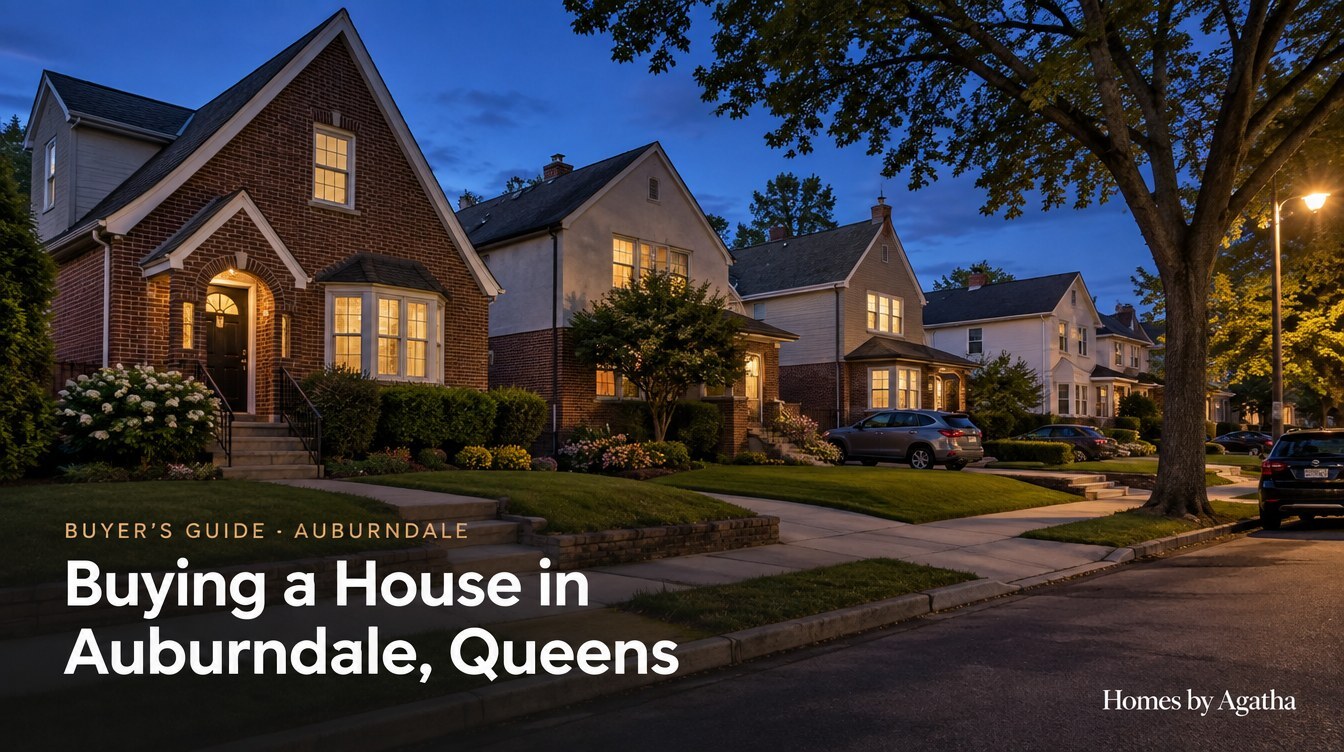
AUBURNDALE REAL ESTATE GUIDE
Buying a House in Auburndale, Queens: Zoning, Due Diligence and the LIRR
Quick Answer
Buying a house in Auburndale, Queens, usually means choosing among detached and semi-detached one- and two-family homes in ZIP code 11358, near the LIRR Port Washington Branch. Get pre-approved, confirm the lot’s zoning and Certificate of Occupancy, check the driveway, drainage and older systems, then negotiate through attorneys before signing a contract.
Buying a house in Auburndale is a different exercise from buying an apartment in a high-rise part of Queens. Most of what you will tour in Auburndale, Queens, is a house on its own lot: a detached Tudor or colonial, a semi-detached two-family, or an attached row house with a rear driveway. That means you are evaluating land, zoning, legal use and building systems, not just a floor plan.
This guide is for buyers who have Auburndale on their shortlist and want to understand what to check before they make an offer. It explains the local housing stock, how the 2010 contextual rezoning affects what an owner can build, how the Long Island Rail Road fits into a commute, what New York City closing costs look like for a house, and how the attorney-driven contract process works.
As a Licensed Associate Real Estate Broker serving Queens and the surrounding New York markets, I help buyers evaluate both the property and the transaction process, in English and in Polish. The goal here is not to sell you on a neighborhood. It is to give you a clear framework so that, if you choose Auburndale, you buy the right house for the right reasons. When you are ready to see what is available, the Auburndale home-buying page is the next stop.
Auburndale at a glance
| Item | Auburndale, Queens |
|---|---|
| Area | Northeast Queens, New York City; part of Queens Community District 11, with Flushing and Murray Hill to the west and Bayside to the east |
| Borough / county | Queens (Queens County), New York City |
| Approximate boundaries | Queens Community Board 11 describes Auburndale as running from Utopia Parkway (west) to the Clearview Expressway (east), and from 26th Avenue (north) to the Long Island Expressway (south). Neighborhood lines are informal. |
| ZIP code | 11358 (mailing addresses commonly read “Flushing, NY”); confirm the ZIP for a specific address with the USPS ZIP Code lookup, since edge blocks can differ |
| Rail | Long Island Rail Road, Port Washington Branch — Auburndale station, on 192nd Street between 39th Avenue and Station Road |
| Subway | No subway station in the neighborhood; the nearest is the 7 train terminal at Flushing–Main Street in downtown Flushing |
| Highways | Clearview Expressway (I-295) runs through the area; Long Island Expressway (I-495) along the southern edge; Northern Boulevard crosses east–west |
| Commercial corridors | Northern Boulevard and Francis Lewis Boulevard (named by Queens Community Board 11); local shops near the station on Station Road and 192nd Street |
| Parks | Peck Park, part of the Kissena Corridor Park system, south of Northern Boulevard; Kissena Park and Cunningham Park nearby |
| Typical property types | Detached one-family houses (Tudor, Dutch colonial, Cape Cod styles), detached and semi-detached two-family houses, some attached row houses, plus garden apartments and low-rise apartment buildings |
| Key local housing considerations | Contextual zoning from the 2010 Auburndale–Oakland Gardens–Hollis Hills Rezoning; legal use vs. actual use; shared driveways and rear alleys; older heating, plumbing and electrical systems; stormwater drainage |
What kind of houses will you find when buying a house in Auburndale?
Auburndale’s housing stock is mostly low-rise and house-based. Queens Community Board 11 describes the neighborhood as a mix of garden apartments, low-rise apartment buildings, attached and semi-attached homes, and one- and two-family houses, and the NYC Department of City Planning describes the area as predominantly lower-density, suburban-style housing.
In practice, that gives a buyer four broad property categories to compare. Each one carries a different ownership structure, a different set of documents to review and a different monthly cost profile.
Detached one-family houses
Detached one-family houses are the classic Auburndale product. Tudor-style homes are common, alongside Dutch colonials and Cape Cod houses. Many sit on lots with a front yard, a side or rear driveway and a detached or attached garage. For a buyer, the detached house offers the most control over the property and the most responsibility: roof, foundation, sewer line, sidewalk, trees and every mechanical system are yours.
Detached and semi-detached two-family houses
Two-family houses appear in several parts of Auburndale, some detached and some semi-detached, meaning they share one wall with the house next door. A two-family can offset part of the mortgage with rental income, but only if the second unit is legal. The Certificate of Occupancy, explained below, is the document that settles that question. Our guide to buying a multi-family home in Queens covers the landlord side in more depth.
Attached row houses
Some Auburndale blocks, such as the area along 172nd Street between Northern Boulevard and Station Road, were described by the Department of City Planning as one- and two-family row houses with parking access through rear alleys. Rear-alley parking is convenient, but the alley itself raises ownership and maintenance questions that a title search and survey must answer.
Apartments: co-op, condo or rental
Garden apartments and low-rise apartment buildings sit mainly along the larger corridors and near Station Road, where the Department of City Planning noted multi-family walk-up apartments. Whether a given building is a co-op, a condo or a rental depends on the building, so confirm the ownership form before you fall in love with a unit. ACRIS records and the listing broker can show how a specific building is organized.
| Property type in Auburndale | What you own | Monthly costs beyond the mortgage | Who approves the purchase | What to check first |
|---|---|---|---|---|
| Detached one-family house | Land and building (fee simple) | Property tax, homeowners insurance, utilities, all repairs | Seller and your lender | Zoning district, survey, roof, sewer line, heating system, permits for additions |
| Two-family house (detached or semi-detached) | Land and building, including the rental unit | Same as above, plus landlord costs; rent may offset part of the payment | Seller and your lender | Certificate of Occupancy shows two legal units; leases; shared wall and driveway |
| Attached row house with rear alley | Land and building; alley rights depend on the deed | Same as a house, plus any shared-alley maintenance | Seller and your lender | Title and survey for alley easements; shared walls; drainage at the rear |
| Co-op apartment | Shares in a corporation plus a proprietary lease | Monthly maintenance, which typically includes a share of building property taxes and any underlying mortgage | Co-op board after an application and interview | Financials, down-payment rules, sublet policy, flip tax (all set by each building) |
| Condo apartment | Real property unit plus share of common elements | Common charges plus separately billed unit property tax | Board right of first refusal (usually waived; rules vary by building) | Budget, reserves, assessments, owner-occupancy rules |
How does zoning affect buying a house in Auburndale?
Zoning tells you what can legally stand on an Auburndale lot today and what an owner could build later. Much of Auburndale was rezoned in 2010 to contextual districts that limit new construction to the scale of existing one- and two-family houses, so the zoning district of a lot directly affects its expansion potential and, in some cases, whether a second unit can exist at all.
On October 27, 2010, the New York City Council adopted the Auburndale–Oakland Gardens–Hollis Hills Rezoning proposed by the NYC Department of City Planning. The Department explained that zoning in the area had generally remained unchanged since 1961 and that some new houses had been built out of scale with their surroundings. The rezoning replaced older districts with contextual ones designed to match the existing pattern of detached and semi-detached homes.
The districts a buyer is likely to see
According to the Department of City Planning’s description of the plan, the Auburndale subarea received several contextual districts. The final map was modified during public review, so always confirm the district for a specific lot on the city’s ZoLa zoning map before relying on it.
| District (as described by DCP for Auburndale) | What it generally permits | What it means for a buyer |
|---|---|---|
| R2A | Single-family detached houses only; maximum floor area ratio (FAR) of 0.5; maximum lot coverage of 30% | A legal second unit is not permitted under this district; expansion room is limited. A house marketed as a “two-family” on an R2A lot needs a very close look at its legal history. |
| R3X | One- or two-family detached houses; FAR 0.6 including an attic allowance | Two-family use is possible if built and approved that way; additions must fit tight bulk limits. |
| R3-1 | One- and two-family detached and semi-detached houses; FAR 0.6 | Semi-detached two-family homes fit this district; the shared wall and driveway become part of your due diligence. |
| R4-1 | One- and two-family detached and semi-detached houses; FAR 0.9 including an attic allowance | Somewhat more floor area than R3 districts; useful for buyers who may want to expand later, subject to permits. |
| R4B | One- and two-family residences, mostly low-rise row houses; maximum height 24 feet; no parking in the front yard | Rear-alley parking is the norm; vertical additions are tightly limited. |
| R4 | A range of housing types, including small multi-family buildings; FAR 0.9 | Mapped on a few blocks near Station Road; walk-up apartment buildings are part of the context. |
Floor area ratio, or FAR, is the total floor area a building may contain divided by the area of its lot. A 0.5 FAR on a 4,000-square-foot lot allows roughly 2,000 square feet of zoning floor area, before the specific exemptions and rules that an architect would apply. FAR is a zoning measurement, not the same number as the “square footage” quoted in a listing.
How to use zoning when you shortlist houses
Look up each address on ZoLa, the NYC Department of City Planning’s free online zoning map at zola.planning.nyc.gov. Note the district, then compare it with what the listing promises. A buyer planning a future dormer, rear extension or finished attic should ask an architect to run a quick zoning analysis before signing the contract, because a house already built to its limit may have little room left.
Citywide rules can also change. In December 2024 the City Council adopted the “City of Yes for Housing Opportunity” zoning text amendment, which changed several low-density rules, including provisions on accessory dwelling units and parking. How those provisions apply depends on the specific lot and its zoning district, which the Department of City Planning’s resources explain. Do not assume a backyard cottage or a new basement unit is allowed on a particular lot without professional confirmation.
Comparing two Auburndale houses on different zoning?
Send me the addresses. I will help you line up zoning, legal use and condition side by side so you can see which house fits your plans before you schedule a second visit.
How much cash do you need to buy a house in Auburndale?
You need three pools of money: the down payment, New York City closing costs and a reserve for the house itself. For a house in Auburndale, buyer closing costs include New York City and New York State taxes that apartment buyers sometimes avoid, so budget for them before you choose a price range.
Buyer closing costs that apply to a house in Queens
Closing costs are the fees and taxes paid at or before closing in addition to the down payment. For an Auburndale house financed with a mortgage, the main categories are listed below. Our article on Queens closing costs walks through each line in more detail.
| Cost category | Upfront or ongoing | How it is set (source) | Applies to an Auburndale house? |
|---|---|---|---|
| NYC mortgage recording tax | Upfront, at closing | Roughly 1.8% of the loan amount for loans under $500,000 and 1.925% for loans of $500,000 and above on 1–3 family homes and condos (NYC Department of Finance / NYS) | Yes, when you finance. Co-op share loans are not subject to it. |
| NYS “mansion tax” | Upfront, at closing | 1% of the price on residential purchases of $1 million or more, paid by the buyer; graduated above $2 million in New York City (NYS Department of Taxation and Finance) | Only if the price is $1 million or more |
| Buyer’s attorney fee | Upfront | Negotiated with your attorney | Yes |
| Title insurance and title search | Upfront | Rates are regulated in New York; quote from the title company | Yes, for houses and condos |
| Lender fees, appraisal, escrow deposits | Upfront | Set by the lender; shown on your Loan Estimate | Yes, when you finance |
| Home inspection, survey, other reports | Upfront, before contract | Quoted by each professional | Yes |
| Property tax, homeowners insurance, utilities | Ongoing | NYC Department of Finance bill; insurer; utility companies | Yes; most houses are in NYC tax class 1 |
| Maintenance and repairs | Ongoing | Your own reserve | Yes; older houses need a larger cushion |
Confirm current rates with the NYS Department of Taxation and Finance and the NYC Department of Finance before closing.
The NYS real estate transfer tax and the NYC Real Property Transfer Tax are customarily paid by the seller, so they usually do not appear on the buyer’s side of an Auburndale house purchase. Your attorney will confirm how they are handled in your contract.
The reserve most first-time house buyers forget
A house reserve is money kept after closing for repairs that an apartment owner would share with a building. In Auburndale, where many houses were built well before modern building codes, that reserve can cover a failed boiler, a sewer-line repair, a roof section or sidewalk work. The inspection report is the most reliable guide to how large that cushion should be for the house you are buying.
Ongoing costs also differ by house type. A detached house carries all of its own exterior maintenance. A semi-detached house shares a wall, and sometimes a driveway, with a neighbor. A two-family house adds landlord costs, such as unit turnover and repairs, in exchange for rent.
How should you approach pre-approval and financing for an Auburndale house?
Get a full mortgage pre-approval before you tour seriously, and make sure your lender knows whether you are buying a one-family or a two-family house. The property type changes how the lender underwrites the loan, how the appraisal is done and, for two-family homes, whether rental income can help you qualify.
Pre-qualification versus pre-approval
A pre-qualification is a quick estimate based on what you tell a lender. A pre-approval is issued after the lender reviews your credit, income and assets. In Queens, sellers and their attorneys generally take a documented pre-approval more seriously, because it reduces the risk that a deal will fall apart after the contract is signed.
Financing a two-family house
Lenders often allow buyers of an owner-occupied two-family house to count part of the expected rent from the second unit toward qualifying income, under their own guidelines. Ask an NMLS-registered mortgage loan originator how current guidelines treat that income. That only works if the second unit is legal. If the Certificate of Occupancy shows a one-family house, a lender and appraiser may treat the second unit as non-conforming, which can affect both the loan and the value.
Appraisals in a house-based market
An appraisal is the lender’s independent estimate of value. In Auburndale, appraisers compare your house with recent sales of similar houses nearby, adjusting for lot size, style, condition, garage, legal unit count and other features. Because detached houses, semi-detached two-families and row houses can sit within a few blocks of each other, choosing the right comparable sales matters. If the appraisal comes in below the contract price, the buyer may need to renegotiate or cover the gap with cash.
Renovation financing
Some Auburndale houses need updating. Renovation loan programs exist that fold improvement costs into the mortgage, but each has its own eligibility rules, contractor requirements and timelines, so confirm eligibility and current limits with the lender. Decide early whether you are buying a finished house or a project, because the financing, the offer and the inspection strategy all differ.
Key Takeaways
- Most Auburndale inventory is houses, so you are buying land, zoning and building systems, not just living space.
- The 2010 contextual rezoning means the lot’s district (R2A, R3X, R3-1, R4-1, R4B or R4) shapes expansion potential and second-unit legality.
- Financed house purchases in Queens carry the NYC mortgage recording tax; the mansion tax applies only at $1 million or more.
- Tell your lender early if the house is a two-family; legal unit count affects underwriting and appraisal.
Set your Auburndale budget before you tour
We can map your pre-approval, expected closing costs and a sensible repair reserve against the kinds of houses in Auburndale, so every showing is within a number you are comfortable with.
How do you get around from Auburndale by train, bus and car?
Auburndale’s main rail link is the Long Island Rail Road’s Port Washington Branch, which stops at Auburndale station on 192nd Street between 39th Avenue and Station Road. There is no subway station in the neighborhood; the nearest subway is the 7 train terminal at Flushing–Main Street. Drivers use the Clearview Expressway, the Long Island Expressway and Northern Boulevard.
The LIRR Port Washington Branch
The Port Washington Branch runs between Port Washington in Nassau County and Manhattan without passing through Jamaica. Westbound trains from Auburndale run through northern Queens toward Manhattan; check the current LIRR timetable for the stops and the Manhattan terminal of the train you would actually take. Eastbound, the next stop is Bayside.
Auburndale station is inside New York City, and LIRR fares depend on the fare zone and the time of travel; check the MTA’s current fare and CityTicket rules for trips within the city. Fares, discounts and schedules change, so recheck them before you base a purchase decision on a particular train.
Buses and the subway
Northern Boulevard and Francis Lewis Boulevard carry local bus service, and local buses connect Auburndale with downtown Flushing and the 7 train. The Queens Bus Network Redesign changed many Queens routes in 2025, so check the current MTA bus map for routes and stops. A bus-to-subway commute takes a different shape from a direct LIRR ride, so test both at the hour you would actually travel.
Driving and parking
The Clearview Expressway (I-295) runs north–south through the area, and the Long Island Expressway (I-495) runs along the southern edge. For many Auburndale houses, a driveway or garage is part of the value. When you compare houses, note whether parking is a private driveway, a shared driveway with the neighbor, a rear-alley space or on-street only.
A practical commute test
- Walk from the house to Auburndale station and time it; note crossings at Northern Boulevard if they apply.
- Ride the train you would actually take, at rush hour, on a weekday.
- Try the bus-to-7-train alternative once, in case of service changes.
- Drive the route to the expressway entrance you would use at the time you would leave.
- Check where you would park if your household has more cars than the driveway holds.
Proximity to the station is one of the clearest ways Auburndale houses differ from each other. A house a short walk from 192nd Street and Station Road offers a different daily routine from one near the Long Island Expressway, and that trade-off is worth weighing alongside lot size and condition.
What should you check on a house before buying in Auburndale?
Check five things on every Auburndale house: legal use on the Certificate of Occupancy, open permits and violations, shared driveways or alleys on the survey and title, drainage and flood exposure, and the age and condition of the major systems. These items are where the expensive surprises tend to hide in older Queens houses.
Certificate of Occupancy and legal units
A Certificate of Occupancy, or CO, is the document issued by the NYC Department of Buildings that states a building’s legal use and number of dwelling units. Many older Queens houses were built before COs were required, so a missing CO is not automatically a problem; in that case the buyer’s attorney looks at other Department of Buildings records to confirm legal use. You can search a property’s records through the Department of Buildings’ Building Information System at a810-bisweb.nyc.gov.
The most important comparison is between what the records show and what is physically there. A finished basement with a kitchen and separate entrance, an attic converted to bedrooms or a “two-family” that the records list as one-family all raise questions about legality, insurance and financing. In a district such as R2A, where only single-family detached houses are permitted, an extra unit is a particular red flag.
Permits, extensions and violations
Rear extensions, dormers, enclosed porches, decks and converted garages are common improvements on Auburndale houses. Ask whether each was permitted and signed off by the Department of Buildings. Your attorney will also search for open violations and for unpaid charges that could follow the property. An unpermitted addition can be legalized in some cases, but that takes time, money and sometimes changes to the work.
Shared driveways, rear alleys and the survey
Semi-detached houses and some row houses in Auburndale share a driveway or use a rear alley. A survey shows where the lot lines run; the title report shows whether there is a recorded easement, which is a legal right for one owner to use part of another’s land. Ask who maintains and repairs the shared surface, who pays for snow removal and whether any written agreement exists between the neighbors.
Drainage, stormwater and flood maps
Auburndale is inland, so coastal storm surge is not the main water concern, but heavy rainfall can still overwhelm sewers and push water into basements in parts of northeast Queens. Check the FEMA Flood Insurance Rate Map for the address through the FEMA Flood Map Service Center and review the NYC Stormwater Flood Maps for rainfall-driven flooding. Ask the seller about past basement water, sump pumps and backwater valves, and have your inspector look for staining, efflorescence and grading that slopes toward the house.
Older-house systems
Many Auburndale houses are decades old, and their systems reflect that. Your inspector should evaluate:
- Heating: boiler or furnace age, fuel type and, for oil-heated homes, the location of the tank. A buried or abandoned oil tank should come with documentation showing proper removal or abandonment.
- Electrical: panel capacity and any older wiring that may limit insurance or modern loads.
- Plumbing and sewer: older supply pipes and the sewer line to the street; a camera inspection of the sewer line is worth considering for older houses with mature trees.
- Roof, chimney and masonry: Tudor-style homes often have steep roofs, chimneys and stucco or brick details that need specialized repair.
- Lead-based paint: for housing built before 1978, federal law requires sellers to disclose known lead-based paint and give buyers an opportunity to test.
Sidewalks and street trees
In New York City, property owners are generally responsible for maintaining and repairing the sidewalk next to their property, and the NYC Department of Transportation can issue sidewalk violations. Street trees fall under NYC Parks. On tree-lined Auburndale blocks, check for lifted sidewalk flags and ask whether any violation is open.
| Due-diligence item | Where to check | Why it matters in Auburndale | Who helps |
|---|---|---|---|
| Zoning district | ZoLa (NYC Department of City Planning) | Contextual districts limit expansion and second units | Architect, attorney |
| Certificate of Occupancy / legal use | NYC Department of Buildings records | Confirms one- vs. two-family and legal basement use | Attorney, expediter |
| Permits and violations | NYC Department of Buildings; municipal searches | Extensions, dormers and conversions are common | Attorney, title company |
| Survey and easements | Survey; title report | Shared driveways and rear alleys | Title company, surveyor, attorney |
| Flood and stormwater exposure | FEMA Flood Map Service Center; NYC Stormwater Flood Maps | Basement water from heavy rain | Inspector, insurance agent |
| Mechanical systems and oil tanks | Home inspection; seller documents | Older boilers, tanks, wiring and pipes | Licensed inspector, specialists |
| Property tax and exemptions | NYC Department of Finance property tax records | Seller exemptions may not carry over to you | Attorney, NYC DOF |
Key Takeaways
- Compare the Certificate of Occupancy and Department of Buildings records with what is physically in the house.
- Shared driveways and rear alleys need a survey, a title review and a clear maintenance answer.
- Inland does not mean dry: check FEMA maps and NYC Stormwater Flood Maps, and look hard at the basement.
- Budget for older-house systems such as boilers, oil tanks, wiring and sewer lines.
Want a due-diligence plan for a specific house?
Before you sign anything, I can help you organize the records search, the inspection questions and the items to raise with your attorney for the Auburndale house you are considering.
How do offers, contracts and buyer representation work in New York?
In New York, an accepted offer is not a binding purchase. Attorneys for the buyer and seller negotiate and prepare the contract of sale, and the deal becomes binding only when both parties sign it and the buyer’s deposit is delivered. Buyer representation is set out in a written agreement, and buyer-agent compensation is negotiable.
From offer to signed contract
When the seller accepts your offer, the agents exchange a “deal sheet” with the price, the parties and the attorneys’ contact details. The seller’s attorney drafts the contract; your attorney reviews it, orders a title search and raises any issues found in the records. In New York City, buyers commonly complete the home inspection before signing the contract, because once signed, the protections come mainly from the contract’s specific terms.
The contract deposit is typically held in escrow by the seller’s attorney. A deposit of around 10% of the price is customary in many New York City house sales, although the amount is negotiable, so confirm the customary deposit for your deal with your attorney. The contract usually includes a mortgage contingency, which lets the buyer cancel and recover the deposit if financing is denied within a set period on the stated terms.
Writing a strong offer on an Auburndale house
A strong offer is more than a price. Sellers also weigh the size of the down payment, the strength of the pre-approval, whether you need to sell another home first, the proposed closing date and how flexible you are about the inspection. For a two-family house with a tenant, clarify whether you expect the unit delivered vacant or with the lease in place.
Base your price on comparable sales of similar houses, not on the list price alone. In Auburndale, a detached house on a wider lot, a semi-detached two-family and a row house with rear-alley parking can each sit in a different pricing tier, even a few blocks apart. Condition, legal unit count, garage and distance to Auburndale station also move value.
Working with a buyer’s agent in 2026
Under the practices that followed the 2024 National Association of Realtors settlement, which remain in effect in 2026, buyer-agent compensation is negotiable and not set by law. It is not automatically paid by the seller; it may be paid by the buyer, by the seller as part of a negotiated agreement, or by a combination. Before touring homes with an agent, you sign a written buyer agreement that states the services and how the agent will be paid.
At the first substantive contact, a New York real estate licensee must also give you the NYS Disclosure Form for Buyer and Seller, which explains the different agency relationships. Our guide to working with a buyer’s agent in NY explains these documents in plain language. If you prefer to discuss the process in Polish, that is simply a matter of communication and comfort; where you buy is always your choice.
Ready to talk offer strategy?
Let’s review comparable sales, contract terms and the structure of your offer before you submit it, so the price and the conditions both make sense for the house.
What is the step-by-step timeline for buying a house in Auburndale?
Buying a house in Auburndale follows the standard New York sequence: preparation, search, offer, due diligence, contract, mortgage commitment and closing. The length of each stage depends on financing, the seller’s situation, the condition of the records and how quickly the attorneys and lender move. Your attorney and lender can give you realistic current timelines for your deal.
| Stage | What happens | Your action | Common Auburndale-specific delay |
|---|---|---|---|
| 1. Preparation | Pre-approval, budget, buyer agreement, NYS Disclosure Form | Collect income and asset documents; set a repair reserve | Not telling the lender the house may be a two-family |
| 2. Search and shortlist | Tours, zoning look-ups, commute tests | Check ZoLa and records for each serious candidate | Discovering late that a “two-family” is legally one-family |
| 3. Offer and acceptance | Price and terms negotiated; deal sheet issued | Choose your attorney; schedule the inspection | Competing offers with different terms |
| 4. Due diligence | Inspection, title search, survey, records review | Review findings with your attorney | Unpermitted extensions, open violations, shared-driveway questions |
| 5. Contract signing | Contract signed; deposit delivered to escrow | Sign only after your attorney is satisfied | Negotiating credits or repairs |
| 6. Mortgage commitment | Appraisal and underwriting completed | Respond quickly to lender requests | Appraisal questions on legal unit count or comparables |
| 7. Closing | Final walk-through; funds and deed transferred | Confirm utilities, insurance and keys | Clearing title items or seller payoffs |
Two stages deserve extra attention in Auburndale. The records review in stage 4 often surfaces older work done without permits, which can take time to resolve. The appraisal in stage 6 depends on finding comparable sales of the same house type, which is harder for unusual houses or lots.
What mistakes do Auburndale house buyers make most often?
The most expensive mistakes come from assuming instead of checking: assuming a second unit is legal, assuming a house can be expanded, assuming a shared driveway is simple, or assuming an inland basement will stay dry. Each of these can be checked before you sign a contract.
- Counting rent from an illegal unit. If the Certificate of Occupancy shows one family, the rent from a basement or second-floor unit may not count for financing and may expose you to enforcement risk.
- Buying for an expansion that zoning will not allow. In contextual districts like R2A, a house built close to its limit may not support the addition you had in mind.
- Skipping the survey on a semi-detached or row house. Driveway and alley rights are recorded, or not, in documents a survey and title report reveal.
- Treating the list price as the value. Comparable sales of the same configuration matter more than the asking number.
- Underestimating NYC closing costs. The mortgage recording tax on a house loan is a meaningful line item, and the mansion tax applies at $1 million or more.
- Choosing a house without testing the commute. A walk to Auburndale station feels different at 7 a.m. in January than on a Sunday afternoon.
- Ignoring the sewer line and boiler. These systems are out of sight and among the costliest to replace.
- Signing a buyer agreement without reading it. Understand the services, the term and the compensation before you tour.
Your Auburndale house-buyer checklist
Use this checklist in order. It condenses the steps above into actions you can complete one at a time while buying a house in Auburndale.
- Get a full pre-approval and tell the lender whether you are considering one-family or two-family houses.
- Set a budget that includes the down payment, NYC closing costs and a repair reserve.
- Review the NYS Disclosure Form for Buyer and Seller and sign a written buyer agreement before touring.
- For each serious candidate, look up the zoning district on ZoLa.
- Pull the Department of Buildings records and compare legal use with the actual layout.
- Test the commute to Auburndale station, the bus to Flushing and the drive to the expressway.
- Check the FEMA Flood Map Service Center and NYC Stormwater Flood Maps for the address.
- Hire a licensed home inspector; add a sewer-line camera inspection and an oil-tank check where relevant.
- Choose a New York real estate attorney before or immediately after your offer is accepted.
- Have your attorney review the title, survey, easements, permits and violations before you sign.
- Confirm the contract deposit, mortgage contingency and closing date terms.
- Arrange homeowners insurance and, if needed, flood insurance before closing.
- Do a final walk-through to confirm the house’s condition and any agreed repairs.
If Auburndale is one of several neighborhoods on your list, compare it with nearby options to the southeast and north, such as buying a home in Oakland Gardens, homes for buyers in Whitestone or houses in Douglaston. Each has its own mix of housing types and transit options, and the same checklist applies.
Start your Auburndale search with a plan
Tell me what you need in a house, from parking to a legal second unit to a short walk to the train, and I will help you build a focused search and a clear path to closing.
Frequently asked questions about buying a house in Auburndale
What types of homes are in Auburndale, Queens?
Auburndale, Queens, is mostly low-rise. Buyers find detached one-family houses in Tudor, Dutch colonial and Cape Cod styles, detached and semi-detached two-family houses, some attached row houses with rear-alley parking, and garden apartments or low-rise apartment buildings along larger corridors and near Station Road.
Is there an LIRR station in Auburndale?
Yes. Auburndale station is on the Long Island Rail Road’s Port Washington Branch, on 192nd Street between 39th Avenue and Station Road. Trains run west toward Flushing and Manhattan and east toward Bayside and Port Washington. Check the MTA’s current timetable and fares before relying on a specific train.
Is there a subway in Auburndale?
No subway station is located in Auburndale. The nearest subway is the 7 train terminal at Flushing–Main Street in downtown Flushing. Residents commonly reach it by bus along Northern Boulevard or nearby corridors, or use the LIRR Port Washington Branch directly from Auburndale station instead.
What ZIP code is Auburndale, Queens?
Auburndale is primarily served by ZIP code 11358, and mailing addresses there commonly use “Flushing, NY” as the city name. Because neighborhood boundaries are informal, confirm the ZIP code of any specific address with the United States Postal Service before using it for searches or paperwork.
What zoning applies to houses in Auburndale?
Much of Auburndale was rezoned in 2010 to contextual districts, including R2A, R3X, R3-1, R4-1 and R4B, which limit new buildings to the scale of existing one- and two-family homes. R2A allows only single-family detached houses. Confirm any lot’s district on the NYC Department of City Planning’s ZoLa map.
How do I know if a two-family house in Auburndale is legal?
Check the Certificate of Occupancy and other NYC Department of Buildings records, which state the legal use and number of units. Compare them with the actual layout. If records show one family but the house has two kitchens and separate entrances, ask your attorney to investigate before signing a contract.
What closing costs does a buyer pay on an Auburndale house?
A financed buyer typically pays the NYC mortgage recording tax, attorney fees, title insurance, lender fees, an appraisal, inspection costs and escrow deposits. The NYS mansion tax of 1% applies only at $1 million or more. Transfer taxes are customarily paid by the seller. Confirm current rates with official sources.
Does Auburndale have flood risk?
Auburndale is inland, so coastal storm surge is not the main concern, but heavy rain can cause basement and street flooding in parts of northeast Queens. Check the FEMA Flood Map Service Center and NYC Stormwater Flood Maps, and ask about past water, sump pumps and backwater valves.
Who pays the buyer’s agent when buying in Queens in 2026?
Buyer-agent compensation is negotiable and not set by law. It is not automatically paid by the seller. The buyer may pay, the seller may agree to contribute, or both may share the cost. The terms are set in a written buyer agreement signed before you tour homes with the agent.
Should I get a home inspection before signing the contract in New York?
Yes. In New York City, buyers usually complete the home inspection before signing the contract of sale, because the attorney-negotiated contract sets the terms once signed. For older Auburndale houses, consider adding a sewer-line camera inspection and an oil-tank check to the general inspection.
Summary and your next step
Auburndale rewards buyers who treat each house as a combination of land, zoning, legal use and systems. Start with a pre-approval that reflects the property type, confirm the zoning district and the Certificate of Occupancy, test the commute from Auburndale station, and let your attorney clear the title, survey and permit questions before you sign. When you are ready to look at specific homes, the guide to buying your home in Auburndale shows how we can search together. If you already own in the area and are weighing a move, the Auburndale seller page explains the other side of the transaction.
This article is for general informational purposes only and reflects conditions that may change. It is not legal, tax, or financial advice, an appraisal, or a guarantee of price or outcome; consult a licensed New York attorney, a CPA, and an NMLS-registered mortgage loan originator as appropriate. A CMA is an opinion of value, not an appraisal. Real estate brokerage services are offered by Agatha Lubas, Licensed Associate Real Estate Broker, NY License #10301213345, Keller Williams Realty Liberty, 96-10 101st Avenue, Ozone Park, NY 11416. The NYS Disclosure Form for Buyer and Seller, the NYS Housing and Anti-Discrimination Disclosure / Fair Housing Notice, and the brokerage’s Standard Operating Procedures are available on request. Equal Housing Opportunity.

Agatha Lubas helps buyers, sellers and investors across Queens, Brooklyn, Nassau County and Suffolk County, guiding them through each step of the New York transaction. She works in English and Polish, so clients can discuss every detail in the language they find most comfortable.
Work with Agatha