
BELLEROSE REAL ESTATE GUIDE
Buying a House in Bellerose, Queens: What to Check Before You Make an Offer
Quick Answer
Buying a house in Bellerose Queens starts with confirming the property is inside New York City, not the Nassau County Village of Bellerose or Bellerose Terrace, because jurisdiction changes taxes, records and costs. Then get pre-approved, review the Certificate of Occupancy and legal units, inspect older systems, and let a New York attorney negotiate the contract.
This guide is for anyone seriously considering buying a house in Bellerose Queens: first-time buyers, people moving from apartments elsewhere in the borough, and households comparing eastern Queens with nearby Nassau County. Bellerose sits on the eastern edge of Queens, right where New York City meets Long Island, and that location creates questions most Queens neighborhoods never raise.
The biggest one is simple: which Bellerose is the listing actually in? The same name appears on both sides of the city line, and the answer affects transfer and recording taxes, the property tax system, where building records live and which train fare you pay.
As a Licensed Associate Real Estate Broker based in Queens, I help buyers evaluate both the property and the transaction process, in English and Polish. In the sections below you will find how the local housing stock is built, what a Bellerose purchase costs to close, how financing and commuting work here, which documents to check on an older house, and how the New York offer-to-contract process actually runs. Nothing here replaces your attorney, lender or inspector; it is meant to help you ask them better questions.
Bellerose at a glance
| Item | Bellerose, Queens |
|---|---|
| Area | Eastern Queens, along the New York City–Nassau County line |
| Borough / County | Queens (Queens County), New York City; Queens Community Board 13 |
| ZIP code(s) | 11426 and 11427 (11427 shared with Queens Village / Bellerose Manor); confirm the ZIP for a specific address with USPS |
| Major transit | MTA local buses on Hillside Avenue and nearby corridors, express buses from parts of eastern Queens, and the Long Island Rail Road nearby; check the current MTA bus map, since routes changed in the 2025 Queens Bus Network Redesign |
| Rail / subway stations | LIRR Bellerose station (Commonwealth Boulevard and Superior Road, located in Nassau County) and LIRR Queens Village station (in Queens); Hillside Avenue buses run west toward Jamaica and the F train’s Jamaica–179 Street terminal; check the current LIRR timetable for service patterns |
| Main parks / landmarks | Queens Public Library Bellerose branch at 250-06 Hillside Avenue; Queens County Farm Museum and Alley Pond Park to the north |
| Commercial corridors | Hillside Avenue, Jamaica Avenue (which continues into Nassau County as Jericho Turnpike), Braddock Avenue |
| Typical property types | Predominantly detached one-family houses, plus semi-detached and attached houses, some two-family houses and mixed-use buildings on the avenues; co-op complexes in neighboring Glen Oaks and Floral Park, Queens |
| Relevant local housing considerations | Confirm NYC vs. Nassau jurisdiction; Certificate of Occupancy or legal-use evidence; basement and attic use; older heating, electrical and sewer systems; owner responsibility for sidewalks in NYC |
Which Bellerose are you buying in: Queens, the Village of Bellerose or Bellerose Terrace?
There are three different places that use the Bellerose name. Bellerose, Queens is a New York City neighborhood. The Village of Bellerose is a separate incorporated village in the Town of Hempstead, Nassau County. Bellerose Terrace is an unincorporated hamlet, also in the Town of Hempstead, next to the village. A buyer has to know which one a listing is in before budgeting.
The distinction is not cosmetic. A house in Bellerose, Queens is taxed by the NYC Department of Finance, its building records sit with the NYC Department of Buildings, and the sale is subject to New York City transfer and recording taxes. A house in the Village of Bellerose or Bellerose Terrace is assessed through Nassau County, regulated by village or town building departments, and is not subject to the NYC Real Property Transfer Tax.
Why the mailing address is not enough
Postal names and ZIP codes do not follow municipal lines neatly. Listings on both sides of the city line can carry “Bellerose,” “Floral Park” or “Queens Village” in the address, so confirm the ZIP code for a specific address with the USPS ZIP Code lookup. A ZIP code tells you where the mail goes. It does not tell you which government taxes the property.
How to confirm jurisdiction in ten minutes
- Look at the tax identifier. A New York City property has a borough-block-lot number (BBL) beginning with 4 for Queens, searchable on the NYC Department of Finance property tax system. A Nassau County property is identified by section, block and lot on Nassau County Department of Assessment records.
- Ask for the most recent property tax bill. An NYC bill comes from the Department of Finance. A Nassau bill reflects county, town and other local levies, plus village taxes inside the Village of Bellerose.
- Check the zoning map. The NYC Department of City Planning’s ZoLa zoning map only shows lots inside New York City. If the lot is not there, it is not in Queens.
- Have your attorney confirm it in the title report. The title search identifies the county where the deed is recorded: Queens County (through the NYC Register) or Nassau County.
| What changes | Bellerose, Queens (NYC) | Village of Bellerose / Bellerose Terrace (Nassau County) |
|---|---|---|
| Property tax and assessment | NYC Department of Finance; one-to-three-family homes are Tax Class 1; appeals go to the NYC Tax Commission | Nassau County Department of Assessment; grievances go to the Nassau County Assessment Review Commission; village taxes apply inside the village |
| Building records and permits | NYC Department of Buildings (Certificate of Occupancy, permits, violations) | Village of Bellerose building department, or the Town of Hempstead for Bellerose Terrace; ask the office how to request records |
| Seller transfer taxes | NYS transfer tax plus NYC Real Property Transfer Tax | NYS transfer tax only; NYC RPT does not apply |
| Buyer mortgage recording tax | Roughly 1.8% of the loan under $500,000; 1.925% at $500,000 and above (one-to-three-family) | 1.05% |
| Zoning tool | NYC Zoning Resolution, viewable on ZoLa | Village or town zoning code |
| LIRR fares | Queens Village station is inside NYC | Bellerose station is in Nassau County, so fares can differ from Queens stations; check current fares on mta.info |
Once you know the jurisdiction, every other step in this guide falls into place. The rest of this article focuses on Bellerose, Queens. If you are also looking across the line, the Nassau County home buying page covers how purchases work on the Long Island side.
Not sure which side of the line a listing is on?
Send me the address and I will help you confirm jurisdiction and what it means for your budget before you schedule a showing.
What kind of houses will you find when buying a house in Bellerose Queens?
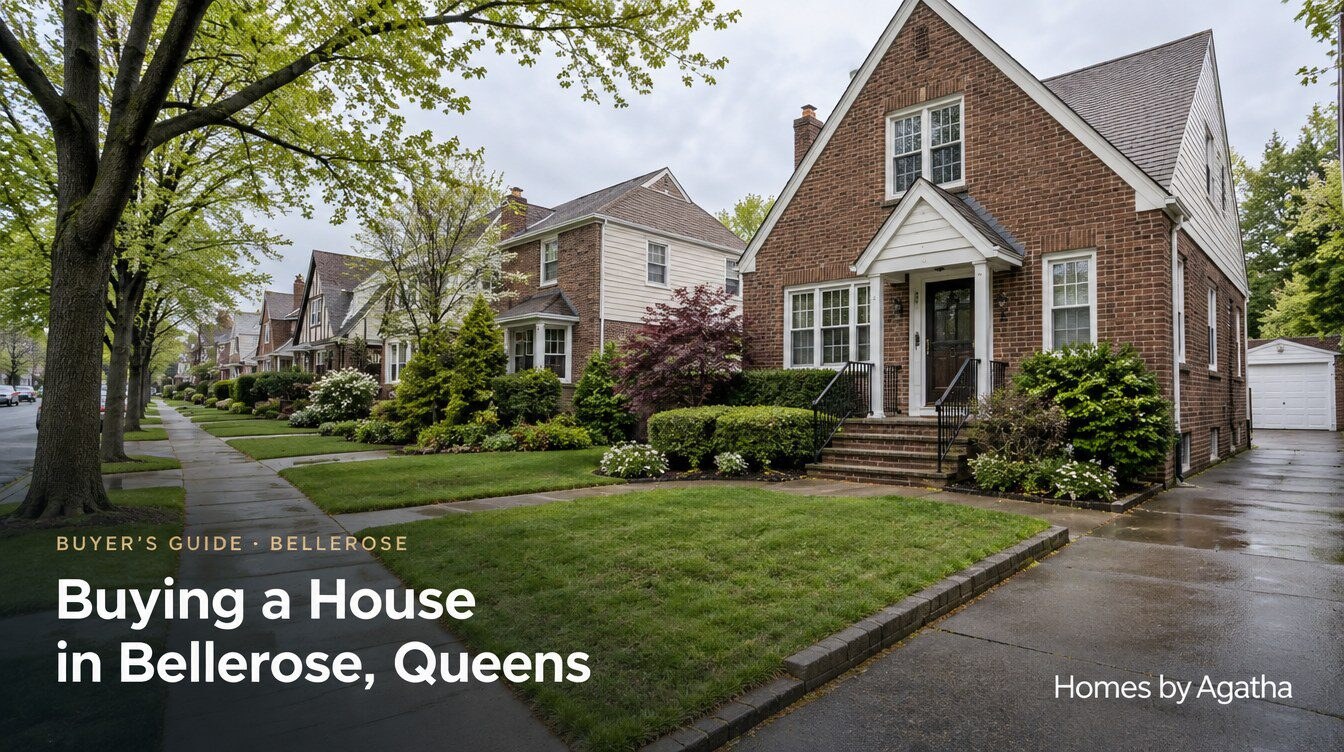
Most of the housing in Bellerose, Queens is detached one-family houses on individual lots, with semi-detached and attached houses on some blocks and a smaller number of two-family houses. Mixed-use buildings with storefronts and apartments line parts of Hillside Avenue and Jamaica Avenue. Large apartment buildings are uncommon inside Bellerose itself.
That mix shapes the whole purchase. When you are buying a house in Bellerose Queens, you are usually buying land plus a structure, with full responsibility for the roof, boiler, sewer line, sidewalk and everything in between. There is no co-op board and no condo association sharing the work.
Common house styles and what they mean for buyers
- Cape Cods and colonials. Often with finished or partially finished attics and basements. Ask whether finished space was permitted, because unpermitted attic bedrooms raise building-code questions and affect the legal room count.
- Tudor-style and brick houses. Solid masonry exteriors, but slate or clay details, chimneys and older drainage need a specialist’s eye.
- Ranches and high-ranches. One-level living or split layouts, sometimes with a lower level that has been used as a separate living area. The lower level’s legal status matters.
- Semi-detached and attached houses. Shared walls mean shared issues: party-wall condition, roof connections and shared driveways need a close look and, sometimes, a written easement.
- Two-family houses. A rental unit can help with carrying costs, but only a unit shown on the Certificate of Occupancy is a legal dwelling. For the full framework, see the guide to buying a multi-family home in Queens.
Building age and why it matters
Construction years vary block by block, and many Bellerose houses are decades old; check the year built for a specific house in NYC Department of Finance records. An older house is not a problem by itself. It does mean the inspection should focus on systems that wear out on a predictable schedule: heating plants, oil tanks, electrical panels and wiring, galvanized or older supply pipes, clay or cast-iron sewer lines, and roof layers.
Age also affects paperwork. The NYC Department of Buildings states that buildings constructed before 1938 are generally not required to have a Certificate of Occupancy unless later work changed their use, egress or occupancy. For those houses, legal use is confirmed differently, as explained in the due-diligence section below.
Lots, driveways and outdoor space
Detached houses in Bellerose, Queens commonly come with driveways, garages or yards, and those features drive value as much as interior finishes. Before relying on a driveway, confirm that the curb cut is legal and that any shared driveway with a neighbor is covered by a recorded agreement. Fences, sheds, decks and pools should appear on a survey; your attorney will compare the survey to the title report.
House, two-family or co-op: which property type fits your plan?
In and around Bellerose, the realistic choices are a one-family house, a two-family house, or a co-op apartment in a neighboring complex. Condos are limited in this part of Queens, so most buyers compare the first three. The right choice depends on your budget, how much maintenance you want to handle and whether rental income is part of your plan.
A co-op, short for cooperative, is a building owned by a corporation; buyers purchase shares and receive a proprietary lease for their unit rather than a deed. Co-op complexes exist in neighboring Glen Oaks and in Floral Park, Queens, including garden-style and high-rise buildings, and every one of them sets its own rules. Ask each building’s managing agent about financing limits, down payment, subletting and flip-tax rules.
| Factor | One-family house (Bellerose) | Two-family house (Bellerose) | Co-op (nearby Glen Oaks / Floral Park, Queens) |
|---|---|---|---|
| What you own | Land and building, by deed | Land and building, by deed, with a second dwelling unit | Shares in a corporation plus a proprietary lease |
| Approval needed | Lender only | Lender only | Lender and co-op board (application package and interview) |
| Monthly costs | Mortgage, property tax, insurance, all repairs | Same as one-family, offset in part by legal rental income | Mortgage plus maintenance, which typically includes building operating costs, a share of property taxes and of the building’s underlying mortgage |
| Mortgage recording tax (NYC) | Applies | Applies | Does not apply; co-op loans are share loans |
| Key document to check | Certificate of Occupancy or legal-use evidence; survey | CO showing two dwelling units; leases and rent records | Offering plan, financial statements, house rules, board minutes |
| Main risk | Deferred maintenance on older systems | An “extra” unit that is not legal; tenant issues | Board rejection; building assessments |
If you are deciding between Bellerose and nearby neighborhoods with different housing mixes, it helps to look at what each area actually offers. North of Bellerose, the Little Neck home buying page covers another eastern Queens market with a mix of houses and co-ops, while buying in Cambria Heights to the south involves a largely house-based stock similar in format to Bellerose.
Weighing a house against a co-op?
Let’s line up the monthly carrying costs, approval steps and maintenance responsibilities side by side for the properties you are actually considering.
How much cash do you need to close on a Bellerose house?
Plan for two separate amounts: the down payment your loan program requires, and closing costs on top of it. For a house in Bellerose, Queens, buyer closing costs include New York City mortgage recording tax, title insurance, attorney fees and lender fees, plus the New York State “mansion tax” if the price is $1 million or more.
Because the mortgage recording tax is calculated on the loan amount, it is often the single largest line item for a financed house purchase in Queens. It also explains why the jurisdiction question in the first section matters so much: the NYC rate and the Nassau County rate are different.
Main buyer closing costs for a Bellerose, Queens house
| Cost | Who sets it | How it works in Bellerose, Queens |
|---|---|---|
| Mortgage recording tax | NYC Department of Finance / New York State | Roughly 1.8% of the loan amount for loans under $500,000 and 1.925% for loans of $500,000 and above on one-to-three-family homes and condos. Co-op share loans are not subject to it. |
| “Mansion tax” | New York State | 1% of the price on residential purchases of $1 million or more, paid by the buyer; graduated above $2 million in New York City. |
| Title insurance and title search | Title company (rates regulated in New York) | Owner’s and lender’s policies; the search also covers liens, violations and municipal records. |
| Buyer’s attorney | Negotiated with the attorney | Contract negotiation, title review, closing. |
| Lender charges | Your lender | Application, appraisal, origination or points, credit report. |
| Prepaids and escrows | Lender and the tax calendar | Homeowners insurance, NYC property tax escrow and prorated adjustments with the seller. |
| Inspection and specialist tests | Inspectors you hire | General inspection, plus sewer-line camera, oil-tank sweep or other tests when warranted. |
Confirm current rates with the NYS Department of Taxation and Finance and the NYC Department of Finance before closing.
Some costs from other parts of the state do not apply here. The Peconic Bay Region tax, for example, applies only in certain East End towns of Suffolk County. The NYS transfer tax and NYC Real Property Transfer Tax are customarily paid by the seller, though contracts can allocate costs differently. For a line-by-line walkthrough with more context, see Queens closing costs explained.
Carrying costs to estimate before you bid
The monthly picture matters as much as the closing figure. For a Bellerose house, estimate the mortgage payment, the NYC property tax shown on the current Department of Finance bill, homeowners insurance, water and sewer charges billed by the NYC Department of Environmental Protection, heating fuel, and a realistic repair reserve for an older structure. If a house was recently renovated, ask whether any tax exemptions or abatements on the bill will change after the sale; exemptions such as STAR are tied to the owner, not the house.
Key Takeaways
- Three places share the Bellerose name; only Bellerose, Queens is in New York City and subject to NYC taxes and NYC Department of Buildings records.
- Confirm jurisdiction with the tax bill, the BBL or Nassau section-block-lot, ZoLa and the title report, not the ZIP code.
- Most Bellerose, Queens properties are detached houses, so you inherit every system and the sidewalk; budget repair reserves accordingly.
- NYC mortgage recording tax is usually the largest buyer closing cost on a financed house; co-op share loans are exempt.
How should you plan pre-approval and financing for a Bellerose purchase?
Get a full pre-approval, not a quick pre-qualification, before you tour seriously. A pre-approval means an NMLS-registered mortgage loan originator has reviewed your income, assets and credit and has issued a conditional commitment amount. Sellers of Bellerose houses typically ask to see one with an offer.
Financing a house on the city line raises a few specific points worth settling early with your lender.
Questions to ask your lender before you shop
- Which closing-cost estimate are you using? Ask the lender to model NYC mortgage recording tax for a Queens address. If you are also viewing Nassau listings, ask for a second estimate at the Nassau rate.
- How will the appraisal treat an older house? Appraisers note condition. Items such as a failing roof, missing handrails or non-working heat can trigger repair conditions on some loan programs, so ask how your program handles them.
- How is rental income counted on a two-family? Lenders apply their own rules to projected or existing rent from a second unit. Income from a unit that is not legal on the Certificate of Occupancy is generally a problem for underwriting.
- What does the lender need for the property tax escrow? NYC property taxes are billed by the Department of Finance on their own schedule; your lender will collect a cushion at closing.
- Is there a renovation option? If the house needs work, ask whether a renovation loan product fits, and how it changes the timeline.
Down payment and cash reserves
Down payment requirements depend on the loan program, not on the neighborhood. What is local is the cash you need after closing. Detached houses in Bellerose, Queens put every repair on the owner, so many buyers keep a reserve for the first year rather than spending every dollar on the down payment. That reserve can be the difference between handling a boiler failure calmly and financing it on a credit card.
If this is your first purchase, the borough-wide first-time home buyer guide for Queens explains pre-approval steps and common first-purchase questions in more detail.
Build your budget before you build your shortlist
I can walk through a realistic closing-cost and carrying-cost picture for Bellerose houses with you and your lender, so your offer price rests on real numbers.
How do you get around from Bellerose, Queens?
Bellerose has no subway station. Residents rely on MTA buses along Hillside Avenue and Jamaica Avenue, the Long Island Rail Road at nearby Bellerose and Queens Village stations, and the highway network, including the Cross Island Parkway and the Grand Central Parkway. Which option fits you depends on the exact block and where you need to go.
Long Island Rail Road options
The LIRR Bellerose station sits at Commonwealth Boulevard and Superior Road, just over the city line in Nassau County. Queens Village station lies inside Queens to the west. Both are on the Hempstead Branch corridor. Check the current LIRR timetable for whether a trip runs direct or changes at Jamaica, and which Manhattan or Brooklyn terminal it serves.
Fare matters for daily commuters. A trip that starts at a station inside New York City can be priced differently from a trip that starts at a Nassau County station, so check current LIRR fares and CityTicket rules on mta.info. For some Bellerose, Queens addresses the Queens station is the cheaper choice; for others the walk to the Bellerose station is shorter. Compare both before deciding that a particular house “is near the train.”
Buses and the subway connection
Hillside Avenue is the main bus spine. Local buses run west along Hillside Avenue toward Jamaica, where riders connect to the F train at Jamaica–179 Street and to the E, J and Z and the LIRR at the Jamaica hubs. Other routes serve Jamaica Avenue and the north–south streets, and MTA express buses offer one-seat rides to Manhattan from parts of eastern Queens. The Queens Bus Network Redesign changed several eastern Queens routes in 2025, so check current maps rather than older listings or articles.
Driving and parking
Many Bellerose houses have driveways or garages, and buyers who drive often value quick access to the Cross Island Parkway and the Grand Central Parkway, plus Jericho Turnpike and Hillside Avenue heading east into Nassau County. If on-street parking is part of your plan, visit the block in the evening and on a weekend; conditions near the commercial avenues differ from interior residential blocks.
How commuting should shape your search
- Time the door-to-door trip at the hour you would actually travel, using both the Queens Village and Bellerose stations if you plan to use the LIRR.
- Map the walk to the nearest Hillside Avenue bus stop if you need the subway.
- For drivers, check how the house connects to the Cross Island Parkway during peak hours.
- Treat “near the LIRR” in a listing as a claim to test, not a fact to price in.
What should you check on an older Bellerose house before you sign?
Before signing a contract on a Bellerose, Queens house, confirm its legal use, check the NYC Department of Buildings record for open permits and violations, and have a licensed inspector examine the heating system, electrical service, plumbing, sewer line and roof. Then compare what you saw on the tour with what the paperwork allows.
Certificate of Occupancy and legal use
A Certificate of Occupancy, or CO, is the NYC Department of Buildings document that states a building’s legal use and number of dwelling units. For a Bellerose house, the CO tells you whether the property is legally a one-family or two-family home. You can search records through the Department of Buildings systems and read the agency’s guidance on its Certificate of Occupancy page.
For houses built before 1938 that were never altered in a way that required a new CO, there may be no CO at all. In that case, the Department of Buildings can issue a Letter of No Objection confirming the legal use, and your attorney may rely on other records as well. A missing CO on an older house is a question to resolve, not automatically a deal-breaker.
Basements, attics and “extra” units
Finished basements and attic rooms are common in eastern Queens houses. A basement apartment that does not appear on the CO is generally not a legal dwelling unit, no matter how finished it looks. Buying a house that relies on an illegal unit for income exposes you to violations, insurance problems and financing complications. Ask the seller for permits covering any finished space, and ask your attorney to address it in the contract.
Permits, violations and zoning
- Open permits: Work that was permitted but never signed off can delay closing. Your title company and attorney search for these, but you can look early.
- Violations: Department of Buildings and Environmental Control Board violations can attach to the property.
- Zoning: If you plan an extension, a dormer or a second unit, check the lot’s zoning district on ZoLa and consult an architect before assuming the work is allowed.
Systems that deserve a specialist
- Heating and oil tanks: Ask whether the house uses or ever used heating oil. If a buried tank was removed or abandoned, ask for documentation; if not, consider a tank sweep.
- Sewer line: In New York City the owner is responsible for the private sewer connection from the house to the city main. A camera inspection is inexpensive compared with a collapsed line under the front yard.
- Electrical service: Older houses may have undersized service, outdated panels or older wiring that insurers ask about.
- Roof and drainage: Count the roof layers, check gutters and leaders, and look for basement water staining after rain.
- Lead-based paint: For homes built before 1978, federal rules require the seller to disclose known lead-based paint hazards and give the buyer an opportunity to inspect.
Sidewalks, street trees and flood maps
In New York City, property owners are responsible for maintaining the sidewalk adjacent to their property, and sidewalk violations can follow the house. Look at the sidewalk on the tour, especially near street trees whose roots lift slabs.
Bellerose is an inland neighborhood, but flood risk is property-specific. Check the address on the FEMA Flood Map Service Center and NYC’s flood-zone tools, and ask the seller and inspector about basement water history. Lenders require flood insurance only for properties in Special Flood Hazard Areas, but basement backup can happen anywhere a drain sits below the street sewer.
| Due-diligence item | Where to check (Bellerose, Queens) | Why it matters |
|---|---|---|
| Jurisdiction | NYC DOF tax bill / BBL, ZoLa, title report | Determines taxes, records and the rules that apply |
| Legal use and unit count | NYC Department of Buildings CO or Letter of No Objection | Confirms one-family vs. two-family status and legal rental use |
| Open permits and violations | NYC Department of Buildings and title search | Unresolved items can delay closing or cost money to clear |
| Zoning for future plans | ZoLa and an architect | Extensions and conversions must fit the zoning district |
| Flood exposure | FEMA Flood Map Service Center and NYC flood tools | Affects insurance requirements and basement planning |
| Property tax and exemptions | NYC Department of Finance | Owner-specific exemptions may not carry over to you |
| Physical condition | Licensed home inspector plus specialists | Older systems drive near-term repair costs |
| Survey and boundaries | Survey reviewed by your attorney | Driveways, fences and sheds must match title and lot lines |
Found a house you like? Let’s check it properly
Before you commit, I can help you organize the CO, permit history and inspection questions for that specific Bellerose property.
How do offers and contracts work when buying a house in Bellerose Queens?
In New York, an accepted offer is not a binding contract. After a seller accepts your offer, the attorneys for buyer and seller negotiate and prepare the contract of sale, and the deal becomes binding only when both parties sign and the seller’s attorney receives your deposit. New York is often called an “attorney state” for this reason.
From offer to signed contract
- Offer. Your agent submits price, financing type, down payment, proposed closing timing and any conditions, along with your pre-approval.
- Accepted offer and memorandum. The agents circulate a deal sheet with the price, terms and both attorneys’ contact information.
- Inspection. Most buyers inspect during this window, before signing, because the contract will usually state that the buyer takes the property in its current condition.
- Contract review. The seller’s attorney drafts the contract; your attorney reviews it, checks the documents and negotiates riders, including the mortgage contingency.
- Signing and deposit. You sign and deliver the deposit, which is customarily held in escrow by the seller’s attorney.
Offer strategy that fits Bellerose houses
Price is only one lever. Sellers of detached houses often weigh the strength of financing, the size of the down payment, the flexibility of the closing date and how cleanly the buyer handles inspection findings. A strong offer on an older house is one that is realistic about condition: if your inspector finds a roof near the end of its life, ask for a fair adjustment rather than a wish list.
Comparable sales should come from the same jurisdiction. A Queens house and a house a few blocks away in the Village of Bellerose carry different tax bills and closing costs, so treat cross-line sales as context, not as direct comparables.
What happens after the contract is signed
After signing, your lender orders the appraisal and moves toward a commitment letter, and the title company runs the title search, including municipal searches for permits and violations. Any issues that surface, such as an open permit or an unrecorded easement, are handled by the attorneys before closing. Closing on a Bellerose, Queens house takes place with the attorneys, the title closer and usually a lender representative present.
How does working with a buyer’s agent work in 2026?
Under the rules that followed the 2024 National Association of Realtors settlement, still in effect in 2026, a buyer signs a written agreement with their agent before touring homes together. That agreement states how the agent will be compensated. Buyer-agent compensation is negotiable, is not set by law and is not automatically paid by the seller.
In practice, a seller may still offer to contribute toward the buyer’s agent compensation, a buyer may ask for it as part of the offer, or the buyer may pay it directly. These are negotiating points, and you should understand your agreement before the first showing.
Agency disclosure in New York
The New York State Disclosure Form for Buyer and Seller explains the different agency relationships a real estate licensee can have. It is presented at the first substantive contact, so you know whether the person you are speaking with represents you, the seller, or acts in another permitted role.
What a buyer’s agent should do on a Bellerose purchase
- Confirm jurisdiction on every address before you invest time in a showing.
- Pull comparable sales from the correct side of the city line.
- Flag CO, permit and legal-unit questions early.
- Coordinate timing between your attorney, lender, inspector and the seller’s side.
- Explain trade-offs honestly, including when a house is not a good fit.
For a fuller explanation of agreements, compensation and what to expect, read working with a buyer’s agent in NY. I offer representation in English and Polish; some clients simply find contract-stage conversations easier in their first language. Where you choose to buy is always your decision.
Want a clear representation agreement before you tour?
Let’s review how buyer representation works, what it costs and what you can expect from me, before we look at a single Bellerose house.
What is the timeline from offer to closing on a Bellerose house?
A financed purchase of a Bellerose, Queens house usually moves through offer, inspection, contract signing, mortgage commitment, title clearance and closing. Each stage depends on several people working in parallel, and the overall timing varies with the lender, the condition of the title and how quickly documents are produced.
| Stage | What happens | Typical range (varies by deal) | Bellerose-specific watch point |
|---|---|---|---|
| 1. Offer accepted | Deal sheet circulated to attorneys | Same day to a few days | Confirm the BBL and jurisdiction on the deal sheet |
| 2. Inspection | General inspection plus specialist tests | About one week | Sewer camera, oil-tank sweep, roof and electrical review on older houses |
| 3. Contract negotiation and signing | Attorney review, riders, deposit | About one to three weeks | CO, Letter of No Objection or legal-unit questions resolved in the contract |
| 4. Mortgage commitment | Appraisal, underwriting, commitment letter | Several weeks | Appraiser’s condition notes on older systems |
| 5. Title and municipal searches | Liens, permits, violations, survey | Runs alongside stage 4 | Open DOB permits, sidewalk violations |
| 6. Clear to close and final walk-through | Scheduling, final review of the property | About one week | Confirm agreed repairs and that systems still work |
| 7. Closing | Funds, deed and mortgage recording | One meeting | NYC mortgage recording tax paid at closing |
Ask your transaction attorney and lender for typical timeframes for each stage of your specific deal.
Cash purchases skip the mortgage commitment and can move faster. Co-op purchases in neighboring buildings add a board package and interview, which adds time that the building controls.
What mistakes should Bellerose buyers avoid, and what belongs on your checklist?
The most expensive mistakes on a Bellerose purchase come from assumptions: assuming an address is in Queens, assuming a finished basement is legal, assuming the commute works without testing it, and assuming an older house’s systems have years left. Each can be checked before you sign.
Mistakes to avoid
- Budgeting with the wrong tax rules. NYC and Nassau County closing costs and property taxes differ; confirm jurisdiction first.
- Counting illegal rent. Income from a unit not on the CO is a risk, not an asset.
- Skipping the sewer camera. On older houses, the line from the house to the street is the owner’s responsibility in NYC.
- Treating the accepted offer as a done deal. Until the contract is signed, either side can walk away; keep your attorney moving.
- Ignoring owner-specific tax benefits on the bill. Exemptions can drop off after the sale, changing the monthly payment.
- Using cross-line sales as direct comparables. A nearby Nassau sale reflects a different tax and cost structure.
- Waiting to read the buyer agreement. Understand compensation terms before the first showing.
Bellerose buyer checklist
- Get a full pre-approval from an NMLS-registered mortgage loan originator, with closing costs modeled for a Queens address.
- Sign a written buyer agreement and review the NYS Disclosure Form for Buyer and Seller.
- For every listing, confirm jurisdiction with the BBL, tax bill and ZoLa.
- Pull the Certificate of Occupancy or confirm legal use another way, such as a Letter of No Objection.
- Check Department of Buildings permits and violations, and ask about any finished basement or attic.
- Test the commute from the actual block at your real travel time.
- Schedule the inspection plus a sewer camera and, where relevant, an oil-tank sweep.
- Check FEMA and NYC flood tools and ask about basement water history.
- Choose a New York real estate attorney before your offer is accepted.
- Review the contract, the mortgage contingency and the closing-cost estimate before you sign.
Key Takeaways
- In New York, the attorneys turn an accepted offer into a contract; nothing is binding until both sides sign.
- Pre-1938 houses may have no CO; a Letter of No Objection or other records can confirm legal use.
- Commuting from Bellerose depends on buses to Jamaica, the LIRR at Bellerose or Queens Village, or the parkways, so test the exact block.
- Buyer-agent compensation is negotiable and set out in a written agreement signed before touring.
Ready to turn research into a plan?
Tell me your budget, timing and commute needs, and I will help you build a focused Bellerose search and an offer strategy that fits it.
Frequently asked questions about buying a house in Bellerose, Queens
Is Bellerose in Queens or Nassau County?
Both names exist. Bellerose, Queens is a New York City neighborhood. The Village of Bellerose is an incorporated village in the Town of Hempstead, Nassau County, and Bellerose Terrace is an unincorporated hamlet next to it. Confirm a property’s jurisdiction with its tax bill, its tax lot identifier and the title report.
How can I tell if a Bellerose address is inside New York City?
Check the property tax bill and identifier. A Queens property has an NYC Department of Finance borough-block-lot number and appears on the NYC Department of City Planning’s ZoLa zoning map. A Nassau County property is assessed by the Nassau County Department of Assessment and is identified by section, block and lot.
What types of homes are common in Bellerose, Queens?
Bellerose, Queens is mostly detached one-family houses, with some semi-detached and attached houses, two-family houses and mixed-use buildings along Hillside Avenue and Jamaica Avenue. Co-op complexes are found in neighboring Glen Oaks and Floral Park, Queens. Large apartment buildings are uncommon inside the neighborhood itself.
Does the NYC mortgage recording tax apply in Bellerose?
It applies to financed purchases of houses and condos in Bellerose, Queens: roughly 1.8% of loans under $500,000 and 1.925% at $500,000 and above on one-to-three-family homes. Co-op share loans are exempt. Properties in the Nassau County village or hamlet follow the county rate instead.
Is there a subway in Bellerose, Queens?
No subway station is located in Bellerose. Local buses along Hillside Avenue connect to the F train at Jamaica–179 Street and to the Jamaica transit hubs. Many residents also use the Long Island Rail Road at Bellerose station, just over the city line, or Queens Village station inside Queens.
What if an older Bellerose house has no Certificate of Occupancy?
Houses built before 1938 generally were not required to have a Certificate of Occupancy unless later work changed their use, egress or occupancy. The NYC Department of Buildings can issue a Letter of No Objection confirming legal use. Your attorney should review the records before you sign the contract.
Can I count rent from a basement apartment when buying in Bellerose?
Only a dwelling unit shown on the Certificate of Occupancy is legal. A basement apartment that does not appear on the CO is generally not a legal unit, and lenders, insurers and the NYC Department of Buildings will treat it accordingly. Verify legal unit count before relying on rental income.
Do I need flood insurance for a house in Bellerose, Queens?
Lenders require flood insurance for properties in FEMA Special Flood Hazard Areas. Bellerose is inland, but flood status is property-specific, so check the address on FEMA’s Flood Map Service Center and NYC’s flood tools. Ask separately about basement water history, since sewer backup can occur outside mapped flood zones.
Who pays the buyer’s agent when buying in Bellerose in 2026?
Buyer-agent compensation is negotiable and not set by law. You sign a written agreement with your agent before touring, and it states the compensation. A seller may agree to contribute, you may request it in your offer, or you may pay directly; none of it is automatic.
How long does it take to close on a Bellerose house?
Timing depends on financing, title and inspection results. A financed purchase moves through inspection, attorney contract negotiation, appraisal and mortgage commitment, title and municipal searches, a final walk-through and closing. Cash deals can move faster. Your attorney and lender can estimate the schedule for a specific Bellerose, Queens property.
Your next step for buying a house in Bellerose, Queens
Bellerose rewards careful buyers. Confirm that the address is in New York City, read the Certificate of Occupancy or other legal-use evidence before you fall for the finished basement, inspect the systems an older house depends on, and test the commute from the actual block. With those answers in hand, your attorney’s contract review and your lender’s commitment become routine rather than stressful. When you are ready to see what is available and how a purchase would come together for you, start with the Bellerose home buying page, and if you already own in the area and plan to move, the companion page on selling your Bellerose home explains the seller side. You can also explore Bellerose purchase options with Homes by Agatha whenever you want a second opinion on a specific house.
This article is for general informational purposes only and reflects conditions that may change. It is not legal, tax, or financial advice, an appraisal, or a guarantee of price or outcome; consult a licensed New York attorney, a CPA, and an NMLS-registered mortgage loan originator as appropriate. A CMA is an opinion of value, not an appraisal. Real estate brokerage services are offered by Agatha Lubas, Licensed Associate Real Estate Broker, NY License #10301213345, Keller Williams Realty Liberty, 96-10 101st Avenue, Ozone Park, NY 11416. The NYS Disclosure Form for Buyer and Seller, the NYS Housing and Anti-Discrimination Disclosure / Fair Housing Notice, and the brokerage’s Standard Operating Procedures are available on request. Equal Housing Opportunity.

Agatha Lubas helps buyers, sellers and investors across Queens, Brooklyn, Nassau County and Suffolk County understand both the property and the New York transaction process. She works with clients in English and Polish, so every conversation can happen in the language that feels most comfortable.
Work with Agatha