

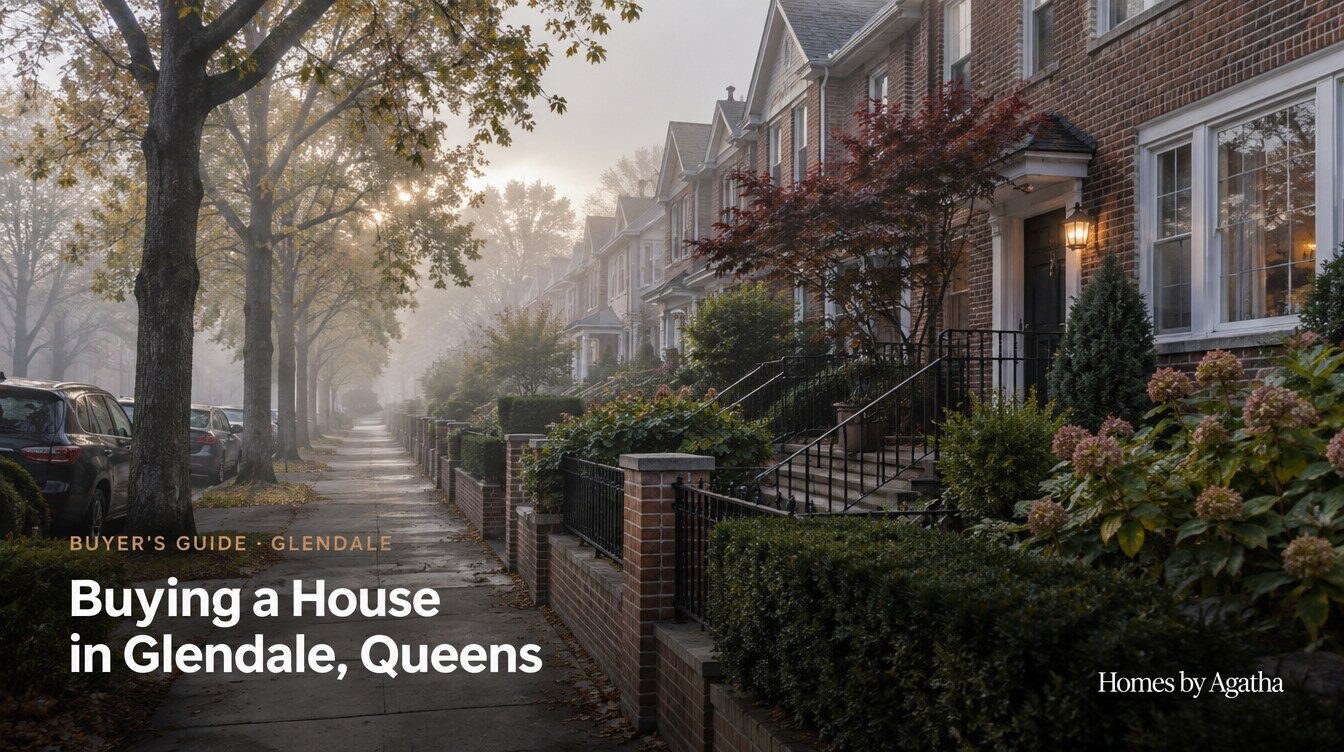
GLENDALE REAL ESTATE GUIDE
Buying a House in Glendale Queens: Row Houses, Two-Family Homes and the Questions to Ask First
Quick Answer
Buying a house in Glendale, Queens usually means choosing an attached or semi-attached row house or a two-family home. Before offering, verify the legal unit count with NYC Department of Buildings records, inspect shared roofs and walls, budget for NYC closing taxes, and test a commute built on buses, the M train and nearby LIRR stations.
This guide is for people who are buying a house in Glendale Queens and want to understand the building before they agree on a price. Glendale sits in west-central Queens between Ridgewood, Middle Village, Forest Hills and Woodhaven, and most of what comes up for sale here is a house, not an apartment. Many of those houses share a wall with a neighbor, and many contain two apartments.
A shared wall means a shared roof line and sometimes a shared driveway; a second apartment raises questions about legal status and rent; and because most Glendale blocks are not next to a subway station, the commute is something you test, not assume.
As a Licensed Associate Real Estate Broker serving Queens, I help buyers evaluate the property and the transaction together, in English or Polish. When you are ready to tour homes, the page on how to buy your home in Glendale with a local buyer’s agent explains how we work together.
Glendale at a glance
| Topic | What to know |
|---|---|
| Area | West-central Queens; long east to west and narrow north to south; bordered by Ridgewood (west), Middle Village (north), Forest Hills (east) and Woodhaven (south), with Forest Park along much of the southern edge (neighborhood lines are informal) |
| Borough / County | Queens (Queens County), New York City; Queens Community District 5 |
| ZIP code | 11385, shared with Ridgewood (confirm the ZIP code for a specific address with USPS) |
| Subway | No station inside most of Glendale; the M train stops at Fresh Pond Rd and Forest Av in neighboring Ridgewood and ends at Middle Village–Metropolitan Av |
| Rail | Nearest Long Island Rail Road stations are Forest Hills and Kew Gardens on the Main Line; Glendale’s own LIRR station closed in 1998 |
| Buses | Q55 on Myrtle Avenue, Q54 on Metropolitan Avenue, Select Bus Service on Woodhaven Boulevard, plus other local routes; stops changed in the 2025 Queens Bus Network Redesign, so check the current MTA bus map |
| Parks and landmarks | Forest Park, Dry Harbor Playground, Joseph F. Mafera Park, The Shops at Atlas Park at 80-00 Cooper Avenue, large cemeteries along parts of the neighborhood’s edges |
| Commercial corridors | Myrtle Avenue, Cooper Avenue, Metropolitan Avenue (northern edge), Fresh Pond Road (western edge), Woodhaven Boulevard (eastern edge) |
| Typical property types | Attached and semi-attached brick row houses, two-family houses, detached frame houses, a few small apartment buildings and a limited number of condo and co-op units |
What kind of houses will you find when buying a house in Glendale Queens?
Most homes for sale in Glendale, Queens are attached or semi-attached row houses and two-family houses, with fewer detached frame houses and a limited supply of condo and co-op apartments. The typical listing is a brick house sharing walls with its neighbors, with a small front yard or stoop and one or two apartments inside.
Attached and semi-attached row houses
An attached row house shares both side walls with its neighbors; a semi-attached house shares one wall and stands free on the other side, usually along a side driveway. Many Glendale blocks were built as rows of similar houses, often two stories over a basement or cellar with a rear yard, so differences in condition and layout changes are easy to compare along one block. Some have a garage on a rear driveway shared among several houses; others have no off-street parking.
Two-family houses
A two-family house is a building legally approved for two separate dwelling units, each with its own kitchen and bathroom. In Glendale, two-family houses are common in both attached and semi-attached form, usually with one apartment per floor. Buyers use them to live in one unit and rent the other, to give relatives their own apartment, or as rentals. Our guide to buying a multi-family home in Queens covers owner-occupied rentals across the borough; this article focuses on how those questions play out on a Glendale block.
Detached houses, condos and co-ops
Detached frame houses appear throughout Glendale, with no party wall but more exterior to maintain. A condominium (condo) unit is real property: you receive a deed and pay common charges plus your own property taxes. A cooperative (co-op) apartment means buying shares in a corporation that owns the building; maintenance usually includes a share of the building’s taxes and any underlying mortgage, and the purchase requires a board application and usually an interview, under rules each building sets. Because Glendale’s apartment inventory is limited, apartment buyers often also look at buying a home in Forest Hills, where co-op and condo buildings are far more common.
| Glendale property type | What you own | What you share | First thing to verify |
|---|---|---|---|
| Attached row house (one-family) | Land and building (deed) | Two party walls, often a connected roof and sometimes a rear driveway | Roof and party-wall condition; driveway rights; CO or Letter of No Objection |
| Semi-attached house | Land and building (deed) | One party wall; often a side driveway | Survey and deed for driveway ownership or easement |
| Two-family house | Land and building (deed) | As above, plus systems serving two households | Legal unit count, existing lease, separate meters |
| Detached house | Land and building (deed) | Usually nothing beyond recorded easements | Lot lines, exterior condition, permits for additions |
| Condo unit | Unit plus share of common elements (deed) | Common elements run by the condo board | Offering plan, budget, reserves, assessments |
| Co-op apartment | Shares and a proprietary lease | The building, through the corporation | Board rules, financials, sublet and financing policies |
Row house, semi-attached or two-family?
Tell me how you want to live, whether rental income matters and how you commute, and I will help you focus on the Glendale house types that fit.
How is buying an attached row house in Glendale different from buying a detached home?
Buying an attached row house in Glendale means part of what you buy is shared: the party walls, the roof line and sometimes the driveway connect to your neighbors’ property. Your inspection, your attorney’s title review and your budget all have to account for components you do not fully control.
Party walls
A party wall is a wall built along the property line that serves both adjoining houses. Each owner generally maintains their side, but the wall works as one structure, so cracks and moisture can come from either house. In a Glendale row house, look at the party walls in the basement or cellar, where staining, white mineral deposits or patched cracks are easiest to see. Before planning work that bears on a party wall, ask an architect whether it needs NYC Department of Buildings filings.
Connected roofs
Many Glendale row houses have flat or low-slope roofs that run continuously across several houses, separated only by small parapets or flashing at the property line. A failing seam next door can show up as a stain on your top-floor ceiling. Ask your inspector to look specifically at the joints between your roof and the neighbors’ roofs. If the roof is “new,” ask for the invoice and any transferable warranty.
Shared driveways and rear access
Some Glendale row houses have garages reached by a common rear driveway, and many semi-attached houses share a side driveway. A shared driveway is usually governed by an easement, a recorded right to use part of someone else’s land for a specific purpose, or by how the lot lines were drawn. Before you sign, your attorney and title company should confirm what the deed and survey show, whether any agreement is recorded in ACRIS (the NYC Department of Finance’s online property records), and who pays for paving, drainage and snow removal.
Facades and sidewalks
Brick facades need repointing over time, and in New York City the property owner is generally responsible for the sidewalk in front of the house. Tree roots on older Glendale blocks can lift sidewalk flags, which can lead to a city sidewalk violation. Ask your attorney to check NYC DOT records for any open sidewalk violation on the address.
| Factor | Attached row house | Semi-attached house | Detached house |
|---|---|---|---|
| Party walls | Two | One | None |
| Roof | Often continuous with neighbors’ roofs | Often connected on one side | Independent |
| Natural light | Front and rear only | Front, rear and one side | All sides |
| Parking | Street, or a garage on a shared rear driveway | Often a side driveway, private or shared | Often a private driveway |
| Renovation complexity | Highest when work touches party walls or the roof line | Moderate | Lowest structural coordination |
Key Takeaways
- In a Glendale row house, the party walls and connected roof line are shared risk; inspect them as carefully as the interior.
- A shared driveway is only as reliable as the deed, survey and any recorded easement say it is.
- Renovations that touch a party wall can require Department of Buildings filings and coordination with neighbors.
- Sidewalk condition is generally the owner’s responsibility in New York City.
How do you confirm that a Glendale two-family house is legal?
You confirm it by finding the building’s Certificate of Occupancy (CO) or, for many older buildings, a Letter of No Objection or other NYC Department of Buildings record, and comparing the legal unit count with the kitchens, entrances and meters that physically exist. A listing that says “two-family” is a description, not proof.
What a Certificate of Occupancy shows
A Certificate of Occupancy is the NYC Department of Buildings document that states a building’s legal use and occupancy, including how many dwelling units it may contain. If the CO says one family and you find two kitchens, the second apartment is not legal; if it says two families and there is a third unit in the basement, that unit is not legal either. CO records can be searched through the DOB’s public systems, BIS and DOB NOW, and the Department explains the document on its Certificate of Occupancy page.
Older Glendale houses without a CO
The NYC Department of Buildings generally did not require Certificates of Occupancy for buildings constructed before January 1, 1938, unless they were later altered in a way that changed their use, exits or occupancy. So an older Glendale house may have no CO, and that is not automatically a problem. The DOB can issue a Letter of No Objection (LNO) confirming that an existing use is acceptable when it complies with code and zoning. Otherwise, your attorney can check the building class and historical records, including the construction date and record history of the specific building in NYC DOB records.
Basements, cellars and the “extra” apartment
Under New York City building rules, a basement has at least half of its height above curb level, while a cellar has more than half below it. A cellar generally cannot be a legal apartment, and a basement can be habitable only if it meets strict height, light, ventilation and exit rules. If you see a lower-level apartment with its own entrance and kitchen that the records do not show, treat it as unapproved: a lender will not count its rent, insurance may not cover it, and the city can order it vacated. An existing unpermitted unit is not legal simply because New York has taken steps toward legalizing some basement apartments; check with NYC HPD and DOB for the current status of any program and the areas it covers.
Cross-checking the public record
| Record | Where to find it | What it tells a Glendale buyer | Red flag |
|---|---|---|---|
| Certificate of Occupancy / Letter of No Objection | NYC Department of Buildings (BIS, DOB NOW) | Legal use and number of units | More kitchens, doors or meters than legal units |
| DOB permits, complaints and violations | NYC Department of Buildings | Work filed and signed off, open violations | Recent renovation with no permits, or permits never signed off |
| OATH / ECB violations | NYC Office of Administrative Trials and Hearings | Penalties tied to building and sanitation issues | Unpaid penalties to resolve before closing |
| Tax and building class | NYC Department of Finance | How the tax roll describes the building | A class that does not match the marketed unit count |
| Deeds, mortgages, easements | ACRIS (NYC Department of Finance) | Ownership chain, mortgages, driveway agreements | Unreleased mortgages; no recorded driveway rights |
| Zoning district | NYC Department of City Planning ZoLa map | What can be built or enlarged on the lot | Expansion plans the zoning may not allow; confirm the district for the specific lot on ZoLa |
Is that Glendale two-family really a two-family?
Send me the address, and we can review the building’s public records together before you schedule an inspection or talk numbers.
How do you get around Glendale without a subway station on most blocks?
Most Glendale residents combine a bus with the M train or another subway line, or drive. The M train serves the western and northern edges at Fresh Pond Rd, Forest Av and Middle Village–Metropolitan Av; buses run on Myrtle Avenue, Metropolitan Avenue and Woodhaven Boulevard; and the nearest Long Island Rail Road stations are in Forest Hills and Kew Gardens.
The M train at the edges
The M runs on the elevated BMT Myrtle Avenue Line. Fresh Pond Rd and Forest Av stations sit in Ridgewood, close to Glendale’s western blocks, and Middle Village–Metropolitan Av is the line’s terminal on the northern side. Buyers on western blocks may walk to the M; buyers farther east, toward Woodhaven Boulevard and Forest Park, are more likely to start with a bus. The M runs at all hours from Middle Village–Metropolitan Av, but where it goes changes by time of day: on weekdays it continues through Manhattan to Forest Hills–71 Av, on evenings and weekends it ends at Delancey St–Essex St, and late at night it runs only as a shuttle to Myrtle Av–Broadway.
Buses on the main avenues
The Q55 runs along Myrtle Avenue between Ridgewood and Richmond Hill, through Glendale’s main shopping street. The Q54 runs along Metropolitan Avenue on the northern edge. Woodhaven Boulevard, on the eastern edge, carries Select Bus Service toward the Queens Boulevard subway lines and south toward the Rockaways. The MTA redesigned the Queens bus network in 2025, changing stops and some route names, so confirm current routes for any address you consider.
Long Island Rail Road and driving
Glendale once had its own LIRR station on the Montauk Branch, near 73rd Street and Edsall Avenue, but it closed in 1998. Today some eastern Glendale residents reach the Forest Hills or Kew Gardens stations by bus or car. The MTA has announced station work and service changes at both stations through 2027, so check the current LIRR timetable and fares before relying on them. Drivers use the Jackie Robinson Parkway along Glendale’s southern side and Woodhaven Boulevard; parking near Myrtle Avenue and Atlas Park is tighter than on interior blocks.
Test the commute from the front door of the specific house at your real departure time, and repeat it in the evening. In Glendale, access changes noticeably from the western blocks near the M train to the eastern blocks near Woodhaven Boulevard, and that test often changes which house a buyer prefers.
What do Forest Park, Atlas Park and Myrtle Avenue mean for the house you choose?
Forest Park, The Shops at Atlas Park and the Myrtle Avenue shopping strip are Glendale’s main everyday destinations, and distance to each changes a house’s trade-offs: green space near the park, convenience and more traffic near Atlas Park and Myrtle Avenue. Freight rail lines, the parkway and the cemeteries are other block-level factors to judge in person.
Forest Park
Forest Park is a city park of more than 500 acres along Glendale’s southern side, with a public golf course, wooded trails, bridle paths and ballfields. Blocks near its entrances gain easy recreation and see more weekend parking demand.
The Shops at Atlas Park
The Shops at Atlas Park is an open-air shopping center at 80-00 Cooper Avenue, opened in 2006 on the site of the former Atlas Terminals industrial complex, with a movie theater, stores, restaurants and a parking garage. Nearby blocks get walkable errands and more car traffic on Cooper Avenue at peak times, so visit them on a weekend afternoon.
Myrtle Avenue and the other corridors
Myrtle Avenue is Glendale’s main commercial street, with shops, restaurants, bakeries and services in low-rise buildings, many with apartments above the stores. A block or two from Myrtle Avenue puts errands and the Q55 within a short walk; living directly on it means more noise and deliveries, and often a mixed-use building rather than a house.
Freight rail, the parkway and the cemeteries
Freight rail lines cross Glendale, and the Fresh Pond rail yards near the Glendale–Ridgewood–Middle Village area handle freight moving to and from Long Island. Houses near the tracks can hear and sometimes feel passing trains, and blocks next to the Jackie Robinson Parkway or Woodhaven Boulevard carry more traffic sound. Train timing varies, so judge rail activity near a specific address by visiting at different hours. Glendale is also bordered in places by large cemeteries, which leaves some houses facing open land rather than another row of buildings; check a map to see what borders a specific block. Visit at different hours and stand in the rear yard, too.
Key Takeaways
- Glendale’s commute usually combines a bus with the M train or the Queens Boulevard lines; test it from the exact address.
- Western blocks sit closer to the M train; eastern blocks rely more on Woodhaven Boulevard buses and, for some, the LIRR in Forest Hills or Kew Gardens.
- Atlas Park and Myrtle Avenue bring convenience and more traffic; Forest Park brings green space and weekend parking demand.
- Check freight rail lines, the parkway and busy avenues in person, at more than one time of day.
Comparing Glendale blocks side by side?
We can line up your shortlist by walk time to the M train or a bus, parking options, and distance from Myrtle Avenue, Atlas Park and the rail lines.
How much cash do you need when buying a house in Glendale Queens?
You need the down payment, buyer closing costs that in New York City include the mortgage recording tax, title insurance, attorney fees and lender charges, and a cash reserve for an older attached house. In a two-family, budget for both units’ systems, the building’s water bill and landlord insurance.
Taxes a Glendale buyer may pay at closing
Because Glendale is a New York City neighborhood, a purchase here carries both city and state closing taxes. The NYC Department of Finance and New York State publish the mortgage recording tax rates: on one-to-three-family homes and condos it is roughly 1.8% of the loan amount for loans under $500,000 and 1.925% for loans of $500,000 and above. A co-op purchase is financed with a share loan, which does not carry mortgage recording tax. The New York State “mansion tax” is 1% of the purchase price on residential purchases of $1 million or more, paid by the buyer; within New York City, the rate is graduated above $2 million. The NYS real estate transfer tax and the NYC Real Property Transfer Tax are customarily paid by the seller, though contract terms can shift costs. Confirm current rates with the NYS Department of Taxation and Finance and NYC Department of Finance before closing.
| Cost | Upfront or ongoing | How it applies in Glendale |
|---|---|---|
| Mortgage recording tax | Upfront | Based on the loan amount for a house or condo; not charged on co-op share loans |
| Mansion tax | Upfront | Only if the price is $1 million or more |
| Title insurance, searches and survey | Upfront | Searches surface violations and recorded easements; the survey shows lot lines and driveway location |
| Attorney, lender fees and appraisal | Upfront | Two-family appraisals may include a rent analysis |
| Inspections | Upfront | General inspection, plus optional sewer camera, oil-tank sweep or roof review |
| Property tax | Ongoing | Billed by the NYC Department of Finance; most one-to-three-family homes are tax Class 1 |
| Water and sewer | Ongoing | Billed to the building by NYC DEP; in a two-family the owner often pays for both units |
| Insurance | Ongoing | Homeowner’s policy, landlord coverage for a rented unit; flood coverage is separate |
| Maintenance reserve | Ongoing | Roof share, brick pointing, boiler, plumbing, electrical and sidewalk repairs |
For a line-by-line explanation of buyer and seller costs across the borough, read Queens closing costs explained, and ask your attorney and lender for a written estimate before you sign. Keep a reserve after closing for the roof, party walls and sewer line.
How should you plan financing for a Glendale one-family or two-family house?
Start with a written pre-approval from an NMLS-registered loan originator that names the property type you are targeting, because a one-family, a two-family and a co-op are underwritten differently. For a two-family, ask in writing whether and how rent from the second unit is counted.
Pre-approval that matches the housing stock
A pre-approval is a lender’s conditional commitment based on your verified income, assets and credit. Because so many Glendale listings are two-family houses, a letter that only says “single-family home” may not tell a seller you can close on a two-family. First-time buyers can read our first-time home buyer guide for Queens for what lenders usually request.
Using rent from a second unit
Mortgage programs treat buildings with one to four units as residential property, and owner-occupant programs may allow lower down payments than investor loans. The appraiser estimates market rent for the second unit, and the lender decides how much of it can offset your housing payment. Percentages and reserve requirements differ by program, so get them from an NMLS-registered loan originator. Only rent from a legal unit counts, so ask what happens to your approval if the appraisal finds the second apartment is not on the CO.
Buying with a tenant in place
Many Glendale two-family houses are sold with a tenant in one unit. Existing leases generally remain in effect after a sale, so the new owner takes over the landlord’s obligations, including the security deposit. If you need the unit vacant at closing, negotiate it in writing and let your attorney confirm the plan is realistic under New York tenant law, including whether the unit has any rent regulation status, which NYS Homes and Community Renewal records can help establish.
Planning to live upstairs and rent downstairs?
Before you tour, let’s review what your pre-approval covers and which questions to bring back to your lender about a Glendale two-family.
What should a home inspection focus on in an older Glendale house?
A Glendale home inspection should focus on the roof and its joints with neighboring roofs, the party walls and foundation, the heating system and any old oil tank, the electrical service, and the plumbing and sewer line to the street. These components are the most likely to be both expensive and invisible during a showing.
Roof, foundation and below-grade space
The inspector should examine the roof, parapet flashing and drains; ponding water on a flat roof is a warning sign. In the basement or cellar, look at the foundation and party walls for past water entry. Fresh paint on only the lower part of a wall can hide water lines, and a finished lower level raises the question of whether the work was permitted.
Heating, oil tanks and electrical service
Many older Queens houses were heated with oil and later converted to gas. If a Glendale house converted, ask whether the old tank was removed or properly abandoned and whether paperwork exists; a tank sweep can locate a tank nobody mentioned. Older electrical service may be undersized, and each unit of a two-family should have its own meter.
Plumbing, sewer line and backwater valve
The sewer lateral is the pipe from the house to the city sewer, and the owner is generally responsible for it. A sewer camera inspection can reveal breaks, sags or roots. The inspector can also tell you whether the house has a backwater valve, a device that helps keep sewage from backing up into below-grade space during heavy storms.
Flood exposure and lead paint
Glendale is an inland neighborhood, not a coastal one, but heavy-rain flooding can affect low-lying blocks and basements anywhere in Queens. Check the FEMA Flood Map Service Center and the NYC Stormwater Flood Maps, which model intense rainfall rather than storm surge. Lenders generally require flood insurance in a Special Flood Hazard Area; elsewhere coverage is optional. Check the specific address on both maps rather than assuming any block is in or out of a flood zone. Federal law also requires sellers of housing built before 1978 to disclose known lead-based paint hazards and allow a lead inspection, which applies to most Glendale houses.
Key Takeaways
- Inspect the roof joints with neighboring houses and the party walls in the basement or cellar.
- Ask for oil-tank documentation after a gas conversion, and consider a tank sweep.
- A sewer camera inspection and a backwater-valve check protect below-grade space.
- Check FEMA and NYC Stormwater Flood Maps; inland flooding is a separate risk from coastal flood zones.
How do offers, contracts and buyer’s agents work for a Glendale purchase?
In New York, an accepted offer is not a binding contract: the buyer’s and seller’s attorneys negotiate and prepare the contract of sale, which becomes binding when both parties sign and the deposit is delivered. Buyers complete inspections and records review in that window, and they sign a written buyer agreement with their agent before touring homes.
New York is an attorney state
Attorneys, not brokers, draft and negotiate New York residential contracts. Many New York City contracts give the buyer limited rights to cancel for physical condition once signed, so buyers usually finish the inspection, review the CO and violations, read any lease and confirm driveway rights before signing. A mortgage contingency lets you cancel if your loan is not approved within a set period, on the contract’s terms. Vacancy, violation cures and deposit transfers are negotiation points, not automatic rights.
Beyond price, Glendale sellers compare financing type, down payment, closing-date flexibility and readiness to sign. If you need a vacant unit, say so in the offer.
Your buyer’s agent under the 2026 rules
Under the rules in effect in 2026, following the 2024 NAR settlement, you sign a written buyer agreement before touring homes, and buyer-agent compensation is negotiable, not set by law and not automatically paid by the seller. Some sellers agree to contribute or offer a closing credit; otherwise the buyer pays under the agreement, and either way it is agreed in writing. At the first substantive contact, a licensee must give you the NYS Disclosure Form for Buyer and Seller, which explains agency relationships. For more, read working with a buyer’s agent in NY. I work with buyers in English or Polish; that choice is about communication and comfort, and where you buy is always your choice.
Found a Glendale house worth an offer?
Before you name a number, let’s look at the records, the driveway rights and the contract protections your attorney may want.
What is the timeline from pre-approval to closing in Glendale?
A Glendale purchase moves through six stages: pre-approval, search and records review, offer, inspection and contract signing, mortgage and title work, and closing. Records review and title work are the stages most likely to slow down, because older attached houses often raise questions about permits, easements and legal use.
| Stage | What happens | Who leads | Glendale-specific delay risk |
|---|---|---|---|
| 1. Pre-approval | Lender reviews income, assets and credit | Buyer and loan originator | Approval not matched to a two-family or a specific co-op |
| 2. Search and records review | Showings, commute tests, CO, DOB, ZoLa and ACRIS checks | Buyer and buyer’s agent | Listings advertising more units than the records support |
| 3. Offer and acceptance | Price and terms agreed in principle; not binding | Buyer’s agent and seller’s agent | Vacancy, driveway and closing-date terms left vague |
| 4. Inspection and contract | Inspection, lease review, contract negotiation, deposit, signatures | Buyer’s attorney and inspector | Roof, party-wall, oil-tank or sewer findings |
| 5. Mortgage and title | Appraisal, underwriting, title and municipal searches, survey | Lender, title company, attorneys | Appraisal counting fewer legal units; unrecorded driveway use; open permits |
| 6. Closing | Final walkthrough, funds, deed and mortgage recorded | Attorneys, lender, title closer | Lease and deposit transfers; delivery of a vacant unit |
Exact timing depends on the lender, the records and both parties’ schedules; open permits or an unclear driveway can slow it down.
What mistakes do Glendale buyers make, and what belongs on your checklist?
The costliest mistakes are paying for an apartment that is not legal, ignoring the shared roof and party walls, assuming a shared driveway comes with clear rights, and choosing a house without testing the commute from that block.
Mistakes to avoid
- Counting rent from an unapproved basement unit. If it is not in the DOB record, keep it out of your math.
- Inspecting only your own roof. On a Glendale row, the joints with the neighbors’ roofs are part of your risk.
- Trusting a driveway by habit. Confirm the deed, survey and any recorded easement.
- Judging the commute from a map. A block near the M train and a block near Woodhaven Boulevard feel very different on a weekday morning.
- Not comparing neighboring areas. If Glendale’s inventory does not fit, homes in Middle Village and houses in Woodhaven offer similar building types with different transit and street patterns.
Glendale buyer checklist
- Get a written pre-approval that names the property type.
- Review the NYS Disclosure Form for Buyer and Seller and sign your written buyer agreement before touring.
- Budget for the down payment, mortgage recording tax, title, survey, attorney and lender fees, inspections and a post-closing reserve.
- Pull the CO or Letter of No Objection, DOB and OATH records, the building class and ACRIS documents for each serious listing.
- Confirm driveway or rear-access rights in the deed, survey and recorded easements.
- Test the commute and visit on a weekday evening and a weekend.
- Order an inspection with a roof and party-wall focus; consider a sewer camera and oil-tank sweep.
- Have your attorney review title, records, survey and any lease before you sign.
If you also own a home you plan to sell, the companion guide on how to sell your home in Glendale covers the seller side of the same market.
Want a due-diligence plan for your Glendale search?
We can set up the records checks, inspection priorities and commute tests for each house on your list before you spend money on inspections.
Frequently asked questions about buying a house in Glendale, Queens
What types of houses are most common in Glendale, Queens?
Glendale, Queens is mostly attached and semi-attached brick row houses and two-family houses, with some detached frame houses and a limited number of condo and co-op apartments. Many blocks were built as rows of similar houses, so comparing condition, layout changes and legal status from house to house on the same block is often practical.
Is there a subway station in Glendale, Queens?
Most of Glendale has no subway station of its own. The M train serves its edges at Fresh Pond Rd and Forest Av in Ridgewood and at Middle Village–Metropolitan Av. Buses on Myrtle Avenue, Metropolitan Avenue and Woodhaven Boulevard connect residents to the M and to the Queens Boulevard subway lines.
How do I check whether a Glendale two-family house is legal?
Look up the building in NYC Department of Buildings records for its Certificate of Occupancy or, for many pre-1938 buildings, a Letter of No Objection. Compare the legal unit count with the kitchens, entrances and meters in the house. Your attorney should also review DOB violations, permits and the Department of Finance building class.
What should I inspect on an attached row house in Glendale?
Focus on the roof and its joints with the neighbors’ roofs, the party walls and foundation in the basement or cellar, the heating system and any old oil tank, the electrical service, and the sewer line to the street. A sewer camera inspection and a backwater-valve check are worth discussing with your inspector.
Who owns a shared driveway between two Glendale houses?
It depends on the deed, the survey and any recorded easement or driveway agreement. Some shared driveways are split along the lot line with mutual rights of use; others belong to one owner with an easement for the neighbor. Your attorney and title company should confirm the arrangement in ACRIS records before you sign a contract.
What closing costs does a buyer pay when buying in Glendale?
Buyers in Glendale typically pay the NYC mortgage recording tax on their loan, title insurance, attorney fees, lender fees, a survey if needed and escrow deposits. At $1 million or more, the buyer also pays the 1% New York State mansion tax. A co-op share loan carries no mortgage recording tax. Check current rates with NYC DOF and NYS DTF.
Can rent from a Glendale two-family house help me qualify for a mortgage?
Often yes, if the second unit is legal and its rent can be documented or supported by the appraisal. Each loan program sets how much of that rent counts, usually not all of it. Rent from an unapproved basement unit is not counted. Ask an NMLS-registered loan originator how rental income affects your pre-approval before you tour.
Is Glendale, Queens in a flood zone?
Glendale is an inland Queens neighborhood rather than a coastal one, but flood exposure has to be checked address by address. Look the address up on FEMA’s Flood Insurance Rate Map and on the NYC Stormwater Flood Maps, which show heavy-rain flooding. Lenders generally require flood insurance only in Special Flood Hazard Areas; elsewhere, coverage is optional but available.
What is near The Shops at Atlas Park in Glendale?
The Shops at Atlas Park sits at 80-00 Cooper Avenue, with residential blocks of row houses and two-family homes around it and Forest Park and Myrtle Avenue a short distance away. Living nearby means walkable errands and a movie theater, along with more car traffic on Cooper Avenue during busy shopping hours.
Must I sign an agreement with a buyer’s agent before seeing Glendale homes?
Yes. Under the rules in effect in 2026, a written buyer agreement comes before any tour with an agent. It sets out compensation, which is negotiable, not fixed by law and not automatically covered by the seller. The NYS Disclosure Form for Buyer and Seller is also provided at the first substantive contact.
Your next step in Glendale
Buying a house in Glendale Queens comes down to understanding what you share and what you can prove. Inspect the roof line and party walls as if they were yours alone, confirm the legal unit count before you trust a rent number, get driveway rights in writing, budget for New York City closing taxes and an older building, and ride the commute from the exact block. When your criteria are clear, the page on how to buy your home in Glendale, Queens with Agatha explains how we can search, review records and negotiate together.
Ready to look at Glendale houses with a plan?
Share your budget, the house type you have in mind and where you commute, and we will set up a search that skips the listings that do not fit. English or Polish, your choice.
This article is for general informational purposes only and reflects conditions that may change. It is not legal, tax, or financial advice, an appraisal, or a guarantee of price or outcome; consult a licensed New York attorney, a CPA, and an NMLS-registered mortgage loan originator as appropriate. A CMA is an opinion of value, not an appraisal. Real estate brokerage services are offered by Agatha Lubas, Licensed Associate Real Estate Broker, NY License #10301213345, Keller Williams Realty Liberty, 96-10 101st Avenue, Ozone Park, NY 11416. The NYS Disclosure Form for Buyer and Seller, the NYS Housing and Anti-Discrimination Disclosure / Fair Housing Notice, and the brokerage’s Standard Operating Procedures are available on request. Equal Housing Opportunity.

Agatha Lubas helps buyers, sellers and investors across Queens, Brooklyn, Nassau County and Suffolk County understand the building and the transaction before they commit. She works in English and Polish so clients can communicate in whichever language they find most comfortable.
Work with Agatha