

HOLLISWOOD REAL ESTATE GUIDE
Buying a House in Holliswood, Queens: Zoning, Hillside Lots and What to Check Before You Sign
Quick Answer
Buying a house in Holliswood, Queens usually means buying a detached single-family home from the 1940s or 1950s on an irregular, sloped lot in an R1-2 zoning district. Before you sign a contract, confirm what the zoning allows, inspect retaining walls, drainage, trees and older systems, check the Certificate of Occupancy, and test a car-and-bus commute.
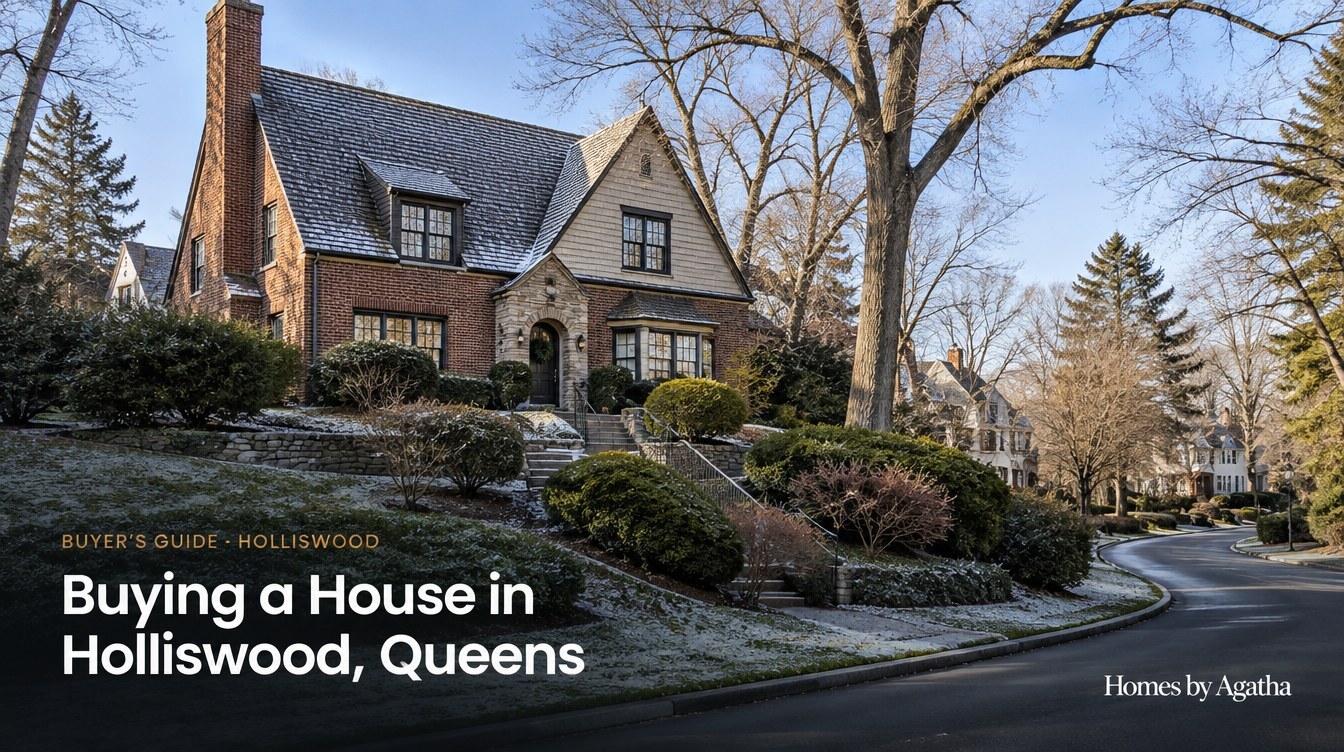
Buying a house in Holliswood is as much about the land as the building. The neighborhood sits on rolling ground in eastern Queens, its streets curve around the hills instead of following a grid, and many houses stand on parcels that are oddly shaped, sloped or set well above or below the road. Those features shape what you can add later, how water moves across the lot, how far you walk to a bus, and which inspections are worth paying for.
This guide is for buyers who are seriously researching Holliswood, Queens and want to understand the purchase before making an offer. It explains the housing stock, what the 2003 rezoning to R1-2 means for additions and extra units, the checks that matter on a hillside lot, the cash you need at closing, financing for houses that have few close comparables, the commute, and the New York contract process from accepted offer to closing.
As a Licensed Associate Real Estate Broker serving Queens and the surrounding New York markets, I help buyers evaluate both the property and the transaction, in English or Polish, whichever is more comfortable. Where you buy is always your choice; my role is to make sure the facts behind that choice are clear and documented.
Holliswood at a glance
| Topic | What to know |
|---|---|
| Location | Eastern Queens, generally bounded by the Grand Central Parkway (north), Francis Lewis Boulevard (east), Hillside Avenue (south) and 188th Street (west), as described by Queens Community Board 8 and the NYC Department of City Planning |
| Borough / district | Queens, New York City; Queens Community District 8 |
| Neighbors | Jamaica Estates to the west, Cunningham Park to the north across the Grand Central Parkway, Hollis to the south across Hillside Avenue, Queens Village to the east |
| ZIP codes | 11423, with some addresses in 11427; confirm the ZIP for a specific address with the USPS ZIP Code lookup |
| Terrain | Rolling, hilly topography on the Long Island terminal moraine, which the City Planning Commission’s 2003 report called the highest ground in Queens; winding streets, irregular parcels and few sidewalks |
| Zoning | Most of the neighborhood was rezoned from R2 to R1-2 (single-family detached houses) in 2003; two blocks with the Holliswood Garden Apartments were rezoned to R3-2; blocks along Hillside Avenue carry other districts; check the current zoning of a specific lot on ZoLa |
| Subway | No station inside the neighborhood; the nearest is Jamaica–179 Street (F) on Hillside Avenue, west of 188th Street |
| Rail | Long Island Rail Road stations nearby in Hollis and Queens Village, plus the Jamaica hub; time the walk or bus ride from a specific block and check the current LIRR timetable |
| Buses | Hillside Avenue is the main bus corridor, with routes toward Jamaica and eastern Queens; the 2025 Queens Bus Network Redesign changed several routes and stops, so check the current MTA bus map |
| Roads | Grand Central Parkway, Francis Lewis Boulevard, Hillside Avenue, 188th Street |
| Parks | Cunningham Park, a large NYC Parks property directly north of the Grand Central Parkway |
| Commercial corridor | Hillside Avenue along the southern edge |
| Typical property types | Detached single-family houses, mostly built in the 1940s and 1950s, on larger and irregular lots; one two-story garden-apartment complex; co-op apartment buildings nearby to the west, outside the rezoned area |
| Key buyer checks | Zoning and legal use, slope and drainage, retaining walls, large trees, private roads or shared driveways, oil-tank history, sewer line, survey and lot lines |
What kinds of houses can you buy in Holliswood, Queens?
Holliswood, Queens is almost entirely detached single-family houses, most of them built in the 1940s and 1950s, on lots that are larger and more irregular than the typical Queens parcel. The main variables are not house type but lot shape, slope, street position and how much the original house has been changed over the years.
The NYC Department of City Planning described Holliswood in its 2003 rezoning report as a fully developed neighborhood of single-family homes on irregularly configured parcels, set at different elevations along winding streets with few sidewalks. That description is still a useful starting point for a buyer, because each of those features turns into a practical question during a purchase.
The interior winding streets
North of Foothill Avenue, streets such as Palermo Street, Santiago Street, Dunton Avenue, Pompeii Avenue, Marengo Street and Epsom Course curve with the terrain instead of meeting at right angles. Lots here can be wedge-shaped, deep, or set on a corner where two curving roads meet. A house may sit high above the street with a long, steep driveway, or below it with the yard draining toward the foundation. Two houses with the same square footage can feel and function very differently depending on where they sit on the hill.
The Hillside Avenue edge
Near the southern boundary, the residential blocks meet Hillside Avenue, the neighborhood’s commercial edge and main bus corridor. The 2003 rezoning map shows that the R1-2 boundary does not run all the way to Hillside Avenue on every block; some frontage was left in other residence districts, with commercial overlays along the avenue itself. A buyer looking at a house on these blocks should check the exact zoning, because the rules that apply can differ from those a few hundred feet north.
The Holliswood Garden Apartments and nearby co-ops
The one significant multi-unit property inside the neighborhood is the Holliswood Garden Apartments, which the City Planning Commission described as a two-story housing complex of approximately 260 dwelling units, now zoned R3-2. Whether a unit there is offered as a co-op share, a condominium unit or a rental affects how, and whether, you can buy it, so ask the listing agent or managing agent to confirm the ownership structure before you plan a purchase. Just west of the neighborhood, the same report identifies the Hilltop Village Cooperative Apartments and the Cunningham Apartments, zoned R4, which buyers sometimes search alongside Holliswood; confirm whether a given unit is a co-op, condo or rental before you search there.
Holliswood is not Hollis
Holliswood and Hollis share part of a name but are separate neighborhoods. Hollis lies south of Hillside Avenue, falls in a different community district and has its own housing stock and LIRR station. Listings sometimes blur the names, so confirm the exact location of any address. If your search covers both, the guide to buying your home in Hollis covers the neighborhood to the south, and buying your home in Jamaica Estates covers the neighborhood to the west, which shares a similar lot pattern and the same R1-2 zoning.
What does R1-2 zoning mean when buying a house in Holliswood?
R1-2 zoning means a Holliswood lot is meant for one single-family detached house, with large minimum lot sizes and generous yards. For a buyer, it decides whether you can split the lot, add a second unit, enlarge the house or rebuild, so it should be checked before you agree on a price, not after closing.
A zoning district is a set of rules in the New York City Zoning Resolution that controls what can be built on a lot: the use, the size of the building, the yards and the parking. Holliswood had been zoned R2 since the citywide zoning of 1961. In May 2003 the City Planning Commission approved a Department of City Planning proposal to rezone about 36 blocks, changing 34 of them to R1-2 and two blocks containing the Holliswood Garden Apartments to R3-2. The stated goal was to keep new development in line with the existing pattern after a single-family house on Santiago Street was demolished and its lot combined with a vacant parcel to build seven detached houses on a new private road.
R2 versus R1-2, as the City described them in 2003
| Rule (2003 CPC report) | Former R2 | R1-2 (most of Holliswood) | What it means for a buyer |
|---|---|---|---|
| Housing type | Single-family detached | Single-family detached | A house used as two families needs a legal basis on the CO |
| Minimum lot area | 3,800 sq ft | 5,700 sq ft | Splitting a lot is only possible if every new lot meets the minimum |
| Minimum lot width | 40 ft | 60 ft | Narrow or wedge-shaped frontage limits subdivision |
| Maximum floor area ratio (FAR) | 0.5 | 0.5 | Caps total floor area relative to lot size; limits large additions |
| Front yard | 15 ft minimum | 20 ft minimum | Front additions and enclosed porches may not fit |
| Side yards | 13 ft total, 5 ft minimum | 20 ft total, 8 ft minimum | Side extensions and garages need room |
| Parking | One space per dwelling unit | One space per dwelling unit | Driveway and garage changes must keep required parking |
These figures are the ones the City Planning Commission published in 2003. The Zoning Resolution has been amended since, including by City of Yes for Housing Opportunity in 2024, so have an architect or zoning attorney confirm the current R1-2 bulk, yard and parking rules for a specific lot before you rely on them.
Floor area ratio, or FAR, is the total floor area of a building divided by the area of its lot. A FAR of 0.5 on a 6,000-square-foot lot allows roughly 3,000 square feet of zoning floor area, before the specific exemptions and definitions in the Zoning Resolution are applied. That arithmetic is only an illustration; an architect calculates the real number for a specific lot.
Additions, rebuilds and “non-complying” houses
Many Holliswood houses were built under earlier rules, so some may not match today’s R1-2 yard or lot requirements. A house that legally existed before the rules changed can generally remain, but enlarging it may have to comply with current rules, and a full rebuild may lose some of what the old house had. How the Zoning Resolution’s non-complying and non-conforming provisions apply to a specific house is a question for an architect or zoning attorney. If your plan depends on adding a bedroom wing, a second story or a larger garage, ask an architect to run a zoning analysis during your due-diligence period.
Can you add a rental unit?
Buyers often ask whether they can add an apartment for income or for a relative. In an R1-2 district the main house remains a single-family detached home. City of Yes for Housing Opportunity, adopted by the New York City Council in December 2024, created a path for one accessory dwelling unit, or ADU, on many one- and two-family lots, such as a backyard cottage, garage conversion or basement unit, subject to size limits, building and fire codes, and exclusions. Whether a specific Holliswood lot qualifies, and which size and siting rules apply, should be checked against current NYC Department of City Planning ADU guidance with an architect. An ADU still needs Department of Buildings permits. An existing basement or attic apartment that was never permitted is not legalized by a zoning change; treat it as a risk, not as income.
No landmark district and no special natural area district
Unlike some other Queens neighborhoods, Holliswood is not a NYC Landmarks Preservation Commission historic district, so exterior changes answer to zoning and the Department of Buildings rather than to landmark review; the LPC’s Discover NYC Landmarks map shows whether any individual landmark designation applies to a specific address. It is also not mapped within a Special Natural Area District, the special zoning district that adds topography and tree protections in parts of Staten Island, Riverdale and Fort Totten; ZoLa shows whether any special district or overlay applies to a specific lot. You can look up any lot’s zoning on the city’s ZoLa zoning map.
Key Takeaways
- Most of Holliswood has been zoned R1-2 since 2003: single-family detached houses, a 5,700-square-foot minimum lot and a 60-foot minimum width, as described by the City Planning Commission.
- Splitting a lot or adding a second legal unit to the main house is much harder than in R2 or two-family districts.
- An ADU may be possible under City of Yes rules, but only with permits; an unpermitted apartment is a liability.
- Ask an architect for a zoning analysis during due diligence if your plans depend on expanding the house.
Want to know what a specific lot will let you do?
Before you commit to a Holliswood house, I can help you organize the zoning, permit and Certificate of Occupancy questions so your architect and attorney can answer them early.
What should you inspect on a hillside lot in Holliswood?
On a Holliswood hillside lot, inspect the land as carefully as the house: slope and drainage, retaining walls, large trees, the driveway, the survey and any private road or shared access. Then inspect the systems typical of a house built in the 1940s or 1950s, from the heating fuel history to the sewer line.
In New York, inspections normally happen before the contract is signed, because a typical residential contract does not include an inspection contingency. That makes this section a pre-offer and pre-contract checklist, not something to schedule after you are bound.
Slope, grading and drainage
On rolling terrain, water always wins. Look at which way the yard slopes relative to the house, where the downspouts discharge, whether there are area drains or dry wells, and whether the basement shows staining, efflorescence or a sump pump that runs often. A house set below the street can receive runoff from the road and the uphill neighbor; a house set above it may have a driveway that sheds water into the garage. Holliswood is inland and on high ground, so stormwater and groundwater are usually bigger questions than coastal flooding, but check the address on the FEMA Flood Map Service Center and NYC’s flood maps anyway, because lenders rely on those maps and flood-zone status is set address by address.
Retaining walls
Retaining walls hold back soil where the lot changes level, and they are common on sloped Holliswood parcels. Ask who owns each wall, because a wall on the lot line may belong to you, the neighbor or both. Look for leaning, cracking, bulging and blocked weep holes. New York City rules require periodic inspection of retaining walls that are 10 feet or higher and face a public right-of-way, so ask the seller and your engineer whether any wall on the lot is covered by the Department of Buildings retaining wall rule (1 RCNY 103-09) and whether inspection reports exist. Repairing a large wall can require an engineer and a DOB permit, so price the risk before contract.
Trees and roots
Mature trees are part of the neighborhood’s landscape and part of the inspection. Trees in the public right-of-way are managed by NYC Parks, and you need a Parks permit to work on them. Trees on your own lot are your responsibility, including limbs over the roof, roots near the foundation and roots that can invade an older sewer line. An arborist’s opinion on large trees close to the house can be worth more than a general inspector’s note.
Driveways, private roads and lot lines
Curving streets and irregular parcels produce shared driveways, easements and, in some places, private roads, like the one the City Planning Commission described on Santiago Street. If access to a house depends on a private road or shared drive, your attorney should confirm who owns it, who maintains and plows it, and whether a written agreement exists. Order or review a survey: fences, walls and plantings on irregular lots often sit off the true line.
Systems in a 1940s–1950s house
- Heating fuel history: ask whether the house uses or ever used heating oil and whether any tank, above or below ground, was removed or abandoned with documentation; a tank sweep can locate a buried one.
- Electrical: original wiring, small service panels and ungrounded outlets can affect insurance and renovation budgets.
- Plumbing and sewer: older galvanized supply pipes and clay or cast-iron drains are common in houses of this age; in New York City the owner is responsible for the sewer and water service lines to the street, so a sewer-camera inspection is sensible, especially near large trees.
- Roof, chimney and masonry: check flashing, chimney liners and brick or stone steps, which take a beating on sloped sites.
- Lead-based paint: houses built before 1978 come with a federal lead-based paint disclosure, and buyers are entitled to an opportunity to test.
Certificate of Occupancy and legal use
A Certificate of Occupancy, or CO, is the NYC Department of Buildings document that states a building’s legal use and number of dwelling units. The Department of Buildings generally does not require a CO for buildings constructed before 1938 unless they were later altered, but most Holliswood houses date from the 1940s and 1950s, so a CO should normally exist; look up the CO and permit history for the specific house in Department of Buildings records. Compare the CO with how the house is actually used. A finished basement with a separate kitchen and entrance, a converted garage or an attic suite can conflict with a one-family CO and with R1-2 zoning.
| Check | Where to look | Why it matters in Holliswood |
|---|---|---|
| Zoning district | ZoLa; architect’s zoning analysis | R1-2 limits lot splits, extra units and additions |
| CO and permits | NYC Department of Buildings records | Confirms one-family use; flags unpermitted basements and garages |
| Survey and lot lines | Survey, title report | Irregular parcels and curving frontage create encroachments |
| Access and easements | Title report, deed, any road agreement | Private roads and shared drives need clear maintenance terms |
| Retaining walls | Inspector, structural engineer, DOB filings | Common on sloped lots; repairs can be costly |
| Drainage | Inspector, seller disclosure, rainy-day visit | Rolling terrain moves water toward lower houses |
| Trees | Arborist, NYC Parks for street trees | Roots, limbs and sewer-line intrusion |
| Oil tank history | Seller records, tank sweep | Common in houses of this era |
| Sewer line | Camera inspection | The owner pays for repairs to the street connection |
| Flood map | FEMA Flood Map Service Center, NYC flood maps | Confirms whether a lender will require flood insurance |
House, garden apartment or nearby co-op: which ownership type fits?
For most buyers, buying in Holliswood means buying a detached house that you own outright as real property. A smaller number consider a unit in the neighborhood’s garden-apartment complex or a co-op just outside it, which changes the approval process, the monthly costs and the financing.
A co-operative apartment, or co-op, is ownership of shares in a corporation that owns the building, plus a proprietary lease for your unit. A condominium, or condo, is real property: you own your unit and a share of the common elements.
| Factor | Detached house (R1-2) | Co-op unit | Condo unit |
|---|---|---|---|
| What you own | Land and house | Shares plus a proprietary lease | The unit plus a share of common elements |
| Approval to buy | Seller and lender only | Board application package and usually an interview | Usually a right of first refusal waiver from the board |
| Monthly costs | Mortgage, NYC property tax, insurance, utilities, upkeep of lot and house | Share loan plus maintenance, which typically includes a share of building taxes and the underlying mortgage | Mortgage, common charges, separate unit property tax |
| Financing | Standard or jumbo mortgage | Share loan; down payment and lender rules set by each building, so ask the managing agent | Mortgage; lender reviews the condo project |
| NYC mortgage recording tax | Applies | Does not apply to co-op share loans | Applies |
| Who maintains outside | You: roof, walls, trees, driveway, retaining walls | The corporation | The condo association |
| Main risk to check | Lot, zoning, older systems | Building finances, rules, board approval | Association finances, reserves, rules |
If you are comparing a Holliswood house with a co-op nearby, ask the managing agent for the financing rules, minimum down payment, post-closing liquidity requirements and any flip tax set in the co-op’s own documents; no city-wide rule sets them.
Comparing a house with a co-op nearby?
I can line up the ownership, approval and monthly-cost differences side by side, so you can see which option fits your budget and how you want to live.
How much cash do you need when buying a house in Holliswood?
When buying a house in Holliswood, plan for the down payment, New York City buyer closing costs, the inspections a hillside lot calls for, and a reserve for older-house repairs. If the price is $1 million or more, add the New York State “mansion tax,” which the buyer pays.
The table summarizes the main buyer-side costs for a New York City house purchase. Tax rules are stated as the official sources publish them; your attorney, lender and title company will give exact figures for your transaction. The borough-wide guide to Queens closing costs goes deeper into each category.
| Buyer cost | Applies to a Holliswood house? | Notes and source |
|---|---|---|
| Down payment | Yes | Set by your loan program and lender |
| NYS “mansion tax” | If the price is $1 million or more | 1% of the price, paid by the buyer; graduated above $2 million in New York City (NYS Department of Taxation and Finance) |
| NYC mortgage recording tax | Yes, if financing | Roughly 1.8% of the loan under $500,000 and 1.925% at $500,000 and above for 1–3 family homes (NYC Department of Finance / NYS) |
| Title insurance and title search | Yes | Quoted by the title company; the search also reveals easements and road rights |
| Buyer’s attorney | Yes | Fee agreed with your attorney |
| Lender fees and appraisal | Yes, if financing | Shown on your Loan Estimate |
| Inspection and specialist reports | Recommended | General inspection plus sewer camera, tank sweep, and engineer or arborist where walls or trees warrant |
| Survey | Often requested | Especially useful on irregular parcels |
| Prepaid taxes, insurance and adjustments | Yes | NYC property tax and insurance escrows, prorated at closing |
| Flood insurance | Only if required or chosen | Depends on the FEMA flood zone of the address |
Confirm current rates with the NYS Department of Taxation and Finance and NYC Department of Finance before closing.
Carrying costs specific to a Holliswood house
Larger detached houses on larger lots cost more to run than attached houses. Budget for heating and cooling more square footage, leaf removal, snow clearing on long or steep driveways, tree pruning, and gutter work under mature canopies. Ask the seller for the current NYC Department of Finance tax bill and recent utility costs, and if a retaining wall, roof or sewer line is near the end of its life, set that money aside before you stretch on price.
How do financing and appraisals work for Holliswood houses?
Financing a Holliswood house starts with a full pre-approval from an NMLS-registered mortgage loan originator, then plans for two local issues: appraisals on houses with few close comparables, and loan amounts that may exceed conforming limits. Both are manageable if you prepare before you make an offer.
A pre-approval means the lender has reviewed your income, assets and credit and is prepared to lend up to a stated amount, subject to the property and final underwriting; a pre-qualification is only an estimate based on what you report.
Appraisals with thin comparables
An appraisal is a lender-ordered opinion of value by a licensed appraiser. In Holliswood, irregular lots, varying elevations and decades of individual renovations mean that few recent sales are truly similar. An appraiser may reach into Jamaica Estates or nearby blocks for comparables and adjust for lot size and condition. If the appraisal comes in below the contract price, you may need more cash, a renegotiation, or the protection of your mortgage contingency. Discuss that scenario with your attorney before signing, and keep a cash reserve if you are stretching for a particular house.
Jumbo loans, renovation loans and insurance
Loans above the conforming loan limit, often called jumbo loans, can carry different down payment, reserve and documentation requirements; ask your loan originator where your loan amount falls. If you plan to renovate, a renovation loan’s draw schedule has to match the time needed for architect drawings and Department of Buildings permits. Finally, get a homeowners insurance quote early: insurers ask about roof age, wiring, heating fuel and large trees, and their answers can change your monthly cost.
Get your financing ready before the right house appears
A strong pre-approval and a realistic view of appraisal risk let you act with confidence. I can help you plan the steps with your lender before your first showing.
How do you commute from Holliswood without a subway station nearby?
Most Holliswood commuters combine a bus or a short drive with the subway or the Long Island Rail Road. The nearest subway is the F at Jamaica–179 Street on Hillside Avenue, and LIRR service is available from stations in Hollis, Queens Village and Jamaica. Your exact block decides which option is practical.
The subway and the LIRR
Jamaica–179 Street is the eastern terminal of the F train, on Hillside Avenue west of 188th Street, so the F is the most direct subway link for many residents. For rail, the LIRR stations in Hollis and Queens Village sit south of Hillside Avenue, and Jamaica station, a major LIRR hub, connects to many branches and to AirTrain JFK. Stopping patterns, travel times and fares to Penn Station and Grand Central Madison change with each timetable, so check the current LIRR schedule. Compare the door-to-desk time of each route at the hour you would actually travel.
Buses after the Queens Bus Network Redesign
Hillside Avenue is the neighborhood’s main bus corridor, with routes running west toward downtown Jamaica and east toward Queens Village and Bellerose. The MTA’s Queens Bus Network Redesign, which took effect in 2025, changed several routes and removed some stops, so older route descriptions online may be out of date. Check the current MTA bus map for route numbers, stops and frequencies, and time the walk from the house, because Holliswood’s hills and missing sidewalks can make a short distance feel longer.
Walking on streets with few sidewalks
The City Planning Commission noted that Holliswood has few sidewalks, and the hills add effort to every walk. A house that looks close to Hillside Avenue on a map may involve a steep climb on a road without a sidewalk. Walk the route at commuting time, in daylight and after dark, before deciding a house is “walkable” to the bus.
Driving
The Grand Central Parkway runs along the northern edge, connecting toward LaGuardia Airport, Manhattan via the Triborough (Robert F. Kennedy) Bridge, and east toward Nassau County, while Francis Lewis Boulevard and 188th Street carry north–south traffic. Most houses have driveways or garages, which matters because street parking on narrow, curving roads can be limited. If you depend on a car, check the driveway’s slope and width and how it handles snow.
How do offers and contracts work when buying in Holliswood?
New York is an attorney state: after a seller accepts your offer, the buyer’s and seller’s attorneys negotiate and prepare the contract of sale, and nothing is binding until both parties sign and the deposit is delivered. An accepted offer on a Holliswood house is the beginning of the process, not the end of it.
From accepted offer to signed contract
The seller’s attorney usually drafts the contract and sends it to your attorney, who reviews it, orders title and municipal searches, and negotiates terms such as the closing date, the mortgage contingency and how problems are handled. Your inspections, survey review and any zoning or engineering opinions should be completed in this window. When terms are agreed, you sign and send the contract deposit, which is held in escrow; the amount is negotiated and written into the contract. Until then, another buyer can still make an offer, so an organized due-diligence process protects you as much as a strong price does.
What makes a clear offer on a Holliswood house
A clear offer states the price, down payment, loan type and amount, proposed timing, and your attorney’s contact details. On a house with a sloped lot or an older wall, line up your inspector and, if needed, an engineer or arborist before you submit, so you can finish diligence quickly. A mortgage commitment contingency gives a financed buyer a defined period to obtain a loan commitment; if a survey, zoning or open-permit question is still unresolved, your attorney may address it in the contract terms.
Make your offer clear and complete
I can help you structure an offer on a Holliswood house, coordinate inspections and specialist visits, and keep your attorney’s review moving.
How does working with a buyer’s agent work in New York in 2026?
In New York in 2026, you sign a written buyer agreement before touring homes with an agent, and the agent’s compensation is negotiable, not set by law and not automatically paid by the seller. These practices follow the 2024 NAR settlement and apply to Holliswood purchases like any other.
Disclosure, agreements and who pays
At the first substantive contact, a New York real estate licensee gives you the NYS Disclosure Form for Buyer and Seller, which explains the agency relationships available to you. Before touring together, you sign a written buyer agreement that sets out the services and how compensation is handled. A seller may offer to contribute, a buyer may ask for a seller concession in the offer, or the buyer may pay directly; none of these is automatic. The guide to working with a buyer’s agent in NY explains the options in more detail.
What local representation adds in Holliswood
In Holliswood, useful buyer representation includes sorting comparable sales by lot size, slope and condition rather than by square footage alone, pulling zoning and Department of Buildings history early, flagging retaining walls, trees and access questions before the offer, and keeping the attorney, lender, inspector and any engineer on one timeline. The page on how to buy your home in Holliswood with Agatha describes how that support is organized.
What is the timeline for buying a house in Holliswood?
A typical purchase moves from pre-approval to search, offer, due diligence and attorney review, signed contract, appraisal and loan commitment, final walkthrough and closing. On a Holliswood house, the due-diligence stage often takes extra planning because of lot, wall, tree and zoning questions.
| Stage | What happens | Holliswood-specific note |
|---|---|---|
| 1. Preparation | Pre-approval, budget, buyer agreement, NYS disclosure form | Decide whether you need room to expand; that shapes which lots fit |
| 2. Search and showings | Tour houses and compare lots | Visit in rain if possible; walk the route to Hillside Avenue |
| 3. Offer | Written offer with price, financing, timing and attorney | Have inspector and, if needed, engineer or arborist on call |
| 4. Due diligence and attorney review | Inspections, title and municipal searches, contract negotiation | Zoning check, CO, survey, retaining walls, access rights, tank and sewer history |
| 5. Contract signed | Both parties sign; deposit held in escrow | The deal is binding only from this point |
| 6. Appraisal and loan commitment | Underwriting, appraisal, commitment letter | Thin comparables can slow or complicate the appraisal |
| 7. Insurance and final checks | Homeowners insurance bound, title cleared | Insurer questions on roof, heating fuel and trees |
| 8. Final walkthrough and closing | Confirm condition, sign documents, receive keys | Confirm agreed repairs and the condition of walls and drainage |
Timing depends on the lender, the attorneys, the title company and the season, so treat any schedule as a plan rather than a promise.
Key Takeaways
- In Holliswood, the lot can matter as much as the house: slope, walls, trees, drainage and access all belong in due diligence.
- Most of the checking happens before the contract is signed, because New York contracts rarely include inspection contingencies.
- Appraisals can be harder where few sales are truly comparable, so keep a cash reserve.
- The commute usually combines a bus or car with the F train or the LIRR; test it from the exact block.
Set a realistic timeline for your move
If you are selling another home, ending a lease or relocating, I can help you sequence financing, inspections and closing so the dates work for you.
What mistakes do Holliswood buyers make, and what belongs on your checklist?
The most common mistakes when buying in Holliswood are assuming a big lot can be split or given a second unit, inspecting the house but not the land, and judging the commute from a map. Each is avoidable with the right questions before the contract is signed.
Mistakes to avoid
- Counting on extra units. R1-2 is a single-family detached district. Do not pay for rental income that depends on an unpermitted apartment.
- Assuming a large lot can be subdivided. Each new lot must meet the R1-2 minimums for area and width, and irregular shapes often make that impossible.
- Skipping the land inspection. Retaining walls, drainage and large trees can cost more than a kitchen renovation.
- Ignoring access rights. A private road or shared driveway without a written agreement can become a dispute.
- Mixing up Holliswood and Hollis. The names are similar; the zoning, housing stock and transit options are not.
Holliswood buyer checklist
- Get a full pre-approval and ask whether your loan amount is conforming or jumbo.
- Sign a written buyer agreement and review the NYS Disclosure Form for Buyer and Seller.
- Confirm the zoning district of each address on ZoLa and decide whether you need room to expand.
- Check the CO and permit history with the Department of Buildings and compare it with the actual layout.
- Inspect the land: slope, drainage, retaining walls, trees, driveway and survey.
- Inspect the house: heating fuel and tank history, electrical service, plumbing, sewer line, roof and chimney.
- Have your attorney confirm title, easements, any private road agreement and municipal searches.
- Estimate closing costs, including the mansion tax if the price is $1 million or more and the mortgage recording tax.
- Get homeowners insurance quotes early, and a flood quote if the map requires one.
- Test the commute from the exact block to the F train, the LIRR or your driving route.
Ready to look at Holliswood houses with a plan?
Share your budget, timing and plans for the property, and we will build a search with the right zoning, lot and inspection questions for every house you see.
If Holliswood is one of several eastern Queens neighborhoods on your list, compare it with buying your home in Bellerose, farther east along Hillside Avenue near the Nassau County line, and with the Jamaica Estates and Hollis guides linked above. Owners in the neighborhood who are planning their own move can read about selling your home in Holliswood.
Frequently asked questions about buying a house in Holliswood
What is Holliswood, Queens known for?
Holliswood, Queens is known for detached single-family houses on irregular, sloped lots along winding streets, mostly built in the 1940s and 1950s. It sits on rolling ground between the Grand Central Parkway and Hillside Avenue, east of 188th Street and west of Francis Lewis Boulevard, with Cunningham Park directly north.
What is the zoning in Holliswood?
Most of Holliswood was rezoned from R2 to R1-2 in 2003, a district for single-family detached houses with a 5,700-square-foot minimum lot and 60-foot minimum width, as described by the City Planning Commission. The Holliswood Garden Apartments blocks became R3-2. Confirm the current zoning of any address on the city’s ZoLa map.
Can I add an apartment to a house in Holliswood?
The main house in an R1-2 district stays single-family. City of Yes for Housing Opportunity, adopted in 2024, allows one accessory dwelling unit on many one- and two-family lots, subject to size, siting and code rules and Department of Buildings permits. Confirm eligibility for a specific lot before paying for rental potential.
Can a large Holliswood lot be subdivided?
Only if every resulting lot meets the R1-2 requirements, including the minimum lot area and width, and the rest of the Zoning Resolution. Irregular shapes, slopes and curving frontage often make subdivision impractical. If subdivision matters to your plans, get a zoning analysis from an architect or zoning attorney before signing a contract.
Is there a subway in Holliswood?
No. The nearest subway station is Jamaica–179 Street, the eastern terminal of the F train, on Hillside Avenue west of 188th Street. Many residents reach it by bus along Hillside Avenue or by car. Long Island Rail Road service is available from nearby stations in Hollis, Queens Village and Jamaica.
What should I inspect on a sloped Holliswood lot?
Check grading and drainage toward the house, basement moisture, retaining walls and who owns them, large trees near the foundation and sewer line, the driveway slope, and the survey for encroachments. Then inspect the house systems, including heating fuel and oil-tank history, wiring, plumbing and the sewer connection to the street.
Is Holliswood the same neighborhood as Hollis?
No. Holliswood lies north of Hillside Avenue in Queens Community District 8 and is mostly detached houses on larger, irregular lots under R1-2 zoning. Hollis is a separate neighborhood south of Hillside Avenue with its own housing stock and LIRR station. Confirm the exact location of any listing rather than relying on its name.
What closing costs does a buyer pay on a Holliswood house?
Typical buyer costs include the NYC mortgage recording tax if you finance, title insurance, attorney fees, lender fees, inspections and prepaid taxes and insurance. If the price is $1 million or more, the buyer also pays the New York State mansion tax of 1%, graduated above $2 million in New York City.
Is an accepted offer binding in New York?
No. New York is an attorney state, so an accepted offer starts the process. The buyer’s and seller’s attorneys negotiate the contract of sale, and the deal becomes binding only when both parties sign and the buyer’s deposit is delivered. Until then, the seller can still consider other offers and either side can walk away.
Who pays the buyer’s agent when buying in Holliswood?
Buyer-agent compensation is negotiable and is not set by law or automatically paid by the seller. Under practices in effect since the 2024 NAR settlement, you sign a written buyer agreement before touring. A seller may contribute, you may request a concession in your offer, or you may pay your agent directly.
Your next step in Holliswood
Buying a house in Holliswood rewards buyers who study the lot before they fall for the living room. Start with the zoning and the Certificate of Occupancy, so you know what the property legally is and what it can become. Add the land checks this terrain demands: drainage, retaining walls, trees, access and the survey. Then build a budget that covers New York City closing costs and the real cost of running a larger detached house, and test the commute from the exact block. When you are ready to tour specific houses, the page on how to buy a home in Holliswood with local representation explains how we can work together from the first showing to the closing table.
This article is for general informational purposes only and reflects conditions that may change. It is not legal, tax, or financial advice, an appraisal, or a guarantee of price or outcome; consult a licensed New York attorney, a CPA, and an NMLS-registered mortgage loan originator as appropriate. A CMA is an opinion of value, not an appraisal. Real estate brokerage services are offered by Agatha Lubas, Licensed Associate Real Estate Broker, NY License #10301213345, Keller Williams Realty Liberty, 96-10 101st Avenue, Ozone Park, NY 11416. The NYS Disclosure Form for Buyer and Seller, the NYS Housing and Anti-Discrimination Disclosure / Fair Housing Notice, and the brokerage’s Standard Operating Procedures are available on request. Equal Housing Opportunity.

Agatha Lubas helps buyers, sellers and investors across Queens, Brooklyn, Nassau County and Suffolk County evaluate both the property and the transaction before they commit. She works in English and Polish, so clients can communicate in whichever language is more comfortable for them.
Work with Agatha