

SAINT ALBANS REAL ESTATE GUIDE
Buying a House in Saint Albans Queens: Landmark Blocks, Basements and the Linden Boulevard Commute
Quick Answer
Buying a house in Saint Albans Queens usually means buying a detached or semi-detached one- or two-family home, many built before World War II. Before you offer, check whether the lot sits in the Addisleigh Park Historic District, confirm zoning and legal units, inspect the basement for groundwater, plan an LIRR or bus commute, and budget NYC closing costs.
This guide is for anyone researching buying a house in Saint Albans Queens — the low-rise neighborhood in southeast Queens that most maps and street signs spell “St. Albans.” What you will find for sale here is mostly a house on its own lot, so the real work is figuring out which set of rules governs the specific house you like.
That question has three parts. Some houses sit inside the Addisleigh Park Historic District, where the NYC Landmarks Preservation Commission regulates exterior changes. Most others are covered by the contextual zoning adopted in 2007. And nearly every house shares a regional issue: Southeast Queens has a documented history of high groundwater, which makes the basement the first place to look.
As a Licensed Associate Real Estate Broker based in Queens, I help buyers evaluate the house and the transaction together, in English or Polish, whichever is more comfortable; where you buy is always your choice. When you are ready to tour, the Saint Albans buyer services page explains how we would work together.
Saint Albans at a glance
| Item | Saint Albans (St. Albans), Queens |
|---|---|
| Area | Southeast Queens, New York City; Queens Community District 12 |
| Borough / County | Queens / Queens County — New York City taxes, records and building rules apply |
| ZIP code | 11412 for most of the neighborhood; blocks near the edges may use a neighboring ZIP code, so confirm each address with USPS |
| General location | Between Hollis to the north, Cambria Heights to the east, Springfield Gardens to the south and Jamaica / South Jamaica to the west; neighborhood edges are informal, so check NYC Department of City Planning community district maps for a specific address |
| Rail | LIRR St. Albans station at Linden Boulevard and Montauk Place (West Hempstead Branch); LIRR Hollis station to the north; Jamaica station a short bus ride west. No subway station in the neighborhood. |
| Subway access | By bus to downtown Jamaica: E, J and Z at Jamaica Center–Parsons/Archer; F at Jamaica–179 St |
| Buses | MTA local buses along Linden Boulevard, Merrick Boulevard and Farmers Boulevard toward Jamaica; routes changed under the Queens bus network redesign, so check the current MTA bus map for routes and stops |
| Parks / landmarks | Roy Wilkins Park (more than 50 acres between Merrick and Baisley Boulevards, with the Roy Wilkins Recreation Center); Addisleigh Park Historic District (designated February 1, 2011); St. Albans VA Community Living Center on Linden Boulevard |
| Commercial corridors | Linden Boulevard (main east–west corridor); Merrick Boulevard; Farmers Boulevard |
| Typical property types | Detached and semi-detached one- and two-family houses in Tudor Revival, Colonial Revival, Arts and Crafts and Cape Cod styles; mixed-use buildings on the corridors; relatively few co-op or condo apartments; current listings show what is available |
| Key buyer considerations | LPC permits inside Addisleigh Park; 2007 St. Albans/Hollis contextual zoning; groundwater and basement history; pre-war heating, wiring and sewer lines; Certificate of Occupancy and legal unit count |
What kinds of houses come up when buying a house in Saint Albans Queens?
Saint Albans is a neighborhood of one- and two-family houses, most of them detached or semi-detached and many built before World War II. Apartment buildings are uncommon on residential blocks and cluster near the commercial corridors. The NYC Department of City Planning described the same pattern when it proposed the 2007 St. Albans/Hollis rezoning, which was designed to protect it from larger, out-of-scale buildings.
Detached Tudor and Colonial houses
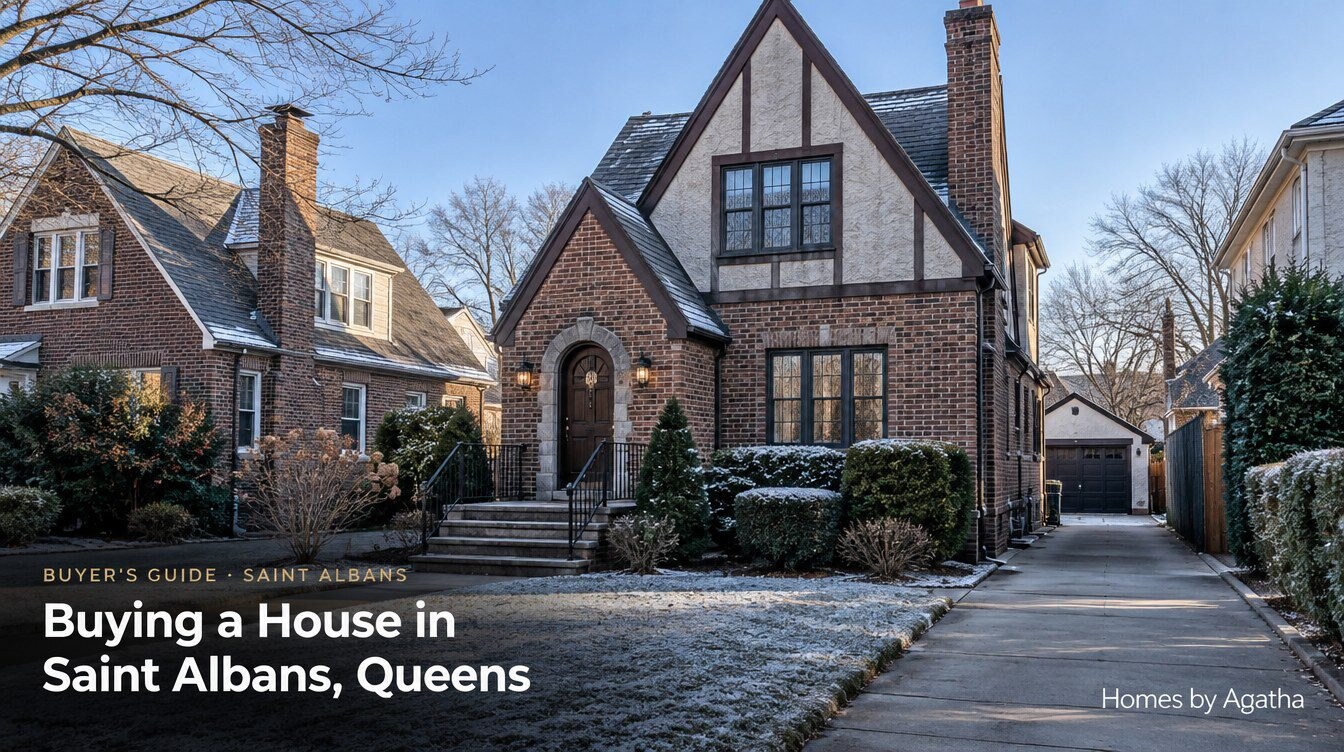
The most recognizable Saint Albans house is a detached brick, stucco or frame house with a steep front gable, often with half-timber detailing, an arched entry and leaded or multi-pane windows — the Tudor Revival look. Colonial Revival, Arts and Crafts and Cape Cod houses sit alongside them, many with a side driveway leading to a rear garage. Slate and clay-tile roofs, stucco and original windows look distinctive, but each needs a specialist when it fails, and each is entirely the owner’s cost.
Semi-detached houses and corridor buildings
Semi-detached houses share a party wall, a roof line and often a driveway that is split down the middle or governed by a recorded easement; the survey and title report, not the listing, show how it works. Along Linden, Merrick and Farmers Boulevards, mixed-use buildings with a store below and apartments above are a different purchase: the commercial space affects financing, insurance and tax class, so review leases, the Certificate of Occupancy and zoning first.
What “two-family” means on a listing
A house described as a two-family is not necessarily a legal two-family. The legal number of units comes from the Certificate of Occupancy (CO) or, for older houses without one, from NYC Department of Buildings records — not from the number of kitchens or entrances. If rental income is part of your plan, read the guide to buying a multi-family home in Queens before you make an offer.
Is the house inside the Addisleigh Park Historic District, and what changes if it is?
Check this first, because it changes how you plan every exterior project. The NYC Landmarks Preservation Commission (LPC) designated the Addisleigh Park Historic District on February 1, 2011. It covers more than 400 houses in the western part of Saint Albans, built mostly between the 1910s and the 1930s in Tudor Revival, Colonial Revival and Arts and Crafts styles.
The district lies in the western part of Saint Albans, but the official boundary follows specific lot lines, so a house across the street from the district may be outside it. The LPC publishes an official Addisleigh Park Historic District map that shows every included property.
What landmark designation means for an owner
In a New York City historic district, the LPC must review most exterior work before it starts: windows, doors, roofing, masonry or stucco, porches, fences, additions and street-visible equipment. Interior work that does not affect the exterior generally needs only NYC Department of Buildings permits where the code requires them.
The LPC issues three main kinds of approval. A Certificate of No Effect covers work that needs a Department of Buildings permit but does not change protected architectural features. A Permit for Minor Work covers changes to protected features that can be approved at staff level, such as many window replacements. A Certificate of Appropriateness covers larger changes, such as additions, and requires a public hearing. The LPC website explains current review steps and timing.
| Question | House inside Addisleigh Park Historic District | House elsewhere in Saint Albans |
|---|---|---|
| Who regulates exterior changes? | NYC Landmarks Preservation Commission, plus the Department of Buildings where a permit is needed | Department of Buildings and the zoning resolution only |
| Window, door or roof replacement | Generally needs an LPC permit; materials and design must suit the house | Building-code and permit rules only; style is the owner’s choice |
| Additions and dormers | Zoning limits plus LPC review of appearance, often a Certificate of Appropriateness | Zoning limits (floor area, height, yards) and Department of Buildings approval |
| Due diligence before contract | Search LPC permit history and any LPC violations; compare the house with its condition at designation | Search Department of Buildings permits and violations |
| Renovation budget | Allow for matching materials and design professionals familiar with LPC filings | Standard renovation budgeting |
| Timeline for exterior projects | Add time for LPC review before Department of Buildings permits | Department of Buildings timeline only |
How to check past exterior work before you sign
Ask the seller for copies of any LPC permits issued since 2011, and have your attorney check for open LPC violations or warning letters. An unapproved change made after designation can become the new owner’s issue to resolve, by legalizing the work or restoring the earlier condition; ask the LPC or a land-use attorney how that would apply to a specific house. None of this is a reason to avoid the district; it is a reason to price exterior projects with an extra approval step and, often, better materials.
Key Takeaways
- Saint Albans is a house market: mostly detached and semi-detached one- and two-family homes.
- The Addisleigh Park Historic District, designated by the LPC on February 1, 2011, covers more than 400 houses; exterior work there generally needs LPC approval.
- District boundaries follow individual lots, so check the LPC map for the exact address.
- A “two-family” listing is only a legal two-family if the CO or Department of Buildings records say so.
Not sure which rules apply to a house you like?
Send me the addresses on your list. I can help you sort out landmark status, house type and legal-use questions before you spend money on inspections.
What did the 2007 St. Albans/Hollis rezoning change for buyers?
It locked in low-density housing. On October 29, 2007, the New York City Council approved, with modifications, the Department of City Planning’s plan to rezone 317 blocks in St. Albans and Hollis, replacing older R2, R3-2, R4 and R6B districts with lower-density or contextual districts.
A contextual zoning district is one whose rules for height, yards and building form match the houses already on the block. The goal was to stop lot subdivisions and out-of-scale replacements of one- and two-family houses.
The districts you are most likely to see
- R3A — the largest new district, mapped on portions of about 190 blocks in several areas of St. Albans and Hollis. R3A allows only one- and two-family detached houses, with rules that keep new buildings in scale with existing ones.
- R2 — extended to all or parts of 25 blocks along Hollis Avenue, Farmers Boulevard and Murdock Avenue. R2 allows only one-family detached houses.
- Commercial overlays — the plan reduced the depth of commercial overlays from 150 feet to 100 feet on 31 block fronts along Linden Boulevard between 180th Street and Francis Lewis Boulevard, and on 29 block fronts along Farmers Boulevard, keeping stores on the corridors.
- Other districts — smaller areas received other districts, including R3X, R4A, R4B, R4-1, R5B, R5D and R6A; for example, R5D was mapped on block fronts along Linden and Farmers Boulevards. ZoLa shows the exact district for any lot.
Source: the NYC Department of City Planning St. Albans/Hollis rezoning document.
What zoning means for your plans
Zoning decides whether you can add a second unit, build a rear extension or convert a garage. On an R2 lot, a second dwelling unit is generally not permitted; on an R3A lot, a two-family house may be possible within floor-area, yard and lot-width rules. Rules have also changed citywide since 2007. The City of Yes for Housing Opportunity amendments adopted in December 2024 introduced rules for accessory dwelling units in many low-density districts, with limits in some areas; an architect can tell you how those rules apply to a specific lot, including any historic-district or flood-area limits. Before you pay for “expansion potential,” look up the lot on ZoLa, the NYC Department of City Planning zoning map, and have an architect read the rules for that lot.
Inside Addisleigh Park, zoning and landmark review stack: a dormer or extension must fit the zoning first, and then the LPC reviews how it looks.
Why is basement water the first inspection question in Saint Albans?
Because Southeast Queens has a documented groundwater problem that varies block by block and house by house. Ask about water history before you fall in love with a finished basement, and have the inspector look closely at foundation walls, floor drains and any sump pump.
For decades, a private utility, the Jamaica Water Supply Company, pumped groundwater from wells in southeast Queens. After that pumping stopped in 1996, when the City took over the water system, the water table across parts of the area rose, and many property owners have reported basement seepage and flooding since. The NYC Department of Environmental Protection and the NYC Department of Design and Construction have been building storm and sanitary sewer upgrades across southeast Queens; ask NYC DEP about planned or completed sewer work on the specific street.
Two different water problems can affect a Saint Albans basement. Groundwater rises from below through the slab or lower walls; stormwater arrives with heavy rain when sewers or yard drainage cannot keep up. The fixes differ, so find out which one a house has experienced.
What to look for and ask
- Physical evidence. White mineral deposits (efflorescence) on the walls, fresh paint only on the lower part of the walls, rusted appliance bases, warped paneling, a musty smell or a dehumidifier running constantly.
- Sump pumps. Ask how often the pump runs, whether it has a backup, and where it discharges. A pump that runs year-round tells you something different from one that runs after storms.
- Seller disclosure. Read the Property Condition Disclosure Statement (PCDS) closely. The New York form asks about flooding and water problems, and sellers of most one- to four-family houses must deliver it.
- Maps. Search the address on the FEMA Flood Map Service Center and on the NYC Stormwater Flood Maps. Saint Albans is inland, so coastal surge is rarely the issue; groundwater and heavy-rain flooding are the usual questions. Check each specific address rather than assuming a block is in or out of a mapped area.
A dry basement and a wet basement are different houses, even if the rooms upstairs are identical. If water history comes up during due diligence, your attorney can negotiate a credit, a price change or repairs before the contract is signed; after signing, your options shrink to what the contract allows.
Plan your inspection around the basement
I can help you line up the right questions and specialists so water history is checked early, while you still have room to negotiate.
What should an inspection cover in a pre-war Saint Albans house?
Hire a licensed New York home inspector and add specialists where needed. In Saint Albans, the items that most often change a deal are basement water, heating and any oil tank, the electrical service, the sewer line, and specialty roofs and stucco.
Heating, oil tanks and wiring
Many older Queens houses were built with oil heat. Ask where the tank is and whether it was tested; if the house converted to gas, ask whether the old tank was removed or abandoned in place, with paperwork. A tank sweep costs little compared with removing a leaking buried tank. Original wiring in a 1920s or 1930s house may also be undersized for central air, a heat pump or an EV charger; upgrades need a licensed electrician and a permit.
The sewer line and the sidewalk
In New York City, the owner is responsible for the sewer service line from the house to the street connection; a sewer camera inspection shows roots, cracks and sags in older pipe. Owners are also generally responsible for the sidewalk, so ask your attorney to check for open sidewalk violations.
Roofs, stucco, garages and lead paint
Ask the inspector to note slipped slates, cracked stucco, failing chimney flashing and rot in decorative timber; inside Addisleigh Park, replacement materials generally need LPC approval. Check rear garages for failing slabs and for unpermitted conversions. For houses built before 1978, federal law requires sellers to disclose known lead-based paint hazards and give buyers an opportunity to test.
| Due-diligence item | Where to check | Why it matters in Saint Albans |
|---|---|---|
| Historic-district status | LPC Addisleigh Park map; LPC permit and violation history | Exterior work inside the district needs LPC approval |
| Zoning district | NYC DCP ZoLa | R2 and R3A rules decide whether a second unit or an addition is possible |
| Certificate of Occupancy and legal units | NYC Department of Buildings records | Confirms whether a “two-family” is legal; affects financing and rental plans |
| Open permits and violations | Department of Buildings and OATH/ECB records, through your attorney | Finished basements, attics and garage conversions are common in older houses |
| Basement water | Inspection, seller’s PCDS, sump records, insurance claims | Southeast Queens groundwater history varies block by block |
| Flood maps | FEMA Flood Map Service Center; NYC Stormwater Flood Maps | Lender flood-insurance requirements and heavy-rain exposure |
| Survey and driveway | Survey; title report | Shared driveways and easements are common on semi-detached lots |
Older houses and the Certificate of Occupancy
New York City buildings constructed before 1938 were generally not required to have a Certificate of Occupancy unless later altered in a way that required one. For many older Saint Albans houses, legal use is shown through other Department of Buildings records or a Letter of No Objection. The question to keep asking: does the paper match the house?
What does a Saint Albans purchase cost, upfront and month to month?
Budget in three layers: the down payment, closing costs paid at the closing table, and a cash reserve you keep afterward. For a financed one- or two-family house in New York City, the largest buyer-side closing items are usually the NYC mortgage recording tax, title insurance, attorney fees and lender fees.
Which tax items apply depends on your price, loan amount and property type. For a line-by-line explanation, see the Queens closing costs guide.
| Cost item | How it applies to a Saint Albans house purchase | Who sets it |
|---|---|---|
| NYC mortgage recording tax | Roughly 1.8% of the loan amount for loans under $500,000 and 1.925% for loans of $500,000 and above on one- to three-family homes and condos; applies only if you finance | NYC Department of Finance / New York State |
| NYS “mansion tax” | 1% of the price on residential purchases of $1 million or more, paid by the buyer; graduated above $2 million in New York City | NYS Department of Taxation and Finance |
| Title insurance and title search | Owner’s and lender’s policies on a fee-simple house | Title insurer rates |
| Buyer’s attorney fee | Required in practice for every New York purchase; quoted by the attorney | Negotiated with your attorney |
| Lender fees, appraisal, credit report | Financed purchases; listed on your Loan Estimate | Your lender |
| Escrow deposits and prepaid items | Initial reserves for property tax and homeowner’s insurance, plus prorated interest | Lender requirements and closing date |
| Inspections and specialists | Home inspection, sewer camera, tank sweep, roof or masonry specialist, possibly a waterproofing assessment | Independent professionals |
Confirm current rates with the NYS Department of Taxation and Finance and NYC Department of Finance before closing.
Two transfer taxes are customarily paid by the seller, not the buyer: the NYS real estate transfer tax and the NYC Real Property Transfer Tax. Contracts can shift costs, so read the contract with your attorney instead of assuming.
The monthly budget for a house
A house has no common charges, so the monthly figure comes from separate bills: mortgage, NYC property tax, homeowner’s insurance, water and sewer charges from the NYC Department of Environmental Protection, heating fuel, electricity and a repair reserve. One- to three-family houses are in property tax Class 1, administered by the NYC Department of Finance; pull the actual bill and exemptions for the specific house.
Two Saint Albans lines deserve extra room: water management (a busy sump pump, possible waterproofing) and exterior upkeep on an older detached house, including LPC-standard materials inside Addisleigh Park.
Turn the cost categories into your numbers
We can map the upfront and monthly costs for the houses you are considering, so your lender, attorney and inspector start from the same budget.
How should you plan financing for a Saint Albans house?
Get a written pre-approval from an NMLS-registered mortgage loan originator before you tour seriously, and ask how the lender handles older houses and two-family income. A pre-approval is a lender’s conditional commitment after reviewing income, assets and credit; a pre-qualification is only an estimate.
Appraisals on distinctive houses
Saint Albans houses vary in size, lot shape, condition and style, so an appraiser may find fewer close comparables than in a neighborhood of identical row houses. Ideally, district houses are compared with district houses and detached R3A houses with similar detached houses. If an appraisal comes in below the contract price, the gap must be covered by cash, renegotiation or, under some contracts, cancellation.
Rental income and houses that need work
Lenders generally count rental income only from a legal unit, so an undocumented basement apartment usually will not help you qualify. Some loan programs also have property-condition standards that can require repairs before closing. If a house needs significant work, ask about renovation loans early, and remember that exterior work inside Addisleigh Park needs LPC approval before it starts. First-time buyers can review the first-time home buyer guide for Queens for the overall sequence.
Key Takeaways
- Groundwater and stormwater history varies house by house in Saint Albans; check the basement before you commit.
- The 2007 rezoning mapped R3A and R2 across most residential blocks, which limits second units and large additions.
- Buyers pay the NYC mortgage recording tax on financed purchases; sellers customarily pay the NYS and NYC transfer taxes.
- Lenders count rent only from legal units, so confirm the CO before planning around a second apartment.
How do you get to work from Saint Albans?
Most transit commutes from Saint Albans use the Long Island Rail Road or a bus to downtown Jamaica; the neighborhood has no subway station. The LIRR St. Albans station, at Linden Boulevard and Montauk Place, is served by West Hempstead Branch trains that run through Jamaica, where riders can change for other LIRR trains, the subway or the AirTrain to JFK Airport.
Convenience depends on the block: a house a few minutes’ walk from the station is a different commute from one near the Cambria Heights or Hollis edges. Accessibility work completed at the station in November 2025 added an ADA-compliant elevator between the street and the platform. Ride the trip at your real travel time before you offer.
| Commute option | How it works from Saint Albans | What to test before you buy |
|---|---|---|
| LIRR from St. Albans station | West Hempstead Branch trains to Jamaica, where riders can change for trains to Manhattan and Brooklyn terminals; check the current LIRR timetable or the TrainTime app for frequency and any through trains | Walk time to the station; train frequency at your hours; weekend service |
| LIRR from Hollis or Jamaica | Northern blocks may be closer to the Hollis station; Jamaica station offers the widest choice of trains | Bus or drive time to each station; parking or drop-off options |
| Bus to the subway | Local buses on Linden, Merrick and Farmers Boulevards to downtown Jamaica for the E, J, Z or F trains | Walk to the nearest stop; rush-hour ride time to Jamaica |
| Express bus | Check the current MTA express bus map for any express stops near the house | Nearest stop, schedule and fare |
| Car | Linden Boulevard runs east–west; Merrick and Farmers Boulevards lead toward the Belt Parkway | Driveway or garage; peak-hour drive time |
If you are comparing commutes across southeast Queens, the buyer pages for buying in Hollis, near the LIRR Hollis station, and buying in Cambria Heights, just east of Saint Albans, cover neighboring house markets with different transit trade-offs. Buyers who want to be closer to the subway can also compare buying in Jamaica.
Parks and everyday places
Roy Wilkins Park, more than 50 acres between Merrick and Baisley Boulevards, has ball fields, a playground, a pond and the Roy Wilkins Recreation Center with an indoor pool. It occupies part of the former St. Albans Naval Hospital site, next to the St. Albans VA Community Living Center. Walk from the house to the places you will use every week before you decide.
Match the house to your daily route
Tell me where you travel each week and I will help you focus on the Saint Albans blocks that fit your commute, whether by LIRR, bus or car.
How do offers, contracts and buyer representation work in New York?
New York is an attorney state for residential sales: after a seller accepts your offer, the buyer’s and seller’s attorneys negotiate and prepare the contract of sale, and the deal is not binding until both sides sign it. An accepted offer is not a signed contract.
From accepted offer to signed contract
After acceptance, the seller’s attorney sends a draft contract; your attorney reviews it, orders the title search, examines building records and negotiates riders, such as a mortgage contingency. Your inspection happens in this window, because once you sign and deliver the deposit — often around 10% of the price, though the amount is negotiated, held in escrow — walking away is limited to what the contract allows.
Riders that fit a Saint Albans house
- Legal use. Address any gap between the house as marketed and as recorded, such as an undocumented basement unit.
- Landmark compliance. Inside Addisleigh Park, cover open LPC violations or unapproved exterior work.
- Water and tenants. Negotiate representations about sump pumps, oil tanks and known water entry, and state whether a legal second unit is delivered vacant; ask your attorney how New York tenant laws, including the 2024 Good Cause Eviction law, apply to the specific building.
Writing an offer a seller can accept
A strong offer is clear, not just high: price, financing, pre-approval strength, contingencies and closing date all count. Base the price on recent sales of truly comparable houses — detached versus semi-detached, inside versus outside the historic district, legal one-family versus legal two-family, similar condition.
Working with a buyer’s agent under the post-2024 rules
Under the rules in effect in 2026 following the 2024 NAR settlement, you sign a written buyer agreement before touring homes with an agent, and it states how the agent is paid. Buyer-agent compensation is negotiable, is not set by law and is not automatically paid by the seller; a seller may agree to contribute as part of the negotiation. You also receive the NYS Disclosure Form for Buyer and Seller at the first substantive contact, explaining whom the agent represents. For more detail, read working with a buyer’s agent in New York.
Have your offer strategy ready early
Let’s decide in advance how you will handle price, financing, landmark questions and inspection findings, so you can act calmly when the right house appears.
What is the timeline, and where do Saint Albans buyers lose time?
A financed house purchase in Saint Albans commonly takes about two to three months from accepted offer to closing, depending on the lender, title work and building records. Most avoidable delays come from paperwork — permits, violations, landmark questions or legal-use gaps.
| Stage | What happens | Common range (varies) |
|---|---|---|
| Preparation | Pre-approval, buyer agreement, budget, commute testing | 1–4 weeks |
| Search and offer | Tours, landmark and zoning checks, comparable-sales review, offer accepted | Varies with inventory and criteria |
| Due diligence and contract | Inspection with basement focus, sewer camera, tank sweep, DOB and LPC records, title search, contract negotiation, signing with deposit | Often 1–3 weeks |
| Mortgage commitment | Appraisal, underwriting, lender conditions | Often 3–6 weeks after contract |
| Clear to close | Title cleared, homeowner’s insurance bound, closing scheduled | Often 1–2 weeks |
| Walk-through and closing | Confirm condition and agreed repairs or credits; sign; pay closing costs; receive keys | Closing day |
Mistakes that cost Saint Albans buyers time or money
- Viewing the basement in dry weather only. Ask about water history and look for evidence; a dry day proves little.
- Assuming a house is outside the historic district. The Addisleigh Park boundary follows individual lots; check the LPC map for the exact address.
- Paying for an illegal unit. Valuing a basement apartment as income before confirming the CO and DOB records.
- Buying “expansion potential” without a zoning check. R2 and R3A rules can rule out the second unit or addition you had in mind.
- Testing the commute on a weekend. LIRR frequency and bus times at rush hour differ from off-peak trips.
- Treating an accepted offer as a done deal. Until the contract is signed, the house can still go to another buyer.
Saint Albans buyer checklist
Use this list in order, from your first conversation to closing day.
- Get a written pre-approval and ask how the lender treats older houses and two-family income.
- Sign a written buyer agreement and review the NYS Disclosure Form for Buyer and Seller.
- Decide on house type: detached or semi-detached, one- or legal two-family, inside or outside Addisleigh Park.
- Test your commute from the blocks you like at your real travel time.
- For each serious house, check the LPC district map and the zoning on ZoLa.
- Once your offer is accepted, schedule the inspection, sewer camera and tank sweep.
- Ask direct questions about basement water and sump pumps, and read the PCDS closely.
- Have your attorney review DOB and LPC records, the survey and the title report.
- Sign the contract and deliver the deposit only after due diligence is complete.
- Close with a reserve still in the bank.
If Saint Albans is one of several southeast Queens neighborhoods on your list, compare it with buying in Springfield Gardens to the south. If you already own a house here and need to sell before you buy, the companion page on how I help owners sell a home in Saint Albans covers the selling side.
Ready to begin your Saint Albans search?
A short conversation now can save weeks later. We can turn your budget, house type, landmark preferences and commute into a focused plan.
Frequently asked questions about buying a house in Saint Albans Queens
Is St. Albans the same neighborhood as Saint Albans, Queens?
Yes. St. Albans and Saint Albans are two spellings of the same neighborhood in southeast Queens, New York City. The LIRR station, many street signs and most maps use “St. Albans.” Most of the neighborhood uses ZIP code 11412, but confirm the ZIP code and borough records for any specific address before relying on them.
What kinds of homes are common in Saint Albans, Queens?
Saint Albans is mostly detached and semi-detached one- and two-family houses, many built before World War II. Tudor Revival, Colonial Revival, Arts and Crafts and Cape Cod styles are common, often with side driveways and rear garages. Mixed-use buildings with stores and apartments line parts of Linden, Merrick and Farmers Boulevards.
What is the Addisleigh Park Historic District?
The Addisleigh Park Historic District is a group of more than 400 houses in western Saint Albans, designated by the NYC Landmarks Preservation Commission on February 1, 2011. The houses were built mostly between the 1910s and 1930s. Exterior changes, such as new windows, roofing or additions, generally require LPC approval before work starts.
Can I replace the windows on a house in Addisleigh Park?
Usually yes, but you generally need an LPC permit first. The Landmarks Preservation Commission reviews window replacements in historic districts to make sure the design and materials suit the house. Many window projects are approved at staff level as minor work. Ask for past permits before buying, and budget for compliant materials.
Do Saint Albans houses have basement water problems?
Some do. Southeast Queens has a documented history of high groundwater after local well pumping stopped in the 1990s, plus heavy-rain flooding in places. Conditions vary house by house, so ask about water history, read the seller’s disclosure, check sump pumps and look for staining or efflorescence during inspection.
Is there a subway station in Saint Albans?
No. Saint Albans has no subway station. Riders use the LIRR St. Albans station on Linden Boulevard, served by the West Hempstead Branch, or take a local bus to downtown Jamaica for the E, J, Z or F trains and more LIRR service. Confirm current bus routes and train schedules with the MTA.
How was Saint Albans rezoned in 2007?
On October 29, 2007, the City Council approved the St. Albans/Hollis rezoning of 317 blocks. Most residential blocks became R3A, which allows one- and two-family detached houses, and some became R2, which allows one-family detached houses. Commercial overlays along Linden and Farmers Boulevards were made shallower.
What closing costs does a buyer pay in Saint Albans?
Buyers of a financed Saint Albans house typically pay the NYC mortgage recording tax, title insurance, attorney fees, lender fees and escrow deposits. Purchases of $1 million or more also carry the NYS mansion tax, paid by the buyer. The NYS transfer tax and NYC Real Property Transfer Tax are customarily seller costs.
How do I confirm that a Saint Albans house is a legal two-family?
Check the Certificate of Occupancy and NYC Department of Buildings records rather than the listing. Houses built before 1938 may have no CO, so your attorney may rely on other DOB records. Also check the zoning: R2 lots allow only one-family houses. Lenders usually count rent only from legal units.
Who pays the buyer’s agent when buying in Saint Albans?
Buyer-agent compensation is negotiable and not set by law. Under the rules in effect in 2026, you sign a written buyer agreement before touring that states how your agent is paid. Sellers are not automatically required to pay it, although a seller may agree to contribute as part of the negotiated deal.
Summary and your next step
Buying a house in Saint Albans Queens comes down to identifying the rules that govern one specific house. Inside Addisleigh Park, the LPC reviews exterior work; on most other blocks, the 2007 R3A and R2 zoning sets what can be built; everywhere, the basement and the paper trail deserve the closest look. Buyers who settle those questions before signing, and who pick a block that fits a real LIRR or bus commute, can negotiate from facts rather than hopes. When you are ready to move from research to touring, the guide to buying your home in Saint Albans with Agatha explains the next steps.
This article is for general informational purposes only and reflects conditions that may change. It is not legal, tax, or financial advice, an appraisal, or a guarantee of price or outcome; consult a licensed New York attorney, a CPA, and an NMLS-registered mortgage loan originator as appropriate. A CMA is an opinion of value, not an appraisal. Real estate brokerage services are offered by Agatha Lubas, Licensed Associate Real Estate Broker, NY License #10301213345, Keller Williams Realty Liberty, 96-10 101st Avenue, Ozone Park, NY 11416. The NYS Disclosure Form for Buyer and Seller, the NYS Housing and Anti-Discrimination Disclosure / Fair Housing Notice, and the brokerage’s Standard Operating Procedures are available on request. Equal Housing Opportunity.

Agatha Lubas helps buyers, sellers and investors across Queens, Brooklyn, Nassau County and Suffolk County, from the first property search through due diligence and the New York attorney-based closing process. She works in English and Polish so every client can communicate in the language that feels most comfortable.
Work with Agatha