

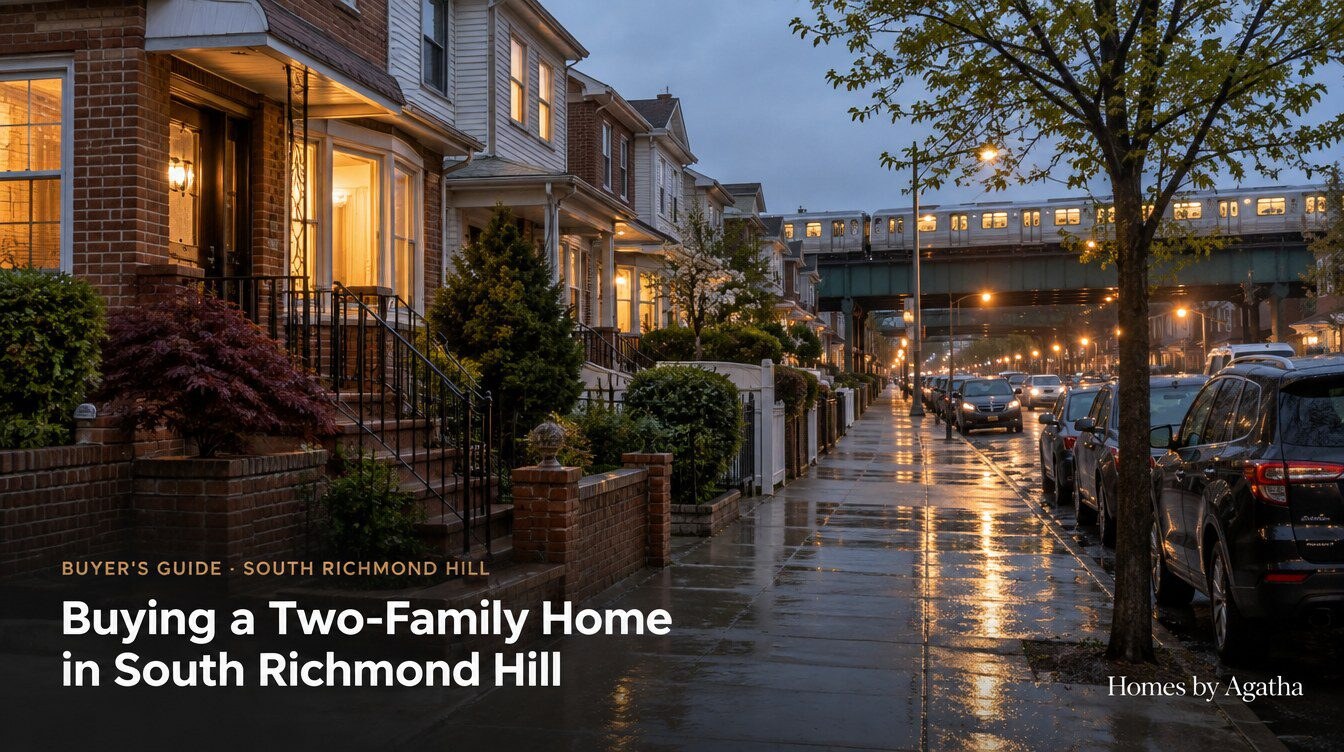
SOUTH RICHMOND HILL REAL ESTATE GUIDE
Buying a Two-Family Home in South Richmond Hill, Queens: Legal Units, Basements and the A Train
Quick Answer
Buying a two-family home in South Richmond Hill, Queens starts with proof: confirm the legal unit count on the Certificate of Occupancy, treat any basement apartment as a risk until DOB records approve it, get a pre-approval written for a multi-unit property, budget NYC closing taxes, and test the walk to the A train on Liberty Avenue.
This guide is written for people who are seriously considering buying a two-family home in South Richmond Hill and want to understand the building before they negotiate the price. South Richmond Hill, Queens, the part of the Richmond Hill area south of Atlantic Avenue, is made up largely of small residential buildings: attached and detached two-family houses, three-family and larger multi-family buildings, one-family houses and mixed-use buildings on the commercial streets.
A two-family house is a home, a rental property and a set of public records at once. The price you can justify, the loan you can get and the risks you inherit depend on what the building legally is, not on what the listing says.
As a Licensed Associate Real Estate Broker based in Ozone Park, next door to South Richmond Hill, I help buyers across Queens evaluate both the property and the transaction, in English or Polish, whichever is more comfortable. Below: how the housing stock is organized, how to verify legal units and below-grade space with the NYC Department of Buildings, how lenders treat rental income, what New York City closing costs look like, and how the A train and the Van Wyck Expressway affect block-by-block choices. When you are ready to tour, the companion page on how to buy your home in South Richmond Hill with a local buyer’s agent explains how we would work together.
South Richmond Hill at a glance
| Topic | What to know |
|---|---|
| Area | Southern Queens, south of Atlantic Avenue, generally described as reaching the Van Wyck Expressway on the east, with Ozone Park to the west and South Ozone Park to the south; edges are informal, so confirm how a specific address is described on NYC Department of City Planning community district maps |
| Borough / County | Queens (Queens County), New York City |
| ZIP code | 11419 for most of the area; Richmond Hill to the north also uses 11418. Confirm the ZIP code for a specific address with USPS |
| Community districts | Split between Queens Community Districts 9 and 10; District 10’s northern line follows Liberty Avenue / 103rd Avenue, as described by Queens Community Boards 9 and 10 |
| Subway | A train, Lefferts Blvd branch: 104 St, 111 St and Ozone Park–Lefferts Blvd, all elevated on Liberty Avenue; J and Z trains on Jamaica Avenue, north of Atlantic Avenue |
| Rail and airport links | Long Island Rail Road and AirTrain JFK at Jamaica station to the east |
| Roads | Van Wyck Expressway (I-678), Atlantic Avenue, Liberty Avenue, Lefferts Boulevard; Conduit Avenue and the Belt Parkway to the south |
| Parks | Phil “Scooter” Rizzuto Park at Atlantic Avenue and 125th Street (opened in 1938 as Smokey Oval Park) |
| Commercial corridors | Liberty Avenue under the elevated A train, Lefferts Boulevard, stretches of 101st Avenue and Atlantic Avenue |
| Typical property types | Attached, semi-attached and detached two-family houses; three-family and larger buildings; one-family houses; mixed-use buildings; few co-ops or condos |
What kind of houses will you find in South Richmond Hill, Queens?
Most homes for sale in South Richmond Hill, Queens are small residential buildings: attached and detached two-family houses, three-family and larger multi-family buildings, one-family houses, and mixed-use buildings along Liberty Avenue and Lefferts Boulevard. Co-op and condo apartments are a small part of what buyers usually see.
The building type decides who answers your questions. In a South Richmond Hill two-family house, no managing agent hands you a building file; you, your attorney, your inspector and your agent build it from public records and what you see inside.
Detached two-family houses
A detached two-family house stands on its own lot with open space on every side, even if that space is only a narrow side yard or driveway. The roof, walls and drainage belong to one owner, which means more control and more responsibility. Compare any side or rear addition with the permit history.
Many detached houses here have a side driveway to a rear garage or parking pad. Whether it is entirely on your lot, shared under a recorded easement or simply used by habit is a question for the survey and title report.
Attached and semi-attached two-family houses
Attached houses share both side walls with neighbors; semi-attached houses share one. For a buyer, a shared wall raises three practical issues: roofs and parapets connect to the neighbors’, water can travel between houses, and work on a party wall may require cooperation from the adjoining owner.
Three-family, multi-family and mixed-use buildings
A three-family house is legally approved for three separate dwelling units, each with its own kitchen and bathroom. The jump from three to four units changes more than the rent roll: it can change the property-tax class, the closing-tax rates and how lenders treat the loan. Along Liberty Avenue, under the elevated A train, and on parts of Lefferts Boulevard, mixed-use buildings combine ground-floor stores with apartments above; depending on the commercial share, they may need commercial underwriting and a larger down payment.
Condos and co-ops
A condo unit is real property with a deed, common charges and its own property tax. A co-op apartment is shares plus a proprietary lease, with maintenance that typically includes a share of building taxes and a board that sets its own financing rules, which vary from building to building. With little of either here, apartment buyers often widen the search.
| Property type | Owner costs beyond the mortgage | First document to check | Typical financing path |
|---|---|---|---|
| Detached two-family house | Tax, insurance, water/sewer, all exterior and system repairs | CO or Letter of No Objection showing two units; survey for driveway and additions | Residential 1–4 unit mortgage; second-unit rent may be partly counted |
| Attached or semi-attached two-family | Same, plus coordination on shared walls and roofs | CO or Letter of No Objection; recorded driveway easements | Residential 1–4 unit mortgage |
| Three-family house | Repairs and utilities for three households; landlord coverage | CO showing three units; HPD registration status | Residential 1–4 unit mortgage; reserves often required |
| Four or more units / mixed-use | Higher insurance, commercial lease obligations, vacancy | CO covering every use; commercial leases; tax class | Residential (four units) or commercial lending |
| Condo or co-op unit (limited supply) | Common charges plus tax (condo); maintenance (co-op) | Offering plan and budget; board rules and financials | Mortgage (condo); share loan under board rules (co-op) |
Detached, attached or three-family: which fits your plan?
Tell me how you want to live, whether you plan to rent a unit and how you plan to pay. I will help you focus on the South Richmond Hill buildings that actually match.
What should you check before buying a two-family home in South Richmond Hill?
Before buying a two-family home in South Richmond Hill, confirm that the building is legally a two-family house. Check the Certificate of Occupancy (CO) or, for older buildings, a Letter of No Objection in NYC Department of Buildings records, then compare that legal count with the kitchens, entrances, doorbells and electric meters you see at the showing.
The Certificate of Occupancy defines the building
A Certificate of Occupancy is the NYC Department of Buildings document that states a building’s legal use and occupancy, including the number of dwelling units and the permitted use of each floor. If the CO says two families and the house has three kitchens, at least one apartment is not legal, however long it has been rented. CO records are searchable in the DOB’s public systems (BIS and DOB NOW); check before you offer.
When an older house has no CO
The NYC Department of Buildings generally did not require Certificates of Occupancy for buildings constructed before January 1, 1938, unless they were later altered in a way that changed their use, exits or occupancy. For those buildings, the DOB can issue a Letter of No Objection (LNO) confirming that an existing use is acceptable, as explained on its Certificate of Occupancy page. Where neither document exists, your attorney will look at historical building records and the tax classification.
Newer and altered houses
Two-family houses built or substantially rebuilt after 1938 should have a CO on file. When a house has been enlarged, with a rear extension, a raised roof or a converted garage, each change should have a permit and a sign-off. A house can hold a valid two-family CO and still carry open permits or unpermitted work that complicates the closing.
Cross-check the public records
| Record | Where to find it | Red flag for a buyer |
|---|---|---|
| Certificate of Occupancy / Letter of No Objection | NYC Department of Buildings (BIS, DOB NOW) | More kitchens, doorbells or meters than legal units |
| DOB permits, complaints and violations | NYC Department of Buildings online records | Open “work without a permit” or illegal-conversion violations; permits never signed off |
| OATH / ECB penalties | NYC Office of Administrative Trials and Hearings | Unpaid penalties that must be resolved before closing |
| Tax class and building class | NYC Department of Finance | A building class that does not match the unit count being marketed (Class 1 covers most residential properties of up to three units) |
| Deeds, mortgages and easements | ACRIS (NYC Department of Finance) | Unreleased mortgages; no recorded easement for a shared driveway |
| HPD registration and violations | NYC Department of Housing Preservation and Development | Open HPD violations in a tenant-occupied unit; a one- or two-family house must register with HPD when neither the owner nor the owner’s immediate family lives there |
Key Takeaways
- In South Richmond Hill, the CO or Letter of No Objection, not the listing, defines how many legal units a house has.
- Pre-1938 houses may lawfully have no CO; ask which DOB records establish their use.
- A legal two-family can still carry unpermitted additions or open permits that delay closing.
- Check DOB, OATH, Department of Finance, ACRIS and HPD records before you sign a contract.
How do basements and cellars affect a South Richmond Hill purchase?
Below-grade space is the most common hidden risk in a South Richmond Hill multi-unit house. Rent from a basement or cellar apartment counts only if NYC Department of Buildings records approve it as a dwelling unit; otherwise it is a liability you inherit at closing, not income.
Basement vs. cellar
Under New York City building rules, a basement is a story partly below curb level with at least half of its height above curb level; a cellar has more than half of its height below curb level. A cellar generally cannot be used as a separate apartment. A basement can be habitable only if it meets strict requirements for ceiling height, light, ventilation and exits. A finished room with a bathroom is not a legal apartment.
Why the city treats below-grade units seriously
In September 2021, the remnants of Hurricane Ida flooded basement and cellar spaces across Queens, and several residents of below-grade apartments in the borough died. New York State’s 2024 budget then authorized a pilot program, which New York City created through Local Law 126 of 2024, to help legalize certain existing basement and cellar units, but only in listed community districts. In Queens, only Community District 2 is included, units must have existed before April 20, 2024, and properties in flood-prone areas are excluded. South Richmond Hill lies in Community Districts 9 and 10, so the pilot does not make an unpermitted unit here legal today.
An illegal below-grade unit creates four problems for a buyer: lenders will not count its rent, the city can issue violations and vacate orders, insurance may limit related claims, and the unit may lack the exits and ventilation that protect anyone living there.
Heavy-rain flooding and the sewer connection
South Richmond Hill is an inland neighborhood, not a coastal one, but intense rainfall can flood low-lying streets and below-grade space anywhere in Queens. Check the FEMA Flood Insurance Rate Map and the NYC Stormwater Flood Maps, which model heavy-rain flooding rather than storm surge, for the exact address; do not assume a block is in or out of a flood zone because a nearby house is. Lenders generally require flood insurance in a Special Flood Hazard Area; elsewhere, coverage is optional but available.
Ask whether the basement has taken on water and whether there is a backwater valve, a device that helps stop sewage backing up into the building. The owner is generally responsible for the house’s sewer connection, so a sewer camera inspection is worth ordering.
Is that basement a unit or a liability?
Before you count any below-grade rent, let’s pull the building’s DOB records together and list the questions your attorney and inspector should answer.
How do you finance a two-family house in South Richmond Hill?
Most buyers finance a South Richmond Hill two-family house with a residential mortgage for one-to-four-unit properties, often as an owner-occupant living in one unit. Lenders may count part of the documented or appraised rent from a legal second unit, but never from an illegal one.
Owner-occupied vs. investor purchases
Residential loan programs treat buildings with one to four units as residential property. When you live in one unit, government-backed and conventional programs may allow lower down payments than an investor loan. The appraiser estimates market rent for the other unit, and the lender’s program rules decide how much of it can offset your housing payment. Rental-income percentages, reserve requirements and down-payment minimums differ by program and change over time, so get the current figures in writing from an NMLS-registered loan originator.
A pre-approval written for the right building
Pre-approval is a lender’s conditional commitment based on verified income, assets and credit. In South Richmond Hill, where so many listings are two-family or larger, the pre-approval should name the property type. Ask your loan originator in writing whether it assumes rental income, how much, and what happens if the appraisal or title report finds fewer legal units than advertised. For first purchases, our first-time home buyer guide for Queens lists the documents lenders usually request.
Buying with tenants in place
Many two-family and three-family houses here are sold with units occupied. Existing leases generally continue after a sale, so the new owner takes over the landlord’s obligations, including security deposits. The contract should require every lease, a rent roll and written confirmation of rent and deposit amounts.
Rent stabilization generally applies to buildings with six or more units built before 1974, so most two-family houses fall outside it; New York’s 2024 Good Cause Eviction law has exemptions that depend on factors such as owner occupancy and how many units an owner holds. Whether either applies depends on the specific tenancy, so confirm it with a New York attorney or NYS Homes and Community Renewal before you sign. If you need a unit vacant at closing, negotiate it and write it into the contract.
Owning a rented unit also brings landlord duties, from heat and hot water to detectors and lead-paint rules. Our guide to buying a multi-family home in Queens covers owner-occupied rentals borough-wide.
What closing costs and ongoing costs should you budget for?
Budget for the down payment, the buyer’s New York City closing costs (mortgage recording tax, title insurance, attorney and lender fees, escrow deposits) and ongoing costs for the whole building. A two-family house means two households’ worth of water, heating and repairs.
Taxes a South Richmond Hill buyer may pay at closing
Because South Richmond Hill is in New York City, city and state transaction taxes both apply. Under the rates published by the NYC Department of Finance and New York State, the mortgage recording tax on one-to-three-family homes and condos is roughly 1.8% of the loan amount for loans under $500,000 and 1.925% for loans of $500,000 and above. Co-op loans are share loans and are not subject to mortgage recording tax. Four-unit and mixed-use buildings fall outside these one-to-three-family brackets: the NYC Department of Finance applies its higher “all other” transfer-tax schedule (1.425% at $500,000 or less, 2.625% above), and the mortgage recording tax can differ as well, so ask your attorney to calculate both for the specific building.
The New York State “mansion tax” is 1% of the price on residential purchases of $1 million or more and is paid by the buyer; within New York City, the rate is graduated above $2 million. The NYS real estate transfer tax ($2 for each $500 of consideration) and the NYC Real Property Transfer Tax (1% at $500,000 or less, 1.425% above $500,000 for one-to-three-family homes) are customarily paid by the seller, though contract terms can shift costs. Confirm current rates with the NYS Department of Taxation and Finance and NYC Department of Finance before closing.
Upfront vs. ongoing costs
| Cost | Upfront or ongoing | How it applies to a two-family purchase here |
|---|---|---|
| Contract deposit | Upfront | Usually held in escrow by the seller’s attorney; credited at closing |
| Mortgage recording tax | Upfront | Based on loan amount and building type |
| Mansion tax | Upfront | Only when the price is $1 million or more |
| Title insurance and municipal searches | Upfront | Searches surface open violations and permits |
| Attorney, lender fees and appraisal | Upfront | Two-family appraisals usually include a market-rent analysis |
| Property tax | Ongoing | NYC Department of Finance; Class 1 for most one-to-three-family homes |
| Water and sewer | Ongoing | Billed to the building by NYC DEP; the owner usually pays for both units |
| Insurance | Ongoing | Coverage for an owner-occupied building with a rented unit; flood coverage is separate |
| Repair and vacancy reserve | Ongoing | Roof, boiler, plumbing and wiring serve both units; plan for gaps between tenants |
For a line-by-line look at buyer and seller costs, read Queens closing costs explained, and ask your attorney and lender for a written estimate before you sign.
The legalization line in your budget
If the records show an unpermitted unit, open permit or violation, fixing it can require an architect, an expediter and contractors. Negotiate it before contract, by price, a seller repair obligation or walking away; handling it after closing means paying twice.
Key Takeaways
- Buyers here typically pay the NYC mortgage recording tax and, at $1 million or more, the NYS mansion tax.
- The unit count can change the tax class and closing-tax rates, so confirm it before comparing listings.
- Budget for the whole building: water and sewer, insurance and repairs for every unit.
- Price any legalization or violation cleanup into the deal before you sign.
Want a realistic all-in budget before you shop?
We can map your down payment, closing costs and owner expenses for a two-family house, then list the questions to take back to your lender.
How does the A train shape a commute from South Richmond Hill?
The A train’s Lefferts Blvd branch is South Richmond Hill’s main subway link, with three elevated stations on Liberty Avenue: 104 St, 111 St and the terminal at Ozone Park–Lefferts Blvd. The J and Z trains run along Jamaica Avenue to the north, beyond Atlantic Avenue, and can be an alternative for blocks on that side.
The Lefferts Blvd branch stations
The Lefferts branch splits from the A train’s Rockaway lines at Rockaway Blvd station, west of the neighborhood, and runs east above Liberty Avenue. 104 St sits toward the Ozone Park side, 111 St serves the middle of the corridor, and Ozone Park–Lefferts Blvd ends the line at Lefferts Boulevard. If step-free access matters to you, check the MTA’s accessible-stations list and current elevator status for each station before relying on it. From the branch, the A runs west through Brooklyn into Lower Manhattan and up Eighth Avenue. Not every A train serves Lefferts Blvd: A trains run to Far Rockaway at all times, while from about 6 a.m. to about midnight additional A trains run to Ozone Park–Lefferts Blvd, and late at night the branch is served by a shuttle to Euclid Av. Weekend and track-work changes are common, so check the MTA’s current A train timetable.
Living near the elevated structure
Homes a short walk from Liberty Avenue gain commuting time; buildings facing the structure hear and see the trains. Visit at rush hour as well as on a weekend, and compare a house on Liberty Avenue with one a few blocks away.
J and Z trains, buses, the LIRR and the airport
For blocks near Atlantic Avenue, the J and Z trains on Jamaica Avenue can be worth comparing for trips toward Brooklyn and Lower Manhattan; measure the walk from the specific house to the nearest J station at the hour you would travel. Local buses fill the gaps between stations; route numbers and stops change, so check the current MTA bus map for the routes nearest a specific house. Jamaica station, east of the Van Wyck Expressway, is a Long Island Rail Road hub and the transfer point for AirTrain JFK.
The Van Wyck Expressway (I-678) runs along the eastern side and connects north toward the Grand Central Parkway and Long Island Expressway and south toward JFK International Airport. Because JFK is close, aircraft noise varies by block and runway use; check the specific house at different times of day.
How is South Richmond Hill different from Richmond Hill and nearby neighborhoods?
South Richmond Hill is the part of the Richmond Hill area south of Atlantic Avenue, oriented toward Liberty Avenue and the A train; Richmond Hill north of Atlantic Avenue is oriented toward Jamaica Avenue, the J and Z trains and Forest Park. Ozone Park, South Ozone Park and Woodhaven nearby offer related housing with different transit and road access.
The comparison is practical: which train, which commercial street and which building type. Where you buy is always your choice.
| Area | Main subway access | Main commercial streets | Housing buyers commonly compare |
|---|---|---|---|
| South Richmond Hill | A train (Lefferts Blvd branch) | Liberty Avenue, Lefferts Boulevard, 101st Avenue | Attached and detached two-family houses; multi-family and mixed-use buildings |
| Richmond Hill (north of Atlantic Avenue) | J and Z trains on Jamaica Avenue | Jamaica Avenue, Lefferts Boulevard | One- and two-family houses, including older detached frame houses; some apartment buildings |
| Ozone Park (west) | A train, Lefferts branch and Rockaway Blvd | Liberty Avenue, 101st Avenue, Rockaway Boulevard | Attached and detached one- and two-family houses |
| South Ozone Park (south) | A train via Lefferts Blvd or Rockaway Blvd; buses | Lefferts Boulevard, Rockaway Boulevard | Detached and semi-attached one- and two-family houses |
| Woodhaven (northwest) | J and Z trains on Jamaica Avenue | Jamaica Avenue | One- and two-family houses, attached and detached |
If a house type or commute does not fit, the natural next searches are buying in Richmond Hill north of Atlantic Avenue, the housing to the south in South Ozone Park, or the J and Z corridor in Woodhaven.
Phil “Scooter” Rizzuto Park, at Atlantic Avenue and 125th Street, is the area’s main city park; NYC Parks records that it opened in 1938 as Smokey Oval Park and was renamed in 2008 for the New York Yankees shortstop and broadcaster. Liberty Avenue and Lefferts Boulevard carry everyday shops, restaurants and services.
Comparing South Richmond Hill with nearby blocks?
Let’s build a shortlist by walk time to the A or the J and Z, distance from the elevated tracks and the house types you want, before you spend weekends at open houses.
What should a home inspection focus on in a South Richmond Hill house?
An inspection here should focus on the systems that serve both units (roof, heating plant, electrical service, plumbing and drainage) and on any work that looks newer than the permits on file. In a two-family house, one failed system affects two households and your rental income at once.
- Roofs, siding and additions: attached houses often have flat roofs joined to the neighbors’; check flashing, parapets and drains, look for top-floor staining, and compare rear or side additions with the permit history.
- Heating and oil tanks: if the house converted from oil to gas, ask whether the old tank was removed or properly abandoned, and consider a tank sweep.
- Meters and electrical service: a legal two-family usually has separate electric meters per unit; match meters to the legal unit count and check whether service capacity suits two households.
- Plumbing and sewer: older cast-iron or galvanized piping, the sewer lateral to the street and a missing backwater valve are common findings in houses with below-grade space.
- Lead paint: federal law requires sellers of homes built before 1978 to disclose known lead-based paint hazards and allow buyers an opportunity to test; ask your attorney how New York City’s lead rules apply if you will rent a unit.
How do offers, contracts and buyer representation work in New York?
In New York, an accepted offer is not a binding contract. After a seller accepts, the buyer’s and seller’s attorneys negotiate and prepare the contract of sale, and the deal binds only when both sign and the deposit is delivered. That gap is your due-diligence window.
Attorney review and a strong offer
New York is an attorney state for residential sales: attorneys, not brokers, draft and negotiate the contract. Many New York City contracts limit the buyer’s ability to cancel for physical condition once signed, so buyers usually finish the inspection, records review and lease review first. Sellers of multi-unit houses compare financing type, down payment, proof of funds, closing-date flexibility and willingness to take tenants in place, not just price. If you need a vacant unit, say so at the offer stage.
Contingencies and seller obligations
A mortgage contingency lets you cancel if your loan is not approved within a set period. Your attorney may also negotiate seller obligations to cure specific violations, deliver specified units vacant and transfer security deposits; each is negotiated, not automatic.
Working with a buyer’s agent in 2026
Under the rules in effect in 2026, following the 2024 NAR settlement, you sign a written buyer agreement with your agent before touring homes. Buyer-agent compensation is negotiable, not set by law and not automatically paid by the seller; the agreement states the amount and how it is paid, whether a seller contributes or the buyer pays. At the first substantive contact, a New York licensee must give you the NYS Disclosure Form for Buyer and Seller, which explains the possible agency relationships. Read more in working with a buyer’s agent in NY.
Here, an agent’s practical job includes pulling building records before showings and flagging listings that advertise more units than the records support. I work with buyers in English or Polish; that is about communication and comfort, and where you buy is always your choice.
About to make an offer on a two-family house?
Before you name a number, let’s review the legal unit count, the leases and the contract protections your attorney may want to negotiate.
What is the timeline from pre-approval to closing?
The purchase moves through six stages: pre-approval, search and records review, offer, inspection and contract, mortgage commitment and title, and closing. In South Richmond Hill, records review and title work are the stages most likely to slow down, because multi-unit and altered buildings generate more documents and questions.
| Stage | What happens | Who leads | Local delay risk |
|---|---|---|---|
| 1. Pre-approval | Lender reviews income, assets and credit | Buyer and loan originator | Approval not written for a two-family or larger building |
| 2. Search and records review | Showings plus DOB, OATH, Finance and ACRIS checks | Buyer and buyer’s agent | Listing advertises a basement unit the CO does not show |
| 3. Offer and acceptance | Terms agreed in principle; not yet binding | Buyer’s and seller’s agents | Vacancy and tenant terms left vague |
| 4. Inspection and contract | Inspection, lease review, contract, deposit | Buyer’s attorney and inspector | Sewer, oil tank or unpermitted-addition findings |
| 5. Commitment and title | Appraisal, underwriting, title and municipal searches | Lender, title company, attorneys | Appraisal counting fewer legal units; open violations |
| 6. Closing | Walkthrough, funds, deed and mortgage recorded | Attorneys, lender, title closer | Lease and deposit transfers; delivery of a vacant unit |
What mistakes should South Richmond Hill buyers avoid, and what belongs on your checklist?
The most expensive mistake when buying a two-family home in South Richmond Hill is paying for rent that cannot legally exist, usually from a basement or extra unit not on the CO. Close behind are underestimating repairs for two households and treating an accepted offer as a done deal.
Mistakes to avoid
- Counting basement rent that is not on the CO. Keep it out of your math and your lender’s.
- Skipping the survey on a shared driveway. Decades of use is not a recorded easement.
- Judging Liberty Avenue on a quiet Sunday. Visit at rush hour to hear the elevated A train.
- Using a generic pre-approval. A letter that ignores the two-family property type weakens your offer.
- Ignoring stormwater risk. Inland flooding shows on the NYC Stormwater Flood Maps, not just FEMA maps.
South Richmond Hill buyer checklist
- Get a written pre-approval that names the property type.
- Review the NYS Disclosure Form for Buyer and Seller and sign a written buyer agreement before touring.
- Budget the down payment, mortgage recording tax, title, attorney and lender fees, reserves and repairs for every unit.
- Pull the CO or Letter of No Objection, DOB permits and violations, OATH records, tax class and ACRIS documents.
- Treat every basement or cellar apartment as unconfirmed until DOB records approve it.
- Walk to the nearest A train station, or the J and Z near Atlantic Avenue, at the hours you will travel.
- Request leases, a rent roll and deposit details; hire an inspector and consider a sewer camera inspection.
- Have your attorney review title, records and leases before you sign.
Have a South Richmond Hill address in mind?
Send it over, and we can review its public building records and your due-diligence list before you book an inspection.
Frequently asked questions about buying a two-family home in South Richmond Hill
What kinds of homes are common in South Richmond Hill, Queens?
South Richmond Hill, Queens is mostly small residential buildings: attached, semi-attached and detached two-family houses, three-family and larger multi-family buildings, one-family houses, and mixed-use buildings with storefronts along Liberty Avenue and Lefferts Boulevard. Co-op and condo apartments are limited, so apartment buyers often compare nearby neighborhoods as well.
How do I confirm a South Richmond Hill house is a legal two-family?
Search the address in NYC Department of Buildings records for its Certificate of Occupancy or, for many pre-1938 houses, a Letter of No Objection. Compare the legal unit count with the kitchens, entrances and meters you see. Your attorney should also review DOB permits, violations, OATH penalties and the Department of Finance tax class.
Can I count rent from a basement apartment in South Richmond Hill?
Only if NYC Department of Buildings records approve the basement as a dwelling unit. A cellar, more than half below curb level, generally cannot be a legal apartment. Lenders will not count rent from an unapproved unit, and the city can issue violations and vacate orders, so treat unlisted below-grade apartments as a liability.
Which subway stations serve South Richmond Hill?
The A train’s Lefferts Blvd branch serves South Richmond Hill at 104 St, 111 St and Ozone Park–Lefferts Blvd, all elevated stations on Liberty Avenue. North of Atlantic Avenue, the J and Z trains run along Jamaica Avenue in Richmond Hill, which can be an option for blocks near that side. Check current MTA schedules.
Is South Richmond Hill the same as Richmond Hill?
South Richmond Hill is generally described as the part of the Richmond Hill area south of Atlantic Avenue, mostly in ZIP code 11419. It centers on Liberty Avenue and the A train, while Richmond Hill to the north centers on Jamaica Avenue and the J and Z trains. Boundaries are informal, so confirm each address.
What closing costs does a buyer pay in South Richmond Hill?
Buyers in South Richmond Hill typically pay the NYC mortgage recording tax on the loan, title insurance, attorney and lender fees, and escrow deposits. The New York State mansion tax of 1% applies at $1 million or more. Transfer taxes are customarily paid by the seller. Confirm current rates with the NYC Department of Finance and NYS DTF.
Can rental income from a two-family house help me qualify for a mortgage?
Often yes, when the rented unit is legal and its rent is documented or supported by the appraisal. Lenders usually count only part of the expected rent and apply program-specific rules. Rent from an illegal basement or extra unit is not counted. Ask an NMLS-registered loan originator how rental income affects your pre-approval before you shop.
Is South Richmond Hill in a flood zone?
South Richmond Hill is an inland Queens neighborhood rather than a coastal one, but flood exposure must be checked address by address. Review the FEMA Flood Insurance Rate Map and the NYC Stormwater Flood Maps for heavy-rain flooding. Lenders generally require flood insurance in Special Flood Hazard Areas; elsewhere, coverage is optional but available.
What happens to tenants when I buy an occupied two-family house?
Existing leases generally continue after the sale, so you become the landlord and take over obligations such as security deposits. Your contract should require copies of leases, a rent roll and deposit details. If you need a unit vacant, negotiate it in writing and have your attorney confirm the plan complies with New York tenant law.
Do I need a written agreement before touring South Richmond Hill homes with an agent?
Yes. Under the rules in effect in 2026, buyers sign a written agreement with their agent before touring homes. It states the agent’s compensation, which is negotiable, not set by law and not automatically paid by the seller. You should also receive the NYS Disclosure Form for Buyer and Seller at the first substantive contact.
Your next step in South Richmond Hill
Buying a two-family home in South Richmond Hill rewards buyers who prove the building before they price it. Confirm the legal unit count, treat below-grade rent as unconfirmed until DOB records say otherwise, align your pre-approval with a multi-unit property, budget New York City closing taxes and whole-building costs, and test your walk to the A train on Liberty Avenue. When your criteria are clear, the page on how to buy your home in South Richmond Hill, Queens with Agatha explains how we can search, review records and negotiate together.
Start your South Richmond Hill search with a clear plan
A short conversation about budget, building type and commute can save weeks of showings that never fit. English or Polish, whichever you prefer.
This article is for general informational purposes only and reflects conditions that may change. It is not legal, tax, or financial advice, an appraisal, or a guarantee of price or outcome; consult a licensed New York attorney, a CPA, and an NMLS-registered mortgage loan originator as appropriate. A CMA is an opinion of value, not an appraisal. Real estate brokerage services are offered by Agatha Lubas, Licensed Associate Real Estate Broker, NY License #10301213345, Keller Williams Realty Liberty, 96-10 101st Avenue, Ozone Park, NY 11416. The NYS Disclosure Form for Buyer and Seller, the NYS Housing and Anti-Discrimination Disclosure / Fair Housing Notice, and the brokerage’s Standard Operating Procedures are available on request. Equal Housing Opportunity.

Agatha Lubas helps buyers, sellers and investors across Queens, Brooklyn, Nassau County and Suffolk County understand the building, the paperwork and the process before they commit. She works in English and Polish so clients can communicate in whichever language they find most comfortable.
Work with Agatha