

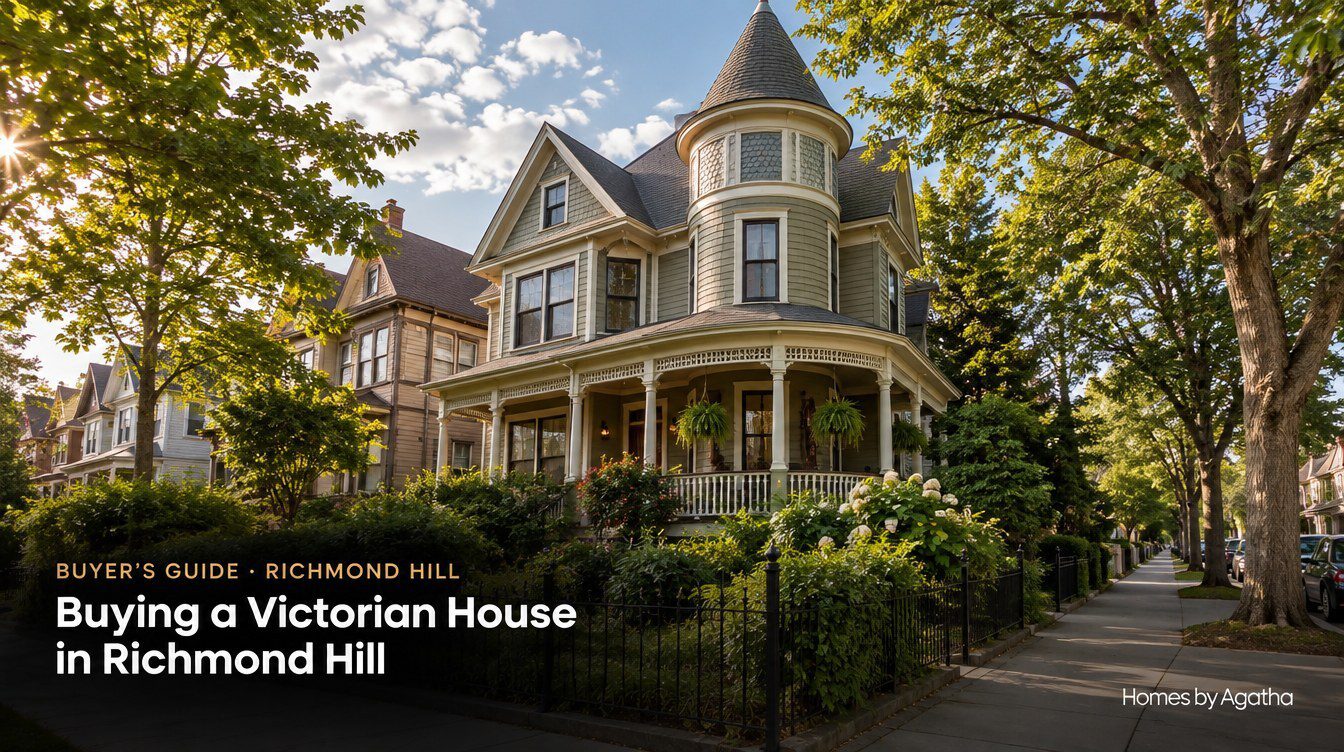
RICHMOND HILL REAL ESTATE GUIDE
Buying a Victorian House in Richmond Hill, Queens: Landmark Status, Legal Units and Frame-House Diligence
Quick Answer
Buying a Victorian house in Richmond Hill, Queens means buying a wood-frame building that is often more than a century old. Before you offer, confirm its legal use with NYC Department of Buildings records, check whether it is a city landmark or only on the National Register, inspect wiring, foundation and siding, and budget for NYC closing costs and restoration.
This guide is for buyers who are drawn to the porches, turrets and deep front yards of Richmond Hill and want to know what buying a Victorian house in Richmond Hill actually involves before they fall for one. The neighborhood was laid out in the late 1860s as a planned suburb, and many of its original detached frame houses still stand between Jamaica Avenue and Forest Park. Alongside them are 1920s attached and semi-attached two-family houses, apartment buildings and mixed-use storefronts.
Older houses reward careful buyers. A house that looks like a one-family home may legally be a two-family home, or the reverse. A house inside the Richmond Hill Historic District may or may not be regulated by the NYC Landmarks Preservation Commission. Fresh paint can hide wiring that predates modern codes.
As a Licensed Associate Real Estate Broker serving Queens, I help buyers evaluate both the property and the transaction, in English or Polish, whichever is more comfortable. Below: the housing stock, landmark and zoning status, legal use, frame-house inspections, budgeting, commuting, and a checklist from pre-approval to closing. When you are ready to tour homes, the page on how to buy your home in Richmond Hill with a local buyer’s agent explains how we work together.
Richmond Hill at a glance
| Topic | What to know |
|---|---|
| Area | South-central Queens, south of Forest Park, between Kew Gardens (north), Woodhaven (west), Jamaica and Briarwood (east) and South Richmond Hill (south). Atlantic Avenue is the commonly used line with South Richmond Hill; edges are informal, so check NYC Department of City Planning community district maps for any specific address |
| Borough / County | Queens (Queens County), New York City; Queens Community District 9 |
| ZIP code(s) | Mainly 11418; edge blocks may use 11419, 11415 or 11421, so confirm the ZIP code for each address with USPS |
| Subway | J/Z above Jamaica Avenue (104 St, 111 St, 121 St); A (Lefferts branch) along Liberty Avenue, south of Atlantic Avenue; E/F at Kew Gardens–Union Tpke; E at Jamaica–Van Wyck |
| Rail | No LIRR station in use; the Richmond Hill station on the Montauk Branch closed in 1998. Nearest: Kew Gardens and Jamaica |
| Parks and landmarks | Forest Park (Park Lane South); NYC landmarks Richmond Hill Republican Club (86-15 Lefferts Boulevard) and Eldridge House (87-61 111th Street); the National Register-listed Richmond Hill Historic District |
| Commercial corridors | Jamaica Avenue, Lefferts Boulevard, Myrtle Avenue, Hillside Avenue, Atlantic Avenue |
| Typical property types | Detached Victorian and early-1900s frame houses; 1920s attached and semi-attached one- and two-family houses; apartment buildings with some co-ops; mixed-use buildings |
| Key buyer considerations | Legal use of converted houses, landmark vs. National Register status, contextual zoning, frame-house systems, oil tanks, lead paint, J/Z noise |
What does the housing stock look like in Richmond Hill, Queens?
Richmond Hill, Queens has three main housing layers: detached wood-frame houses from roughly the 1880s through the 1910s, closer-set attached and semi-attached houses built mostly in the 1920s, and apartment and mixed-use buildings along the main avenues. Which layer you are shopping in changes the inspection, the financing and the paperwork.
A planned 19th-century suburb
In 1868, Albon Platt Man bought several farms in what was then rural Queens and hired the landscape architect Edward Richmond to lay out a suburban village. Richmond Hill became an incorporated village in 1894 and joined New York City at consolidation in 1898. That origin explains why the blocks toward Forest Park have generous lots and large frame houses rather than a uniform row-house grid.
Detached Victorian frame houses
The houses most buyers picture are Queen Anne, Shingle style and Stick style designs with wraparound porches, projecting bays, corner turrets and irregular rooflines, plus Colonial Revival houses from the early 1900s. They are built of wood on brick or stone foundations, often with full attics and basements, and many have been re-sided over the decades.
Converted Victorians
Large houses were sometimes divided into apartments over the years. Some conversions were approved by the NYC Department of Buildings; others were not. A converted Victorian can be a legal two-family house with a valuable rental unit, or a one-family house with an unapproved apartment that creates liability for the next owner. That distinction is the core diligence issue here.
1920s attached and semi-attached houses
As rail lines reached Queens, builders filled remaining lots with smaller, closer-set brick and frame houses, many of them two-family. They share side walls, often have flat roofs, and sometimes share a driveway to rear garages. Shared walls and roofs replace a large lot, and upkeep is more compact.
Apartments and mixed-use buildings
Apartment buildings, some of them co-ops, appear near the main avenues and toward the Kew Gardens edge; the offering plan and listing records confirm whether a given building is a co-op or a condo. Mixed-use buildings line Jamaica Avenue and Lefferts Boulevard. Apartment buyers often also compare Kew Gardens, where apartment buildings are more common.
Richmond Hill versus South Richmond Hill
South Richmond Hill, south of Atlantic Avenue toward Liberty Avenue, has a different street pattern and more attached and semi-detached houses. If your search extends below Atlantic Avenue, read the separate guide to buying a home in South Richmond Hill, which covers that housing stock on its own terms.
| Property type in Richmond Hill | What you own | Main diligence focus | Typical financing path | Ongoing cost profile |
|---|---|---|---|---|
| Detached Victorian frame house (one-family) | Land and building (deed) | Legal use, wiring, foundation, siding layers, porch structure, oil tank | Standard residential mortgage; renovation loan if major work is planned | Highest exterior upkeep: paint, roof, porch, gutters, large lot |
| Converted Victorian (two or three units) | Land and building (deed) | Whether the conversion is legal; separate meters, exits and kitchens | Residential 1–4 unit mortgage; legal rent may help qualify | Every unit’s systems, water/sewer for all units, landlord insurance |
| 1920s attached or semi-attached two-family | Land and building (deed) | Legal unit count, shared walls and roof, shared driveway rights | Residential 1–4 unit mortgage | Moderate; roof and party-wall coordination with neighbors |
| Co-op apartment | Shares and a proprietary lease | Board rules, building financials, sublet and financing policies | Share loan; board sets minimum down payment | Monthly maintenance usually includes building taxes and underlying mortgage share |
Victorian, two-family or co-op: which fits your plan?
Tell me how you want to live, how much upkeep you can take on and how you plan to finance, and I will help you focus on the Richmond Hill property types that match.
Is a Victorian house in Richmond Hill landmarked?
Usually not in the regulatory sense. A few Richmond Hill buildings are individual New York City landmarks, and part of the neighborhood is listed on the State and National Registers of Historic Places, but National Register listing is not the same as designation by the NYC Landmarks Preservation Commission. The difference decides whether exterior changes need city preservation approval.
The Richmond Hill Historic District (National Register)
The Richmond Hill Historic District was listed on the National Register of Historic Places on March 7, 2019. According to its National Register nomination, it covers about 30 acres generally around 84th and 85th Avenues and 113th to 118th Streets, bounded on the north by Forest Park and 84th Avenue and stopping short of Lefferts Boulevard and Myrtle Avenue. It contains about 185 houses, 173 of them contributing, most of them freestanding wood-frame houses, many built during a building boom from about 1890 to the mid-1910s. The nomination’s map, available through the NYS Historic Preservation Office (SHPO), shows the exact boundary.
For a private owner using private money, National Register listing generally recognizes significance without imposing city review of exterior alterations. It can open eligibility for certain incentives, such as the New York State Historic Homeownership Rehabilitation Tax Credit for qualifying owner-occupied houses. Program rules and eligible areas change, so confirm them with NYS SHPO before relying on any credit.
NYC landmarks in Richmond Hill
The NYC Landmarks Preservation Commission (LPC) is the city agency that designates and regulates landmarks. In Richmond Hill, it has designated individual buildings, including the Richmond Hill Republican Club at 86-15 Lefferts Boulevard (designated in 2002) and the Daniel and Abbie B. Eldridge House at 87-61 111th Street, an Italianate villa built around 1867 and designated in 2011. Owners of designated buildings generally need LPC approval before exterior work. The LPC’s online landmarks map shows current designations, including any added after this guide was written.
How to check a specific address
Before you make an offer, check the address in three places: the LPC’s online landmarks map, the NYS Cultural Resource Information System (CRIS) or SHPO for National Register status, and ZoLa, the NYC Department of City Planning’s zoning map, which shows the zoning district and flags landmark designations. Your attorney’s searches should confirm the result.
Contextual zoning: what you can build or add
The NYC Department of City Planning has rezoned large parts of Richmond Hill, including a 2005 rezoning covering parts of Kew Gardens and Richmond Hill and the Woodhaven–Richmond Hill rezoning approved in 2012. Contextual districts such as R4A and R4B generally limit the height, bulk and building type of new construction; ZoLa shows the district and permitted building types for a specific lot. If you plan to add a floor, a rear extension or a unit, zoning may say no even when the house is not landmarked. Ask an architect before you price an expansion into your offer.
Key Takeaways
- The Richmond Hill Historic District is a National Register listing, which generally does not by itself require city approval for a private owner’s exterior work.
- Individual NYC landmarks, such as the Richmond Hill Republican Club and the Eldridge House, do require LPC review for exterior changes.
- Check every address on the LPC map, with SHPO and on ZoLa before you price renovations.
- Contextual zoning can block an addition or extra unit even when landmark rules do not apply.
How do you confirm the legal use of an older Richmond Hill house?
You confirm legal use by checking NYC Department of Buildings records for a Certificate of Occupancy or, for many older buildings, a Letter of No Objection, and comparing the documented unit count with what physically exists. In Richmond Hill, where many houses predate 1938 and some were later divided, this step matters more than any photo in the listing.
Pre-1938 houses and the missing CO
A Certificate of Occupancy (CO) is the NYC Department of Buildings document that states a building’s legal use and number of dwelling units. According to the DOB, buildings constructed before 1938 were generally not required to have a CO unless a later alteration changed their use, exits or occupancy. Many Richmond Hill Victorians therefore have no CO, and that alone is not a defect.
For those buildings, the DOB can issue a Letter of No Objection (LNO), which confirms that the existing use is acceptable when it complies with code and zoning and the occupancy and exits are unchanged. The DOB explains both documents on its Certificate of Occupancy page. If neither exists, your attorney can review historical building records and the Department of Finance building classification.
Signs that a conversion may not be legal
- More kitchens than the records allow, including a second kitchen in the basement or attic.
- Extra electric or gas meters added without a matching DOB filing.
- An attic apartment reached only by an interior stair, with no second exit.
- A below-grade unit in space that qualifies as a cellar rather than a basement.
Under New York City building rules, a cellar has more than half its height below curb level and generally cannot be used as a separate apartment; a basement has at least half its height above curb level and can be habitable only if it meets strict height, light, ventilation and exit rules. Attic units raise similar exit and fire-separation questions in a wood-frame building.
The records to cross-check
| Record | Where to find it | What it tells a Richmond Hill buyer |
|---|---|---|
| CO or Letter of No Objection | NYC Department of Buildings (BIS, DOB NOW, Queens borough office) | Legal use and unit count; whether a conversion was approved |
| Permits, complaints and violations | NYC Department of Buildings | Work filed or done without permits; open jobs never signed off |
| Building class and tax bill | NYC Department of Finance | How the city classifies the house (one-family, two-family and so on) |
| Deeds, mortgages and easements | ACRIS (NYC Department of Finance) | Ownership chain and recorded agreements, such as shared-driveway easements |
| Landmark and zoning status | LPC map, NYS SHPO, ZoLa | Whether exterior work needs LPC approval and what zoning allows |
Our guide to buying a multi-family home in Queens explains two-family ownership across the borough; the steps above test the claim on a specific Richmond Hill house.
Found a house that “has always been a two-family”?
Send me the address before you schedule an inspection, and we can review its public building records and the questions your attorney will want answered.
What should an inspection cover when buying a Victorian house in Richmond Hill?
An inspection of a century-old frame house should concentrate on structure, electrical wiring, the building envelope (roof, siding, porches and windows), heating and fuel history, plumbing and the sewer line, and hazardous materials. Cosmetic updates are easy to see; these systems are where the money goes.
Wiring that predates modern codes
Houses built before about the 1930s were often wired with knob-and-tube wiring: individual conductors on ceramic insulators with no ground wire. Some remains hidden behind walls even after partial upgrades. Insurers and lenders may ask about it, and some insurers may decline to cover a house that still relies on it; a licensed New York insurance broker can tell you how carriers currently treat it. Ask a licensed electrician to evaluate the service size, the panel and any remaining old circuits.
Framing, foundations and fire-stopping
Many Victorian-era houses were built with balloon framing, in which wall studs run continuously from the foundation to the roof. Without fire-blocking, wall cavities can act as chimneys for fire. An inspector or contractor can tell you whether blocking was added during later work. Brick and stone foundations should be checked for mortar loss, water entry and settlement, and porch footings for rot and movement.
Siding layers and what lies beneath
Many frame houses in Queens were re-clad with asbestos-cement shingles, aluminum or vinyl over the original wood. Asbestos-cement shingles are generally stable when intact but require licensed handling if removed. Later siding can hide rotted sheathing and sills. If you hope to restore original clapboard, budget for discovery: no one knows its condition until the outer layer comes off.
Roofs, turrets, porches and chimneys
Turrets, dormers and valleys give water more places to enter than a simple roof. Ask about the roof covering’s age, flashing, gutters and whether chimneys are lined. Wraparound porches are a neighborhood signature and a maintenance item: check columns, decking, railings and the porch roof.
Heating, oil tanks and sewer lines
Many older Queens houses were heated with oil, and some later converted to gas. Ask whether the old tank was removed or properly abandoned, with paperwork; a tank sweep can locate a buried one. Mature street trees are part of Richmond Hill’s appeal, and their roots can invade old sewer laterals, so a sewer camera inspection of the line to the street, generally the owner’s responsibility, is worth considering.
Lead paint and flood exposure
Federal law requires sellers of homes built before 1978 to disclose known lead-based paint hazards and to give buyers an opportunity to conduct a lead inspection or risk assessment. In a Victorian with original trim, assume layers of old paint. Richmond Hill is an inland neighborhood, but heavy-rain flooding can still affect basements, so check the address on the FEMA Flood Map Service Center and on the NYC Stormwater Flood Maps. Check each specific address, and do not assume any block is in or out of a flood zone.
How much should you budget beyond the purchase price?
Budget for the down payment, New York City buyer closing costs, lender reserves, insurance that reflects frame construction, and a repair fund. With a century-old house, the repair fund is part of the price.
Closing taxes a Richmond Hill buyer may pay
Richmond Hill is in New York City, so city and state taxes apply. Under rates published by the NYC Department of Finance and New York State, the mortgage recording tax on one-to-three-family homes and condos is roughly 1.8% of the loan amount for loans under $500,000 and 1.925% for loans of $500,000 and above. Co-op loans are share loans and are not subject to mortgage recording tax.
The New York State “mansion tax” is 1% of the price on residential purchases of $1 million or more and is paid by the buyer; within New York City the rate is graduated above $2 million. The NYS real estate transfer tax and the NYC Real Property Transfer Tax are customarily paid by the seller, though a contract can shift costs, so read the draft carefully. Confirm current rates with the NYS Department of Taxation and Finance and NYC Department of Finance before closing.
| Cost | Upfront or ongoing | How it applies to an older Richmond Hill house |
|---|---|---|
| Mortgage recording tax | Upfront | Based on the loan amount; not charged on co-op share loans |
| Mansion tax | Upfront | Only at a price of $1 million or more |
| Buyer’s attorney | Upfront | Reviews legal use, landmark status, title and the contract |
| Inspections | Upfront | General inspection plus electrician, sewer camera, tank sweep or lead testing as needed |
| Property tax | Ongoing | Billed by the NYC Department of Finance; most one-to-three-family homes are Tax Class 1 |
| Homeowners insurance | Ongoing | Frame construction, wiring and roof age can affect availability and premium |
| Exterior upkeep | Ongoing | Painting, porch repair, roof sections and gutters on a large frame house |
For a line-by-line breakdown, see Queens closing costs explained, and ask your attorney and lender for a written estimate before you sign.
The restoration budget
Restoration is the line most buyers underestimate. Matching wood windows, rebuilding a porch, repairing decorative shingles or removing asbestos siding costs more than generic renovation. If a house is an individual NYC landmark, add time for LPC review. Get contractor estimates during due diligence, not after closing, so the numbers inform your offer.
Key Takeaways
- Richmond Hill buyers pay NYC and NYS closing taxes; the buyer typically pays mortgage recording tax and, at $1 million or more, the mansion tax.
- Insurance for an old frame house can depend on wiring, roof age and construction, so get quotes before signing.
- A restoration fund is part of the real price of a Victorian house.
- Collect contractor estimates while you can still negotiate.
Want a realistic all-in number?
We can map the purchase price, closing costs, insurance and first-year repairs for the houses on your list, so your offer reflects the full cost of ownership.
How do you get around from Richmond Hill?
Most Richmond Hill commuters use the J and Z above Jamaica Avenue, the A along Liberty Avenue to the south, or the E and F at Kew Gardens–Union Tpke to the north. The closest line depends on the block.
The J and Z on Jamaica Avenue
The BMT Jamaica Line runs on an elevated structure above Jamaica Avenue, with Richmond Hill stations at 104 St, 111 St and 121 St. The J serves 111 St at all times. During rush hours, J and Z trains run a skip-stop pattern in the peak direction: the Z stops at 104 St and 121 St while the J stops at 111 St, and the J serves all three outside those hours. The skip-stop window is short, so check the current J/Z timetable on the MTA website for exact hours. To the west, the line continues through Woodhaven and Brooklyn toward Lower Manhattan; to the east, it runs to Sutphin Blvd–Archer Av–JFK Airport and Jamaica Center–Parsons/Archer.
Houses near a station save time, while buildings facing the structure on Jamaica Avenue hear and see the trains. Visit at rush hour, not only on a weekend.
The A train on Liberty Avenue
The A train’s Lefferts branch runs on an elevated structure above Liberty Avenue, with stations at 104 St, 111 St and Ozone Park–Lefferts Blvd. Liberty Avenue lies south of Atlantic Avenue, so these stations sit in South Richmond Hill and Ozone Park, a walk or short bus ride from Richmond Hill’s southern blocks. Service on the Lefferts branch can differ by time of day, so check the MTA website for the current A train pattern.
The E and F, and the LIRR
Near the northern edge, the Kew Gardens–Union Tpke station serves the E and F on the Queens Boulevard line, and the Jamaica–Van Wyck station serves the E near the eastern edge. The Long Island Rail Road’s Montauk Branch crosses Richmond Hill on an elevated structure near Hillside Avenue, but the Richmond Hill station closed in 1998 and no LIRR station in the neighborhood is in passenger use. The closest stations are Kew Gardens, on the Main Line, and Jamaica; the LIRR timetable shows current Kew Gardens service and fares.
Buses and roads
Local buses run along Jamaica Avenue, Lefferts Boulevard, Liberty Avenue and other corridors toward Jamaica, Kew Gardens, Ozone Park and JFK Airport; routes changed under the Queens bus network redesign, so check the current MTA bus map for routes and stops. Drivers use the Van Wyck Expressway at the eastern edge and the Jackie Robinson Parkway through Forest Park.
Forest Park and everyday life
Forest Park, one of the largest parks in Queens, forms Richmond Hill’s northern edge along Park Lane South, with wooded trails and ballfields a short walk from the Victorian blocks. Park proximity, distance from the elevated line and lot size explain much of the variation among houses that look similar on paper. If you are also considering streets west of Richmond Hill, compare the frame-house blocks in Woodhaven, which shares the J line and Forest Park.
How does financing work for an older or two-family Richmond Hill house?
Financing an older Richmond Hill house works like any one-to-four-unit residential purchase, with three local twists: the appraiser may struggle to find truly comparable Victorians, rental income counts only from legal units, and lenders may condition the loan on repairs to items such as wiring or a failing porch.
Pre-approval that names the property type
Pre-approval is a lender’s conditional commitment based on your verified income, assets and credit. A letter for a “one-family home” does not tell a seller that you can close on a converted two-family Victorian. Ask your NMLS-registered loan originator whether the approval assumes rental income, how much, and what happens if the appraisal finds fewer legal units than advertised. Rental-income and reserve rules differ by loan program, so get the answer in writing. If this is your first purchase, the first-time home buyer guide for Queens explains the documents lenders request.
Appraisals for one-of-a-kind houses
An appraiser values a house mainly by comparing it with recent sales of similar homes. A detached Victorian on a large lot may have few close comparables, so the appraiser may reach further in time or distance, or adjust heavily for lot size and condition. If the appraisal comes in below the contract price, the buyer must cover the gap, renegotiate or rely on the contract’s protections.
Renovation and co-op financing
Some loan programs combine purchase and renovation costs in one mortgage, releasing funds as work is completed; availability and requirements vary by lender, and these loans require contractor bids and more time. A co-op apartment is financed with a share loan, and each board sets its own down-payment and reserve rules, so ask the managing agent for that building’s requirements.
How do offers, contracts and buyer’s agents work when you buy an old house in New York?
In New York, an accepted offer is not a binding contract: the buyer’s and seller’s attorneys negotiate the contract of sale, and the deal binds only when both sides sign and the deposit is delivered. Before touring, buyers sign a written agreement with their agent, and that agent’s compensation is negotiable.
Inspect before you sign
New York is an attorney state for residential sales: attorneys, not brokers, draft and negotiate the contract. Standard New York City contracts often give the buyer limited rights to cancel over physical condition once signed, so buyers usually finish inspections and records review first. With a century-old house, book the inspector, electrician and sewer camera right after acceptance so findings arrive while terms are still open.
Points your attorney may negotiate
A mortgage contingency lets you cancel if your loan is not approved within a set period on the contract’s terms. Other points may include delivering the house in a stated legal status, curing specific violations, documenting an oil tank, delivering units vacant or transferring tenant deposits. Sellers of most one-to-four-family houses must deliver the Property Condition Disclosure Statement; since a 2024 change in New York law, a $500 credit is no longer an alternative.
Buyer representation under the 2026 rules
Following the 2024 NAR settlement, buyer-agent compensation is negotiable, not set by law and not automatically paid by the seller; your written agreement states the amount and how it will be paid. At the first substantive contact, a licensee must give you the NYS Disclosure Form for Buyer and Seller, which explains agency relationships. Our article on working with a buyer’s agent in NY covers the details.
For an older house, a buyer’s agent checks building, landmark and zoning records before showings, flags listings that do not match DOB records, and lines up inspectors who understand frame construction. I work with buyers in English or Polish; that choice is about communication and comfort, and where you decide to buy is always your choice.
Ready to write an offer on a Richmond Hill house?
Before you name a price, let’s go over the legal use, the inspection plan and the contract points your attorney may want to raise.
What is the timeline from pre-approval to closing in Richmond Hill?
A Richmond Hill purchase moves through six stages: pre-approval, search and records review, offer, inspection and contract, mortgage and title work, and closing. With older houses, the records review and the inspection stage are the most likely to take extra time.
| Stage | What happens | Older-house delay risk in Richmond Hill |
|---|---|---|
| 1. Pre-approval | Lender verifies income, assets and credit | Approval not matched to a two-family or renovation purchase |
| 2. Search and records review | Showings plus DOB, LPC, SHPO, ZoLa and Department of Finance checks | Listing describes more units than the records show |
| 3. Offer and acceptance | Price and terms agreed in principle; not yet binding | Tenant, vacancy and repair terms left vague |
| 4. Inspection, attorney review, contract | Inspections, estimates, contract negotiation, deposit, signatures | Wiring, oil tank, foundation or sewer findings reopening price |
| 5. Mortgage commitment and title | Appraisal, underwriting, title and municipal searches | Few comparable sales; lender repair conditions; open permits |
| 6. Closing | Final walkthrough, funds, deed and mortgage recorded | Lease and deposit transfers; repairs promised in the contract |
Buying a Victorian house in Richmond Hill: mistakes to avoid and a buyer checklist
The most expensive mistakes when buying a Victorian house in Richmond Hill are paying for rental income from a unit that is not legal, assuming National Register status means the city controls (or protects) the exterior, and treating a restoration as cosmetic. Each is avoidable with records and estimates gathered before contract.
Mistakes to avoid
- Counting rent from an unapproved apartment. If the attic or basement unit is not in the records, leave its rent out of your math and your lender’s.
- Confusing “historic district” labels. Check whether the house is an NYC landmark, a National Register contributing building, or neither.
- Planning an addition before checking zoning. Contextual zoning may limit height, bulk or unit count.
- Skipping the electrician. A general inspector may not open enough of the system to find old wiring.
Richmond Hill buyer checklist
- Get a written pre-approval that names the property type, and sign a written buyer agreement.
- Set a budget covering down payment, closing taxes, attorney, inspections, insurance and a restoration fund.
- For each serious listing, pull the CO or Letter of No Objection, DOB permits and violations, the building class and ACRIS documents.
- Check the LPC map, National Register status with SHPO, and zoning on ZoLa.
- Count kitchens, entrances and meters against the legal unit count.
- Book a general inspection plus an electrician, sewer camera and tank sweep as needed.
- Get insurance quotes and contractor estimates before signing the contract.
- Walk to the J/Z, A or E/F station you would actually use, at rush hour.
- Have your attorney review title, records, leases and the contract before you sign.
If you already own a Richmond Hill home and plan to sell before or after you buy, the companion guide on how to sell your home in Richmond Hill explains the seller side of the same market.
Want help planning due diligence on a frame house?
We can set the order of inspections, records checks and contractor visits so nothing important is left until after you sign.
Frequently asked questions about buying a Victorian house in Richmond Hill, Queens
Are Victorian houses in Richmond Hill, Queens landmarked?
Most are not NYC landmarks. Part of Richmond Hill is listed on the National Register of Historic Places as the Richmond Hill Historic District, which generally does not require city approval for a private owner’s exterior work. Individual landmarks, such as the Richmond Hill Republican Club, need Landmarks Preservation Commission approval. Check each address before buying.
Where is the Richmond Hill Historic District?
The Richmond Hill Historic District lies just south of Forest Park, generally around 84th and 85th Avenues and 113th to 118th Streets, stopping short of Lefferts Boulevard and Myrtle Avenue. Listed on the National Register on March 7, 2019, it contains about 185 houses, 173 of them contributing, most of them freestanding wood-frame houses.
Does an old Richmond Hill house need a Certificate of Occupancy?
Not necessarily. The NYC Department of Buildings generally did not require Certificates of Occupancy for buildings constructed before 1938 unless later alterations changed their use, exits or occupancy. Many Richmond Hill houses predate 1938. In that case, a Letter of No Objection or other DOB records can document the legal use and unit count.
How can I tell if a converted Victorian in Richmond Hill is a legal two-family?
Compare NYC Department of Buildings records, such as a Certificate of Occupancy or Letter of No Objection, with what you see inside: kitchens, entrances, meters and exits. Check the Department of Finance building class and any DOB permits for the conversion. Rent from an unapproved unit will not count toward your mortgage and creates liability.
What should I inspect in a 100-year-old frame house in Queens?
Focus on wiring, including possible knob-and-tube circuits, the foundation and porch structure, siding layers that may hide rot or contain asbestos, roof and flashing around turrets and dormers, the boiler and any old oil tank, the sewer line, and lead paint. Bring in an electrician and a sewer camera inspection when needed.
Which subway lines serve Richmond Hill, Queens?
The J and Z run above Jamaica Avenue with Richmond Hill stations at 104 St, 111 St and 121 St, using a skip-stop pattern at rush hour. The A train’s Lefferts branch runs along Liberty Avenue to the south, and the E and F stop at Kew Gardens–Union Tpke near the northern edge.
Is there a Long Island Rail Road station in Richmond Hill?
No station is in passenger use today. The Richmond Hill station on the LIRR Montauk Branch, near Hillside Avenue, closed in 1998, and the branch now carries only occasional freight. Richmond Hill residents who use the LIRR generally travel to the Kew Gardens station on the Main Line or to Jamaica station.
What closing costs does a buyer pay in Richmond Hill?
Richmond Hill buyers typically pay the NYC mortgage recording tax on their loan, title insurance, attorney and lender fees, inspections and escrow deposits. The New York State mansion tax of 1% applies at $1 million or more. Co-op share loans are not subject to mortgage recording tax. Confirm current rates with NYC DOF and NYS DTF.
Can I add an extension to a house in Richmond Hill?
Possibly, but zoning decides first. Large parts of Richmond Hill were rezoned to contextual districts that limit height, bulk and building type, so an addition or extra unit may not be allowed. Check the lot on the NYC Department of City Planning’s ZoLa map and consult an architect before pricing a renovation into your offer.
Do I need a buyer’s agent agreement before touring homes in Richmond Hill?
Yes. Under the rules in effect in 2026, buyers sign a written agreement with their agent before touring. The agreement states the agent’s compensation, which is negotiable, not set by law and not automatically paid by the seller. You should also receive the NYS Disclosure Form for Buyer and Seller at first substantive contact.
Your next step in Richmond Hill
Buying a Victorian house in Richmond Hill goes more smoothly when the paperwork comes before the porch. Confirm legal use with DOB records, tell National Register status apart from NYC landmark designation, check zoning before you plan an addition, inspect the wiring, foundation and siding, and price restoration and insurance into your offer. Then test the commute from the actual block. When your criteria are clear, the page on how to buy your home in Richmond Hill, Queens with Agatha explains how we can search, review records and negotiate together.
Start your Richmond Hill search with a plan
A short conversation about your budget, the upkeep you are ready for and your commute can save weeks of showings that never fit. English or Polish, whichever you prefer.
This article is for general informational purposes only and reflects conditions that may change. It is not legal, tax, or financial advice, an appraisal, or a guarantee of price or outcome; consult a licensed New York attorney, a CPA, and an NMLS-registered mortgage loan originator as appropriate. A CMA is an opinion of value, not an appraisal. Real estate brokerage services are offered by Agatha Lubas, Licensed Associate Real Estate Broker, NY License #10301213345, Keller Williams Realty Liberty, 96-10 101st Avenue, Ozone Park, NY 11416. The NYS Disclosure Form for Buyer and Seller, the NYS Housing and Anti-Discrimination Disclosure / Fair Housing Notice, and the brokerage’s Standard Operating Procedures are available on request. Equal Housing Opportunity.

Agatha Lubas helps buyers, sellers and investors across Queens, Brooklyn, Nassau County and Suffolk County evaluate both the property and the transaction before they commit. She works in English and Polish so clients can communicate in whichever language they find most comfortable.
Work with Agatha