

ELMHURST REAL ESTATE GUIDE
Elmhurst Co-op vs Condo vs House: How to Choose What to Buy in Elmhurst, Queens
Quick Answer
In Elmhurst, Queens, a co-op usually offers a lower entry price but requires board approval and a monthly maintenance that includes building taxes; a condo gives you a deed and more flexibility; an attached or two-family house adds land, possible rental income and every repair. Compare monthly costs, financing rules, closing taxes and building records before choosing.
The Elmhurst co-op vs condo question is usually the first real decision a buyer faces here, and the answer shapes everything after it: which lender you call, how much cash you need, who must approve you and what documents you read before signing. Elmhurst also has blocks of attached brick houses and two-family homes, so the real comparison often has three options, not two.
This guide is for buyers who already like Elmhurst’s location along Broadway and Queens Boulevard and want to understand what they would actually own in each type of property. It explains how cooperative and condominium ownership differ, how monthly charges are built, how a co-op board review works, how financing changes by property type, which New York City closing taxes apply, and what to check in a building’s records before you commit.
As a Licensed Associate Real Estate Broker serving Queens, I help buyers compare buildings and houses on the same terms, in English or Polish, whichever is more comfortable. When you are ready to tour, the page on how to buy your home in Elmhurst with a buyer’s agent explains how we work together.
Elmhurst at a glance
| Topic | What to know |
|---|---|
| Area | West-central Queens, between Jackson Heights to the north, Corona to the east, Rego Park and Middle Village to the south, and Maspeth and Woodside to the west (neighborhood edges are informal) |
| Borough / County | Queens (Queens County), New York City; generally within Queens Community Board 4; because neighborhood edges are informal, check NYC Planning’s community district map for a specific address |
| ZIP code(s) | 11373 covers most of Elmhurst; edge blocks may use neighboring ZIP codes, so confirm the ZIP code for a specific address with USPS |
| Subway | M and R local trains on the Queens Boulevard Line at Elmhurst Av (Broadway at 45th Avenue) and Grand Av–Newtown (Queens Boulevard at Broadway and Grand Avenue); Woodhaven Blvd station near Queens Center; 7 train on Roosevelt Avenue at 82 St–Jackson Hts and 90 St–Elmhurst Av; E and F express trains stop at nearby Jackson Heights–Roosevelt Av |
| Service note | The M runs in Queens on weekdays; the R runs at all times except late nights, when E trains make the local stops in Queens; check MTA.info for planned work and current service |
| Rail | No Long Island Rail Road station operates in Elmhurst today; nearby LIRR stations include Woodside and Forest Hills |
| Roads | Queens Boulevard, Broadway, Woodhaven Boulevard, the Long Island Expressway across the southern part of the neighborhood and the Brooklyn-Queens Expressway to the west |
| Parks and landmarks | Elmhurst Park (a city park of about six acres on the former gas-tank site at Grand Avenue and 57th Avenue), Queens Center at 90-15 Queens Boulevard, NYC Health + Hospitals/Elmhurst on Broadway |
| Commercial corridors | Broadway, Queens Boulevard, Whitney Avenue, Roosevelt Avenue on the northern edge, Grand Avenue, Corona Avenue and Woodhaven Boulevard |
| Typical property types | Prewar and postwar elevator co-op buildings, garden-style and walk-up apartments, newer condo buildings, attached brick one- and two-family houses, some detached frame houses and mixed-use buildings on commercial streets |
| Key buyer considerations | Co-op board rules and financing limits, condo budgets and tax abatements, building local-law compliance costs, legal unit counts in houses, walk time to the M/R or 7, highway and elevated-train noise |
What does the housing stock look like in Elmhurst, Queens?
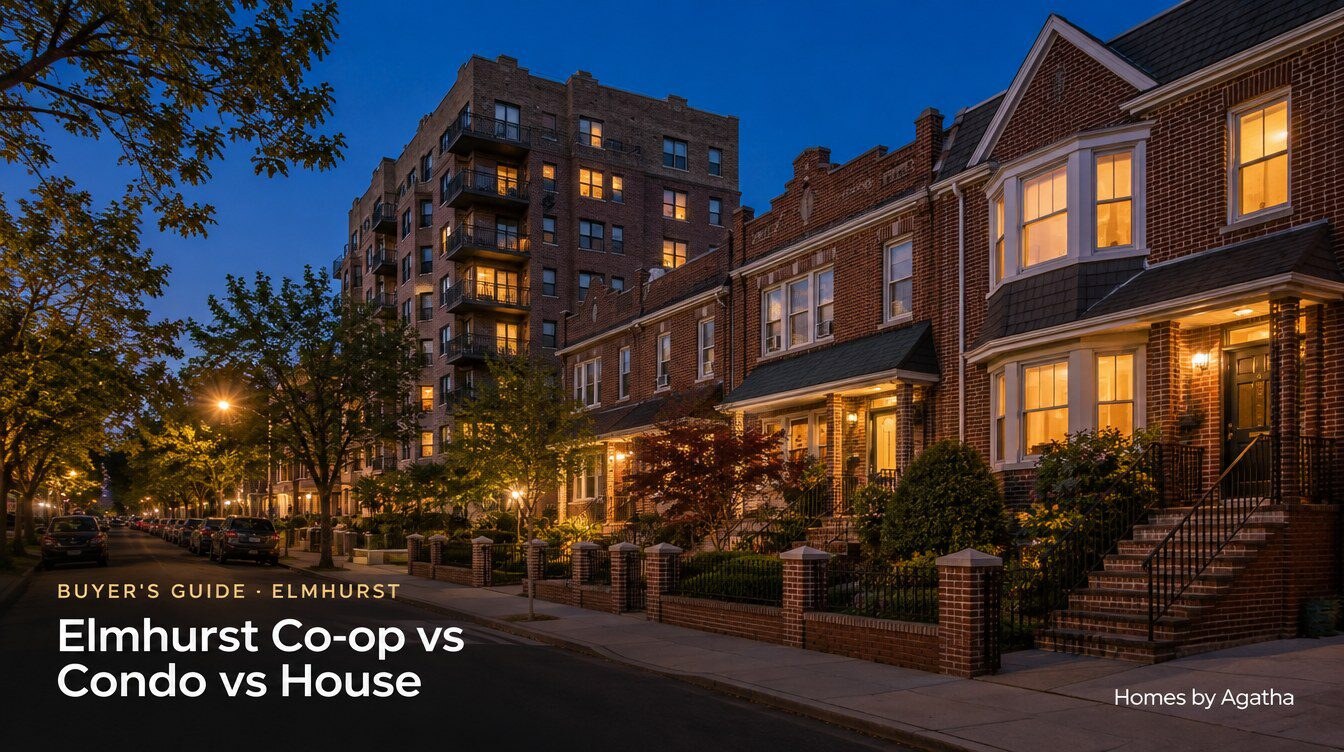
Elmhurst, Queens has a mixed housing stock: apartment buildings, many of them co-ops, cluster along and near Broadway, Queens Boulevard and the subway, while side streets hold attached brick houses, two-family homes and a smaller number of detached houses. Condo buildings are generally newer and fewer than co-ops.
That pattern follows the transit history. The Queens Boulevard subway opened through Elmhurst in the 1930s, and apartment construction followed the stations. The area’s older name, Newtown, survives in the Grand Av–Newtown station; the neighborhood took the Elmhurst name in the late nineteenth century.
Elevator apartment buildings
Six-story elevator buildings with brick facades are a common Elmhurst building type, built before and after World War II. Many of these buildings converted to cooperative ownership, which is why so many apartment listings in Elmhurst are co-ops. Others remain rental buildings, and some are condominiums. The building’s ownership form, not its appearance, decides how you buy.
Garden-style and walk-up apartments
Some Elmhurst apartments sit in low-rise garden complexes or walk-up buildings without elevators. For a buyer, the top-floor walk-up and the garden-level unit raise different questions: stairs and roof condition on one hand, ground-level drainage and privacy on the other.
Newer condo buildings
Condominium buildings in Elmhurst tend to be newer construction on or near the main corridors. Newer buildings often include features buyers value, such as in-unit laundry or central air, but they also come with their own questions: how many units the sponsor still owns, whether the building has a time-limited real estate tax abatement, and how mature the reserve fund is.
Attached houses and two-family homes
On the residential blocks between the corridors, Elmhurst has rows of attached and semi-attached brick houses, many built as one- or two-family homes, plus some older detached frame houses. A two-family house is a building legally approved for two separate dwelling units. Buyers who want outdoor space, a garage or rental income from a second apartment usually end up comparing these houses with apartment options.
Because Elmhurst sits between neighborhoods with different mixes, it helps to compare across lines. Buyers who want more co-op choices often also look at buying in Jackson Heights and buying in Rego Park, while buyers focused on two- and three-family houses often add Corona to the search.
Elmhurst co-op vs condo: what is the real difference for a buyer?
The real difference is what you own. A co-op buyer owns shares in a corporation and holds a proprietary lease; a condo buyer owns real property with a deed. That single distinction changes approval, financing, taxes, monthly charges and how freely you can rent or sell later.
How co-op ownership works
A cooperative housing corporation, or co-op, owns the entire building. When you buy an Elmhurst co-op apartment, you buy shares allocated to your unit and sign a proprietary lease, which gives you the right to live there under the building’s rules. The co-op’s board of directors, elected by shareholders, approves or rejects buyers, sets the house rules and manages the budget through a managing agent.
Your monthly maintenance covers your share of the building’s operating costs, which typically include a share of the building’s real estate taxes and any underlying mortgage on the building. That is why maintenance in a co-op can look high next to a condo’s common charges: it already contains items a condo owner pays separately.
How condo ownership works
A condominium, or condo, unit is real property. You receive a deed, the unit has its own tax lot, and the NYC Department of Finance bills property taxes to you directly. You pay common charges to the condo association for the building’s operating costs. Condo boards generally do not interview buyers; most condo bylaws instead give the board a right of first refusal, which the board usually waives. The exact terms are in each building’s bylaws.
How the house option compares
An Elmhurst house means you own the land and the building outright, with no board and no common charges, but also no shared budget for the roof, boiler, facade or sewer line. A two-family house adds a second unit that may produce rental income, together with landlord duties. For a deeper look at owner-occupied rentals across the borough, see our guide to buying a multi-family home in Queens.
| Factor | Elmhurst co-op | Elmhurst condo | Elmhurst house (one- or two-family) |
|---|---|---|---|
| What you own | Shares plus a proprietary lease | Unit plus a share of common elements (deed) | Land and building (deed) |
| Who approves you | Co-op board, after an application package and usually an interview | Usually no interview; board may waive a right of first refusal | No board; the lender and the seller’s acceptance |
| Monthly charges | Maintenance, usually including a share of building taxes and the underlying mortgage | Common charges plus separately billed property tax | Property tax, insurance, water and sewer, all repairs |
| Financing | Share loan; board sets the minimum down payment | Mortgage; building must meet the lender’s project requirements | Mortgage for one-to-four-unit property; rental income may be counted in part |
| Mortgage recording tax | Not charged on co-op share loans | Charged on the loan amount | Charged on the loan amount |
| Renting it out later | Governed by the building’s sublet policy | Usually more flexible, subject to bylaws | Legal units can be rented under New York law |
| What to verify | Financial statements, underlying mortgage, reserves, assessments, sublet and flip-tax rules | Offering plan, budget, reserves, sponsor-owned units, tax abatement status | Certificate of Occupancy, legal unit count, violations, systems |
Key Takeaways
- An Elmhurst co-op sells shares and a proprietary lease; an Elmhurst condo sells real property with a deed.
- Co-op maintenance usually includes building taxes and the underlying mortgage, so compare it with condo common charges plus taxes, not alone.
- Co-op boards approve buyers; condo boards generally hold a right of first refusal instead.
- An Elmhurst house trades board rules for full responsibility for land, building and any tenants.
Undecided between a co-op, a condo and a house?
Tell me how you want to live, how long you plan to stay and how you plan to pay, and we can rule options in or out before you spend weekends at open houses.
How do monthly costs compare between an Elmhurst co-op, condo and house?
To compare monthly costs fairly, add up the full housing payment for each option: for a co-op, the loan payment plus maintenance; for a condo, the mortgage plus common charges plus property tax; for a house, the mortgage plus property tax, insurance, water and sewer and a repair reserve. Only then is the Elmhurst co-op vs condo vs house comparison accurate.
What sits inside co-op maintenance
Co-op maintenance is the monthly charge each shareholder pays toward the corporation’s budget. In most Elmhurst co-ops it covers staff or superintendent costs, heat and hot water, building insurance, repairs, management fees, a share of the building’s real estate taxes and the debt service on any underlying mortgage. Electricity in your apartment is usually billed separately, but inclusions vary, so ask the managing agent exactly what the maintenance covers.
Because maintenance includes the building’s taxes and mortgage, part of it may be tax-deductible for the shareholder. The co-op typically issues an annual statement showing that portion. Ask a CPA how it applies to you; do not rely on a listing that says maintenance is “partly deductible” without a figure from the building.
Eligible primary-residence owners in New York City co-ops and condos may also receive the Co-op and Condo Property Tax Abatement, which the NYC Department of Finance applies through the building, usually as a credit against maintenance or taxes. Owners do not apply individually: the co-op or condo board applies for the whole development, and each owner certifies that the unit is a primary residence. The Department of Finance website lists the current eligibility rules.
What sits inside condo common charges
Condo common charges pay for the shared parts of the building: staff, insurance on common elements, repairs, amenities and reserves. Your property taxes are billed separately by the Department of Finance. In newer Elmhurst condos, ask whether the building has a time-limited tax abatement, when it phases out, and what your taxes will look like after it does; the building’s tax records and offering plan show the schedule. A low tax bill today can rise substantially as an abatement ends.
What a house actually costs each month
An Elmhurst house has no maintenance or common charges, but the owner pays the property tax bill from the Department of Finance, homeowners or landlord insurance, the water and sewer bill from the NYC Department of Environmental Protection, and every repair. Attached brick houses often have flat roofs shared at the parapet line with neighbors, and a roof, boiler or sewer-line repair lands on one owner, not a corporation.
Building-wide costs that reach your monthly charge
New York City local laws add building-level obligations that flow into co-op maintenance and condo common charges. They are worth understanding because many Elmhurst apartment buildings are exactly the size these laws target.
- Local Law 11, the Facade Inspection and Safety Program (FISP): buildings taller than six stories must have their facades inspected periodically and repair unsafe conditions. A six-story building is generally outside FISP; a seven-story or taller building is inside it.
- Local Law 97: most buildings over 25,000 gross square feet must meet greenhouse-gas emissions limits or pay penalties, which can mean boiler, window or insulation upgrades funded by owners.
- Local Law 152: most buildings other than one- and two-family homes must have their gas piping periodically inspected by a licensed master plumber.
Ask the managing agent how the building has planned for these costs: through reserves, an assessment, a loan or a maintenance increase. An upcoming assessment is a cost you inherit when you buy.
| Monthly cost item | Co-op | Condo | House |
|---|---|---|---|
| Loan payment | Share loan | Mortgage | Mortgage |
| Building operating costs | In maintenance | In common charges | Paid directly by the owner |
| Real estate tax | Building’s share in maintenance | Billed separately to the owner | Billed separately to the owner |
| Building’s underlying mortgage | Often in maintenance | None | None |
| Water and sewer | Usually in maintenance | Usually in common charges | Billed to the owner |
| Insurance | Apartment (contents) policy; building insured by co-op | Unit-owner policy; common elements insured by condo | Full homeowners or landlord policy |
| Assessments | Possible for major projects or local-law compliance | Possible for major projects or local-law compliance | Not applicable; the owner pays repairs directly |
What does a co-op board review in Elmhurst involve?
A co-op board review is the building’s approval of you as a shareholder: you submit a board application package with financial documents and references, the board reviews it, and usually you attend an interview. The purchase cannot close without board approval, and each Elmhurst co-op sets its own standards, so ask the managing agent for the building’s written requirements.
What goes into an Elmhurst board package
The board package is a set of forms and documents defined by the managing agent. It commonly includes the signed contract of sale, a loan commitment letter if you are financing, tax returns, bank and investment statements, employment verification, a financial statement on the building’s form, reference letters and the building’s application fees. Incomplete or inconsistent packages are the most common reason a board review slows down.
Financial criteria set by the building
Co-op boards set their own financing rules. Some buildings require a minimum down payment higher than a lender would; some limit how much of your income can go to the loan payment and maintenance; and some require cash left in the bank after closing, often called post-closing liquidity. These are building policies, not laws, and they vary from one Elmhurst co-op to the next.
Sublets, guarantors and other house rules
Read the building’s house rules and proprietary lease before you make an offer. Questions that commonly matter to Elmhurst co-op buyers include whether you may sublet and after how long, whether co-purchasers or guarantors are accepted, whether pets are allowed, how renovations must be approved and whether the building charges a flip tax when you sell. A flip tax is a transfer fee set by each co-op’s own documents; there is no city-wide rate.
Sponsor units
Some Elmhurst co-ops still have apartments owned by the original sponsor or a holder of unsold shares from the conversion. Depending on the offering plan, a sponsor sale may follow different approval rules, and a building where one holder owns many units carries its own risks for maintenance collections and voting. The offering plan and its amendments set the approval terms for sponsor sales, so have your attorney review them.
Wondering whether a co-op board would approve you?
We can review the building’s stated requirements against your finances before you bid, so you know which Elmhurst co-ops are realistic and which belong on a condo or house shortlist.
How do you finance an Elmhurst co-op, condo or house?
You finance an Elmhurst co-op with a share loan from a lender that lends in that building, a condo with a mortgage on a building the lender has reviewed, and a house with a residential mortgage for one-to-four-unit property. Get a pre-approval that names the property type, because a letter written for one type does not prove you can close on another.
Co-op share loans
A co-op share loan is secured by your shares and proprietary lease rather than by a deed. The co-op, your lender and you sign a recognition agreement in which the co-op acknowledges the lender’s interest. Not every lender makes co-op loans, and some lenders work only in buildings they have already reviewed. Ask your loan originator early whether they lend in the specific Elmhurst building you are considering.
Condo financing and building review
Condo lenders review the building as well as the buyer. Common review points include the share of units owned by investors or the sponsor, reserves, pending litigation and commercial space. A building that does not meet a lender’s project requirements may still be financeable through other loan programs, often on different terms. Project requirements differ by lender and loan program, so ask an NMLS-registered loan originator how a specific building is treated.
House financing and rental income
For one-to-four-unit houses, residential loan programs may allow lower down payments when you live in one unit. Lenders count only rental income from legal units and usually only part of it; the exact rules depend on the loan program, so confirm them with an NMLS-registered loan originator. If the Elmhurst house you like has a basement apartment that does not appear on the Certificate of Occupancy, its rent will not help you qualify.
What a useful pre-approval looks like
Pre-approval is a lender’s conditional commitment based on verified income, assets and credit. For Elmhurst, ask the lender to confirm in writing which property types the approval covers, the maximum loan for each, and whether co-op board requirements such as post-closing liquidity would change your plan. First-time buyers can find a step-by-step view of the paperwork in our first-time home buyer guide for Queens.
How much are closing costs when buying in Elmhurst?
Buyer closing costs in Elmhurst depend heavily on property type: condo and house buyers pay the New York City mortgage recording tax on their loan and title insurance, while co-op buyers do not pay mortgage recording tax but pay co-op-specific fees such as a lien search and building application charges. Every buyer at $1 million or more pays the New York State mansion tax.
Taxes that may apply to an Elmhurst buyer
Elmhurst is in New York City, so both city and state transaction taxes apply. Under the rates published by the NYC Department of Finance and New York State, the mortgage recording tax on one-to-three-family homes and condos is roughly 1.8% of the loan amount for loans under $500,000 and 1.925% for loans of $500,000 and above. Co-op loans are share loans and are not subject to mortgage recording tax.
The New York State “mansion tax” is 1% of the price on residential purchases of $1 million or more and is paid by the buyer; within New York City, it is graduated above $2 million. The NYS real estate transfer tax ($2 for each $500 of consideration) and the NYC Real Property Transfer Tax (1% at $500,000 or less and 1.425% above $500,000 for residential properties) are customarily paid by the seller. In new-development sponsor sales, the contract may shift transfer taxes to the buyer, so read the offering plan and contract carefully. Confirm current rates with the NYS Department of Taxation and Finance and NYC Department of Finance before closing.
| Closing cost | Co-op buyer | Condo buyer | House buyer |
|---|---|---|---|
| Mortgage recording tax | No (share loan) | Yes, on the loan amount | Yes, on the loan amount |
| Mansion tax (price of $1 million or more) | Yes | Yes | Yes |
| Title insurance | Generally not required; a lien search replaces the title search | Owner’s and lender’s policies | Owner’s and lender’s policies |
| Building charges | Application, credit-check and move-in fees or deposits, set by each building | Possible application or move-in fees; working-capital contribution in some new buildings | None |
| Buyer’s attorney | Yes | Yes | Yes |
| Lender fees and appraisal | Yes, if financing | Yes, if financing | Yes, if financing |
| Escrow for taxes and insurance | Usually not, since taxes are in maintenance | Often required by the lender | Often required by the lender |
The table describes cost categories, not amounts. Your attorney and lender should give you a written estimate for your actual purchase before you sign a contract. For a line-by-line view of buyer and seller costs across the borough, read Queens closing costs explained.
Key Takeaways
- Co-op share loans skip the NYC mortgage recording tax; condo and house loans do not.
- The 1% mansion tax applies to any residential purchase of $1 million or more, regardless of property type.
- Transfer taxes are customarily the seller’s, but sponsor sales can shift them to the buyer by contract.
- Ask each building for its application, move-in and working-capital charges before you budget.
Want your cash-to-close compared side by side?
Bring your price range and down payment, and we can line up the cost categories for a co-op, a condo and a house so your lender’s numbers make sense.
How do the M, R and 7 trains shape where you buy in Elmhurst?
Most Elmhurst homes are a walk from either the M and R local stations on Broadway and Queens Boulevard or the 7 train on Roosevelt Avenue, and that walk shapes commute time, noise and resale appeal. Express E and F service is one transfer away at Jackson Heights–Roosevelt Av, which matters for Midtown and Long Island City commuters.
Queens Boulevard Line stations
Elmhurst Av station sits under Broadway at 45th Avenue, and Grand Av–Newtown sits under Queens Boulevard where it meets Broadway and Grand Avenue. Both are local stations on the IND Queens Boulevard Line. Woodhaven Blvd station, at the edge of Elmhurst and Rego Park near Queens Center, is another local stop. On weekdays the M and R both serve these stations; the R runs at all times except late nights, when E trains make the local stops. Check MTA.info for current service and planned work before you time a commute.
Because the E and F run express between Jackson Heights–Roosevelt Av and Forest Hills–71 Av during most hours, many Elmhurst commuters ride the local one or two stops to Jackson Heights and transfer to an express. When you compare two buildings, time the full trip, including the transfer, at the hour you would actually travel.
The 7 train on Roosevelt Avenue
The northern edge of Elmhurst is served by the 7 train at 82 St–Jackson Hts and 90 St–Elmhurst Av, elevated local stations above Roosevelt Avenue. The 7 runs through Long Island City to Grand Central and Hudson Yards, so blocks near Roosevelt Avenue give buyers a second line to choose from. Homes facing the elevated structure trade convenience for noise; visit at rush hour before you decide.
Long Island Rail Road access
No Long Island Rail Road station operates in Elmhurst today. Buyers who need LIRR service typically use Woodside, reachable by the 7 train, or Forest Hills on the Queens Boulevard Line. Proposals to restore an Elmhurst station have been discussed publicly, but buyers should not price a home on a station that does not yet exist; the MTA’s current capital program shows which rail projects are funded.
Buses, highways and parking
Bus routes run along Queens Boulevard, Woodhaven Boulevard, Grand Avenue and Corona Avenue, among others. Since the MTA redesigned the Queens bus network, check current route numbers and stops on the MTA bus map rather than older guides. Drivers use the Long Island Expressway, which crosses the southern part of the neighborhood, and the Brooklyn-Queens Expressway to the west. Ask every co-op and condo whether it has a garage or parking lot, whether there is a waiting list and whether spaces are rented or deeded.
Queens Center, Elmhurst Park and everyday amenities
Queens Center, the shopping mall at 90-15 Queens Boulevard where Queens Boulevard, Woodhaven Boulevard and the Long Island Expressway meet, anchors the southern end of Elmhurst. Buildings nearby offer walking access to large retailers, while blocks close to the mall and the expressway see heavier traffic, especially on weekends and during holiday shopping periods.
Elmhurst Park, which opened in 2011 on the site of the former Elmhurst gas tanks between Grand Avenue and 57th Avenue, offers lawns, paths and a playground. NYC Health + Hospitals/Elmhurst, a public hospital on Broadway, is a major local institution and employer. Broadway, Whitney Avenue and the stretch of Queens Boulevard near Grand Av–Newtown carry much of the neighborhood’s everyday retail and dining.
What should you check before buying an Elmhurst co-op, condo or house?
Before you sign a contract, check the building’s financial health for a co-op or condo, and the legal status and physical systems for a house. Each property type has a different set of documents, and your attorney’s review should be finished before the contract is signed.
Co-op due diligence
For an Elmhurst co-op, your attorney typically reviews the last two years of audited financial statements, the proprietary lease, the bylaws, house rules, board minutes when available, and the managing agent’s questionnaire. Key questions include: How large is the underlying mortgage and when does it mature? How much is in reserves? Are any assessments planned? Has maintenance risen recently, and why? Is the building in compliance with Local Law 11, Local Law 97 and Local Law 152?
Condo due diligence
For an Elmhurst condo, your attorney reviews the offering plan and its amendments, the declaration and bylaws, the current budget, the financial statements and the managing agent’s questionnaire. Ask how many units the sponsor or investors own, whether the building is in litigation, whether any tax abatement is phasing out, and how reserves compare with planned work. In a newer building, ask whether the sponsor’s warranty or construction-defect issues have been resolved.
House due diligence
For an Elmhurst house, start with the Certificate of Occupancy, the NYC Department of Buildings document that states the building’s legal use and number of dwelling units. Buildings constructed before 1938 may lawfully have no CO; the DOB explains the alternatives, such as a Letter of No Objection, on its Certificate of Occupancy page. Compare the legal unit count with the kitchens, entrances and electric meters you see, and review open DOB violations, permits never signed off and OATH penalties.
Under New York City building rules, a cellar, with more than half its height below curb level, generally cannot be a legal apartment, and a basement can be habitable only if it meets strict standards for height, light, ventilation and exits. If an Elmhurst house is marketed with a below-grade rental unit that is not on the CO, that rent is not legal income and the unit is a liability for the owner.
Flood and stormwater exposure
Elmhurst is an inland neighborhood, but heavy rainfall can flood low-lying streets, basements and garages anywhere in Queens. Check the FEMA Flood Insurance Rate Map for the address and the NYC Stormwater Flood Maps, which model rainfall flooding rather than coastal storm surge. Lenders generally require flood insurance in a Special Flood Hazard Area. Check the specific address on both maps rather than assuming any block is in or out of a flood zone.
Older-building systems and lead paint
Much of Elmhurst’s housing predates 1978, so federal law requires sellers and landlords to disclose known lead-based paint hazards. In an apartment building, ask about the age of the boiler, the elevator, the roof and the electrical risers; in a house, have the inspector look at the roof and parapets, the heating plant, any oil-tank history and the sewer line to the street.
| Document or check | Co-op | Condo | House | Why it matters |
|---|---|---|---|---|
| Audited financial statements | Required | Required | Not applicable | Shows reserves, debt and operating results |
| Proprietary lease, bylaws, house rules | Required | Bylaws and rules | Not applicable | Sets sublet, renovation, pet and flip-tax rules |
| Offering plan and amendments | Useful, especially with sponsor units | Required | Not applicable | Defines ownership, sponsor obligations and unit shares |
| Managing agent questionnaire | Required | Required | Not applicable | Answers on assessments, litigation, arrears and insurance |
| Local Law 11, 97 and 152 status | Ask | Ask | Generally limited for one- and two-family homes | Future compliance costs reach owners |
| Certificate of Occupancy and DOB records | Building-level | Building-level | Essential | Confirms legal use and unit count |
| Home inspection | Unit-focused | Unit-focused | Whole building, sewer and roof | Finds repair costs before you sign |
| FEMA and NYC stormwater maps | Building-level | Building-level | Essential | Flood insurance and basement risk |
Comparing two buildings and a house at once?
We can line up their documents, monthly charges and records on one page, so you compare the same facts for each Elmhurst option.
How do offers, contracts and buyer representation work in New York?
In New York, an accepted offer is not a binding contract: the buyer’s and seller’s attorneys negotiate the contract of sale, and the deal binds only after both sides sign and the deposit is delivered. Your buyer’s agent helps you form the offer, and your attorney protects you in the contract.
The attorney-state process
New York is an attorney state for residential sales. After a seller accepts your offer, your attorney reviews the building documents or the house records, negotiates contract terms and coordinates with the lender. For co-ops, the contract is typically conditioned on board approval; for condos, on the board’s waiver of its right of first refusal; and for financed purchases, often on a loan commitment, under terms your attorney negotiates.
What makes an Elmhurst offer stronger
A strong offer is more than a price. For a co-op, sellers look for buyers whose finances clearly fit the building’s requirements, because a board rejection costs the seller time. For a condo, they look at financing certainty and closing flexibility. For a two-family house, they look at whether the buyer can take the building with tenants in place or needs a unit delivered vacant, which must be negotiated in writing and evaluated by your attorney under New York tenant law. Your attorney, or NYS Homes and Community Renewal for regulated apartments, can confirm the rules for a specific tenancy, including any rent regulation status.
Buyer representation under 2026 rules
Under the rules in effect in 2026, following the 2024 NAR settlement, you sign a written buyer agreement with your agent before touring homes. Buyer-agent compensation is negotiable, not set by law and not automatically paid by the seller; the agreement states the amount and how it will be paid. In some deals a seller contributes toward it, in others the buyer pays, and either way it must be agreed in writing. Our guide to working with a buyer’s agent in NY explains the options.
At the first substantive contact, a New York real estate licensee must provide the NYS Disclosure Form for Buyer and Seller, which explains buyer’s agency, seller’s agency, dual agency and related arrangements. I work with buyers in English or Polish; that choice is about communication and comfort, and where you decide to buy is always your choice.
What is the timeline from pre-approval to closing in Elmhurst?
A purchase moves from pre-approval through search, offer, attorney review and contract, loan and approvals, and closing. The co-op path usually takes the longest because the board package and interview come after the contract, while a condo or house purchase depends more on the lender, the title search and the building’s records.
| Stage | Co-op | Condo | House |
|---|---|---|---|
| 1. Pre-approval | Share-loan approval from a lender that lends in the building | Mortgage approval; lender reviews the building | Mortgage approval naming one- or two-family property |
| 2. Search and early review | Read house rules and financial requirements before bidding | Check sponsor ownership and abatement status | Pull CO, DOB and OATH records |
| 3. Offer and acceptance | Not binding; price and terms in principle | Not binding; price and terms in principle | Not binding; include tenant and vacancy terms |
| 4. Due diligence and contract | Financials, minutes, lease review; contract and deposit | Offering plan, budget; contract and deposit | Inspection, records, leases; contract and deposit |
| 5. Approvals and financing | Loan commitment, board package, interview, approval | Loan commitment, right-of-first-refusal waiver, title | Loan commitment, appraisal, title and municipal searches |
| 6. Closing | Often at the managing agent’s or an attorney’s office; shares and lease transfer | Deed and mortgage recorded | Deed and mortgage recorded; leases and deposits transfer |
| Most common delay | Incomplete board package | Lender’s building review | Open violations or unit-count questions |
Exact timing depends on the building, the lender and both parties’ schedules. A cash purchase can shorten the financing steps, but it does not skip a co-op board review.
Key Takeaways
- Co-op purchases add a board package and interview after contract signing; plan for that in your lease or move dates.
- Condo purchases depend on the lender approving the building as well as you.
- House purchases hinge on the Certificate of Occupancy, violations and tenant terms.
- Cash shortens financing, not board review.
Need your move dates to line up with a closing?
Let’s build a realistic Elmhurst timeline around your lease, your lender and the approval path of the property type you choose.
What mistakes do Elmhurst buyers make, and what belongs on your checklist?
The most common mistake is comparing a co-op’s maintenance with a condo’s common charges as if they covered the same things. Close behind are bidding on a co-op without reading its financial requirements and paying house prices for rental units that are not legal.
Mistakes to avoid
- Comparing the wrong monthly numbers. In any Elmhurst co-op vs condo comparison, add condo taxes to common charges before comparing them with co-op maintenance.
- Skipping the house rules. Sublet limits, renovation rules and flip-tax terms affect what you can do later.
- Ignoring local-law exposure. A building facing Local Law 97 upgrades or Local Law 11 facade work may raise maintenance or assess owners.
- Trusting an abatement without its end date. A newer condo’s low tax bill may not last.
- Counting illegal basement rent. If it is not on the CO, it is not legal income.
- Timing the commute on a weekend. Test the M/R or 7 and the express transfer at rush hour.
- Using a generic pre-approval. A letter that does not mention co-op share loans or two-family property can weaken your offer.
Elmhurst buyer checklist
- Decide which property types are realistic: co-op, condo, one-family or two-family house.
- Get a written pre-approval that names those property types, including co-op share-loan eligibility.
- Sign a written buyer agreement and review the NYS Disclosure Form for Buyer and Seller.
- Build a full monthly comparison: loan payment plus maintenance, or mortgage plus common charges plus taxes, or mortgage plus taxes, insurance, water and repairs.
- Ask each co-op for its down-payment, debt-to-income and post-closing liquidity requirements before you bid.
- For condos, ask about sponsor ownership, tax abatements and the lender’s building review.
- For houses, pull the CO, DOB violations and permits, and compare the legal unit count with what you see.
- Ask about Local Law 11, 97 and 152 compliance and any planned assessments.
- Check FEMA and NYC Stormwater Flood Maps for the exact address.
- Walk to Elmhurst Av, Grand Av–Newtown or the 7 train at the hour you would commute.
- Have your attorney finish document review before you sign the contract.
- For co-ops, assemble the board package as soon as the contract is signed.
If you already own a home in the area and need to sell before you buy, the companion page on how to sell your home in Elmhurst explains the seller side of the same process.
Frequently asked questions about Elmhurst co-ops, condos and houses
Is it better to buy a co-op or a condo in Elmhurst, Queens?
Neither is better for everyone. Elmhurst co-ops often have lower purchase prices but require board approval, set their own financing rules and limit subletting. Condos cost more to buy in many cases but give you a deed, separate taxes and more flexibility. Compare full monthly costs, your timeline and whether you may rent later.
Why is co-op maintenance in Elmhurst higher than condo common charges?
Co-op maintenance usually includes your share of the building’s real estate taxes and any underlying mortgage, in addition to operating costs. Condo common charges cover operating costs only, and the owner pays property taxes separately to the NYC Department of Finance. Add condo taxes to common charges before comparing the two numbers.
What does an Elmhurst co-op board look for in a buyer?
Each Elmhurst co-op board sets its own standards, but boards commonly review your down payment, the ratio of your debts and housing costs to income, cash remaining after closing, credit history and references. Requirements vary by building, so ask the listing agent or managing agent for the written criteria before you make an offer.
Do co-op buyers in Elmhurst pay the NYC mortgage recording tax?
No. Co-op loans are share loans secured by your shares and proprietary lease, not by real property, so they are not subject to the New York City mortgage recording tax. Condo and house buyers who finance do pay it on the loan amount. Confirm current rates with NYC DOF and NYS DTF before you budget.
Which subway stations serve Elmhurst, Queens?
Elmhurst is served by the M and R local trains at Elmhurst Av and Grand Av–Newtown on the Queens Boulevard Line, with Woodhaven Blvd near Queens Center. The 7 train stops at 82 St–Jackson Hts and 90 St–Elmhurst Av on Roosevelt Avenue. Express E and F trains stop at nearby Jackson Heights–Roosevelt Av.
Is there a Long Island Rail Road station in Elmhurst?
No Long Island Rail Road station operates in Elmhurst today. Residents who need LIRR service usually use Woodside, reachable on the 7 train, or Forest Hills on the Queens Boulevard Line. Proposals to restore an Elmhurst station have been discussed, but buyers should check the MTA for current status rather than rely on future plans.
What should I check before buying a two-family house in Elmhurst?
Start with the Certificate of Occupancy or other NYC Department of Buildings records to confirm the legal unit count, then compare it with the kitchens, entrances and electric meters. Review open violations and unsigned permits, existing leases and security deposits, the roof and boiler, the sewer line, and FEMA and NYC stormwater flood maps.
How do NYC local laws affect Elmhurst apartment buildings?
Local Law 11 requires periodic facade inspections for buildings taller than six stories, Local Law 97 sets emissions limits for most buildings over 25,000 square feet, and Local Law 152 requires periodic gas piping inspections. Compliance costs reach co-op and condo owners through maintenance, common charges or assessments, so ask about each before buying.
Do I need a buyer’s agent agreement before touring Elmhurst co-ops and condos?
Yes. Under the rules in effect in 2026, you sign a written buyer agreement before touring homes with an agent. Buyer-agent compensation is negotiable, not set by law and not automatically paid by the seller. You should also receive the NYS Disclosure Form for Buyer and Seller at your first substantive contact with the agent.
How long does it take to buy a co-op in Elmhurst?
A co-op purchase in Elmhurst usually takes longer than a condo or house purchase because the board package, review and interview happen after the contract is signed and the loan is approved. Timing depends on the building, the managing agent and how complete your package is, so prepare financial documents before you make an offer.
Choosing your Elmhurst property type
The right answer to the Elmhurst co-op vs condo vs house question comes from four comparisons made on equal terms: what you own, what you pay each month in total, who must approve you, and what the building’s records reveal about future costs. Settle those first, and the search narrows to the buildings and blocks that genuinely fit. When you are ready to tour and make offers, the page on how to buy your home in Elmhurst, Queens with Agatha explains the next step.
Start your Elmhurst search with clear criteria
A short conversation about property type, budget and commute can turn a long list of listings into a focused plan. English or Polish, whichever you prefer.
This article is for general informational purposes only and reflects conditions that may change. It is not legal, tax, or financial advice, an appraisal, or a guarantee of price or outcome; consult a licensed New York attorney, a CPA, and an NMLS-registered mortgage loan originator as appropriate. A CMA is an opinion of value, not an appraisal. Real estate brokerage services are offered by Agatha Lubas, Licensed Associate Real Estate Broker, NY License #10301213345, Keller Williams Realty Liberty, 96-10 101st Avenue, Ozone Park, NY 11416. The NYS Disclosure Form for Buyer and Seller, the NYS Housing and Anti-Discrimination Disclosure / Fair Housing Notice, and the brokerage’s Standard Operating Procedures are available on request. Equal Housing Opportunity.

Agatha Lubas helps buyers, sellers and investors across Queens, Brooklyn, Nassau County and Suffolk County compare properties and understand each step of a New York transaction. She works in English and Polish so clients can communicate in the language they find most comfortable.
Work with Agatha