
FOREST HILLS REAL ESTATE GUIDE
Forest Hills Co-op vs Condo vs House: How to Choose What to Buy in Forest Hills, Queens
Quick Answer
In Forest Hills, Queens, a co-op usually offers a lower entry price but requires board approval, building-set down payments and sublet limits. A condo gives you a deed and more flexibility, typically at a higher price and higher closing taxes. Houses, including Forest Hills Gardens, add private-community rules. Compare monthly costs, financing and commute.
The Forest Hills co-op vs condo question is usually the first real decision a buyer faces here, and it shapes everything that follows: how much cash you need, which lenders will work with you, how long closing takes and what you can do with the home later. Forest Hills has one of the larger concentrations of apartment buildings in Queens, most of them cooperatives, alongside a smaller number of condominiums and several distinct pockets of houses.
This guide is for buyers who already like the area and now need to decide which type of property to pursue. For a general neighborhood overview, read our complete guide to real estate in Forest Hills, Queens.
As a Licensed Associate Real Estate Broker serving Queens, I help buyers compare not only apartments and houses but the legal structures behind them, in English or Polish, whichever is more comfortable. Below you will find how co-op boards here review buyers, what to read in a building’s financials, how Forest Hills Gardens’ covenants affect a house purchase, and how closing taxes and the commute differ by property type. When you are ready to tour, the page on how to buy your home in Forest Hills with a local buyer’s agent explains how we work together.
Forest Hills at a glance
| Topic | What to know |
|---|---|
| Area | Central Queens along Queens Boulevard, between Rego Park, Kew Gardens, Middle Village, Glendale and Forest Park (neighborhood edges are informal) |
| Borough / County | Queens (Queens County), New York City; Queens Community Board 6 |
| ZIP code | 11375 (confirm the ZIP code for a specific address with USPS) |
| Subway | Forest Hills–71 Av (E and F at all times, running express except late nights; R at all times except late nights; M on weekdays), 75 Av (F; E at some hours) and 67 Av (R; M on weekdays) on the Queens Boulevard line; check MTA schedules for the hours you travel |
| Commuter rail | Long Island Rail Road Forest Hills station at Station Square, on 71st (Continental) Avenue between Austin Street and Burns Street |
| Buses | Local routes along Queens Boulevard and other corridors, plus express buses to Manhattan; routes and stops changed in the 2025 Queens Bus Network Redesign, so check the current MTA bus map |
| Parks and landmarks | Forest Park on the southern edge, Flushing Meadows Corona Park to the northeast, MacDonald Park on Queens Boulevard, Station Square, Forest Hills Stadium at the West Side Tennis Club |
| Commercial corridors | Austin Street, Queens Boulevard, 71st (Continental) Avenue, 108th Street, Metropolitan Avenue |
| Typical property types | Pre-war and post-war co-op apartments, condo units in newer and converted buildings, single-family houses and attached row houses in Forest Hills Gardens, detached and attached houses in other residential pockets |
| Key buyer considerations | Co-op board approval and building rules, building financial health, facade and energy-law compliance, Forest Hills Gardens covenants and annual charges, Certificates of Occupancy for houses, express vs. local station access |
What does the housing stock in Forest Hills, Queens look like?
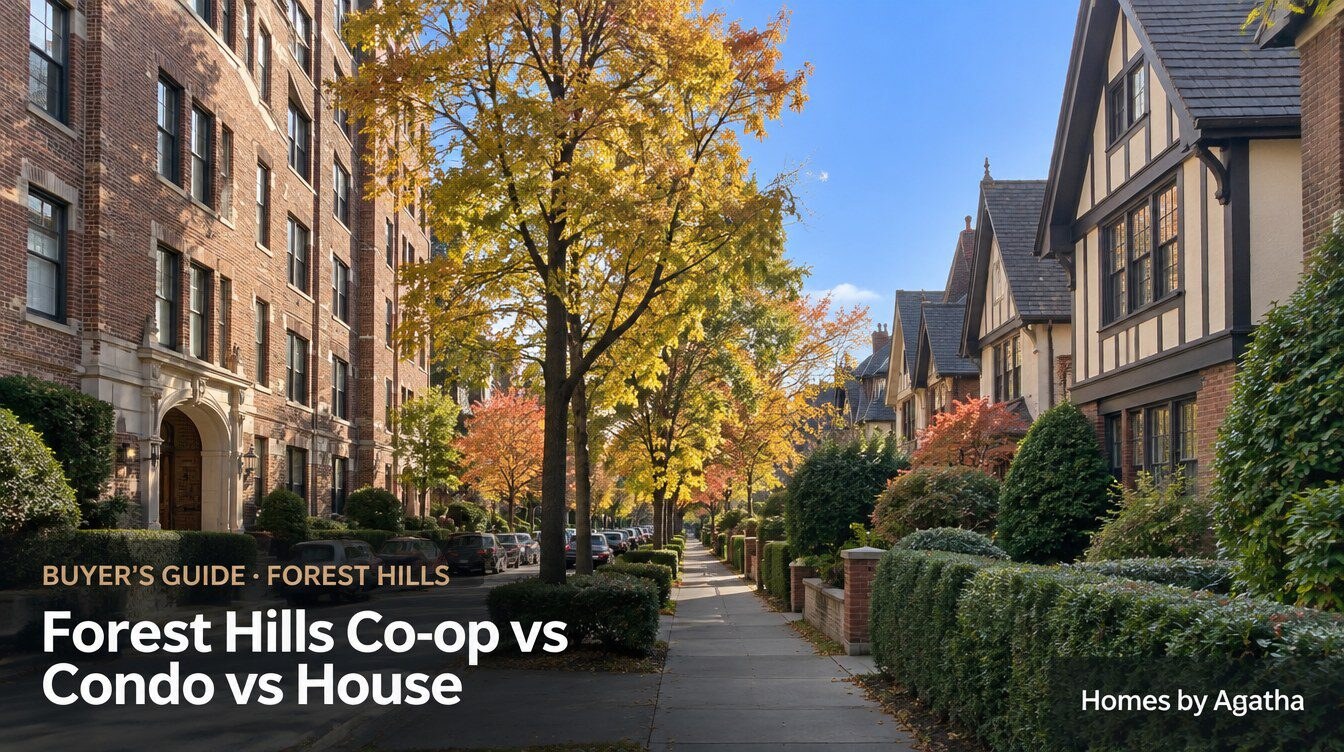
Forest Hills housing falls into three broad groups: cooperative apartment buildings, which make up most of the apartment inventory; condominium units, which are fewer; and houses, concentrated in Forest Hills Gardens and in residential pockets away from Queens Boulevard. Each group follows a different buying process, so it helps to know which one a listing belongs to before you schedule a showing.
Post-war co-op buildings along Queens Boulevard
Queens Boulevard, the wide multi-lane road that runs through the neighborhood, is lined with mid-rise and high-rise elevator buildings, many of them built in the decades after World War II and later operated as cooperatives. Many have elevators, laundry rooms and garage arrangements, and many sit within a short walk of a Queens Boulevard subway station.
A building’s age influences the condition of its risers, elevators, roof and facade, and therefore the likelihood of assessments. Check each building’s construction year and ownership type in NYC Department of Finance and Department of Buildings records and in the offering plan, rather than relying on the listing.
Pre-war co-ops on the side streets
Near Austin Street, Station Square and the edges of Forest Hills Gardens are older pre-war apartment buildings, some with Tudor-revival details. Pre-war units often have larger rooms and original details, but also older plumbing and electrical systems and smaller kitchens; some are walk-ups.
Condominiums
Condo units in Forest Hills are found in newer buildings, in some conversions and in smaller boutique projects. Because condos are less common here than co-ops, buyers who require a condo often widen the search to nearby areas. Buying a home in Rego Park, just northwest along Queens Boulevard, gives access to a similar mix of apartment buildings, and Kew Gardens, to the southeast, adds another set of pre-war buildings.
Houses: Forest Hills Gardens and beyond
Forest Hills Gardens is a planned community south of the Long Island Rail Road tracks, developed beginning around 1909 by the Sage Foundation Homes Company, an affiliate of the Russell Sage Foundation, with architect Grosvenor Atterbury and landscape architect Frederick Law Olmsted Jr. Its houses, many in Tudor-revival and similar styles, sit on curving private streets around Station Square. Outside the Gardens, Forest Hills also has detached houses in residential sections north of Queens Boulevard, plus attached and semi-attached houses in other pockets. Informal sub-area names and edges vary from source to source, so rely on the exact address and public records rather than a neighborhood label.
This mix is why the Forest Hills co-op vs condo decision is rarely abstract: a tight budget may point to co-ops, a plan to rent later to condos, and a wish for outdoor space to a house.
Forest Hills co-op vs condo: what is the real difference for a buyer?
A co-op buyer purchases shares in a corporation that owns the building and receives a proprietary lease to a specific apartment; a condo buyer receives a deed to the unit plus a share of the common elements. That difference decides who approves you, how much you put down, how you are taxed at closing and whether you can rent the apartment out later.
Approval and control
In a cooperative, the board of directors reviews and approves or rejects each purchaser, usually after a written application (the “board package”) and an interview. In a condominium, the board generally does not approve buyers in the same way; many condo bylaws instead give the board a right of first refusal, which means the condo can match the contract terms and buy the unit itself, and boards commonly waive that right after reviewing the sale. The exact process is set by each condo’s bylaws, so your attorney should confirm it.
Monthly costs: maintenance vs. common charges
A co-op owner pays monthly maintenance, which covers the building’s operating costs and, typically, a share of the building’s property taxes and its underlying mortgage. A condo owner pays monthly common charges for building operations and receives a separate property tax bill from the NYC Department of Finance. When you compare a co-op and a condo in Forest Hills, compare the total monthly housing cost: mortgage plus maintenance for the co-op, versus mortgage plus common charges plus property taxes for the condo.
The NYC Department of Finance also administers a Co-op and Condo Property Tax Abatement for qualifying primary residences; in a co-op the benefit usually appears as a maintenance credit. Eligibility rules can change, so confirm them with NYC DOF and ask the managing agent how the building applies the abatement.
Flexibility after you buy
Co-ops typically restrict subletting and require board consent; condos are usually more flexible, within their bylaws. If you might relocate and rent the apartment out, this one difference can decide the Forest Hills co-op vs condo question for you.
| Factor | Forest Hills co-op | Forest Hills condo | Forest Hills house (incl. Gardens) |
|---|---|---|---|
| What you own | Shares plus a proprietary lease | Deeded unit plus share of common elements | Deeded land and building |
| Who must approve you | Co-op board (application and interview) | Usually no approval; board may hold a right of first refusal | No board; Gardens properties are subject to recorded covenants and the Forest Hills Gardens Corporation |
| Monthly costs beyond the mortgage | Maintenance (usually includes share of building taxes and underlying mortgage) | Common charges plus separate property tax bill | Property tax, insurance, utilities, all repairs; Gardens annual charge where applicable |
| Down payment rules | Set by each building, often above lender minimums; confirm with the managing agent | Set by lender and loan program; building must meet lender review | Set by lender and loan program |
| Mortgage recording tax | Not charged on co-op share loans | Charged on the loan amount | Charged on the loan amount |
| Renting it out later | Restricted; board consent and building rules | Generally more flexible, subject to bylaws | Owner’s choice, subject to legal use and the Gardens covenants |
| Typical closing pace | Longer, because of the board package and interview | Moderate; waiver of right of first refusal needed | Moderate; title, survey and records review |
Undecided between a co-op and a condo?
Bring me your budget, your timeline and any plans to rent later, and we can map which Forest Hills ownership types actually fit before you spend weekends at open houses.
How does a Forest Hills co-op board review buyers?
A Forest Hills co-op board reviews your finances, your references and your fit with the building’s written rules, through a board package and usually an interview, after you sign the contract and before closing. Each building sets its own criteria, so two co-ops on the same block of Queens Boulevard can ask for different down payments and different reserves.
What goes into a board package
A board package is the application a co-op buyer submits to the managing agent for the board’s review. It commonly includes the contract, a financial statement, tax returns, employment and bank documentation, the loan commitment, reference letters and signed house-rule acknowledgments, often on the building’s own forms, which the managing agent supplies.
The financial tests boards apply
Co-op boards commonly look at three measures: the share of the price you are financing, your debt-to-income ratio, and the liquid assets you will have left after closing (often called post-closing liquidity). The thresholds are building policy, not law, and many buildings do not publish them. Ask the listing agent and the managing agent early, because an offer that does not meet the building’s thresholds can be accepted by the seller and still fail at the board.
The interview and the decision
If the package is acceptable, the board usually schedules an interview, then approves or rejects the purchase. Co-op boards in New York City must comply with federal, state and city fair housing and human rights laws, which prohibit discrimination based on protected characteristics. Your contract should address what happens to your deposit if the board does not approve the sale; this is a standard point your attorney will negotiate.
House rules that affect daily life
Before you fall for a unit, read the house rules and proprietary lease on renovations, washer-dryers, pets, sublets, storage and move-in procedures. In a co-op, these rules are part of what you are buying.
What should you read before buying a co-op or condo in Forest Hills?
Before signing, read the building’s last two years of audited financial statements, the board or annual meeting minutes your attorney can obtain, the offering plan and amendments for a condo or newer co-op, and any notice of assessments or upcoming capital projects. In older Forest Hills buildings, the financial statements and the building’s compliance with city facade and energy laws tell you more about future monthly costs than the apartment itself.
Financial statements and the underlying mortgage
A co-op’s underlying mortgage is the loan the corporation itself owes, secured by the building. Its balance, rate and maturity date affect maintenance, and a maturity in the next few years means refinancing risk. Your attorney should also check reserves, operating results and how much commercial or garage income supports the building, because these figures differ from one building to the next.
Local Law 11 facade inspections
New York City’s Facade Inspection and Safety Program, created under Local Law 11 of 1998, requires owners of buildings taller than six stories to have exterior walls inspected every five years and to repair unsafe conditions. Many Forest Hills elevator buildings along Queens Boulevard are tall enough to be covered. Ask what the most recent facade report found, whether repairs are pending and whether sidewalk sheds are up, and check the building’s current facade filing status in NYC Department of Buildings records.
Local Law 97 energy limits
Local Law 97 of 2019 sets greenhouse-gas emission limits for most New York City buildings larger than 25,000 gross square feet, with penalties for buildings that exceed them. Many Forest Hills co-op and condo buildings fall in that size range; ask the managing agent how the building intends to comply, how the cost will be funded and whether any assessment is planned.
Condo-specific documents
For a condo, your attorney reviews the offering plan, declaration, bylaws, budget, reserves and any litigation. In a sponsor sale, where the developer sells a newly created unit, some contracts shift costs a reseller would normally pay, such as transfer taxes, to the buyer.
Key Takeaways
- In a Forest Hills co-op, the board’s financial thresholds can stop a deal the seller already accepted; learn them before you offer.
- Compare total monthly cost: co-op maintenance already includes a share of building taxes, condo common charges do not.
- Read the financial statements for the underlying mortgage, reserves and commercial income.
- Ask about Local Law 11 facade status and Local Law 97 energy compliance in larger buildings.
Want help reading a building before you offer?
We can list the documents to request from the managing agent and the questions your attorney should ask about assessments, reserves and the underlying mortgage.
What changes when you buy a house in Forest Hills Gardens?
A house in Forest Hills Gardens comes with private obligations on top of normal city rules: the property is subject to recorded covenants and restrictions, owners pay an annual charge to the Forest Hills Gardens Corporation, and exterior changes may need the Corporation’s approval. Your attorney should review those obligations during title review, before you sign a contract.
The Forest Hills Gardens Corporation and the Declaration of Restrictions
Forest Hills Gardens properties are subject to covenants and restrictions that the developer, the Sage Foundation Homes Company, imposed in a Declaration dated April 18, 1913, recorded in the Queens County Clerk’s Office, as described in New York court decisions involving the community. The developer’s rights under the Declaration were assigned in 1923 to the Forest Hills Gardens Corporation, the property owners’ organization that maintains the community’s private streets, sidewalks and green spaces. Court decisions also describe the Declaration as providing for an annual charge on owners and for unpaid charges to become a lien on the land. Ask the Corporation for the current charge and the property’s payment status, and have a New York attorney review how the charge is calculated and collected.
Exterior changes and architectural review
The recorded restrictions can limit exterior changes and additions, and some work may require the Corporation’s approval. For a buyer, this matters in two ways. First, if you plan to change windows, roofs, fences, driveways or additions, ask the Corporation which approvals, forms and fees currently apply, in addition to any NYC Department of Buildings permits. Second, ask whether past exterior changes on the house you are buying were approved, because unapproved work can become your problem after closing.
Private streets, parking and through traffic
The streets in Forest Hills Gardens are private and maintained by the Corporation, not by the City, so parking and street rules there can differ from those on ordinary city blocks. Ask the Corporation about current parking rules and any permit procedures before you count on street parking. If off-street parking matters to you, confirm whether the house has a garage or driveway and whether it is legal and deeded.
Houses outside the Gardens
Houses elsewhere in Forest Hills are not subject to the Gardens covenants unless their deeds say otherwise. Confirm legal use and unit count on the Certificate of Occupancy, the NYC Department of Buildings document that states a building’s legal use and occupancy; many pre-1938 houses lawfully have none, as the DOB explains on its Certificate of Occupancy page.
How much cash do you need for a co-op, condo or house in Forest Hills?
You need the down payment, closing costs and reserves. Co-op buyers avoid the mortgage recording tax but often face higher building-set down payments and reserve requirements; condo and house buyers pay mortgage recording tax and title insurance. Purchases of $1 million or more add the mansion tax.
Closing taxes that apply in Forest Hills
Forest Hills is in New York City, so both city and state transaction taxes apply. Under the rates published by the NYC Department of Finance and New York State, the mortgage recording tax on one-to-three-family homes and condos is roughly 1.8% of the loan amount for loans under $500,000 and 1.925% for loans of $500,000 and above. Co-op loans are share loans and are not subject to mortgage recording tax. The New York State “mansion tax” is 1% of the price on residential purchases of $1 million or more and is paid by the buyer; within New York City it is graduated above $2 million. The NYS real estate transfer tax and the NYC Real Property Transfer Tax are customarily paid by the seller, except where a contract, such as some sponsor condo contracts, shifts them. Confirm current rates with the NYS Department of Taxation and Finance and NYC Department of Finance before closing.
| Cost item | Co-op | Condo | House | Upfront or ongoing |
|---|---|---|---|---|
| Mortgage recording tax | Not charged on share loans | Charged on loan amount | Charged on loan amount | Upfront |
| Mansion tax ($1M and above) | Applies | Applies | Applies | Upfront |
| Title insurance | Not used; a lien search on the shares instead | Owner’s and lender’s policies | Owner’s and lender’s policies; survey | Upfront |
| Building or community fees | Application, credit check and move-in fees set by each building | Application and move-in fees; sometimes working-capital contribution in sponsor sales | Gardens: annual charge to the Corporation where applicable | Upfront and ongoing |
| Attorney fees | Contract, board process and closing | Contract, offering-plan review and closing | Contract, title, survey and closing | Upfront |
| Lender fees and appraisal | Share-loan fees; recognition agreement with the co-op | Standard fees; building questionnaire | Standard fees | Upfront |
| Monthly building charge | Maintenance (includes building taxes) | Common charges | None (house owner pays all costs directly) | Ongoing |
| Property tax | Included in maintenance | Separate DOF bill | Separate DOF bill | Ongoing |
| Assessments and capital projects | Possible; check minutes | Possible; check budget and reserves | Owner pays for roof, facade, systems | Ongoing |
For a line-by-line view of typical buyer costs across the borough, see Queens closing costs explained. Ask your attorney and loan originator for a written estimate before you sign.
The reserve question in co-ops
Because many Forest Hills co-op boards look at post-closing liquidity, the cash you keep after closing can matter as much as the cash you spend. A buyer left with little in the bank after a maximum down payment may look weaker to a board than one who puts down less, provided the building’s minimum is met. Also ask how maintenance has changed in recent years; a low charge that jumps after a refinancing is not a bargain.
Building your Forest Hills budget?
Let’s line up down payment, closing taxes, reserves and monthly charges for each property type you are considering, so your offer matches your real numbers.
How does financing differ for a Forest Hills co-op, condo or house?
A co-op is financed with a share loan, which only some lenders offer and which must fit the building’s own down-payment and financing rules; a condo or house is financed with a standard mortgage, but a condo building must also pass the lender’s project review. Get pre-approved for the specific property type you are targeting.
Share loans and recognition agreements
A share loan is a loan secured by your co-op shares and proprietary lease rather than by real property. The lender, the co-op and the buyer typically sign a recognition agreement, in which the co-op acknowledges the lender’s interest. Not every lender makes share loans, and some lenders limit which buildings they lend in. Ask your NMLS-registered loan originator whether they have closed share loans in Forest Hills buildings and whether they need to review the building’s financials first.
Condo project review
For a condo, the lender reviews the building as well as the borrower, often through a questionnaire completed by the managing agent. Factors such as owner-occupancy levels, reserves, pending litigation and commercial space can affect which loan programs are available; an NMLS-registered loan originator can confirm the current project-review requirements.
Pre-approval that names the property type
Pre-approval is a lender’s conditional commitment based on your verified income, assets and credit. A Forest Hills pre-approval should say whether it covers a co-op share loan, a condo or a house. A co-op seller wants to see that your lender makes share loans. If you are buying for the first time, our first-time home buyer guide for Queens explains the documents lenders request.
How do the subway and LIRR affect where you buy in Forest Hills?
Forest Hills–71 Av is the neighborhood’s main station: the E and F stop there at all times and run express toward Manhattan except late nights, the R begins and ends its route there except late nights, and the M does so on weekdays, so homes within a short walk of 71st Avenue and Queens Boulevard usually have the widest choice of trains. The 75 Av and 67 Av stations and the Long Island Rail Road Forest Hills station at Station Square give other blocks their own options.
Forest Hills–71 Av, 75 Av and 67 Av
The Queens Boulevard line runs beneath Queens Boulevard. At Forest Hills–71 Av, riders can switch between express and local trains. The 75 Av station, toward Kew Gardens and Briarwood, is served by the F, with E trains also stopping at some hours; the 67 Av station, toward Rego Park, by the R and, on weekdays, the M. On evenings, weekends and late nights the M does not run to Forest Hills, so check MTA schedules for the hours you travel. A co-op near 67th Avenue and a Gardens house south of the railroad can have very different commutes.
The Long Island Rail Road at Station Square
The Long Island Rail Road’s Forest Hills station sits at Station Square, on 71st (Continental) Avenue between Austin Street and Burns Street, at the entrance to Forest Hills Gardens. It is on the LIRR Main Line between Woodside and Kew Gardens, with trains toward Manhattan terminals and toward Jamaica and Long Island. The MTA has announced station work and service changes at Forest Hills and Kew Gardens through 2027, so check the current LIRR timetable or the TrainTime app for stop patterns at your hours.
Driving, parking and event nights
Drivers reach the Grand Central Parkway, the Long Island Expressway, the Jackie Robinson Parkway and the Van Wyck Expressway from different edges of Forest Hills, depending on the block. In co-op buildings, garage spaces may be limited or waitlisted; ask the managing agent how spaces are assigned. Forest Hills Stadium, the concert venue at the West Side Tennis Club inside Forest Hills Gardens, draws crowds on event nights, so buyers near Station Square should visit on one. Forest Park, along the southern edge, is the neighborhood’s largest green space.
Key Takeaways
- Forest Hills–71 Av offers E and F service at all times plus the R and, on weekdays, the M, so walk time to 71st Avenue often shapes the shortlist.
- The LIRR Forest Hills station at Station Square offers a rail alternative toward Manhattan terminals and Jamaica; check stop frequency for your hours.
- Forest Hills Gardens houses come with recorded covenants, an annual charge and possible Corporation approval for exterior changes.
- Get a pre-approval that names the property type; share loans are not offered by every lender.
Narrowing your Forest Hills shortlist?
We can compare buildings and blocks by station access, building rules and monthly cost, then schedule showings only where the numbers and the commute work.
What should you inspect and verify on a Forest Hills property?
In a co-op or condo, inspect the apartment’s own systems and verify the building’s condition through documents; in a house, inspect everything from roof to sewer line and verify legal use with the NYC Department of Buildings.
Inside a co-op or condo apartment
A targeted inspection of an apartment in an older building can be worthwhile. Check electrical capacity, windows, plumbing fixtures, radiators and signs of leaks from above. In pre-war buildings, ask whether the building restricts renovations such as moving kitchens or bathrooms over living space below.
Who is responsible for what
In a co-op, the proprietary lease divides repair responsibility between shareholder and corporation; in a condo, the declaration and bylaws do. Windows, risers and radiators are common gray areas, so read those sections before you buy.
For a house: roofs, systems and records
Older Forest Hills houses, in the Gardens and elsewhere, often have slate or tile roofs, masonry and stucco exteriors and decades-old heating plants. Ask the inspector to evaluate the roof, chimneys, heating, electrical service and sewer line. If a house converted from oil to gas, ask for proof the old tank was removed or abandoned, and search DOB records for open permits and violations.
Flood and stormwater exposure
Forest Hills is inland, but heavy rain can still affect low-lying blocks and below-grade spaces. Check the address on the FEMA Flood Map Service Center and on the NYC Stormwater Flood Maps, which model flooding from intense rainfall rather than coastal storm surge. Federally regulated lenders generally require flood insurance in Special Flood Hazard Areas. Check the specific address on both maps rather than assuming any block is in or out of a flood zone.
Lead paint in older buildings
Federal law requires sellers of most housing built before 1978, including co-op and condo units, to disclose known lead-based paint hazards and offer buyers a chance to test. Expect this disclosure in most Forest Hills buildings.
How do offers, contracts and buyer representation work in Forest Hills?
In New York, an accepted offer is not a contract. After the seller accepts your offer, the buyer’s and seller’s attorneys negotiate the contract of sale, and the deal becomes binding only when both sign and the deposit is paid. In a co-op, the contract is also typically conditioned on board approval.
The attorney-state process
New York is an attorney state for residential sales: attorneys, not brokers, prepare and negotiate the contract. Between acceptance and signing, your attorney reviews the building documents or title, and you complete any inspection. For a Forest Hills co-op, your attorney reads the financials, minutes and proprietary lease; for a Gardens house, your attorney also reviews the recorded covenants and the status of any Corporation charges.
What makes a Forest Hills offer strong
For a co-op, sellers look for buyers likely to pass the board: a down payment at or above the building’s minimum, a lender that makes share loans, and finances that meet the building’s ratios. For a condo or house, sellers weigh the financing type, down payment, contingencies and closing date.
Buyer representation in 2026
Under the rules in effect in 2026, following the 2024 NAR settlement, you sign a written agreement with your buyer’s agent before touring homes. Buyer-agent compensation is negotiable, not set by law and not automatically paid by the seller; the agreement states the amount and how it will be paid. At the first substantive contact, a New York licensee must give you the NYS Disclosure Form for Buyer and Seller, which explains the agency relationships available to you. For a deeper explanation, read working with a buyer’s agent in NY.
In a co-op purchase, a buyer’s agent also requests building information early and helps you assemble the board package. I work with buyers in English or Polish; that choice is about communication and comfort, and where you decide to buy is always your choice.
Preparing to offer on a Forest Hills co-op?
Before you write a number, let’s check the building’s down-payment rule and financial thresholds and organize the file a board will expect.
What is the timeline from offer to closing in Forest Hills?
A condo or house purchase moves from accepted offer to contract, mortgage commitment, title and closing; a co-op purchase adds the board package, the interview and the board’s decision between the mortgage commitment and closing. That extra stage is why co-op closings in Forest Hills typically take longer.
| Stage | Co-op | Condo | House (incl. Gardens) | Common delay risk |
|---|---|---|---|---|
| 1. Pre-approval | Share-loan pre-approval | Mortgage pre-approval | Mortgage pre-approval | Lender does not lend in the building |
| 2. Offer and acceptance | Terms agreed; not binding | Terms agreed; not binding | Terms agreed; not binding | Down payment below the building’s minimum |
| 3. Due diligence and contract | Financials, minutes, lease review; contract signed | Offering plan, budget review; contract signed | Inspection, title, covenants, CO review; contract signed | Assessment or facade project discovered |
| 4. Financing | Loan commitment; recognition agreement | Loan commitment; building questionnaire | Loan commitment; appraisal | Condo fails lender review; low appraisal |
| 5. Building or community step | Board package, interview, approval | Right-of-first-refusal waiver | Gardens: confirm charges and approvals with the Corporation | Incomplete board package |
| 6. Closing | Stock and lease transferred; time and place arranged by the attorneys and the managing agent | Deed and mortgage recorded | Deed and mortgage recorded | Final walkthrough issues; move-in scheduling with the building |
Ask the managing agent how often the board meets, so your rate lock and moving dates fit the building’s calendar.
What mistakes do Forest Hills buyers make, and what belongs on your checklist?
The most common mistakes are choosing a property type before checking its rules, offering on a co-op without knowing the building’s financial thresholds, and comparing monthly costs incorrectly between co-ops and condos. Each is avoidable with a short checklist.
Mistakes to avoid
- Treating every apartment as the same product. In the Forest Hills co-op vs condo decision, the legal structure matters as much as the layout.
- Ignoring the building’s balance sheet. A low maintenance figure can hide an upcoming refinancing, facade project or Local Law 97 upgrade.
- Assuming Gardens rules are optional. The covenants and annual charge run with the land.
- Relying on a generic pre-approval. A letter that does not mention a share loan weakens a co-op offer.
- Not comparing neighboring areas. If Forest Hills inventory does not fit, look at homes in Middle Village, Rego Park or Kew Gardens.
Forest Hills buyer checklist
- Decide which ownership types fit: co-op, condo, house, or a short list of two.
- Get pre-approved for that property type, including a share loan if you are considering co-ops.
- Sign a written buyer agreement and review the NYS Disclosure Form for Buyer and Seller.
- For each co-op, learn the minimum down payment, financial thresholds, sublet and pet policies before offering.
- Request financial statements, house rules, assessment history and Local Law 11 and Local Law 97 status.
- For a Gardens house, have your attorney review the covenants, Corporation charges and approvals for past exterior work.
- For any house, verify legal use on the Certificate of Occupancy or other DOB records and inspect roof, systems and sewer line.
- Check FEMA and NYC Stormwater Flood Maps for the exact address.
- Build a monthly cost table for each option, including maintenance or common charges, taxes and insurance.
- Time your walk to 71 Av, 75 Av, 67 Av or the LIRR at the hour you commute, and visit near Station Square on an event night.
If you already own in the area and are thinking about the other side of the transaction, the companion page on how to sell your home in Forest Hills covers the seller’s perspective.
Have a Forest Hills listing in mind?
Send me the address and we can review the building’s rules, likely board requirements and the documents to request before you commit to an inspection or offer.
Frequently asked questions about co-ops, condos and houses in Forest Hills, Queens
Is it better to buy a co-op or a condo in Forest Hills?
The answer comes from your plans, not a universal rule. Forest Hills co-ops often cost less to buy but require board approval, building-set down payments and sublet limits. Condos give you a deed and more rental flexibility, usually at a higher price and with mortgage recording tax on the loan. Compare total monthly costs and future plans.
Why are there so many co-ops in Forest Hills, Queens?
Much of Forest Hills’ apartment stock consists of pre-war and post-war elevator and walk-up buildings, especially along Queens Boulevard and near Austin Street, and many of those buildings operate as cooperatives. As a result, co-op apartments usually outnumber condo units in Forest Hills listings, and buyers who need a condo often compare nearby Rego Park or Kew Gardens.
What does a Forest Hills co-op board look for in a buyer?
Boards review the board package, which includes a financial statement, tax returns, bank statements, references and the loan commitment. They commonly evaluate the financed share of the price, debt-to-income ratio and liquid assets remaining after closing. Thresholds are set by each building, so ask the managing agent before you make an offer.
Do co-op buyers in Forest Hills pay mortgage recording tax?
No. A co-op purchase is financed with a share loan secured by shares and a proprietary lease, and co-op share loans are not subject to New York City mortgage recording tax. Condo and house buyers who finance pay it on the loan amount. The New York State mansion tax still applies to residential purchases of $1 million or more.
What is Forest Hills Gardens and what rules apply to its houses?
Forest Hills Gardens is a planned community in Forest Hills, Queens, begun around 1909 by the Sage Foundation Homes Company. Its properties are subject to recorded covenants from 1913 and an annual charge to the Forest Hills Gardens Corporation, which maintains the private streets. Exterior changes may need Corporation approval, so ask the Corporation about current rules.
Which subway station is best for commuting from Forest Hills?
Forest Hills–71 Av offers the most choices: the E and F stop there at all times, the R begins and ends there except late nights, and the M does so on weekdays. Nearby, 75 Av is served by the F, and 67 Av by the R and weekday M. The LIRR station at Station Square adds a commuter-rail option.
Can I rent out my Forest Hills co-op apartment later?
Only if the building’s proprietary lease and sublet policy allow it. Many co-ops limit subletting, may require a period of owner occupancy first, charge sublet fees and require board approval of each subtenant. Condos are usually more flexible but still follow their bylaws. Read the sublet policy before you buy, not after.
What is Local Law 97 and why does it matter for Forest Hills buildings?
Local Law 97 is a New York City law that sets greenhouse-gas emission limits for most buildings over 25,000 gross square feet, with penalties for exceeding them. Many Forest Hills co-op and condo buildings are that large. Ask how the building plans to comply, because upgrades or penalties can affect maintenance and assessments.
How long does it take to close on a co-op in Forest Hills?
A co-op closing usually takes longer than a condo or house closing because it adds a board package, interview and board decision after the contract and mortgage commitment. The exact time depends on the lender, the completeness of your package and how often the board meets. Ask the managing agent about the board’s schedule early.
Do I need a buyer’s agent agreement before touring apartments in Forest Hills?
Yes. Under the rules in effect in 2026, buyers sign a written agreement with their agent before touring. The agreement states the agent’s compensation, which is negotiable, not set by law and not automatically paid by the seller. You should also receive the NYS Disclosure Form for Buyer and Seller at first substantive contact.
Your next step in Forest Hills
The right answer to the Forest Hills co-op vs condo question comes from your plans, not from the listing photos. A co-op can lower your entry price and closing taxes but asks you to pass a board and live by building rules; a condo trades a higher price for deeded ownership and flexibility; a house, especially in Forest Hills Gardens, adds land, private covenants and full responsibility for the building. Decide which structure fits, get pre-approved for it and read the documents before signing. When you are ready to search, the page on how to buy your home in Forest Hills, Queens with Agatha explains how we can tour, review buildings and negotiate together.
Start your Forest Hills search with a clear plan
A short conversation about ownership type, budget and commute can save weeks of showings in buildings that never fit. English or Polish, whichever you prefer.
This article is for general informational purposes only and reflects conditions that may change. It is not legal, tax, or financial advice, an appraisal, or a guarantee of price or outcome; consult a licensed New York attorney, a CPA, and an NMLS-registered mortgage loan originator as appropriate. A CMA is an opinion of value, not an appraisal. Real estate brokerage services are offered by Agatha Lubas, Licensed Associate Real Estate Broker, NY License #10301213345, Keller Williams Realty Liberty, 96-10 101st Avenue, Ozone Park, NY 11416. The NYS Disclosure Form for Buyer and Seller, the NYS Housing and Anti-Discrimination Disclosure / Fair Housing Notice, and the brokerage’s Standard Operating Procedures are available on request. Equal Housing Opportunity.

Agatha Lubas helps buyers, sellers and investors across Queens, Brooklyn, Nassau County and Suffolk County compare properties and the legal structures behind them before they commit. She works in English and Polish so clients can communicate in the language they find most comfortable.
Work with Agatha