

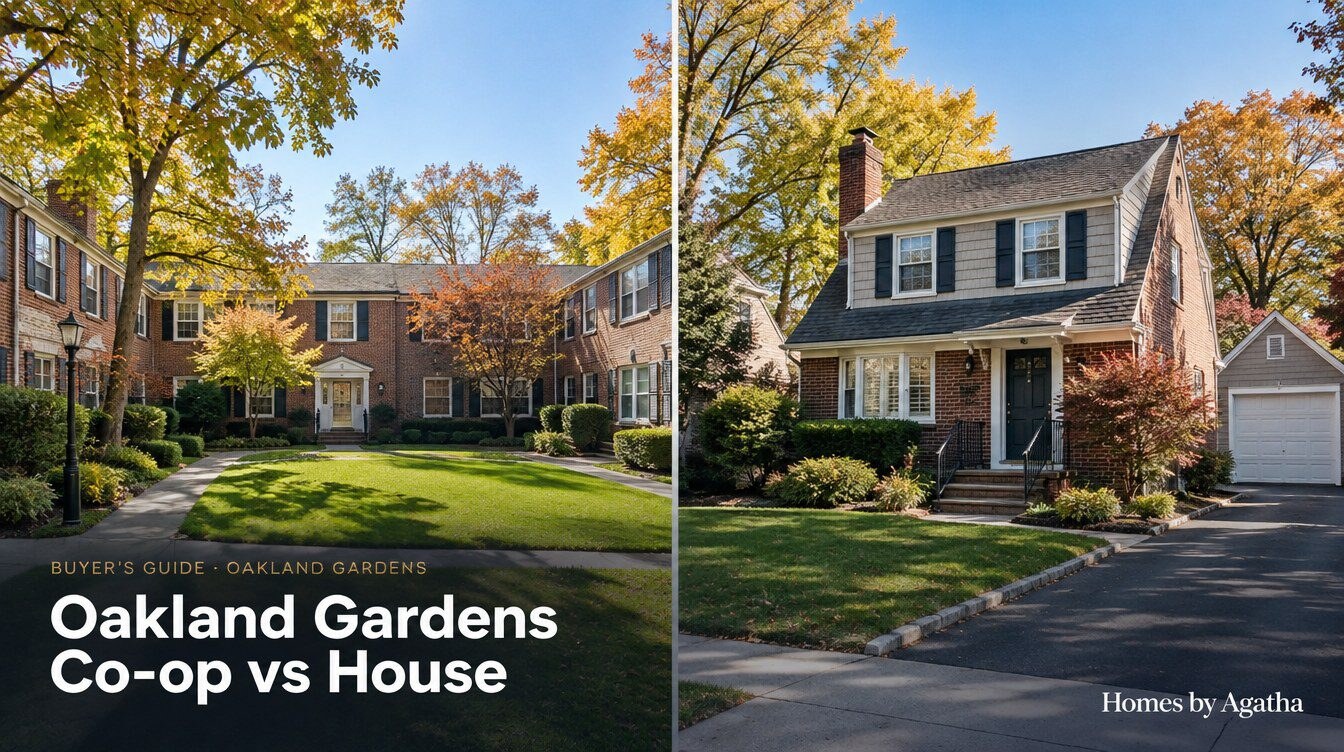
OAKLAND GARDENS REAL ESTATE GUIDE
Oakland Gardens Co-op vs House: How to Choose and Buy in Queens
Quick Answer
In Oakland Gardens, Queens (ZIP 11364), most buyers choose between a garden co-op apartment and a postwar one- or two-family house. A co-op means board approval, monthly maintenance and building rules but lower entry cash. A house means full control, property taxes, repairs and a mortgage recording tax at closing.
The Oakland Gardens co-op vs house question is usually the first real decision a buyer makes in this corner of northeast Queens. Queens Community Board 11 describes Oakland Gardens as a neighborhood developed largely in the 1950s, with single-family homes, two-family homes and large cooperative garden apartment complexes. Those are two very different purchases that happen to share a ZIP code.
A garden co-op apartment is bought through a share transfer, approved by a board and paid for partly through monthly maintenance. A house is bought through a deed, financed with a conventional mortgage and maintained entirely by you. Paperwork, closing costs, lending, inspections and timeline all differ.
This guide lays those differences side by side so you can decide which path fits your budget, your timeline and how you want to live. As a Licensed Associate Real Estate Broker serving Queens and the surrounding New York markets, I help buyers compare property types before they commit to one, in English and in Polish. When you are ready to look at what is available, the Oakland Gardens home-buying page explains how we can search together.
Oakland Gardens at a glance
| Item | Oakland Gardens, Queens |
|---|---|
| Area | Northeast Queens, New York City; one of the neighborhoods of Queens Community District 11, alongside Bayside, Auburndale, Douglaston–Little Neck and Hollis Hills |
| Borough / county | Queens (Queens County), New York City |
| Approximate boundaries | Queens Community Board 11 describes Oakland Gardens as lying south of the Long Island Expressway and north of 73rd Avenue, from Oceania Street to the Cross Island Parkway. Other sources draw the lines differently, and some complexes south of 73rd Avenue are marketed under the Oakland Gardens name. |
| ZIP code | 11364; the USPS lists “Oakland Gardens” as the primary city name, with “Bayside” and “Hollis Hills” among accepted alternates |
| Subway / rail | No subway or LIRR station inside the neighborhood; LIRR Port Washington Branch stations, such as Bayside, lie to the north of the Long Island Expressway; check the walking or bus connection from a specific address |
| Buses | Local buses on Springfield Boulevard, 73rd Avenue and the Horace Harding Expressway corridor, plus express buses to Manhattan; check the current MTA bus map for routes and stops |
| Highways | Long Island Expressway (I-495) on the northern edge; Clearview Expressway (I-295) to the west; Cross Island Parkway to the east; Grand Central Parkway to the south beyond Hollis Hills |
| Parks | Alley Pond Park on the east side; Cunningham Park on the west side; the historic Vanderbilt Motor Parkway route runs through the area |
| Commercial streets | Queens Community Board 11 describes a small commercial strip on Union Turnpike at Springfield Boulevard, to the south, and a busy commercial district on Bell Boulevard in Bayside, to the north; check a map for the stores closest to a specific address |
| Typical property types | Garden co-op apartments in large low-rise complexes; detached one-family houses, including the homes Community Board 11 refers to as Tall Oaks; two-family houses |
| Key local housing considerations | Co-op board rules and building finances; 2010 contextual rezoning (much of the area mapped R2A); legal use on the Certificate of Occupancy; 1950s-era house systems; stormwater; car-dependent commuting and parking |
What is the Oakland Gardens co-op vs house decision really about?
The Oakland Gardens co-op vs house decision is about ownership structure first and space second. A co-op gives you shares in a corporation and the right to occupy one apartment under the building’s rules; a house gives you the land, the building and every obligation that comes with them. Price, monthly cost, approval and responsibility all follow from that difference.
The garden co-op complexes
A garden apartment complex is a group of low-rise buildings, usually two or three stories, arranged around lawns, courtyards and walkways rather than stacked into a tower. Oakland Gardens has several of these complexes, many built in the postwar years and later converted to cooperative ownership. Units typically range from studios and one-bedrooms to two-bedroom apartments, and some complexes include upper and lower duplex-style layouts. Layouts and unit mix differ from complex to complex, so confirm them with the listing and the managing agent.
Windsor Park, a large garden co-op near Cunningham Park and Bell Boulevard, is one of the best-known complexes in the area and is commonly marketed with an Oakland Gardens or Bayside address. Community Board 11’s own description, however, places Oakland Gardens north of 73rd Avenue and treats the area south of 73rd Avenue as Hollis Hills, so a complex on that side may sit outside the board’s Oakland Gardens lines even when listings use the name. Garden co-ops also line streets such as Springfield Boulevard and 64th Avenue. Be careful with complex names in online searches: Hilltop Village, for example, sits on Francis Lewis Boulevard in ZIP code 11427 and is outside Oakland Gardens, even though it often appears in the same garden co-op searches.
The houses
The house side of Oakland Gardens is mostly detached one-family homes from the postwar building period, along with two-family houses. Community Board 11 refers to a group of single-family homes in the area as the Tall Oaks homes. Many houses have driveways, garages and rear yards, and some back onto or sit within a few blocks of Alley Pond Park or Cunningham Park.
Why the choice is sharper here than in many Queens neighborhoods
Community Board 11 describes Oakland Gardens’ apartment housing as large cooperative garden apartment complexes, so for many buyers the realistic comparison here is co-op versus house, not co-op versus condo. Ownership form is set building by building, so confirm it for any specific listing through ACRIS, the city’s online register of recorded property documents, or with the listing broker and your attorney.
| Factor | Garden co-op apartment | One-family house | Two-family house |
|---|---|---|---|
| What you own | Shares in a cooperative corporation plus a proprietary lease | Land and building (fee simple) | Land and building, including the second unit |
| Who must approve you | The co-op board, after an application package and usually an interview | Seller and lender | Seller and lender |
| Monthly costs besides the loan | Maintenance, which typically includes a share of the building’s property taxes and any underlying mortgage | Property tax, insurance, utilities, all repairs | Same as a one-family house, plus landlord costs; rent may offset part of the payment |
| Exterior, roof, grounds | Handled by the co-op, funded through maintenance and any assessments | Your responsibility | Your responsibility |
| Renting it out | Limited by the co-op’s sublet policy, which differs by building | Your decision, subject to law | Second unit can be rented if it is legal |
| Renovations | Need board or managing-agent approval and an alteration agreement | Need Department of Buildings permits where required | Same as a house; legal unit count cannot change without approvals |
| Key document to review | Financial statements, house rules, proprietary lease | Certificate of Occupancy, survey, title report | Certificate of Occupancy confirming two legal units |
How does buying a garden co-op in Oakland Gardens work?
Buying a garden co-op in Oakland Gardens means agreeing on a price with the seller, signing a contract through attorneys, and then winning the approval of the co-op board. The board reviews a detailed financial application and usually interviews you; the sale cannot close until the board consents.
Shares, the proprietary lease and the house rules
A cooperative, or co-op, is a corporation that owns the land and buildings. Each buyer purchases shares allocated to a specific apartment and receives a proprietary lease, which is the long-term lease that gives the shareholder the right to live in that unit. The house rules, set by the board, cover everyday matters such as pets, laundry machines, renovations, parking, move-in hours and subletting. In a garden complex, the rules can also cover grounds use, storage rooms and shared amenities.
The board package
The board package is the application a co-op requires before it will approve a buyer. It typically includes tax returns, pay stubs, bank and investment statements, a letter from your employer, reference letters, a credit report authorization and the signed contract. Your lender’s commitment letter is usually part of it when you finance. The managing agent, which is the company that runs the co-op’s day-to-day operations, collects the package and passes it to the board.
Each co-op sets its own approval criteria. Common items include a minimum down payment, a maximum debt-to-income ratio and a requirement that you keep a certain amount of cash or liquid assets after closing. These thresholds vary by building, and some co-ops do not publish them until asked. Ask for the co-op’s written purchase requirements before you make an offer, because a unit you can afford on paper may still fall outside the building’s rules.
The interview and the decision
If the package passes the first review, the board usually schedules an interview. Treat it as a professional meeting: the board wants to confirm that the information is accurate and that you understand the rules. Under New York law, a board cannot reject a buyer for discriminatory reasons, and boards have generally not been required to explain a decision. Proposals to require written reasons have been debated, so ask your attorney which rules apply when you apply. Your attorney will explain how the contract handles a board rejection, which is normally a reason the buyer can cancel and recover the deposit.
Questions worth asking about a garden co-op
- What does maintenance include: heat, hot water, gas, electricity, real estate taxes? The answer differs from one co-op to the next.
- Is there an underlying mortgage on the property, when does it mature and is refinancing planned?
- Have there been recent assessments, and are capital projects such as roofs, boilers or paving planned?
- What is the policy on subletting, pets, in-unit washers and dryers, and air-conditioner installation?
- Is parking available on site, how is it assigned and is there a waiting list or monthly fee?
- Is there a flip tax, and who pays it? A flip tax is a transfer fee set by each co-op’s own documents; there is no city-wide rate.
Torn between a garden co-op and a house?
Tell me your budget, your commute and how much upkeep you want to take on. I will help you compare the two paths in Oakland Gardens with real numbers from your own pre-approval, not guesses.
What will you pay each month: co-op maintenance or house carrying costs?
A co-op owner pays a mortgage on a share loan plus monthly maintenance; a house owner pays a mortgage plus property taxes, insurance, utilities and every repair. Maintenance can look high next to a mortgage, but it already bundles costs that a house owner pays separately, so compare total monthly outlay, not single line items.
What co-op maintenance covers
Maintenance is the monthly charge each shareholder pays to the co-op. It typically includes a share of the building’s real estate taxes and of any underlying mortgage, plus operating costs such as building insurance, staff or contractors, landscaping, snow removal, exterior repairs, and in many complexes heat and hot water. What is included varies by building, so ask the managing agent for a written breakdown. Your share is usually based on the number of shares allocated to your apartment.
Part of the maintenance that goes to real estate taxes and mortgage interest may be tax-deductible for some owners; the co-op’s accountant typically reports the deductible share each year. Some New York City co-op owners also benefit from the Cooperative and Condominium Property Tax Abatement administered by the NYC Department of Finance. The co-op board applies on behalf of the whole development, and the credit goes to units that are the owner’s primary residence; developments receiving certain other benefits, such as J-51 or 421-a, are not eligible. A CPA can tell you how these apply to you.
What a house owner pays instead
A house owner pays the NYC Department of Finance directly (most one- to three-family houses are in tax class 1), buys a full homeowners policy and pays every utility and repair. Those repairs arrive unevenly, which is why a reserve matters more for a house than for a co-op.
| Monthly or annual cost | Garden co-op owner | House owner |
|---|---|---|
| Loan payment | Share loan (if financed) | Mortgage (if financed) |
| Property taxes | Included in maintenance as a share of the building’s bill | Paid directly to the NYC Department of Finance, often through a lender escrow |
| Building or home insurance | Master policy in maintenance; you buy a separate contents and liability policy | Full homeowners policy; flood insurance if required or chosen |
| Heat and hot water | Often included in maintenance; confirm for each co-op | Paid directly (gas, oil or electric) |
| Water and sewer | Usually paid by the co-op | Billed to the owner |
| Exterior repairs, roof, grounds, snow | Co-op’s responsibility, through maintenance and assessments | Owner’s responsibility, paid when needed |
| Interior repairs and appliances | Generally the shareholder’s responsibility, per the proprietary lease | Owner’s responsibility |
| Surprise costs | Special assessments voted by the board | Major system failures |
How much cash do you need at closing for a co-op compared with a house?
A financed house purchase in Oakland Gardens usually needs more closing cash than a co-op at a similar loan size, mainly because house loans carry the New York City mortgage recording tax and house buyers pay for title insurance. Co-op share loans are not subject to mortgage recording tax, but co-ops often require a larger down payment.
Closing costs by property type
Closing costs are the taxes and fees paid at or before closing in addition to the down payment. The table below follows the official rules as published; our guide to Queens closing costs walks through each item in more detail.
| Buyer cost | Source of the rule | Garden co-op | House |
|---|---|---|---|
| NYC mortgage recording tax | NYC Department of Finance / NYS: roughly 1.8% of the loan amount for loans under $500,000 and 1.925% for $500,000 and above on 1–3 family homes and condos | Not applicable; co-op loans are share loans and are not subject to mortgage recording tax | Applies when you finance |
| NYS “mansion tax” | NYS Department of Taxation and Finance: 1% of the price on residential purchases of $1 million or more, paid by the buyer; graduated above $2 million in New York City | Only at $1 million or more | Only at $1 million or more |
| Title insurance and title search | Regulated rates; quoted by the title company | Usually replaced by a lien search on the shares and the seller | Yes |
| Buyer’s attorney | Negotiated | Yes; includes board-package and closing coordination | Yes |
| Lender fees, appraisal, bank attorney | Set by the lender; shown on the Loan Estimate | Yes, plus co-op–specific lender requirements | Yes, plus escrow deposits for taxes and insurance |
| Co-op application and move-in fees | Set by the co-op and managing agent | Yes; amounts vary by building | Not applicable |
| Inspection, survey, reports | Quoted by each professional | Optional unit inspection | Home inspection, survey, sewer camera or oil-tank checks as needed |
Confirm current rates with the NYS Department of Taxation and Finance and NYC Department of Finance before closing.
The NYS real estate transfer tax and the NYC Real Property Transfer Tax are customarily paid by the seller for both co-op and house sales, so they normally do not appear on the buyer’s side. Your attorney will confirm how they are allocated in your contract.
Down payment and post-closing cash
A lender sets the minimum down payment for each loan program, but a co-op board can set a higher minimum for its building and may also require liquid reserves after closing; get each building’s figures in writing. A house has no board, so the lender’s rules govern, but a house buyer still needs a reserve for the systems described below.
Key Takeaways
- In Oakland Gardens the realistic choice is usually a garden co-op apartment or a postwar house, not a condo.
- Co-op maintenance bundles property taxes, building costs and often heat; compare total monthly outlay, not maintenance alone.
- Co-op share loans avoid the NYC mortgage recording tax, but boards may require larger down payments and post-closing reserves.
- Get each co-op’s written purchase requirements before you make an offer.
Know your real closing number before you bid
We can build a side-by-side estimate of cash to close and monthly cost for a garden co-op and a house at your target price, so you see the trade-off in dollars before you fall for a listing.
How do lenders treat Oakland Gardens co-ops and houses differently?
Lenders underwrite you for both property types, but for a co-op they also underwrite the building. A lender must be willing to lend in that specific co-op, and the board must accept the loan terms. For a house, the lender focuses on you, the appraisal and the property’s legal status.
Pre-approval that fits the property type
A pre-approval is a lender’s conditional commitment issued after reviewing your credit, income and assets. Tell your loan officer early that you are considering co-ops, because not every lender offers co-op share loans; if a house is also on your list, ask for a pre-approval that covers both.
Building approval for co-op loans
Before lending on a co-op, a lender reviews the cooperative’s finances and documents, often through a questionnaire completed by the managing agent. The lender looks at items such as reserves, the underlying mortgage, the share of owner-occupied units and any litigation. Each lender sets its own review criteria, so ask an NMLS-registered mortgage loan originator what it requires for the building you are considering. A recognition agreement, signed by the lender and the co-op, sets out the lender’s rights in the shares. These steps add time, so build them into your contract dates.
Two-family houses and rental income
For an owner-occupied two-family house, lenders often allow part of the expected rent from the second unit to count toward qualifying income, under their own guidelines; ask an NMLS-registered mortgage loan originator how much rent the loan program you are using will count. That only works when the Certificate of Occupancy shows two legal units. Our guide to buying a multi-family home in Queens covers the landlord side of that decision.
Appraisals in a two-market neighborhood
An appraisal is the lender’s independent estimate of value. For a garden co-op, the strongest comparable sales are usually other units in the same complex with a similar layout, floor and exposure, adjusted for differences in maintenance. For a house, the appraiser compares similar houses nearby, adjusting for lot size, style, condition, parking and legal unit count. Because the co-op and house markets in Oakland Gardens are almost separate, a house appraisal should not lean on co-op sales, and the reverse is equally true.
What should you inspect before buying a house in Oakland Gardens?
Before buying a house in Oakland Gardens, confirm the legal use and zoning, then focus the inspection on the systems a 1950s house is most likely to need: heating and any oil tank, electrical capacity, plumbing and the sewer line, the roof, and basement water. These are the items that most often change the price or the deal.
Certificate of Occupancy and legal use
A Certificate of Occupancy, or CO, is the NYC Department of Buildings document that states a building’s legal use and number of dwelling units. Because much of Oakland Gardens was built after World War II, a CO often exists, but later changes such as a basement apartment or attic conversion may not be reflected in it. Compare the CO and other records in the Department of Buildings’ Building Information System with what you see in the house, and let your attorney follow up on any mismatch.
Zoning after the 2010 rezoning
In October 2010 the New York City Council adopted the Auburndale–Oakland Gardens–Hollis Hills Rezoning, a Department of City Planning plan covering hundreds of blocks in northeast Queens. The Oakland Gardens–Hollis Hills subarea was generally bounded by the Long Island Expressway, the Grand Central Parkway, Alley Pond Park and the Clearview Expressway, and the plan applied R2A zoning broadly to portions of Oakland Gardens to reinforce detached one-family housing.
R2A is a contextual district for single-family detached houses, with limits on floor area and lot coverage, so a conventional two-family conversion is not an option and an expansion has limited room. Citywide rules changed with the 2024 “City of Yes for Housing Opportunity” zoning amendment. According to the NYC Department of City Planning, it allows one accessory dwelling unit (ADU), such as a basement apartment, garage conversion or backyard cottage, of up to 800 square feet on a one- or two-family home in low-density districts. Some ADU types are restricted in certain flood-risk areas, historic districts and contextual districts, and every ADU still has to meet building code and Department of Buildings requirements. Look up any address on the city’s ZoLa zoning map, and if you plan an addition or an ADU, ask an architect to review the specific lot before you sign.
The 1950s house checklist
- Heating and oil tanks: many postwar houses were built with oil heat. If the house was converted to gas, ask whether the old tank was removed or properly abandoned and whether documentation exists. A buried tank needs particular attention.
- Electrical service: original service may be too small for modern loads such as central air, induction cooking or vehicle charging. An electrician can estimate the cost of an upgrade.
- Plumbing and sewer line: older supply pipes and the sewer connection to the street deserve a look; a sewer camera inspection is worth considering on blocks with mature street trees.
- Roof, chimney and masonry: brick, stucco and shingle exteriors common in the area need periodic pointing, flashing and roof work.
- Materials of the era: houses built before 1978 may contain lead-based paint; federal law requires sellers to disclose known lead-based paint and give buyers an opportunity to test. Older pipe insulation and floor tiles can contain asbestos, which an inspector may flag for testing.
Water, stormwater and the parks next door
Oakland Gardens is inland and largely upland, so coastal storm surge is not the main water concern. Heavy rainfall is the bigger concern, because intense storms can push water into basements in parts of northeast Queens. Check the address on the FEMA Flood Map Service Center and on the NYC Stormwater Flood Maps, ask about past basement water, sump pumps and backwater valves, and have the inspector check grading and gutters. Houses near the wooded edges of Alley Pond Park or Cunningham Park also see more roots and leaf load in gutters.
| What to verify | For a garden co-op | For a house | Who helps |
|---|---|---|---|
| Financial health | Co-op financial statements, reserves, underlying mortgage, assessments | Not applicable; your own reserve matters | Attorney, accountant |
| Rules that affect daily life | House rules, sublet policy, pets, parking, alterations | Zoning and DOB permits | Attorney, managing agent |
| Legal use | Offering plan and unit share allocation | Certificate of Occupancy and DOB records | Attorney, expediter |
| Physical condition | Unit inspection; ask about building capital projects | Full home inspection plus sewer and oil-tank checks | Licensed inspector, specialists |
| Water exposure | Ground-floor and lower units: ask about past water | FEMA and NYC Stormwater Flood Maps; basement review | Inspector, insurance agent |
| Title and liens | Lien search on the shares and the seller | Title search, survey, easements | Title company, attorney |
Key Takeaways
- For a house, the Certificate of Occupancy and the R2A zoning common in Oakland Gardens decide whether a second unit or an addition is possible.
- For a co-op, the financial statements, minutes and house rules decide most of your long-term cost and flexibility.
- Oil tanks, electrical capacity, sewer lines and basement water are the recurring issues in 1950s houses.
- Inland does not mean dry: check FEMA maps and NYC Stormwater Flood Maps for every address.
Want a second set of eyes on a specific listing?
Send me the address of the co-op or house you are considering. I will help you list the records to pull, the questions for the managing agent or seller, and the inspection add-ons worth paying for.
How do you get around Oakland Gardens without a subway?
Oakland Gardens has no subway or LIRR station inside the neighborhood, so daily travel relies on local buses, express buses to Manhattan, a drive or bus ride to a nearby LIRR station, and the car. The Long Island Expressway, the Clearview Expressway and the Cross Island Parkway put the neighborhood close to major highways.
Local and express buses
Springfield Boulevard, 73rd Avenue and the Horace Harding Expressway service roads carry local bus routes that connect Oakland Gardens with downtown Flushing, Jamaica and other parts of Queens, and express buses toward Manhattan stop in the same corridors. The 2025 Queens Bus Network Redesign changed many route numbers, paths and stop spacings across the borough, so check the current MTA bus map for the routes and stops nearest a specific address rather than relying on older lists. Express buses are a premium-fare service with a different schedule pattern from local buses, so check weekday and weekend service on the MTA Queens Bus Network Redesign page before you rely on one.
Rail connections
LIRR access for Oakland Gardens is outside the neighborhood. Bayside station, on the Port Washington Branch north of the Long Island Expressway, is a common choice; that branch runs toward Manhattan without passing through Jamaica. Which station is most convenient depends on the address, so time the bus ride or drive and check parking at the station before you count on it. The nearest subway is the 7 train terminal at Flushing–Main Street, reachable by bus.
Driving and parking: a real co-op vs house difference
Parking is where the Oakland Gardens co-op vs house comparison becomes very concrete. Many houses have a driveway or garage. Garden co-op complexes may offer assigned spaces, open lots or garages, sometimes with a fee or a waiting list, and some units have no dedicated parking at all. Parking rules are set complex by complex. If your household relies on one or two cars, ask about parking before you make an offer on a co-op, not after.
Proximity to an express-bus stop is one of the clearest ways otherwise similar homes in Oakland Gardens differ. A unit close to Springfield Boulevard or 73rd Avenue supports a different routine from a house tucked against the park edge, and that trade-off is worth weighing alongside size and condition.
How do offers, contracts and buyer representation work for each property type?
For both co-ops and houses in New York, an accepted offer is not a binding deal. Attorneys for the buyer and seller negotiate and prepare the contract of sale, and the deal binds only when both sides sign and the deposit is delivered. A co-op contract adds a board-approval condition; a house contract relies more heavily on the title and inspection review done before signing.
From accepted offer to signed contract
When the seller accepts your offer, the agents circulate a deal sheet with the price, terms and attorney contacts. The seller’s attorney drafts the contract; your attorney reviews it. For a house, your attorney orders a title search, and buyers in New York City commonly complete the home inspection before signing. For a co-op, your attorney reviews the co-op’s documents, and the contract is typically a co-op–specific form that makes the sale subject to board approval.
The deposit, often around 10% of the price in New York City sales but negotiable (ask your attorney what is customary for your deal), is typically held in escrow by the seller’s attorney. A mortgage contingency lets the buyer cancel and recover the deposit if financing is denied within a set period on the stated terms.
Writing an offer that fits the property
For a garden co-op, a strong offer shows that you meet the building’s requirements: a down payment at or above the co-op’s minimum, a debt-to-income ratio inside its range and reserves after closing. Sellers of co-op units care about board approval odds, because a rejected buyer costs them weeks. For a house, sellers weigh the price, the size of the down payment, the strength of the pre-approval, the closing date and how much you are likely to renegotiate after inspection. If a two-family house has a tenant, state whether you expect the unit vacant or the lease in place.
Base the price on comparable sales of the same property type, not on the list price alone. A two-bedroom garden co-op unit, a detached one-family house near Alley Pond Park and a two-family house near Springfield Boulevard sit in different pricing tiers, and each is valued against its own peers.
Buyer representation and compensation in 2026
Under the practices that followed the 2024 National Association of Realtors settlement, which remain in effect in 2026, buyer-agent compensation is negotiable and not set by law. It is not automatically paid by the seller; it may be paid by the buyer, by the seller under a negotiated agreement, or by both. Before touring with an agent, you sign a written buyer agreement that sets out the services and how the agent is paid.
At the first substantive contact, a New York real estate licensee also gives you the NYS Disclosure Form for Buyer and Seller, which explains the agency relationships. Our guide to working with a buyer’s agent in NY explains these documents in plain language. If you prefer to talk through a board package or a contract in Polish, that is a matter of communication and comfort only; where you buy is always your choice.
Make your offer read well to a seller and a board
A co-op offer has two audiences and a house offer has one. Let’s structure your price, down payment and timing so each audience sees a buyer who is ready to close.
What does the timeline look like from offer to keys?
A co-op purchase in Oakland Gardens usually takes longer than a house purchase because the board package, board review and interview sit between the signed contract and closing. A house purchase moves from contract to mortgage commitment to closing without that step, though title or permit issues can slow it. No fixed timeline applies to either, so ask your attorney and lender for realistic dates for your specific purchase.
| Stage | Garden co-op | House |
|---|---|---|
| 1. Preparation | Pre-approval from a lender that finances co-ops; get the co-op’s purchase requirements | Pre-approval reflecting one- or two-family use; set a repair reserve |
| 2. Offer accepted | Deal sheet; buyer’s attorney requests co-op documents | Deal sheet; inspection scheduled; title ordered |
| 3. Due diligence | Review of financials, minutes, house rules; optional unit inspection | Home inspection, survey, DOB records, zoning check |
| 4. Contract signed | Deposit to escrow; contract subject to board approval | Deposit to escrow; mortgage contingency period starts |
| 5. Financing | Lender reviews the building; appraisal; loan commitment | Appraisal; underwriting; loan commitment |
| 6. Approval | Board package submitted; board review and interview; approval letter | Not applicable |
| 7. Closing | Closing usually coordinated with the managing agent; stock certificate and proprietary lease transferred | Deed recorded; mortgage recording tax paid; keys delivered |
Two delays are common in Oakland Gardens. On the co-op side, an incomplete board package can push the board review into its next meeting, so assemble documents while the contract is being negotiated. On the house side, records searches sometimes reveal older work done without permits, which needs time to resolve before a lender or title company will proceed.
Which mistakes do Oakland Gardens buyers make most often?
The most common mistakes come from applying house logic to a co-op or co-op logic to a house: judging a co-op by price without reading its finances, or judging a house by its finishes without checking legal use, zoning and systems. Each can be avoided before you sign.
- Comparing prices without monthly costs. Maintenance changes the math.
- Offering before reading the co-op’s requirements. A down payment or reserve below the building’s minimum can end the deal at the board.
- Counting rent from an unlisted unit. If the Certificate of Occupancy shows one family, a basement apartment is not a legal rental; legalizing one depends on the zoning, the citywide ADU rules and the building code.
- Ignoring the minutes. Board minutes often reveal planned assessments or capital projects early.
Your Oakland Gardens co-op vs house checklist
Use this checklist in order. It turns the Oakland Gardens co-op vs house comparison into steps you can complete one at a time.
- Decide which matters more: lower upkeep and shared grounds, or full control of land and building.
- Get a pre-approval from a lender that finances both co-op share loans and houses.
- Review the NYS Disclosure Form for Buyer and Seller and sign a written buyer agreement before touring.
- For each co-op, request the purchase requirements, recent financial statements, house rules and parking policy.
- For each house, look up the zoning on ZoLa and pull Department of Buildings records.
- Compare total monthly cost for your top co-op and top house, including a repair reserve for the house.
- Estimate cash to close for both, remembering that only the house loan carries the mortgage recording tax.
- Test the commute by express bus, local bus and car at the hours you would travel.
- Hire a New York real estate attorney before or immediately after your offer is accepted.
- For a house, complete the inspection, sewer camera and oil-tank checks before signing; for a co-op, finish the document review.
- For a co-op, assemble the board package early and prepare for the interview.
- Arrange insurance: a contents and liability policy for a co-op, a full homeowners policy for a house.
If you are weighing Oakland Gardens against neighboring areas, compare it with homes for buyers in Auburndale to the northwest, buying in Douglaston beyond Alley Pond Park, or houses in Bellerose to the southeast. Each has its own mix of houses, co-ops and transit, and the same checklist applies.
Build your Oakland Gardens shortlist
Whether the answer is a garden co-op, a one-family house or a two-family with a legal rental, I can help you narrow the field to the homes that fit your numbers, your commute and your plans.
Frequently asked questions about buying a co-op or house in Oakland Gardens
Is it better to buy a co-op or a house in Oakland Gardens, Queens?
Neither is better in general. A garden co-op in Oakland Gardens usually needs less cash and less upkeep but requires board approval and follows building rules. A house gives you full control, parking and expansion options within zoning, but you pay property taxes and every repair directly. Choose based on budget, lifestyle and plans.
What ZIP code is Oakland Gardens?
Oakland Gardens uses ZIP code 11364. The United States Postal Service lists “Oakland Gardens” as the primary city name for that ZIP code and also accepts alternates such as Bayside and Hollis Hills. Because neighborhood lines are informal, confirm the ZIP code of any specific address with the USPS before relying on it.
What does co-op maintenance include in an Oakland Gardens garden complex?
Maintenance typically includes a share of the building’s real estate taxes and any underlying mortgage, plus insurance, grounds care, snow removal and exterior repairs. Many garden co-ops also include heat and hot water. Electricity, parking and amenity memberships are often separate. Each co-op is different, so ask the managing agent for a written breakdown.
Do co-op buyers in Queens pay the mortgage recording tax?
No. Co-op purchases are financed with share loans, which are not subject to the New York City mortgage recording tax. House and condo buyers who finance do pay it, at roughly 1.8% of loans under $500,000 and 1.925% at $500,000 and above. Confirm current rates with the NYC Department of Finance.
How long does co-op board approval take in Oakland Gardens?
Board approval time depends on each co-op’s schedule, how complete your package is and when the board meets. The managing agent reviews the package first, then the board reviews it and usually schedules an interview. Submitting a complete, well-organized package early is the most reliable way to avoid an extra month of waiting.
Is there a subway or LIRR station in Oakland Gardens?
No. Oakland Gardens has no subway or LIRR station inside the neighborhood. Residents use local buses toward Flushing and Jamaica, express buses toward Manhattan, LIRR stations such as Bayside on the Port Washington Branch, and nearby highways including the Long Island Expressway, Clearview Expressway and Cross Island Parkway.
Can I add a basement apartment to a house in Oakland Gardens?
Often not without approvals. Much of Oakland Gardens was rezoned R2A in 2010, a district for single-family detached houses, and any unit must appear on the Certificate of Occupancy. Newer citywide rules on accessory units may apply in some cases, so have an architect and attorney review the specific lot first.
Which parks are near Oakland Gardens?
Alley Pond Park lies along the eastern side of Oakland Gardens and Cunningham Park along the western side, with the historic Vanderbilt Motor Parkway route running through the area. Oakland Lake and its surrounding parkland sit just north of the Long Island Expressway in Bayside. Park edges also mean mature trees near many homes.
Can I rent out my Oakland Gardens co-op apartment later?
Only if the co-op’s proprietary lease and house rules allow it. Many co-ops limit subletting by length, frequency or a minimum period of owner occupancy, and some charge a sublet fee. Ask for the written sublet policy before you buy if renting the apartment out in the future matters to you.
Who pays the buyer’s agent when buying in Oakland Gardens in 2026?
Buyer-agent compensation is negotiable and not set by law. The seller does not automatically pay it. The buyer may pay, the seller may agree to contribute, or both may share it, as set out in a written buyer agreement signed before you tour homes with the agent. The same rules apply to co-ops and houses.
Summary and your next step
Oakland Gardens offers two distinct ways in: a share in a garden co-op complex, with board approval, bundled monthly maintenance and no mortgage recording tax, or a postwar house, with full control, direct taxes and repairs, and zoning that often limits a second unit. Decide which ownership model fits you, then match your pre-approval, your commute test and your due diligence to that choice. When you are ready to look at specific homes, the guide to buying your home in Oakland Gardens is the next step. If you already own in the neighborhood and plan to move, the Oakland Gardens seller page covers the other side of the transaction.
This article is for general informational purposes only and reflects conditions that may change. It is not legal, tax, or financial advice, an appraisal, or a guarantee of price or outcome; consult a licensed New York attorney, a CPA, and an NMLS-registered mortgage loan originator as appropriate. A CMA is an opinion of value, not an appraisal. Real estate brokerage services are offered by Agatha Lubas, Licensed Associate Real Estate Broker, NY License #10301213345, Keller Williams Realty Liberty, 96-10 101st Avenue, Ozone Park, NY 11416. The NYS Disclosure Form for Buyer and Seller, the NYS Housing and Anti-Discrimination Disclosure / Fair Housing Notice, and the brokerage’s Standard Operating Procedures are available on request. Equal Housing Opportunity.

Agatha Lubas helps buyers, sellers and investors across Queens, Brooklyn, Nassau County and Suffolk County, from the first property comparison through closing. She works in English and Polish, so clients can talk through contracts, board packages and inspections in the language they find most comfortable.
Work with Agatha