

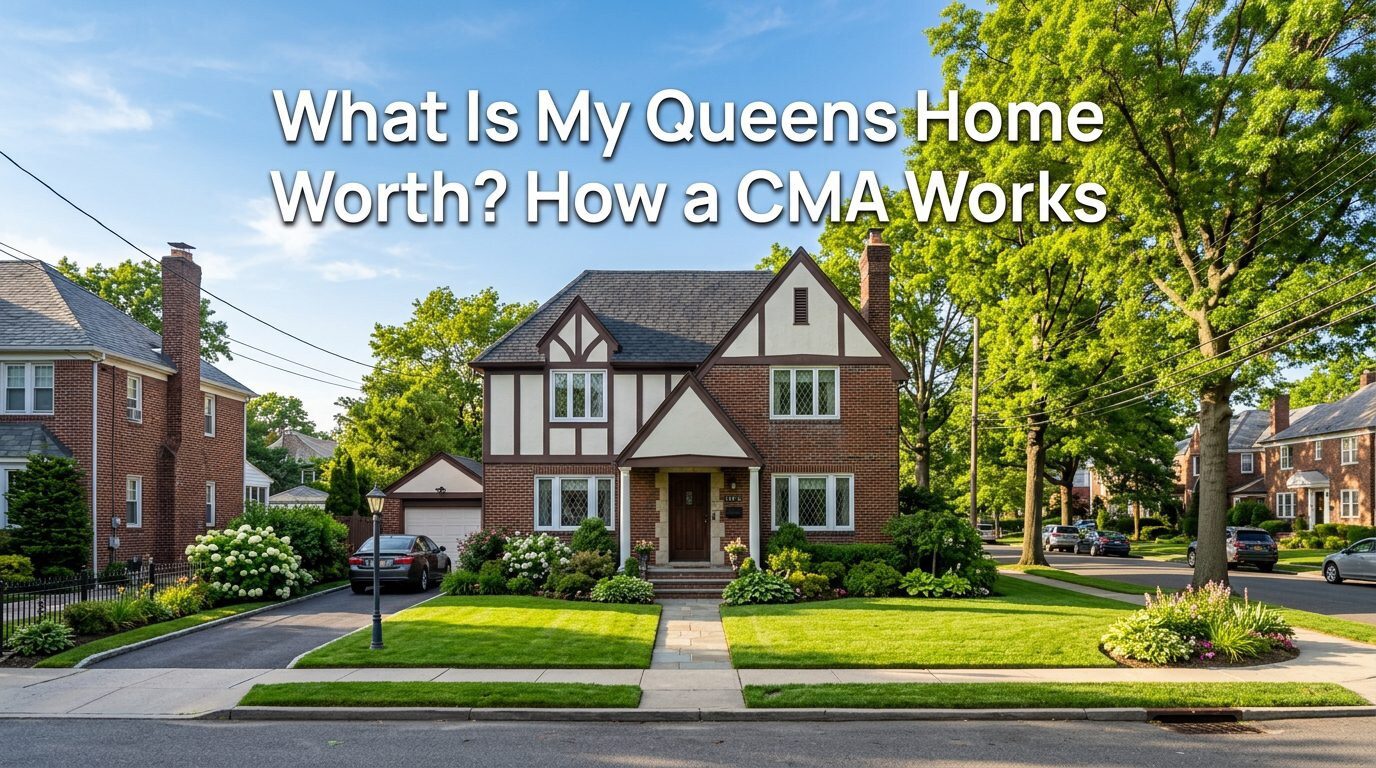
What Is My Queens Home Worth? How a CMA Works
Wondering what is my Queens home worth? Your home’s value is best estimated with a Comparative Market Analysis (CMA) — a broker’s review of recent comparable sales, current listings, and your home’s condition. A CMA is a professional opinion of value (not an appraisal), and it’s the most reliable starting point for pricing in the local 2026 market.
“What is my home worth?” is the first question almost every Queens homeowner asks — whether you’re planning to sell, refinancing, or just curious. Online estimates give a ballpark, but they don’t know your block, your renovations, or this week’s buyer demand. This guide explains how a real valuation works so you can answer what is my Queens home worth with confidence.
As a Licensed Associate Real Estate Broker based in Queens, I prepare CMAs for homeowners across the borough — in English and Polish. Here’s how value is actually determined.
1. What a CMA Is (and Isn’t)
A Comparative Market Analysis (CMA) is a broker’s data-driven estimate of your home’s likely market value, based on what similar homes have actually sold for. It is a professional opinion of value — not an appraisal and not a guarantee. An appraisal is a separate, formal valuation performed by a licensed appraiser (often required by a lender); a CMA helps you set a smart list price before you ever reach that stage.
2. How a CMA Estimates Your Home’s Value
A good CMA compares your home to recent “comps” — similar nearby properties — then adjusts for the differences.
- Recently sold comps (ideally within the last few months and close by) show what buyers actually paid.
- Active and pending listings reveal current competition and demand.
- Adjustments account for size, condition, renovations, layout, outdoor space, and (for co-ops/condos) monthly charges.
The result is a realistic value range, plus a recommended pricing strategy.
3. What Affects Your Queens Home’s Value
Value isn’t just square footage. In Queens, these factors move the number most:
- Location & property type — block, transit access, and whether it’s a co-op, condo, or one-to-three-family home.
- Condition & updates — kitchens, baths, systems, and overall upkeep.
- Comparable sales — the strongest signal of current market value.
- Market timing — inventory, mortgage rates, and seasonal demand.
- Income potential — for two- and three-family homes, possible rental income.
Describing a home’s value, we focus on the property and verifiable amenities — never on demographics, in keeping with Fair Housing.
4. CMA vs. Appraisal vs. Online Estimate
| Tool | What it is | Best for |
|---|---|---|
| CMA | Broker’s opinion of value from local comps | Setting a smart list price |
| Appraisal | Licensed appraiser’s formal valuation | Lender financing requirements |
| Online estimate | Automated algorithm (no eyes on the home) | A rough, early ballpark only |
Online tools are a starting point, but they can’t see your renovations or your block’s latest sale. A local CMA closes that gap.
5. So, What Is My Queens Home Worth? Getting an Accurate Number
The most accurate answer comes from an associate broker who knows your neighborhood and reviews your home in person or in detail. To prepare, gather: a list of upgrades and their timing, recent tax/maintenance info, and anything unique about the property (parking, outdoor space, income units).
Then we compare against the freshest comps and current demand to land on a confident range. Curious how this connects to listing? See the full how to sell your home in Queens checklist.
6. Turning Value Into the Right List Price
Knowing your value is step one; pricing strategy is step two. Price too high and the home sits (often selling for less later); price it right and you attract strong, timely offers. Your CMA range plus current buyer activity guide the launch price — and we adjust based on the first week’s response.
Key Takeaways
- A CMA is a professional opinion of value, not an appraisal.
- Recent local comps are the strongest signal of value.
- Online estimates are a ballpark, not a list price.
- Accurate pricing usually sells faster and closer to ask.
Frequently Asked Questions
Is a CMA the same as an appraisal?
No. A CMA is a real estate broker’s opinion of value based on comparable sales, used to set a list price. An appraisal is a formal valuation by a licensed appraiser, often required by a lender. Both estimate value, but they serve different purposes.
How accurate are online home value estimates in Queens?
Automated estimates can be a rough starting point, but they don’t account for your renovations, condition, or the latest nearby sales. In a varied market like Queens, a local CMA is far more reliable for setting an actual price.
How much does a CMA cost?
A broker typically provides a CMA at no cost and with no obligation, as part of discussing a potential sale. It’s a professional opinion of value, not a paid appraisal.
What information helps make a CMA more accurate?
Share your home’s upgrades and their timing, square footage, layout, condition, any income units, and recent tax or maintenance figures. The more detail, the tighter the value range your broker can provide.
Does a higher list price mean my home will sell for more?
Not usually. Overpriced homes tend to sit and then sell for less than a well-priced listing. Pricing to the market — guided by a CMA and current demand — typically yields stronger, faster offers.
Ready to Find Out What Your Queens Home Is Worth?
Skip the guesswork. I’ll prepare a clear, no-pressure CMA for your home — in English or Polish — so you know exactly where you stand. Reach out for your free Queens home valuation whenever you’re ready.

About the Author — Agatha Lubas
Licensed Associate Real Estate Broker · NY License #10301213345 · Keller Williams Realty Liberty
Agatha Lubas helps buyers, sellers, and investors across Queens, Brooklyn, Nassau, and Suffolk Counties, working in both English and Polish. She’s known for accurate pricing, sharp negotiation, and patient, straightforward guidance — from first valuation through closing day.
Work with Agatha →