

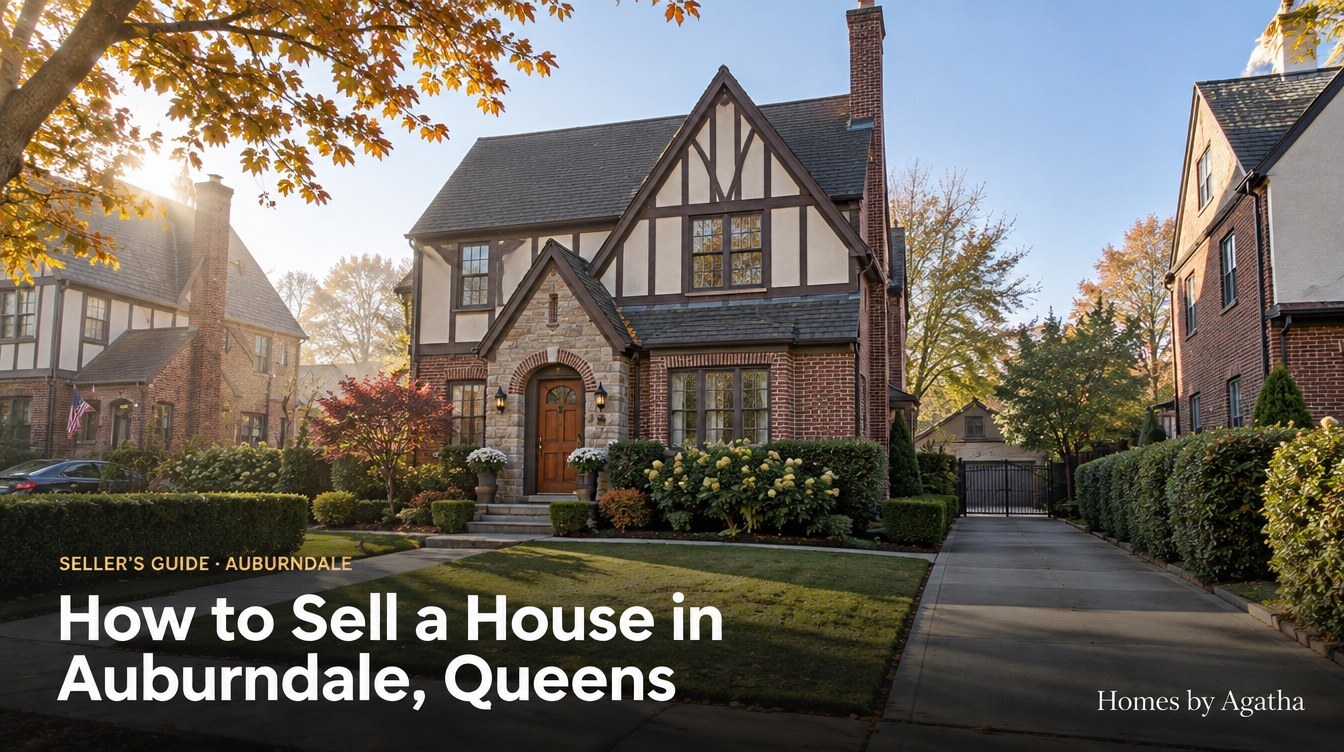
AUBURNDALE HOME SELLER GUIDE
How to Sell a House in Auburndale, Queens: Pricing, Paperwork and What You Net
Quick Answer
To sell a house in Auburndale, Queens, price it against recent sales of the same configuration and zoning, gather your Certificate of Occupancy, permits and survey before listing, deliver the Property Condition Disclosure Statement, and budget for the NYS transfer tax and NYC Real Property Transfer Tax. Attorneys finalize the contract after you accept an offer.
Learning how to sell a house in Auburndale starts with an honest look at what you own on paper, not only what you see when you walk through the front door. Buyers for Auburndale, Queens, houses arrive with a lender, an appraiser and a New York attorney, and each of them will check the zoning district, the legal unit count, the permit history and the survey. A seller who has those answers ready controls the conversation.
This guide is for owners of detached houses, semi-detached two-families and row houses in Auburndale who are thinking about selling in the next year or two. It covers how buyers value houses here, how a comparative market analysis is built, which documents to gather, what to repair, which New York disclosures apply, what you will pay at closing and how to compare offers that look similar on the surface.
As a Licensed Associate Real Estate Broker serving Queens, Brooklyn and Long Island, I prepare pricing opinions and listing plans for sellers, and I work with clients in English and in Polish. Nothing here replaces your attorney or accountant. It will help you walk into those conversations prepared. For a direct conversation about your property, the Auburndale home-selling page explains how we can work together.
Auburndale at a glance for sellers
| What buyers look up | Auburndale, Queens |
|---|---|
| Location | Northeast Queens, New York City; Queens Community District 11, between Flushing and Murray Hill to the west and Bayside to the east |
| Boundaries buyers may see | Queens Community Board 11 describes Auburndale as running from Utopia Parkway to the Clearview Expressway, and from 26th Avenue to the Long Island Expressway; listing portals may draw the lines differently |
| ZIP code | 11358, usually with “Flushing, NY” in the mailing address; confirm the ZIP for a specific address with USPS |
| Rail access | LIRR Port Washington Branch, Auburndale station at 192nd Street between 39th Avenue and Station Road |
| Nearest subway | 7 train terminal at Flushing–Main Street |
| Roads | Clearview Expressway (I-295), Long Island Expressway (I-495), Northern Boulevard, Francis Lewis Boulevard, Utopia Parkway |
| Commercial strips | Northern Boulevard and Francis Lewis Boulevard, plus shops near Auburndale station |
| Open space | Peck Park, part of the Kissena Corridor Park system, south of Northern Boulevard; Kissena Park and Cunningham Park nearby |
| Typical houses for sale | Detached one-family Tudors, Dutch colonials and Cape Cods; detached and semi-detached two-family houses; some row houses with rear-alley parking |
| Zoning context | 2010 Auburndale–Oakland Gardens–Hollis Hills Rezoning mapped contextual districts such as R2A, R3X, R3-1, R4-1 and R4B |
How do buyers judge a house in Auburndale before they make an offer?
Buyers judge an Auburndale house on five things: configuration (detached, semi-detached or attached), legal unit count, lot and zoning, condition of the major systems, and location details such as parking and distance to Auburndale station. Price follows those facts, so your listing should state them clearly and your documents should support them.
Configuration and lot
A detached house on a wider lot, a semi-detached two-family and a row house with rear-alley parking appeal to different buyers and are valued against different comparable sales. Lot width and depth, driveway type and garage space matter more here than in apartment-heavy parts of Queens, because buyers are paying for land as well as living space.
Zoning and what a buyer could build
Much of Auburndale was rezoned in 2010 to contextual districts that keep new construction close to the scale of existing one- and two-family houses. A buyer who plans an addition will ask what the district allows. In an R2A district, which the NYC Department of City Planning described as permitting only single-family detached houses at a floor area ratio of 0.5 with 30% maximum lot coverage, there may be little room to expand. In an R4-1 district, which allows a floor area ratio of 0.9 including an attic allowance, there may be more. Look up your lot on the city’s ZoLa map at zola.planning.nyc.gov before you list, so you know what buyers will see.
Legal use
Legal use is the use recorded by the NYC Department of Buildings, usually on the Certificate of Occupancy. A two-family house with records that confirm two units is a different product, for financing and for value, from a one-family house with an extra apartment. Buyers’ lenders and attorneys will check, so it is better to know the answer before the first showing.
Condition and systems
Auburndale houses are generally older, and buyers know it. They will focus on the roof, the heating system and fuel type, the electrical panel, the sewer line, the basement and any signs of water. A recent boiler replacement or a documented oil-tank removal is worth more when you can hand over the paperwork.
Transit and parking
Distance to Auburndale station on the Port Washington Branch, access to the Clearview Expressway and the Long Island Expressway, and off-street parking all shape how a buyer pictures daily life. State them factually in the listing; let buyers weigh them.
| Buyer question | What the buyer’s side checks | What you should prepare |
|---|---|---|
| Is it really a two-family? | Certificate of Occupancy and Department of Buildings records | A copy of the CO or other records confirming legal use |
| Can I expand it? | Zoning district on ZoLa; architect’s opinion | Your zoning district and any prior plans or permits |
| Were the additions legal? | Permits and sign-offs for dormers, extensions, decks | Permit numbers and sign-off letters |
| Who owns the driveway or alley? | Survey and title report for easements | Your survey, deed and any neighbor agreements |
| Will the basement stay dry? | Inspection; FEMA and NYC Stormwater Flood Maps | Records of drainage work, sump pumps or backwater valves |
| How old are the systems? | Home inspection | Receipts and warranties for boiler, roof, electrical and sewer work |
How do you price a house in Auburndale with a CMA?
Price an Auburndale house with a comparative market analysis that uses recent sales of the same configuration, legal unit count and, ideally, zoning context, then adjusts for lot, condition, parking and location. A list price based on a neighbor’s asking price or an online estimate usually misses the details that appraisers and buyers will weigh.
A comparative market analysis, or CMA, is a real estate broker’s professional opinion of value based on relevant market evidence. It is not an appraisal and does not guarantee a sale price. An appraisal is a separate valuation ordered by the buyer’s lender after you accept an offer, and it can confirm or challenge the price you agreed to.
Choosing comparable sales in Auburndale
The quality of a CMA depends on the comparables. In Auburndale, the strongest comparables usually share these traits with your house:
- the same configuration: detached, semi-detached or attached;
- the same legal unit count: one-family or two-family;
- a similar lot width and depth, and similar parking (private driveway, shared driveway, rear alley or street);
- a similar zoning context, because expansion potential differs between districts such as R2A and R4-1;
- a similar location relative to Auburndale station, Northern Boulevard and the expressways;
- a recent sale date, since older sales may not reflect current mortgage rates and buyer demand.
Closed sales are the core of the analysis. Active listings show the competition you will face, and contract-signed listings show what is moving, but neither proves a price. Public sale records for New York City can be searched through the NYC Department of Finance’s ACRIS system.
Adjustments that move value
No two Auburndale houses are identical, so a CMA adjusts. A renovated kitchen and baths, a newer roof and boiler, a finished basement with proper permits, a two-car driveway or a detached garage, and a wider lot can each push value up. A legal-use problem, an unpermitted addition, a shared driveway without a clear agreement, or deferred maintenance can push it down or narrow the pool of buyers who can finance the purchase.
Pricing strategy, not just a number
The list price also determines which buyers see the house. Buyers filter portal searches by price bands, so a price just above a common search threshold can hide your house from people who would have paid it. Overpricing tends to produce a long period on the market, followed by reductions that invite lower offers. Our article on what your Queens home is worth explains the valuation logic for the borough more broadly. Current Auburndale sale prices and market conditions should come from recent records, not from a blog: ask for a written comparative market analysis based on dated ACRIS and MLS records.
Request a CMA for your Auburndale house
I will select comparables that match your house’s configuration, legal use and lot, explain every adjustment, and give you a price range with the reasoning behind it. It is an opinion of value, not an appraisal, and there is no obligation to list.
Which documents should you gather before listing an Auburndale house?
Gather your deed, survey, Certificate of Occupancy or other legal-use records, permit sign-offs, recent tax bill, utility history, repair receipts and any documents about a shared driveway or oil tank before you list. In New York, buyers’ attorneys review these items before the contract is signed, so missing papers become delays later. Of all the steps in how to sell a house in Auburndale, this one tends to save the most time.
Legal-use and permit records
The NYC Department of Buildings keeps records of Certificates of Occupancy, permits, sign-offs and violations, searchable through its Building Information System at a810-bisweb.nyc.gov. Many older houses in Queens were built before Certificates of Occupancy were required, which is common and not automatically a problem; in that case your attorney identifies other records that show legal use. What matters is that the records match the house as it stands today.
If you added a dormer, enclosed a porch, extended the kitchen or finished the basement, look for the permit and the sign-off. If a past owner did work without permits, talk to your attorney and, if needed, an architect or expediter before listing. Some issues can be resolved before you sell; others are disclosed and priced in.
Survey, deed and driveway agreements
Semi-detached houses and row houses in Auburndale often share a driveway or use a rear alley. A buyer’s title company will look for recorded easements, which are legal rights to use part of another person’s land. If you have a survey, a written agreement with your neighbor or a history of how the shared surface is maintained, put it in the file.
Oil tanks, systems and receipts
If your house was ever heated with oil, buyers will ask where the tank is. A tank that was removed or properly abandoned should come with paperwork. Collect receipts and warranties for the boiler or furnace, roof, windows, electrical upgrades and sewer-line work. Organized records reassure buyers and their inspectors.
| Document | Where it usually comes from | Why an Auburndale buyer’s side asks |
|---|---|---|
| Deed and title policy | Your closing file or attorney; ACRIS (NYC Department of Finance) | Confirms ownership and recorded rights |
| Survey | Your closing file; a licensed surveyor | Shows lot lines, driveway and alley locations |
| Certificate of Occupancy or legal-use records | NYC Department of Buildings | Confirms one-family vs. two-family use |
| Permits and sign-offs | NYC Department of Buildings; your contractors | Proves additions and conversions were legal |
| Property tax bill and exemptions | NYC Department of Finance | Shows carrying cost; exemptions may not transfer |
| Oil-tank removal or abandonment records | Contractor who did the work | Avoids last-minute environmental questions |
| Repair receipts and warranties | Your own files | Supports condition claims and value |
| Leases and rent records (two-family) | Your own files | Lets the buyer and lender evaluate the income |
What should you repair, stage or leave alone before selling?
Fix what a buyer’s inspector will flag as a safety, water or system issue, refresh what photographs badly, and leave large renovations alone unless the numbers clearly support them. In Auburndale, the most valuable preparation usually targets roofs, basements, curb appeal and documentation rather than new kitchens.
Preparation priorities for Auburndale houses
| Priority | Typical items | Why it matters for an Auburndale house |
|---|---|---|
| 1. Safety and water | Roof leaks, gutters and leaders, basement dampness, grading, working smoke and carbon monoxide detectors | Water and safety findings are the issues most likely to trigger renegotiation |
| 2. Systems documentation | Boiler or furnace service, electrical panel information, sewer-line camera report if available | Older houses invite questions; paperwork answers them |
| 3. Curb appeal | Trimmed hedges, cleared driveway, repaired walkway, painted trim, tidy sidewalk | Detached and semi-detached houses are judged from the street first |
| 4. Interior presentation | Decluttering, neutral paint where needed, bright lighting, clean windows | Tudor-style interiors can feel dark in photos without preparation |
| 5. Optional upgrades | Kitchen or bath remodels, new flooring throughout | Worth it only when a CMA shows the cost will likely be recovered |
Pre-listing inspection
A pre-listing inspection is a home inspection the seller orders before going on the market. It shows you what a buyer’s inspector is likely to find, so you can repair, price or disclose those items in advance. For an older Auburndale house with original systems, it can prevent surprises after you have accepted an offer.
Staging a house-based listing
Staging means arranging the house so buyers can picture living there. In Auburndale houses, that often means opening up front rooms with lighter furniture, showing the basement as clean and usable space, and presenting the yard and driveway as part of the home. In a two-family, the second unit should look cared for, whether it will be delivered vacant or with a tenant.
Sidewalks and street trees
In New York City, property owners are generally responsible for maintaining the sidewalk next to their property, and the NYC Department of Transportation can issue sidewalk violations. Lifted flags near street trees are common on older blocks. Check for open violations early, because buyers’ attorneys will.
Key Takeaways
- Auburndale buyers price configuration, legal use, lot and zoning, not just square footage.
- A CMA built on same-type comparables is a broker’s opinion of value, not an appraisal or a guarantee.
- Gather the Certificate of Occupancy, permits, survey and oil-tank paperwork before listing.
- Spend preparation money on water, safety, systems documentation and curb appeal first.
Get a room-by-room preparation plan
We can walk through your house together and decide what to fix, what to document and what to leave, so your budget goes where Auburndale buyers will notice it.
Which New York disclosures apply when selling a house in Auburndale?
Sellers of most one- to four-family houses in New York must deliver the Property Condition Disclosure Statement before the buyer signs the contract. Real estate licensees must provide the NYS Disclosure Form for Buyer and Seller at the first substantive contact, and houses built before 1978 also require the federal lead-based paint disclosure.
Property Condition Disclosure Statement
The Property Condition Disclosure Statement, or PCDS, is a New York State form in which the seller answers questions about the property’s condition, systems, environmental issues and other matters, based on the seller’s actual knowledge. Since March 20, 2024, a change in New York law removed the option of giving the buyer a $500 credit instead of delivering the disclosure, so sellers of most 1–4 family houses must now provide the PCDS. Co-op and condo units are outside the PCDS requirement, because the law’s definition of residential real property excludes condominium units and cooperative apartments.
For an Auburndale house, questions about flooding, basement water, oil tanks, permits and the property’s legal status deserve careful, accurate answers. Review the form with your attorney before you sign it.
Agency disclosure
The NYS Disclosure Form for Buyer and Seller explains the different relationships a real estate licensee can have with buyers and sellers. You will receive it at the first substantive contact with a licensee, and signing it acknowledges receipt; it is not a contract.
Lead-based paint
For housing built before 1978, federal law requires sellers to disclose known lead-based paint and lead-based paint hazards, provide an EPA-approved pamphlet and give buyers an opportunity to test. Many Auburndale houses fall into this category.
Smoke and carbon monoxide detectors
New York City requires a smoke detector affidavit with the transfer tax filings for the sale of a one- or two-family dwelling. Confirm that detectors are installed and working before closing.
Selling a two-family, semi-detached or inherited house in Auburndale: what changes?
A two-family adds tenants and income records to the sale, a semi-detached house adds a neighbor’s shared wall and often a shared driveway, and an inherited house adds estate paperwork. Each changes the timeline and the documents a buyer’s attorney will request.
Two-family houses with tenants
Decide early whether you will deliver the second unit vacant or with the tenant in place. Many buyers who plan to live in the house and rent the other unit want to see the lease, the rent history and the tenant’s deposit. Other buyers want the unit vacant to move in a relative or renovate. Your attorney will advise on lease terms and notice requirements, and showings must be coordinated with the tenant’s rights in mind.
Semi-detached and row houses
A shared wall means shared maintenance questions at the roof line, the chimney and the foundation. A shared driveway or rear alley means access questions. Gather your survey and any written agreements with the neighbor, and be prepared to explain how snow removal and repairs have been handled.
Co-op and condo apartments
If you own an apartment rather than a house in one of Auburndale’s garden or low-rise buildings, the sale follows building rules. A co-op sale requires the buyer to submit a board application package and usually attend an interview; the board must approve before closing. A condo sale usually involves a right of first refusal that the board waives. A flip tax, if any, is set by the co-op’s own documents; there is no city-wide rate. Ask the managing agent for the building’s current sale requirements.
Inherited houses
When an Auburndale house is part of an estate, the executor or administrator usually needs authority from the Queens County Surrogate’s Court before signing a contract, and the closing must follow the estate’s requirements. Our probate real estate guide explains how sales of inherited New York property typically work.
Selling a two-family or an estate property?
Tenants, shared driveways and estate approvals change the order of steps. Let’s lay out a listing strategy that fits your situation before the first buyer walks in.
How will your Auburndale house be marketed to buyers?
Effective marketing for an Auburndale house combines accurate facts, professional photography, a floor plan, an OneKey MLS listing and online distribution, plus showings that let buyers see the lot, the parking and the basement. The listing should describe the configuration, legal use and transit options precisely, without claims that a buyer’s attorney will later contradict.
Photography, floor plans and description
Professional photography matters for houses whose appeal includes exterior architecture, yards and driveways. A measured floor plan helps buyers understand older layouts, such as center-hall colonials or Tudors with irregular rooms. The written description should state the configuration, the legal unit count, parking, and the walking route to Auburndale station or the nearest bus lines, all in verifiable terms.
OneKey MLS and online distribution
OneKey MLS is the multiple listing service used by brokers across much of the New York metropolitan area, including Queens and Long Island. A listing entered there is shared with participating brokers and typically distributed to major real estate websites. That reach matters in Auburndale, where buyers may come from elsewhere in Queens, from Long Island or from other parts of the city.
| Marketing channel | What it does | Auburndale-specific note |
|---|---|---|
| OneKey MLS | Shares the listing with participating brokers | Reaches buyer agents across Queens and Long Island |
| Major listing portals | Exposes the listing to buyers searching online | Portals may label the area as Flushing or Auburndale; describe the location precisely |
| Professional photos and floor plan | Creates the first impression | Show the lot, driveway, garage and basement, not only the living room |
| Open houses and private showings | Let buyers experience the house and street | Coordinate carefully with tenants in two-family houses |
| Yard sign and agent outreach | Reaches local and agent networks | Useful on residential blocks with steady neighborhood traffic |
Marketing in Polish as well as English can help some buyers and sellers communicate comfortably. It is a communication choice only; every listing is open to every buyer, and where someone buys is always their decision.
What does it cost to sell a house in Auburndale?
A seller of an Auburndale house typically pays brokerage compensation as negotiated, the NYS real estate transfer tax, the NYC Real Property Transfer Tax, the seller’s attorney fee, the payoff of any mortgage and related recording charges, and any agreed repairs or credits. Each item is either set by an official rate or negotiated in advance.
| Seller expense | How it is set | Source or decision-maker |
|---|---|---|
| Listing brokerage compensation | Negotiated between seller and listing broker; not set by law | Your listing agreement |
| Buyer-agent compensation (if offered) | Optional and negotiable; not automatically paid by the seller | Your decision, often negotiated in the offer |
| NYS real estate transfer tax | $2 for each $500 of consideration (0.4%), customarily paid by the seller; a higher combined NYS rate (0.65%) applies to NYC residential conveyances of $3 million or more | NYS Department of Taxation and Finance |
| NYC Real Property Transfer Tax (RPT) | 1–3 family homes, co-op and condo units: 1% when the price is $500,000 or less; 1.425% when above $500,000; customarily paid by the seller | NYC Department of Finance |
| Seller’s attorney fee | Negotiated | Your attorney |
| Mortgage payoff and satisfaction recording | Per your lender’s payoff letter and recording fees | Your lender; title company |
| Repairs, credits and concessions | Negotiated after inspection | Contract negotiation |
| Co-op flip tax (apartments only) | Set by each co-op’s own documents | The co-op’s board and documents |
Confirm current rates with the NYS Department of Taxation and Finance and the NYC Department of Finance before closing.
A simple way to estimate the two transfer taxes
For a house in Auburndale above $500,000 and below $3 million, the two transfer taxes combine to 1.825% of the price (0.4% NYS plus 1.425% NYC). As pure arithmetic, not a price estimate, a hypothetical $800,000 sale would carry $3,200 in NYS transfer tax and $11,400 in NYC Real Property Transfer Tax, for $14,600 in total. Your attorney will calculate the exact figures for your contract.
Commission is negotiable, and buyer-agent pay is a separate decision
Brokerage compensation in New York is negotiable and not fixed by law. Since the 2024 National Association of Realtors settlement, whose practice changes remain in effect in 2026, buyer-agent compensation is not automatically paid by the seller. A seller may choose to offer a contribution, a buyer may request one in an offer, or the buyer may pay their own agent under a written buyer agreement. Discuss the options before you list.
Taxes on the gain
Federal and state income tax on any gain from the sale depends on your ownership history, use of the property and other factors. A CPA should review your situation, especially for a two-family house where part was rented or for an inherited property. Our overview of closing costs in Queens shows how seller and buyer costs line up at the closing table.
How do you compare offers on an Auburndale house?
Compare offers on the net amount you are likely to receive and the likelihood the deal closes, not on price alone. Financing type, down payment, appraisal risk, contingencies, contract deposit and the closing date can make a slightly lower offer the stronger one.
| Offer term | What to look for | Why it matters in Auburndale |
|---|---|---|
| Price | Headline number compared with your CMA | Only meaningful if the buyer can close at it |
| Financing type and down payment | Cash, conventional or government-backed loan; size of down payment | A larger down payment gives more room if the appraisal is lower than the price |
| Pre-approval quality | Full pre-approval from an identified lender | Reduces the risk of a failed mortgage commitment |
| Appraisal gap | Whether the buyer will cover a shortfall | House comparables vary by type, so appraisals can differ from contract prices |
| Contingencies | Mortgage contingency; sale of another home | Each one adds a way for the deal to stall |
| Contract deposit | Amount held in escrow at signing | Signals commitment; your attorney advises on the customary amount |
| Closing date and occupancy | Timing and any request to stay after closing | Matters if you are buying your next home at the same time |
| Tenant terms (two-family) | Vacant delivery or lease in place | Must match what you can legally deliver |
Negotiating after the inspection
In New York City, buyers usually inspect before signing the contract, so repair requests arrive while the contract is still being negotiated. Respond with your attorney’s input. For an older Auburndale house, it is often cleaner to offer a credit than to manage repairs yourself, but each situation differs. If you already ordered a pre-listing inspection and disclosed the findings, there is less room for surprise requests.
Multiple offers
When several buyers are interested, ask each buyer to submit their strongest terms by a set deadline, and compare them on the same sheet. Accepting an offer is not the same as signing a contract; until the contract is signed by both parties, either side can still walk away, which is why the strength of the buyer’s financing matters.
Key Takeaways
- The NYS transfer tax (0.4%) and NYC Real Property Transfer Tax (1% or 1.425%) are customarily paid by the seller in Auburndale.
- Brokerage compensation is negotiable, and buyer-agent compensation is not automatically the seller’s cost.
- The PCDS is required for most 1–4 family houses; the $500 credit option ended March 20, 2024.
- Judge offers on financing strength, appraisal risk, contingencies and timing, not just price.
Have offers on the table?
Send them over. I will help you line up financing, contingencies, timing and estimated net proceeds side by side so you can respond with confidence.
How to sell a house in Auburndale: the listing-to-closing timeline
Selling a house in Auburndale moves through preparation, pricing, listing, offers, attorney negotiation, the buyer’s mortgage commitment and closing. Most delays come from missing documents, legal-use questions, appraisal issues and the buyer’s financing, so the preparation stage protects every later stage. Your attorney can estimate current durations for your sale.
| Phase | Seller’s main tasks | Who else is involved | Auburndale-specific watch-out |
|---|---|---|---|
| 1. Preparation | Gather records, pre-listing inspection, repairs, staging | Listing agent, contractors, attorney | Missing permit sign-offs; oil-tank paperwork |
| 2. Pricing | Review the CMA and choose a list price | Listing agent | Using comparables of a different configuration or unit count |
| 3. Listing and showings | Photography, OneKey MLS, open houses | Listing agent, photographer | Tenant coordination in two-family houses |
| 4. Offers | Compare and negotiate; accept an offer | Listing agent, buyer’s agent | Weak pre-approvals hidden behind strong prices |
| 5. Contract | Attorney drafts contract; PCDS delivered; buyer’s deposit placed in escrow | Both attorneys | Legal-use or easement questions raised by the buyer’s attorney |
| 6. Mortgage commitment | Provide access for the appraisal; answer questions | Buyer’s lender, appraiser | Appraiser’s choice of comparables for an unusual house |
| 7. Closing | Final walk-through, transfer tax forms, deed, payoff | Attorneys, title company | Open violations or sidewalk issues that must be cleared |
Planning the next move matters too. If you are selling one Auburndale house to buy another home, talk with your attorney about coordinating the two closings, and look at the Auburndale buyer page or nearby options before you sign a contract on the sale.
What mistakes cost Auburndale sellers time and money?
The costliest seller mistakes are pricing from the wrong comparables, listing before the paperwork is ready, and describing the house in ways the records do not support. Each one can lead to price reductions, renegotiation or a contract that falls through.
- Calling a house a two-family when the records say otherwise. Buyers’ lenders and attorneys will find out, and late surprises reduce leverage.
- Pricing from the wrong comparables. A detached house on a wide lot and a semi-detached two-family are different products.
- Ignoring open permits and violations. These often surface during the buyer’s attorney review and can delay the contract.
- Leaving the shared-driveway question unanswered. A survey and any neighbor agreement should be ready before listing.
- Treating the PCDS casually. Answers should be accurate and reviewed with your attorney.
- Over-renovating. A new kitchen may not return its cost; a dry basement and a documented boiler often do more.
- Choosing the highest price without checking the financing. A deal that fails after weeks costs you time and momentum.
- Forgetting the transfer taxes when estimating net proceeds. Together they are a significant line on the seller’s side of a Queens closing.
Your Auburndale seller checklist
Work through this list in order. It turns the steps of how to sell a house in Auburndale into tasks you can complete before and during the sale.
- Look up your zoning district on ZoLa and note what it allows.
- Pull your Department of Buildings records and confirm legal use matches the house today.
- Find your deed, survey and any shared-driveway or alley agreements.
- Collect permit sign-offs, oil-tank paperwork, repair receipts and warranties.
- For a two-family, gather leases, rent records and deposit information.
- Ask for a CMA based on comparables of the same configuration and unit count.
- Consider a pre-listing inspection and fix safety and water issues first.
- Prepare the exterior, declutter and stage the interior for photography.
- Choose a New York real estate attorney before you accept an offer.
- Negotiate and sign a listing agreement that sets compensation and decides on any buyer-agent contribution.
- Complete the Property Condition Disclosure Statement with your attorney’s review.
- Estimate net proceeds, including the NYS transfer tax, NYC Real Property Transfer Tax and attorney fee.
- Compare offers on financing, contingencies, deposit and timing, then let attorneys finalize the contract.
- Confirm smoke and carbon monoxide detectors, clear violations and plan your move before closing.
If you own property in more than one part of northeast Queens, or are comparing listing approaches, see our guides to selling a home in Flushing, selling in Oakland Gardens and selling a house in Whitestone. For a borough-wide overview, read how to sell your home in Queens.
Build your Auburndale selling timeline
Whether you plan to list next month or next year, we can set a calm, step-by-step timeline from paperwork to closing that fits your move.
Frequently asked questions about selling a house in Auburndale
How do I find out what my Auburndale house is worth?
Ask a licensed broker for a comparative market analysis based on recent sales of houses with the same configuration, legal unit count and similar lot and parking. A CMA is an opinion of value, not an appraisal. The buyer’s lender will order a separate appraisal after you accept an offer.
What transfer taxes does a seller pay in Auburndale, Queens?
A seller customarily pays the NYS real estate transfer tax of 0.4% and the NYC Real Property Transfer Tax, which is 1% when the price is $500,000 or less and 1.425% above $500,000 for 1–3 family homes. Confirm current rates with the NYS Department of Taxation and Finance and NYC Department of Finance.
Do I have to give buyers a Property Condition Disclosure Statement?
Yes, for most one- to four-family houses in New York. Since March 20, 2024, sellers can no longer give a $500 credit instead of the disclosure. The Property Condition Disclosure Statement must be delivered before the buyer signs the contract. Review your answers with your attorney before signing the form.
Can I sell my Auburndale house as a two-family if the Certificate of Occupancy says one-family?
You should not market it as a legal two-family if the records do not support that. Buyers’ lenders and attorneys check NYC Department of Buildings records. Talk to your attorney about legalization options or about describing and pricing the house accurately according to its legal use before listing.
Does zoning affect the price of an Auburndale house?
It can. Many Auburndale lots were placed in contextual districts in 2010, such as R2A, R3X, R3-1, R4-1 and R4B, which limit building size and, in R2A, allow only single-family detached houses. Buyers planning additions weigh that, so zoning can shape both demand and comparable sales.
Do I have to pay the buyer’s agent when selling in Queens?
No, not automatically. Buyer-agent compensation is negotiable and not set by law. A seller may choose to contribute, a buyer may request it in an offer, or the buyer may pay their own agent under a written buyer agreement. Decide your approach with your listing agent before going on the market.
Should I renovate my Auburndale house before selling?
Usually, focus first on water, safety and system issues, curb appeal and documentation rather than large remodels. A dry basement, a serviced boiler and organized permits often matter more to buyers of older Auburndale houses than a new kitchen. Use a CMA to test whether a bigger project would pay back.
Can I sell a two-family house in Auburndale with a tenant living there?
Yes, but plan it. Decide whether the buyer will receive the unit vacant or with the lease in place, share the lease and rent records, and coordinate showings with the tenant’s rights in mind. Your attorney should confirm what you can legally deliver at closing before you accept an offer.
What happens after I accept an offer on my Auburndale house?
Your attorney drafts the contract and sends it to the buyer’s attorney, who reviews title, records and the inspection results. The contract becomes binding when both sides sign and the buyer’s deposit is placed in escrow. The buyer then obtains a mortgage commitment before the closing is scheduled.
How is selling an inherited house in Auburndale different?
The executor or administrator usually needs authority from the Queens County Surrogate’s Court before signing a contract, and the estate’s attorney coordinates the closing. Gather the will, court papers and property records early. A probate-experienced attorney and broker can help plan the sale around court requirements.
Summary and your next step
Knowing how to sell a house in Auburndale comes down to matching the right comparables to the right house, proving its legal use and condition with documents, and understanding the costs that come off the top at closing. Start with your zoning district and Department of Buildings records, request a CMA built on same-type sales, prepare the house where buyers will look hardest, and let your attorney manage the contract once you accept an offer. When you want a plan tailored to your property, the guide to selling your home in Auburndale is the place to begin.
This article is for general informational purposes only and reflects conditions that may change. It is not legal, tax, or financial advice, an appraisal, or a guarantee of price or outcome; consult a licensed New York attorney, a CPA, and an NMLS-registered mortgage loan originator as appropriate. A CMA is an opinion of value, not an appraisal. Real estate brokerage services are offered by Agatha Lubas, Licensed Associate Real Estate Broker, NY License #10301213345, Keller Williams Realty Liberty, 96-10 101st Avenue, Ozone Park, NY 11416. The NYS Disclosure Form for Buyer and Seller, the NYS Housing and Anti-Discrimination Disclosure / Fair Housing Notice, and the brokerage’s Standard Operating Procedures are available on request. Equal Housing Opportunity.

Agatha Lubas works with sellers, buyers and investors throughout Queens, Brooklyn, Nassau County and Suffolk County, from pricing and preparation through closing. She offers her services in English and Polish, so each client can talk through the details in whichever language feels most comfortable.
Work with Agatha