

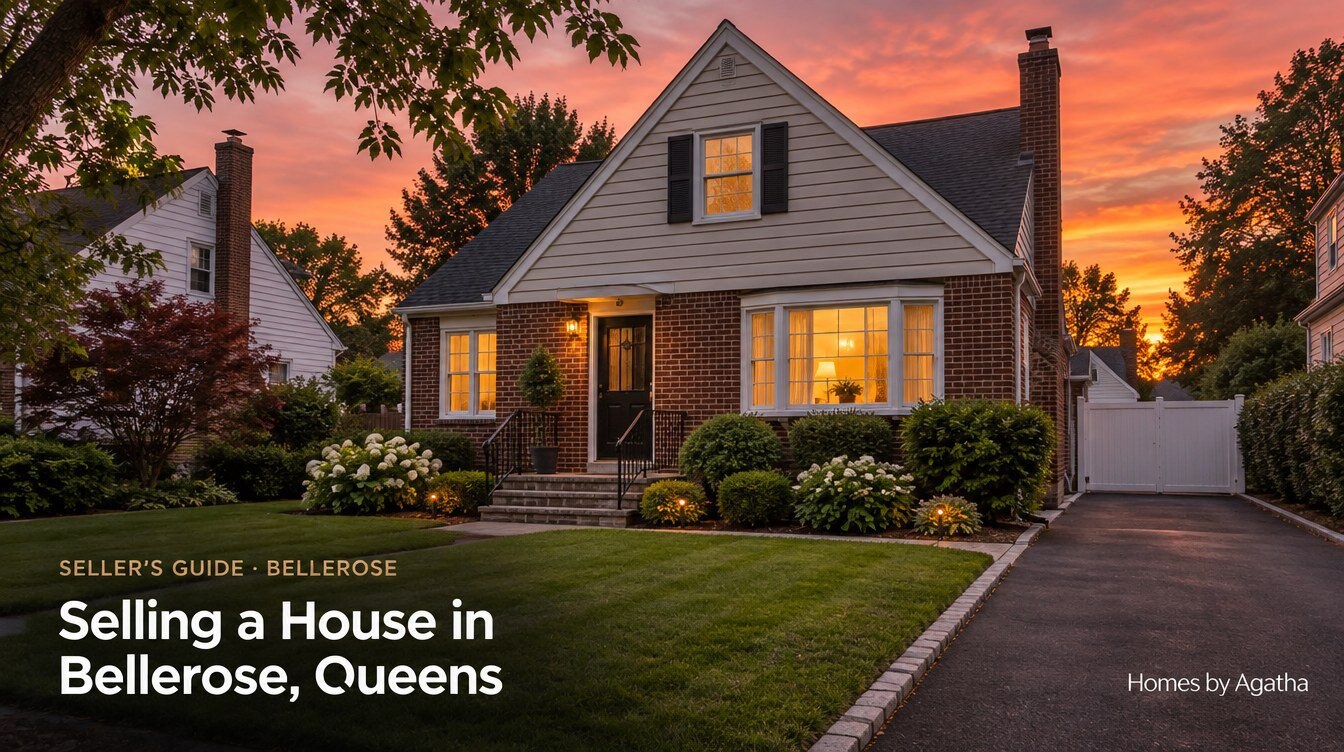
BELLEROSE REAL ESTATE GUIDE
Selling a House in Bellerose, Queens: Pricing, Preparation and Seller Costs Explained
Quick Answer
Selling a house in Bellerose Queens means pricing from recent Queens comparables rather than nearby Nassau sales, clearing Certificate of Occupancy and permit issues before listing, delivering the Property Condition Disclosure Statement, and budgeting for both the NYS transfer tax and the NYC Real Property Transfer Tax, which applies only on the Queens side.
This guide is for owners who are thinking about selling a house in Bellerose Queens in the next few months or the next few years: people moving to a different home, heirs settling an estate, and owners who simply want to know what a sale would involve before deciding. It is written for houses, which make up most of the Bellerose, Queens market, with a short section on co-ops in neighboring buildings.
Bellerose has a feature most Queens neighborhoods do not. It sits on the New York City line, with the Village of Bellerose and Bellerose Terrace across the border in Nassau County. Buyers often look on both sides, but the taxes, records and seller costs are different on each, and that affects how you price, prepare and plan your net proceeds.
As a Licensed Associate Real Estate Broker based in Queens, I help sellers understand both the value of their property and the steps of a New York sale, in English and Polish. Below you will find how buyers evaluate Bellerose houses, how a comparative market analysis is built, which repairs and documents matter most, how marketing works, what selling costs, how to compare offers and how long the process usually takes.
Bellerose at a glance for sellers
| Item | What applies to a Bellerose, Queens house |
|---|---|
| Area | Eastern Queens, on the New York City–Nassau County line; Queens Community Board 13 |
| Borough / County | Queens (Queens County), New York City — not the Village of Bellerose or Bellerose Terrace, which are in the Town of Hempstead, Nassau County |
| ZIP code(s) | 11426 and 11427; confirm the ZIP for a specific address with USPS |
| Major transit buyers ask about | MTA buses on Hillside Avenue toward the F train at Jamaica–179 Street; LIRR Bellerose station (in Nassau County) and Queens Village station (in Queens); bus routes changed in the 2025 Queens Bus Network Redesign, so check current MTA maps and LIRR timetables |
| Main parks / landmarks | Queens Public Library Bellerose branch on Hillside Avenue; Queens County Farm Museum and Alley Pond Park to the north |
| Commercial corridors | Hillside Avenue, Jamaica Avenue (Jericho Turnpike in Nassau County), Braddock Avenue |
| Typical property types | Mostly detached one-family houses; some semi-detached, attached and two-family houses; mixed-use buildings on the avenues; co-ops in neighboring Glen Oaks and Floral Park, Queens |
| Seller transfer taxes | NYS real estate transfer tax plus NYC Real Property Transfer Tax (Queens side only) |
| Records buyers’ attorneys will check | NYC Department of Buildings (Certificate of Occupancy, permits, violations), NYC Department of Finance (tax and exemptions), title and municipal searches |
| Required seller disclosures | Property Condition Disclosure Statement for most one-to-four-family houses; federal lead-based paint disclosure for homes built before 1978; NYS agency disclosure |
How do buyers evaluate a house in Bellerose, Queens?
Buyers judge a Bellerose house on four things: its legal use and paperwork, the condition of its major systems, the lot and its practical features such as a driveway or garage, and how the location works for their commute. Price is measured against all four, and against what similar money buys a few blocks away in Nassau County.
Paperwork and legal use
A buyer’s attorney will look at the Certificate of Occupancy, or CO, which is the NYC Department of Buildings document stating a building’s legal use and number of dwelling units. A two-family house that is legally a two-family on its CO is a different product from a one-family house with an informal basement apartment. Buyers who need rental income to qualify for a mortgage, and their lenders, care about that difference.
For houses built before 1938, there may be no CO at all, because the NYC Department of Buildings generally did not require one for older buildings unless later work changed their use, egress or occupancy. Sellers of those houses should be ready to show legal use in another way, such as a Letter of No Objection from the Department of Buildings.
Condition of older systems
Many Bellerose houses have been standing for decades, and buyers know it. Inspectors focus on the heating plant and any oil tank, the electrical service and panel, plumbing supply lines, the sewer connection to the street, the roof and drainage, and basement moisture. A house with recent, documented work on those systems competes differently from one where the buyer must guess.
Lot, parking and outdoor space
Detached houses in Bellerose, Queens often include a driveway, garage or yard. Buyers value usable parking and outdoor space, and they will ask whether a shared driveway has a recorded agreement, whether fences and sheds match the survey and whether any curb cut is legal.
Location and commute
Bellerose has no subway station, so buyers weigh the walk to Hillside Avenue buses, the trip to the LIRR at Bellerose or Queens Village, and access to the Cross Island Parkway and Grand Central Parkway. A listing that explains these options accurately, without overstating distances, helps the right buyers self-select.
The cross-line comparison
Some buyers will look at your house and at houses in the Village of Bellerose, Bellerose Terrace or Floral Park in the same week. They compare property tax bills, closing costs and commute options as well as the houses themselves. Have your current NYC Department of Finance tax bill ready so buyers can see the real annual cost instead of estimating it.
How should you price a Bellerose house with a CMA?
Start with a comparative market analysis built from recent sales of similar houses inside Bellerose, Queens and adjacent Queens blocks, then adjust for condition, lot, layout and legal use. Treat sales across the line in Nassau County as context only, because they carry different taxes and closing costs.
A comparative market analysis, or CMA, is a real estate broker’s professional opinion of value based on relevant market evidence such as recent sales, pending sales and competing listings. It is not an appraisal and does not guarantee a sale price. An appraisal is performed by a licensed appraiser, usually for the buyer’s lender, after a contract is signed.
What goes into a Bellerose CMA
- Same-jurisdiction comparables. Closed sales of houses in Bellerose, Queens and nearby Queens neighborhoods such as Glen Oaks, Floral Park (Queens) and Queens Village, ideally of the same style and size.
- Legal use. One-family and legal two-family houses are compared separately.
- Lot and parking. Lot size, driveway, garage and yard usability.
- Condition and updates. Kitchen, baths, roof, heating, electrical and windows, with dates and permits where available.
- Competing listings. What a buyer touring your house this month can buy instead, on both sides of the line.
- Pending sales. Recent contracts signal where the market is heading before closings are recorded.
For a broader explanation of how home values are estimated across the borough, see what is my Queens home worth.
Price thresholds that change buyer and seller math
Two tax thresholds influence pricing decisions in Bellerose, Queens. The first is the NYC Real Property Transfer Tax rate change: for one-to-three-family houses, the rate is 1% of the price at $500,000 or less and 1.425% above $500,000, applied to the whole price. The second is the New York State “mansion tax,” which the buyer pays at 1% of the full price on residential purchases of $1 million or more.
Near either threshold, a small change in price can shift costs disproportionately, either for you or for your buyer. That does not mean you should always price below a threshold. It means your pricing conversation should include the after-tax result, not just the headline number.
Choosing a list price strategy
A list price is a marketing decision informed by the CMA. Pricing within the range the evidence supports tends to attract more qualified showings early, when a new listing gets the most attention. Pricing well above the evidence can push buyers toward competing listings, including those across the line, and an appraisal that comes in below the contract price can force a renegotiation later.
Curious what your Bellerose house could sell for?
I can prepare a complimentary CMA built from Queens comparables and walk you through the reasoning, the price thresholds and your likely net proceeds.
Which repairs and preparation matter most when selling a house in Bellerose Queens?
Focus first on anything that could stop a buyer’s lender, insurer or attorney: non-working heat, active leaks, open permits, unsafe electrical conditions and a disputed legal use. Next, address what buyers see first, such as the exterior, the entry and the kitchen. Cosmetic upgrades come last and should be chosen for return, not personal taste.
When selling a house in Bellerose Queens, preparation also means knowing what the buyer’s inspector will find. A pre-listing inspection, paid by the seller, gives you time to fix items, gather receipts or price them in before a buyer uses them in negotiation.
| Priority | Item | Why it matters for a Bellerose house |
|---|---|---|
| 1 — Fix before listing | Heating, active roof or basement leaks, electrical hazards | Can trigger lender repair conditions, insurance questions or a renegotiation after inspection |
| 1 — Fix before listing | Open DOB permits and violations | Title searches surface them; unresolved items can delay closing |
| 1 — Fix before listing | Sidewalk condition and any sidewalk violations | In NYC, owners are responsible for the adjacent sidewalk; violations can follow the sale |
| 2 — Document | Roof age, boiler or furnace service, oil-tank removal or abandonment, sewer work | Receipts and permits replace a buyer’s worst-case assumptions with facts |
| 2 — Document | CO or Letter of No Objection; permits for finished basement or attic | Confirms room count and legal use before buyers ask |
| 3 — Present | Curb appeal: lawn, paint, front door, lighting, clear driveway | Detached houses are judged from the street first, in photos and in person |
| 3 — Present | Declutter, neutral paint, bright lighting, clean basement | Shows the true size of rooms and the basement’s condition |
| 4 — Optional | Kitchen or bath cosmetic refresh | Worth it only when the CMA shows a clear gap with competing listings |
Staging a Bellerose house
Staging means arranging furniture and decor so buyers can picture living in the house. In a detached Bellerose house, the high-value spaces are usually the living and dining rooms, the kitchen, the main bedroom and the yard. Remove extra furniture, open window treatments, and make the basement read as clean, dry storage or recreation space rather than a mystery. If a basement or attic room is not legal bedroom space, do not stage or describe it as a bedroom.
Exterior first
Many buyers look at the street and the exterior, online or in person, before booking a showing. Edge the lawn, trim shrubs away from windows, clean gutters, repair loose railings and make sure the driveway and walkway are clear. Small exterior repairs cost little compared with the impression a neglected front yard makes in listing photos.
Key Takeaways
- Bellerose buyers compare your house with Queens and Nassau options, so present taxes, legal use and commute facts clearly.
- A CMA is a broker’s opinion of value from same-jurisdiction comparables, not an appraisal or a guarantee.
- The NYC RPT rate change at $500,000 and the buyer’s mansion tax at $1 million both affect pricing math.
- Fix items that block financing or closing before you spend on cosmetic upgrades.
What paperwork and disclosures should a Bellerose seller prepare?
Before listing, gather proof of legal use, permit history, your current tax bill and your mortgage payoff information, and prepare the Property Condition Disclosure Statement. For houses built before 1978, prepare the federal lead-based paint disclosure. These documents shorten attorney review and reduce surprises.
Property Condition Disclosure Statement (PCDS)
The Property Condition Disclosure Statement is a New York State form on which sellers of most one-to-four-family houses answer questions about the property’s condition based on their actual knowledge. Since the state law change effective March 20, 2024, sellers can no longer give a $500 credit instead of delivering the disclosure. Owners of Bellerose houses should plan to complete the form before a contract is signed and answer each question carefully, consulting their attorney about anything unclear. Co-op and condo units are outside the PCDS requirement, because the law’s definition of residential real property excludes condominium units and cooperative apartments.
Lead-based paint disclosure
For housing built before 1978, federal rules require the seller to disclose known lead-based paint and lead-based paint hazards, provide available records and the federal lead hazard pamphlet, and give the buyer an opportunity to conduct a lead inspection. Because much of the Bellerose housing stock is older, check the year built of your house; if it is before 1978, this disclosure applies. NYC Department of Finance property records show the recorded year built.
Agency disclosure
The New York State Disclosure Form for Buyer and Seller explains the agency relationships a real estate licensee can have with you. It is presented at the first substantive contact, so you know whom the licensee represents before you share confidential information about your plans or price.
Documents to gather
- Deed and title insurance policy from your purchase.
- Current NYC Department of Finance property tax bill and any exemption details.
- Certificate of Occupancy or Letter of No Objection, and permits for any alterations.
- Mortgage and home equity line statements for payoff requests.
- Receipts and warranties for roof, heating, electrical, plumbing and sewer work.
- Survey, and any recorded shared-driveway or easement agreements.
- Oil-tank removal or abandonment documentation, if applicable.
Inherited Bellerose houses
When a Bellerose house is being sold by an estate, the executor or administrator usually needs authority from the Surrogate’s Court before signing a contract, and the timeline depends on that process. The probate real estate page explains how estate sales work in New York and what to organize first. New York’s PCDS law exempts a transfer by a fiduciary in the course of administering a decedent’s estate, a guardianship, a conservatorship or a trust, so ask the estate attorney which disclosures apply.
Want a pre-listing paperwork review?
Let’s go through your CO, permits, tax bill and disclosure questions together so your attorney starts with a clean file.
How is a Bellerose home marketed to buyers?
A Bellerose house is marketed through professional photography and floor plans, a listing on OneKey MLS that syndicates to major real estate portals, a clear and accurate description of the property and its jurisdiction, and organized showings and open houses. The goal is to reach every qualified buyer, including those searching across the Nassau County line.
| Channel | What it does | Bellerose-specific detail |
|---|---|---|
| Professional photography | Creates the first impression on every portal | Exterior, driveway and yard shots matter as much as interiors for detached houses |
| Floor plan | Shows layout and room sizes | Helps buyers understand basement and attic space accurately |
| OneKey MLS | Shares the listing with cooperating brokers and syndicates it to portals | Reaches agents working with buyers on both the Queens and Nassau sides |
| Listing description | Explains features and facts | State that the property is in Bellerose, Queens (New York City), its legal use and verified commute options |
| Open houses and private showings | Lets buyers experience the house | Schedule some showings at commute-relevant hours so buyers can test the trip |
| Digital and social distribution | Extends reach beyond portals | Use factual, Fair Housing–compliant language that describes the property, not the people |
Write the listing description carefully
The listing description should describe the property: style, size, legal use, updates, lot, parking, heating type and the transit and roads nearby. Under federal, New York State and New York City fair housing laws, listing language must not describe who a home is suitable for based on protected characteristics. Describing a house as having a large yard is fine; describing it as ideal for a particular kind of household is not.
Accuracy also prevents confusion. Because the Bellerose name is shared with the Nassau County village and hamlet, a description that says “Bellerose, Queens” and is backed by the NYC tax bill avoids misunderstandings about taxes and costs.
Is selling a co-op near Bellerose different?
Yes. Co-op apartments in neighboring Glen Oaks and Floral Park, Queens are sold as shares in a corporation, and the buyer must be approved by the co-op board after submitting an application package and usually attending an interview. Sellers should request the building’s sale requirements from the managing agent early. Some co-ops charge a flip tax, a transfer fee set by each building’s own documents; there is no city-wide rate. Confirm the board package, flip tax and sale fees with the managing agent. The NYC RPT applies to the transfer of an individual co-op unit.
Let’s map out how your listing reaches buyers
I can outline a marketing plan for your Bellerose property, from photography and floor plan to OneKey MLS and showing schedule, before you decide to list.
What does it cost to sell a house in Bellerose, Queens?
A Bellerose, Queens seller customarily pays the New York State real estate transfer tax, the New York City Real Property Transfer Tax, their own attorney’s fee, brokerage compensation as negotiated, and the payoff of any mortgage or liens. Because Bellerose, Queens is inside New York City, the NYC RPT applies; it does not apply to houses in the Village of Bellerose or Bellerose Terrace in Nassau County.
| Seller cost | Source / who sets it | Bellerose, Queens (NYC) | Village of Bellerose / Bellerose Terrace (Nassau) |
|---|---|---|---|
| NYS real estate transfer tax | NYS Department of Taxation and Finance | $2 for each $500 of consideration (0.4%), customarily paid by the seller | Same 0.4%, customarily paid by the seller |
| NYC Real Property Transfer Tax (RPT) | NYC Department of Finance | 1% at $500,000 or less; 1.425% above $500,000 (one-to-three-family houses, co-op and condo units); customarily paid by the seller | Does not apply |
| Brokerage compensation | Negotiated in the listing agreement | Negotiable; not set by law | Negotiable; not set by law |
| Buyer-agent compensation | Negotiated between parties | Not automatically paid by the seller; may be offered or requested as a term of sale | Same |
| Seller’s attorney | Negotiated with the attorney | Contract, title clearance, closing | Same |
| Mortgage payoff and lien releases | Your lender(s) | Paid from proceeds at closing | Same |
| Clearing violations or open permits | NYC Department of Buildings / contractors | Cost depends on the issue | Village or town building department |
| Prorations | Contract and tax calendar | NYC property tax and water/sewer adjusted at closing | Nassau and local taxes adjusted at closing |
| Flip tax (co-ops only) | Each co-op’s documents | Only if the building imposes one; no city-wide rate | Only if the building imposes one |
Confirm current rates with the NYS Department of Taxation and Finance and the NYC Department of Finance before closing.
An illustration of the transfer-tax difference
The following arithmetic uses a hypothetical $900,000 price for illustration only; it is not an estimate of any Bellerose home’s value. On the Queens side, the NYS transfer tax at 0.4% would be $3,600 and the NYC RPT at 1.425% would be $12,825, for $16,425 in transfer taxes. For a Nassau County house at the same price, the NYS transfer tax of $3,600 would apply and the NYC RPT would not. Your attorney will calculate the exact figures on your contract price.
When selling a house in Bellerose Queens, this difference is why you should never estimate net proceeds from a Nassau-side calculator or a neighbor’s experience across the line. For a broader look at transaction costs in the borough, Queens closing costs explained covers both buyer and seller line items.
Brokerage compensation after the 2024 settlement
Brokerage compensation is negotiable and is not set by law. Under the rules that followed the 2024 National Association of Realtors settlement, still in effect in 2026, the listing agreement states what you pay your listing brokerage, and any compensation toward a buyer’s agent is a separate decision, not an automatic seller expense. Buyers sign written agreements with their own agents before touring, and a buyer may ask you to contribute as part of an offer. Treat that request like any other term: weigh it against price and the rest of the offer.
How should you compare offers and negotiate on a Bellerose house?
Compare offers on net proceeds and certainty, not price alone. A slightly lower offer with a larger down payment, a strong pre-approval, a realistic closing date and few conditions can be worth more than a higher offer that depends on a stretched appraisal or an uncertain loan.
| Factor | What to look at | Why it matters for a Bellerose house |
|---|---|---|
| Price and net proceeds | Price minus transfer taxes, requested credits and any buyer-agent contribution | RPT thresholds and credits change what you keep |
| Financing type | Cash, conventional, government-backed loan | Some loan programs have stricter property-condition standards for older houses |
| Down payment | Size and source of funds | A larger down payment can absorb an appraisal shortfall |
| Pre-approval quality | Who issued it and what was verified | A full pre-approval is stronger than a pre-qualification |
| Appraisal approach | Whether the buyer can cover a gap | Few exact comparables for unusual houses can make appraisals harder |
| Inspection expectations | Whether the buyer has already inspected or plans to | Older systems invite repair requests; ask how the buyer handles findings |
| Closing timing | Proposed date and flexibility | Matters if you are buying your next home or settling an estate |
| Attorney readiness | Has the buyer named an attorney? | In New York, a deal moves only as fast as the attorneys |
Negotiating after the inspection
In New York, the buyer usually inspects before signing the contract, and requests follow. Respond with documentation when you have it, offer a credit when a repair is better handled by the buyer’s own contractor, and fix items that the buyer’s lender will require. A measured response to a reasonable request often keeps a good buyer; an all-or-nothing stance can return you to the market.
Multiple offers
When more than one buyer is interested, your agent may ask everyone for their highest and best terms by a set time. Treat the responses like the table above: review net proceeds and certainty side by side, and ask your attorney about any unusual rider before you accept. An accepted offer is not a contract; the deal becomes binding only when both parties sign and the deposit is delivered.
Have offers on the table?
Send them over and I will help you compare net proceeds, financing strength and timing side by side, so you can respond with confidence.
What is the timeline from listing to closing in Bellerose?
A typical financed sale of a Bellerose, Queens house moves through preparation, listing and showings, an accepted offer, attorney contract negotiation, the buyer’s mortgage and title work, and closing. Preparation is the stage you control most; the rest depends on the buyer’s lender and both attorneys.
| Stage | Seller’s main tasks | Typical range (varies by deal) |
|---|---|---|
| 1. Preparation | CMA, repairs, documents, PCDS, staging, photography | A few weeks; longer if permits or violations must be cleared |
| 2. Listing and showings | OneKey MLS launch, showings, open houses, feedback | Depends on pricing, condition and current demand |
| 3. Accepted offer | Choose an offer; agents circulate the deal sheet | A few days |
| 4. Contract | Your attorney drafts; buyer’s attorney reviews; signing and deposit | About one to three weeks |
| 5. Buyer’s mortgage and appraisal | Provide access for the appraiser; respond to requests | Several weeks |
| 6. Title clearance | Payoff letters, clearing violations or open permits | Runs alongside stage 5 |
| 7. Closing | Final walk-through, deed signing, transfer-tax filings, payoff | One meeting |
Ask your attorney for typical timeframes for each stage of your specific sale.
Estate sales and co-op sales usually take longer: an estate needs court authority, and a co-op buyer needs board approval. Cash buyers can shorten stage 5.
Planning your next move around the timeline
If you are buying another home, talk to your attorney and lender about coordinating closings, using a sale contingency on your purchase, or negotiating a short post-closing occupancy with your buyer. If you are moving across the line into Nassau County, the Nassau County seller page and its buyer counterpart explain how the Long Island side works. Owners comparing nearby Queens markets may also find the pages on selling in Little Neck and selling in Cambria Heights useful context.
What mistakes do Bellerose sellers make, and what should your checklist include?
The costliest seller mistakes in Bellerose come from pricing off the wrong comparables, estimating net proceeds without the NYC RPT, discovering CO or permit problems after a contract is signed, and describing finished basement or attic space as legal bedrooms. Each can be avoided with preparation.
Mistakes to avoid
- Pricing from Nassau sales. A sale in the Village of Bellerose is not a direct comparable for a Queens house.
- Forgetting the RPT. NYC Real Property Transfer Tax applies to Bellerose, Queens sales and changes net proceeds.
- Overstating rooms or units. Marketing an illegal unit or non-conforming bedroom creates legal and financing problems.
- Leaving permits open. Unclosed permits surface in the title search and can delay closing.
- Skipping the PCDS. The $500 credit option ended on March 20, 2024; prepare the form.
- Ignoring the sidewalk. NYC owners are responsible for adjacent sidewalks, and violations can complicate a sale.
- Choosing the highest price without checking certainty. Financing, appraisal and timing can matter more than a small price difference.
Bellerose seller checklist
- Confirm the property is in Bellerose, Queens on your NYC Department of Finance tax bill.
- Review the NYS Disclosure Form for Buyer and Seller and sign a listing agreement with clearly negotiated compensation.
- Request a CMA built from Queens comparables and review it against the $500,000 and $1 million thresholds.
- Pull your CO or Letter of No Objection and check DOB permits and violations.
- Consider a pre-listing inspection; fix items that affect financing, building-code compliance or closing.
- Gather receipts, warranties, survey, deed and oil-tank documentation.
- Complete the Property Condition Disclosure Statement and, for pre-1978 houses, the lead-based paint disclosure.
- Choose a New York real estate attorney before listing.
- Prepare the exterior, declutter, stage and schedule professional photography and a floor plan.
- Compare offers on net proceeds and certainty, then let the attorneys move the contract.
If you want the borough-wide version of these steps, how to sell your home in Queens covers the general Queens process. Owners who would like to discuss their sale in Polish can learn more on the Polish-speaking real estate agent in Queens page; language is only about comfort and clear communication.
Key Takeaways
- Bellerose, Queens sellers pay the NYS transfer tax and the NYC RPT; Nassau-side sellers in the Village of Bellerose or Bellerose Terrace do not pay the RPT.
- The PCDS is required for most one-to-four-family houses, and the $500 credit option no longer exists.
- Brokerage and buyer-agent compensation are negotiable and not set by law.
- Compare offers on net proceeds, financing strength, appraisal risk and timing.
Thinking about a sale this year or next?
Let’s build a seller timeline for your Bellerose house, from preparation to closing, around your next move and your goals.
Frequently asked questions about selling a house in Bellerose, Queens
Do Bellerose sellers pay the NYC Real Property Transfer Tax?
Sellers of houses in Bellerose, Queens customarily pay the NYC Real Property Transfer Tax: 1% at $500,000 or less and 1.425% above $500,000 for one-to-three-family homes. Sellers in the Village of Bellerose or Bellerose Terrace, Nassau County, do not pay it. Both sides pay the New York State transfer tax.
How is a Bellerose house priced for sale?
A broker prepares a comparative market analysis using recent sales of similar Queens houses, competing listings and pending sales, adjusted for condition, lot, parking and legal use. A CMA is a professional opinion of value, not an appraisal or guarantee. Nassau County sales serve as context, not direct comparables.
Do I need a Property Condition Disclosure Statement to sell in Bellerose?
Sellers of most one-to-four-family houses in New York, including Bellerose, Queens, must deliver the Property Condition Disclosure Statement. Since March 20, 2024, the option of giving the buyer a $500 credit instead of the form no longer exists. Ask your attorney to review your answers before signing a contract.
What if my Bellerose house has no Certificate of Occupancy?
Houses built before 1938 generally were not required to have a Certificate of Occupancy unless later work changed their use, egress or occupancy. The NYC Department of Buildings can issue a Letter of No Objection confirming legal use. Resolve this before listing so the buyer’s attorney and lender are not surprised.
Should I make repairs before selling my Bellerose house?
Repair items that affect financing, insurance or closing first: heating, active leaks, electrical hazards, open permits and sidewalk violations. Document roof, boiler and sewer work with receipts. Cosmetic updates make sense only when your CMA shows a clear gap between your house and competing listings in Bellerose, Queens.
Does the seller pay the buyer’s agent in Bellerose?
Not automatically. Under post-2024 rules in effect in 2026, buyer-agent compensation is negotiable and set in the buyer’s written agreement with their agent. A buyer may ask the seller to contribute as part of an offer, and the seller can accept, counter or decline like any other term.
Where are Bellerose, Queens homes listed for sale?
Most Bellerose houses are listed on OneKey MLS, which shares listings with cooperating brokers and syndicates them to major real estate portals. Professional photography, a floor plan and an accurate description stating that the property is in Bellerose, Queens help buyers on both sides of the city line understand it.
How long does it take to sell a house in Bellerose, Queens?
Timing depends on preparation, pricing, demand and the buyer’s financing. After an accepted offer, attorneys negotiate the contract, the buyer’s lender completes the appraisal and commitment, and the title company clears searches before closing. Estate and co-op sales usually take longer because of court authority or board approval.
Can I sell an inherited house in Bellerose before probate is finished?
An executor or administrator generally needs authority from the Queens County Surrogate’s Court before signing a binding contract to sell estate property. Preparation, valuation and cleanout can start earlier. Work with an estate attorney on timing, and plan the listing around when the fiduciary can legally sign.
Is a flip tax due when selling a co-op near Bellerose?
Only if the specific co-op’s documents impose one. A flip tax is a transfer fee set by each building, and there is no city-wide rate. Ask the managing agent of your Glen Oaks or Floral Park, Queens co-op for the current sale requirements, fees and board package before you list.
Next steps for selling your Bellerose, Queens house
A well-run Bellerose sale starts long before the sign goes up. Confirm your property’s NYC status, base your price on Queens comparables and the after-tax math, clear the paperwork that attorneys and lenders will ask for, and prepare the house so buyers see its condition clearly. Then compare offers on certainty as well as price. When you are ready to talk about your own property, visit the Bellerose home selling page to see how I approach listings in this neighborhood, or start planning your Bellerose sale with Homes by Agatha. If you are also buying, the companion page on buying a home in Bellerose covers the purchase side.
This article is for general informational purposes only and reflects conditions that may change. It is not legal, tax, or financial advice, an appraisal, or a guarantee of price or outcome; consult a licensed New York attorney, a CPA, and an NMLS-registered mortgage loan originator as appropriate. A CMA is an opinion of value, not an appraisal. Real estate brokerage services are offered by Agatha Lubas, Licensed Associate Real Estate Broker, NY License #10301213345, Keller Williams Realty Liberty, 96-10 101st Avenue, Ozone Park, NY 11416. The NYS Disclosure Form for Buyer and Seller, the NYS Housing and Anti-Discrimination Disclosure / Fair Housing Notice, and the brokerage’s Standard Operating Procedures are available on request. Equal Housing Opportunity.

Agatha Lubas guides sellers, buyers and investors through pricing, preparation and the New York transaction process across Queens, Brooklyn, Nassau County and Suffolk County. She serves clients in English and Polish, so each step can be discussed in the language that feels most comfortable.
Work with Agatha