

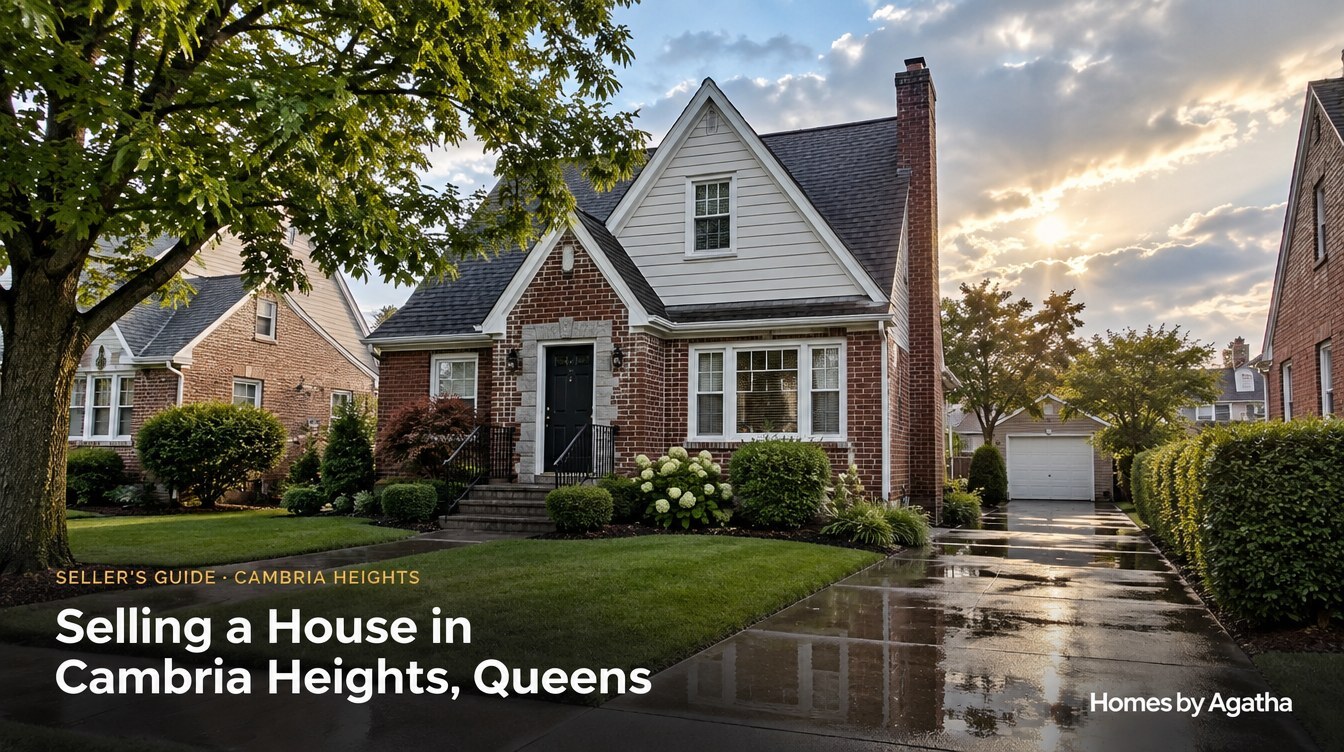
CAMBRIA HEIGHTS HOME SELLER GUIDE
Selling a House in Cambria Heights, Queens: Pricing, Preparation and Paperwork
Quick Answer
Selling a house in Cambria Heights, Queens, starts with a CMA built from truly comparable one- and two-family houses, matched by detached or attached style, lot and legal use. Gather Certificate of Occupancy and permit records, fix what inspectors will flag, deliver the Property Condition Disclosure Statement, and budget for brokerage compensation, attorney fees and transfer taxes.
Owners planning to list often ask the same first question: what will buyers actually notice? When you are selling a house in Cambria Heights, the answer is more specific than square footage. Buyers, their attorneys and their lenders look closely at whether the house is detached or attached, what the zoning allows, whether a second unit is legal, how old the heating and drainage systems are, and — on two landmarked blocks — whether exterior work had approval.
This guide walks through those questions from the seller’s side of the table. It covers how a comparative market analysis is built for this housing stock, what to repair and what to leave, how to present a pre-war Tudor or Cape Cod, which documents to collect before the first showing, which disclosures New York requires, what the seller pays at closing, and how to compare offers.
As a Licensed Associate Real Estate Broker serving Queens, I help owners plan a sale from pricing through closing, in English or Polish — whichever is more comfortable for the conversation. If you would like a broader overview of my listing services here, visit the page on how to sell your Cambria Heights home with Agatha.
Cambria Heights at a glance for sellers
| What buyers look up | Cambria Heights facts | Why it matters to your sale |
|---|---|---|
| Location and ZIP | Southeast Queens, NYC, Community District 13; ZIP 11411 (confirm the ZIP for a specific address with the USPS ZIP Code lookup) | NYC transfer taxes and NYC building records apply to every sale |
| Boundaries (NYC Department of City Planning rezoning area) | Murdock Avenue (north); Cross Island Parkway and Nassau County line (east); 121st Avenue and Montefiore Cemetery (south); Springfield and Francis Lewis Boulevards (west) | Buyers compare against nearby Queens and Nassau options |
| Housing stock | Mostly one- and two-family houses; detached homes dominate, with row and semi-detached houses mainly in the northern and western sections | Comparable sales must match the house type |
| Zoning | Contextual districts adopted in 2005: R2A on most blocks, plus R3A, R3-1 and R4B; C1-3/C2-3 overlays along Linden and Springfield Boulevards | Determines legal unit count and expansion potential buyers can rely on |
| Historic districts | Cambria Heights–222nd Street and Cambria Heights–227th Street Historic Districts (LPC, 2022) | Exterior work needs LPC approval; buyers ask about permit history |
| Transit | No subway station; local buses (Q4, Q27, Q83, Q84) and nearby LIRR stations at Queens Village, St. Albans and Laurelton; check current MTA bus maps and LIRR timetables for stops and service | Proximity to a bus corridor or LIRR station is a buyer filter |
| Corridors and landmarks | Linden Boulevard retail corridor; Cambria Playground at Francis Lewis Boulevard and 121st Avenue; Cross Island Parkway access | Useful listing context described by distance, not by claims |
How do buyers evaluate a house in Cambria Heights?
Buyers in Cambria Heights evaluate a house as a combination of building, lot and legal status. Most compare detached houses with other detached houses and attached houses with other attached houses, and they weigh condition and documentation almost as heavily as layout and finishes.
House type and lot
The NYC Department of City Planning reported in its 2005 rezoning study that one- and two-family detached homes made up 78.5% of the neighborhood’s housing stock. Because detached houses are the norm, buyers notice what distinguishes yours: lot width, a private driveway versus a shared one, a detached garage, yard depth and the side yards that give a detached house its separation. For row and semi-detached houses, buyers focus on the condition of shared walls, roofs and driveways.
Legal use and the unit count
Many Cambria Heights blocks are zoned R2A, which permits one-family detached homes only. That means a buyer’s attorney will compare the house’s actual use with its Certificate of Occupancy or Department of Buildings records. A basement apartment or extra kitchen that is not legal does not become a selling point just because it exists; it can become a negotiation point against you if it surfaces late.
Systems and condition
Older Queens houses get the same scrutiny everywhere, but certain items appear again and again in inspection reports on pre-war houses: oil tanks and older boilers, original wiring, cast-iron or clay sewer lines, basement moisture, and roofs on steep Tudor gables. Buyers also look at whether past updates were done with permits.
Location within the neighborhood
Without a subway station, buyers measure distance to a bus corridor such as Linden Boulevard or Murdock Avenue, to the Long Island Rail Road stations at Queens Village, St. Albans and Laurelton, and to the Cross Island Parkway. These are factual descriptors you can use in marketing, stated as routes and distances rather than as promises about travel time.
The two landmarked blocks
If your house is one of the 1931 Storybook-style row houses in the Cambria Heights–222nd Street or Cambria Heights–227th Street Historic Districts, described in the LPC’s 2022 designation announcement, buyers will value the intact architecture and also ask whether windows, roofing and masonry work since designation had Landmarks Preservation Commission approval. Having those permits in a folder makes the conversation easy.
How do you price a Cambria Heights house with a CMA?
Price a Cambria Heights house from a comparative market analysis that uses recent sales of genuinely similar houses, not neighbors’ asking prices. A CMA, or comparative market analysis, is a real estate broker’s professional opinion of value based on relevant market evidence; it is not an appraisal and does not guarantee a sale price.
The quality of a CMA depends on the comparables. In a neighborhood where detached Tudors, Cape Cods, Colonials and attached row houses sit within a few blocks of each other, a “nearby sale” can be a poor comparison if the house type, lot or legal use differs. The table below shows what a careful CMA matches first.
| Comparable factor | Why it matters in Cambria Heights | How a broker adjusts |
|---|---|---|
| Detached vs semi-detached vs row | Buyers and appraisers treat these as different products | Use sales of the same type first; adjust only when no close match exists |
| Legal unit count | A legal two-family supports different financing and income than a one-family | Compare legal one-family with one-family and legal two-family with two-family |
| Lot size and driveway | Private driveways, garages and wider lots are visible differences on R2A blocks | Adjust for lot width, parking and yard depth |
| Condition and updates | Pre-war systems vary widely from house to house | Adjust for permitted updates to heating, electrical, roof, kitchen and baths |
| Historic-district status | Intact Storybook architecture plus LPC rules on future work | Compare within the district where sales exist; explain rules to buyers |
| Location factors | Proximity to Linden Boulevard, LIRR stations and the Cross Island Parkway | Note differences rather than assume a fixed premium |
| Sale date | Market conditions change over months | Weight the most recent closed sales and current competing listings |
Pricing strategy, not just a number
A CMA produces a value range. Choosing a list price within that range is a strategy decision: pricing near the middle of the evidence can attract more buyers and stronger financing; pricing well above it often leads to longer marketing time and price reductions that buyers notice. The right choice depends on your timeline and the current competing listings, so the CMA should be refreshed with current inventory and recent closed sales from OneKey MLS at the moment you set the price.
Keep the appraisal in mind. Most buyers finance, so the lender’s appraiser will test the price against closed sales. If the contract price is well above what the comparables support, the buyer may need to cover an appraisal gap in cash, renegotiate or walk away under the mortgage contingency. For a step-by-step look at valuation, see what is my Queens home worth.
Key Takeaways
- A CMA is a broker’s opinion of value, not an appraisal or a guarantee.
- In Cambria Heights, match comparables by house type and legal unit count before anything else.
- Landmarked Storybook houses need comparables and explanations that address LPC rules.
- Price with the buyer’s appraisal in mind, because most buyers finance.
Request a Cambria Heights CMA
I will prepare a comparative market analysis using houses that truly match yours and explain the range — a professional opinion of value, not an appraisal.
What should you repair before selling a house in Cambria Heights?
Repair items that a buyer’s inspector, appraiser or lender is likely to flag, and items that make the house show poorly in photographs. Skip large cosmetic renovations that a buyer may redo anyway; focus on hazards, systems, water and paperwork.
For pre-war houses, a pre-listing inspection by a licensed home inspector can be worth considering. It tells you what a buyer’s inspector will likely find, so you can decide whether to repair, price for the condition, or disclose and offer a credit.
| Preparation item | Priority | Why it matters for older Cambria Heights houses |
|---|---|---|
| Open permits and DOB violations | High | Can delay closing; buyers’ attorneys search records early |
| Oil tank documentation (in use, removed or abandoned) | High | Buyers often order tank sweeps; missing records invite renegotiation |
| Active leaks, basement water, failed sump pump | High | Water stains and odors are visible in showings and in inspection reports |
| Heating system service | High | A serviced boiler or furnace with records reassures buyers and lenders |
| Roof and gutters on steep gables | Medium–High | Missing slate or tile and clogged gutters show in photos and reports |
| Electrical hazards (exposed wiring, double-tapped breakers) | Medium–High | Hazards like these are commonly flagged by inspectors and some lenders |
| Paint, lighting, caulk, minor carpentry | Medium | Low cost; improves photographs and first impressions |
| Full kitchen or bath remodel | Usually low | Buyers may prefer their own choices; cost may not be recovered |
Landmark blocks: plan exterior work early
For houses inside the two historic districts, exterior repairs such as window replacement, roofing and masonry generally need Landmarks Preservation Commission review before work starts. Work that conforms to the Commission’s rules can be approved by LPC staff through a Permit for Minor Work or a Certificate of No Effect; work that does not conform needs a Certificate of Appropriateness, which goes to a public hearing. LPC reports that about 95% of its permit approvals are issued at staff level. Ask LPC staff about current review times for your specific project. If you need exterior work before listing, start the LPC process first; do not start the work first.
Do not “legalize by description”
If the basement is finished but not a legal apartment, prepare and present it as what it legally is — for example, finished recreation space — rather than as a rental unit. Legalizing an apartment is a separate process involving zoning, building-code compliance and DOB filings. On R2A blocks, a conventional two-family conversion is not permitted. The City of Yes for Housing Opportunity amendments adopted in December 2024 created an accessory dwelling unit (ADU) option for one- and two-family homes, but with limits — for example, NYC Planning says detached ADUs are not allowed in historic districts or in R2A districts outside the Greater Transit Zone, basement ADUs are not allowed in the expanded 2050 and 2080 flood areas, and the owner must live on the property. Existing units seeking legalization follow different rules, so have an architect or land-use attorney review the specific lot before you describe any space as a possible unit.
How should you stage and photograph an older Queens house?
Stage a Cambria Heights house to show its architecture and its usable space, then hire a professional photographer who shoots both. Buyers searching online decide in seconds whether to visit, and the photographs are the first showing.
Let the architecture lead
Tudor, Storybook and Cape Cod houses have details that photographs can carry: arched doorways, leaded or diamond-pane windows, steep gables, fireplaces, original woodwork and built-ins. Clean, repair and light those details rather than hiding them. Remove heavy window treatments, clear mantels and shelves, and keep color choices neutral so the original features stand out.
Show the space buyers care about
In houses of this age, rooms can be smaller than in newer construction, and buyers mentally test whether furniture fits. Remove extra furniture, define each room’s purpose, and make sure bedrooms read as bedrooms. A measured floor plan helps buyers understand layout, dormer space and how the stairs connect floors. In the basement, show clean, dry, well-lit space and keep mechanical areas accessible for inspection.
Curb appeal is the exterior photograph
The front elevation of a detached house is often the lead image. Trim hedges, clean the walkway and driveway, repaint the front door if needed, replace broken light fixtures and clear gutters. For attached houses, a neat, well-kept facade helps the house read as distinct from its neighbors in the row.
Photography, video and accuracy
Professional photography, a floor plan and, where useful, a video walk-through are standard tools. Every image and description must be accurate: no digital removal of permanent defects, no unit counts that the CO does not support, and no claims about the neighborhood beyond verifiable facts such as streets, transit routes and parks.
Get a preparation plan for your house
Walk through the house with me and we will rank repairs, cleanup and staging by impact, so you spend only where buyers will notice.
Which documents should you gather before listing?
Assemble the house’s legal and maintenance records before the first showing. In Cambria Heights, the documents that most often affect the timeline are the Certificate of Occupancy or DOB records, permit sign-offs, oil-tank paperwork and — on the landmarked blocks — LPC permits.
Legal-use and building records
The Certificate of Occupancy states a building’s legal use and number of units. Many New York City houses built before 1938 were never required to have a CO unless later altered, so for an older Cambria Heights house your attorney may rely on other DOB records. Pull the property’s DOB record early: open permits, unresolved violations and work without sign-off are easier to address before a buyer’s attorney finds them.
Seller’s document checklist
- Deed and any existing survey
- Certificate of Occupancy, or DOB records for a pre-1938 house
- Permits and sign-offs for renovations, boiler replacement, electrical upgrades and extensions
- LPC permits for exterior work on the 222nd Street or 227th Street historic blocks
- Oil-tank records: removal, abandonment or testing certificates
- Recent property tax bills (NYC Department of Finance) and water/sewer bills (NYC DEP)
- 12 months of heating and utility costs
- Warranties and service records for roof, boiler, water heater and appliances
- Mortgage payoff information and any home-equity line details
If you are selling a condo or co-op unit
Cambria Heights is predominantly houses, but if you are selling a condo or co-op unit nearby, the process adds building documents. A co-op sale requires the buyer to submit a board application package and usually attend an interview; a condo sale may involve a right-of-first-refusal waiver. Any flip tax is set by that co-op’s own documents — there is no city-wide rate — so check your proprietary lease and house rules. Condo units and co-op apartments are outside the PCDS requirement, because New York’s Real Property Law excludes them from the definition of residential real property covered by the disclosure law; your attorney will still tell you what other disclosures the building or contract requires.
Which disclosures does a New York seller have to give?
Most sellers of one- to four-family houses in New York must deliver the Property Condition Disclosure Statement (PCDS) before the buyer signs the contract. Since March 20, 2024, a change in New York law removed the option of giving the buyer a $500 credit instead of delivering the form.
The Property Condition Disclosure Statement
The PCDS is a state form in which the seller answers questions about the property based on actual knowledge — for example, structural issues, water, environmental items, fuel storage tanks and the heating, plumbing and electrical systems. It is not a warranty and does not replace a buyer’s inspection, but answers must be truthful. The current form, published by the NYS Department of State, also includes flood-related questions — for example, whether the property is in a FEMA-designated floodplain or Special Flood Hazard Area and whether federal law requires flood insurance on it. Complete it carefully with your attorney’s guidance, especially if you inherited the house and have limited personal knowledge.
Lead-based paint disclosure
Federal law requires sellers of most housing built before 1978 to disclose known lead-based paint and hazards, provide available records and the federal pamphlet, and give the buyer an opportunity to test. Given the age of most houses in Cambria Heights, plan on providing this disclosure.
Agency and fair housing disclosures
At the first substantive contact, a New York agent provides the NYS Disclosure Form for Buyer and Seller, which explains whom the agent represents. Sellers also receive the NYS Housing and Anti-Discrimination Disclosure. Separately, the NYC Department of Finance’s document-recording checklist requires a completed smoke detector form for a one- or two-family dwelling when the deed is recorded, so make sure the house’s smoke and carbon monoxide alarms are installed and working. Your attorney will tell you which forms the closing requires.
Key Takeaways
- Pull your DOB record and CO early; open permits and violations are the most common delay.
- The PCDS is mandatory for most one- to four-family sellers; the $500 credit option ended March 20, 2024.
- Pre-1978 houses require the federal lead-based paint disclosure.
- On the landmarked blocks, keep LPC permits ready for buyers’ attorneys.
Build your listing strategy
Let’s line up your documents, disclosures and launch plan so buyers see a complete, well-documented house from the first day.
How is a Cambria Heights home marketed today?
A Cambria Heights house is typically marketed through OneKey MLS, the multiple listing service that covers Queens and Long Island, which shares listings with participating brokers and feeds major real estate websites. Strong presentation, accurate data and a clear showing plan matter as much as reach.
| Channel | What it does | What to get right for a Cambria Heights listing |
|---|---|---|
| OneKey MLS | Shares the listing with participating brokers and syndicates to portals | Correct house type, legal unit count, lot data and zoning; accurate room counts |
| Real estate portals | Where most buyers start their search | Lead with exterior and architectural-detail photos; include a floor plan |
| Open houses and private showings | Let buyers test layout, light and condition | Clean, dry basement; accessible boiler and panel; documents on hand |
| Listing description | Explains what photos cannot | Describe architecture, updates with permits, parking, and factual distances to Linden Boulevard, LIRR stations and the Cross Island Parkway |
| Agent-to-agent outreach | Reaches buyers already working with agents | Clear instructions for offers and any seller-offered buyer-broker terms |
| Social media and email | Extends reach to local and relocating buyers | Same accurate facts as the MLS; Fair Housing–compliant wording |
Brokerage compensation is negotiable
Listing-broker compensation is negotiable and set in your written listing agreement. Under the rules in effect in 2026, buyer-agent compensation is also negotiable and not set by law. Sellers are not automatically required to pay the buyer’s agent; buyers sign their own written agreements with their agents. A seller may choose to offer a contribution or consider it as part of an offer, and offers of compensation to buyer brokers are no longer displayed in MLS listings. Discuss these choices with your listing agent and attorney.
What a listing agreement should spell out
Read the listing agreement before signing: the term, the compensation and when it is earned, how buyer-agent compensation requests will be handled, marketing commitments, and how the agreement can be ended. Ask questions until every line is clear.
What does it cost to sell a house in Cambria Heights?
Seller costs when selling a house in Cambria Heights typically include brokerage compensation, the seller’s attorney fee, the NYS real estate transfer tax, the NYC Real Property Transfer Tax, and payoff of any mortgage or liens. Because Cambria Heights is in New York City, the NYC transfer tax applies to every sale here.
| Seller cost | How it is calculated | Source |
|---|---|---|
| NYS real estate transfer tax | $2 for each $500 of consideration (0.4%), customarily paid by the seller | NYS Department of Taxation and Finance |
| NYC Real Property Transfer Tax (1–3 family houses) | 1% when the price is $500,000 or less; 1.425% when the price is above $500,000; customarily paid by the seller | NYC Department of Finance |
| Listing-broker compensation | Negotiated in the listing agreement | Your agreement |
| Buyer-agent compensation (if the seller agrees to contribute) | Negotiable; not required by law | Negotiated in the transaction |
| Seller’s attorney fee | Quoted by the attorney | Your attorney |
| Mortgage payoff and lien releases | Per lender payoff letter; recording fees for satisfactions | Your lender; title company |
| Open violations, water/sewer balances, agreed credits | Paid or escrowed at closing | Contract and title report |
Confirm current rates with the NYS Department of Taxation and Finance and NYC Department of Finance before closing.
How the NYC threshold works — an arithmetic illustration
The NYC rate applies to the full price, so crossing $500,000 changes the tax on the whole amount. Using hypothetical round figures for arithmetic only — not an estimate of any house’s value — a $500,000 sale would carry $2,000 in NYS transfer tax and $5,000 in NYC transfer tax, while a $600,000 sale would carry $2,400 and $8,550. Your attorney calculates the actual figures on the transfer tax returns.
Costs that are not the seller’s
The NYS “mansion tax” — 1% on residential purchases of $1 million or more — is paid by the buyer, and the mortgage recording tax is paid by the borrower. Capital-gains tax on a sale depends on your personal situation; ask a CPA before you list, not after. For a wider view of buyer and seller costs in the borough, see Queens closing costs explained.
Estimate your net proceeds
I can help you organize the cost categories for your sale so you and your attorney can estimate what you will take home at different price points.
How should you compare offers and negotiate?
Compare offers on certainty and net proceeds, not just price. In Cambria Heights, where most buyers finance an older house, the strength of the financing, the size of the down payment and the buyer’s flexibility on inspection and appraisal issues can matter as much as the headline number.
| Offer term | What to ask | Why it matters for an older house |
|---|---|---|
| Price | How does it compare with the CMA range? | A price far above the comparables raises appraisal risk |
| Financing type and down payment | Cash, conventional or government-backed? How much down? | Some loan types have property-condition standards that older houses must meet |
| Pre-approval quality | Who issued it, and was income and asset documentation reviewed? | A thin pre-approval can fail during underwriting |
| Appraisal gap | Will the buyer cover a shortfall in cash? | Unusual houses can have fewer close comparables |
| Contingencies | Mortgage contingency length; any sale-of-home contingency | Longer contingencies extend uncertainty |
| Inspection approach | Will the buyer accept the house as-is or request credits? | Pre-war systems almost always produce findings |
| Closing date | Does it fit your move or purchase plans? | Timing can be worth more than a small price difference |
Negotiating after the inspection
Expect an inspection report on any older Cambria Heights house to list items. Separate hazards and failing systems from routine maintenance. A credit at closing is often simpler than making repairs under time pressure, and on the landmarked blocks, exterior repairs may need LPC approval that cannot be rushed. Your disclosures and pre-listing records give you a stronger position, because the buyer already knew about documented items before making the offer.
Multiple offers
If several buyers are interested, your agent may ask for highest and best offers by a set deadline. Treat each offer’s terms — financing, contingencies and timing — with the same weight as price, and remember that nothing is binding until the contract is signed by both sides.
What happens from accepted offer to closing — and what if the house was inherited?
After you accept an offer, your attorney sends the buyer’s attorney a contract of sale; the deal becomes binding when both sides sign and the buyer delivers the contract deposit, commonly held in escrow by the seller’s attorney. A financed sale then typically moves through appraisal, mortgage commitment and title clearance before closing.
| Stage | Seller’s role | Common range (varies) |
|---|---|---|
| Preparation and pricing | CMA, repairs, documents, PCDS draft, listing agreement | 2–6 weeks |
| Marketing and offers | Showings, offer review, acceptance | Varies with price, condition and inventory |
| Contract | Attorney negotiates and signs; deposit placed in escrow | Often 1–3 weeks after acceptance |
| Buyer’s mortgage and appraisal | Provide access for appraiser; answer lender questions through attorneys | Often 3–6 weeks |
| Title clearance | Resolve violations, liens and payoff letters | Runs in parallel |
| Walk-through and closing | Deliver the house as agreed; sign deed and transfer tax forms | Closing day |
Remember that New York is an attorney state: an accepted offer is not a signed contract, and your attorney — not your agent — negotiates the contract terms. For a borough-wide view of the sequence, see how to sell your home in Queens.
Selling an inherited house in Cambria Heights
Many older Queens houses are sold by heirs. Before an inherited house can be sold, the person with legal authority to sell must be established — usually an executor appointed through probate or an administrator appointed when there is no will, through the Queens County Surrogate’s Court. Heirs often have limited knowledge of the house’s history, which makes gathering DOB records, tank paperwork and permits even more important. The probate real estate guide explains how estate sales work in New York.
Have an offer to review?
Send it over and I will help you compare price, financing, contingencies and timing side by side before you respond.
What mistakes should Cambria Heights sellers avoid?
The most expensive seller mistakes in Cambria Heights involve paperwork and pricing rather than paint colors. Avoiding them protects both your price and your closing date.
- Marketing an illegal unit as rental income. It misleads buyers, conflicts with the CO and can unravel the deal during the buyer’s attorney review.
- Pricing from the wrong comparables. A detached house priced from row-house sales — or the reverse — misses the market.
- Waiting to pull DOB records. Open permits and violations found late can push back closing.
- Losing oil-tank paperwork. Buyers who find an undocumented tank will ask for testing, removal or a credit.
- Starting exterior work on a landmarked house without LPC approval. It creates a problem for you and the next owner.
- Treating the PCDS casually. Answers must be truthful and based on what you actually know.
- Choosing the highest price over the strongest terms. A weaker offer that fails at appraisal costs time.
Cambria Heights seller checklist
- Request a CMA and choose a pricing strategy based on comparable houses of the same type and legal use.
- Pull the CO or DOB records, open permits and violations; resolve what you can.
- Collect oil-tank, boiler, roof and renovation records, plus LPC permits if your house is in a historic district.
- Consider a pre-listing inspection and fix hazards, water and system issues first.
- Engage a New York real estate attorney before you accept an offer.
- Complete the PCDS and the federal lead-based paint disclosure with your attorney’s guidance.
- Prepare, stage and professionally photograph the house; add a floor plan.
- Sign a clear listing agreement and launch on OneKey MLS with accurate data.
- Compare offers on price, financing, contingencies and timing.
- Sign the contract only through your attorney and track the buyer’s mortgage commitment.
- Clear violations, liens and payoff letters ahead of closing.
- Leave the house in the agreed condition for the final walk-through.
If you are also deciding where to go next, the companion guide on how I help clients buy a home in Cambria Heights covers the purchase side, and nearby owners can compare notes with the seller pages for Laurelton, Saint Albans and Springfield Gardens.
Plan your sale on your timeline
Whether you are listing next month or next year, a short conversation can turn this checklist into a schedule built around your house and your plans.
Frequently asked questions about selling a house in Cambria Heights
How do I find out what my Cambria Heights house is worth?
Start with a comparative market analysis from a licensed broker. A CMA compares recent sales of similar houses, matched by detached or attached style, legal unit count, lot and condition. It is a professional opinion of value, not an appraisal, and a buyer’s lender will still order its own appraisal.
Do I have to give buyers a Property Condition Disclosure Statement?
Most sellers of one- to four-family houses in New York must deliver the Property Condition Disclosure Statement before the buyer signs the contract. Since March 20, 2024, sellers can no longer give a $500 credit instead of the form. Complete it truthfully, based on actual knowledge, with your attorney’s guidance.
What transfer taxes does a seller pay in Cambria Heights?
Sellers customarily pay the NYS real estate transfer tax of 0.4% and the NYC Real Property Transfer Tax. For one- to three-family houses, the NYC tax is 1% when the price is $500,000 or less and 1.425% above $500,000. Confirm current rates with the NYS DTF and NYC Department of Finance.
Does the seller have to pay the buyer’s agent in New York?
No. Buyer-agent compensation is negotiable and not set by law, and sellers are not automatically required to pay it. Buyers sign written agreements with their own agents. A seller may choose to contribute as part of the negotiation, so discuss the options with your listing agent and attorney before reviewing offers.
What if my house is in a Cambria Heights historic district?
Houses on the landmarked 222nd Street and 227th Street blocks can be sold like any other house, but exterior work generally requires Landmarks Preservation Commission approval. Gather permits for past window, roof and masonry work, and do not start new exterior repairs before listing without LPC review.
Can I market my basement apartment as rental income?
Only if the unit is legal according to the Certificate of Occupancy or Department of Buildings records. Most Cambria Heights blocks are zoned R2A, which permits one-family detached homes. Describing an illegal unit as income misleads buyers, conflicts with lender rules and can cause the deal to fall apart.
Which repairs matter most before selling an older Cambria Heights house?
Prioritize open permits and DOB violations, oil-tank documentation, leaks and basement water, heating-system service, roof and gutter problems, and electrical hazards. These are the issues inspectors, lenders and attorneys flag most often in pre-war houses. Large cosmetic remodels are usually a lower priority than systems and paperwork.
How long does it take to sell a house in Cambria Heights?
Timing depends on price, condition and current inventory. Once an offer is accepted, a financed sale commonly takes about two to three months to close, covering contract signing, the buyer’s appraisal and mortgage commitment, and title clearance. Missing permits or open violations are the most common causes of delay.
Can I sell an inherited house in Cambria Heights before probate ends?
A sale generally requires someone with legal authority, such as an executor or administrator appointed by the Queens County Surrogate’s Court. Preparation, pricing and gathering records can start earlier. Talk with an estate attorney about timing, because the court appointment and estate documents affect when a contract can be signed.
Does my Cambria Heights house need a Certificate of Occupancy to sell?
Not always. Many New York City houses built before 1938 were never required to have a CO unless later altered. In those cases, attorneys and title companies rely on other Department of Buildings records. If your house was altered or converted, confirm the CO and permits match its current use.
Summary and your next step
Selling a house in Cambria Heights rewards preparation more than promotion. Owners who price from comparables of the same house type and legal use, assemble their DOB, tank and LPC records early, deliver complete and truthful disclosures, and judge offers on certainty as well as price give themselves the smoothest path to closing. When you are ready to turn this plan into a listing, the page on how we sell Cambria Heights homes together explains the next steps.
This article is for general informational purposes only and reflects conditions that may change. It is not legal, tax, or financial advice, an appraisal, or a guarantee of price or outcome; consult a licensed New York attorney, a CPA, and an NMLS-registered mortgage loan originator as appropriate. A CMA is an opinion of value, not an appraisal. Real estate brokerage services are offered by Agatha Lubas, Licensed Associate Real Estate Broker, NY License #10301213345, Keller Williams Realty Liberty, 96-10 101st Avenue, Ozone Park, NY 11416. The NYS Disclosure Form for Buyer and Seller, the NYS Housing and Anti-Discrimination Disclosure / Fair Housing Notice, and the brokerage’s Standard Operating Procedures are available on request. Equal Housing Opportunity.

Agatha Lubas helps sellers, buyers and investors across Queens, Brooklyn, Nassau County and Suffolk County plan pricing, preparation and the New York attorney-based closing process. She works in English and Polish so every client can discuss their sale in the language they find most comfortable.
Work with Agatha