

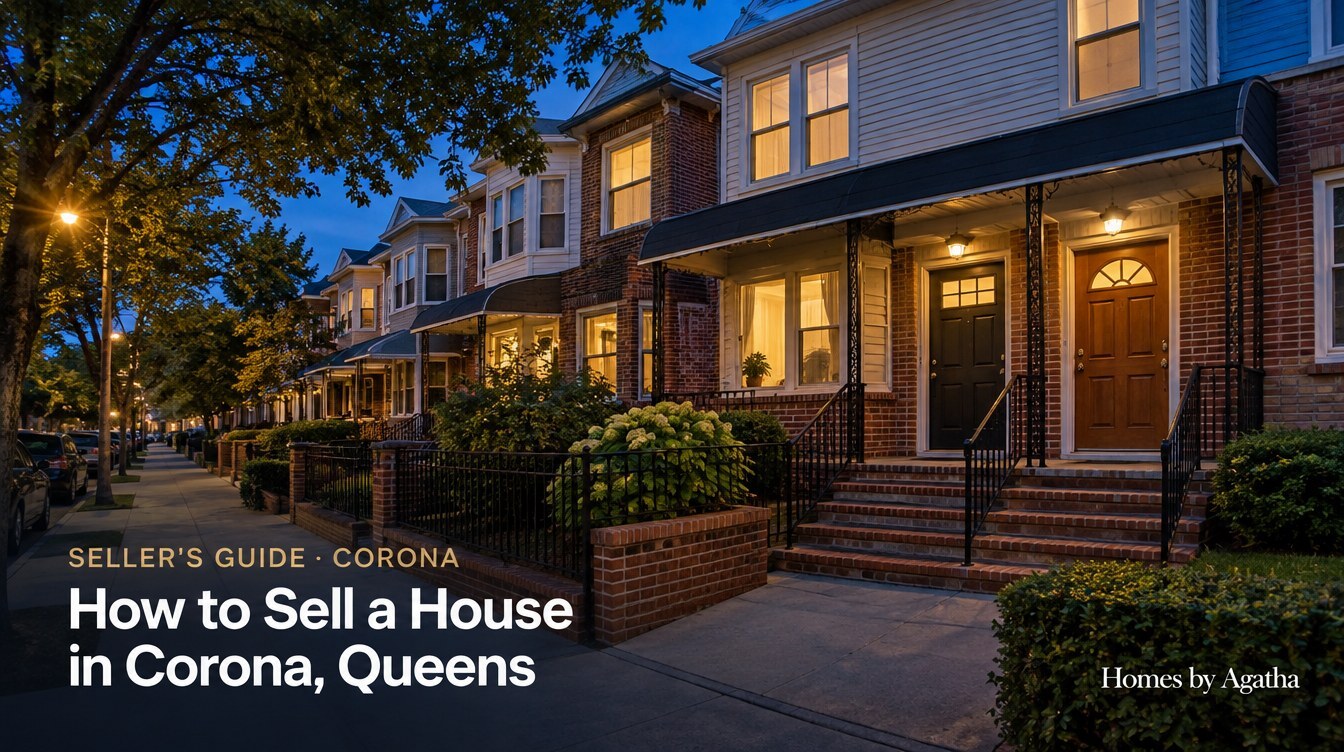
CORONA SELLER GUIDE
How to Sell a House in Corona Queens: Pricing Legal Units, Handling Tenants and Getting Your Paperwork Ready
Quick Answer
To sell a house in Corona, Queens, start with a CMA based on comparable homes with the same legal unit count, then gather your Certificate of Occupancy, violation records and leases before listing. Decide whether to deliver tenants or vacant units, prepare every unit for photos, list on OneKey MLS, and budget for NYS and NYC transfer taxes.
If you are researching how to sell a house in Corona Queens, you probably own something more complicated than a single apartment: an attached two-family house with a tenant upstairs, a three-family building you inherited, or a storefront with apartments above on a commercial street. Corona’s housing is built largely from these small residential buildings, and that shapes how buyers judge them, how lenders finance them and how quickly a sale can close.
This guide explains the seller side of that reality. You will learn how buyers in Corona evaluate a property, how a comparative market analysis prices one, which records to collect before your house goes on the market, how tenants change the plan, what New York requires you to disclose, what a seller pays at closing, and how to compare offers that look similar on paper but are not.
As a Licensed Associate Real Estate Broker serving Queens, I help owners prepare a sale step by step, in English or Polish, so the paperwork is ready before the first buyer asks for it. When you want a property-specific plan, the page on how to sell your home in Corona with Agatha explains how we work together.
Corona at a glance for sellers
| Feature | Detail | What buyers will check |
|---|---|---|
| Location | Queens (Queens County), New York City, west of Flushing Meadows Corona Park, bordering Jackson Heights, East Elmhurst and Elmhurst | Which side of the neighborhood, and how close to the park or the commercial streets |
| ZIP code | Mostly 11368; confirm the ZIP code with USPS and the community district on NYC Planning’s maps for the specific address | Search filters on portals often use ZIP codes |
| Subway | 7 train at Junction Blvd (local and express), 103 St–Corona Plaza and 111 St (local), all elevated above Roosevelt Avenue | Walking time to the nearest station; noise from the elevated line |
| Rail | Long Island Rail Road Port Washington Branch at Mets–Willets Point, just east of Corona, served full-time since April 2023, though some peak-hour trains skip the stop | Alternative commute options for eastern blocks |
| Parks and landmarks | Flushing Meadows Corona Park, New York Hall of Science, Queens Museum, Queens Zoo, Louis Armstrong House Museum, Corona Plaza; Citi Field and the USTA Billie Jean King National Tennis Center nearby | Proximity to park access and event-day traffic |
| Commercial corridors | Roosevelt Avenue, Junction Boulevard, National Street, 108th Street, Corona Avenue, Northern Boulevard | Everyday shopping access vs. storefront activity next door |
| Common property types | Attached and semi-attached one-to-three-family houses, row houses, some detached houses, mixed-use buildings, walk-ups, limited condo and co-op units | Legal unit count, separate meters and entrances, rental potential |
How do buyers evaluate a house in Corona, Queens?
Buyers evaluate a Corona house on four things: its legal configuration, the condition of the systems that serve every unit, its location relative to the 7 train and the commercial streets, and the income or flexibility the extra units provide. A house that looks large but has fewer legal units than its layout suggests will be judged by its legal count.
Two buyer profiles shape most Corona sales
The first is the owner-occupant who plans to live in one unit and rent another. This buyer is often financing with a residential mortgage, cares about the condition of the owner’s unit, and needs the rental unit to be legal so the lender can consider its income.
The second is the investor who will rent every unit. This buyer reads the property as a stream of income and expenses: current rents, lease terms, water and heating costs, insurance and the cost of deferred maintenance. Investors may pay cash or use investor financing and tend to move faster, but they price more conservatively.
Knowing which profile your property attracts tells you how to prepare it. A two-family house with a renovated owner’s floor and a vacant second unit appeals strongly to owner-occupants. A fully rented three-family with documented leases and newer mechanical systems speaks to investors.
Features that move Corona buyers
- Separate entrances and floor-through units. Privacy between units matters to both owner-occupants and tenants.
- Separate utility meters. When each unit has its own electric and gas meter, tenants pay their own usage, and buyers notice.
- Driveway or garage. On-street parking near Roosevelt Avenue and Junction Boulevard is in demand, so legal off-street parking stands out.
- Distance to the 7 train. A short walk to Junction Blvd, the express stop, can widen the buyer pool; a house directly facing the elevated structure may need its noise addressed honestly in showings.
- Updated mechanicals. A newer boiler, roof or electrical service reduces the buyer’s risk across every unit.
Curious how buyers would read your Corona property?
I can prepare a complimentary CMA that compares your house with recent sales of the same legal configuration, so you see the price range before you decide anything.
How should you price a house in Corona?
Price a Corona house from a comparative market analysis that matches it with recent sales of similar legal configuration, size, condition and location, then adjust for tenancy and income. A CMA, or comparative market analysis, is a real estate broker’s professional opinion of value based on relevant market evidence. It is not an appraisal and does not guarantee a sale price.
Compare legal configuration, not just square footage
A legal two-family house should be compared with other legal two-family houses, and a three-family with three-family sales. Mixing configurations gives a misleading result, because buyers, lenders and appraisers treat them differently. A one-family house with an unapproved basement apartment is, for pricing purposes, a one-family house.
How the appraisal can reshape your price
Most financed buyers need an appraisal. For a two-to-four-unit building, the appraiser usually reviews comparable sales and may also estimate market rents. If the appraisal comes in below the contract price, the buyer may renegotiate, add cash or, depending on the contract, cancel. Pricing that matches the evidence protects the deal from collapsing at this stage.
Pricing factors for Corona properties
| Pricing factor | How buyers and appraisers read it | What you can do before listing |
|---|---|---|
| Legal unit count | Defines comparable sales and how lenders count income | Pull the Certificate of Occupancy or Letter of No Objection and match the marketing to it |
| Tenant occupancy | Investors value documented rent; owner-occupants may need a vacant unit | Organize leases, rent records and deposit details |
| Open violations or permits | Raise risk, may block some financing, and invite price reductions | Have your attorney or expediter review DOB and OATH records early |
| Building systems | Roof, boiler and electrical age affect every unit’s costs | Gather invoices, warranties and permit sign-offs |
| Location within Corona | Walk to the 7 train, exposure to the elevated line and commercial streets, proximity to the park | Describe commute options factually; schedule showings at quiet and busy hours as appropriate |
| Parking | Legal driveway or garage adds practical value | Confirm the driveway’s legal status on the survey and deed |
| Commercial space (mixed-use) | Valued partly on lease income and tenant quality | Prepare commercial lease copies and expense history |
For a broader explanation of how valuation works across the borough, read what is my Queens home worth. Market statistics change quickly, so any price discussion for your house should rely on current, documented comparable sales, drawn from OneKey MLS and NYC Department of Finance sales records at the time you list.
Key Takeaways
- A CMA is a broker’s professional opinion of value, not an appraisal and not a guarantee.
- Compare your Corona house with sales of the same legal configuration.
- An unapproved extra apartment does not add a legal unit to your price.
- Documented rents, permits and system upgrades support value at the appraisal stage.
What paperwork should a Corona seller gather before listing?
Before listing, gather the documents that prove what your building is and how it is operated: the Certificate of Occupancy or other legal-use records, any DOB and OATH violations and open permits, leases and rent records, utility and tax bills, and records of major repairs. In Corona, missing paperwork is a more common cause of delay than missing buyers.
Legal-use records
A Certificate of Occupancy is the NYC Department of Buildings document stating a building’s legal use and number of units. Many Corona houses predate 1938, when the Department of Buildings generally did not require Certificates of Occupancy; for those buildings, a Letter of No Objection from the DOB can confirm that the existing use is acceptable. Your attorney can tell you which document your buyer’s attorney and lender will expect.
Violations and open permits
Open DOB violations, unpaid OATH (formerly ECB) penalties and permits that were never signed off appear in the buyer’s title and municipal searches. Clearing them can take time because it may require inspections, filings or corrections. Review your building’s records before listing, not after a buyer’s attorney finds them.
Tenant and income records
If your house is rented, collect every current lease, a rent roll showing each unit’s rent and lease dates, records of security deposits, and your HPD registration if one applies. HPD requires annual registration for buildings with three or more units and for one- and two-family homes where neither the owner nor the owner’s immediate family lives. Investor buyers and their lenders will ask for these, and a complete package signals a well-run building.
Systems, repairs and environmental items
Keep invoices and permits for the roof, boiler, electrical work and plumbing. If the house converted from oil heat, locate paperwork showing how the old tank was removed or abandoned. Recent water, gas and electric bills help buyers estimate operating costs.
Inherited Corona houses
Many Corona houses come to market after an owner passes away. To sell an inherited house, the person selling usually needs legal authority from the Queens County Surrogate’s Court, such as letters testamentary or letters of administration, or the property must pass under another valid arrangement. Coordinate with an estate attorney early; our page on selling probate real estate in New York explains the general process.
Want to know what’s missing from your file?
Let’s review your building’s public records and your documents together, so violations or missing paperwork are handled before buyers arrive.
Should you sell a Corona multi-family house with tenants in place or vacant?
Selling with tenants in place usually suits investor buyers and avoids lost rent, while delivering one or more units vacant widens the pool to owner-occupants who need to move in. The right choice depends on your leases, your timeline and New York tenant law, so decide with your attorney before you list.
Selling with tenants in place
A tenant-occupied sale keeps rent coming in during marketing. The buyer takes the building subject to existing leases, and your attorney arranges for security deposits and lease obligations to transfer at closing. To make this work, organize the leases, provide estoppel-style confirmations of rent and deposits if requested, and coordinate showings with tenants according to their lease terms and applicable law.
Delivering a unit vacant
Some owner-occupant buyers need a vacant unit. If you promise vacant delivery in a contract, you are responsible for lawfully delivering it. New York law limits when and how a tenancy can end, and a seller who signs a “vacant at closing” contract without a realistic plan risks delay or default. Do not rely on informal arrangements; your attorney should evaluate the specific tenancies, including whether any unit is rent regulated, which NYS Homes and Community Renewal can confirm.
Showing occupied units respectfully
Tenants’ cooperation affects your photos, showings and inspection access. Give the notice the lease and law require, explain the schedule, and keep showings to reasonable windows. Well-kept occupied units photograph well; units with personal items everywhere can be shown with fewer photos and a floor plan.
How do you prepare and stage a Corona house for sale?
Prepare a Corona house by fixing hazards, building systems and appraisal issues first, then improving what buyers see in photos: the facade and stoop, the owner’s unit, and every kitchen and bathroom. Staging in a multi-unit house is about making each unit read clearly as its own home.
| Priority | Item | Why it matters in Corona |
|---|---|---|
| High | Resolve open violations and unsigned permits where possible | Prevents title and lender delays and price renegotiation |
| High | Repair active leaks, roof and parapet issues on attached houses | Water problems in shared-wall houses alarm inspectors and buyers |
| High | Service the boiler and document it | Heating serves every unit and is a top inspection item |
| Medium | Paint, patch and deep-clean vacant units | Vacant units photograph as blank canvases; flaws show |
| Medium | Clean the facade, stoop, awnings and front yard | The street view is the first photo on every portal |
| Medium | Clear and light basements and cellars | Buyers inspect below-grade space for water and use |
| Lower | Major remodeling | Rarely recovers its cost before a sale; can trigger permit requirements |
Present below-grade space honestly
If your basement or cellar was converted into an apartment without approval, do not market it as a rentable unit. Under New York City building rules, a cellar, more than half below curb level, generally cannot be a legal apartment, and a basement must meet strict standards to be habitable. Talk to your attorney and, if needed, an architect about whether to correct or disclose the condition before listing. Presenting the space as storage, laundry or recreation space that matches the legal records keeps your marketing accurate.
The owner’s unit and the street view
In a two-family house aimed at owner-occupants, the owner’s unit sells the property. Declutter it, neutralize bold colors if needed, and make sure light fixtures and windows are in working order. Outside, attached houses are judged as a row; clean awnings, a repaired gate and a tidy front area help your house stand out from neighbors that share its silhouette.
Need a preparation plan that fits your budget?
We can walk the property together and rank repairs by what buyers, inspectors and appraisers in Corona will actually notice.
How is a Corona house marketed to buyers?
A Corona house is marketed through OneKey MLS, the multiple listing service for the region, which shares listing data with participating brokerages and major home-search portals, supported by professional photography, floor plans and accurate unit-by-unit details. Accurate marketing that matches the building’s legal status attracts buyers who can close.
Listing details that matter for multi-unit houses
For a two- or three-family house, buyers want to know the layout of each unit, which units are occupied, lease terms, which utilities tenants pay and the age of major systems. Listing the legal unit count exactly as the records show avoids attracting buyers whose financing depends on units that do not exist.
Photography and floor plans
Professional photography should show the facade, each unit’s main rooms, kitchens, bathrooms, any yard and the basement or cellar. A floor plan for each level helps out-of-area buyers and investors understand a building they cannot easily visualize from photos alone.
Showings around Corona’s calendar
Near the park and 111th Street, Citi Field games and the US Open bring crowds and parking pressure. Scheduling open houses around major event days can make parking and arrival easier for visitors. Near Roosevelt Avenue, let buyers experience the 7 train honestly rather than avoiding it; surprises discovered after contract are worse than facts shared upfront.
If your Corona property is a condo or co-op unit
Selling a condo unit usually involves the condominium’s managing agent, who supplies building financials, and may involve a right of first refusal held by the board. Selling a co-op apartment requires the buyer to submit a board application, often called a board package, and usually to attend an interview. A flip tax, if any, is set by the co-op’s own documents; there is no citywide rate. Board package requirements, any right of first refusal and any flip tax vary by building, so ask the managing agent for the governing documents early.
| Marketing channel | What it does | How to use it for a Corona listing |
|---|---|---|
| OneKey MLS | Shares the listing with participating brokerages and feeds many portals | Core exposure to agents representing owner-occupant and investor buyers |
| Home-search portals | Reach buyers searching online by ZIP code, price and property type | Complete unit-by-unit data and accurate property type |
| Photography and floor plans | Show layout and condition of each unit | Essential for multi-unit houses that are hard to picture |
| Open houses and private showings | Let buyers experience the block, the commute and the units | Schedule around tenant notice and park event days |
| Broker network outreach | Alerts agents with investor or owner-occupant clients | Useful for fully rented or mixed-use buildings |
What disclosures do you have to make when selling in Corona?
Most sellers of one-to-four-family houses in New York must deliver the Property Condition Disclosure Statement, and sellers of homes built before 1978 must provide the federal lead-based paint disclosure. Licensees also give the NYS Disclosure Form for Buyer and Seller at the first substantive contact.
The Property Condition Disclosure Statement
The Property Condition Disclosure Statement (PCDS) is a New York State form in which the seller answers questions about the property’s condition, including the structure, systems, environmental items and flood history. Since March 20, 2024, the law no longer allows sellers to give a $500 credit instead of delivering the disclosure; sellers of most one-to-four-family homes must provide the PCDS. According to the NYS Department of State, the PCDS does not apply to condominium units or co-op apartments. Answer accurately and consult your attorney on anything uncertain.
Lead-based paint disclosure
Federal law requires sellers of housing built before 1978 to disclose known lead-based paint and hazards and provide available records. Because much of Corona’s housing is older, expect this form in most sales.
Agency and fair housing disclosures
The NYS Disclosure Form for Buyer and Seller explains whom a real estate licensee represents. The NYS Housing and Anti-Discrimination Disclosure Form explains fair housing protections. Both are part of a compliant New York sale. Sellers should also know that every buyer must be treated equally regardless of protected characteristics; offers are evaluated on their terms, not on who the buyer is.
Key Takeaways
- Gather legal-use records, violations, leases and repair invoices before listing.
- Choose tenant-occupied or vacant delivery with your attorney, before you sign a contract.
- Market the legal unit count exactly as the records show.
- Most one-to-four-family sellers must deliver the PCDS; the $500 credit option ended in 2024.
Planning when and how to list?
We can map a listing strategy around your tenants, your paperwork and the calendar near the park, so your launch is accurate from day one.
What does it cost to sell a house in Corona?
A Corona seller typically pays the New York State real estate transfer tax, the NYC Real Property Transfer Tax, brokerage compensation as negotiated, attorney fees and the payoff of any mortgage, plus any costs to resolve violations. Exact amounts depend on the price, the property type and the contract.
Transfer taxes
The NYS real estate transfer tax, administered by the New York State Department of Taxation and Finance, is $2 for each $500 of consideration (0.4%) and is customarily paid by the seller. The NYC Real Property Transfer Tax, administered by the NYC Department of Finance, applies to Corona because it is in New York City: for residential one-to-three-family homes, individual co-op units and condo units, the rate is 1% when the price is $500,000 or less and 1.425% when it is above $500,000, customarily paid by the seller. Buildings with four or more units fall outside the residential one-to-three-family category, and the NYC Department of Finance taxes those “all other” transfers at 1.425% when the price is $500,000 or less and 2.625% above $500,000. Mixed-use buildings can also land in that category depending on how they are classified, so ask your attorney to confirm the NYC and NYS transfer-tax treatment for your specific building. Confirm current rates with the NYS Department of Taxation and Finance and NYC Department of Finance before closing.
Seller expense overview
| Expense | Who sets it | Notes for a Corona sale |
|---|---|---|
| Listing brokerage compensation | Negotiated between seller and listing broker | Not set by law; agree on it in writing in the listing agreement |
| Buyer-agent compensation | Negotiated; the seller may or may not agree to contribute | Not automatically paid by the seller after the 2024 settlement rules |
| NYS real estate transfer tax | NYS Department of Taxation and Finance | 0.4% of the consideration, customarily paid by the seller |
| NYC Real Property Transfer Tax | NYC Department of Finance | 1% up to $500,000, 1.425% above, for one-to-three-family homes, co-op and condo units |
| Seller’s attorney | Agreed with your attorney | Prepares the contract, handles title objections, violations and lease transfers |
| Mortgage payoff and lien releases | Your lender and any lienholders | Request a payoff letter early |
| Violation and permit cleanup | Depends on the issue | May require an architect, expediter or contractor |
| Co-op or condo charges | Building documents | Flip tax only if the co-op’s documents impose one; move-out or processing fees vary |
Taxes on any gain from the sale depend on your situation; ask a CPA before you list, especially for a rental or inherited property. For more on how costs are split across a borough transaction, see Queens closing costs explained.
Brokerage compensation after the 2024 settlement
Under the rules in effect in 2026, brokerage compensation is negotiable and not set by law. A seller decides whether to offer any contribution toward a buyer’s agent’s compensation, and buyers sign written agreements with their own agents. Those choices can affect how many buyers and agents engage with your listing, so discuss them openly when you sign your listing agreement.
How do you compare offers on a Corona house?
Compare offers by net proceeds and certainty, not only by price: look at financing type, down payment, contingencies, appraisal risk, closing date, tenant or vacancy terms and the buyer’s readiness to sign a contract. In Corona, the offer most likely to close is often the one whose financing matches the building.
| Offer element | Question to ask | Why it matters for a Corona multi-unit house |
|---|---|---|
| Price | What will I net after taxes, compensation and credits? | Two offers with the same price can produce different net proceeds |
| Financing type | Cash, conventional, government-backed or investor loan? | Some loan programs have property standards that older buildings must meet |
| Down payment and proof of funds | Is the money documented now? | A larger down payment can absorb a lower appraisal |
| Pre-approval scope | Does it cover a two-family, three-family or mixed-use property? | A one-family approval may not fit your building |
| Rental-income reliance | Does the buyer’s loan depend on your unit’s rent? | Rent counts only for legal units; mismatches derail approvals |
| Contingencies | Mortgage contingency length? Other conditions? | Shorter, clearer contingencies add certainty |
| Closing date and possession | Does it fit my move and my tenants’ situation? | Vacancy promises must be achievable under New York law |
| Attorney readiness | Does the buyer have an attorney ready to review the contract? | New York sales are not binding until the contract is signed |
Negotiating after inspection
In New York, buyers usually inspect after the offer is accepted and before the contract is signed. When the inspection report arrives, buyers may ask for repairs or credits, particularly on roofs, boilers, oil tanks and sewer lines. Decide in advance which items you are willing to credit and which you will hold firm on. Credits must be acceptable to the buyer’s lender, so coordinate with both attorneys.
Remember: an accepted offer is not a contract
An accepted offer means the parties agree on terms in principle. The buyer’s and seller’s attorneys then negotiate the contract of sale, and the deal binds both sides only after signatures and the buyer’s deposit. Keep backup interest alive politely until the contract is fully signed.
Weighing more than one offer?
Send me the offers you have received, and we can compare net proceeds, financing fit and closing risk side by side before you respond.
How to sell a house in Corona Queens: the timeline from listing to closing
A Corona sale moves through seven stages, from the valuation and records review to the closing table. Delays usually come from records, appraisals and tenant arrangements rather than from marketing, so the early stages deserve the most attention.
| Stage | Seller’s main tasks | Common Corona snag |
|---|---|---|
| 1. Valuation and strategy | Review the CMA, choose tenant or vacant delivery, sign the listing agreement | Pricing based on units that are not legal |
| 2. Records and preparation | Gather CO or LNO, violations, leases, invoices; complete priority repairs | Open permits discovered late |
| 3. Marketing and showings | Photography, OneKey MLS listing, showings with tenant notice | Limited access to occupied units |
| 4. Offers and acceptance | Compare offers, negotiate terms | Pre-approval that does not match the building type |
| 5. Inspection and contract | Respond to inspection requests; attorneys sign contract; deposit held in escrow | Oil tank or sewer findings reopening price |
| 6. Appraisal, financing and title | Provide access and documents; resolve title objections | Appraisal counting fewer legal units; unpaid penalties in the municipal search |
| 7. Closing | Deliver deed, transfer leases and deposits, hand over keys and possession as agreed | Vacancy not delivered as promised |
Exact timing depends on the buyer’s financing, the condition of your records and both attorneys’ schedules. A seller who completes stage 2 before listing usually experiences fewer surprises in stages 5 and 6. If you are comparing Corona with nearby markets because you own property in more than one, the pages on selling in Elmhurst, Jackson Heights and Flushing explain the same process in those neighborhoods.
What mistakes do Corona sellers make, and what belongs on your checklist?
The costliest seller mistakes in Corona are advertising units that are not legal, listing before checking violations and permits, and promising vacant delivery without a lawful plan. Each one surfaces during the buyer’s due diligence and can cost price, time or the deal itself.
Common seller mistakes
- Marketing an illegal basement or attic apartment as income. The buyer’s attorney and lender will check the records, and the price will fall back to the legal configuration.
- Discovering violations after the contract. Unresolved DOB or OATH items can delay closing or force credits.
- Overpromising on tenants. A contract that requires a vacant unit you cannot lawfully deliver creates legal risk.
- Pricing from a neighbor’s sale with a different configuration. A three-family sale does not set the price for a two-family house.
- Skipping the PCDS or answering casually. The disclosure is required for most one-to-four-family sales, and accurate answers protect you.
- Ignoring the net sheet. Transfer taxes, compensation and attorney fees should be estimated before you choose a list price.
- Choosing an offer by price alone. Financing fit and contingencies often decide whether a Corona sale closes.
Corona seller checklist
- Request a CMA that compares your house with sales of the same legal configuration.
- Pull your Certificate of Occupancy or Letter of No Objection and check DOB, OATH and HPD records.
- Ask your attorney to review title, violations and any tenancy issues before listing.
- Decide whether to sell with tenants in place or deliver one or more units vacant, based on legal advice.
- Collect leases, rent records, deposit details, utility bills and repair invoices.
- Complete high-priority repairs: leaks, roof, boiler and anything that affects the appraisal.
- Prepare each unit for photography and arrange floor plans.
- Complete the Property Condition Disclosure Statement and the lead-based paint disclosure if the house was built before 1978.
- Agree on brokerage compensation in writing and decide your approach to buyer-agent compensation.
- Estimate your net proceeds, including NYS transfer tax and NYC Real Property Transfer Tax.
- Compare offers on certainty and net, not price alone.
- Prepare lease and deposit transfers and possession details for closing.
If you are planning to buy your next home after the sale, the companion guide to buying a home in Corona covers the other side of the transaction, and our general guide on how to sell your home in Queens covers borough-wide steps.
Frequently asked questions about selling a house in Corona, Queens
Can I sell my Corona two-family house with tenants living in it?
Yes. A Corona two-family house can be sold with tenants in place, and the buyer generally takes over the existing leases and security deposits at closing. Investors often prefer occupied buildings with documented rent. If a buyer needs a vacant unit, your attorney should confirm the plan complies with New York tenant law before you sign.
What taxes does a seller pay when selling a house in Corona?
A Corona seller customarily pays the NYS real estate transfer tax of 0.4% and the NYC Real Property Transfer Tax, which for one-to-three-family homes, co-op and condo units is 1% up to $500,000 and 1.425% above. Four-family and mixed-use buildings may differ. Confirm current rates with NYS DTF and NYC DOF.
Do I need a Certificate of Occupancy to sell a house in Corona?
Not always. Many Corona houses were built before 1938, when the NYC Department of Buildings generally did not require Certificates of Occupancy. Those buildings may rely on a Letter of No Objection or other records. Buyers’ attorneys and lenders will still ask how legal use is documented, so gather records before listing.
Can I advertise my basement apartment as a rental unit?
Only if NYC Department of Buildings records approve it as a legal dwelling unit. A cellar, more than half below curb level, generally cannot be a legal apartment. Marketing an unapproved unit as income misleads buyers, fails lender review and can create liability. Describe below-grade space in a way that matches the legal records.
Is the Property Condition Disclosure Statement required in Corona?
Yes, for most one-to-four-family houses. Since March 20, 2024, New York sellers can no longer give a $500 credit instead of delivering the Property Condition Disclosure Statement. Co-op and condo units are generally outside the requirement. Homes built before 1978 also require the federal lead-based paint disclosure. Ask your attorney about your situation.
How is a CMA different from an appraisal for a Corona house?
A CMA is a real estate broker’s professional opinion of value based on comparable sales; it is not an appraisal and does not guarantee a price. An appraisal is prepared by a licensed appraiser, usually for the buyer’s lender. For Corona multi-unit houses, both should compare properties with the same legal unit count.
Who pays the buyer’s agent when I sell in Corona?
It depends on what is negotiated. Under the rules in effect in 2026, buyer-agent compensation is negotiable, not set by law and not automatically paid by the seller. Buyers sign written agreements with their agents. A seller may choose to contribute toward that compensation, and any arrangement should be agreed in writing.
How do I sell an inherited house in Corona, Queens?
The seller of an inherited Corona house usually needs legal authority from the Queens County Surrogate’s Court, such as letters testamentary or letters of administration, before signing a contract. Work with an estate attorney to confirm authority, gather the property’s records and coordinate with heirs. A CPA can explain tax considerations before the sale.
Does being near the 7 train affect selling a house in Corona?
Distance to the 7 train influences how buyers and renters see a Corona house. A short walk to Junction Blvd, an express stop, or to 103 St–Corona Plaza or 111 St can widen interest. Homes facing the elevated tracks should be shown honestly, with buyers experiencing train noise during visits.
What should I fix before listing my Corona house?
Start with items inspectors and appraisers will flag: active leaks, roof and parapet problems on attached houses, boiler service, electrical hazards and open violations or permits. Then clean and paint vacant units and tidy the facade and stoop. Major remodeling rarely pays back before a sale and may require permits.
Your next step as a Corona seller
Learning how to sell a house in Corona Queens comes down to documentation and fit: price from comparable sales with the same legal configuration, prepare the records before buyers ask, settle the tenant plan with your attorney, and choose the offer whose financing matches the building. When you want a property-specific CMA and listing plan, the page on how to sell your home in Corona, Queens is the place to start.
Map your Corona sale from first call to closing
Share your property’s basics, and I will outline a seller timeline, preparation priorities and a net-proceeds estimate, in English or Polish.
This article is for general informational purposes only and reflects conditions that may change. It is not legal, tax, or financial advice, an appraisal, or a guarantee of price or outcome; consult a licensed New York attorney, a CPA, and an NMLS-registered mortgage loan originator as appropriate. A CMA is an opinion of value, not an appraisal. Real estate brokerage services are offered by Agatha Lubas, Licensed Associate Real Estate Broker, NY License #10301213345, Keller Williams Realty Liberty, 96-10 101st Avenue, Ozone Park, NY 11416. The NYS Disclosure Form for Buyer and Seller, the NYS Housing and Anti-Discrimination Disclosure / Fair Housing Notice, and the brokerage’s Standard Operating Procedures are available on request. Equal Housing Opportunity.

Agatha Lubas helps sellers, buyers and investors across Queens, Brooklyn, Nassau County and Suffolk County prepare transactions that hold up from listing to closing. She works in English and Polish, so clients can discuss every detail in the language most comfortable for them.
Work with Agatha