

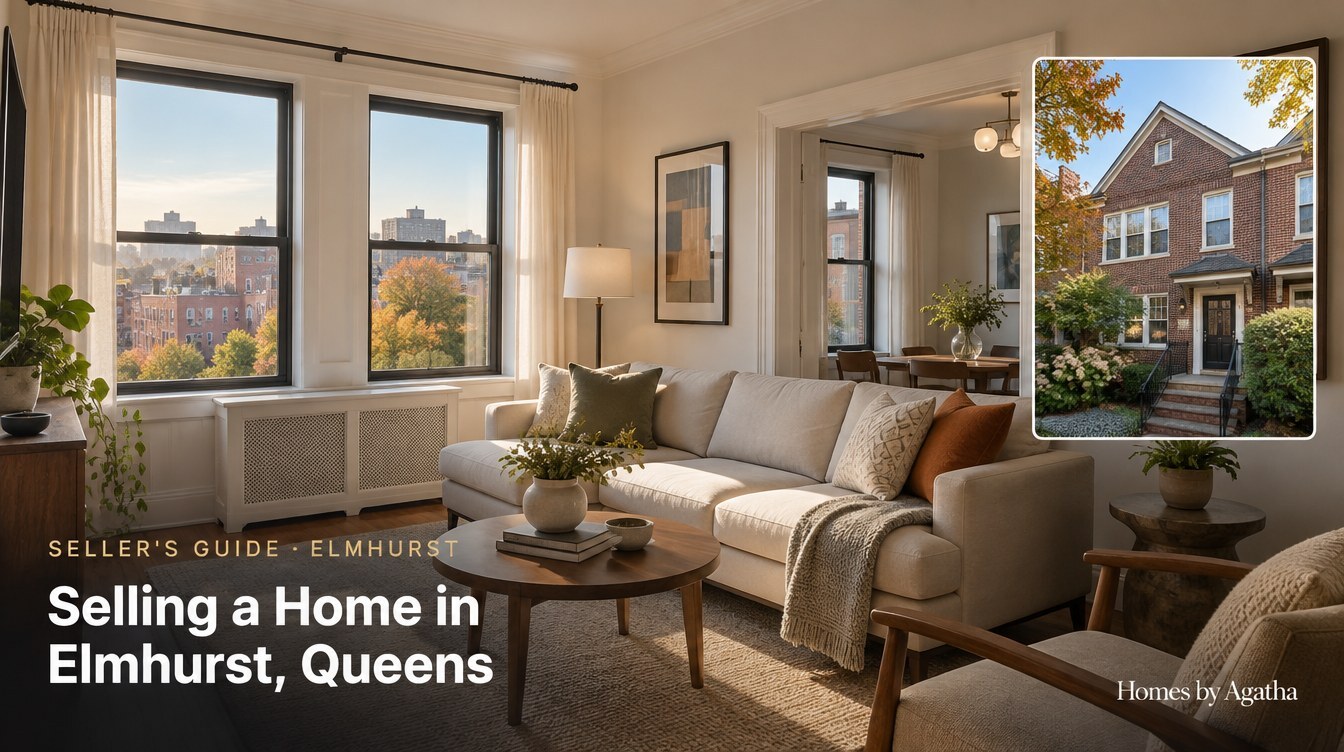
ELMHURST SELLER GUIDE
Selling a Home in Elmhurst Queens: How Co-op, Condo and House Sales Really Work
Quick Answer
Selling a home in Elmhurst, Queens starts with knowing your sale path: a co-op sale needs board approval, a condo sale needs the board’s right-of-first-refusal waiver, and a house sale needs clean building records and a Property Condition Disclosure Statement. Price with a CMA, budget for NYS and NYC transfer taxes, and choose offers that can close.
Selling a home in Elmhurst Queens rarely follows a single script, because the neighborhood mixes co-op buildings, condo buildings and attached or two-family houses within a few blocks of each other. The paperwork, the approvals, the costs and even the kind of buyer you attract change with what you own.
This guide is for Elmhurst owners who are thinking about selling in the next months or the next year and want to understand the process before they talk numbers. It covers how buyers compare units and houses here, how a comparative market analysis is built, what a co-op board package or condo waiver means for your timeline, how to prepare and market the property, which New York disclosures apply, what comes off the top of your sale price, and how to choose between offers.
As a Licensed Associate Real Estate Broker serving Queens, I help sellers plan the whole path from pricing to closing, in English or Polish, whichever is more comfortable. When you want a property-specific plan, the page on how to sell your home in Elmhurst with a local listing agent explains how we would work together.
Elmhurst at a glance for sellers
| Topic | Why it matters to a seller |
|---|---|
| Location | West-central Queens, bordered by Jackson Heights, Corona, Rego Park, Middle Village, Maspeth and Woodside (edges are informal); buyers often search across these lines |
| Borough / County / ZIP | Queens (Queens County), New York City; ZIP code 11373 for most addresses; confirm the ZIP code for a specific address with USPS |
| Transit buyers ask about | M and R local trains at Elmhurst Av and Grand Av–Newtown; Woodhaven Blvd near Queens Center; 7 train at 82 St–Jackson Hts and 90 St–Elmhurst Av; E and F express at nearby Jackson Heights–Roosevelt Av; check MTA.info for current service and planned work |
| Landmarks buyers recognize | Queens Center at 90-15 Queens Boulevard, Elmhurst Park on the former gas-tank site at Grand Avenue, NYC Health + Hospitals/Elmhurst on Broadway |
| Commercial corridors | Broadway, Queens Boulevard, Whitney Avenue, Grand Avenue, Corona Avenue, Woodhaven Boulevard, Roosevelt Avenue on the northern edge |
| Property types sold | Co-op apartments in elevator and walk-up buildings, condo units (often newer buildings), attached one- and two-family brick houses, some detached and mixed-use buildings |
| Seller taxes | NYS real estate transfer tax and NYC Real Property Transfer Tax, both customarily paid by the seller; flip tax only if the co-op’s documents impose one |
| Common delay points | Incomplete co-op board packages, condo waiver timing, open DOB violations, missing legal-use records on older houses |
What are you actually selling: co-op shares, a condo unit or a house?
Your ownership type decides your sale path. An Elmhurst co-op seller transfers shares and a proprietary lease and needs the board to approve the buyer; a condo seller conveys a deed and needs the board to waive its right of first refusal; a house seller conveys land and building and must deliver clean title, accurate legal-use records and the required disclosures.
Selling co-op shares
A co-op apartment is not real property in the legal sense. You own shares in the cooperative corporation that owns the building, plus a proprietary lease for your unit. When you sell, the shares and lease are assigned to the buyer, and nothing transfers until the co-op board approves the purchaser. Your contract, your timeline and much of your preparation revolve around that approval.
Selling a condo unit
A condo unit is real property with its own tax lot and deed. Condo boards generally do not interview buyers, but most condo bylaws give the board a right of first refusal: the option to buy the unit on the same terms. In practice, boards usually waive it, but the waiver must be requested and issued before closing. The exact procedure is in each building’s bylaws.
Selling an Elmhurst house
A house sale has no board, but the building itself is under review. The buyer’s attorney, lender and title company look at the Certificate of Occupancy or other NYC Department of Buildings records, open violations, the legal unit count of a two-family house and any tenants in place. Paperwork problems in a house sale surface later in the process than in a co-op sale, which is why they cause more renegotiations.
| Sale path | What transfers | Who must sign off | Key seller documents | Main seller costs beyond commission |
|---|---|---|---|---|
| Co-op apartment | Shares and proprietary lease | Co-op board (buyer approval) and managing agent (transfer) | Stock certificate, proprietary lease, recent maintenance statements, alteration approvals | NYS transfer tax, NYC RPT, flip tax if the co-op imposes one, managing agent transfer fees, attorney |
| Condo unit | Deed to the unit | Board waiver of right of first refusal | Deed, common-charge statements, alteration approvals, tax bills | NYS transfer tax, NYC RPT, managing agent or waiver fees, attorney |
| One- or two-family house | Deed to land and building | No board; buyer’s lender and title company review | CO or other legal-use records, permits, leases, PCDS, repair records | NYS transfer tax, NYC RPT, cost to clear violations, attorney |
Related neighborhoods follow the same patterns. Owners who also hold property nearby can compare guidance for selling in Jackson Heights, selling in Rego Park and selling in Woodside.
How do buyers compare Elmhurst homes in the same building or on the same block?
Buyers in Elmhurst compare a co-op or condo against other units in the same building and nearby buildings, line by line, and compare a house against similar houses within walking distance of the same subway line. The details that win or lose a buyer are monthly charges, layout, light, floor and noise, legal unit count and walk time to the train.
What apartment buyers weigh
- The monthly number. Co-op maintenance or condo common charges plus taxes directly reduce how much a buyer can borrow, so two similar units with different monthly charges attract different prices.
- Line, floor and exposure. A unit in a well-laid-out line, on a higher floor or facing a quiet street often competes better than the same size unit facing Queens Boulevard, the Long Island Expressway or the elevated 7.
- Building features. Elevator versus walk-up, laundry, storage, bike room, garage or parking waiting list and live-in superintendent all appear in buyer comparisons.
- Building health. Reserves, any underlying mortgage, recent assessments and Local Law 11, 97 and 152 compliance show up in the buyer’s attorney review.
- Building policies. Sublet rules, pet policy, financing limits and flip-tax terms widen or narrow the pool of eligible buyers.
What house buyers weigh
- Legal unit count. A two-family house that is legally two units on the CO sells to a different pool of buyers than one that is advertised as two but recorded as one.
- Condition of shared and major systems. Roof and parapets on attached houses, boiler, electrical service, sewer line and windows.
- Parking and outdoor space. A legal driveway, garage or usable yard is a meaningful difference on blocks where street parking is in demand.
- Commute. Walk time to Elmhurst Av, Grand Av–Newtown or the 7 train, and access to Queens Boulevard and the Long Island Expressway.
Curious how buyers will see your unit or house?
We can walk through your property the way a buyer’s attorney and lender will, and identify the points that help or hurt it against nearby listings.
How should you price an Elmhurst co-op, condo or house?
Price an Elmhurst property with a comparative market analysis built from the closest true comparables: recent sales in the same building or line for apartments, and similar houses with the same legal unit count nearby for houses. Then adjust for monthly charges, condition, floor, exposure and timing.
What a CMA is, and what it is not
A comparative market analysis, or CMA, is a real estate broker’s professional opinion of value based on recent sales, active and pending listings, and the property’s features. It is not an appraisal and does not guarantee a sale price. A lender’s appraisal, ordered after you accept an offer, is a separate valuation that can confirm or challenge the contract price. For a borough-wide explanation, read what is my Queens home worth.
Pricing a co-op: the building is the market
For an Elmhurst co-op, the most persuasive comparables are recent sales in the same building, ideally in the same line, then sales in similar nearby buildings. Adjust for maintenance: a buyer comparing two similar apartments will pay attention to which one has lower monthly charges, because maintenance affects both their budget and the board’s debt-to-income review. If the building has a flip tax, a planned assessment or a financing limit such as a high minimum down payment, those factors reduce the number of qualified buyers and belong in the pricing discussion.
Pricing a condo: abatements and competing units
For an Elmhurst condo, compare sales in the same building and in similar newer buildings. Two condo-specific factors matter. First, if the building has a time-limited tax abatement, buyers will ask when it ends and what the taxes will be afterward; the building’s tax records show the schedule. Second, if the sponsor still owns unsold units, your listing may compete with sponsor units, sometimes with different terms.
Pricing a house: legal units first
For an Elmhurst house, comparables should match the legal unit count, construction (attached, semi-attached or detached), lot and parking, and condition. A house marketed with an extra apartment that is not legal should not be priced as if that rent existed; the buyer’s lender will not count it, and the appraisal will not support it.
Pricing to the first two weeks
The first days on the market usually bring the most attention from active buyers who have been watching the building or the block. A price set above what comparable sales support often leads to fewer showings and, later, a reduction that can draw less interest than an accurate initial price. Market conditions change, so review recent sales and pending listings right before you list rather than relying on an older estimate. A current CMA should rely on dated sales from OneKey MLS and NYC Department of Finance rolling sales data.
Key Takeaways
- For Elmhurst co-ops and condos, sales in the same building and line are the strongest comparables.
- Monthly charges affect what buyers can borrow and what boards approve, so they affect price.
- Condo tax abatements and sponsor-owned units change how buyers compare your unit.
- House pricing starts with the legal unit count; illegal rent is not value.
What does a co-op board package or condo waiver mean for an Elmhurst seller?
It means your closing depends on a building approval after the contract is signed: for a co-op, the board must approve your buyer after reviewing a board package and usually an interview; for a condo, the board must waive its right of first refusal. As the seller, you cannot control the decision, but you can control how prepared the buyer and the paperwork are.
How the co-op approval works from the seller’s side
After the contract is signed, the buyer assembles a board package defined by the managing agent: the contract, loan commitment if financing, tax returns, bank statements, the building’s financial forms, reference letters and fees. The board reviews it, usually interviews the buyer and then approves or declines. New York City Local Law 58 of 2026 now requires a co-op covered by the law to tell the purchaser, within 45 days after a complete application, whether consent is granted, granted with conditions, or denied. The law sets the timing of the decision; it does not require the board to explain a denial, so the quality of the buyer you accept still matters. Ask your attorney how the law applies to your building.
Sellers help the process by obtaining the building’s written purchase requirements before marketing, sharing them with buyers’ agents, and accepting offers from buyers whose finances clearly meet them.
Flip tax: only if your co-op has one
A flip tax is a transfer fee that some co-ops charge when an apartment is sold. It is set by each co-op’s own documents, typically the proprietary lease, bylaws or board resolutions, and there is no city-wide rate. Whether it is paid by the seller or buyer, and how it is calculated, depends entirely on those documents and the contract. Ask the managing agent for the current flip-tax terms in writing before pricing.
What else the managing agent needs
The co-op’s managing agent typically handles the stock transfer and may charge transfer or processing fees. Your attorney will need the original stock certificate and proprietary lease, or a lost-document procedure if they cannot be found. If you have a co-op share loan, your lender’s payoff and the release of its lien are part of closing. Some buildings also require proof that past alterations were approved; ask the managing agent what your building needs.
The condo waiver
For a condo, your attorney requests the right-of-first-refusal waiver from the board or managing agent after the contract is signed. Ask the managing agent early about the waiver procedure, the expected timing and any fees, so the closing date in the contract is realistic.
Selling a co-op and want fewer board surprises?
Let’s gather your building’s purchase requirements, flip-tax terms and transfer procedures before you list, so every offer can be measured against them.
How do you prepare and stage an Elmhurst apartment or house for sale?
Prepare by fixing what buyers, inspectors and appraisers will question first, then improving what buyers see in photos. In an Elmhurst apartment that means light, layout, storage and condition of the kitchen and bath; in a house it adds the roof, the boiler, the facade and the legal status of every space.
Preparation priorities by property type
| Priority | Co-op or condo apartment | Attached or two-family house | Why it matters |
|---|---|---|---|
| High | Confirm alteration approvals for past renovations | Resolve or plan for open DOB violations and unsigned permits | Prevents delays in the buyer’s attorney review and title |
| High | Fix leaks, outlets, windows and appliances | Repair roof, parapet and active leaks; service the boiler | Inspection findings drive renegotiation |
| High | Request the building’s purchase requirements and fees | Gather CO or legal-use records and leases | Lets buyers qualify themselves before bidding |
| Medium | Declutter closets and storage; maximize light | Clean facade, stoop, gate and yard | The first photo and first impression |
| Medium | Neutral paint where walls are dark or worn | Paint and clean vacant units | Units read as move-in ready in photos |
| Lower | Full kitchen or bath renovation | Major remodeling | Rarely recovers its cost before a sale; may require approvals or permits |
Staging an Elmhurst apartment
Many Elmhurst co-op apartments are in prewar and postwar buildings with defined rooms, foyers and closets. Staging should show how each room works: a clear dining area, a bedroom that fits a full set of furniture, and closets that are visibly organized. Clean windows and working light fixtures make a large difference in photos of units facing interior courtyards.
Check building rules for showings before you list. Some co-ops limit open-house hours, require notice to the superintendent or doorman, or restrict signage and elevator use for showings; the managing agent can confirm the current rules.
Preparing an attached or two-family house
An attached brick house is judged against its neighbors, so the facade, awning, gate and front area should look cared for. Inside, the owner’s unit sells a two-family house to owner-occupant buyers. If the basement or cellar has been converted to living space without approval, do not market it as an apartment. Under New York City building rules, a cellar, more than half below curb level, generally cannot be a legal apartment, and a basement must meet strict standards to be habitable. Present it according to the legal records, and talk to your attorney about disclosure.
Tenants in a two-family house
If one unit is rented, decide with your attorney whether to sell with the tenant in place or to deliver the unit vacant. Existing leases generally continue after a sale, and New York law limits how and when a tenancy can end, so a promise of vacant delivery requires a realistic plan. Your attorney, or NYS Homes and Community Renewal for regulated apartments, can confirm the rules for ending a specific tenancy, including any rent regulation status.
How is an Elmhurst home marketed to buyers?
An Elmhurst home is marketed through OneKey MLS, the multiple listing service serving the region, which shares listing data with participating brokerages and major home-search portals, supported by professional photography, a floor plan and complete, accurate building or house details. Accuracy attracts buyers who can actually close.
Listing details that matter here
- For co-ops: monthly maintenance, the tax-deductible portion if the building provides it, any assessment, the building’s down-payment and financing policies, sublet and pet policies, and whether a flip tax applies.
- For condos: common charges, current property taxes, any abatement and its end date, and building amenities.
- For houses: legal unit count as recorded, lot and building dimensions, parking, heating type and the age of major systems.
- For every listing: walking routes to Elmhurst Av, Grand Av–Newtown, Woodhaven Blvd or the 7 train, without inflating times or distances.
Photography and floor plans
Professional photography matters more for apartments than many sellers expect, because buyers screen listings by photo before reading the details. A measured floor plan helps buyers compare your unit with others in the same line, and it answers layout questions that photos cannot. For houses, include a clear front facade photo and every unit, not only the owner’s apartment.
Fair Housing in marketing
Listing descriptions should describe the property, the building and its location through housing features, transit, parks and commercial streets. Fair Housing rules prohibit language that expresses a preference about who should live there. Marketing that sticks to facts protects the seller as well as buyers.
Want a listing plan for your Elmhurst property?
We can outline the photography, floor plan, building data and showing schedule that fit your unit or house, before anything goes live.
What disclosures does an Elmhurst seller have to make?
Sellers of most one-to-four-family houses in New York must deliver the Property Condition Disclosure Statement; sellers of homes built before 1978 must give the federal lead-based paint disclosure; and every client receives the NYS Disclosure Form for Buyer and Seller explaining agency relationships. Co-op and condo units are generally outside the PCDS requirement.
Property Condition Disclosure Statement
The Property Condition Disclosure Statement, or PCDS, is a New York State form on which the seller answers questions about the property’s condition based on actual knowledge. Since March 20, 2024, a change in New York law removed the option of giving the buyer a $500 credit instead of delivering the disclosure, so sellers of most one-to-four-family homes, including Elmhurst attached and two-family houses, must provide the PCDS. Co-op and condo units are outside the requirement, because the law’s definition of residential real property excludes condominium units and cooperative apartments.
Lead-based paint disclosure
Federal law requires sellers of housing built before 1978 to disclose known lead-based paint and lead hazards, provide available records and give buyers an opportunity to test. Much of Elmhurst’s housing stock, including many co-op buildings, predates 1978, so expect this disclosure in most sales.
Agency disclosure and Fair Housing notice
At the first substantive contact, a New York real estate licensee must provide the NYS Disclosure Form for Buyer and Seller, which explains whom the licensee represents. Sellers also receive the NYS Housing and Anti-Discrimination Disclosure. These forms are about transparency, not commitment; read them before you sign a listing agreement.
Honest answers protect the sale
Beyond the forms, your attorney will answer the buyer’s attorney’s questions in the contract and through riders. In a co-op, the managing agent answers the building questionnaire. Disclosing known issues early, such as a past leak, a pending assessment or an unapproved alteration, gives you control of the conversation. Problems discovered late tend to cost more.
What does it cost when selling a home in Elmhurst Queens?
The main costs when selling a home in Elmhurst Queens are the brokerage commission, which is negotiable; the New York State real estate transfer tax; the New York City Real Property Transfer Tax; your attorney’s fee; payoff of any loan; and, for co-ops, a flip tax only if the building’s documents impose one, plus managing agent transfer fees.
Transfer taxes
Under the rules published by the NYS Department of Taxation and Finance, the NYS real estate transfer tax is $2 for each $500 of consideration (0.4%) and is customarily paid by the seller. In New York City, residential conveyances of $3 million or more carry a higher combined state rate of 0.65%.
Under the rules published by the NYC Department of Finance, the NYC Real Property Transfer Tax (RPT) on residential one-to-three-family homes, individual co-op units and condo units is 1% when the price is $500,000 or less and 1.425% when the price is above $500,000. It is customarily paid by the seller and applies to Elmhurst because Elmhurst is in New York City. Confirm current rates with the NYS Department of Taxation and Finance and NYC Department of Finance before closing.
Seller cost categories
| Cost | Co-op | Condo | House | Notes |
|---|---|---|---|---|
| Brokerage commission | Yes | Yes | Yes | Negotiable; set in the listing agreement, not by law |
| Buyer-agent compensation | Only if agreed | Only if agreed | Only if agreed | Not automatically paid by the seller; any contribution is negotiated and written |
| NYS real estate transfer tax | Yes | Yes | Yes | $2 per $500 of consideration (0.4%) |
| NYC Real Property Transfer Tax | Yes | Yes | Yes | 1% at $500,000 or less; 1.425% above $500,000 |
| Flip tax | Only if the co-op’s documents impose one | No | No | No city-wide rate; terms set by each co-op |
| Managing agent fees | Transfer and processing fees | Waiver or processing fees | No | Ask the managing agent for a written fee list |
| Seller’s attorney | Yes | Yes | Yes | Fee agreed with your attorney |
| Loan payoff | Share loan and lien release | Mortgage satisfaction | Mortgage satisfaction | Paid from proceeds at closing |
| Violations or repairs | Unit-level | Unit-level | Building-level, can be significant | Clearing open violations before contract avoids price pressure |
| Adjustments | Maintenance prorated | Common charges and taxes prorated | Taxes, water and rents prorated | Calculated by the attorneys at closing |
Ask your attorney for a seller net sheet, an estimate of proceeds after all costs, before you list, and update it when you have an offer. Capital-gains tax and any exclusion for a primary residence are questions for a CPA. For a borough-wide overview, see Queens closing costs explained.
Key Takeaways
- Elmhurst sellers customarily pay both the NYS transfer tax and the NYC Real Property Transfer Tax.
- The NYC RPT rate depends on whether the price is above or below $500,000.
- Flip tax exists only where a co-op’s own documents create it; never assume a rate.
- Brokerage and buyer-agent compensation are negotiable and must be agreed in writing.
Want to see what you might net?
We can prepare a CMA for your Elmhurst property and line up the cost categories with your attorney’s estimate, so your pricing decision starts from real numbers.
How do you compare offers when board or lender approval is part of the deal?
Compare offers by how likely they are to reach closing, not only by price. In an Elmhurst co-op sale, the strongest offer is the one whose buyer clearly meets the building’s requirements; in a condo or house sale, financing strength, appraisal risk, contingencies and closing flexibility often matter as much as the number.
An offer-comparison framework
| Factor | What to ask | Why it matters in Elmhurst |
|---|---|---|
| Price and net | What is the net after all seller costs? | A higher price with seller concessions can net less |
| Down payment | Does it meet or exceed the co-op’s minimum? | Boards may decline buyers below their requirement |
| Financing | Pre-approved for this property type? Does the lender lend in this building? | Co-op share loans and condo building reviews can stall a deal |
| Post-closing liquidity and debt-to-income | Does the buyer’s file fit the building’s stated policy? | Weak files risk a board decline after weeks of waiting |
| Appraisal gap | Can the buyer cover a low appraisal? | Protects your price if the appraisal comes in under contract |
| Contingencies | Mortgage contingency length; other conditions | Fewer, shorter contingencies mean less uncertainty |
| Closing date and possession | Does it match your move or purchase? | Coordinates with your next home and tenant timing |
| Tenants (houses) | Will the buyer take the building with tenants in place? | Avoids a vacant-delivery obligation you cannot meet |
Negotiating without losing the deal
In New York, an accepted offer is not a binding contract. The deal binds only when the attorneys have negotiated the contract of sale and both parties sign it with the deposit delivered. During that window, buyers may ask for credits after an inspection or after reviewing building documents. A complete disclosure package and realistic pricing reduce those requests, and a clear understanding of your bottom line, net of costs, keeps negotiation focused.
If you receive several offers, your agent can ask each buyer for final terms in a consistent way. Every buyer should receive accurate information, and the decision remains yours.
What is the timeline for selling a home in Elmhurst Queens?
The timeline for selling a home in Elmhurst Queens runs through preparation, listing, offer, contract, approvals and closing. Co-op sales typically take longest because the board review comes after the contract; condo and house sales depend more on the buyer’s lender, the title search and the building’s records.
| Stage | What happens | Co-op specifics | Condo and house specifics |
|---|---|---|---|
| 1. Pre-listing | CMA, repairs, documents, attorney selected | Get purchase requirements, flip-tax terms and fee list | Condo: abatement and tax data; house: CO, violations, leases |
| 2. Listing and marketing | Photos, floor plan, OneKey MLS, showings | Follow building showing rules | House: coordinate tenant access as leases and law require |
| 3. Offer accepted | Price and terms agreed; not yet binding | Screen buyer finances against building policy | Screen financing and appraisal risk |
| 4. Contract signed | Attorneys negotiate; buyer signs and delivers deposit; seller signs | Managing agent questionnaire answered | House: PCDS delivered; inspection usually done before signing |
| 5. Approvals | Loan commitment and building or title approvals | Board package, review, interview, approval | Condo: right-of-first-refusal waiver; house: title and municipal searches |
| 6. Closing | Funds, adjustments, transfer taxes, documents | Shares and lease assigned; managing agent present or represented | Deed recorded; leases and deposits transferred for occupied houses |
Exact timing depends on the building, the buyer’s lender and both attorneys. Building approvals and missing records are the two most common reasons a closing date moves.
Need to time your sale with your next move?
We can map your Elmhurst sale’s approval path against your purchase or lease dates and plan the contract terms around them.
What mistakes do Elmhurst sellers make, and what belongs on your checklist?
The most costly mistakes are pricing above what building and block sales support, accepting an offer from a buyer who does not meet the co-op’s requirements, and discovering violations or missing legal-use records after the contract is signed. Each one costs time, and time usually costs money.
Mistakes to avoid
- Pricing from the wrong comparables. A sale in a different building with lower maintenance is not a fair comparison for your co-op.
- Hiding the monthly charges. Buyers and lenders will find maintenance, assessments and taxes; listing them up front builds trust.
- Assuming a flip tax amount. Get the terms in writing from the managing agent.
- Accepting an offer the board is unlikely to approve. A higher price is worth less if the buyer’s file does not fit the building’s policy.
- Marketing an illegal unit as income. It exposes the seller and collapses under appraisal.
- Skipping the PCDS on a house. Since March 2024, the $500 credit alternative is no longer available.
- Waiting on paperwork. A missing stock certificate, an unapproved alteration or an open violation can delay closing by weeks.
Inherited Elmhurst co-ops and houses
When an owner passes away, the estate’s representative usually needs authority from the Queens County Surrogate’s Court, such as letters testamentary or letters of administration, before selling. For an inherited co-op, the shares pass as personal property, the board still must approve the buyer, and maintenance continues to accrue during the estate process. Coordinate early with an estate attorney; our page on selling probate real estate in New York explains the general process.
Elmhurst seller checklist
- Identify your sale path: co-op shares, condo unit or house.
- Choose a New York real estate attorney and ask for a seller net sheet.
- Review the NYS Disclosure Form for Buyer and Seller and sign a listing agreement with negotiated compensation terms.
- Get a CMA based on your building, line or block, with recent comparable sales.
- Co-op: obtain purchase requirements, flip-tax terms, fee list, stock certificate and proprietary lease.
- Condo: confirm the waiver procedure, common charges, taxes and any abatement end date.
- House: gather the CO or legal-use records, permits, violations, leases and repair invoices; prepare the PCDS.
- Confirm approvals for past renovations.
- Complete high-priority repairs, declutter and schedule professional photography and a floor plan.
- List on OneKey MLS with accurate monthly charges and building or house details.
- Compare offers by net proceeds and likelihood of approval and financing.
- Support the buyer’s board package or condo waiver and plan the closing.
If you plan to buy again in the area, the companion page on how to buy your home in Elmhurst covers the purchase side, and our guide on how to sell your home in Queens gives the borough-wide picture.
Frequently asked questions about selling a home in Elmhurst, Queens
How long does it take to sell a co-op in Elmhurst, Queens?
A co-op sale in Elmhurst usually takes longer than a condo or house sale because the board package, review and buyer interview happen after the contract is signed. Timing depends on the building’s managing agent, the buyer’s lender and how complete the package is. Choosing a buyer who clearly meets the building’s requirements reduces delays.
What taxes does a seller pay when selling in Elmhurst?
Elmhurst sellers customarily pay the New York State real estate transfer tax of $2 per $500 of consideration and the New York City Real Property Transfer Tax, which is 1% at $500,000 or less and 1.425% above $500,000 for residential properties. Confirm current rates with NYS DTF and NYC DOF before closing.
Does every Elmhurst co-op charge a flip tax?
No. A flip tax exists only if the co-op’s own documents, such as the proprietary lease, bylaws or board resolutions, impose one. There is no city-wide rate, and the amount, method and who pays vary by building. Ask the managing agent for the current flip-tax terms in writing before you set a price.
Do I need a Property Condition Disclosure Statement to sell my Elmhurst house?
Yes, for most one-to-four-family houses. Since March 20, 2024, New York no longer allows sellers to give a $500 credit instead of delivering the Property Condition Disclosure Statement. Co-op and condo units are generally outside this requirement, but federal lead-paint disclosure still applies to most housing built before 1978.
How is a CMA different from an appraisal for an Elmhurst property?
A CMA is a real estate broker’s professional opinion of value based on comparable sales, listings and the property’s features. It is not an appraisal and does not guarantee a price. An appraisal is ordered by the buyer’s lender after an offer is accepted and determines how much the lender is willing to lend.
What happens if the co-op board rejects my buyer?
If the board declines the buyer, the sale does not close, and the contract usually ends under its board-approval terms, with the deposit handled as the contract provides. You would then return to the market. Screening offers against the building’s written financial requirements before accepting one is a practical way to reduce this risk.
Can I sell my Elmhurst two-family house with tenants living in it?
Yes. Many two-family houses sell with tenants in place, and existing leases generally continue after the sale, with security deposits transferred to the buyer. If a buyer needs a vacant unit, the contract must say so, and your attorney should confirm whether vacant delivery is lawful and realistic under New York tenant law.
Who pays the buyer’s agent when I sell in Elmhurst?
It depends on what is negotiated. Under the rules in effect in 2026, buyer-agent compensation is negotiable, not set by law and not automatically paid by the seller. A seller may agree to contribute or offer a credit, or the buyer may pay under their buyer agreement. Any arrangement must be agreed in writing.
Does being near the M, R or 7 train help an Elmhurst listing?
Transit access is one of the first things Elmhurst buyers check. Listings within a reasonable walk of Elmhurst Av, Grand Av–Newtown, Woodhaven Blvd or the 7 train on Roosevelt Avenue should state accurate walking routes. Units facing the elevated tracks or busy roads should be presented honestly, with photos and floor plans highlighting quieter rooms.
How do I sell an inherited co-op in Elmhurst?
The estate’s representative usually needs letters testamentary or letters of administration from the Queens County Surrogate’s Court before selling. The co-op board must still approve the buyer, and maintenance continues during the estate process. Work with an estate attorney and the managing agent early to confirm the documents the building requires.
Your next step as an Elmhurst seller
A smooth Elmhurst sale comes from three early decisions: understanding your approval path, pricing from the right comparables, and knowing your net before you see an offer. Gather building or house documents first, market with accurate monthly charges and legal details, and choose the buyer most likely to clear the board or the lender. For a property-specific plan, the page on how to sell your home in Elmhurst, Queens with Agatha describes the next step.
Talk through your Elmhurst sale, no obligation
Share your property type and timing, and we can outline pricing, preparation and the approval path that applies to you. English or Polish, whichever you prefer.
This article is for general informational purposes only and reflects conditions that may change. It is not legal, tax, or financial advice, an appraisal, or a guarantee of price or outcome; consult a licensed New York attorney, a CPA, and an NMLS-registered mortgage loan originator as appropriate. A CMA is an opinion of value, not an appraisal. Real estate brokerage services are offered by Agatha Lubas, Licensed Associate Real Estate Broker, NY License #10301213345, Keller Williams Realty Liberty, 96-10 101st Avenue, Ozone Park, NY 11416. The NYS Disclosure Form for Buyer and Seller, the NYS Housing and Anti-Discrimination Disclosure / Fair Housing Notice, and the brokerage’s Standard Operating Procedures are available on request. Equal Housing Opportunity.

Agatha Lubas helps sellers, buyers and investors across Queens, Brooklyn, Nassau County and Suffolk County plan transactions from pricing to closing. She works in English and Polish so clients can communicate in the language they find most comfortable.
Work with Agatha