

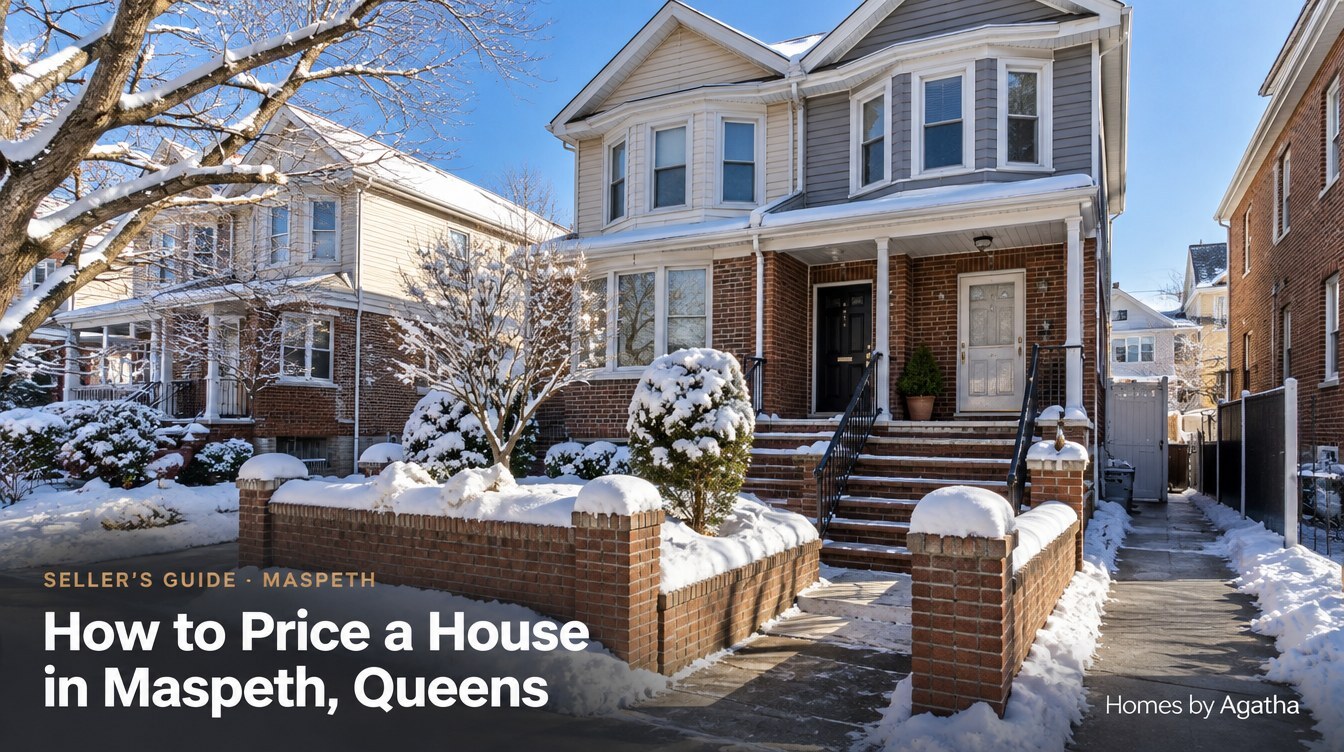
MASPETH SELLER GUIDE
How to Price a House in Maspeth, Queens: Comparables, Block-Level Factors and Two-Family Value
Quick Answer
To price a house in Maspeth, Queens, start with recent sales of homes with the same legal unit count and building type, then adjust for condition, lot, parking and block-level factors such as nearby manufacturing zoning and distance to Grand Avenue buses or the M, R and 7 trains. A CMA turns that evidence into a defensible list price.
Learning how to price a house in Maspeth is the most important decision you will make before listing, because the price sets who looks, how fast offers arrive and how much negotiating room you keep. Maspeth is a western Queens neighborhood of attached and semi-attached one- and two-family houses, with detached homes and small multi-family buildings mixed in. Buyers who shop here compare houses block by block, and they increasingly check the same public records an agent would.
That means two houses that look alike in photos can deserve different prices. One may be a legal two-family a short walk from the Grand Avenue buses; the other may be legally one family on a block that faces a warehouse loading zone. A pricing plan has to account for both the building and its setting.
As a Licensed Associate Real Estate Broker serving Queens, I prepare comparative market analyses for owners and walk them through the evidence behind every number, in English or Polish, whichever is more comfortable. For a general introduction to the neighborhood, see our overview of real estate in Maspeth. When you want a plan for your own property, the page on how to sell your home in Maspeth with Agatha explains how we would work together.
Maspeth at a glance for sellers
| Feature | Detail | Why it matters for price |
|---|---|---|
| Location | Western Queens (Queens County), New York City, between Newtown Creek, Woodside, Elmhurst, Middle Village, Glendale and Ridgewood; Queens Community Board 5 | Buyers compare Maspeth listings with nearby neighborhoods on the same portals |
| ZIP code | Mostly 11378; confirm the ZIP code for a specific address with the USPS ZIP Code lookup | Portal searches often filter by ZIP code |
| Transit | No subway station inside Maspeth; Q58 and Q59 buses on Grand Avenue; M and R at Grand Av–Newtown, M at Metropolitan Av and Fresh Pond Rd, 7 at 69 St and 61 St–Woodside; LIRR at Woodside | Walk time to a bus stop or station varies widely by block |
| Highways | Long Island Expressway (I-495) on the northern edge; Brooklyn–Queens Expressway (I-278) via the Kosciuszko Bridge | Drivers value quick access; some buyers discount blocks next to highway or truck noise |
| Zoning | Residential blocks alongside manufacturing districts and the Maspeth Industrial Business Zone | Buyers check ZoLa; a lot’s own zoning and its neighbors’ affect demand |
| Parks and open space | Frontera Park, Frank Principe Park; Juniper Valley Park in Middle Village; Mount Olivet and Mount Zion cemeteries along parts of the edges | Proximity to open space is a factor some buyers weigh |
| Commercial corridor | Grand Avenue, the main shopping street | Walking distance to shops versus living directly on a busy corridor |
| Common property types | Attached and semi-attached one- and two-family houses, some detached houses, small multi-family and mixed-use buildings, limited condo and co-op units | Legal unit count and building type define the comparable set |
How to price a house in Maspeth: what actually sets the value?
A Maspeth house is priced from recent sales of genuinely comparable homes, adjusted for the differences that buyers pay for. The main drivers are the legal unit count, the building type and size, condition and systems, the lot and parking, and the block’s setting, including its zoning neighbors and its distance to transit. Current competing listings show what buyers will see next to yours.
Notice what is missing from that list: the price a neighbor says they got, the amount you need to net, what you paid plus renovations, and an automated online estimate. Each can be a useful data point, but none sets value. Buyers and appraisers judge the property against the market, not against the owner’s history with it.
The value drivers buyers weigh in Maspeth
- Legal configuration. A legal two-family house competes in a different pool from a one-family house, and an unapproved extra unit adds little or no value in the eyes of a lender.
- Building type and width. Attached, semi-attached and detached houses attract different buyers. A semi-attached house with a side driveway is not a direct comparable for an attached row house without one.
- Interior size and layout. Livable square footage, bedroom count per unit and whether bedrooms are real rooms with windows and closets all matter.
- Condition and systems. Roof, heating, electrical and plumbing condition affect both price and the pool of buyers who can finance the home.
- Parking. A legal driveway, a garage or a usable curb cut can carry real weight in a neighborhood where many residents drive.
- Block setting. Distance to Grand Avenue buses and the edge stations, highway proximity, truck traffic and what sits across the street.
For a borough-wide explanation of how home values are estimated, read what is my Queens home worth. The rest of this guide applies those principles to Maspeth’s housing and geography.
How does a CMA work for a Maspeth home?
A comparative market analysis, or CMA, is a real estate broker’s professional opinion of value based on recent sales, pending sales and active listings of similar properties. It is not an appraisal and does not guarantee a sale price. For a Maspeth house, the quality of a CMA depends almost entirely on choosing comparables with the same legal configuration and a similar setting.
CMA vs. appraisal
An appraisal is a licensed appraiser’s independent estimate of value, usually ordered by the buyer’s lender after a contract is signed. A CMA is prepared before listing to guide pricing. The two use similar evidence, which is why a well-built CMA reduces the risk that a buyer’s appraisal comes in below the contract price. That risk matters because a low appraisal can force renegotiation or end a financed deal.
Choosing comparables in Maspeth
The comparable set should mirror your house as closely as the market allows. In practice, that means matching legal unit count first, building type second and setting third, then using recent sales from Maspeth and, when needed, closely similar blocks in neighboring Middle Village, Woodside or Elmhurst.
| Factor | Strong comparable | Weak comparable | Why it matters in Maspeth |
|---|---|---|---|
| Legal unit count | Same count on the CO or other DOB records | A “two-family” that is legally one family | Lenders and appraisers value legal units only |
| Building type | Same attached, semi-attached or detached form | Detached house used to price an attached row house | Side yards, driveways and party walls change buyer appeal |
| Size and layout | Similar square footage and bedrooms per unit | Larger lot or extra floor not adjusted | Layout drives rent potential and owner comfort |
| Condition | Similar level of updating and system age | Gut-renovated house compared with an original-condition house | Buyers price in roof, boiler and electrical work |
| Setting | Similar zoning neighbors, traffic and transit distance | Quiet residential interior block compared with a truck route | Block-level differences are large within Maspeth |
| Timing | Recent closed and pending sales | Older sales from a different rate environment | Buyer budgets track current mortgage rates |
Adjusting for differences
No two houses match exactly, so a CMA adjusts. If a comparable had a legal driveway and yours does not, or if yours has a new roof and the comparable needed one, the analysis accounts for it. Good adjustments are explained in plain language, so you can see why a number moved. Avoid any estimate that cannot tell you which sales it used and why. The comparable sales for your specific property should come from current OneKey MLS data and NYC Department of Finance sales records at the time you price, not from a list assembled months earlier.
Curious what the evidence says about your Maspeth house?
I will prepare a CMA built on comparables with your legal unit count and building type, and walk you through every adjustment.
How do block-level factors inside Maspeth change a price?
Block-level factors change a Maspeth price because buyers can see them for free: the zoning of nearby lots on ZoLa, the bus stop or station distance on a transit map, the truck traffic on a weekday visit and whether parking is legal. A pricing plan should anticipate what buyers will discover rather than hope they will not notice.
Neighboring manufacturing zoning
Maspeth combines residential districts with large manufacturing districts and the Maspeth Industrial Business Zone, especially toward Newtown Creek and the Brooklyn border. ZoLa, the NYC Department of City Planning’s public zoning map, shows any buyer whether a lot or its neighbors are in a manufacturing (M) district. A house that faces or backs onto active industrial use will usually be compared with similar houses, not with homes on interior residential blocks. Seller tip: look up your own lot on ZoLa before listing, so the pricing conversation starts with the same facts buyers will find.
Houses on manufacturing-zoned lots
Some older Maspeth houses stand on manufacturing-zoned lots as legal non-conforming uses. That status can limit enlargement and rebuilding, and some buyers or lenders ask more questions, so these houses need comparables with similar status where possible. Non-conforming status and rebuild limits depend on the specific lot and its history, so a zoning attorney or architect should confirm them. Discuss this with your attorney before listing, so you can answer buyer questions with documents.
Transit distance and Grand Avenue
Because Maspeth has no subway station of its own, walking time matters more than in many Queens neighborhoods. Buyers who commute by train compare the walk or bus ride to Grand Av–Newtown (M, R), Metropolitan Av or Fresh Pond Rd (M) and 69 St or 61 St–Woodside (7). Homes a short walk from the Q58 and Q59 on Grand Avenue appeal to bus commuters, while homes directly on Grand Avenue trade that convenience for more traffic and activity. The 2025 Queens Bus Network Redesign removed some stops on these routes, so confirm the current nearest stop on the MTA bus map before describing it in marketing.
Highway, truck and parking factors
Proximity to the Long Island Expressway is a plus for drivers and a minus for buyers sensitive to noise; the same house can attract one group and lose the other. Designated truck routes carry weekday traffic that buyers notice on second showings; the NYC Department of Transportation truck route map shows whether one runs near your property. A legal driveway or garage often widens the buyer pool, while a shared or informal driveway needs documentation before it can be marketed as parking.
Open space and edges
Blocks near Frontera Park or Frank Principe Park, and blocks along the open edges created by Mount Olivet and Mount Zion cemeteries, have a different outlook from blocks facing commercial or industrial lots. These are factors to describe accurately and let buyers weigh for themselves, not features to exaggerate.
Key Takeaways
- A CMA is a broker’s opinion of value, not an appraisal; its quality depends on comparables with the same legal unit count, building type and setting.
- Buyers check ZoLa, transit maps and truck routes themselves, so price with those facts in mind.
- Walk time to Grand Avenue buses and the M, R and 7 stations varies widely across Maspeth.
- Document a driveway or garage before marketing it as parking.
How do you price a two-family house in Maspeth?
A Maspeth two-family house is priced against other legal two-family sales, with attention to two buyer groups: owner-occupants who will live in one unit and rent the other, and investors who rent both. Tenant status, documented rents and the condition of both units shape which group pays the most.
Owner-occupants and investors
An owner-occupant usually finances with a residential mortgage, cares about the condition and layout of the owner’s unit, and needs the second unit to be legal so the lender can consider its rent. An investor focuses on rent, expenses and the cost of future repairs, and may pay cash or use investment financing with different terms. Pricing for the wrong group can leave the right buyers uninterested.
Tenant-occupied or vacant delivery
A house delivered with a unit vacant can attract owner-occupants who want to move in, while a house with a long-term tenant at documented rent may suit an investor. Existing leases generally survive a sale, and ending a tenancy is governed by New York law, so decide the delivery plan with your attorney before you set the price. The rules depend on the specific tenancy, including any rent regulation status, which a New York attorney or NYS Homes and Community Renewal can confirm. Never promise “vacant at closing” in a listing unless your attorney confirms it is achievable.
What to document before pricing
- The Certificate of Occupancy or, for many pre-1938 houses, a Letter of No Objection or other DOB records showing the legal unit count.
- Current leases, a rent roll and security-deposit records.
- Utility setup: separate electric meters, how heat and hot water are provided and who pays the water bill.
- Repair and replacement records for the roof, boiler and other shared systems.
Investors read this information to estimate net income; owner-occupants read it to judge how much of the payment the second unit can carry. A clean file supports the price; a gap invites a discount. For a borough-wide view of how buyers assess these properties, see our guide to buying a multi-family home in Queens.
Unapproved units and finished lower levels
A finished basement used as part of the main home can add appeal. A lower-level apartment that is not on the CO is a different matter: a buyer’s lender will not count its rent, the buyer’s attorney will flag it and it can become a negotiation point. Price the house on its legal configuration and describe the space accurately.
Selling a Maspeth two-family with a tenant in place?
We can compare owner-occupant and investor pricing for your building and decide, with your attorney, whether vacant or occupied delivery serves you better.
Which repairs and preparation protect a Maspeth price?
The preparation that protects a Maspeth price most is fixing what a buyer’s inspector and attorney will find: open permits and violations, roof and parapet leaks, heating problems and missing oil-tank paperwork. Cosmetic work comes second. Large renovations right before listing rarely return their full cost and can delay the sale.
| Item | Why Maspeth buyers care | Typical seller action | Priority |
|---|---|---|---|
| Open DOB permits and violations | Attorneys flag them; some must be resolved before closing | Have an expediter or architect close permits and clear violations | High, start first |
| Roof, parapets and flashing | Attached houses share roof lines; leaks travel | Repair leaks; gather roof records | High |
| Heating and oil tank | Many older houses converted from oil; buyers ask for tank paperwork | Service the system; locate tank removal or abandonment records | High |
| Lower-level moisture | Buyers and inspectors look for staining and odor | Address the source; avoid cosmetic cover-ups | High |
| Curb appeal | Front stoops, siding and awnings set the first impression on the block | Clean siding, repair steps and railings, trim the yard | Medium |
| Interior presentation | Photos drive showings on portals | Declutter, clean, repair small items, neutral touch-ups | Medium |
| Tenant-occupied unit | Buyers need to see both units | Coordinate showings lawfully with the tenant and with notice | Medium |
| Major renovation | Costly and time-consuming; buyers may prefer to choose finishes | Usually skip; price the condition instead | Low |
Staging an attached or semi-attached house
Many Maspeth houses are narrow, so light and flow matter. Remove extra furniture, open window treatments and make each bedroom read clearly as a bedroom. In a two-family house, the owner’s unit should look cared for and lived-in, while a tenant’s unit simply needs to be clean and accessible. Staging should never disguise a defect a buyer is entitled to know about.
Inherited and estate homes
Some Maspeth houses are sold by heirs or an estate. Before setting a price, confirm who has legal authority to sell, often an executor or administrator appointed through the Queens County Surrogate’s Court, and whether the house needs to be cleared before photos. Our probate real estate page explains how an estate sale fits with the court process.
How should you set the list price and launch the listing?
Set the list price inside the range the CMA supports, choose a strategy for where in that range to start, and launch with complete photos, accurate unit information and documents ready. The first two weeks of buyer activity tell you whether the price is working.
Three pricing strategies
- At the market. List near the middle of the supported range. This is the most common choice and invites serious buyers who have seen the comparables.
- Slightly below the market. Some sellers start lower to attract more buyers at once. This can create competition, but it guarantees nothing, and you should be prepared to sell at the list price.
- Above the market. Starting high leaves room to negotiate but can reduce showings, invite low appraisals and lead to price reductions that make a listing look stale.
Portal price bands
Buyers search online in price brackets. A list price just above a common search threshold can hide a Maspeth house from buyers whose maximum is just below it. Your agent should check how the price falls within the search filters of the major portals before launch.
Marketing that supports the price
Professional photography, a clear floor plan for each unit and an accurate written description are the basics. The listing goes on OneKey MLS, the multiple listing service used across Queens, Long Island and the wider region, which feeds participating brokers and many consumer portals. For a two-family house, state the legal unit count exactly as the records show, and describe the bus and train options by name rather than with vague claims. Plan showings around tenants’ rights and schedules. For a broader view of the selling process in the borough, read our guide on how to sell your home in Queens.
Reading the first weeks
Showing counts, second visits, feedback from buyers’ agents and whether offers arrive all signal how the market sees the price. If buyers consistently raise the same objection, such as truck traffic, parking or a dated kitchen, adjust the strategy deliberately rather than waiting and hoping.
Ready to choose a list price strategy?
Let’s compare at-market, below-market and above-market launches for your Maspeth house and decide what fits your timeline.
What disclosures and documents does a Maspeth seller need?
Most sellers of one-to-four-family houses in New York must deliver the Property Condition Disclosure Statement, sellers of homes built before 1978 must provide the federal lead-based paint disclosure, and real estate licensees give the NYS Disclosure Form for Buyer and Seller at the first substantive contact. Building records, leases and any co-op or condo documents complete the file.
Property Condition Disclosure Statement
The Property Condition Disclosure Statement (PCDS) is a New York State form in which the seller answers questions about the property’s condition, including structure, systems, environmental issues and flood history. Since March 20, 2024, sellers can no longer give a $500 credit instead of delivering the disclosure; sellers of most one-to-four-family homes must provide the PCDS. Co-op and condo units are generally outside the PCDS requirement; a New York attorney can confirm how it applies to a specific unit. Answer accurately and ask your attorney about anything uncertain.
Lead-based paint, agency and fair housing disclosures
Federal law requires sellers of housing built before 1978 to disclose known lead-based paint and hazards; most Maspeth houses fall into this group. The NYS Disclosure Form for Buyer and Seller explains whom a licensee represents, and the NYS Housing and Anti-Discrimination Disclosure Form explains fair housing protections. Every buyer must be treated equally; offers are judged on their terms, not on who the buyer is.
Building records
Gather the CO or Letter of No Objection, DOB permit and violation history, the deed and any recorded driveway or access agreement, and the survey. If the lot is in a manufacturing district, ask your attorney what documentation supports its residential use.
Co-op and condo sales
Maspeth has a limited number of co-op and condo units. A co-op sale requires the buyer to submit a board application package and usually attend an interview, and the board can approve or reject the buyer. A flip tax, a transfer fee some co-ops charge at sale, applies only if the co-op’s own documents impose one; there is no city-wide rate. A condo sale may require the board to waive a right of first refusal. Board package requirements, any flip tax and the right of first refusal are set building by building, so ask the managing agent for the current rules before you list. Allow extra time for either.
Key Takeaways
- Fix what inspectors and attorneys will find first: permits, violations, roof, heating and oil-tank paperwork.
- Price a two-family on its legal configuration and documented rents, and decide tenant delivery with your attorney.
- List the legal unit count exactly as the records show on OneKey MLS and the portals.
- Most one-to-four-family sellers must deliver the PCDS; the $500 credit option ended in 2024.
What does it cost to sell a house in Maspeth, and what will you net?
A Maspeth seller typically pays the New York State real estate transfer tax, the NYC Real Property Transfer Tax, brokerage compensation as negotiated, attorney fees, the mortgage payoff and any costs to resolve violations. Net proceeds are the sale price minus those costs and any concessions agreed in the contract.
Transfer taxes
The NYS real estate transfer tax, administered by the New York State Department of Taxation and Finance, is $2 for each $500 of consideration (0.4%) and is customarily paid by the seller. The NYC Real Property Transfer Tax, administered by the NYC Department of Finance, applies because Maspeth is in New York City: for residential one-to-three-family homes, individual co-op units and condo units, the rate is 1% when the price is $500,000 or less and 1.425% when it is above $500,000, customarily paid by the seller. Buildings with four or more units and other property outside those residential categories, which generally includes mixed-use buildings, fall under the NYC Department of Finance’s “all other” rates: 1.425% when the price is $500,000 or less and 2.625% above $500,000. New York State also imposes supplemental transfer taxes on larger sales in New York City, above $2 million or $3 million depending on property type, so ask your attorney which apply. Confirm current rates with the NYS Department of Taxation and Finance and NYC Department of Finance before closing.
| Expense | Who sets it | Notes for a Maspeth sale |
|---|---|---|
| Listing brokerage compensation | Negotiated between seller and listing broker | Not set by law; agreed in writing in the listing agreement |
| Buyer-agent compensation | Negotiated; the seller may or may not contribute | Not automatically paid by the seller under the post-2024 rules |
| NYS real estate transfer tax | NYS Department of Taxation and Finance | 0.4% of the consideration, customarily paid by the seller |
| NYC Real Property Transfer Tax | NYC Department of Finance | 1% up to $500,000, 1.425% above, for one-to-three-family homes and co-op and condo units |
| Seller’s attorney | Agreed with your attorney | Contract, title objections, violations, lease and deposit transfers |
| Mortgage payoff and lien releases | Lender and lienholders | Order a payoff letter early |
| Permit and violation cleanup | Depends on the issue | Architect, expediter or contractor costs |
| Co-op or condo charges | Building documents | Flip tax only if the co-op’s documents impose one; processing fees vary |
Estimating your net proceeds
A net sheet starts with a realistic sale price from the CMA, subtracts transfer taxes, brokerage compensation, attorney fees and the mortgage payoff, and then subtracts any repair credits or concessions. Run it at two or three prices, not only the list price, so you know your floor before offers arrive. Taxes on any gain depend on your situation, especially for a rental or inherited property, so talk with a CPA before listing. For more on how costs are split in a borough transaction, see Queens closing costs explained.
Brokerage compensation after the 2024 settlement
Under the rules in effect in 2026, brokerage compensation is negotiable and not set by law. A seller decides whether to offer any contribution toward a buyer’s agent’s compensation, and buyers sign written agreements with their own agents. Those decisions can affect buyer engagement, so discuss them openly when you sign the listing agreement.
Want to see your net at three different prices?
We can build a Maspeth net sheet with transfer taxes, payoff and likely concessions, so you know your numbers before the first offer.
How do you compare offers on a Maspeth house?
Compare offers on certainty and net, not only price: financing type and strength, down payment, appraisal risk, contingencies, closing date and how the buyer handles tenants. A slightly lower offer with fewer risks can produce a better result than the highest number.
| Offer term | What to check | Why it matters for a Maspeth sale |
|---|---|---|
| Price | Gross amount and any requested credits | Credits reduce your net just like a lower price |
| Financing | Cash, conventional, government-backed or investment loan; pre-approval that names the property type | A one-family pre-approval may not fit your two-family |
| Down payment | Size relative to price | A larger down payment can absorb a modest appraisal gap |
| Appraisal risk | How far the price is above the CMA range | Over-market offers can be renegotiated after a low appraisal |
| Contingencies | Mortgage contingency length and other conditions | Longer or broader contingencies keep the deal uncertain |
| Tenant terms | Accepts the tenant or requires vacant delivery | Vacant delivery must be achievable under New York law |
| Closing date | Timing relative to your move or purchase | Matters if you are buying your next home at the same time |
| Buyer-agent compensation request | Whether the buyer asks you to contribute | A negotiable term that affects your net |
Remember that an accepted offer in New York is not a binding contract. Attorneys for both sides negotiate the contract of sale, and the deal binds only when both parties sign and the buyer’s deposit is delivered. Keep backup interest warm until then.
What is the timeline from pricing to closing in Maspeth?
A Maspeth sale moves from preparation and pricing through listing, offers, contract, the buyer’s mortgage and title work, and closing. The stages most likely to slow down are permit and violation cleanup before listing and title work afterward, because older houses and two-family buildings generate more records.
| Stage | What happens | Maspeth-specific watch point |
|---|---|---|
| 1. Records and preparation | Pull CO, DOB history, leases; repairs; clear what you can | Open permits can take longer than repairs |
| 2. CMA and pricing | Select comparables; choose a strategy; prepare a net sheet | Match legal unit count, building type and setting |
| 3. Listing launch | Photos, floor plans, OneKey MLS, showings | Coordinate tenant-occupied showings lawfully |
| 4. Offers and acceptance | Compare terms; accept; not yet binding | Check that the buyer’s financing fits the property type |
| 5. Contract | Attorneys negotiate; buyer signs and delivers deposit; seller signs | Buyers often finish inspections before signing |
| 6. Mortgage, appraisal and title | Appraisal, underwriting, title and municipal searches | Violations or unit-count questions can surface here |
| 7. Closing | Deed transfers, taxes paid, payoff, keys | Lease and deposit transfers for occupied units |
Exact timing depends on the buyer’s lender, the property’s records and both parties’ schedules. Starting the records work before listing is the single most effective way to shorten the timeline.
If you plan to buy again after selling, the companion guide on how to buy your home in Maspeth covers the buyer side, and nearby owners can compare our pages on how to sell a home in Middle Village how to sell a home in Glendale and how to sell a home in Woodside.
What pricing mistakes do Maspeth sellers make, and what belongs on your checklist?
The most common pricing mistakes in Maspeth are pricing an unapproved unit as legal income, using comparables from a different building type or block setting, and starting high “to leave room” without evidence. Each is avoidable with records gathered before the price is set, which is the practical core of how to price a house in Maspeth.
Mistakes to avoid
- Pricing from a neighbor’s sale alone. One sale is a data point, not a market, and the neighbor’s house may differ in units, condition or parking.
- Counting rent from an unapproved unit. Lenders and appraisers will not, so buyers will not either.
- Ignoring what buyers see on ZoLa. If a manufacturing district is next door, buyers will find it.
- Overstating transit. Describe the actual nearest stop or station and the walk, not a vague promise of convenience.
- Waiting to clear violations. Discovering them during title work can delay or derail the sale.
- Chasing the market down. Repeated small reductions often cost more than one well-reasoned adjustment.
Maspeth seller checklist
- Pull your CO or Letter of No Objection, DOB permit and violation history, deed, survey and any driveway agreement.
- Look up your lot on ZoLa and note the zoning of your lot and the lots around it.
- Gather leases, a rent roll, deposit records and utility details for any rented unit.
- Decide tenant-occupied or vacant delivery with your attorney.
- Request a CMA built on comparables with the same legal unit count, building type and setting.
- Prepare a net sheet at several prices, including transfer taxes and payoff.
- Fix high-priority items: permits, violations, roof, heating, oil-tank paperwork, lower-level moisture.
- Clean, declutter and present each unit for professional photos and floor plans.
- Prepare the PCDS and lead-based paint disclosure with your attorney.
- Agree on brokerage compensation and any buyer-agent contribution in writing.
- Launch on OneKey MLS with the legal unit count and transit described accurately.
- Review the first weeks of feedback and compare every offer on certainty and net.
Have offers in hand, or expecting them soon?
Send me the terms and we will compare them side by side on financing strength, appraisal risk, tenant terms and your net.
Frequently asked questions about pricing a house in Maspeth, Queens
How do I find out what my Maspeth house is worth?
Ask a broker for a comparative market analysis built on recent sales of Maspeth homes with the same legal unit count, building type and block setting. A CMA is a broker’s professional opinion of value, not an appraisal and not a guarantee. Online estimates can help, but they rarely account for legal units or zoning neighbors.
What is the difference between a CMA and an appraisal in New York?
A CMA is prepared by a real estate broker before listing to guide pricing and is an opinion of value. An appraisal is an independent estimate by a licensed appraiser, usually ordered by the buyer’s lender after the contract is signed. A well-supported CMA lowers the risk of a low appraisal later.
Does being near industrial zoning affect a Maspeth home’s price?
It can. Maspeth has residential blocks beside manufacturing districts and the Maspeth Industrial Business Zone, and buyers can check any lot on the city’s ZoLa map. Homes facing active industrial use are usually compared with similar homes rather than interior residential blocks. Look up your own lot before pricing.
How is a two-family house in Maspeth priced?
A Maspeth two-family is priced against other legal two-family sales, adjusted for size, condition, parking and setting. Documented rents, lease terms and tenant status matter, because owner-occupant buyers and investors weigh them differently. Rent from a unit not shown on the Certificate of Occupancy should not be priced as legal income.
Should I sell my Maspeth two-family with the tenant in place?
It depends on your buyer pool and the tenancy. Vacant delivery can attract owner-occupants, while a tenant at documented rent may suit investors. Existing leases generally survive a sale, and ending a tenancy is governed by New York law, so decide the delivery plan with your attorney before you set the price.
Does the lack of a subway station lower Maspeth home values?
Transit access is one factor among many. Maspeth has no subway station inside the neighborhood, so buyers compare walk or bus times to Grand Av–Newtown, Metropolitan Av, Fresh Pond Rd, 69 St and 61 St–Woodside. Homes close to the Q58 and Q59 on Grand Avenue or to an edge station often appeal to commuters.
What taxes does a seller pay when selling a house in Maspeth?
A Maspeth seller customarily pays the New York State transfer tax of 0.4% and the NYC Real Property Transfer Tax of 1% at $500,000 or less or 1.425% above $500,000 for one-to-three-family homes. Income tax on any gain depends on your situation. Confirm current rates with NYS DTF and NYC DOF.
Do I have to give buyers a Property Condition Disclosure Statement in Maspeth?
Most sellers of one-to-four-family houses in New York must deliver the Property Condition Disclosure Statement. Since March 20, 2024, sellers can no longer give a $500 credit instead. Co-op and condo units are generally outside the requirement. Homes built before 1978 also need the federal lead-based paint disclosure. Review both with your attorney.
Should I renovate before selling my Maspeth house?
Usually, fix what inspectors and attorneys will find first: open permits, violations, roof leaks, heating problems and missing oil-tank paperwork. Cleaning, decluttering and curb appeal come next. Large renovations right before listing rarely return their full cost and can delay the sale. Price the remaining condition honestly using comparable sales.
Is buyer-agent compensation paid by the seller in Maspeth?
Not automatically. Under the rules in effect in 2026, brokerage compensation is negotiable and not set by law. A seller may choose to contribute toward a buyer’s agent’s compensation or not, and buyers sign written agreements with their own agents. Any arrangement should be agreed in writing and factored into your net proceeds.
Your next step as a Maspeth seller
Knowing how to price a house in Maspeth comes down to evidence: comparables with the same legal unit count and building type, honest adjustments for condition and parking, and a clear view of the block-level factors buyers will check for themselves. Gather your records first, decide how a rented unit will be delivered, and run your net at several prices before you list. When you are ready for a property-specific plan, the page on how to sell your Maspeth home with Agatha explains the next steps.
Start with a pricing conversation, not a listing
A short meeting about your house, your records and your timeline is enough to outline a realistic price range. English or Polish, whichever you prefer.
This article is for general informational purposes only and reflects conditions that may change. It is not legal, tax, or financial advice, an appraisal, or a guarantee of price or outcome; consult a licensed New York attorney, a CPA, and an NMLS-registered mortgage loan originator as appropriate. A CMA is an opinion of value, not an appraisal. Real estate brokerage services are offered by Agatha Lubas, Licensed Associate Real Estate Broker, NY License #10301213345, Keller Williams Realty Liberty, 96-10 101st Avenue, Ozone Park, NY 11416. The NYS Disclosure Form for Buyer and Seller, the NYS Housing and Anti-Discrimination Disclosure / Fair Housing Notice, and the brokerage’s Standard Operating Procedures are available on request. Equal Housing Opportunity.

Agatha Lubas helps sellers, buyers and investors across Queens, Brooklyn, Nassau County and Suffolk County price, prepare and negotiate with the evidence in front of them. She works in English and Polish so clients can communicate in the language they find most comfortable.
Work with Agatha