

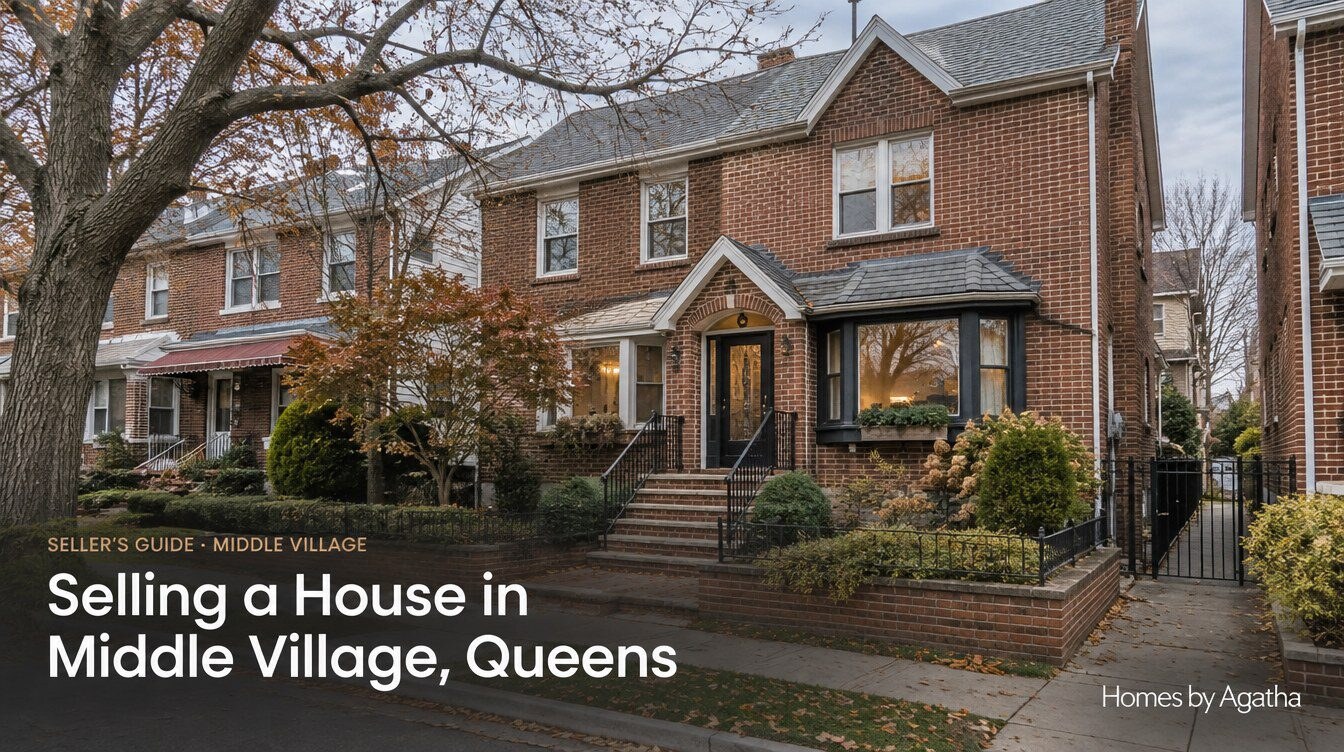
MIDDLE VILLAGE SELLER GUIDE
Selling a House in Middle Village, Queens: Pricing by Configuration, Preparation and What You Net
Quick Answer
Selling a house in Middle Village, Queens, works best when you price against recent sales of the same configuration (interior row, end-of-row, semi-detached or detached), gather the Certificate of Occupancy, permits and survey early, deliver the Property Condition Disclosure Statement, and budget for the NYS transfer tax, the NYC Real Property Transfer Tax and negotiable commission.
Selling a house in Middle Village is a comparison exercise. Buyers touring Middle Village, Queens, often see several brick row houses with similar layouts in the same week, so they notice quickly which one has the rear driveway, the legal second unit, the newer roof or the cleaner paperwork. Your price and your preparation need to account for that side-by-side shopping.
This guide is for owners of row houses, semi-detached and detached houses, and for co-op and condo owners who want to understand the process before they list. It explains how buyers judge Middle Village homes, how a comparative market analysis is built, which documents to collect, what to fix, which New York disclosures apply, how marketing works, what selling costs in New York City and how to compare offers.
As a Licensed Associate Real Estate Broker based in Queens, I help sellers plan the price, the preparation and the paperwork together, in English and in Polish. Nothing here is a valuation of your home; it is a framework you can use before we talk about specifics. When you are ready for a plan for your property, the Middle Village home-selling page explains how we work.
Middle Village at a glance for sellers
| Item | What it means for a Middle Village sale |
|---|---|
| Location | West-central Queens, New York City; Queens Community District 5, bordered by Maspeth, Glendale, Rego Park and Elmhurst |
| ZIP code | 11379; confirm the ZIP code for edge blocks with the USPS ZIP Code lookup |
| Housing stock | Mostly attached brick row houses, semi-detached and detached one- and two-family houses, plus some co-op and condo buildings |
| Transit buyers ask about | Walking distance to the M train terminal at Middle Village–Metropolitan Avenue (Metropolitan Avenue and 69th Street); bus links; Long Island Expressway and Woodhaven Boulevard access |
| Nearby amenities buyers ask about | Juniper Valley Park; shops along Metropolitan Avenue, 69th Street, Eliot Avenue and Dry Harbor Road |
| Zoning context | Contextual districts from a 1994 R4B rezoning and the 2009 Middle Village–Glendale–Maspeth Rezoning limit additions on many lots |
| Records buyers’ attorneys review | Certificate of Occupancy or other legal-use records, permits and sign-offs, open violations, survey and driveway easements |
| Seller transfer taxes | NYS real estate transfer tax and NYC Real Property Transfer Tax (NYC address) |
How do buyers judge a house in Middle Village before making an offer?
Buyers judge a Middle Village house mainly by configuration, parking, legal use and condition, then by location within the neighborhood. Because so many houses share a layout, buyers can compare quickly, and small differences such as a rear driveway or an updated roof often decide which house gets the offer.
Configuration
The first sort is physical: interior row house, end-of-row house, semi-detached or detached. Interior houses have two shared walls; end and semi-detached houses usually add side windows; detached houses add yard and privacy. Buyers then sort by layout: a one-family house, a legal two-family with an apartment on each floor, or a house with a finished basement.
Parking
In Middle Village, a garage or a parking space reached from a rear or side driveway is a feature buyers search for specifically. If your house has one, the listing should show it clearly, and your documents should show that the right to use any shared driveway is recorded.
Legal use
Buyers of two-family houses need the second unit to be legal on NYC Department of Buildings records, because lenders and appraisers rely on those records. A basement apartment that is not legal will not be valued as a rental unit by most lenders, and it can raise questions during the buyer’s attorney review.
Condition
For older brick houses, buyers and inspectors look first at the roof, the masonry and stoop, the boiler and the basement. Evidence of maintenance, such as receipts for repointing, a roof replacement or boiler service, reassures buyers that the costly systems have been looked after.
Location within the neighborhood
Within Middle Village, buyers compare walking distance to the M train terminal, proximity to Juniper Valley Park, access to the expressway and the character of the block. Some blocks face open cemetery land rather than other houses, and buyers weigh that setting differently. These factors are descriptive, not a ranking; they simply explain why two similar houses a few blocks apart can draw different responses.
How do you price a Middle Village house with a CMA?
Price a Middle Village house with a comparative market analysis that uses recent sales of the same configuration, legal use and parking type, adjusted for condition. A comparative market analysis, or CMA, is a broker’s professional opinion of value based on market evidence; it is not an appraisal and does not guarantee a sale price.
Choosing comparable sales
The quality of a CMA depends on its comparables. In Middle Village, the strongest comparables are recent closed sales of houses with the same structure (interior, end, semi-detached or detached), the same legal unit count, similar parking and similar lot size, on nearby blocks with a similar setting. Active listings show the competition, but closed sales show what buyers actually paid. The comparables for your specific house should come from current OneKey MLS data and NYC Department of Finance sales records at the time you price.
Adjustments that move value
| Factor | How it usually affects a Middle Village comparison | What to document |
|---|---|---|
| Interior vs. end-of-row vs. semi-detached | End and semi-detached houses usually add light and side access; buyers and appraisers often treat them as a different tier | Survey; photos of side windows and yard |
| One-family vs. legal two-family | A legal second unit adds income potential; an unrecorded one does not count the same way | Certificate of Occupancy or Department of Buildings records |
| Parking | Garage or driveway parking is a sought-after feature compared with street-only houses | Survey and recorded driveway easement |
| Condition of major systems | Newer roof, boiler, electrical and repointed brick reduce buyer repair estimates | Receipts, permits, warranties |
| Finished basement | Adds usable space; legal status and ceiling height matter | Permits and sign-offs |
| Block setting and transit | Walking distance to the M terminal and park access can shift buyer interest | Accurate distances in the listing |
Turning a value range into a list price
A CMA produces a range, not a single number. The list price is a strategy decision within that range: pricing close to the evidence tends to draw the widest pool of buyers in the first weeks, while pricing well above the comparables usually requires a feature the comparables lack. The article what is my Queens home worth explains how value opinions are built across the borough.
Request a CMA built on the right comparables
I will match your Middle Village house to recent sales of the same configuration, legal use and parking type, and walk you through the value range before you choose a list price.
Which documents should you gather before selling a house in Middle Village?
Gather legal-use records, permits and sign-offs, the deed and survey, any driveway agreements and records of major systems before you list. Buyers’ attorneys will request most of these anyway, and having them early prevents delays between the accepted offer and the signed contract.
Legal use and permits
Start with the Certificate of Occupancy, the NYC Department of Buildings document that states a building’s legal use and number of units, if one exists for your house. Many older Queens houses predate CO requirements, so your attorney may rely on other Department of Buildings records instead. Search your property’s records in the Building Information System at a810-bisweb.nyc.gov, and check for open permits or violations. Extensions, enclosed porches, converted garages, rebuilt stoops and basement work should have been permitted and signed off.
Deed, survey and driveway rights
Locate your deed and any survey from your purchase. If your row house or semi-detached house uses a shared rear or side driveway, ask your attorney whether a recorded easement exists. A missing easement does not always stop a sale, but it is better discovered before a buyer’s attorney raises it.
Systems, tanks and receipts
Collect receipts and warranties for the roof, boiler, windows, electrical upgrades and masonry work. If the house has or had oil heat, find any records of tank removal or proper abandonment. If the house was built before 1978, gather any lead-based paint reports you have, because federal disclosure rules apply.
Tax and zoning information
Have your latest NYC Department of Finance property tax bill and note any exemptions in your name, since they do not transfer to the buyer; a new owner applies for their own benefits, for example by registering for the STAR credit with the NYS Department of Taxation and Finance. Look up your lot on ZoLa, the Department of City Planning’s zoning map at zola.planning.nyc.gov, so you can answer zoning questions accurately; many Middle Village lots are in contextual districts that limit additions, and ZoLa shows the district mapped on your specific lot.
What should you repair, stage or leave alone before listing?
Fix what an inspector or appraiser would flag and what buyers can see on the first visit; leave large discretionary renovations alone unless the numbers clearly support them. In Middle Village, that usually means the roof, masonry, stoop, basement moisture and heating system first, then paint, lighting and decluttering.
| Preparation item | Priority | Why it matters for a Middle Village house |
|---|---|---|
| Roof leaks or a failing roof seam | High | Shared roof lines on row houses draw close inspection; active leaks undermine buyer confidence |
| Brick repointing, lintels, front stoop | High | The brick façade and stoop are the first thing buyers see; visible cracks prompt repair estimates |
| Basement dampness | High | Buyers check for water staining; address gutters, grading and sump issues before photos |
| Boiler service and detector checks | High | A recent service record and working detectors reduce inspection friction |
| Paint, lighting, minor fixes | Medium | Low cost, visible in photos and showings |
| Rear driveway and yard clean-up | Medium | Parking is a selling feature; show it clear and usable |
| Full kitchen or bath remodel | Usually low | Costly and slow; buyers often prefer to choose finishes; discuss with your broker first |
Pre-listing inspection
A pre-listing inspection is a home inspection the seller orders before going on the market. For an older Middle Village house, it can reveal issues, such as a sewer-line problem or a party-wall crack, that you can repair, price in or disclose before a buyer’s inspector finds them. Discuss with your attorney how any report you obtain affects your disclosures.
Staging a row-house layout
Row houses are long and narrow, with windows at the front and back. Staging should open the sightline from front to rear, maximize light and show how each floor works. For a legal two-family, present each unit as a clean, separate home; if a tenant occupies one unit, coordinate access and photos respectfully and within the lease.
Key Takeaways
- Middle Village buyers compare similar houses side by side, so configuration, parking and legal use drive the first impression.
- A CMA is a broker’s opinion of value, not an appraisal; it is only as good as its same-configuration comparables.
- Collect the Certificate of Occupancy or legal-use records, permits, survey and driveway documents before you list.
- Repair the roof, masonry, basement and heating first; large remodels rarely need to come before a sale.
Get a preparation plan for your house
Walk through your Middle Village house with me and leave with a short, prioritized list of what to fix, what to stage and what to leave for the buyer.
Which New York disclosures apply when selling a house in Middle Village?
Sellers of most one- to four-family houses in New York must deliver the Property Condition Disclosure Statement before the buyer signs the contract. You also receive and sign the NYS Disclosure Form for Buyer and Seller at your first substantive meeting with a licensee, and federal lead-based paint rules apply to housing built before 1978.
Property Condition Disclosure Statement
The Property Condition Disclosure Statement, or PCDS, is a New York State form in which the seller answers questions about the property’s condition, systems, environmental issues and history. Since March 20, 2024, a change to New York law removed the option of giving the buyer a $500 credit instead of delivering the form, so sellers of most one- to four-family homes must provide it. Answer from actual knowledge, and ask your attorney about any question you are unsure of. Co-op and condo units are generally outside the PCDS requirement; your attorney can confirm how it applies to a specific unit.
Agency disclosure
At the first substantive contact, a New York real estate licensee gives you the NYS Disclosure Form for Buyer and Seller, which explains the agency relationships available to you. Signing it acknowledges receipt; it is not a listing agreement.
Lead-based paint and detectors
For housing built before 1978, federal law requires sellers to disclose known lead-based paint and related records and to give buyers an opportunity to test. In New York City, sellers of one- and two-family houses also typically sign an affidavit at closing confirming that required smoke and carbon monoxide detectors are installed; your attorney will confirm the current requirement and prepare the affidavit with the closing documents.
Flood history
The PCDS includes questions on flood history and flood insurance. Middle Village is inland, but basement water from heavy rain can occur in parts of Queens. Review the FEMA Flood Map Service Center for your address and answer the flood questions accurately from your knowledge. Ask your attorney to make sure you are completing the current version of the form published by the NYS Department of State.
How is selling a co-op, condo, two-family or inherited home different?
Co-op sales add a board package and board approval; condo sales add the board’s right of first refusal; tenant-occupied two-family sales depend on the leases; and inherited houses require the estate’s legal authority to sell. Each changes the documents, the timeline and sometimes the buyer pool.
Co-op apartments
Selling a co-op means transferring shares and a proprietary lease. The buyer submits a board package, and the board usually interviews the buyer before approving. Each co-op sets its own rules on financing, down payments and fees. A flip tax, if the building has one, is set by the co-op’s own documents; there is no citywide rate, so confirm with the managing agent whether one applies and who pays it under the building’s rules.
Condo apartments
Condo sales are closer to house sales: the seller delivers a deed, and the buyer usually obtains title insurance. Condo boards often hold a right of first refusal, which is commonly waived; the managing agent issues the waiver and any required documents. The procedure and fees vary by building, so request them as soon as you list.
Two-family houses with a tenant
If a tenant occupies one unit, the sale is subject to the lease and to New York tenant protections. Decide with your attorney whether the house will be sold with the tenant in place or delivered vacant, and gather the lease, rent records and security deposit information. Buyers who plan to live in one unit and rent the other will ask for these early.
Inherited houses
An inherited Middle Village house is usually sold by an executor or administrator appointed by the Surrogate’s Court. The authority to sign the contract and deed comes from those court papers, so confirm it before listing. The probate real estate guide explains how estate sales work in New York.
Selling something other than a one-family house?
Co-ops, condos, tenant-occupied two-families and estate sales each need their own sequence. Let’s map the documents and approvals your Middle Village sale requires before you list.
How will your Middle Village house be marketed to buyers?
A Middle Village house is marketed through professional photography and floor plans, an accurate description that states configuration, legal use and parking, a listing on OneKey MLS and distribution to the major real estate portals. The goal is to show buyers, before they visit, why your house stands out from similar ones nearby.
Photography, floor plans and description
Photos should show the façade, the light at the front and rear, each floor and, where it exists, the driveway or garage. A floor plan helps buyers understand a narrow row-house layout and a two-family split. The description should state the configuration (interior, end, semi-detached or detached), the legal use as shown on the records, the parking and the walking distance to the M train terminal, without unverifiable claims.
OneKey MLS and online distribution
OneKey MLS is the multiple listing service used by brokers across Queens, Long Island and nearby regions. A listing entered there is shared with participating brokers and, through data feeds, can also appear on consumer real estate websites; which sites display it depends on the feeds in place at the time, so your broker can tell you where the listing will show. Brokerage websites, email to agents with active buyers and open houses complete the plan.
| Marketing channel | What it does | Middle Village focus |
|---|---|---|
| OneKey MLS | Shares the listing with participating brokers | Accurate configuration, legal use and parking fields |
| Consumer portals | Reach buyers browsing online | Lead photo of the façade; floor plan; driveway photo |
| Broker outreach | Alerts agents with active buyers | Buyers looking for row houses near the M or two-family homes |
| Open houses and private showings | Let buyers compare in person | Schedule around light; show the basement and rear access |
What does it cost to sell a house in Middle Village, and how do you estimate your net?
A Middle Village seller typically pays the NYS real estate transfer tax, the NYC Real Property Transfer Tax, the seller’s attorney fee and the agreed brokerage commission, plus payoff of any mortgage and smaller closing items. Net proceeds are the sale price minus those costs and the loan payoff.
| Seller cost | How it is set (source) | Notes for a Middle Village sale |
|---|---|---|
| NYS real estate transfer tax | $2 for each $500 of consideration (0.4%), customarily paid by the seller (NYS Department of Taxation and Finance) | Applies to houses, co-ops and condos |
| NYC Real Property Transfer Tax | 1% when the price is $500,000 or less; 1.425% when above $500,000, for 1–3 family homes, individual co-op units and condo units; customarily paid by the seller (NYC Department of Finance) | Applies because Middle Village is in New York City |
| Brokerage commission | Negotiable; set in the listing agreement | Not set by law |
| Buyer-agent compensation | Negotiable; not automatically paid by the seller | A separate decision from the listing commission |
| Seller’s attorney fee | Negotiated with your attorney | Needed for the contract and closing |
| Mortgage payoff and lien releases | Your lender’s payoff letter | Includes any home equity line |
| Co-op or condo charges | Building documents | Flip tax if the co-op’s documents impose one; move-out or processing fees vary by building |
Confirm current rates with the NYS Department of Taxation and Finance and NYC Department of Finance before closing.
A simple way to estimate the two transfer taxes
Multiply the sale price by 0.4% for the NYS transfer tax. For the NYC Real Property Transfer Tax, multiply the whole price by 1% if it is $500,000 or less, or by 1.425% if it is above $500,000. As an illustration only, not an estimate of any Middle Village value, a hypothetical $700,000 sale would carry $2,800 in NYS transfer tax and $9,975 in NYC Real Property Transfer Tax. Your attorney prepares the exact figures for the closing statement.
Commission and buyer-agent compensation
Brokerage commission is negotiable and set in your listing agreement. Since the 2024 National Association of Realtors settlement, whose practices remain in effect in 2026, buyer-agent compensation is also negotiable, is not set by law and is not automatically paid by the seller. A seller may choose to offer a contribution, a buyer may request one in an offer, or the buyer may pay their own agent; discuss the trade-offs before you list. The overview of how to sell your home in Queens and the guide to Queens closing costs show how these items fit together.
Taxes on the gain
Federal and state income tax on any gain depends on your ownership history, use of the property and basis, so ask a CPA before you list. Owners of a two-family house who rented one unit, and heirs selling inherited property, should ask specifically how those facts affect the calculation.
Key Takeaways
- Middle Village sellers typically pay both the NYS transfer tax (0.4%) and the NYC Real Property Transfer Tax (1% or 1.425%).
- The NYC rate is applied to the whole price, so a sale just above $500,000 moves into the higher rate.
- Listing commission and buyer-agent compensation are separate, negotiable decisions.
- Ask a CPA about gain taxes before listing, especially for rented units or inherited houses.
See an estimated net before you list
Share your payoff and your goals, and I will prepare a seller net sheet for your Middle Village house showing transfer taxes, commission scenarios and closing items side by side.
How do you compare offers on a Middle Village house?
Compare offers by net proceeds and by the likelihood that each one will close on time, not by price alone. Financing type, down payment, appraisal risk, contingencies, closing date and tenant terms can make a lower offer the stronger one.
| Offer element | What to ask | Why it matters |
|---|---|---|
| Price and requested contributions | What is the net after any requested buyer-agent compensation or credits? | Headline price and net can differ |
| Financing | Cash, conventional or government-backed? Is there a full pre-approval? | Affects certainty and timing |
| Down payment | How much of the price is the buyer’s own money? | Larger down payments cushion a low appraisal |
| Appraisal approach | Will the buyer cover a gap if the appraisal is low? | Same-configuration comparables usually support the price, but not always |
| Contingencies | Mortgage contingency length; sale of another home? | More contingencies mean more ways for the deal to end |
| Closing date and occupancy | Does the date fit your move? Vacant or with tenant? | Coordinates your next purchase or lease |
After the inspection
In New York City, buyers commonly inspect before signing the contract, so repair requests usually arrive before the contract is final. Respond with your broker and attorney: a credit, a price adjustment or a specific repair are all options. Requests about older-house items, such as a boiler near the end of its life or masonry work, are common in Middle Village and are easier to answer if you already have records.
Multiple offers
When several buyers compete, your broker can ask for best and final offers by a stated deadline. Review each on the same framework above, and remember that an accepted offer is not binding in New York until both parties sign the contract and the deposit is delivered.
Selling a house in Middle Village: the listing-to-closing timeline
Selling a house in Middle Village moves through preparation, listing, offers, attorney review and contract, the buyer’s mortgage commitment and closing. Co-op sales add board approval. The length of each stage depends on the market, the buyer’s financing and how ready your documents are, so ask your attorney and broker for typical current timelines before you commit to a moving date.
| Stage | What happens | Seller’s role | Common Middle Village delay |
|---|---|---|---|
| 1. Planning | CMA, agency disclosure form, listing agreement | Choose price strategy and attorney | Unclear legal use or open permits |
| 2. Preparation | Repairs, staging, photos, floor plan | Complete priority repairs | Roof or masonry work waiting on weather |
| 3. On the market | OneKey MLS listing, showings, open houses | Keep the house show-ready | Coordinating tenant access |
| 4. Offer accepted | Deal sheet to attorneys; PCDS delivered | Provide documents promptly | Missing survey or driveway easement |
| 5. Contract signed | Buyer’s deposit to escrow | Sign after attorney review | Repair-credit negotiation |
| 6. Buyer’s mortgage and appraisal | Lender underwriting; board review for co-ops | Allow appraisal access | Appraiser questions on legal units |
| 7. Closing | Deed or shares transferred; taxes and payoffs paid | Deliver keys and agreed condition | Clearing liens, violations or estate paperwork |
Holding more than one offer?
Send me the offers on your Middle Village house. We will compare net proceeds, financing strength, contingencies and timing on one page before your attorney finalizes the contract.
What mistakes cost Middle Village sellers, and what goes on your checklist?
Most seller mistakes come from pricing against the wrong comparables or discovering paperwork problems after an offer is accepted. Both are avoidable with preparation.
Common seller mistakes
- Pricing an interior row house off a detached sale. Use comparables of the same configuration, legal use and parking.
- Advertising a second unit that is not legal. Describe the house as the records show it; let your attorney advise on anything else.
- Waiting for the buyer’s attorney to find open permits. Check Department of Buildings records before listing.
- Hiding the parking. If a rear driveway or garage exists, show it and document the right to use it.
- Skipping the PCDS. The $500 credit option no longer exists for most one- to four-family homes.
- Forgetting the NYC transfer tax threshold. The 1.425% rate applies to the whole price above $500,000.
- Choosing the highest offer without checking its terms. Weak financing or long contingencies can cost more than a lower, cleaner offer.
Your Middle Village seller checklist
- Review the NYS Disclosure Form for Buyer and Seller and choose your listing broker and attorney.
- Request a CMA based on same-configuration comparables.
- Pull Department of Buildings records; resolve open permits or violations where practical.
- Find the deed, survey and any driveway easement or agreement.
- Gather receipts for the roof, boiler, masonry, windows and electrical work, plus oil-tank and lead-paint records.
- Complete priority repairs; then paint, declutter and stage.
- Prepare the Property Condition Disclosure Statement with your attorney’s guidance.
- Collect leases and rent records for any tenant-occupied unit, or estate papers for an inherited house.
- Approve photos, floor plan and an accurate description before the OneKey MLS listing goes live.
- Compare offers on net proceeds and certainty, then let the attorneys negotiate the contract.
- Plan your move around the closing date and keep the house in its agreed condition.
Owners comparing their options across nearby areas can review selling a home in Glendale, home sales in Rego Park and selling in Maspeth. If your next step is a purchase, the Middle Village buyer page covers the other side of the market.
Build your selling timeline
Tell me when you would like to move, and I will lay out a step-by-step schedule for pricing, preparing, listing and closing on your Middle Village house, including how offers will be reviewed.
Frequently asked questions about selling a house in Middle Village
How do I find out what my Middle Village house is worth?
Ask a licensed broker for a comparative market analysis based on recent sales of houses with the same configuration, legal unit count and parking in Middle Village, Queens. A CMA is a professional opinion of value, not an appraisal or a guarantee. A lender’s appraiser will form an independent opinion after you accept an offer.
What transfer taxes does a seller pay in Middle Village, Queens?
Sellers customarily pay the NYS real estate transfer tax of $2 per $500 of consideration (0.4%) and the NYC Real Property Transfer Tax of 1% at $500,000 or less or 1.425% above $500,000 for residential 1–3 family homes, co-op units and condo units. Confirm current rates with official sources.
Do I have to give buyers a Property Condition Disclosure Statement in New York?
Yes, for most one- to four-family houses. Since March 20, 2024, New York no longer allows sellers to give a $500 credit instead of the Property Condition Disclosure Statement. Deliver the completed form before the buyer signs the contract. Co-op and condo units are generally outside the requirement; confirm with your attorney.
Is an end-of-row house valued differently from an interior row house?
Often, yes. End-of-row and semi-detached houses usually have side windows and sometimes side yards, so buyers and appraisers in Middle Village frequently treat them as a separate tier from interior row houses. The difference depends on the specific houses, which is why a CMA should compare the same configuration.
Can I sell my Middle Village house as a two-family if the records say one-family?
You should describe the house as the Certificate of Occupancy or other Department of Buildings records show it. A second unit that is not legal will not be treated as a rental by most lenders and can complicate the buyer’s attorney review. Discuss legalization options or disclosure strategy with your attorney before listing.
Do I have to pay the buyer’s agent when selling in Queens?
No rule requires it. Since the 2024 National Association of Realtors settlement, buyer-agent compensation is negotiable, not set by law and not automatically paid by the seller. A seller may agree to contribute, a buyer may request it in an offer, or the buyer may pay their own agent directly.
Should I renovate my Middle Village house before selling?
Usually, fix what inspectors and buyers notice first: roof leaks, masonry and stoop cracks, basement dampness and heating issues, then paint and lighting. Full kitchen or bath remodels are costly and slow, and many buyers prefer to choose their own finishes. Review any large project with your broker before starting.
How is selling a co-op in Middle Village different from selling a house?
A co-op sale transfers shares and a proprietary lease rather than a deed. The buyer must submit a board package and usually attend an interview, and the board must approve the sale before closing. A flip tax applies only if the co-op’s documents impose one, and the building sets its own fees.
What happens after I accept an offer on my Middle Village house?
Your broker sends a deal sheet to both attorneys. The buyer typically inspects, your attorney drafts the contract, and you deliver the Property Condition Disclosure Statement. The sale becomes binding only after both parties sign and the deposit is delivered. Then the buyer’s lender appraises and underwrites before closing.
How do I sell an inherited house in Middle Village?
An inherited house is usually sold by the executor or administrator appointed by the Queens County Surrogate’s Court, whose court papers authorize signing the contract and deed. Confirm that authority, gather the property records, and ask a CPA about taxes on the sale before listing. An attorney experienced in estates should guide the process.
Summary and your next step
Selling a house in Middle Village goes most smoothly when price, paperwork and preparation are planned together. Price against sales of the same configuration and legal use, gather your legal-use records, permits and driveway documents before buyers ask, fix the roof, masonry, basement and heating first, and estimate your net with both transfer taxes and a negotiated commission in view. When you want a plan for your specific property, the guide to selling your home in Middle Village explains how we can work together from CMA to closing.
This article is for general informational purposes only and reflects conditions that may change. It is not legal, tax, or financial advice, an appraisal, or a guarantee of price or outcome; consult a licensed New York attorney, a CPA, and an NMLS-registered mortgage loan originator as appropriate. A CMA is an opinion of value, not an appraisal. Real estate brokerage services are offered by Agatha Lubas, Licensed Associate Real Estate Broker, NY License #10301213345, Keller Williams Realty Liberty, 96-10 101st Avenue, Ozone Park, NY 11416. The NYS Disclosure Form for Buyer and Seller, the NYS Housing and Anti-Discrimination Disclosure / Fair Housing Notice, and the brokerage’s Standard Operating Procedures are available on request. Equal Housing Opportunity.

Agatha Lubas helps sellers, buyers and investors across Queens, Brooklyn, Nassau County and Suffolk County plan and complete their New York real estate transactions. She works in English and Polish, so clients can review every price, document and offer in the language they find most comfortable.
Work with Agatha