
JACKSON HEIGHTS REAL ESTATE GUIDE
Selling a Home in Jackson Heights, Queens: Pricing, Landmark Compliance and Paperwork
Quick Answer
Selling a home in Jackson Heights, Queens works best when you price from a CMA built on same-building or same-type sales, clear any Landmarks Preservation Commission or DOB issues early, and assemble co-op or house documents before listing. Sellers typically pay the NYS transfer tax, the NYC Real Property Transfer Tax, attorney fees and negotiated brokerage compensation.
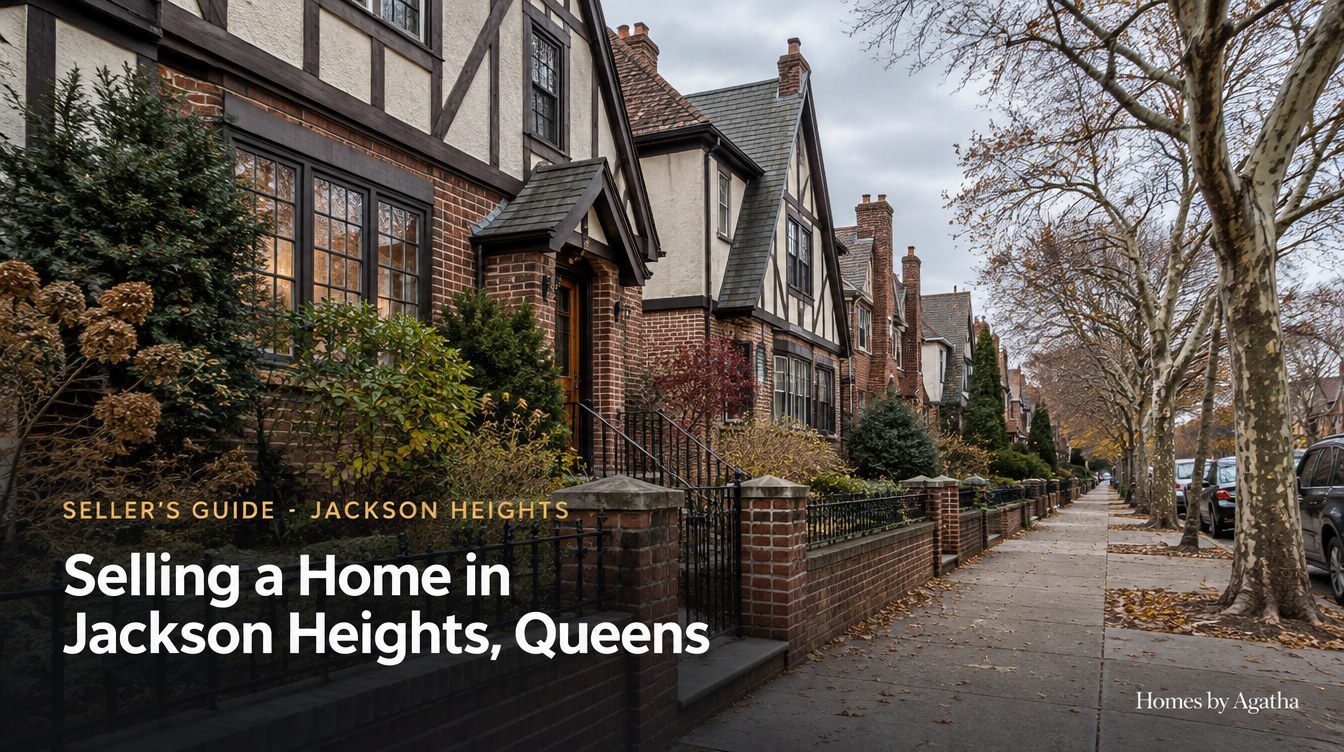
Selling a home in Jackson Heights means selling into a market shaped by two features: a large stock of prewar garden co-ops and a designated historic district. Buyers here read building finances, board rules and landmark records as closely as they look at kitchens. A sale goes smoothly when the seller has answered those questions before the buyer’s attorney asks them.
This guide is for owners of a co-op apartment or an attached house in Jackson Heights, Queens who want to understand pricing, preparation, disclosures, costs and timing before they list. It explains how buyers compare garden co-ops, how a comparative market analysis is built here, what the Landmarks Preservation Commission means for a sale, which documents to gather, and how to compare offers.
As a Licensed Associate Real Estate Broker based in Queens, I help sellers prepare the property and the paperwork together, in English and Polish. When you are ready for a pricing conversation, the Jackson Heights seller services page explains how we would work together.
Jackson Heights at a glance
| Item | Jackson Heights, Queens |
|---|---|
| Borough / county | Queens (Queens County), New York City; Queens Community Board 3 |
| ZIP code | 11372 for the core of the neighborhood; confirm the ZIP code for a specific address with USPS, because blocks near the edges may use a different one |
| Subway | 74 St–Broadway (7) and Jackson Hts–Roosevelt Av (E, F, M, R) station complex; 69 St, 82 St–Jackson Hts, 90 St–Elmhurst Av and Junction Blvd on the 7 |
| Historic district | Jackson Heights Historic District, designated by the NYC Landmarks Preservation Commission on October 19, 1993; roughly Roosevelt Avenue to 34th Avenue between about 76th and 88th Streets, with irregular edges; check a specific lot on the LPC map |
| Parks and public space | Travers Park (34th Avenue at 77th–78th Streets); the 34th Avenue Open Street between 69th and 96th Streets |
| Commercial corridors | 37th Avenue, 74th Street, 82nd Street, Roosevelt Avenue, Northern Boulevard, Junction Boulevard |
| Typical property types | Garden co-ops and other prewar co-op buildings; attached and semi-detached one- and two-family houses; a smaller number of condominiums |
| Seller considerations | LPC and DOB records; co-op board package, managing-agent fees and any flip tax; Certificate of Occupancy for houses; NYS and NYC transfer taxes |
What do buyers look for when they compare homes in Jackson Heights?
Buyers in Jackson Heights compare buildings first and apartments second. For a co-op, they weigh maintenance, building finances, board rules, garden access and exposure; for an attached house, they weigh legal unit count, condition, landmark status and outdoor space. Commute time to the Roosevelt Avenue station complex affects both.
Co-op buyers read the building
A co-op buyer is buying a share of a corporation, so the building’s health is part of your product. Buyers and their attorneys look at the underlying mortgage, reserves, recent and planned assessments, the sublet and pet policies, and how the board handles exterior work in the historic district. A building with a clear capital plan and stable maintenance makes every apartment in it easier to sell.
Garden, exposure and floor
Within a garden co-op, buyers compare apartments by what the rooms face. Garden-facing rooms usually offer a quieter outlook than rooms on a busy avenue, while upper floors in walk-up buildings involve stairs that some buyers weigh carefully, so state accurately whether your building has an elevator. Light, cross-ventilation and the view into the interior garden are the features that photographs need to show accurately.
House buyers read the records
For an attached or semi-detached house, buyers check the Certificate of Occupancy, open DOB violations and permits, and, inside the district, LPC violations. A house marketed as a two-family that is legal only as a one-family loses buyers who need rental income to qualify. Rear yards, garages and driveway access, where they exist, are highly visible comparison points.
Transit and daily convenience
Distance to the 74 St–Broadway / Jackson Hts–Roosevelt Av complex, where the 7 meets the E, F, M and R, is a common question. So is the walk to 37th Avenue for shopping and to the 34th Avenue Open Street and Travers Park. Describe these facts accurately in the listing; buyers will walk the route themselves.
How do you price a home in Jackson Heights?
Price a Jackson Heights home from a comparative market analysis that uses the closest possible comparables: sales in the same building or complex first, then similar co-ops nearby, adjusted for floor, exposure, size, maintenance and condition. For houses, comparables should match legal unit count, size, condition and whether the house is inside the historic district.
A comparative market analysis, or CMA, is a real estate broker’s professional opinion of value based on recent comparable sales, active competition and the property’s features. It is not an appraisal and does not guarantee a sale price. The appraisal that matters for financing is ordered later by the buyer’s lender.
What moves value in a Jackson Heights co-op
- Maintenance relative to size: buyers convert maintenance into a monthly payment, so higher maintenance lowers what they can pay for the shares.
- Building finances: an underlying mortgage nearing maturity, thin reserves or a pending assessment all reduce buyer confidence.
- Exposure and floor: garden-facing versus street-facing rooms, and floor level in walk-up versus elevator buildings.
- Financing rules: a building that allows higher financing reaches more buyers than one requiring a large down payment.
- Condition and approved renovations: kitchens and baths renovated with board approval and any required permits support value; undocumented work raises questions.
- Flip tax: if the co-op imposes one, it affects your net proceeds rather than the buyer’s price.
What moves value in an attached house
- Legal unit count: the Certificate of Occupancy, not the current use, sets what a lender will finance.
- Landmark status: inside the district, a facade with approved windows and doors avoids a buyer’s discount for future legalization.
- Systems: roof, boiler, electrical service, plumbing and sewer line, which a 1920s house has likely replaced at least once.
- Outdoor space and parking: rear yards, garages and driveways, where present, along with any shared-access arrangement.
Avoiding the two classic pricing errors
Pricing above the evidence tends to produce early showings without offers and a later reduction that buyers notice. Pricing well below the evidence can leave money on the table if the buyer pool is not given time to respond. A CMA that explains which comparables were used and why gives you a defensible range. For a broader view of valuation across the borough, see what is my Queens home worth. Comparable sales should be pulled from current records at the time of the CMA.
Want a CMA built on your building’s sales?
I can prepare a comparative market analysis that weighs your building, floor, exposure and maintenance against the most relevant Jackson Heights sales.
How do landmark rules affect selling a home in Jackson Heights?
Landmark rules affect selling a home in Jackson Heights when exterior work was done without the required Landmarks Preservation Commission permit. According to the LPC, an uncorrected violation can cause problems when an owner sells or refinances, so check the LPC’s records before listing and resolve or document any issue early.
The Landmarks Preservation Commission (LPC) is the New York City agency that designates landmarks and historic districts and regulates work on designated buildings. In the Jackson Heights Historic District, exterior work such as window and door replacement, masonry, storefronts and rooftop additions requires an LPC permit, and interior work that needs a Department of Buildings permit also needs an LPC sign-off.
Check the records before the buyer does
LPC’s Landmark Violation Search shows the status and description of landmark violations for a property, and LPC’s online permit map shows past applications. The agency notes that its search is not a substitute for a title search or other legal due diligence, so your attorney should still run the standard searches. For an attached house, search the address yourself; for a co-op, ask the managing agent whether the building has open LPC matters.
How LPC enforcement works
When LPC learns of work done without a permit, it usually issues a Warning Letter that gives the owner a chance to correct the condition without a fine, generally by applying for a permit to correct the condition; LPC describes this as the first grace period. If the condition is not addressed, a summons may follow, with a second grace period and a hearing date at the Office of Administrative Trials and Hearings (OATH). Source: NYC Landmarks Preservation Commission enforcement guidance.
Common landmark questions in a sale
| Item a buyer may ask about | Applies to | What the seller can do before listing |
|---|---|---|
| Replacement windows or doors | Attached houses; co-ops where shareholders own windows | Find the LPC permit or the building’s master plan approval; if none exists, ask your attorney about applying to legalize |
| Through-wall air conditioners or new exterior openings | Co-ops and houses | Confirm approval with the managing agent or LPC records |
| Masonry, stoops, fences or rooftop work | Mostly attached houses | Locate permits; disclose known work to your attorney |
| Interior renovation with a DOB permit | Co-ops and houses | Gather the DOB permit, sign-off and LPC Certificate of No Effect, plus board approval for a co-op |
Landmark status itself is not a defect. Some buyers look specifically for the protected streetscape and the interior gardens. What they discount is uncertainty: an unexplained window or an open violation turns into a negotiating point or a closing delay. Blocks outside the district boundaries do not have historic district review, which is why the exact lot matters; confirm district status on LPC’s Discover NYC Landmarks map.
What should you repair, clean or stage before listing?
Prioritize work that removes buyer doubt over work that changes your taste: fix visible defects, document past renovations, clean and declutter, and present light and layout clearly. In a co-op, coordinate any work with the managing agent first; in the historic district, avoid starting new exterior work that needs LPC review just before listing.
| Priority | Co-op apartment | Attached house | Why it matters in Jackson Heights |
|---|---|---|---|
| 1. Paperwork | Stock certificate, proprietary lease, alteration approvals, maintenance statement | Deed, survey, Certificate of Occupancy, permits, any LPC approvals | Buyers’ attorneys ask early; missing documents slow contract signing |
| 2. Visible repairs | Leaks, cracked tile, loose fixtures, painted-shut windows | Roof leaks, damp basement, broken steps, worn gutters | Small defects in a prewar home suggest bigger hidden ones |
| 3. Systems evidence | Electrical panel and any upgrade approval | Boiler service records, sewer and oil-tank history | Century-old buildings make buyers ask about systems first |
| 4. Light and layout | Open window treatments, especially on the garden side | Remove clutter from small rooms and stairs | Prewar rooms show best when proportions and light are visible |
| 5. Cosmetic refresh | Neutral paint, refinished floors where worn | Paint, yard clean-up, front-entry tidy | Inexpensive and quick; avoid major remodels just to sell |
Staging a prewar apartment
Prewar apartments in Jackson Heights often have generous rooms, separate dining areas and original details such as moldings or arched doorways, though details vary by building. Staging should show what each room is for and keep architectural details visible. Remove extra furniture, clear radiator tops, and make sure every window opens; buyers notice painted-shut sashes in older buildings.
Preparing an attached house
For an attached house, the front facade, the entry and the rear yard set first impressions. Clean masonry and windows without starting exterior work that needs an LPC permit, service the boiler and keep the record, and clear the basement so buyers and inspectors can see walls, pipes and the electrical panel. If the house is a legal two-family, present each unit as it is legally configured.
Key Takeaways
- Price from a CMA anchored in same-building or same-type sales, adjusted for floor, exposure, maintenance and condition.
- Search LPC and DOB records before listing; an uncorrected landmark violation can delay a sale or refinance.
- Document past renovations with board approvals, permits and LPC sign-offs so they support value instead of raising questions.
- Prepare for doubt-removal first and cosmetics second; avoid new exterior work that needs LPC review right before listing.
Not sure which repairs are worth doing?
We can walk through your apartment or house together and rank repairs, paperwork and staging by how much each one removes buyer doubt.
What is different about selling a co-op in Jackson Heights?
Selling a co-op adds a third party to your sale: the co-op board, which must approve your buyer. The seller’s job is to choose a buyer likely to be approved, provide the building’s documents quickly, and plan for managing-agent fees and any flip tax set by the co-op’s own documents.
Documents to gather before listing
- your original stock certificate and proprietary lease;
- the building’s purchase application and board package requirements;
- the most recent financial statements, budget and house rules, which the buyer’s attorney will request;
- your current maintenance statement and any assessment schedule;
- written approvals for past alterations, plus any DOB permits and LPC sign-offs;
- your share-loan payoff information, if you have a loan.
If the original stock certificate or proprietary lease cannot be found, tell your attorney early; replacing them can take time and may require a lost-document affidavit under the building’s own procedure.
Choosing a buyer the board will approve
A co-op seller compares offers partly by approval risk. An offer whose financing fits the building’s limit and whose buyer appears to meet the board’s liquidity expectations is usually stronger than a slightly higher offer that stretches those rules. Ask your agent to collect the building’s financing and liquidity requirements before showings so offers can be screened against them. A board may decline a buyer, but it may not discriminate on any basis protected by the federal Fair Housing Act, the New York State Human Rights Law or the New York City Human Rights Law.
Flip tax and building fees
A flip tax is a transfer fee that some co-ops charge when shares are sold. There is no city-wide rate: whether one applies, how it is calculated and who pays it are set by the co-op’s own documents and the contract. Managing agents also typically charge transfer, processing and lien-search-related fees. Ask the managing agent for the current fee schedule before you set your net-proceeds target.
Photographing common areas
The interior garden is one of a garden co-op’s strongest visual features, but it is common property. Ask the managing agent before photographing the garden, lobby or other shared spaces, and follow any building rules on open houses and showings.
What is different about selling an attached house in Jackson Heights?
Selling an attached house adds deed-and-title work, the Property Condition Disclosure Statement, and closer scrutiny of the Certificate of Occupancy, permits and shared-property arrangements. Inside the historic district, LPC records join the list of what the buyer’s attorney will review.
Certificate of Occupancy and legal units
The Certificate of Occupancy, issued by the NYC Department of Buildings, states a building’s legal use and number of dwelling units. If the house is used differently from its Certificate of Occupancy — for example, a basement or attic unit that is not legal — expect lenders, appraisers and buyers’ attorneys to raise it. If no Certificate of Occupancy is on file for an older house, DOB records and your attorney help establish its legal use.
Violations, permits and old tanks
Search NYC DOB records for open violations and unclosed permits, and resolve what you can before listing. Ask about any history of an oil tank, above or below ground, and gather documentation of removal or abandonment if it applies. Buyers’ attorneys frequently request these items, and missing sign-offs are a common cause of closing delays in older Queens housing.
Shared walls, driveways and access
Attached houses share party walls, and some share rear driveways, alleys or garage access with neighbors, so ask your attorney to check the title for easements or agreements. Gather any written agreement or survey that shows shared access, so your attorney can answer title questions quickly.
Inherited homes
If you are selling a Jackson Heights house or co-op you inherited, the executor or administrator’s authority usually comes through the Queens County Surrogate’s Court, and a co-op sale by an estate still requires board approval of the buyer. See the guide to selling probate real estate in New York for the steps involved.
Gathering your co-op or house documents?
I can give you a document checklist tailored to your building or house, so your attorney and the buyer’s attorney are not waiting on paperwork after the offer.
How will buyers find your Jackson Heights listing?
Most buyers will first see your Jackson Heights listing through OneKey MLS and the consumer portals that receive MLS data, then on agents’ own marketing. Strong photography, an accurate floor plan, and a description that states building facts — maintenance, financing rules, garden access, transit — do more work than adjectives.
OneKey MLS and portal distribution
OneKey MLS is the multiple listing service used by member brokers across much of the New York metro area, including Queens. A listing entered there is shared with participating brokers and typically syndicated to consumer search sites. Accurate data fields matter: property type (co-op versus condo versus house), maintenance, number of units for houses, and whether pets or subletting are allowed affect which search filters find your home.
Photography and floor plans
Professional photography should show light, room proportions, original details and, with the building’s permission, the interior garden. A floor plan helps buyers understand prewar layouts that photos can make confusing. For a house, include the facade, the yard and any garage or driveway.
Writing a description buyers can trust
- State the distance to the nearest station as a fact, such as the 74 St–Broadway / Jackson Hts–Roosevelt Av complex or 82 St–Jackson Hts.
- Name the building type and the garden access accurately.
- For co-ops, list maintenance and what it includes, with the building’s financing limit if the managing agent confirms it.
- For houses, describe the legal configuration as shown on the Certificate of Occupancy.
- Describe the property, not the people: Fair Housing rules prohibit describing a home or neighborhood by who should live there.
Showings and open houses
Co-ops may set rules on open houses, showing hours and access to common areas, so confirm them with the managing agent. For both property types, a schedule that lets buyers see garden-facing light during the day helps them understand the home’s best feature.
Which disclosures does a New York seller owe?
Most sellers of one- to four-family houses in New York must deliver the Property Condition Disclosure Statement before the buyer signs the contract; since March 20, 2024, the option of giving a $500 credit instead has been removed. All sellers receive the NYS Disclosure Form for Buyer and Seller explaining agency relationships, and sellers of housing built before 1978 have federal lead-based paint disclosure duties.
The Property Condition Disclosure Statement
The Property Condition Disclosure Statement (PCDS) is a New York State form in which the seller answers questions about the property’s condition, systems, environmental issues and legal status based on actual knowledge. For a Jackson Heights attached house, expect questions that touch on roof age, water in the basement, an oil tank, and whether the use matches the Certificate of Occupancy. Co-op and condo units are outside the PCDS requirement, because New York’s Real Property Law excludes them from its definition. Complete the form carefully with your attorney.
Agency disclosure
The New York State Disclosure Form for Buyer and Seller, required under NYS Department of State regulations, explains whom a real estate agent represents. A seller receives it at the first substantive contact with an agent and signs to acknowledge receipt.
Lead-based paint disclosure
Under federal rules, sellers of most housing built before 1978 must disclose known lead-based paint and hazards, provide any available reports, give the buyer the federal lead-hazard pamphlet, and offer an opportunity for a lead inspection unless the buyer waives it. Much of Jackson Heights’ housing stock was built in the early twentieth century, so many sellers here will have this duty; confirm the year built for your property in NYC Department of Finance or DOB records.
Planning your listing launch?
From photography permissions to MLS details and disclosures, I can help you set up a Jackson Heights listing that answers buyers’ questions before they ask.
What does selling a home in Jackson Heights cost?
The main costs of selling a home in Jackson Heights are negotiable brokerage compensation, the New York State real estate transfer tax, the New York City Real Property Transfer Tax, the seller’s attorney fee, payoff of any loan and, for co-ops, managing-agent fees and any flip tax. The NYC Real Property Transfer Tax applies because Jackson Heights is in New York City.
| Cost | Rule or amount | Applies to | Source / who sets it |
|---|---|---|---|
| NYS real estate transfer tax | $2 for each $500 of consideration (0.4%), customarily paid by the seller | Houses, co-op units and condo units | NYS Department of Taxation and Finance |
| NYC Real Property Transfer Tax (RPT) | 1% when the price is $500,000 or less; 1.425% when above $500,000 (residential 1–3 family homes, individual co-op units and condo units), customarily paid by the seller | Jackson Heights houses, co-ops and condos | NYC Department of Finance |
| Brokerage compensation | Negotiable; not set by law | All sales | Listing agreement |
| Buyer-agent compensation | Negotiable; not automatically paid by the seller; may be offered or negotiated within an offer | All sales | Agreement between the parties |
| Seller’s attorney | Fee agreed with the attorney | All sales | Your attorney |
| Loan payoff | Per the lender’s payoff letter | Mortgages and share loans | Your lender |
| Flip tax | Only if the co-op’s documents impose one; no city-wide rate | Co-ops only | The co-op’s own documents |
| Managing-agent and transfer fees | Set by the building | Co-ops | Managing agent |
| Violations, repairs and credits | Negotiated; open DOB or LPC issues may need to be resolved | Mostly houses | Contract / NYC DOB and LPC records |
Confirm current rates with the NYS Department of Taxation and Finance and NYC Department of Finance before closing.
The “mansion tax” of 1% on residential purchases of $1 million or more (graduated above $2 million in New York City) is paid by the buyer, not the seller, though it can influence how buyers respond to prices near that threshold. The NYC mortgage recording tax is a buyer cost for houses and condos and does not apply to co-op share loans. For a borough-wide breakdown, see the guide to Queens closing costs.
How should you compare offers on a Jackson Heights home?
Compare offers by net proceeds and probability of closing, not by price alone. In Jackson Heights, the strongest offer is often the one with financing that fits the co-op’s rules or the house’s appraisal, a buyer likely to pass board review, and a timeline that matches yours.
| Factor | What to look for | Why it matters here |
|---|---|---|
| Price and net proceeds | Price minus transfer taxes, flip tax, fees and any credits | Two offers with the same price can net differently |
| Financing | Loan amount versus the building’s financing limit; pre-approval from a lender active in co-ops | Over-limit financing in a co-op usually means a board problem |
| Board-readiness (co-ops) | Evidence of liquidity and a buyer prepared to assemble a complete package | Approval risk is the main co-op deal-killer |
| Appraisal exposure (houses) | Down payment cushion if the appraisal comes in low | Prewar houses can be hard to compare, so appraisal gaps happen |
| Contingencies | Financing, board approval and any other conditions | Each one is a point where the deal can fail |
| Timing | Proposed contract and closing dates | Matters if you are buying your next home at the same time |
Negotiating after inspection and due diligence
In New York, an accepted offer is not a signed contract. The buyer’s attorney reviews documents and, for a house, the inspection typically happens before contract signing. Requests for credits or repairs usually arrive during this window. Having the paperwork, permits and LPC records ready shortens the window and narrows what can be renegotiated.
Key Takeaways
- Sellers in Jackson Heights customarily pay the NYS transfer tax and the NYC Real Property Transfer Tax; the mansion tax is a buyer cost.
- Brokerage compensation is negotiable, and buyer-agent compensation is not automatically paid by the seller.
- For co-ops, flip tax and managing-agent fees come from the building’s own documents, so get them in writing early.
- Rank offers by net proceeds and certainty of closing, including board-readiness and financing that fits the building.
Weighing more than one offer?
I can help you compare net proceeds, financing fit and approval risk side by side, so you choose the offer most likely to close on your terms.
How long does it take to sell, and what mistakes slow it down?
A Jackson Heights sale moves from preparation and listing to an accepted offer, contract signing, the buyer’s loan commitment, board approval for a co-op or title clearance for a house, and closing. Time on market depends on price and conditions; time after the offer depends mostly on documents, the lender and the board.
| Stage | Co-op | Attached house | What the seller controls |
|---|---|---|---|
| 1. Preparation | Gather stock certificate, lease, approvals; confirm building fees and rules | Gather deed, survey, CO, permits; search DOB and LPC records | Start before listing |
| 2. Listing and showings | OneKey MLS; follow building showing rules | OneKey MLS; open houses as you choose | Price, presentation, access |
| 3. Accepted offer | Screen against financing and liquidity rules | Screen for financing and appraisal cushion | Offer selection |
| 4. Contract | Attorneys negotiate; buyer’s deposit into escrow | Inspection, PCDS delivered, contract signed | Document speed |
| 5. Commitment and approval | Buyer’s loan commitment; board package, interview and decision | Buyer’s loan commitment; title search and clearance | Quick answers to attorney and title requests |
| 6. Closing | Shares and lease transferred; flip tax and fees paid; transfer taxes paid | Deed transferred; transfer taxes paid; loan paid off | Move-out and final readings |
Mistakes that cost Jackson Heights sellers time or money
- Listing before checking LPC and DOB records. An unpermitted window or open violation found by the buyer’s attorney becomes a negotiation or a delay.
- Pricing from a different building. Co-op values depend on maintenance, finances and rules, so a nearby building’s sale may not be comparable.
- Accepting an offer the board is unlikely to approve. A higher price means little if the buyer exceeds the building’s financing limit.
- Overstating the legal configuration of a house. Marketing a one-family as a two-family invites problems with lenders and buyers.
- Losing track of co-op documents. A missing stock certificate or lease can hold up closing.
- Starting exterior work right before listing. In the historic district, new exterior projects need LPC permits first.
Your Jackson Heights seller checklist
- Review the NYS Disclosure Form for Buyer and Seller and agree on brokerage terms in writing.
- Request a CMA based on same-building or same-type comparables.
- Search LPC’s Landmark Violation Search and NYC DOB records for the property or building.
- Gather the stock certificate and lease (co-op) or deed, survey and Certificate of Occupancy (house).
- Ask the managing agent for fees, flip tax terms, showing rules and board requirements.
- Complete visible repairs, document past renovations, then clean, declutter and stage.
- Schedule photography, with permission for any common-area photos.
- Prepare the PCDS with your attorney for a house, plus the lead-based paint disclosure.
- Compare offers by net proceeds and approval or appraisal risk.
- Respond quickly to attorney, lender, title and board requests through closing.
If you plan to buy again after selling, the companion guide to buying a home in Jackson Heights explains the purchase side. Owners comparing markets nearby can also look at selling in Woodside, Elmhurst or Corona, and the borough-wide guide on how to sell a home in Queens covers the general process.
Map out your Jackson Heights sale from start to closing
Tell me your timing and goals, and we can build a seller timeline that covers pricing, landmark records, documents and the board or title steps ahead.
Frequently asked questions about selling a home in Jackson Heights
Do I need landmark approval to sell a home in the Jackson Heights Historic District?
No approval is needed to sell, but exterior work done without a Landmarks Preservation Commission permit can complicate a sale. According to the LPC, an uncorrected violation can cause problems when an owner sells or refinances. Check LPC’s Landmark Violation Search before listing and ask your attorney how to resolve any open issue.
How is a Jackson Heights co-op priced?
A Jackson Heights co-op is priced from a comparative market analysis that starts with recent sales in the same building or complex, then similar co-ops nearby, adjusted for floor, exposure, size, condition and maintenance. A CMA is a broker’s opinion of value, not an appraisal, and it does not guarantee a sale price.
What taxes does a seller pay in Jackson Heights?
Sellers customarily pay the New York State real estate transfer tax of $2 per $500 of consideration and the NYC Real Property Transfer Tax of 1% at $500,000 or less, or 1.425% above $500,000 for residential sales. Confirm current rates with the NYS Department of Taxation and Finance and NYC Department of Finance.
Is there a flip tax when selling a Jackson Heights co-op?
Only if your co-op’s documents impose one. There is no city-wide flip tax rate; whether a flip tax applies, how it is calculated and who pays it are set by each co-op’s own documents and the contract. Ask your managing agent for the current terms before you calculate your expected net proceeds.
Do co-op sellers in Jackson Heights fill out the Property Condition Disclosure Statement?
Co-op and condo units are generally outside New York’s Property Condition Disclosure Statement requirement, which applies to most one- to four-family houses. Confirm with your attorney. Co-op sellers still provide building documents, and sellers of homes built before 1978 have federal lead-based paint disclosure duties regardless of ownership type.
Can the co-op board reject my buyer?
Yes. A co-op board can decline a buyer, often without giving a reason, but it may not discriminate on any basis protected by federal, New York State or New York City fair housing laws. Sellers reduce approval risk by choosing an offer whose financing and finances fit the building’s published requirements.
Who pays the buyer’s agent when I sell in Jackson Heights?
Buyer-agent compensation is negotiable and not set by law. Since the 2024 NAR settlement, it is not automatically paid by the seller. A seller may agree to contribute, the buyer may pay directly under a written buyer agreement, or the terms may be negotiated within an offer. Your listing agreement should address it.
What documents should I gather before selling a Jackson Heights house?
Gather the deed, a survey if you have one, the Certificate of Occupancy, permits and sign-offs for past work, any LPC approvals for exterior changes, boiler and roof records, and oil-tank documentation if it applies. Search NYC DOB and LPC records for open violations so your attorney can address them before contract.
Can I photograph the interior garden for my co-op listing?
The interior garden of a Jackson Heights garden co-op is common property, so ask the managing agent before photographing it, the lobby or other shared spaces. Many buildings also set rules for open houses and showings. With permission, accurate garden photos help buyers understand one of the building’s most distinctive features.
How long does it take to close on a Jackson Heights co-op sale?
There is no fixed timeline. After the contract is signed, the buyer needs a loan commitment, then submits a board package, interviews and waits for the board’s decision before closing. Quick document delivery from the seller and managing agent, and a buyer whose finances fit the building, keep the process moving.
Before you list your Jackson Heights home
A strong Jackson Heights sale is prepared before the listing goes live. Build the price from the closest comparables in your building or among similar houses, search LPC and DOB records so no surprise reaches the buyer’s attorney first, gather your co-op or house documents, and budget for the NYS transfer tax, the NYC Real Property Transfer Tax and any co-op fees. Then compare offers by net proceeds and certainty of closing. When you want a pricing opinion and a plan for your property, start on the Jackson Heights home selling page.
This article is for general informational purposes only and reflects conditions that may change. It is not legal, tax, or financial advice, an appraisal, or a guarantee of price or outcome; consult a licensed New York attorney, a CPA, and an NMLS-registered mortgage loan originator as appropriate. A CMA is an opinion of value, not an appraisal. Real estate brokerage services are offered by Agatha Lubas, Licensed Associate Real Estate Broker, NY License #10301213345, Keller Williams Realty Liberty, 96-10 101st Avenue, Ozone Park, NY 11416. The NYS Disclosure Form for Buyer and Seller, the NYS Housing and Anti-Discrimination Disclosure / Fair Housing Notice, and the brokerage’s Standard Operating Procedures are available on request. Equal Housing Opportunity.

Agatha Lubas helps sellers, buyers and investors across Queens, Brooklyn, Nassau County and Suffolk County, from pricing and preparation through board approval and closing. She works with clients in English and Polish, so every document and decision is clear and comfortable.
Work with Agatha