

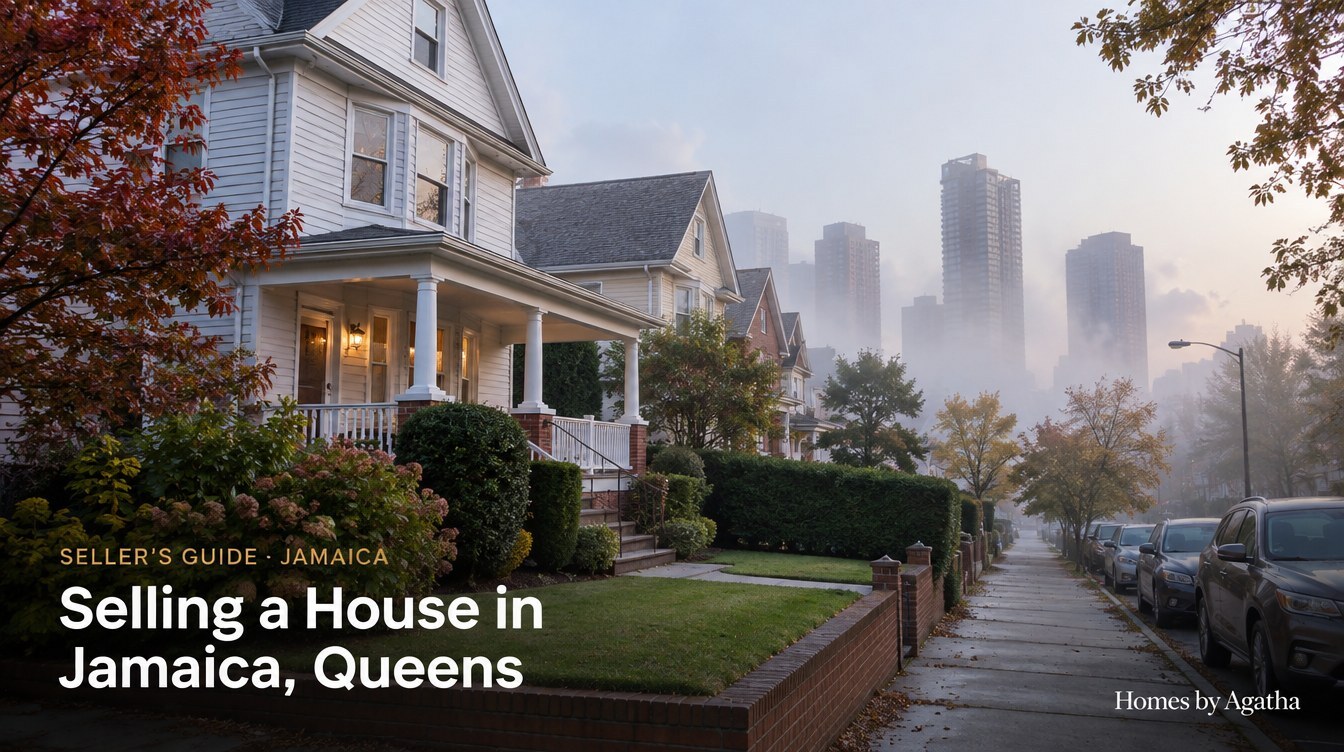
JAMAICA SELLER GUIDE
Selling a House in Jamaica Queens: Pricing the Home, the Lot and the Paperwork
Quick Answer
Selling a house in Jamaica, Queens starts with a CMA that compares legal unit count, distance to the Jamaica LIRR and subway hub, lot size, zoning and basement condition. Then gather the Certificate of Occupancy, violations, leases and water records, deliver the Property Condition Disclosure Statement, and estimate net proceeds after NYS and NYC transfer taxes.
This guide is for owners considering selling a house in Jamaica Queens who want to understand how buyers will judge the property before the first showing. Jamaica is a transit hub, where Jamaica station on the Long Island Rail Road, AirTrain JFK and the E, J, Z and F trains all meet. It has also been rezoned twice, in 2007 and in 2025. Together, those two facts mean the same house can attract very different buyers, each with a different idea of what it is worth.
Some buyers see a home: a place to live near the train, perhaps with a rental unit that helps pay the mortgage. Others see a lot: land whose zoning may allow a larger building. Your pricing, preparation and paperwork should anticipate both, without promising either.
As a Licensed Associate Real Estate Broker serving Queens, I help sellers prepare the property and the transaction, in English or Polish, whichever is more comfortable. Below you will find who buys in Jamaica and what they check, how a comparative market analysis works here, what the rezonings do and do not mean for value, which records to gather, how to prepare and market the house, what you must disclose, what selling costs, and how to compare offers. When you are ready to talk about your specific property, the page on how to sell your home in Jamaica with a local listing agent explains how we would work together.
Jamaica at a glance for sellers
| Topic | Why it matters when you sell |
|---|---|
| Location | Southeast-central Queens, between Jamaica Estates and Jamaica Hills to the north, Hollis and St. Albans to the east, South Jamaica to the south, and Briarwood, Richmond Hill and South Ozone Park to the west (edges are informal; buyers will compare across them) |
| Borough / County | Queens (Queens County), New York City, so the NYC Real Property Transfer Tax applies in addition to the NYS transfer tax |
| ZIP code(s) | Commonly 11432, 11433, 11434, 11435 and 11436, depending on the block; confirm the ZIP code for each specific address with the USPS |
| Transit buyers ask about | Jamaica station (LIRR to Penn Station, Grand Central Madison and Atlantic Terminal); AirTrain JFK; E, J and Z at Sutphin Blvd–Archer Av–JFK Airport and Jamaica Center–Parsons/Archer; E at Jamaica–Van Wyck; F along Hillside Avenue to Jamaica–179 St |
| Zoning context | Special Downtown Jamaica District (2007) and the Jamaica Neighborhood Plan (approved 2025); check each lot on ZoLa |
| Typical property types | Detached and semi-attached frame houses, attached brick houses, two- and three-family houses, mixed-use buildings, co-op and condo apartments |
| Local offices sellers deal with | Queens County Surrogate’s Court at 88-11 Sutphin Boulevard for estate matters; NYC Department of Buildings and NYC Department of Finance records online |
| Top seller considerations | Legal unit count, basement water history, open violations, tenant status, zoning of the lot, measured walking time to the station |
Who buys houses in Jamaica, Queens, and what do they check first?
Most Jamaica house buyers fall into three groups by purpose: owner-occupants who want a home near transit, often with a rental unit; investors who buy for rental income; and builders who look at the land under the zoning. Each group checks different things first, and a seller who knows which group fits the property can price and present it accordingly.
Owner-occupants
An owner-occupant plans to live in the house, and in a two-family or three-family house, often to rent the other units. These buyers usually finance with a residential mortgage, sometimes with a low down payment, and their lender will count only documented rent from legal units. They check the walk to Jamaica station or the nearest subway, the condition of the kitchen, bathrooms and systems, parking, and whether the basement is dry and legally usable.
Rental investors
An investor buys for income. Investors read the Certificate of Occupancy, the leases and the rent roll before they read the listing description. They want to know which units are legal, whether tenants are in place, what the water and heating costs are, and whether any unit is subject to rent regulation. They often pay with cash or investor financing and may close faster, but they price conservatively.
Builders and developers
On some lots, especially larger ones or those near the hub inside rezoned areas, a builder may value the property as a development site. These buyers look at zoning, lot dimensions, what the zoning would allow to be built, existing tenants and demolition costs. Their price reflects their building economics, not the condition of your kitchen. Not every Jamaica lot interests builders; the zoning section below explains how to tell.
Apartment buyers
If you are selling a condo or co-op apartment, your buyer pool is mostly people who want to live near the hub or along Hillside Avenue. They compare monthly costs, building finances and, for co-ops, the board’s requirements. The section on condo and co-op sales below covers what they need from you.
| Buyer group | What they check first | How they usually pay | What helps you |
|---|---|---|---|
| Owner-occupant | Commute, condition, dry basement, legal rental unit | Residential mortgage, sometimes low down payment | Clean records, repaired systems, accurate unit description |
| Rental investor | CO, leases, rent roll, operating costs | Cash or investor loan | Organized income documents and tenant estoppels |
| Builder or developer | Zoning, lot size, tenants, site conditions | Cash or construction financing | Survey, title clarity, zoning summary, vacancy plan |
| Condo or co-op buyer | Monthly costs, building financials, board rules | Mortgage or co-op share loan | Complete building documents and a prepared board package |
How do you price a house in Jamaica with a CMA?
You price a Jamaica house with a comparative market analysis (CMA) that compares recent sales of properties with the same legal configuration, similar distance to transit, similar lot size and zoning, and similar condition. A CMA is a broker’s professional opinion of value, not an appraisal and not a guarantee of a sale price.
Compare legal configuration first
In Jamaica, a legal two-family house and a one-family house with an unpermitted basement apartment are different products, even if they look similar from the street. Buyers and appraisers value the legal units on the CO. A CMA that treats an illegal unit as income will overprice the house, and the overpricing will surface at the appraisal or in a buyer’s attorney’s review.
Measure distance to the hub honestly
Walking time to Jamaica station, Jamaica Center–Parsons/Archer, Sutphin Blvd–Archer Av or the F stations along Hillside Avenue is one of the variables buyers price most directly. Measure it with a map, not an estimate, and compare against sales at a similar distance. Proximity is also a trade-off: blocks right at the hub experience more bus, taxi and construction activity, which some owner-occupants weigh against convenience.
Account for lot size and zoning
Two houses of the same size can differ in value if one sits on a larger lot in a district that allows more building. That difference matters most for sellers whose lots interest builders. The CMA should note the zoning district and, where relevant, sales of comparable development sites, not only comparable houses.
The basement and the appraisal
Below-grade condition affects price more in parts of Southeast Queens than in many other areas, because buyers know about local groundwater and stormwater history. A finished, dry basement with a documented sump system and waterproofing invoices supports value; visible staining or a musty smell invites a lower offer or a repair request. If a buyer finances, the lender’s appraiser will form an independent opinion, and a low appraisal can force renegotiation. For a broader look at how values are estimated across the borough, see what is my Queens home worth.
| Pricing factor | Pushes value up when… | Pushes value down when… |
|---|---|---|
| Legal unit count | CO or Letter of No Objection matches every unit marketed | Extra units are unpermitted or the records are unclear |
| Distance to transit | Short, measured walk to the LIRR or subway | Long walk or a bus transfer is required |
| Basement condition | Dry, documented water management, legal use | Staining, active seepage, illegal occupancy |
| Lot and zoning | Larger lot in a district builders find useful | Small or irregular lot; zoning limits change of use |
| Tenancy | Documented leases at market rent, or vacancy when buyers want it | Missing leases, unclear deposits, disputed occupancy |
| Systems and permits | Updated boiler, roof and electrical with permits closed | Open permits, violations or an abandoned oil tank without paperwork |
| Parking | Legal driveway or garage confirmed by survey | Shared or informal driveway with no recorded agreement |
Curious how buyers would value your Jamaica house?
I can prepare a CMA that compares your legal configuration, transit distance, lot and condition against the sales that actually match.
Does the Jamaica rezoning make your house worth more?
Not automatically. The 2007 and 2025 rezonings changed what can be built on many lots near the Jamaica hub, which can raise interest from builders in some properties, but a house is worth more only if a buyer can actually use the added development potential. Lot size, shape, tenants and building costs decide that.
What changed
On September 10, 2007, the New York City Council adopted the Jamaica Plan, which created the Special Downtown Jamaica District and rezoned 368 blocks in Queens Community Boards 8 and 12 to encourage mixed-use, transit-oriented development. On October 29, 2025, the Council approved the Jamaica Neighborhood Plan, a city-led rezoning of roughly 230 blocks that includes a large Mandatory Inclusionary Housing area, which requires new residential developments in the mapped area to include permanently income-restricted units; the city describes it as the largest Mandatory Inclusionary Housing area to date.
How to tell whether your lot interests builders
- Look up your lot on ZoLa. The NYC Department of City Planning’s Zoning and Land Use map shows the zoning district and special districts for every tax lot.
- Check the lot dimensions. Small or narrow lots often cannot support a larger building on their own; builders may need to assemble neighboring lots.
- Consider occupancy. A tenant-occupied building is harder and slower to redevelop, which affects a builder’s price.
- Ask a professional. A zoning attorney or architect can estimate what is buildable; a broker’s CMA can then compare that with house sales.
Avoid two common pricing errors
The first error is pricing a typical house as if it were a development site because “the area was rezoned.” Owner-occupant buyers will not pay land value they cannot use, and their appraisers will not support it. The second error is the reverse: selling a lot that does interest builders to the first cash offer without testing that market. If your lot may have development value, expose it to both buyer groups and compare the net results.
Key Takeaways
- Price Jamaica houses by legal unit count first; illegal units do not count as income or value.
- Measured walking time to the LIRR and subway is a direct pricing variable near the hub.
- A dry, documented basement supports value in Southeast Queens.
- Rezoning raises builder interest only on lots where added development is actually usable.
What records should you gather before selling a house in Jamaica Queens?
Gather the documents that answer buyers’ first questions before you list: legal-use records, permits and violations, leases, utility and repair history, water-management records and, for an inherited property, estate papers. When selling a house in Jamaica Queens, a complete file shortens attorney review and reduces the chance of renegotiation.
Legal-use and permit records
Start with the Certificate of Occupancy, the NYC Department of Buildings document that states the building’s legal use and number of units. Many Jamaica houses were built before 1938, when Certificates of Occupancy generally were not required; for those, look for a Letter of No Objection or other DOB records, as explained on the DOB’s Certificate of Occupancy page. Then check DOB permits and violations and OATH/ECB penalties. Open items do not always prevent a sale, but buyers’ attorneys will find them, and resolving them early usually costs less than negotiating them under deadline.
Tenant and income records
For a tenant-occupied house, collect every lease, a rent roll, security-deposit records and any correspondence about renewals. If a unit may be subject to rent regulation, ask your attorney to confirm its status before you market it; your attorney may also check with NYS Homes and Community Renewal. Decide with your attorney whether to sell with tenants in place or deliver units vacant; that choice affects which buyers you attract.
Water, systems and environmental records
Because Jamaica buyers ask about groundwater and stormwater, gather records of sump pump installation or replacement, waterproofing work, backwater valves, sewer-line repairs and any flood insurance policy or claims. Add boiler, roof and electrical invoices. If the house converted from oil to gas, find the paperwork showing the oil tank was removed or properly abandoned. Note whether the NYC Department of Environmental Protection has completed sewer work on your street as part of its Southeast Queens program; check the current status for your specific street with DEP before you list.
Inherited Jamaica houses
If you are selling a house you inherited, the executor or administrator generally needs authority from the Surrogate’s Court before signing a contract. For Queens estates, that court is the Queens County Surrogate’s Court at 88-11 Sutphin Boulevard, in Jamaica itself. Timing depends on the estate, so involve an estate attorney early. Our page on selling a probate property in New York explains the steps.
Not sure which records your sale will need?
We can go through your property’s DOB, Finance and lease records together and build a pre-listing file before buyers start asking.
How do you prepare a Jamaica house for buyers?
Prepare in order of what buyers judge first: water and systems, then the legal presentation of each unit, then cosmetics. In Jamaica, a dry, clean, honestly presented basement and a well-kept exterior often matter more than a full renovation.
Preparation priorities
| Priority | What to do | Why it matters in Jamaica |
|---|---|---|
| 1. Water management | Service the sump pump, fix gutters and leaders, regrade soil away from the foundation, clean and dehumidify the basement | Buyers and inspectors look hard at below-grade space in Southeast Queens |
| 2. Records-driven fixes | Close open permits, resolve simple violations, remove unpermitted kitchens if advised by your attorney | The legal unit count drives price and financing |
| 3. Systems | Service the boiler, check smoke and carbon monoxide detectors, address obvious electrical issues | Older houses draw detailed inspection reports |
| 4. Exterior | Repair porch steps and railings, paint trim, clean siding, tidy the yard and driveway | Many Jamaica frame houses are judged from the porch and sidewalk |
| 5. Interior presentation | Declutter, neutral paint where needed, bright lighting, clean windows | Photographs and first impressions |
| 6. Tenant coordination | Agree on showing windows with tenants, with proper notice | Smooth access protects both the sale and the tenancy |
Present below-grade space honestly
Stage a basement for its legal use. If the CO describes it as storage or accessory space, present it that way, perhaps as a laundry and storage area or recreation room. Do not stage a bedroom or market a “basement apartment” that is not legal. Accurate presentation protects you from misrepresentation claims and keeps the appraisal aligned with the price.
Multi-unit and tenant-occupied houses
For a two-family or three-family house, prepare the owner’s unit as the showcase and make sure each rental unit is clean and in good working order, with working locks, smoke detectors and heat. Respect tenants’ rights to notice and privacy. Many investors will want to see every unit, so schedule tours that minimize disruption.
How should a Jamaica home be marketed?
Market a Jamaica home with professional photography, a floor plan, an accurate description of legal units and measured transit distances, distribution through OneKey MLS and major portals, and a showing plan that fits occupancy. Accuracy is the strategy: Jamaica buyers check records, and a listing that matches them builds trust quickly.
Photography, floor plans and the listing description
Professional photographs and a floor plan help buyers compare layouts, especially in multi-unit houses where the configuration of each apartment matters. The description should state the legal unit count as the records show it, describe the basement by its legal use, and give measured walking times to specific stations, for example to Jamaica station or to Jamaica–179 St on the F, rather than vague phrases.
OneKey MLS and online distribution
OneKey MLS is the multiple listing service used by brokers across Queens, Long Island and other parts of the New York region. Listing there shares the property with participating brokers and feeds many consumer portals. Your listing agreement should state how the property will be marketed and how buyer-agent compensation, if any, will be handled.
Selling a condo or co-op in Jamaica
If your property is a co-op apartment, the buyer must apply to the board, usually with a detailed financial package and an interview. Ask the managing agent early for the building’s application requirements, financial statements and any flip tax, which is a transfer fee set only by the co-op’s own documents; there is no city-wide rate. If your property is a condo unit, the buyer’s lender will review the building, and the condo board may have a right of first refusal that must be waived. In either case, a complete set of building documents keeps the sale moving.
Ready to plan how your listing will launch?
Let’s decide how to present your legal units, your basement and your distance to the hub so that the listing matches the records from day one.
What disclosures are required when selling in Jamaica?
Most sellers of one-to-four-family houses in New York must deliver the Property Condition Disclosure Statement, and sellers of homes built before 1978 must provide the federal lead-based paint disclosure. Real estate licensees also give the NYS Disclosure Form for Buyer and Seller at the first substantive contact.
The Property Condition Disclosure Statement
The Property Condition Disclosure Statement (PCDS) is a New York State form in which the seller answers questions about the property’s condition, including its structure, systems, environmental items and flood history. Since March 20, 2024, sellers can no longer give a $500 credit instead of delivering the disclosure; sellers of most one-to-four-family homes must provide the PCDS. Condominium units and co-op apartments are excluded from the statute’s definition of residential real property, so the PCDS requirement does not apply to them. In Jamaica, the flood-related questions deserve particular care: answer accurately about past water entry, flood insurance and any claims, and ask your attorney about anything you are unsure of.
Lead-based paint disclosure
Federal law requires sellers of housing built before 1978 to disclose known lead-based paint and hazards, provide available records and give buyers an opportunity to test. Much of Jamaica’s house stock predates 1978, so expect this form in most sales.
Agency and fair housing disclosures
The NYS Disclosure Form for Buyer and Seller explains whom a real estate licensee represents. The NYS Housing and Anti-Discrimination Disclosure Form explains fair housing protections. Every buyer must be treated equally regardless of protected characteristics; offers are evaluated on their terms, not on who the buyer is.
What does it cost to sell a house in Jamaica, Queens?
A Jamaica seller typically pays the New York State real estate transfer tax, the NYC Real Property Transfer Tax, brokerage compensation as negotiated, attorney fees and the payoff of any mortgage or liens, plus any costs to resolve violations or make agreed repairs. Exact amounts depend on the price, the property type and the contract.
Transfer taxes
The NYS real estate transfer tax, administered by the New York State Department of Taxation and Finance, is $2 for each $500 of consideration (0.4%) and is customarily paid by the seller. The NYC Real Property Transfer Tax, administered by the NYC Department of Finance, applies because Jamaica is in New York City: for residential one-to-three-family homes, individual co-op units and condo units, the rate is 1% when the price is $500,000 or less and 1.425% when it is above $500,000, customarily paid by the seller. Four-family, mixed-use and vacant-land transfers are taxed differently: for these, the NYC Department of Finance applies an RPT rate of 1.425% when the price is $500,000 or less and 2.625% when it is above, which matters if a builder buys your lot. Ask your attorney how the state transfer tax applies to that kind of sale. Confirm current rates with the NYS Department of Taxation and Finance and the NYC Department of Finance before closing.
Seller expense overview
| Expense | Who sets it | Notes for a Jamaica sale |
|---|---|---|
| Listing brokerage compensation | Negotiated between seller and listing broker | Not set by law; agree on it in writing in the listing agreement |
| Buyer-agent compensation | Negotiated; the seller may or may not agree to contribute | Not automatically paid by the seller under the post-2024 rules |
| NYS real estate transfer tax | NYS Department of Taxation and Finance | 0.4% of the consideration, customarily paid by the seller |
| NYC Real Property Transfer Tax | NYC Department of Finance | 1% up to $500,000 and 1.425% above, for one-to-three-family homes, co-op and condo units |
| Seller’s attorney | Agreed with your attorney | Contract, title objections, violations, lease and deposit transfers |
| Mortgage payoff and lien releases | Your lender and any lienholders | Request a payoff letter early; check ACRIS for old unreleased mortgages |
| Violation and permit cleanup | Depends on the issue | May need an architect, expediter or contractor |
| Water and repair items | Your choice or negotiated | Sump, waterproofing or credits requested after inspection |
| Co-op or condo charges | Building documents | Flip tax only if the co-op’s documents impose one; processing fees vary |
Taxes on any gain from the sale depend on your situation; ask a CPA before you list, especially for a rental, inherited or long-held property. For how costs are split across a borough transaction, see Queens closing costs explained, and for the borough-wide selling process, our guide on how to sell your home in Queens.
Brokerage compensation after the 2024 settlement
Under the rules in effect in 2026, brokerage compensation is negotiable and not set by law. The seller decides whether to offer any contribution toward a buyer’s agent’s compensation, and buyers sign written agreements with their own agents before touring. Those choices can affect how many buyers and agents engage with your listing, so discuss them openly when you sign your listing agreement.
Key Takeaways
- Jamaica sellers usually pay the NYS transfer tax (0.4%) and the NYC RPT (1% or 1.425% for residential one-to-three-family, co-op and condo sales).
- Land, mixed-use and four-family sales can be taxed differently; confirm before accepting a builder’s offer.
- Brokerage compensation is negotiable and agreed in writing.
- Answer the PCDS flood questions accurately; Jamaica buyers will read them closely.
Want an estimate of what you would net?
We can model transfer taxes, compensation, payoff and likely credits against a realistic price range before you decide to list.
How do you compare offers on a Jamaica property?
Compare offers by net proceeds and certainty, not price alone: look at financing type, down payment, appraisal risk, contingencies, closing date, tenant or vacancy terms and the buyer’s readiness to sign a contract. In Jamaica, an owner-occupant’s financed offer and a builder’s cash offer can differ in every one of those terms.
| Offer element | Question to ask | Why it matters in Jamaica |
|---|---|---|
| Price and net | What will I net after taxes, compensation and credits? | Different tax treatment for land or mixed-use sales can change the net |
| Financing type | Cash, conventional, government-backed or investor loan? | Some loan programs have property standards older houses must meet |
| Appraisal exposure | Can the buyer cover a gap if the appraisal is low? | Appraisers value legal units and basement condition conservatively |
| Pre-approval scope | Does it cover a two-family, three-family, mixed-use or co-op purchase? | A one-family approval may not fit your building |
| Due-diligence period | How long before the buyer signs a contract? | Builders may need zoning studies; owner-occupants need inspections |
| Tenant and vacancy terms | Will the buyer take tenants in place or require vacancy? | Vacancy delivery depends on New York tenant law, not just the contract |
| Closing date | Does it fit your move, estate timeline or purchase? | Estate sales may need court authority first |
Negotiating after the inspection
Expect inspection findings in an older Jamaica house, often about the basement, roof, boiler or electrical service. A seller can repair, give a credit, adjust the price or decline. Your pre-listing records help here: a buyer is less likely to ask for a large credit on a sump system you can show was replaced and serviced.
An accepted offer is not a contract
In New York, an accepted offer is not binding. The attorneys negotiate the contract of sale, and the deal becomes binding only when both parties sign and the buyer’s deposit is delivered. Until then, keep showing the property if your agreement allows, and keep your records ready for the buyer’s attorney.
What is the timeline from listing to closing in Jamaica?
A typical Jamaica sale moves through preparation, listing and showings, offer and acceptance, contract, buyer financing and title, and closing. The steps most likely to slow down are records clean-up before listing, the appraisal on multi-unit houses, co-op board approval and estate authority for inherited homes.
| Stage | What happens | Who leads | Jamaica-specific delay risk |
|---|---|---|---|
| 1. Preparation | CMA, records file, repairs, water management, staging | Seller and listing agent | Open permits or violations needing professionals |
| 2. Listing and showings | Photography, OneKey MLS, portals, open houses | Listing agent | Coordinating access in tenant-occupied units |
| 3. Offer and acceptance | Terms agreed in principle; not yet binding | Listing agent and buyer’s agent | Vague tenant, vacancy or closing-date terms |
| 4. Contract | Buyer inspection, attorney review, contract signing, deposit | Attorneys | Basement or system findings; zoning review by builders |
| 5. Financing, title and approvals | Appraisal, underwriting, title search, board review | Buyer’s lender, title company, board | Appraisal counting fewer legal units; board timing |
| 6. Closing | Final walkthrough, payoff, transfer taxes, deed or stock transfer | Attorneys and title closer | Lease and deposit transfers; vacant-unit delivery |
Timing varies with the buyer’s financing, the building’s records and both parties’ schedules. A cash sale with clean records can close quickly; an estate sale or a house with open violations can take longer whatever the market.
What mistakes do Jamaica sellers make, and what belongs on your checklist?
The costliest seller mistakes in Jamaica are pricing illegal units as income, assuming the rezoning raised every house’s value, and treating basement water as something buyers will not notice. Each is avoidable with records, measurement and honest presentation.
Common seller mistakes
- Marketing more units than the CO allows. It invites lower appraisals, failed financing and legal risk.
- Pricing as a development site without evidence. Only some lots interest builders; test both markets if yours might.
- Hiding or minimizing water history. Answer the PCDS accurately and show what you did about it.
- Listing before the records are ready. Violations found during attorney review cost time and negotiating power.
- Ignoring tenants until contract. Decide occupancy strategy with your attorney first.
- Overlooking nearby comparisons. Buyers compare Jamaica with nearby areas such as Hollis, Saint Albans and Richmond Hill, so your CMA should too.
Jamaica seller checklist
- Review the NYS Disclosure Form for Buyer and Seller and sign a written listing agreement with negotiated compensation.
- Request a CMA that compares legal configuration, transit distance, lot, zoning and condition.
- Look up your lot on ZoLa and decide whether builder interest is realistic.
- Pull the CO or Letter of No Objection, DOB permits and violations, OATH penalties, tax class and ACRIS records.
- Collect leases, rent roll, deposit records and decide on tenants in place or vacancy with your attorney.
- Gather sump, waterproofing, sewer, boiler, roof, electrical and oil-tank records.
- Complete water management and priority repairs; stage the basement for its legal use.
- Prepare the PCDS and lead-based paint disclosure with your attorney.
- For co-ops and condos, request the board package, financials and any flip-tax terms.
- Estimate net proceeds, including NYS transfer tax and NYC RPT.
- For an inherited home, confirm authority from the Queens County Surrogate’s Court before signing.
- Compare offers by net and certainty, then let the attorneys finalize the contract.
If you plan to buy again after selling, the companion guide on how to buy your home in Jamaica explains the buyer side of this market.
Weighing offers or a timeline decision?
Whether you are comparing a cash offer with a financed one or deciding when to list, a second opinion on the terms can protect your net.
Frequently asked questions about selling a house in Jamaica, Queens
What taxes does a seller pay when selling a house in Jamaica, Queens?
A Jamaica seller customarily pays the New York State real estate transfer tax of 0.4% and the NYC Real Property Transfer Tax, which is 1% at $500,000 or less and 1.425% above for one-to-three-family homes, co-op and condo units. Land and mixed-use sales can differ. Confirm current rates with NYS DTF and NYC DOF.
Did the Jamaica rezoning increase my home’s value?
Not automatically. The 2007 Special Downtown Jamaica District and the 2025 Jamaica Neighborhood Plan changed what can be built on many lots, which can attract builders to some properties. Value rises only if a buyer can use that potential, which depends on lot size, shape, tenants and building costs. Check your lot on ZoLa.
How is a CMA different from an appraisal for a Jamaica house?
A CMA is a broker’s professional opinion of value based on comparable sales, used to set a list price. An appraisal is a licensed appraiser’s independent valuation, usually ordered by the buyer’s lender. In Jamaica, both weigh legal unit count, basement condition and transit distance, and neither guarantees the final sale price.
Do I need a Certificate of Occupancy to sell a house in Jamaica?
You can sell without one, but buyers, lenders and attorneys will ask what the building legally is. Many Jamaica houses built before 1938 never needed a CO and may have a Letter of No Objection or other DOB records instead. Gather these before listing so the legal unit count is clear.
Should I disclose basement water problems when selling in Jamaica?
Yes. The Property Condition Disclosure Statement asks about flood history, water entry and flood insurance, and most one-to-four-family sellers must deliver it. Answer accurately with your attorney’s help. Parts of Southeast Queens have documented groundwater and stormwater issues, so buyers will inspect basements closely and records of repairs help support your price.
Can I sell my Jamaica two-family house with tenants in place?
Yes. Existing leases generally continue after a sale, and investors often prefer documented tenants. Provide leases, a rent roll and security-deposit records. If a buyer needs a unit vacant, your attorney must confirm that delivering it is lawful and realistic under New York tenant law before you agree to it in the contract.
Who pays the buyer’s agent when I sell in Jamaica?
It is negotiable. Under the rules in effect in 2026, buyer-agent compensation is not set by law and not automatically paid by the seller. Buyers sign written agreements with their agents, and a seller may choose to contribute or offer a credit. Discuss the approach with your listing agent and put it in writing.
How do I sell an inherited house in Jamaica, Queens?
The executor or administrator usually needs authority from the Queens County Surrogate’s Court, located at 88-11 Sutphin Boulevard in Jamaica, before signing a contract. Work with an estate attorney on letters testamentary or administration, gather the house’s records, secure the property, and price it with a CMA once authority and timing are clear.
Does being near Jamaica station help when selling a house?
Often. Buyers value a short, measured walk to Jamaica station, AirTrain JFK and the E, J, Z or F trains. Proximity also brings more bus, taxi and construction activity, which some buyers weigh against convenience. List measured walking times to specific stations instead of general claims, and compare sales at similar distances.
Is a flip tax charged when selling a co-op in Jamaica?
Only if the co-op’s own documents impose one. There is no city-wide flip tax rate in New York City; each building sets its own transfer fee, if any, and its formula. Ask the managing agent for the bylaws, proprietary lease terms and board package requirements early, so your net estimate is accurate before you list.
Your next step as a Jamaica seller
Selling a house in Jamaica Queens goes most smoothly when the price reflects what the records support and the right buyer group can use. Confirm your legal units, measure your distance to the hub, check your lot’s zoning, document how the basement stays dry, and estimate your net after New York State and New York City transfer taxes before you choose a list price. When you want a plan for your specific property, the page on how to sell your home in Jamaica, Queens with Agatha explains how we prepare, market and negotiate together.
Map out your Jamaica sale from first step to closing
A conversation about your property, your timeline and your goals is the fastest way to a realistic plan. English or Polish, whichever you prefer.
This article is for general informational purposes only and reflects conditions that may change. It is not legal, tax, or financial advice, an appraisal, or a guarantee of price or outcome; consult a licensed New York attorney, a CPA, and an NMLS-registered mortgage loan originator as appropriate. A CMA is an opinion of value, not an appraisal. Real estate brokerage services are offered by Agatha Lubas, Licensed Associate Real Estate Broker, NY License #10301213345, Keller Williams Realty Liberty, 96-10 101st Avenue, Ozone Park, NY 11416. The NYS Disclosure Form for Buyer and Seller, the NYS Housing and Anti-Discrimination Disclosure / Fair Housing Notice, and the brokerage’s Standard Operating Procedures are available on request. Equal Housing Opportunity.

Agatha Lubas helps sellers, buyers and investors across Queens, Brooklyn, Nassau County and Suffolk County prepare the property, the paperwork and the pricing before they go to market. She works in English and Polish so clients can communicate in whichever language they find most comfortable.
Work with Agatha