

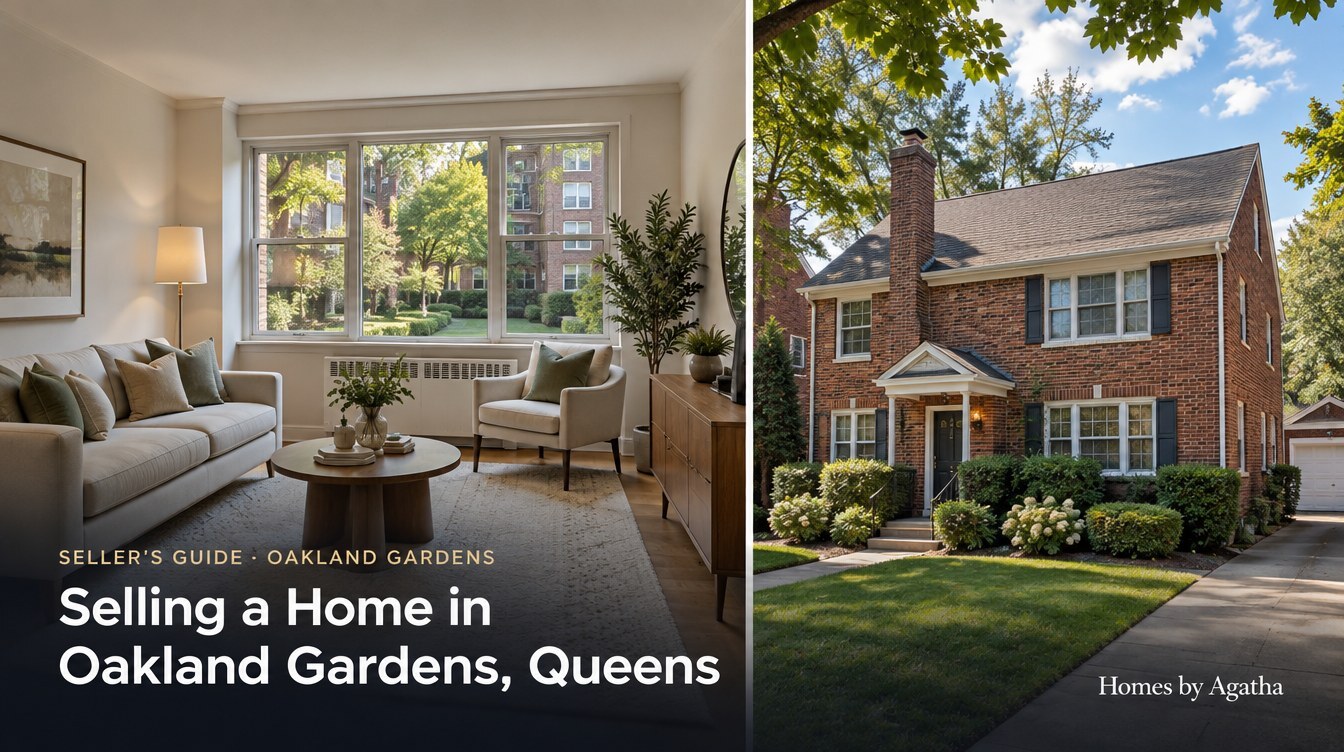
OAKLAND GARDENS SELLER GUIDE
Selling a Home in Oakland Gardens, Queens: Co-op and House Sales Explained
Quick Answer
Selling a home in Oakland Gardens, Queens, starts with knowing which market you are in. A garden co-op sale transfers shares and needs board approval of your buyer; a house sale transfers a deed and requires the Property Condition Disclosure Statement. Price from matching comparables, gather documents early, and budget for NYS and NYC transfer taxes.
Selling a home in Oakland Gardens means selling into one of two markets that rarely overlap. Queens Community Board 11 describes the neighborhood as a mix of single-family homes, two-family homes and large cooperative garden apartment complexes, most of it built in the 1950s. A two-bedroom garden co-op unit and a detached house a few blocks away attract different buyers, use different comparable sales and close through different legal processes.
This guide is for owners in ZIP code 11364 who want to understand the sale before they choose a listing strategy. It covers how buyers compare Oakland Gardens listings, how a co-op sale differs from a house sale, how a comparative market analysis is built for each, what to prepare and disclose, what selling costs, how to compare offers when a board has the final word, and what happens between contract and closing.
As a Licensed Associate Real Estate Broker serving Queens and the surrounding New York markets, I help sellers plan the price, the preparation and the paperwork before a listing goes live, in English and in Polish. When you want a property-specific plan, the Oakland Gardens seller page explains how we work together.
Oakland Gardens at a glance
| Item | What a seller should know |
|---|---|
| Location | Northeast Queens, New York City; part of Queens Community District 11. Community Board 11 places Oakland Gardens south of the Long Island Expressway and north of 73rd Avenue, from Oceania Street to the Cross Island Parkway; listings sometimes use the name more broadly. |
| ZIP code | 11364; the USPS lists “Oakland Gardens” as the primary city name, with “Bayside” and “Hollis Hills” accepted as alternates. Listings for the same building may appear under more than one name. |
| Resale property types | Garden co-op apartments in large low-rise complexes; detached one-family houses, including the homes Community Board 11 refers to as Tall Oaks; two-family houses |
| Transfer taxes that apply | NYS real estate transfer tax and NYC Real Property Transfer Tax, both customarily paid by the seller, for houses and co-op units alike |
| Zoning context | 2010 Auburndale–Oakland Gardens–Hollis Hills Rezoning; R2A, a single-family detached district, mapped broadly across portions of Oakland Gardens |
| Parks buyers ask about | Alley Pond Park to the east, Cunningham Park to the west, the historic Vanderbilt Motor Parkway route |
| Transit buyers ask about | No subway or LIRR station in the neighborhood; local and express buses on Springfield Boulevard and 73rd Avenue (check the current MTA bus map for routes and stops); LIRR Port Washington Branch stations, such as Bayside, to the north |
| Highways | Long Island Expressway (I-495), Clearview Expressway (I-295), Cross Island Parkway |
| Documents that often decide the sale | Co-op: sale requirements, financial statements, house rules, flip-tax terms. House: Certificate of Occupancy, permits, survey, oil-tank records, the Property Condition Disclosure Statement |
What do buyers compare when they shop Oakland Gardens listings?
Buyers in Oakland Gardens compare a listing with its own peers: co-op shoppers compare units within and across garden complexes, and house shoppers compare houses by lot, legal use, condition and parking. A seller who understands which comparison the buyer is making can price and present the home for that comparison.
How co-op buyers judge a garden unit
A garden co-op buyer starts with two numbers, the price and the monthly maintenance, and treats them together. Two similar units in the same complex can draw very different interest if one carries noticeably higher maintenance, because the monthly figure affects the buyer’s debt-to-income ratio, which lenders and boards both review. After the numbers, buyers look at layout, floor, light, the view across the grounds, the condition of kitchens and baths, and practical items: laundry rules, storage, pets and parking.
Co-op buyers also read the building. They, or their attorney, will ask about the co-op’s finances, planned capital projects, assessments and sublet policy. A building with clear, current answers makes a unit easier to sell.
How house buyers judge an Oakland Gardens house
A house buyer compares the lot, the style and size of the house, the driveway or garage, the yard and the systems. Legal status weighs heavily: whether the Certificate of Occupancy matches the layout, whether extensions were permitted, and, for two-family homes, whether both units are legal. Buyers who plan to expand also check the zoning, because much of Oakland Gardens was mapped R2A in 2010, a district for single-family detached houses. Since the city’s 2024 “City of Yes for Housing Opportunity” amendment, a second home on such a lot is generally limited to one accessory dwelling unit where the specific lot and house qualify.
Location details that come up in showings
Within Oakland Gardens, buyers often ask how far a home is from an express-bus stop, how quickly they can reach the Long Island Expressway or the Clearview Expressway, and how close the home is to Alley Pond Park or Cunningham Park. These are facts you can state accurately in marketing. Fair housing rules and good practice both keep a listing description focused on the property, its transit and its amenities, never on who lives nearby.
How is selling a co-op different from selling a house in Oakland Gardens?
Selling a co-op transfers shares and a proprietary lease, needs the board’s approval of your buyer and runs through the co-op’s managing agent. Selling a house transfers a deed, needs a clear title and the Property Condition Disclosure Statement, and closes when the deed is recorded. The price negotiation is similar; almost everything after it is different.
| Step | Selling a garden co-op unit | Selling a house |
|---|---|---|
| What transfers | Stock certificate and proprietary lease | Deed to the land and building |
| Who must approve the buyer | The co-op board, after a board package and usually an interview | No board; the buyer’s lender approves the loan |
| Key third party | Managing agent, which issues the sale requirements and coordinates closing | Title company, which insures title and records the deed |
| Property Condition Disclosure Statement | Not required; the law’s definition of residential real property excludes co-op apartments | Required for most 1–4 family houses |
| Transfer taxes (seller, customarily) | NYS transfer tax and NYC RPT apply to individual co-op units | NYS transfer tax and NYC RPT apply to 1–3 family houses |
| Possible extra costs | Flip tax if the co-op’s documents impose one; managing-agent processing fees, which vary by building | Clearing open permits or violations; title issues |
| Paying off your loan | Share-loan payoff; the lender returns the stock and lease and files a UCC-3 termination | Mortgage payoff and satisfaction recorded |
| Main risk after contract | Board declines the buyer | Inspection or appraisal issues; buyer’s financing |
Whichever market you are in, selling a home in Oakland Gardens runs through attorneys. New York is an attorney state: the seller’s attorney drafts the contract of sale, the buyer’s attorney reviews and negotiates it, and an accepted offer is not a signed contract. Until both parties sign and the deposit is delivered, either side can still walk away.
Not sure which sale process applies to you?
If you own a garden co-op unit, a one-family house or a two-family with a tenant, the plan looks different. Tell me what you own and I will outline the steps, documents and timing for your specific sale.
How do you price a home in Oakland Gardens with a CMA?
Price an Oakland Gardens home from the closest comparable sales of the same property type: for a co-op, recent sales in the same complex or similar garden complexes, adjusted for maintenance; for a house, nearby houses with similar lots, legal use and condition. A comparative market analysis brings that evidence together.
A comparative market analysis, or CMA, is a real estate broker’s professional opinion of value based on recent sales, pending sales and competing listings. It is not an appraisal and does not guarantee a sale price. The buyer’s lender will order its own appraisal later, and that appraisal relies on the same kind of evidence, so a CMA built on the right comparables helps avoid a price the appraisal cannot support. For a broader look at valuation, see our guide what is my Queens home worth.
Pricing a garden co-op unit
- Same-complex sales first. Units in the same complex share the same building finances, rules and grounds, so they are the cleanest comparables.
- Adjust for maintenance. A unit with higher monthly maintenance supports a lower price for the same monthly budget, and buyers do that math.
- Layout and position. Bedroom count, upper versus lower floor, corner exposure, and view of the courtyard or the street all matter.
- Renovation and approvals. A renovated kitchen or bath adds value when the work was approved under the co-op’s alteration process.
- Building rules. Sublet, pet and parking policies widen or narrow the buyer pool.
Pricing an Oakland Gardens house
- Lot and house type. Lot size, frontage and whether the house is detached, and its style and living area.
- Legal use. A legal two-family is valued differently from a one-family with an unpermitted basement apartment.
- Zoning context. On an R2A lot, a buyer cannot convert the house into a conventional two-family, and any extra unit is limited to an accessory dwelling unit where the lot qualifies, so expansion potential is limited; that is priced in.
- Condition of major systems. Roof, heating, electrical service, plumbing and sewer line.
- Parking and setting. Driveway, garage, yard, and location relative to the parks and the express-bus stops.
What a pricing strategy adds to the CMA
The CMA gives a range; the pricing strategy decides where in that range to list. Consider the competing listings buyers will see the same weekend, the condition of your home relative to recent sales, and your timing. In a co-op, also consider how the price and maintenance together fit the building’s buyer requirements: a price that pushes most buyers past the board’s debt-to-income limit narrows your pool. Current market data should come from a dated, sourced report, such as recent OneKey MLS sales pulled when you price, rather than general impressions.
What should you prepare before listing your Oakland Gardens home?
Prepare documents before photographs. For a co-op, obtain the managing agent’s sale requirements, recent financial statements, house rules and any flip-tax terms; for a house, gather the Certificate of Occupancy, permits, survey, tax bills and records of system work. Documents found late are a common cause of delayed or failed deals.
The co-op seller’s document set
- The managing agent’s written sale and purchase requirements, including the board package format and any fees; each managing agent sets its own.
- The two most recent financial statements and current maintenance amount for your unit.
- House rules, the sublet policy, pet rules and parking information.
- The flip-tax provision, if the co-op’s documents include one. A flip tax is a transfer fee set by each co-op’s own documents; there is no city-wide rate, so read the co-op’s terms.
- Approvals for past alterations, such as kitchen, bath or window work.
- Your stock certificate and proprietary lease, or the name of the lender holding them if you have a share loan.
The house seller’s document set
- The deed and your title policy from the purchase.
- The Certificate of Occupancy, or other NYC Department of Buildings records showing legal use, available through the Department of Buildings’ Building Information System.
- Permits and sign-offs for extensions, dormers, decks, basement work and boiler replacements.
- A survey, if you have one, showing lot lines and any shared driveway.
- Records of heating conversions, including documentation that an old oil tank was removed or properly abandoned.
- Recent property tax bills from the NYC Department of Finance and any exemptions on the account.
- For a two-family house with a tenant, the lease, rent records and security-deposit details.
Fixing paperwork problems early
If records show a one-family house but the property has a second kitchen and entrance, or an extension has no sign-off, talk with your attorney before listing. Some issues can be resolved with filings, some require work, and some are simplest to disclose and price in. Resolving them on your own schedule is usually easier than doing it under a buyer’s contract deadline.
Key Takeaways
- Oakland Gardens has two resale markets, garden co-ops and houses, and each is priced against its own comparables.
- For co-op units, maintenance is part of the price conversation because buyers and boards measure monthly affordability.
- For houses, legal use on the Certificate of Occupancy and R2A zoning shape what a buyer will pay.
- Collect the managing agent’s requirements or the house’s Department of Buildings records before you list.
See where your home sits among its true comparables
Request a CMA built from the right peer group, whether that is units in your garden complex or houses with similar lots and legal use. It is a professional opinion of value to plan with, not an appraisal.
Which repairs and staging matter most for Oakland Gardens homes?
Fix what a buyer’s inspector or a board would flag, clean and declutter thoroughly, and present the space and light; skip major renovations unless the numbers clearly support them. In a garden co-op, the focus is the unit’s interior and approvals; in a 1950s house, it is systems, water and curb appeal.
Garden co-op units
Co-op buyers cannot change the building, so they judge the unit closely. Repaint in neutral colors, repair worn floors where practical, fix dripping fixtures and loose hardware, and make sure windows open and close. Remove items stored in common areas, confirm that any in-unit appliance or air conditioner complies with the house rules, and gather proof of approval for past renovations. Buyers’ attorneys often ask.
Postwar houses
For an Oakland Gardens house, the priorities are the items inspectors flag in houses of this age: heating equipment, electrical panels, visible plumbing, roof and gutters, grading and basement moisture. A pre-listing inspection can surface these items early, so you can repair, obtain estimates or disclose them on your terms. Outside, trim plantings, clear leaves from gutters, especially near the wooded edges of Alley Pond Park and Cunningham Park, and repair loose steps or lifted sidewalk flags.
| Preparation item | Priority for a garden co-op unit | Priority for a house | Why it matters |
|---|---|---|---|
| Deep cleaning and decluttering | High | High | Photographs and showings depend on space and light |
| Neutral paint and minor repairs | High | Medium to high | Removes easy objections at a modest cost |
| Heating, electrical and plumbing review | Low (building systems are the co-op’s) | High | The most common inspection findings in older houses |
| Basement moisture and grading | Ground-floor units only | High | Water stains and odors alarm buyers and inspectors |
| Proof of approvals and permits | High (alteration approvals) | High (DOB permits and sign-offs) | Attorneys request them before contract |
| Curb appeal and exterior | Low (grounds are the co-op’s) | High | First photo and first impression |
| Professional staging | Medium (small rooms benefit from scale) | Medium | Helps buyers read room sizes and use |
| Major renovation | Usually low; needs board approval and time | Usually low | Rarely returns its cost before a sale |
How will your Oakland Gardens listing be marketed?
A well-marketed Oakland Gardens listing combines professional photography, a floor plan, accurate facts about maintenance or taxes, and distribution through OneKey MLS to the brokerages and portals buyers use. The marketing should answer the questions that co-op and house buyers ask before they schedule a showing.
Photography and floor plans
Professional photography and a measured floor plan matter in both markets. For a garden co-op unit, include images of the grounds, courtyards and building entrances if the co-op permits it, because the setting is part of what buyers are paying for. For a house, the exterior, driveway, yard and any garage are as important as the kitchen.
Listing facts that reduce wasted showings
- Co-op: monthly maintenance, what it includes, any assessment, the flip-tax terms if applicable, financing and down-payment rules, pet and sublet policies, and parking availability, each confirmed with the managing agent before publishing.
- House: legal use as one- or two-family, lot size, heating type, parking, and annual property taxes.
- Both: approximate distance to express-bus stops and highway access, stated as facts rather than promises.
OneKey MLS and online distribution
OneKey MLS is the multiple listing service that serves Queens and much of the New York metropolitan region outside Manhattan. Listing there shares your home with participating brokerages and, through data feeds, with many consumer real estate portals. Marketing must follow fair housing rules: describe the property, its features, its transit and its surroundings, not the people a seller hopes will buy it.
Showings in a co-op complex
Some co-ops have rules on showings, open houses, signage and lockboxes. Check with the managing agent before scheduling an open house, and make sure buyers know where to park and which entrance to use. Small logistics shape first impressions in a large complex.
Plan your preparation and launch
Let’s decide what to fix, what to disclose and what to leave alone, then line up photography and listing facts so your Oakland Gardens home goes to market ready for the questions buyers will ask.
Which disclosures does a New York seller owe?
A seller of most one- to four-family houses in New York must deliver the Property Condition Disclosure Statement before the buyer signs the contract; since March 20, 2024, the option of giving a $500 credit instead has been removed. Co-op units are generally outside that requirement. Every seller also receives the NYS Disclosure Form for Buyer and Seller from their agent, and homes built before 1978 carry a federal lead-based paint disclosure.
The Property Condition Disclosure Statement
The Property Condition Disclosure Statement, or PCDS, is a form under New York’s Real Property Law in which the seller answers questions about the property’s condition, including the roof, water, systems, environmental matters and known defects. Before the March 2024 change, many sellers gave a $500 credit at closing instead of delivering the form; that option no longer exists, so a house seller in Oakland Gardens should complete the PCDS carefully and with their attorney’s guidance. Co-op and condo units are outside the PCDS requirement, because the law’s definition of residential real property excludes condominium units and cooperative apartments (Real Property Law section 461).
Lead-based paint
For housing built before 1978, which includes most of Oakland Gardens’ postwar stock, federal law requires sellers to disclose known lead-based paint and lead-based paint hazards, provide available records and the EPA pamphlet, and give buyers an opportunity to test. This applies to co-op units as well as houses.
Agency disclosure and fair housing notice
At the first substantive contact, a New York real estate licensee gives you the NYS Disclosure Form for Buyer and Seller, which explains whom the agent represents. Sellers also receive the NYS Housing and Anti-Discrimination Disclosure Form. These protect you as a consumer; read them before you sign a listing agreement.
What to disclose about the co-op
A co-op seller does not complete the PCDS but should still answer the buyer’s attorney’s questions accurately, including known unit issues, alterations and any assessments. The building’s financial information normally comes from the managing agent. Your attorney will advise what you must state and how to state it.
What does it cost to sell, and what will you net?
When selling a home in Oakland Gardens, a seller typically pays the NYS real estate transfer tax, the NYC Real Property Transfer Tax, their own attorney’s fee and the brokerage compensation agreed in the listing agreement, plus any loan payoff. Co-op sellers may also pay a flip tax and managing-agent fees, depending on the co-op’s documents.
| Seller cost | Rule and source | Garden co-op unit | House |
|---|---|---|---|
| NYS real estate transfer tax | NYS Department of Taxation and Finance: $2 for each $500 of consideration (0.4%), customarily paid by the seller | Yes | Yes |
| NYC Real Property Transfer Tax (RPT) | NYC Department of Finance: for residential 1–3 family homes, individual co-op units and condo units, 1% when the price is $500,000 or less and 1.425% when above $500,000; customarily paid by the seller | Yes | Yes |
| Brokerage compensation | Negotiable and set in the listing agreement; not fixed by law | Yes | Yes |
| Buyer-agent compensation | Negotiable; not automatically paid by the seller; any seller contribution is a negotiated choice | Optional | Optional |
| Seller’s attorney | Negotiated with the attorney | Yes | Yes |
| Flip tax | Set by each co-op’s own documents; no city-wide rate | Only if the co-op imposes one | Not applicable |
| Managing-agent and transfer fees | Set by the co-op and managing agent | Often; amounts vary by building | Not applicable |
| Loan payoff | Your lender’s payoff letter | Share loan and UCC-3 termination | Mortgage payoff and satisfaction |
| Clearing issues | Varies | Unapproved alterations | Open permits, violations, title items |
| Adjustments at closing | Prorated | Maintenance | Property taxes, water and fuel |
Confirm current rates with the NYS Department of Taxation and Finance and NYC Department of Finance before closing.
Because the NYC RPT rate steps up from 1% to 1.425% when the price is above $500,000, the transfer-tax line can change noticeably for homes priced near that threshold. Your attorney prepares and files the state and city transfer tax returns at closing. A CPA can explain how capital-gains rules, including any primary-residence exclusion, apply to your sale. Our article on Queens closing costs breaks down the seller’s side in more detail.
Estimating your net proceeds
- Start with the expected sale price from your CMA and pricing strategy.
- Subtract the NYS transfer tax and the NYC RPT at the applicable rate.
- Subtract brokerage compensation and attorney fees as agreed.
- Subtract the loan payoff from your lender’s payoff letter.
- For a co-op, subtract any flip tax and managing-agent fees; for a house, subtract any costs to clear permits or violations.
- Add or subtract closing adjustments for maintenance or taxes.
Key Takeaways
- House sellers must deliver the PCDS; the $500 credit option ended March 20, 2024. Co-op units are generally outside the PCDS.
- Both co-op units and houses in Oakland Gardens carry the NYS transfer tax and the NYC RPT, customarily paid by the seller.
- A flip tax applies only where the co-op’s documents impose one; read the actual terms.
- Brokerage compensation is negotiable, and buyer-agent compensation is not automatically the seller’s cost.
Know your number before you list
We can walk through a net-proceeds estimate for your co-op or house, including transfer taxes, payoffs and the costs specific to your building or lot, so your pricing decision starts from what you will actually keep.
How do you compare offers when a board must approve the buyer?
Compare offers on certainty as well as price. For a garden co-op, the offer most likely to pass the board, with a strong down payment, a debt-to-income ratio inside the building’s limits and solid reserves, is often worth more than a slightly higher bid from a borderline buyer. For a house, compare financing strength, contingencies and timing alongside the price.
Reading a co-op offer
Ask your agent to compare each buyer’s figures with the co-op’s written requirements. Look at the down payment against the building’s minimum, the buyer’s income relative to the loan and maintenance, and the reserves they will hold after closing, using the figures in your building’s written requirements. A buyer whose lender already works with your co-op can also shorten the financing stage. A board rejection usually ends the contract and returns the buyer’s deposit, so a rejected buyer can cost a seller weeks.
Reading a house offer
For a house, weigh the size of the down payment, the type of financing, whether the buyer must sell another home first, the requested closing date and the buyer’s inspection approach. If you own a two-family house with a tenant, clarify whether the buyer expects the unit delivered vacant or with the lease in place, because that changes timing and terms.
| Offer factor | What to look for | Why it matters in Oakland Gardens |
|---|---|---|
| Price | Relative to the CMA range and competing listings | Co-op units and houses each have their own comparables |
| Down payment | At or above the co-op’s minimum; larger for borderline appraisals | Boards and appraisers both test it |
| Financing | Pre-approval; a lender that finances co-ops in your complex | Co-op lenders review the building as well as the buyer |
| Board fit (co-op) | Debt-to-income and post-closing reserves inside the co-op’s rules | A rejection resets the sale |
| Contingencies | Mortgage contingency length; sale-of-home contingency | Each adds risk and time |
| Inspection approach (house) | Completed before contract; scope of requests | Postwar systems are where renegotiation starts |
| Closing date and occupancy | Fit with your move; tenant delivery terms for a two-family | Board schedules and tenant notices affect dates |
Negotiating after inspection or appraisal
In New York City, house buyers usually inspect before signing the contract, so repair requests typically arrive before the deposit is delivered. Respond with your attorney’s guidance: a credit, a price adjustment or a repair are all possible answers. If an appraisal comes in below the contract price, the options include renegotiating, the buyer covering the gap in cash, or, where the contract allows, cancellation.
What happens between contract and closing in Oakland Gardens?
After both sides sign and the deposit is in escrow, a house sale moves through the buyer’s appraisal, loan commitment and title clearance to closing, while a co-op sale adds the board package, board review and interview before a closing coordinated with the managing agent. The co-op path is usually longer. No fixed timeline applies, so ask your attorney and the managing agent for realistic dates based on the board’s meeting schedule.
| Stage | Garden co-op sale | House sale |
|---|---|---|
| 1. Pre-listing | Sale requirements from the managing agent; CMA; preparation | DOB records, permits, PCDS draft; CMA; preparation |
| 2. Listing and showings | OneKey MLS; co-op showing rules | OneKey MLS; open houses |
| 3. Accepted offer | Deal sheet; seller’s attorney prepares a co-op contract | Deal sheet; buyer inspects; seller’s attorney drafts contract |
| 4. Contract signed | Deposit to escrow; sale subject to board approval | Deposit to escrow; mortgage contingency period |
| 5. Buyer financing | Lender reviews building; appraisal; commitment | Appraisal; commitment |
| 6. Approval and clearance | Board package, review, interview, approval letter | Title report; clearing violations, liens or permit issues |
| 7. Closing | Stock and lease transferred; flip tax and fees paid if applicable | Deed delivered and recorded; transfer taxes paid |
Inherited homes and estate sales
When an Oakland Gardens house or co-op unit is sold by an estate, the executor or administrator generally needs court authority before signing a contract, and a co-op may require additional documents for a transfer from an estate. Timing and documents depend on the estate’s status, so involve an attorney early. Our page on probate real estate in New York explains how these sales typically work.
Selling a home in Oakland Gardens: mistakes to avoid and a final checklist
The costliest seller mistakes in Oakland Gardens come from treating a co-op sale like a house sale, or the reverse: pricing a unit without accounting for maintenance, accepting a buyer who cannot pass the board, or listing a house before checking its legal use and paperwork. Each is preventable with preparation.
Common mistakes
- Pricing a co-op unit from house sales, or a house from co-op sales. The two markets do not substitute for each other.
- Ignoring maintenance in the price. Buyers and boards measure affordability monthly.
- Choosing the highest co-op offer without checking board fit. A rejected buyer costs time and momentum.
- Listing a house with unresolved permits or a mismatched Certificate of Occupancy. These surface in the buyer’s attorney’s search.
- Treating the PCDS as optional. The $500 credit alternative ended in 2024.
- Assuming a flip tax amount. Only the co-op’s documents set it.
- Forgetting the RPT threshold. The NYC rate rises above $500,000.
Seller checklist
- Confirm which market you are in: garden co-op unit, one-family house or two-family house.
- Review the NYS Disclosure Form for Buyer and Seller and the listing agreement terms, including negotiable compensation.
- Request a CMA based on the right comparables and set a pricing strategy.
- Co-op: obtain the managing agent’s sale requirements, financials, house rules and flip-tax terms.
- House: pull DOB records, permits and the survey; locate oil-tank and system records.
- Choose a New York real estate attorney before you accept an offer.
- Prepare the home using the priorities above; schedule photography and a floor plan.
- House: complete the PCDS with your attorney’s guidance; for pre-1978 homes, prepare the lead-based paint disclosure.
- List on OneKey MLS with accurate maintenance or tax details.
- Compare offers on price, financing, board fit and timing.
- Co-op: support the buyer’s board package; house: respond to inspection and appraisal items.
- Order loan payoff letters and confirm closing costs and transfer taxes with your attorney.
If you own property in more than one nearby area, the same principles apply to selling in Auburndale, Douglaston home sales and selling a house in Bellerose, each with its own housing mix. For a borough-wide overview, see how to sell your home in Queens.
Talk through offers before you accept one
When offers arrive, I can help you compare price, financing, board fit and timing side by side, so you choose the buyer most likely to reach the closing table on terms you accept.
Frequently asked questions about selling a home in Oakland Gardens
How long does it take to sell a co-op in Oakland Gardens?
A co-op sale in Oakland Gardens usually takes longer than a house sale because the buyer must submit a board package, pass the board’s review and often attend an interview before closing. The total time depends on the building’s schedule, the buyer’s lender and how complete the package is. Ask your managing agent about the board’s meeting calendar.
Do I need a Property Condition Disclosure Statement to sell my Oakland Gardens house?
Yes, for most one- to four-family houses. Since March 20, 2024, New York sellers can no longer give a $500 credit instead of the Property Condition Disclosure Statement. Co-op units are generally outside the requirement. Complete the form with your attorney’s guidance and answer each question accurately based on what you know.
What transfer taxes does a seller pay in Oakland Gardens?
Sellers customarily pay the NYS real estate transfer tax of 0.4% and the NYC Real Property Transfer Tax, which is 1% when the price is $500,000 or less and 1.425% above $500,000 for houses, co-op units and condo units. Confirm current rates with the NYS Department of Taxation and Finance and the NYC Department of Finance.
Does my Oakland Gardens co-op charge a flip tax?
Only if your co-op’s own documents impose one. A flip tax is a transfer fee set by each cooperative, and there is no city-wide rate. The governing documents or the managing agent will state whether it applies, how it is calculated and who pays it. Confirm the terms before you price your unit.
Can the co-op board reject my buyer?
Yes. A co-op board reviews each buyer’s financial package and usually interviews them, and it can decline a purchaser, though not for discriminatory reasons. When a board declines, the contract usually ends and the buyer’s deposit is returned. Choosing a buyer who clearly meets the building’s written requirements reduces that risk.
Is a CMA the same as an appraisal?
No. A comparative market analysis is a real estate broker’s professional opinion of value based on recent sales, pending sales and competing listings. An appraisal is a licensed appraiser’s valuation, usually ordered by the buyer’s lender. A CMA helps you set a list price; it does not guarantee what a buyer or appraiser will conclude.
Does the seller have to pay the buyer’s agent in Queens?
No. Buyer-agent compensation is negotiable and not set by law, and it is not automatically paid by the seller. A seller may choose to offer or contribute to it as part of a negotiation, or the buyer may pay under their written buyer agreement. Your listing agreement sets out what you have agreed to pay.
How does R2A zoning affect the value of my Oakland Gardens house?
R2A, mapped across portions of Oakland Gardens in the 2010 rezoning, is a district for single-family detached houses with floor-area limits. A conventional two-family conversion is not allowed, and an extra unit is limited to a qualifying accessory dwelling unit. Comparable sales reflect this, so a CMA should use nearby houses with the same zoning.
Can I sell an inherited house or co-op in Oakland Gardens?
Yes, once the executor or administrator has legal authority to sell, which usually comes from the Surrogate’s Court. A co-op may also require estate documents before it approves the transfer. Involve a New York attorney early, because the estate’s status and the paperwork often set the timeline more than the market does.
Should I renovate my garden co-op kitchen before selling?
Usually not. A full renovation needs board or managing-agent approval, takes time and rarely returns its cost before a sale. Cleaning, neutral paint, minor repairs and proof of approval for earlier work usually matter more. Ask for a CMA first to see how renovated and original units in your complex compare.
Summary and your next step
Selling a home in Oakland Gardens successfully begins with recognizing which market you are in. Garden co-op sellers price against units in the same complex with maintenance in mind, prepare the managing agent’s requirements and choose a buyer who can pass the board. House sellers check legal use and zoning, prepare 1950s systems and complete the Property Condition Disclosure Statement. Both pay the NYS transfer tax and the NYC RPT and close through attorneys. When you want a plan for your own property, start with selling your home in Oakland Gardens with Agatha. If you are also buying nearby, the Oakland Gardens buyer page covers the purchase side.
This article is for general informational purposes only and reflects conditions that may change. It is not legal, tax, or financial advice, an appraisal, or a guarantee of price or outcome; consult a licensed New York attorney, a CPA, and an NMLS-registered mortgage loan originator as appropriate. A CMA is an opinion of value, not an appraisal. Real estate brokerage services are offered by Agatha Lubas, Licensed Associate Real Estate Broker, NY License #10301213345, Keller Williams Realty Liberty, 96-10 101st Avenue, Ozone Park, NY 11416. The NYS Disclosure Form for Buyer and Seller, the NYS Housing and Anti-Discrimination Disclosure / Fair Housing Notice, and the brokerage’s Standard Operating Procedures are available on request. Equal Housing Opportunity.

Agatha Lubas helps sellers, buyers and investors across Queens, Brooklyn, Nassau County and Suffolk County plan pricing, preparation and paperwork from listing to closing. She works in English and Polish, so clients can review every document and decision in the language they find most comfortable.
Work with Agatha