

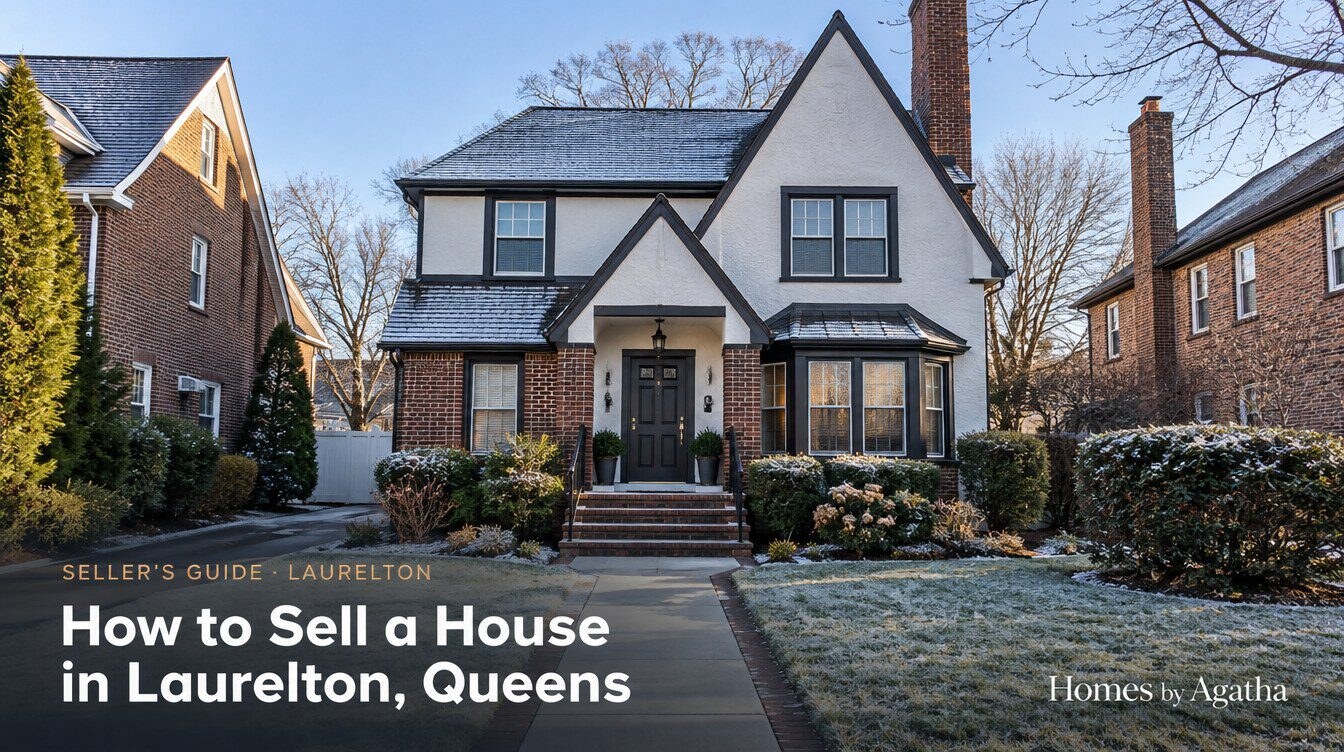
LAURELTON SELLER GUIDE
How to Sell a House in Laurelton, Queens: A Step-by-Step Plan From Pricing to Closing
Quick Answer
To sell a house in Laurelton, Queens, price it with a CMA built from truly similar houses — same building type, zoning district and legal unit count — then fix water, heating and hazard items, gather Certificate of Occupancy and permit records, deliver the Property Condition Disclosure Statement, and budget for NYS and NYC transfer taxes and attorney fees.
If you are researching how to sell a house in Laurelton, you are probably asking three questions at once: what the house is worth, what needs to happen before it goes on the market, and what you will actually keep after closing. This guide answers them in the order a sale really unfolds.
Laurelton is a neighborhood of one- and two-family houses between Springfield Boulevard and the Laurelton Parkway, with the Nassau County line just to the east. That setting shapes your sale. Buyers here compare your house with similar houses on nearby blocks, with houses in other zoning districts, and often with homes across the city line. Appraisers, lenders and the buyer’s attorney then test what the listing says against the Certificate of Occupancy, the building records and the basement.
As a Licensed Associate Real Estate Broker based in Queens, I help owners plan pricing, preparation and paperwork before a listing goes live, in English and Polish for clients who prefer it. If you would rather talk through your house directly, my Laurelton home selling services page explains how I work with sellers here.
Laurelton at a glance for sellers
| Item | Laurelton, Queens | Why it matters when you sell |
|---|---|---|
| Location | Southeast Queens, New York City; Queens Community District 13; ZIP 11413 for most addresses; confirm the ZIP code for your address with USPS | NYC rules apply, including the NYC Real Property Transfer Tax |
| Boundaries (NYC DCP 2008 rezoning area) | Montefiore Cemetery and 121st Avenue (north); Laurelton Parkway (east); South Conduit Avenue and the Belt Parkway (south); Springfield Boulevard (west) | Buyers often compare with Cambria Heights, Springfield Gardens and Nassau County communities |
| Housing stock | Mainly one- and two-family houses, many detached Tudor- and Colonial-style homes; semi-detached and attached houses on some blocks; small apartment and mixed-use buildings on Merrick and Springfield Boulevards | Comparable sales must match building type and unit count |
| Zoning | R2, R2A, R3A, R3X, R3-1 and R4B on residential blocks; R5D on parts of Merrick and Springfield Boulevards (adopted September 4, 2008) | Zoning limits what a buyer can add, which shapes value |
| Rail | LIRR Laurelton station on the Far Rockaway Branch, made accessible with an elevator in an MTA renovation; Locust Manor and Rosedale stations nearby | Walking distance to a station is a feature to state accurately |
| Roads | Belt Parkway and Conduit Avenue (south); Laurelton Parkway to the Cross Island Parkway (east) | Driveway, garage and highway access matter to many buyers |
| Water | Part of the area served by the City’s Southeast Queens drainage program | Buyers ask about basement water; documented fixes help |
How to sell a house in Laurelton: what are the steps?
Selling a Laurelton house follows ten practical steps: get a CMA, confirm the legal facts, choose repairs, prepare and photograph the house, list on OneKey MLS, deliver disclosures, review offers with your attorney, sign the contract, manage the buyer’s mortgage process and close. Most delays come from skipping the second step.
- Get a comparative market analysis. Ask for a CMA built from houses that match your building type, lot, zoning district and legal unit count.
- Confirm the legal facts. Pull the Certificate of Occupancy or Department of Buildings records, check for open permits and violations, and look up your zoning district.
- Decide what to fix. Prioritize water, heating, electrical and hazard items over cosmetic upgrades.
- Prepare and photograph. Declutter, light the house well, and document the basement and mechanicals honestly.
- List and market. Publish on OneKey MLS and the major portals with accurate descriptions and floor plans.
- Deliver disclosures. Provide the Property Condition Disclosure Statement, lead-paint disclosure where applicable and the agency disclosure form.
- Review offers. Compare net proceeds, financing strength, contingencies and timing, not just price.
- Sign the contract. Your attorney negotiates the contract of sale; the buyer’s deposit is held in escrow.
- Support the buyer’s mortgage process. Provide access for the appraisal and answer document requests quickly.
- Close. Pay off your mortgage, pay transfer taxes and fees, and hand over keys.
The rest of this guide on how to sell a house in Laurelton expands each step with the details that matter locally. If you want the borough-wide version first, the guide on selling a home in Queens gives a broader overview.
What are Laurelton buyers comparing your house against?
Laurelton buyers compare your house against three things: similar houses on nearby blocks, different house types elsewhere in the neighborhood, and similar-looking homes across the Nassau County line. Your price and presentation need to hold up against all three.
Building type and lot
A detached house on a wide lot with a side driveway and rear garage is a different product from a semi-detached or attached house a few blocks away, even with a similar floor plan. Buyers notice lot width, yard depth, off-street parking and whether the driveway is shared. If your driveway is shared, buyers’ attorneys will ask for the recorded easement, so locate it early.
Zoning district and future flexibility
The 2008 Laurelton rezoning placed residential blocks in R2, R2A, R3A, R3X, R3-1 or R4B. R2 and R2A permit one-family detached houses only; R3A, R3X and R3-1 allow one- and two-family houses; R4B allows low-rise attached houses. A buyer who wants to add space or a second unit will check the district, and the answer affects what they will pay. You can look up your lot on ZoLa, the NYC Department of City Planning zoning map. Zoning text has changed since 2008, including the City of Yes for Housing Opportunity amendments adopted in December 2024, so have an architect or land-use attorney confirm the current rules for your lot before you market any expansion potential.
Legal unit count
A legal two-family house in Laurelton attracts buyers who plan to use rental income to qualify for a mortgage. A one-family house with a basement apartment does not — lenders generally count rent only from legal units. How your house is described must match its Certificate of Occupancy or Department of Buildings records, or the gap will surface during the buyer’s due diligence.
Water history and systems
Southeast Queens buyers ask about basements. A dry basement, a documented backwater valve, working sump pump, regraded yard, newer boiler or gas conversion and a clean sewer-line camera report all reduce a buyer’s uncertainty. Undocumented water history does the opposite, because buyers price in the worst case.
Commute and the city line
Some buyers want a short walk to the Laurelton LIRR station; others drive and value the Belt and Laurelton Parkways. Many also look at Valley Stream or Elmont in Nassau County, where house styles can look similar but taxes and closing costs differ. A buyer comparing both sides of the line will weigh NYC’s mortgage recording tax and property tax structure against the Nassau alternative, so a clear, well-documented listing helps your house compete on substance.
How do you price a Laurelton house with a CMA?
Start with a comparative market analysis. A CMA is a real estate broker’s professional opinion of value based on recent comparable sales, active competition and the condition of your house; it is not an appraisal and does not guarantee a sale price. In Laurelton, a useful CMA filters comparables by building type, zoning district and legal unit count before it looks at distance.
The most common pricing error is mixing house types. Averaging a detached one-family on a wide lot with an attached two-family produces a number that fits neither. The table below shows how a careful CMA adjusts for the features that separate Laurelton houses.
| Feature | How it shows up in Laurelton | How a CMA should handle it |
|---|---|---|
| Building type | Detached, semi-detached or attached | Use comparables of the same type first; adjust only when there are too few |
| Legal unit count | One-family vs legal two-family | Never treat an undocumented basement unit as a second legal unit |
| Zoning district | R2/R2A one-family districts vs R3 and R4B districts | Account for expansion potential, or the lack of it, for the specific lot |
| Lot and parking | Lot width, private vs shared driveway, garage | Adjust for off-street parking and yard size |
| Condition and systems | Roof, heating type and age, electrical, sewer line | Adjust for major systems a buyer would replace soon |
| Basement and water | Dry vs history of water; documented fixes | Account for documented improvements; do not ignore known issues |
| Location within Laurelton | Distance to the LIRR station, Merrick Boulevard or the parkways | Compare within similar micro-locations where possible |
The comparable sales in your CMA should match your house type and, where possible, your part of the neighborhood, come from OneKey MLS and NYC Department of Finance sales records, and be dated, because a CMA reflects the market at the time it is prepared.
From value range to list price
A CMA usually produces a range. The list price is a strategy decision inside that range. Pricing close to the well-supported comparables tends to attract more buyers and stronger offers; pricing far above them usually means a longer time on the market and, often, a later price reduction. Remember that most buyers finance, so the house must also appraise. An offer far above what comparables support can fail at the appraisal and come back as a renegotiation.
For a closer look at how value is estimated across the borough, read what is my Queens home worth.
Key Takeaways
- Laurelton buyers compare by building type, zoning district, legal unit count and water history.
- A CMA is a broker’s opinion of value, not an appraisal or a guarantee.
- Never price a basement apartment as a legal second unit unless the CO or DOB records support it.
- Price within what comparables support, because the buyer’s appraisal has to agree.
Request a Laurelton CMA built on true comparables
I will prepare a comparative market analysis that matches your house’s type, zoning district and legal unit count, and explain the range in plain terms.
Which repairs are worth making before you list a Laurelton house?
Fix what a buyer’s inspector will flag as a defect, especially water, heating, electrical and code-related hazards, and keep cosmetic work modest. In Laurelton’s older houses, documented repairs to basements, boilers and sewer lines usually do more for a sale than a new kitchen.
| Priority | Typical Laurelton items | Why |
|---|---|---|
| Do before listing | Active leaks; gutters and downspouts discharging at the foundation; broken heating or hot water; exposed or deteriorated wiring; missing smoke and carbon monoxide detectors | These show up in every inspection and invite large repair requests |
| Strongly consider | Sewer-line camera inspection; oil-tank documentation or sweep; chimney check; resolving open permits or minor violations | Answers buyer questions before they become contract issues |
| Consider if inexpensive | Fresh neutral paint; minor flooring repairs; landscaping and front walk; replacing broken fixtures | Improves photos and first impressions at modest cost |
| Usually skip | Full kitchen or bath remodels; finishing a basement without permits; converting space to a “unit” | Rarely recovered in price; unpermitted work can create legal problems |
Water first
If your basement has ever taken on water, address the cause where you can and keep the paperwork: receipts for regrading, gutter work, waterproofing, a sump pump or a backwater valve installed by a licensed plumber. The City has carried out sewer and catch-basin projects in Laurelton through its Southeast Queens drainage program, and that work has reached different blocks at different times; if your block received new infrastructure, that is useful context, but the buyer will still judge your basement on its own condition.
Permits and violations
Search Department of Buildings records for open permits and violations before you list. An old permit that was never signed off, or a violation for an unpermitted basement or extension, can delay closing or reduce what a buyer will pay. Closing out paperwork before listing is usually faster than doing it under contract pressure.
How should a Laurelton house be presented and marketed?
Present the house as it legally is, photograph it professionally, and distribute it widely through OneKey MLS and the major portals. In Laurelton, the architecture, the lot and the basement are the three things buyers want to see clearly.
Staging the architecture and the lot
Tudor-style houses photograph well when their details are visible: arched doorways, leaded or divided-light windows, fireplaces and steep rooflines. Colonial-style houses benefit from clear sightlines through center halls and symmetrical rooms. Remove excess furniture, open window treatments and use consistent warm lighting. Outside, show the driveway, garage and yard depth, because off-street parking and outdoor space are part of what buyers compare.
Showing the basement honestly
A clean, bright, dry basement with visible mechanicals — boiler, water heater, electrical panel and any backwater valve or sump pump — reassures buyers. Do not stage a basement as a separate apartment unless it is a legal unit. Describing space accurately protects you and avoids problems when the buyer’s attorney compares the listing with the CO.
Where Laurelton listings reach buyers
| Channel | What it does | Laurelton-specific note |
|---|---|---|
| OneKey MLS | Shares the listing with participating brokers across the region and feeds many consumer portals | Reaches agents working with buyers in Queens and Nassau County alike |
| Consumer portals | Where most buyers start their search | Accurate building type, unit count and lot details reduce mismatched inquiries |
| Professional photography, video and floor plan | Shows layout and condition before a visit | A floor plan clarifies one-family vs two-family layout |
| Open houses and private showings | Lets buyers experience the house and block | Schedule some showings at commuting hours for LIRR-focused buyers |
| Property fact sheet | Summarizes systems, upgrades and documents | List drainage work, heating type and age, and permit sign-offs |
All marketing should describe the property, the transit and the amenities — never the people who live nearby. Fair Housing rules apply to listing copy as much as to conversations.
Brokerage compensation is negotiable
Listing-broker compensation is negotiable and is not set by law. Since the 2024 NAR settlement, buyer-agent compensation is agreed between buyers and their agents in a written buyer agreement; a seller is not automatically required to pay it, although a seller may choose to offer a concession or contribution as part of a negotiation. Discuss the options and their trade-offs before you sign a listing agreement.
Map out your preparation and launch
Walk through the house with me and we will rank repairs, plan photography and set a realistic listing date.
Which records should a Laurelton seller gather before listing?
Gather the documents that prove what the house is and how it has been maintained: the deed, the Certificate of Occupancy or DOB records, permit sign-offs, a survey, recent tax and water bills, and receipts for major work. Having them ready shortens attorney review and keeps buyers confident.
Legal-use and building records
The Certificate of Occupancy states the legal use and number of units. Houses built before 1938 were not required to have one unless later work required it, so older Laurelton houses may rely on other DOB records. Also check the NYC Department of Finance building class: classes beginning with “A” describe one-family dwellings and those beginning with “B” describe two-family dwellings. If the CO, the building class and the way you plan to market the house disagree, talk with your attorney before listing.
Seller document checklist
- Deed and any recorded easements (for example, a shared driveway)
- Certificate of Occupancy or DOB records; permit sign-offs for past work
- Survey, if you have one
- Recent NYC property tax bill and any exemptions shown on it; ask your attorney how they are handled at sale
- Recent DEP water and sewer bills
- Heating records: boiler or furnace age, service history, oil-tank removal or abandonment paperwork
- Receipts for roof, waterproofing, sewer, backwater valve, electrical and plumbing work
- Flood-insurance policy and claims history, if any
- Existing leases and security-deposit records for a two-family house
- Mortgage payoff information and any home-equity lines
If you are selling a condo or co-op unit
Most Laurelton sales are houses, but if you own a condo or co-op unit along one of the boulevards, the process adds steps. A co-op sale requires the buyer to submit a board application package and usually attend an interview; the building’s managing agent supplies financial statements and other documents. A flip tax, if any, is set by the co-op’s own documents — there is no city-wide rate. Condo sales may involve a right of first refusal under the bylaws. Ask the managing agent early for the requirements and timeline, because each building sets its own.
What must you disclose when selling a house in New York?
Most sellers of one- to four-family houses in New York must deliver the Property Condition Disclosure Statement before the buyer signs the contract. Since March 20, 2024, sellers can no longer give a $500 credit instead of the form. Sellers of most pre-1978 housing must also provide a federal lead-based paint disclosure.
The Property Condition Disclosure Statement
The Property Condition Disclosure Statement (PCDS) is a New York form in which the seller answers questions about the property’s condition based on actual knowledge — including water, structural, environmental and system questions. The updated form includes questions about flood history and flood insurance, including whether the property is in a FEMA floodplain and whether flood insurance is required. In Laurelton, answer the water and flood questions carefully; receipts for drainage work let you show what was done. Co-op and condo units are outside the PCDS requirement, because the law’s definition of the residential property it covers excludes them.
Lead-based paint
Federal law requires sellers of most housing built before 1978 to disclose known lead-based paint hazards, provide available reports and give the buyer an opportunity to test. Because much of Laurelton was built before 1978, plan on this disclosure.
Agency and fair housing notices
At the first substantive contact, your agent provides the NYS Disclosure Form for Buyer and Seller, which explains agency relationships. New York also requires the Housing and Anti-Discrimination Disclosure Form. These protect you by making roles and rights clear from the start.
Key Takeaways
- Pull the CO or DOB records and check open permits before you list, not after an offer.
- Since March 20, 2024, the PCDS must be delivered; the $500 credit option is gone.
- Answer water and flood questions carefully and keep drainage-work receipts.
- Market the house as it legally is, with accurate unit counts and Fair Housing-compliant copy.
Check your paperwork before buyers do
I can help you assemble the records and disclosure answers buyers’ attorneys will ask for, so your listing launches without surprises.
What does it cost to sell a house in Laurelton?
A Laurelton seller typically pays brokerage compensation as negotiated, the NYS real estate transfer tax, the NYC Real Property Transfer Tax, a seller’s attorney fee, the mortgage payoff and smaller recording and payoff-related charges. Because Laurelton is in New York City, the NYC Real Property Transfer Tax applies; it would not apply to a house across the line in Nassau County.
| Seller cost | How it applies to a Laurelton house | Source / who sets it |
|---|---|---|
| NYS real estate transfer tax | $2 for each $500 of consideration (0.4%), customarily paid by the seller | NYS Department of Taxation and Finance |
| NYC Real Property Transfer Tax (RPT) | For 1–3 family houses: 1% when the price is $500,000 or less; 1.425% when above $500,000; customarily paid by the seller | NYC Department of Finance |
| Brokerage compensation | Negotiable; set in the listing agreement; any contribution to a buyer’s agent is a separate negotiation | Agreement between seller and broker |
| Seller’s attorney | Required in practice for New York contracts and closings | Quoted by the attorney |
| Mortgage payoff and related fees | Payoff of all loans and lines of credit; recording of satisfactions | Your lender and title company |
| Repairs, credits and concessions | Negotiated after inspection or offered to close a deal | Contract negotiation |
| Moving and carrying costs | Mortgage, taxes, insurance and utilities until closing | Your own budget |
Confirm current rates with the NYS Department of Taxation and Finance and NYC Department of Finance before closing.
How the NYC transfer tax threshold works
For one- to three-family houses, the NYC RPT rate depends on whether the price is above or below $500,000, and the rate applies to the full consideration, not only the part above the threshold. Combined with the NYS transfer tax, the seller’s transfer taxes on a New York City house are therefore higher than on a similar house in Nassau County, where only the NYS tax applies. Any plan for how to sell a house in Laurelton should include a net-proceeds sheet, so ask your attorney to estimate both taxes from your expected price.
Costs that are not the seller’s
The buyer usually pays the NYC mortgage recording tax on a financed purchase (roughly 1.8% of the loan under $500,000 and 1.925% at $500,000 and above on 1–3 family homes) and, on purchases of $1 million or more, the NYS “mansion tax” of 1%, graduated above $2 million in New York City. Contracts can shift costs, so read yours with your attorney. Capital-gains questions belong with a CPA. For a full comparison of buyer and seller costs, see the Queens closing costs guide.
How do you compare offers on a Laurelton house?
Compare offers on what you will net and how likely each is to close, not on the headline price alone. In Laurelton, financing type, appraisal risk, the buyer’s inspection approach and the closing timeline often separate two similar prices.
| Offer term | What to ask | Why it matters for a Laurelton house |
|---|---|---|
| Price | How does it compare with the CMA range? | A price far above comparables raises appraisal risk |
| Financing type and down payment | Cash, conventional, FHA or VA? How much down? | Larger down payments leave more room if the appraisal comes in low; some loan types have property-condition standards |
| Pre-approval quality | Who is the lender, and has the buyer’s file been reviewed? | A reviewed file reduces surprises during underwriting |
| Rental-income reliance | Does the buyer need the second unit’s rent to qualify? | Only legal units count; a mismatch can sink the loan |
| Contingencies | Mortgage, sale-of-home or other conditions? | Each one adds a way for the deal to fail |
| Inspection approach | Will the buyer accept a credit rather than repairs? | Older houses often produce long reports; credits are simpler |
| Closing date and flexibility | Does it fit your next move? | Matters if you are buying elsewhere at the same time |
Negotiating after the inspection
In New York, the inspection usually happens after the offer is accepted and before the contract is signed. Expect requests on older-house items such as heating, roofs, electrical service, the sewer line and basement water. Respond with documents where you have them, and consider a credit rather than doing repairs under time pressure. An accepted offer is not a signed contract; until both sides sign, either party can still walk away.
Multiple offers
If several buyers are interested, your agent can ask all parties for their strongest terms by a set deadline. Treat every buyer the same way and keep the process documented. Then compare the offers using the table above, with your attorney’s input on contract terms.
Compare your offers side by side
Share the offers you receive and I will help you weigh net proceeds, financing strength and timing before you respond.
What happens from accepted offer to closing, including special situations?
After you accept an offer, your attorney sends a draft contract, the buyer completes due diligence, both sides sign, and the buyer’s lender moves toward a mortgage commitment. A financed sale often closes about two to three months after acceptance, though the timeline varies with the lender, title and building records.
| Stage | Seller’s role | Common range (varies) |
|---|---|---|
| Pre-listing | CMA, records, repairs, photography | 2–6 weeks |
| On the market | Showings, open houses, offer review | Varies with price and condition |
| Accepted offer to signed contract | Attorney sends contract; buyer inspects; negotiate credits; buyer’s deposit placed in escrow | Often 1–3 weeks |
| Mortgage commitment | Provide access for the appraisal; respond to document requests | Often 3–6 weeks after contract |
| Clear to close | Resolve title items, violations and payoff letters | Often 1–2 weeks |
| Closing | Sign the deed and transfer-tax forms; pay off loans; hand over keys | Closing day |
Selling and buying at the same time
Many Laurelton owners sell to buy elsewhere in Queens or in Nassau County. Coordinate the two closings with both attorneys, decide whether you need a sale contingency on your purchase, and confirm with your lender how your sale proceeds affect the new loan. If your next home is across the city line, remember that the buyer-side costs there differ, as described in the guide to buying in Nassau County.
Selling an inherited house
When a Laurelton house belongs to an estate, the person with legal authority — usually an executor or administrator appointed by the Surrogate’s Court — signs the contract and deed. The timing of a sale depends on that authority and on the estate’s paperwork. Talk with an estate attorney early, and see the probate real estate guide for how estate sales typically proceed in New York.
Selling a two-family house with a tenant
If you are selling a legal two-family with a tenant, decide with your attorney whether you will deliver the unit vacant or occupied, and disclose existing leases and security deposits. Many buyers who plan to use the rental income prefer an occupied unit with a documented lease; others want it vacant. Tenant rights still apply during a sale, so plan the timeline with legal advice.
Which mistakes should Laurelton sellers avoid?
The costliest Laurelton seller mistakes are paperwork and pricing mistakes: marketing an undocumented unit, mixing house types in a CMA, ignoring basement water and listing before records are checked.
- Calling a basement apartment a second unit. If the CO or DOB records do not support it, buyers’ lenders and attorneys will find out.
- Pricing against the wrong comparables. Detached, attached and two-family houses are different products.
- Leaving water questions unanswered. Missing receipts for drainage or waterproofing work invite low offers.
- Discovering open permits under contract. Old permits and violations take time to resolve.
- Judging offers by price alone. Financing, appraisal risk and contingencies decide whether a deal closes.
- Forgetting the NYC transfer tax. Budget for both the NYS and NYC transfer taxes in your net-proceeds estimate.
Laurelton seller checklist
Use this list as the short version of how to sell a house in Laurelton, in the order the work usually happens.
- Request a CMA based on houses of your type, zoning district and legal unit count.
- Pull your Certificate of Occupancy or DOB records and check open permits and violations.
- Look up your zoning district on ZoLa and confirm the DOF building class.
- Fix water, heating, electrical and hazard items; keep every receipt.
- Consider a pre-listing sewer camera and oil-tank documentation.
- Gather the deed, survey, tax and water bills, leases and system records.
- Complete the Property Condition Disclosure Statement carefully, especially water and flood questions.
- Negotiate the listing agreement, including brokerage compensation.
- Launch with professional photos, a floor plan and a property fact sheet on OneKey MLS.
- Compare offers on net proceeds and certainty with your attorney.
- Coordinate closing dates if you are also buying, and budget for both transfer taxes.
If you are deciding between Laurelton and nearby areas for your next home, the neighboring seller guides for selling in Cambria Heights, selling in Springfield Gardens and selling in Saint Albans show how the same process applies a few blocks away, and the companion page on buying a home in Laurelton covers the purchase side.
Build your Laurelton selling timeline
From the first CMA to closing day, we can set a schedule that fits your next move and keeps paperwork ahead of buyers’ questions.
Frequently asked questions about how to sell a house in Laurelton
How do I find out what my Laurelton house is worth?
Ask a licensed broker for a comparative market analysis built from recent sales of houses like yours: same building type, zoning district, legal unit count and condition. A CMA is a professional opinion of value, not an appraisal or guarantee. The buyer’s lender will order its own appraisal after you accept an offer.
What transfer taxes does a seller pay on a Laurelton house?
Laurelton sellers customarily pay the NYS real estate transfer tax of 0.4% and the NYC Real Property Transfer Tax, which for 1–3 family houses is 1% at $500,000 or less and 1.425% above $500,000. Contracts can shift costs, so confirm the figures with your attorney before you price.
Do I have to give buyers a Property Condition Disclosure Statement?
Yes, for most one- to four-family houses. Since March 20, 2024, New York sellers can no longer give a $500 credit instead of the form, so the PCDS must be delivered before the buyer signs the contract. Answer carefully, especially questions about water, flooding and past repairs.
Can I market my basement as a rental unit?
Only if the Certificate of Occupancy or Department of Buildings records show it as a legal unit. Lenders generally count rent only from legal units, and buyers’ attorneys compare listings with the records. Describe unlisted space accurately, for example as a finished basement, rather than as an apartment.
Should I fix basement water problems before selling in Laurelton?
Yes, where you can address the cause. Southeast Queens buyers ask about basements, so repairs such as regrading, gutter work, waterproofing or a backwater valve, with receipts, reduce uncertainty. Disclose past water accurately on the Property Condition Disclosure Statement even after repairs are complete.
Does the seller pay the buyer’s agent in New York?
Not automatically. Under the rules in effect in 2026, buyers sign written agreements with their agents that set compensation, which is negotiable and not fixed by law. A seller may agree to contribute toward a buyer’s agent as part of the negotiation, but there is no requirement to do so.
How long does it take to sell a house in Laurelton?
Preparation often takes two to six weeks, marketing time varies with price and condition, and a financed sale commonly closes about two to three months after an accepted offer. Open permits, violations, unit-count questions or estate paperwork are the most common reasons a Laurelton sale takes longer.
Is selling in Laurelton different from selling in Valley Stream?
Yes. Laurelton is in New York City, so the NYC Real Property Transfer Tax applies on top of the NYS transfer tax, and building records come from the NYC Department of Buildings. Valley Stream is in Nassau County, where the NYC tax does not apply and village or town records are used.
Can I sell an inherited house in Laurelton?
Yes, once the person with legal authority over the estate, usually an executor or administrator appointed by the Surrogate’s Court, can sign the contract and deed. Timing depends on the estate’s paperwork. Speak with an estate attorney early and gather the house’s records while the court process moves forward.
Do I need a Certificate of Occupancy to sell my Laurelton house?
Buyers, lenders and title companies will ask for it or for equivalent Department of Buildings records. Houses built before 1938 were not required to have a CO unless later work required one, so your attorney may rely on other records. Problems usually arise when the use does not match the records.
Summary and your next step
Knowing how to sell a house in Laurelton comes down to sequence. Price from truly similar houses, confirm the legal facts before buyers do, fix water and system issues with paperwork to prove it, disclose carefully, and compare offers on certainty as well as price. The NYC transfer tax and the Nassau alternative across the Laurelton Parkway both shape the numbers, so build your net-proceeds estimate early. When you are ready to turn the plan into a listing, the Laurelton seller representation page explains how we can work together.
This article is for general informational purposes only and reflects conditions that may change. It is not legal, tax, or financial advice, an appraisal, or a guarantee of price or outcome; consult a licensed New York attorney, a CPA, and an NMLS-registered mortgage loan originator as appropriate. A CMA is an opinion of value, not an appraisal. Real estate brokerage services are offered by Agatha Lubas, Licensed Associate Real Estate Broker, NY License #10301213345, Keller Williams Realty Liberty, 96-10 101st Avenue, Ozone Park, NY 11416. The NYS Disclosure Form for Buyer and Seller, the NYS Housing and Anti-Discrimination Disclosure / Fair Housing Notice, and the brokerage’s Standard Operating Procedures are available on request. Equal Housing Opportunity.

Agatha Lubas helps sellers, buyers and investors across Queens, Brooklyn, Nassau County and Suffolk County plan pricing, preparation and the New York attorney-based closing process. She works in English and Polish so clients can communicate in whichever language they prefer.
Work with Agatha