

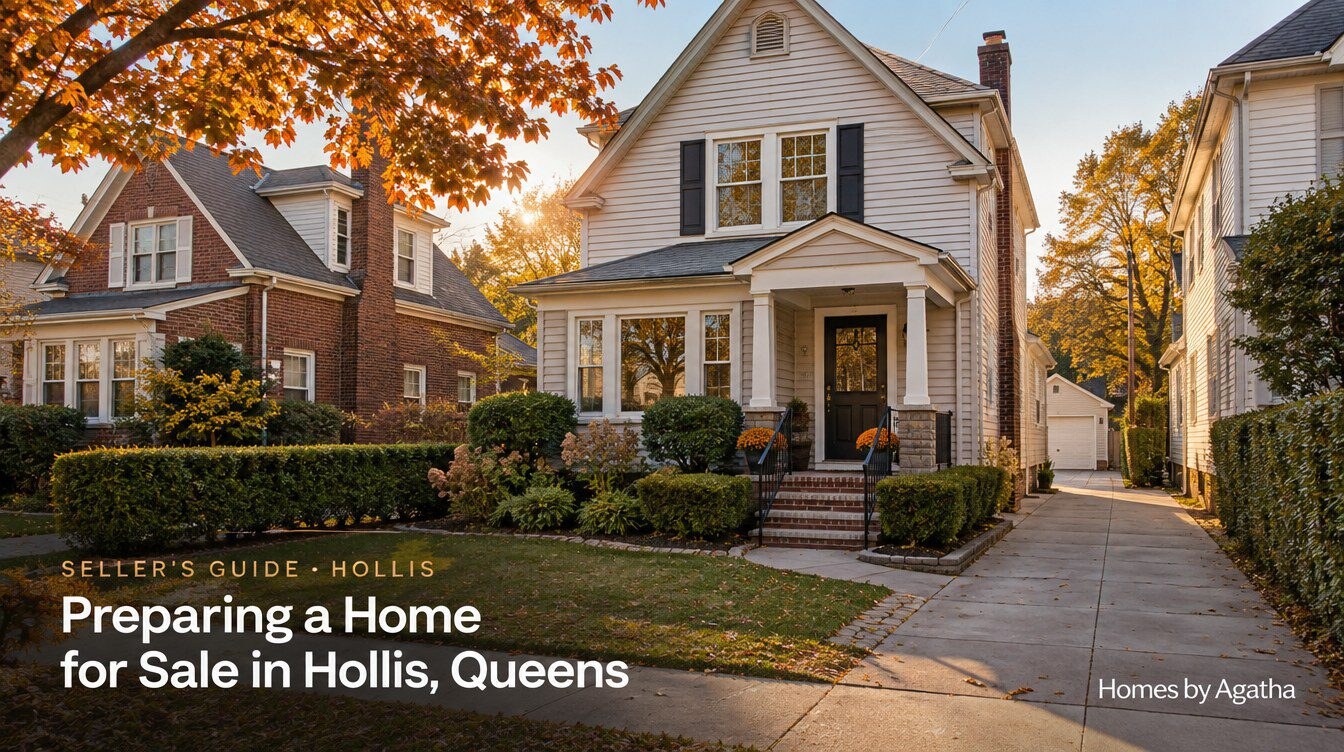
HOLLIS SELLER GUIDE
Preparing a Home for Sale in Hollis Queens: Records, Basement, Repairs and Pricing in the Right Order
Quick Answer
Preparing a home for sale in Hollis, Queens follows a clear order: gather the deed, legal-use records and permits; document any basement water history and repairs; fix what inspectors will flag; present the yard, driveway and rooms clearly; then price with a CMA based on comparable detached or semi-detached houses with the same legal unit count.
This guide is for owners who are preparing a home for sale in Hollis Queens and want to know what to do, and in what order, before the listing goes live. Most Hollis houses are detached or semi-detached one- or two-family homes, often decades old, with a driveway, a yard and a basement. Buyers inspect every one of those features, and the questions they ask can be answered before they ask them.
Preparation is not only about paint. In Hollis, the most valuable work often happens on paper: confirming the legal unit count, closing old permits, organizing receipts for a roof or a sump pump, and answering the Property Condition Disclosure Statement accurately. Then come repairs and presentation.
As a Licensed Associate Real Estate Broker serving Queens, I help sellers plan the sequence from first walk-through to closing, in English or Polish. Below you will find how buyers judge a Hollis house, what to gather first, how to handle a basement with a water history, which repairs tend to matter, how a comparative market analysis prices the house, how marketing and disclosures work, what selling costs in New York City, how to compare offers, and a checklist. For how we would list and sell together, see the page on how to sell your home in Hollis with Agatha.
Hollis at a glance for sellers
| Topic | What it means for a seller |
|---|---|
| Location | Southeast Queens between Jamaica and Queens Village; commonly described as south of Hillside Avenue, west of Francis Lewis Boulevard and north of Murdock Avenue (edges are informal, and city community district maps show district lines rather than neighborhood names). Holliswood and Hollis Hills, to the north, are separate neighborhoods and separate comparable-sales pools. |
| Borough / County | Queens (Queens County), New York City, so the NYC Real Property Transfer Tax applies in addition to the NYS transfer tax |
| ZIP code(s) | 11423 for most of Hollis; some southern blocks use 11412; confirm the ZIP code for your address with the USPS ZIP Code lookup before it goes on the listing |
| Typical housing | Detached and semi-detached one- and two-family houses in frame, brick and stucco; some attached houses and mixed-use buildings near Jamaica Avenue and Hollis Avenue |
| Zoning | Most blocks were rezoned in 2007 (St. Albans/Hollis rezoning) to lower-density, contextual districts that reinforce one- and two-family housing |
| Transit buyers ask about | LIRR Hollis station at 193rd Street and Woodhull Avenue (Hempstead Branch); buses on Hollis and Jamaica Avenues to downtown Jamaica; F train at Jamaica–179 St |
| Common buyer concerns | Legal unit count, basement water history, roof and boiler age, oil tank status, shared driveway easements, open permits or violations |
How do buyers judge a house in Hollis, Queens?
Buyers judge a Hollis house by its type and lot, its legal unit count, the condition of its basement and major systems, its driveway and parking, and its distance to the LIRR or the Jamaica buses. Cosmetic finishes matter, but they rarely outweigh a dry basement, a sound roof and clean paperwork.
Detached versus semi-detached
A detached house in Hollis offers open space on all sides, and buyers compare it mainly with other detached houses. A semi-detached house shares a wall, and buyers will look at the shared roof line, the condition of the neighbor’s side and the driveway arrangement. Pricing and marketing are most accurate when the house is compared within its own type.
Legal unit count
A legal two-family house can produce rent that some buyers’ lenders may count toward qualifying income. A one-family house with an extra apartment that is not in the NYC Department of Buildings records does not get that treatment, and buyers’ attorneys will raise it. The legal unit count is one of the first facts a serious buyer checks, so it should be one of the first facts you confirm.
Lot, driveway and expansion questions
Many Hollis buyers ask about the yard, the garage and whether the house could be expanded. Since the 2007 St. Albans/Hollis rezoning by the NYC Department of City Planning, most of Hollis sits in contextual districts that limit building form and the number of units. Avoid describing a lot as “buildable” or “ready for expansion” unless an architect has confirmed what the zoning allows; buyers will check the district on the city’s ZoLa map.
Commute access
Buyers ask how far the house is from the LIRR Hollis station, Hillside Avenue and the buses that run to downtown Jamaica, where the E, J and Z trains, the LIRR’s Jamaica station and the AirTrain to JFK connect. Accurate walk times help a listing. Note that, according to the MTA, from March 24, 2025, through 2027 it is replacing the four-car wooden platforms at Hollis station with eight-car concrete ones and adding an elevator and a ramp; during the work, trains do not stop at Hollis in one direction during some weekday off-peak and overnight hours. Check mta.info before quoting train times in your marketing.
What should you do first when preparing a home for sale in Hollis Queens?
Start with records, not repairs. When preparing a home for sale in Hollis Queens, gather the deed, legal-use records, permits and violations, utility and repair documents, and survey before you spend money on the house. The records tell you which repairs are necessary, which are optional and what you will need to disclose.
The records to gather
- Deed and ownership: confirm how title is held and who must sign. Deeds and mortgages for NYC properties are searchable on ACRIS, the NYC Department of Finance’s property records system.
- Legal use: a Certificate of Occupancy, or CO, is the NYC Department of Buildings document stating a building’s legal use and number of units. Houses built before 1938 often have no CO; their legal use may be shown through other Department of Buildings records or a Letter of No Objection.
- Permits and violations: look for open permits, Department of Buildings violations and Environmental Control Board violations. Old open permits for a finished basement or a new boiler can delay closing until they are signed off.
- Survey: find your survey from the purchase. It shows fences, the garage and any shared driveway relative to lot lines.
- System records: roof, boiler, water heater, electrical upgrades, sump pump or waterproofing invoices and warranties.
- Oil tank status: if the house converted from oil to gas, find any documentation that the old tank was removed or properly abandoned.
- Tax and utility bills: the current NYC Department of Finance property tax bill, any exemptions, and recent water and sewer bills.
- Leases: for a two-family house with a tenant, the lease, rent records and security deposit details. A one- or two-family house must be registered with the NYC Department of Housing Preservation and Development when neither the owner nor the owner’s immediate family lives there, so have the registration record ready if that applies.
Inherited and estate properties
When the Hollis house was inherited, the person signing the contract generally needs legal authority from the Queens County Surrogate’s Court, such as letters testamentary or letters of administration. Start that process with an estate attorney before listing, because buyers’ attorneys will ask for proof of authority. The probate real estate guide explains how an estate sale fits together.
| Preparation priority | Why Hollis buyers care | Typical seller action |
|---|---|---|
| 1. Legal-use records | Unit count drives financing, appraisal and price | Pull Department of Buildings records; describe the house to match them |
| 2. Open permits and violations | Can delay or derail closing | Have an expediter or architect close out what you can before listing |
| 3. Basement water history | Southeast Queens groundwater and stormwater questions come up at inspection | Document past water, repairs and equipment; answer the PCDS accurately |
| 4. Roof, boiler, electrical | Largest repair items in older detached houses | Service the boiler, fix active leaks, correct hazards |
| 5. Oil tank | A leaking buried tank is a feared cost | Locate removal or abandonment paperwork; consider a pre-listing sweep |
| 6. Exterior and yard | First impression of a detached house | Clean gutters, trim landscaping, clear the driveway and garage |
| 7. Interiors | Photos and showings | Declutter, paint where needed, improve lighting |
Not sure where your Hollis records stand?
Before you hire a contractor, we can review the public records for your house and build a short list of documents and sign-offs to gather first.
How should you handle a basement with a water history before listing?
Handle a basement water history by documenting it and disclosing it accurately, not by covering it up. Buyers’ inspectors in southeast Queens look closely at basements, and a seller who can show what happened, what was repaired and how water is managed now is in a far stronger position than one who cannot.
Why Hollis basements get extra attention
Parts of southeast Queens have a documented history of high groundwater and stormwater flooding. The Jamaica Water Supply Company long pumped groundwater from wells in the area; the NYC Department of Environmental Protection acquired that system in 1996, reduced its use and has not used it for drinking water since 2007. A 2013 New York State Senate bill calling for a city study of the problem described groundwater levels in Jamaica rising sharply after the pumping was discontinued, with homes and businesses across southeast Queens running basement pumps. The City has also been upgrading sewers in parts of southeast Queens; NYC DEP and NYC Department of Design and Construction project information shows whether work is planned on a specific street. Buyers who have read about this will ask, and their inspectors will look.
What to document
- When water entered, how often and after what kind of event (heavy rain, snowmelt, a sewer backup or a plumbing leak).
- What was done: sump pump, interior drainage, exterior grading, gutter extensions, backwater valve, foundation sealing.
- Who did the work, when, and whether permits were required and closed.
- Warranties that may transfer to a buyer.
- Any insurance claims related to water.
Practical steps before photos and showings
Basement work is often the most visible part of preparing a home for sale in Hollis Queens. Test the sump pump, clear floor drains, extend downspouts away from the foundation, and run a dehumidifier so the basement smells and feels dry for showings. Do not paint over stains or install new flooring to hide evidence of past water. A buyer’s inspector can usually spot fresh concealment, and hiding a known defect can expose a seller to legal claims after closing. Present the basement as it is, with the paperwork beside it.
Key Takeaways
- In Hollis, the records come before repairs: legal use, permits, violations, survey and system invoices.
- The legal unit count shapes buyer financing, the appraisal and the price.
- A basement water history should be documented and disclosed, never concealed.
- Describe zoning and expansion potential only as far as an architect has confirmed.
Which repairs are worth making on an older Hollis house?
The repairs worth making before a Hollis sale are the ones a buyer’s inspector, appraiser or lender will flag: active leaks, roof failures, a boiler that has not been serviced, electrical hazards, and open permits or violations. Large remodels rarely pay back before a sale and may need permits that delay the listing.
Fix before listing
- Roof and gutters: repair leaks, missing shingles and failed flashing; clean gutters and extend downspouts.
- Heating: service the boiler or furnace and keep the service tag; buyers of older houses often ask for it.
- Electrical hazards: exposed wiring, double-tapped breakers and missing covers are easy inspection findings to eliminate.
- Smoke and carbon monoxide detectors: confirm working detectors in every unit.
- Sidewalk: NYC property owners are generally responsible for the sidewalk in front of their property; an open sidewalk violation can surface in the buyer’s municipal searches.
- Exterior wood: on frame houses, repair rotted porch boards, trim and steps.
Consider, depending on the house
- A pre-listing inspection, which surfaces problems while you still control the timing.
- An oil tank sweep when paperwork is missing on a house that once used oil.
- A sewer camera inspection if the line has a history of backups.
- Fresh neutral paint in high-traffic rooms and in a vacant rental unit.
Usually skip
Full kitchen or bath remodels, finishing a basement that has had water, and converting space into an additional unit. Each takes time, may require permits and may not return its cost before closing. Some Hollis buyers prefer to renovate to their own taste, and pricing can reflect that.
Want a repair plan that fits your Hollis house and timeline?
Walk the house with me, and I will separate the items buyers will flag from the projects you can safely leave for the next owner.
How do you price a Hollis house with a CMA?
A Hollis house is priced through a comparative market analysis, or CMA, which compares it with recent sales of similar homes nearby and adjusts for the differences. A CMA is a real estate broker’s professional opinion of value; it is not an appraisal and does not guarantee a sale price.
Choosing the right comparables
The comparables that matter most for a Hollis house are recent sales of the same type and legal configuration, in Hollis or the closest similar blocks. A detached one-family should be compared with detached one-families; a legal two-family with legal two-families. Sales in Holliswood or Hollis Hills, which have different housing and lot patterns, are generally not direct comparables for Hollis proper. Because the market moves, pull current comparable sales from OneKey MLS and the NYC Department of Finance rolling sales data at the time you list, not months earlier.
| Pricing factor | How it affects a Hollis house |
|---|---|
| Detached vs. semi-detached | Buyers compare within type; open sides, privacy and maintenance differ |
| Legal unit count | A documented two-family is valued differently from a one-family with an unapproved unit |
| Lot size and yard | Larger usable yards and lots are valued by many buyers, within zoning limits |
| Driveway and garage | Private, legal off-street parking is a frequent buyer request |
| Basement condition | A dry, documented basement supports value; active water reduces it |
| Major systems | Roof, boiler, electrical and windows change a buyer’s first-year budget |
| Transit distance | Walking distance to the LIRR Hollis station or a Jamaica bus line can widen interest |
| Commercial frontage | Houses facing Jamaica Avenue or Hollis Avenue are valued differently from quiet side-street houses |
Why the appraisal matters
Most Hollis buyers finance, so the lender’s appraiser will also compare the house with recent sales. If the contract price outruns what the comparables support, the appraisal may come in low, and the buyer may ask to renegotiate. Pricing in line with the evidence protects the deal later. For a deeper look at valuation, see what is my Queens home worth.
Pricing mistakes specific to Hollis
- Pricing a one-family with an extra apartment as a legal two-family.
- Using Holliswood sales to justify a Hollis price.
- Adding value for expansion potential the zoning may not allow.
- Ignoring a known basement issue in the price, then renegotiating after inspection.
How do you stage, photograph and market a house in Hollis?
A Hollis house is marketed through professional photography, a detailed listing on OneKey MLS that syndicates to major real estate portals, and showings that let buyers see the yard, driveway, basement and every unit. Preparation pays off when the listing description matches the records.
Staging a detached or semi-detached house
For a detached house, the exterior is the first photo. Trim hedges, clear the walkway and driveway, empty the garage enough to show it holds a car, and repair the front steps. Inside, remove personal items, open blinds, replace dim bulbs and give each room one clear purpose. In a two-family house, stage the owner’s unit and present a vacant rental unit clean and freshly painted, so buyers can picture both uses.
Photography and listing content
Professional photography and an accurate floor plan help buyers understand a house before they visit. The listing should state the property type, legal unit count, lot dimensions from the survey, heating type, parking and recent system work. Describe the house, its rooms, its systems and its distance to transit, not the people who might live there; fair housing rules apply to every advertisement.
OneKey MLS and portals
OneKey MLS is the multiple listing service used by brokers across Queens, Long Island and parts of the Hudson Valley. A listing entered there is shared with cooperating brokers and syndicated to major real estate websites, which is how most buyers first see a Hollis house. Open houses and private showings follow.
| Marketing channel | What it does for a Hollis listing |
|---|---|
| OneKey MLS | Shares the listing with cooperating brokers and feeds major portals |
| Professional photos and floor plan | Shows the lot, driveway, basement and each unit clearly |
| Open houses | Lets buyers compare several Hollis houses on one weekend |
| Private showings | Gives serious buyers time with the basement, systems and rental unit |
| Disclosure packet | PCDS, records and invoices ready for buyers’ attorneys |
Ready to see how your Hollis house compares?
I can prepare a CMA using recent comparable sales of the same type and legal configuration, so your list price starts from evidence rather than guesswork.
What disclosures does a Hollis seller have to make?
Most Hollis sellers must deliver the New York Property Condition Disclosure Statement before the buyer signs the contract, and sellers of houses built before 1978 must also provide the federal lead-based paint disclosure. Every seller also receives the NYS Disclosure Form for Buyer and Seller from the real estate licensee at the first substantive contact.
The Property Condition Disclosure Statement
The Property Condition Disclosure Statement, or PCDS, is a New York form in which the seller answers questions about the property’s condition, systems and history based on actual knowledge. Since March 20, 2024, New York sellers of most one-to-four-family homes can no longer give a $500 credit instead of delivering the PCDS. The form includes questions about flooding and flood history, so a Hollis seller with a basement water history should answer carefully and consult an attorney, who can also confirm that you are using the current version of the form. The Department of State form defines the covered property as a one-to-four-family dwelling and excludes condominium units and cooperative apartments.
Lead-based paint disclosure
For homes built before 1978, federal law requires the seller to disclose known lead-based paint hazards, provide available reports and the federal pamphlet, and give the buyer an opportunity to test. Many Hollis houses predate 1978.
Agency and fair housing disclosures
The NYS Disclosure Form for Buyer and Seller explains agency relationships so you understand whom each licensee represents. New York also requires the Housing and Anti-Discrimination Disclosure / Fair Housing Notice. These forms protect you and the buyer and are part of a compliant sale.
Tenants
If a tenant occupies a unit, the buyer generally takes over existing leases and security deposits at closing. If a buyer wants a unit delivered vacant, your attorney should confirm that the plan complies with New York tenant law, including the 2024 Good Cause Eviction law where it applies to the building, before you agree to it.
What does it cost to sell a house in Hollis?
A Hollis seller’s main costs are brokerage compensation, which is negotiable, the NYS real estate transfer tax, the NYC Real Property Transfer Tax, the seller’s attorney fee, the payoff of any mortgage and closing adjustments for taxes and utilities. Because Hollis is in New York City, both the state and city transfer taxes apply.
| Seller expense (Hollis house) | How it works | Source / note |
|---|---|---|
| NYS real estate transfer tax | $2 for each $500 of consideration (0.4%), customarily paid by the seller | NYS Department of Taxation and Finance |
| NYC Real Property Transfer Tax | For one-to-three-family homes: 1% when the price is $500,000 or less; 1.425% when above $500,000; customarily paid by the seller | NYC Department of Finance |
| Brokerage compensation | Negotiable and agreed in the listing agreement; any contribution toward a buyer’s agent is a separate, negotiable choice | Listing agreement |
| Seller’s attorney | Contract negotiation, title objections, closing | Negotiated with the attorney |
| Mortgage payoff and lien releases | Existing loan balance and recording of the satisfaction | Lender payoff letter |
| Closing adjustments | Property taxes and water and sewer charges prorated between seller and buyer | NYC Department of Finance bills; final water reading |
| Repairs or credits | Only if negotiated after inspection | Contract terms |
Confirm current rates with the NYS Department of Taxation and Finance and NYC Department of Finance before closing.
Buyer-agent compensation, under the rules in effect in 2026, is negotiable, not set by law and not automatically paid by the seller. Buyers sign written agreements with their own agents. A seller may choose to contribute toward that compensation, and any arrangement should be agreed in writing. Capital gains and the federal home-sale exclusion for a primary residence are tax questions for a CPA. For more on the closing table, see Queens closing costs explained.
Key Takeaways
- Hollis sellers customarily pay both the NYS transfer tax (0.4%) and the NYC Real Property Transfer Tax (1% or 1.425% for one-to-three-family homes).
- Brokerage compensation is negotiable, and buyer-agent compensation is not automatically paid by the seller.
- A CMA is a broker’s opinion of value, not an appraisal; compare within the same house type and legal configuration.
- The PCDS must be delivered for most one-to-four-family houses; the $500 credit option ended March 20, 2024.
Curious what you would net from a Hollis sale?
Share your expected price range and mortgage balance, and I will walk you through a seller cost estimate line by line, to review with your attorney and CPA.
How do you compare offers on a Hollis house?
Compare offers on a Hollis house by their net strength, not just the price: financing type, down payment, appraisal exposure, contingencies, closing date and how the buyer handled the inspection questions. A slightly lower offer with strong financing can be the safer path to closing.
| Offer element | What to look at | Why it matters in Hollis |
|---|---|---|
| Price | Gross offer and any requested credits | Net proceeds after transfer taxes and costs |
| Financing | Cash, conventional, FHA or other; pre-approval documents | Two-family loans and rental-income underwriting can add steps |
| Down payment | Size of deposit and down payment | Larger cushions absorb a low appraisal more easily |
| Appraisal exposure | Price relative to comparable sales | Detached-house comps vary by lot and condition |
| Inspection posture | How the buyer plans to handle findings | Basement, roof and oil tank findings are common negotiation points |
| Closing date and occupancy | Timing, tenant status, vacant delivery requests | Must fit your move and any tenant obligations |
Negotiating after inspection
In New York, the inspection usually happens before the contract is signed, so negotiation over findings happens during the attorney-review period. Because an accepted offer is not a binding contract, either side can still renegotiate or walk away until both sign. This is where a documented basement history, a serviced boiler and closed permits pay off: buyers have fewer unknowns to price in, and requests for large credits are easier to answer.
Once both parties sign and the buyer’s deposit is delivered, the deal becomes binding under its terms. Your attorney then works through the buyer’s title report, responds to objections and coordinates the closing.
What is the timeline from preparation to closing in Hollis?
A typical financed sale of a Hollis house runs from preparation and listing, through offers and contract signing, to the buyer’s mortgage commitment and closing. Preparation time depends mostly on records and repairs; the time from contract to closing depends mostly on the buyer’s lender and on title.
| Stage | What happens | Hollis-specific checkpoint |
|---|---|---|
| 1. Records and plan | Gather deed, legal-use records, permits, survey, invoices | Confirm the legal unit count; start estate authority if inherited |
| 2. Repairs and staging | Fix flagged items; prepare exterior and interiors | Sump pump, gutters, boiler service, driveway and garage cleared |
| 3. Pricing and listing | CMA, photos, OneKey MLS listing, showings | Comparables matched by type and legal configuration |
| 4. Offer and attorney review | Accepted offer; buyer inspection; contract drafted and negotiated | PCDS delivered; basement and oil tank questions answered with documents |
| 5. Contract to commitment | Buyer’s appraisal and underwriting; title search | Open permits or violations cleared; leases and rent records provided |
| 6. Closing | Final walk-through, payoff, transfer taxes paid, deed delivered | Keys for every unit and garage; security deposits transferred |
Open permits, an unclear unit count, estate paperwork or a buyer’s appraisal question can each add weeks. When preparing a home for sale in Hollis Queens, starting with records shortens the part of the timeline you control.
Have offers on your Hollis house to weigh?
We can line up each offer by financing, appraisal risk, contingencies and timing, so you can choose the one most likely to close on your terms.
What mistakes should Hollis sellers avoid, and what belongs on your checklist?
The most costly mistakes Hollis sellers make are listing before checking the records, describing an unapproved unit as legal, hiding basement water, overpricing on expansion potential, and treating an accepted offer as a done deal. Each is avoidable with preparation.
Common seller mistakes
- Listing before pulling records. Open permits and unit-count questions found by the buyer’s attorney cost time and leverage.
- Marketing an extra apartment as legal. If the Department of Buildings records do not show it, describe the space accurately.
- Cosmetic cover-ups in the basement. Fresh paint over water stains invites distrust and potential legal claims.
- Pricing on the wrong comparables. Holliswood or Hollis Hills sales are not substitutes for Hollis sales.
- Over-renovating. A new kitchen rarely pays back before closing; a serviced boiler and a dry basement often matter more.
- Forgetting the driveway and garage. Buyers want to see that the car fits and that any shared driveway is documented.
Hollis seller checklist
- Confirm ownership and who must sign; begin Surrogate’s Court authority if the house was inherited.
- Pull Department of Buildings records and confirm the legal unit count.
- Check for open permits and violations, including sidewalk violations, and plan sign-offs.
- Find the survey and any shared driveway easement.
- Collect invoices and warranties for roof, boiler, waterproofing and sump pump.
- Locate oil tank removal or abandonment paperwork, or schedule a sweep.
- Complete the PCDS carefully, with your attorney’s input on water questions.
- Fix active leaks, hazards and items inspectors will flag; skip large remodels.
- Clean, declutter and stage the exterior, driveway, garage and every unit.
- Review a CMA built on comparable Hollis houses of the same type and legal configuration.
- Agree on brokerage compensation in writing and choose a real estate attorney.
- Prepare leases, rent records and deposit details if a tenant stays.
Owners comparing their options across southeast Queens can also review how sales work in nearby areas: selling a home in Jamaica, Queens, selling in Saint Albans and selling in Cambria Heights. For a borough-wide overview, see how to sell your home in Queens.
Frequently asked questions about preparing a Hollis home for sale
What should I do first before selling my house in Hollis, Queens?
Start with records. Confirm ownership, pull NYC Department of Buildings records for the legal unit count, check for open permits and violations, find your survey, and gather invoices for the roof, boiler and any waterproofing. Those documents decide which repairs matter and what you must disclose, so they come before contractors.
Do I have to disclose past basement water when selling in Hollis?
Most Hollis sellers must deliver the Property Condition Disclosure Statement, which asks about water and flooding based on your actual knowledge. Answer accurately and attach documentation of repairs, such as a sump pump or drainage system. Concealing a known defect can expose a seller to claims after closing, so consult a New York attorney.
Can I still give a $500 credit instead of the Property Condition Disclosure Statement?
No. Since March 20, 2024, New York sellers of most one-to-four-family homes can no longer give a $500 credit instead of delivering the Property Condition Disclosure Statement. Co-op and condo units are generally outside the requirement. Houses built before 1978 also need the federal lead-based paint disclosure. Confirm your obligations with your attorney.
Can I list my Hollis house as a two-family if the basement is rented?
Only if NYC Department of Buildings records show two legal dwelling units. A rented basement or cellar that is not in the records is not a legal unit, and lenders, appraisers and buyers’ attorneys will treat it that way. Describe the space accurately and price the house according to its legal configuration.
How is a CMA different from an appraisal for a Hollis house?
A CMA is a real estate broker’s professional opinion of value based on comparable sales; it is not an appraisal and does not guarantee a price. An appraisal is prepared by a licensed appraiser, usually for the buyer’s lender. For Hollis, both should compare houses of the same type and legal unit count.
Are Holliswood sales good comparables for pricing a Hollis house?
Generally not. Holliswood, north of Hillside Avenue, and Hollis Hills, farther north, are separate neighborhoods with different housing and lot patterns. A Hollis house should be priced against recent sales of similar detached or semi-detached houses with the same legal unit count in Hollis or the closest comparable blocks.
What taxes does a seller pay when selling a house in Hollis?
A Hollis seller customarily pays the NYS real estate transfer tax of 0.4% and the NYC Real Property Transfer Tax, which for one-to-three-family homes is 1% at $500,000 or less and 1.425% above. Capital gains questions belong with a CPA. Confirm current rates with NYS DTF and NYC DOF.
Which repairs should I make before listing a Hollis house?
Focus on items inspectors and lenders flag: active roof leaks, gutters and downspouts, boiler service, electrical hazards, working smoke and carbon monoxide detectors, sidewalk violations and open permits. Keep the basement dry and documented. Large kitchen or bath remodels rarely pay back before a sale and may need permits that delay listing.
Who pays the buyer’s agent when I sell a house in Hollis?
It depends on what is negotiated. Under the rules in effect in 2026, buyer-agent compensation is negotiable, not set by law and not automatically paid by the seller. Buyers sign written agreements with their own agents. A seller may choose to contribute, and any arrangement should be agreed in writing before closing.
How do I sell an inherited house in Hollis, Queens?
The person selling an inherited Hollis house usually needs authority from the Queens County Surrogate’s Court, such as letters testamentary or letters of administration, before signing a contract. Work with an estate attorney, gather the house’s records and coordinate with heirs early. A CPA can explain tax considerations before the sale.
Your next step as a Hollis seller
Preparing a home for sale in Hollis Queens pays off when the work happens in the right order: records first, then the basement and its history, then the repairs inspectors will flag, then presentation, and only then the price. A house whose paperwork matches its description, whose basement is documented and whose systems are serviced gives buyers fewer reasons to renegotiate. When you are ready to talk about listing, the page on how to sell a house in Hollis, Queens with Agatha explains the process. If you plan to buy again nearby, the guide to buying a home in Hollis covers the other side of the move.
Map your Hollis sale from first walk-through to closing
Tell me about your house and your timing, and I will outline a preparation sequence, a pricing approach and a seller timeline, in English or Polish.
This article is for general informational purposes only and reflects conditions that may change. It is not legal, tax, or financial advice, an appraisal, or a guarantee of price or outcome; consult a licensed New York attorney, a CPA, and an NMLS-registered mortgage loan originator as appropriate. A CMA is an opinion of value, not an appraisal. Real estate brokerage services are offered by Agatha Lubas, Licensed Associate Real Estate Broker, NY License #10301213345, Keller Williams Realty Liberty, 96-10 101st Avenue, Ozone Park, NY 11416. The NYS Disclosure Form for Buyer and Seller, the NYS Housing and Anti-Discrimination Disclosure / Fair Housing Notice, and the brokerage’s Standard Operating Procedures are available on request. Equal Housing Opportunity.

Agatha Lubas helps sellers, buyers and investors across Queens, Brooklyn, Nassau County and Suffolk County prepare homes and paperwork so transactions hold up from listing to closing. She works in English and Polish, so clients can discuss every detail in the language most comfortable for them.
Work with Agatha