
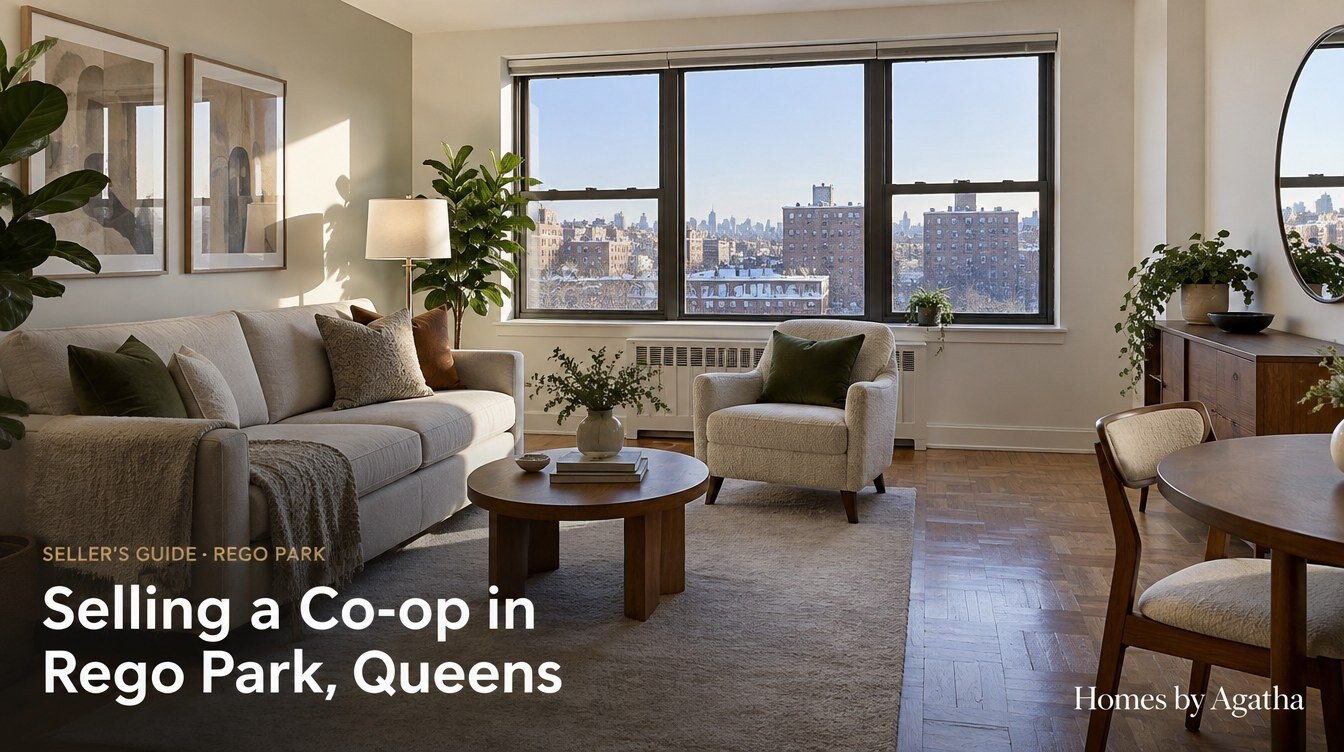
REGO PARK SELLER GUIDE
Selling a Co-op in Rego Park, Queens: Pricing, Board Approval and Paperwork From Listing to Closing
Quick Answer
Selling a co-op in Rego Park, Queens works in five stages: price against recent sales in the same or similar buildings, assemble the building’s documents, market to buyers who fit the co-op’s financing rules, accept an offer that can pass the board, and close after board approval. Seller costs include transfer taxes, attorney fees and any flip tax.
Selling a co-op in Rego Park is less about one apartment and more about two approvals: the buyer’s and the board’s. A buyer may love your sunny two-bedroom off 63rd Drive, but the sale closes only when that buyer meets the building’s financing and liquidity rules and the board approves the application. That is why the strongest co-op sales in the neighborhood are planned before the listing goes live.
This guide is for shareholders in Rego Park’s mid-century apartment buildings along Queens Boulevard, 63rd Drive and the surrounding streets, and for executors handling an inherited co-op. You will learn how buyers and boards judge a unit, how a comparative market analysis is built for a co-op, which documents to collect first, how to prepare the apartment, what the sale costs, and how to compare offers by their chance of closing. A shorter section covers owners of houses in the Crescents. As a Licensed Associate Real Estate Broker based in Queens, I help sellers organize the paperwork and the timeline as well as the marketing — in English and Polish. For details about listing services, see the Rego Park home selling page.
Rego Park at a glance for sellers
| Item | Rego Park, Queens |
|---|---|
| Borough / county | Queens (Queens County), New York City; Queens Community Board 6 |
| ZIP code | 11374; confirm the ZIP code and mailing name of the specific address with the USPS |
| Where co-ops concentrate | Mid-century elevator buildings along and near Queens Boulevard and 63rd Drive, between Woodhaven Boulevard and the Forest Hills border; some buildings in the corridor are rentals or condos, so ownership type is confirmed building by building in ACRIS or the offering plan |
| Other housing | Condominium buildings in the same corridor; attached and detached one-family houses in the Crescents and southern blocks; some two-family houses |
| Subway | 63rd Drive–Rego Park and 67th Avenue local stations, served by M and R trains; express transfer at Forest Hills–71st Avenue. Service hours vary by line, so check current MTA schedules |
| Local landmarks buyers mention | Lost Battalion Hall Recreation Center at 93-29 Queens Boulevard; Real Good Playground on 62nd Avenue; the Rego Center shopping complex; Queens Center across Woodhaven Boulevard in Elmhurst |
| Who must approve a co-op sale | The co-op board, after the managing agent reviews the buyer’s board package |
| Seller transfer taxes | NYS real estate transfer tax and NYC Real Property Transfer Tax, customarily paid by the seller |
| Building-specific costs | Flip tax only if the co-op’s documents impose one; managing-agent transfer and processing fees |
How do buyers and boards judge a co-op apartment in Rego Park?
Buyers judge a Rego Park co-op on three layers: the apartment itself, the building’s rules and finances, and the location within the Queens Boulevard corridor. Boards then judge the buyer. A unit that is priced well but sits in a building with strict financing limits attracts a narrower pool of buyers, so a seller has to understand all three layers.
The apartment
Inside the unit, buyers compare layout, room count, light, exposure, floor height, condition of the kitchen and bathrooms, closet space and electrical capacity for air conditioners. In mid-century buildings, buyers also notice original details where they survive, such as parquet floors or step-down living rooms, and whether earlier renovations were done well and with board approval. An apartment facing a courtyard or side street is often quieter than one directly on Queens Boulevard or Woodhaven Boulevard, and buyers weigh that against views and light.
The building
A Rego Park co-op buyer is buying into a corporation, so the building’s numbers travel with your apartment. Buyers and their attorneys look closely at these items:
- Maintenance: the monthly charge and what it includes. Higher maintenance generally reduces what buyers can pay, because lenders count it in the buyer’s monthly debt.
- Financing limit and liquidity rule: how much the building lets a buyer borrow and how much savings must remain after closing; each building sets its own figures.
- Sublet and pet policies: tighter rules shrink the buyer pool, especially for buyers who may rent the apartment out later.
- Capital projects and assessments: façade work under Local Law 11, boiler or energy work tied to Local Law 97 (which covers most buildings larger than 25,000 square feet), and any open assessment. Whether each law applies depends on the building, so check its NYC Department of Buildings records.
- Underlying mortgage and reserves: how soon the building’s loan matures and how much it holds in reserve.
- Amenities: elevator, laundry room, garage or parking wait-list, storage, bike room, doorman or live-in superintendent.
The location inside Rego Park
Walking distance to 63rd Drive–Rego Park or 67th Avenue station matters to many buyers, as does the walk to the Forest Hills–71st Avenue express stop and access to the stores on Queens Boulevard and 63rd Drive. Drivers ask about the Long Island Expressway and Woodhaven Boulevard. These factors explain why two similar apartments a few blocks apart can sell differently.
How should you price a co-op in Rego Park?
Price a Rego Park co-op mainly against recent sales in the same building and in comparable co-op buildings nearby, adjusted for maintenance, size, floor, exposure and condition. Condos and houses are poor comparables for a co-op, because they carry different ownership, financing and monthly costs.
A comparative market analysis, or CMA, is a real estate broker’s professional opinion of value based on relevant sales, listings and market evidence. It is not an appraisal and does not guarantee a sale price. For a co-op, the CMA should explain each adjustment so you can see why the suggested range is where it is. The article what is my Queens home worth explains how valuation works across the borough.
Why same-building sales lead the analysis
Apartments in the same building share the same maintenance structure, rules, amenities and board. A recent sale of a similar line two floors away is often the most useful single data point. When the building has few recent sales, the next step is similar co-op buildings in the Queens Boulevard corridor with comparable financing rules and maintenance levels. Pull those comparables from OneKey MLS and NYC Department of Finance records at the time you price, because older sales lose relevance quickly.
Pricing factors for a Rego Park co-op
| Factor | Tends to support a higher price | Tends to limit the price |
|---|---|---|
| Maintenance | Moderate for the size, with a clear breakdown | High relative to similar units; recent large increases |
| Financing rules | Allows financing most buyers can use | Low maximum financing or all-cash requirement |
| Sublet policy | Reasonable subletting after an ownership period | Little or no subletting |
| Assessments | None open; major projects completed | Open assessment or upcoming façade or boiler work |
| Exposure and floor | Higher floor, good light, quieter side | Low floor on a busy boulevard; limited light |
| Condition | Updated kitchen and baths with approved alterations | Dated systems; unapproved past renovations |
| Transit and parking | Short walk to the 63rd Drive or 67th Avenue station; parking available | Longer walks; long garage wait-list |
How the first weeks shape the result
Pricing too high narrows the pool twice: fewer buyers schedule showings, and lenders’ appraisals may not support the price, which can leave a buyer short of the down payment the building requires. A price grounded in the CMA and clearly explained to buyers’ agents usually draws the most qualified interest early.
Wondering what your Rego Park co-op could sell for?
I can prepare a CMA built on same-building and same-corridor co-op sales — a professional opinion of value, explained adjustment by adjustment, with no obligation to list.
What should you gather before listing a Rego Park co-op?
Collect the building’s sale requirements and your ownership documents before the listing goes live. In a co-op, the buyer’s attorney, lender and board all depend on documents that only you or the managing agent can supply, and delays in producing them are a common reason co-op sales slow down.
Documents to request early
- The managing agent’s sale package: the building’s board application, fee schedule, financing and liquidity rules, and any move-out requirements.
- Your stock certificate and proprietary lease: the originals are surrendered at closing. If you cannot find them, ask the managing agent and your attorney now; a replacement usually requires a lost-instrument affidavit and sometimes a bond, under a procedure each co-op sets.
- Recent financial statements and the current budget: the buyer’s attorney and lender will ask for them.
- Board minutes: usually reviewed by the buyer’s attorney through the managing agent.
- House rules, sublet, pet and alteration policies.
- The flip tax provision, if any: where it appears and how it is calculated.
- Alteration approvals: written approvals for past renovations, and DOB permits where required.
- Your share-loan information: lender, account and payoff contact, so a payoff letter and lien release can be ordered.
Flip tax: read the documents, not the rumor
A flip tax is a transfer fee that some co-ops charge when shares are sold, set by the co-op’s own documents. There is no city-wide rate. Depending on the building, it may be calculated in different ways, and the documents and contract decide who pays it. Ask the managing agent for the exact provision before pricing, because it affects your net proceeds.
Selling an inherited or estate co-op
When a shareholder has died, the executor or administrator generally needs court authority, such as letters testamentary, before signing a contract, and the co-op will have its own requirements for transferring the estate’s shares. Ask your attorney to confirm what the Queens County Surrogate’s Court and the co-op will each require before you set a listing date. The probate real estate guide explains how court steps and the sale timeline fit together.
How should you prepare a Rego Park co-op apartment for sale?
Focus preparation on what buyers see in photos and what inspectors and boards will question: clean, bright, neutral rooms; working fixtures and outlets; and documented, approved alterations. In a co-op, check the alteration agreement before any pre-sale work, because even modest projects may need board approval.
Preparation priorities
| Priority | What to do | Why it matters for a Rego Park co-op |
|---|---|---|
| 1. Paperwork | Locate alteration approvals; confirm no open violations tied to the unit | Buyers’ attorneys and boards ask; missing approvals delay contracts |
| 2. Small repairs | Fix leaks, loose fixtures, outlets, cabinet doors, radiator covers | Small defects suggest larger neglect in a mid-century building |
| 3. Paint and floors | Neutral paint; clean or refinish parquet or hardwood where practical | Photographs well and lets buyers picture their own furniture |
| 4. Light and windows | Clean windows; open blinds; replace bulbs; remove heavy drapes | Light is a major value factor on Queens Boulevard and side streets |
| 5. Declutter and stage | Remove extra furniture; clear counters and closets | Room count and closet space are central for apartment buyers |
| 6. Air conditioners | Service window or sleeve units; confirm electrical capacity | Buyers ask about cooling and wiring limits in older buildings |
| 7. Larger renovations | Usually skip unless the CMA shows a clear return | Board approval and timelines can delay the listing |
Staging for mid-century layouts
Many apartments in Rego Park’s older buildings have foyers, dining alcoves and long hallways. Staging should show how those spaces work: a small dining table in the alcove, a home-office corner in a foyer, or a reading chair in a deep living room. A floor plan in the listing helps buyers understand the flow before they visit.
Showings under building rules
Co-op buildings often control showing access through doormen, superintendents or sign-in procedures, and some restrict open houses or require notice. Confirm the rules with the managing agent before scheduling, and let neighbors know if your building asks you to.
Key Takeaways
- A Rego Park co-op sells against same-building and same-corridor co-op sales, adjusted for maintenance, floor, exposure and rules.
- A CMA is a broker’s opinion of value, not an appraisal; it should explain each adjustment.
- Collect the managing agent’s sale package, your stock certificate, proprietary lease and alteration approvals before listing.
- Check the flip tax provision and alteration rules before setting a price or starting pre-sale work.
Need a preparation plan for your apartment?
We can decide together what to fix, what to document and what to leave alone, and line up the building’s requirements before your listing launches.
How does the board package work when you are the seller?
The buyer prepares and submits the board package, but the seller has a direct stake in how fast and how completely it is done. Board approval is a condition of closing a co-op sale, so a seller who helps the buyer’s side stay organized protects the timeline.
The sequence from contract to approval
- Both sides sign the contract of sale prepared by their attorneys; the buyer’s deposit goes into escrow, customarily with the seller’s attorney.
- The buyer obtains a loan commitment, if financing.
- The buyer submits the board package to the managing agent, which checks completeness.
- The board reviews the package and schedules an interview.
- The board approves or declines; after approval, the attorneys schedule the closing with the managing agent.
What the seller can do to help
- Share the building’s requirements with buyers’ agents before offers arrive, so buyers self-qualify.
- Respond quickly when the buyer’s attorney requests documents through your attorney.
- Confirm that your maintenance is current, because arrears can complicate the transfer.
- Ask your agent to check that the buyer’s package is complete before submission.
If the board declines
A co-op board may decline a buyer without giving a reason, but it may not discriminate on any basis protected by the federal Fair Housing Act, the New York State Human Rights Law or the New York City Human Rights Law. If a board declines, the contract’s board-approval contingency usually governs what happens to the deposit, and you return to the market. That risk is why offer review in a co-op weighs approval likelihood alongside price.
If you own a condo in Rego Park instead
Condo sales usually involve a right of first refusal rather than a full board approval: the condo board has the option to buy the unit on the same terms and typically issues a waiver. Condo sales also transfer a deed and require title insurance for the buyer, so the paperwork and costs differ from a co-op sale. The waiver deadline is set by each condo’s bylaws, so ask the managing agent for it early.
How will buyers find your Rego Park co-op listing?
Most buyers find Rego Park co-ops through OneKey MLS, the multiple listing service serving the New York metro area including Queens, and the consumer portals that display its listings. Strong photography, a floor plan and clear building information — maintenance, financing rules, pet policy — decide whether a buyer schedules a showing.
| Channel | What it does | Co-op detail to include |
|---|---|---|
| OneKey MLS | Shares the listing with cooperating brokers and feeds many public portals | Maintenance, what it includes, financing limit, pet and sublet policy |
| Professional photography | First impression on every portal | Light, room count, views toward courtyards or Queens Boulevard |
| Floor plan | Shows layout and flow before a visit | Foyers, dining alcoves, closets |
| Listing remarks | Explains what photos cannot | Building amenities, distance to the 63rd Drive or 67th Avenue station |
| Showings and open houses | Lets buyers see the unit and building | Building access rules and any open-house limits |
| Broker outreach | Reaches buyers’ agents with active clients | A one-page sheet of building requirements |
Publishing building rules up front
Listing the financing limit and liquidity expectations in the marketing materials saves time for everyone. Buyers who cannot meet them skip the showing, and the buyers who remain are more likely to pass the board. Accuracy matters: confirm every rule with the managing agent before publishing, because an error can derail a deal later.
Fair Housing in marketing
Listing descriptions should focus on the apartment, the building, transit and nearby amenities such as Lost Battalion Hall or the stores on 63rd Drive. They must not describe the neighborhood or the ideal buyer in terms of any protected characteristic under federal, New York State or New York City fair housing law.
Planning how to launch your listing?
I can help you set the timing, photography, floor plan and building-requirement sheet so buyers’ agents bring clients who can actually pass your board.
What does selling a co-op in Rego Park cost?
Selling a co-op in Rego Park typically involves the NYS real estate transfer tax, the NYC Real Property Transfer Tax, your attorney’s fee, negotiable brokerage compensation, managing-agent fees, any flip tax the co-op imposes, and payoff of any share loan. The buyer, not the seller, pays the mansion tax when it applies.
The table below follows the rules published by the New York State Department of Taxation and Finance and the NYC Department of Finance. Confirm current rates with the NYS Department of Taxation and Finance and NYC Department of Finance before closing.
| Cost item | How it works | Who sets it / source |
|---|---|---|
| NYS real estate transfer tax | $2 for each $500 of consideration (0.4%); customarily paid by the seller. Residential conveyances of $3 million or more in NYC carry a higher combined rate (0.65%) | NYS Department of Taxation and Finance |
| NYC Real Property Transfer Tax | Individual co-op units: 1% when the price is $500,000 or less; 1.425% when above $500,000; customarily paid by the seller | NYC Department of Finance |
| Brokerage compensation | Negotiable; set in the listing agreement. Any contribution toward a buyer’s agent is also negotiable | Your agreement with your broker |
| Seller’s attorney | Fee negotiated with the attorney | Your attorney |
| Flip tax | Only if the co-op’s documents impose one; no city-wide rate | The co-op’s own documents |
| Managing-agent fees | Transfer, processing or stock-transfer fees; possible move-out deposit | The building’s managing agent |
| Share-loan payoff | Your remaining loan balance plus any payoff or lien-release charges | Your lender |
| Adjustments | Maintenance prorated to the closing date; any assessment allocated as the contract says | Contract / attorneys |
| Mansion tax | 1% at $1 million or more, graduated above $2 million in New York City; paid by the buyer | NYS Department of Taxation and Finance |
Mortgage recording tax does not apply to co-op share loans, so it does not affect your buyer’s costs either — a point worth mentioning to buyers comparing your co-op with a condo. For a borough-wide walk-through, see Queens closing costs explained. Questions about capital gains, the primary-residence exclusion or estate tax basis belong with a CPA.
Which disclosures apply when you sell a co-op in New York?
Co-op sellers in New York deal with three main disclosure topics: the agency disclosure form at the start of the broker relationship, the federal lead-based paint disclosure for housing built before 1978, and honest answers to the buyer’s attorney’s questions. The Property Condition Disclosure Statement is required for most one-to-four-family houses, and co-op units are generally outside it.
Agency disclosure
The New York State Disclosure Form for Buyer and Seller, required by the NYS Department of State, explains whom a real estate agent represents. Sellers receive it at the first substantive contact with a broker, before discussing confidential details.
Property Condition Disclosure Statement
Since March 20, 2024, sellers of most one-to-four-family houses in New York must deliver the Property Condition Disclosure Statement, and the former option of a $500 credit instead of the form was removed. Co-op and condo units are outside the PCDS requirement, because the law’s definition of residential real property excludes condominium units and cooperative apartments (Real Property Law section 461). Owners of houses in the Crescents, covered below, are within it.
Lead-based paint
Federal rules from the U.S. Environmental Protection Agency and HUD require sellers of most housing built before 1978 to disclose known lead-based paint and hazards, share available reports, provide the EPA pamphlet and give buyers an opportunity for an inspection. Many of Rego Park’s apartment buildings date from the middle of the 20th century, so expect this disclosure in many co-op sales. Your attorney will confirm the building’s construction year and how the rule applies to your transfer.
Answering the buyer’s questions
The buyer’s attorney will send questions about assessments, litigation, alterations and the apartment’s condition. Answer accurately through your attorney. Known problems, such as past leaks from a riser, are better disclosed and documented than discovered during the buyer’s inspection or in the board minutes.
Key Takeaways
- Seller transfer taxes on a Rego Park co-op are the NYS transfer tax and the NYC Real Property Transfer Tax; the mansion tax falls on the buyer.
- Flip tax exists only if your co-op’s documents impose one — read the provision before pricing.
- Brokerage compensation is negotiable in 2026, including any contribution toward a buyer’s agent.
- Co-op units are generally outside the PCDS, but lead-based paint disclosure applies to most pre-1978 buildings.
Want to see your estimated net proceeds?
I can outline transfer taxes, building fees, flip tax and loan payoff for your apartment, so you know what a given price means for you before you list.
How should you compare offers on a Rego Park co-op?
Compare offers on price, on the buyer’s fit with the building’s financing and liquidity rules, and on contingencies and timing. In a co-op, the highest offer is not the strongest if the buyer is unlikely to pass the board, because a declined application sends you back to the market weeks later.
| Offer element | What to look for | Why it matters in a co-op |
|---|---|---|
| Price | Offer amount and any requested seller concessions | Sets gross proceeds, but only if the deal closes |
| Financing | Loan amount versus the building’s maximum; lender experienced with co-op share loans | A loan above the building’s limit cannot close |
| Liquidity | Assets left after closing compared with the building’s expectation | A common reason boards decline buyers |
| Pre-approval quality | Full underwriting review versus a basic letter | Predicts how smoothly the commitment arrives |
| Contingencies | Financing contingency and its deadline; board-approval contingency | Fewer and shorter contingencies reduce risk |
| Closing timing | Proposed date versus the board’s meeting schedule | Unrealistic dates cause extensions |
| Plans for the unit | Owner-occupancy versus a plan to sublet or renovate heavily | Plans that conflict with house rules raise board risk |
Negotiating in an attorney state
New York is an attorney state: after you accept an offer, the attorneys negotiate and prepare the contract of sale, and either side can walk away until both have signed. Keep showing the apartment until the contract is signed and the deposit is in escrow, unless you and your agent agree otherwise. Counteroffers can address more than price — a firmer financing deadline, a larger deposit or a closing date that fits your move.
Cash offers and investors
All-cash offers remove the financing risk but not the board review. Buyers who plan to sublet soon after closing may face restrictions under the building’s policy, so read their plans against the house rules.
How long does it take to sell a Rego Park co-op, from listing to closing?
A Rego Park co-op sale moves through preparation, marketing, contract, loan commitment, board review and closing. No fixed number of days applies, because the board’s meeting schedule and the speed of document delivery often control the calendar more than the buyer or seller does.
| Stage | What happens | What controls the timing |
|---|---|---|
| 1. Preparation | CMA, documents, repairs, staging, photography | Your readiness and the managing agent’s responses |
| 2. Marketing | OneKey MLS listing, showings, open houses where allowed | Price, presentation and building rules |
| 3. Accepted offer | Terms agreed; attorneys exchange information | Negotiation |
| 4. Contract | Buyer’s attorney reviews financials and minutes; contract signed; deposit into escrow | Document delivery |
| 5. Loan commitment | Appraisal and building questionnaire | Lender and managing agent |
| 6. Board review | Package submitted, checked, reviewed; interview; decision | Board meeting schedule |
| 7. Closing | Shares and lease assigned; taxes paid; your share loan paid off; keys handed over | Attorneys, lenders and managing agent |
If you are buying your next home at the same time, coordinate both closings with your attorney. The companion guide to buying a home in Rego Park covers the purchase side of a move within the neighborhood.
Comparing offers or planning around a board date?
I can help you weigh each offer’s approval risk, financing strength and timing alongside price before you respond to any buyer.
What if you are selling a house in the Crescents or southern Rego Park?
Selling a house in Rego Park follows a different path than a co-op: no board approval, a deed transfer with title insurance for the buyer, a mandatory Property Condition Disclosure Statement for most one-to-four-family houses, and buyer due diligence focused on the Certificate of Occupancy and the condition of an older structure.
What buyers check on a Crescents house
The Crescents are curving streets near Alderton Street, between Woodhaven Boulevard and the Long Island Rail Road, associated with the Real Good Construction Company and lined with attached and detached one-family houses. Construction dates vary by house, so have your Department of Buildings records ready. Buyers of these houses look at roofs and shared roof lines, party walls, drainage, older wiring and plumbing, sewer laterals, boilers and possible oil tanks. Having service records and permits ready answers many questions before they are asked.
Certificate of Occupancy and legal use
The Certificate of Occupancy issued by the NYC Department of Buildings states a house’s legal use and number of units. A one-family house marketed with a basement rental, or a two-family without a matching Certificate of Occupancy, can create lender and title problems late in the deal. Some older houses predate Certificates of Occupancy, so your attorney may rely on other DOB records; which situation applies is specific to each address.
House seller costs
House sellers pay the same NYS transfer tax and NYC Real Property Transfer Tax as co-op sellers (1–3 family homes: 1% at $500,000 or less, 1.425% above), plus attorney fees and negotiable brokerage compensation, but there is no flip tax or managing-agent fee. Owners comparing nearby markets can also look at selling in Middle Village, Forest Hills or Elmhurst, and the borough-wide guide on how to sell your home in Queens.
What mistakes cost Rego Park co-op sellers time or money?
Most avoidable problems in selling a co-op in Rego Park come from treating it like a house sale: ignoring the building’s rules, starting without documents and accepting an offer that cannot pass the board.
- Pricing from condo or house sales. Use co-op comparables with similar maintenance and rules.
- Listing before collecting documents. A missing stock certificate or alteration approval can stall a signed deal.
- Guessing the flip tax. Read the provision; it changes your net proceeds.
- Hiding the building’s rules. Buyers who cannot meet the financing or liquidity rule waste weeks.
- Choosing the highest offer by price alone. Approval risk and financing fit matter as much as price.
- Renovating without approval. Unapproved work can trigger board objections during the sale.
- Treating an accepted offer as a deal. Nothing is binding until both sides sign the contract.
Your Rego Park co-op seller checklist
- Review the NYS Disclosure Form for Buyer and Seller with your broker.
- Request the managing agent’s sale package and the building’s financing, liquidity, sublet and pet rules.
- Locate your stock certificate, proprietary lease and alteration approvals.
- Confirm the flip tax provision, if any, and any open assessment.
- Get a CMA based on same-building and corridor co-op sales.
- Estimate net proceeds, including transfer taxes, fees and loan payoff.
- Make small repairs, paint, declutter and stage for the layout.
- Commission professional photos and a floor plan; prepare a building-requirements sheet.
- List on OneKey MLS and confirm showing rules with the building.
- Compare offers by price, financing fit, liquidity, contingencies and timing.
- Respond quickly to document requests during contract and board review.
- Coordinate the closing date, move-out rules and share-loan payoff.
Map out your Rego Park sale from start to finish
Whether you are moving, downsizing or settling an estate, we can work backward from your target date to a clear plan for your co-op or house.
Frequently asked questions about selling a co-op in Rego Park
Does the seller pay transfer taxes on a Rego Park co-op?
Customarily, yes. The seller of a Rego Park co-op usually pays the NYS real estate transfer tax of 0.4% and the NYC Real Property Transfer Tax, which is 1% at $500,000 or less and 1.425% above $500,000 for individual co-op units. Confirm current rates with NYS DTF and the NYC Department of Finance.
Do Rego Park co-ops charge a flip tax?
Only some do. A flip tax is a transfer fee set by each co-op’s own documents, and there is no city-wide rate. The building’s proprietary lease or bylaws state whether one applies, how it is calculated and who pays. Ask the managing agent for the exact provision before setting your price.
Can the co-op board block the sale of my apartment?
The board can decline a buyer, which stops that particular sale, but it cannot stop you from selling to another approved buyer. Boards may decline without giving reasons, yet they may not discriminate on any basis protected by federal, New York State or New York City fair housing and human rights laws.
Do I need a Property Condition Disclosure Statement to sell a co-op?
Generally no. The Property Condition Disclosure Statement applies to most one-to-four-family houses, and co-op units are generally outside it, though your attorney should confirm. Co-op sellers still provide the agency disclosure form, the federal lead-based paint disclosure for pre-1978 buildings, and accurate answers to the buyer’s attorney.
How is a Rego Park co-op priced?
A Rego Park co-op is usually priced against recent sales in the same building and in similar co-op buildings along the Queens Boulevard corridor, adjusted for maintenance, size, floor, exposure, condition and building rules. A CMA is a broker’s opinion of value, not an appraisal, and condos or houses make poor comparables.
What documents does a co-op seller need?
A co-op seller typically needs the original stock certificate and proprietary lease, the managing agent’s sale package, recent financial statements and budget, house rules and policies, any flip tax provision, alteration approvals for past renovations, and share-loan payoff details. Collecting them before listing prevents delays during contract and board review.
How does maintenance affect my sale price?
Maintenance affects how much buyers can borrow and pay, because lenders and boards count it in the buyer’s monthly obligations. Two similar Rego Park apartments with different maintenance often sell at different prices. Explaining what your maintenance includes, such as heat or a share of property taxes, helps buyers compare fairly.
Who pays the buyer’s agent when I sell in Rego Park?
Brokerage compensation is negotiable and not set by law. Since the 2024 NAR settlement, a seller is not automatically required to pay the buyer’s agent. A seller may agree to contribute toward buyer-agent compensation, or the buyer may pay under their own written agreement, as negotiated in the listing agreement and offer.
Can I sell an inherited co-op in Rego Park?
Yes, but the executor or administrator usually needs court authority, such as letters testamentary from the Surrogate’s Court, before signing a contract. The co-op will also have its own requirements for transferring the estate’s shares. A buyer still needs board approval, so plan the estate and board timelines together with an attorney.
Which stations do Rego Park buyers ask about?
Buyers usually ask about 63rd Drive–Rego Park and 67th Avenue, the two local stations on the IND Queens Boulevard Line served by M and R trains. Many also ask about the express transfer at Forest Hills–71st Avenue and LIRR service from Forest Hills. Point buyers to current MTA schedules for service hours.
Your next step as a Rego Park co-op seller
A successful Rego Park co-op sale is shaped before the first showing: a price grounded in same-building and corridor co-op sales, a complete set of building and ownership documents, marketing that states the board’s rules clearly, and offer review that weighs approval risk as heavily as price. With those pieces in place, the board package and closing become a schedule rather than a surprise. When you are ready to plan your own sale, start with the Rego Park seller services page and we can build a pricing and preparation plan for your apartment.
This article is for general informational purposes only and reflects conditions that may change. It is not legal, tax, or financial advice, an appraisal, or a guarantee of price or outcome; consult a licensed New York attorney, a CPA, and an NMLS-registered mortgage loan originator as appropriate. A CMA is an opinion of value, not an appraisal. Real estate brokerage services are offered by Agatha Lubas, Licensed Associate Real Estate Broker, NY License #10301213345, Keller Williams Realty Liberty, 96-10 101st Avenue, Ozone Park, NY 11416. The NYS Disclosure Form for Buyer and Seller, the NYS Housing and Anti-Discrimination Disclosure / Fair Housing Notice, and the brokerage’s Standard Operating Procedures are available on request. Equal Housing Opportunity.

Agatha Lubas helps buyers, sellers and investors across Queens, Brooklyn, Nassau County and Suffolk County, including co-op sellers who need pricing, paperwork and board timelines handled with care. She works with clients in English and Polish so that each step of a sale is clear and comfortable.
Work with Agatha