

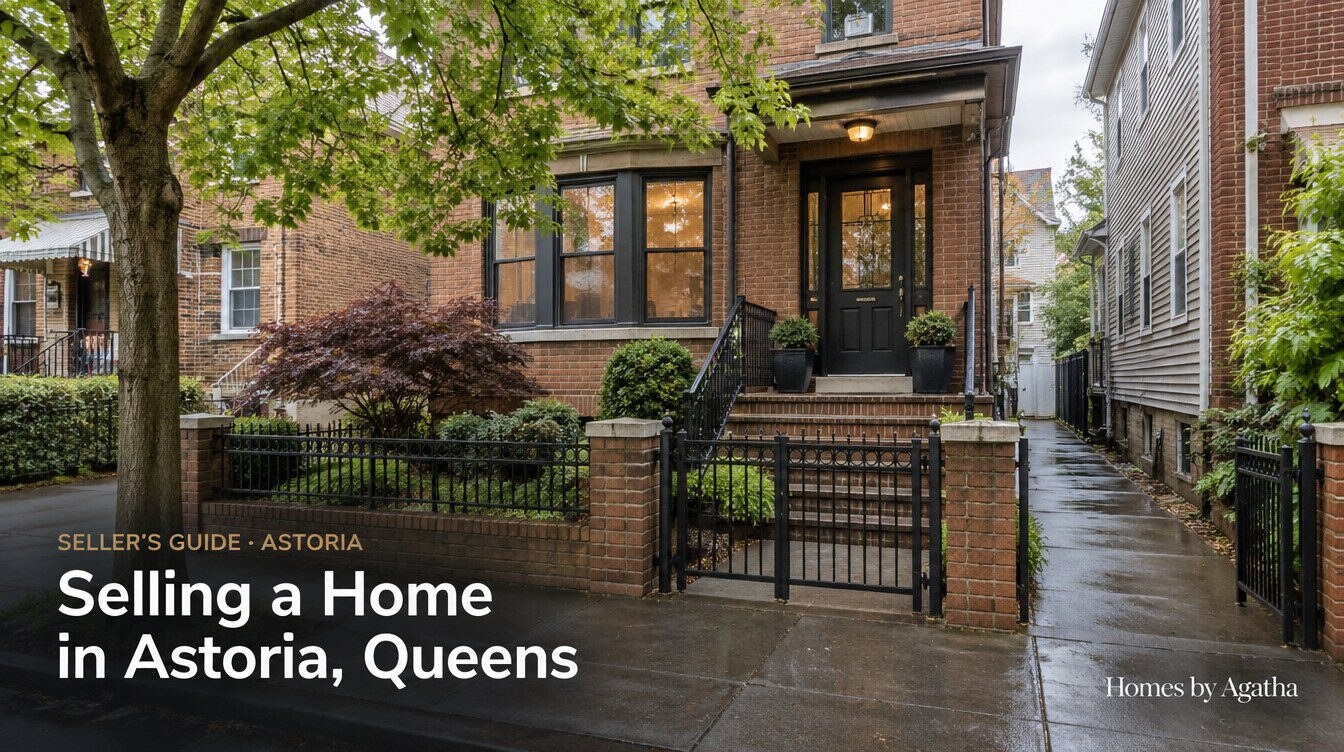
ASTORIA HOME SELLER GUIDE
Selling a Home in Astoria, Queens: How Buyers Compare, How to Price, and What You Net
Quick Answer
Selling a home in Astoria, Queens works best when you price against what buyers tour alongside your property: houses, co-ops and condos near the same stations. Start with a CMA, confirm your legal unit count or building documents, prepare for photos, and budget for New York State and New York City transfer taxes, attorney fees and negotiable brokerage compensation.
Selling a home in Astoria is different from selling in a neighborhood made up mostly of one property type. In Astoria, Queens, a buyer who tours your brick two-family on a Saturday may have seen a co-op on 31st Street and a newer condo near Broadway that same morning. Your home is measured against all of them.
This guide is for owners of Astoria houses, co-op apartments and condos who are thinking about selling in the next months or the next year. It explains how buyers evaluate Astoria property, how a comparative market analysis shapes a price, which preparation steps pay off for older housing stock, how co-op and condo sales differ, what New York requires you to disclose, what selling costs, and how to compare offers.
As a Licensed Associate Real Estate Broker serving Queens and the surrounding New York markets, I prepare sellers for both the market and the paperwork, in English or Polish, whichever is more comfortable for the conversation. I will not quote prices here; values change and every home differs. Instead, you will learn the mechanics that move a sale price up or down in Astoria, so the number you eventually choose has a reason behind it.
Astoria at a glance for sellers
| Item | What it means for an Astoria seller |
|---|---|
| Location | Northwestern Queens on the East River, next to Long Island City, Sunnyside, Woodside, Jackson Heights and East Elmhurst |
| ZIP codes | 11102, 11103, 11105, 11106 (11106 shared with parts of Long Island City); confirm the ZIP for a specific address with the USPS ZIP Code lookup |
| Transit buyers ask about | N/W stations on 31st Street (Astoria–Ditmars Blvd, Astoria Blvd, 30 Av, Broadway, 36 Av, 39 Av–Dutch Kills); M/R at Steinway St and 46 St; NYC Ferry “Astoria” landing near Hallets Point |
| Landmarks buyers recognize | Astoria Park, RFK (Triborough) and Hell Gate bridges, Museum of the Moving Image, Kaufman Astoria Studios, Socrates Sculpture Park, Athens Square Park |
| Commercial corridors | Steinway Street, 30th Avenue, Broadway, Ditmars Boulevard, 31st Street, 36th Avenue |
| Competing property types | Attached and semi-attached one- and two-family houses, older frame houses, pre-war and post-war co-ops, newer condos |
| Paperwork buyers check | Certificate of Occupancy or Letter of No Objection, DOB violations, leases and deposits, co-op financials and rules, condo budgets and abatements |
| Seller taxes (NYC address) | NYS real estate transfer tax and NYC Real Property Transfer Tax, customarily paid by the seller |
How do buyers compare homes when shopping in Astoria?
Buyers in Astoria compare homes by property type, monthly cost, walk to a specific train station, legal status and condition. Because houses, co-ops and condos sit close together, many buyers cross-shop types, so your home competes with options that are bought and financed differently.
The station walk comes first
Astoria buyers usually describe their search by a train, not a street. A home near an N/W station along 31st Street, or near Steinway St or 46 St on the M and R, is evaluated against other homes with a similar walk. Your listing should name the nearest stations accurately and leave the walking time for buyers to confirm. Proximity to the elevated structure is a two-sided factor: convenient for the commute, noisier for the bedrooms facing it.
Monthly cost is how buyers equalize property types
A buyer comparing a co-op, a condo and a two-family converts each into a monthly figure. For a co-op, that means the mortgage plus maintenance. For a condo, the mortgage plus common charges and the separate property tax bill. For a two-family, the mortgage plus taxes, insurance and repairs, minus legal rental income. A seller who understands this math can present the home’s numbers clearly, which is often more persuasive than adjectives.
Legal status is a value factor, not a footnote
For an Astoria house, the Certificate of Occupancy, or CO, is the NYC Department of Buildings record of the building’s legal use and number of units. Buyers’ attorneys and lenders compare the CO with what they see. A legal two-family with two clean units competes as a two-family. A house that is legally a two-family but used as three units does not gain value from the third unit in most buyers’ calculations; it adds questions, and sometimes it costs the seller time.
Condition and systems in older housing stock
Much of Astoria’s house stock is older, so inspectors focus on the boiler and fuel type, any oil tank, electrical capacity, plumbing materials, flat roofs on attached rows, brick pointing and party walls. Buyers in Astoria co-ops look at the building’s finances and upcoming projects. Condo buyers look at reserves and future taxes. Knowing which questions are coming lets you gather answers before the first showing.
How do you price a home when selling in Astoria?
Price an Astoria home from a comparative market analysis built on recent sales of the same property type, in the same section of Astoria, with a similar station walk, size, legal unit count and condition. A CMA is a broker’s professional opinion of value based on market evidence; it is not an appraisal and does not guarantee a sale price.
What goes into an Astoria CMA
A useful Astoria CMA starts with sold comparables, not asking prices, because sold prices show what buyers actually paid. It then adjusts for the differences that matter locally:
- Property type and configuration: a legal two-family is compared with legal two-families; a co-op with co-ops in buildings of similar age and amenities.
- Section of Astoria: Ditmars and Steinway, Old Astoria near Hallets Point, central Astoria between 30th Avenue and Broadway, Astoria Heights and the southern edge near Dutch Kills each have their own comparable set.
- Transit: the walk to N/W or M/R stations, and for some waterfront homes, to the ferry landing.
- Outdoor space and parking: yards, decks, legal driveways and garages carry weight with Astoria house buyers.
- Condition and systems: renovated kitchens and baths, a newer boiler or roof, or work that still needs permits signed off.
- Building factors for co-ops and condos: maintenance or common charges, reserves, elevator, laundry, sublet rules and tax abatements.
- Occupancy: whether a rental unit will be delivered vacant or with a tenant in place.
For a broader explanation of how home values are estimated across the borough, see what is my Queens home worth.
Pricing strategy, not just a number
The list price is a marketing decision built on the CMA. Pricing within the range supported by recent comparable sales tends to bring the most qualified buyers in the first weeks, when a new listing gets the most attention. Pricing well above that range often means buyers compare your home with better-priced alternatives and move on. Precise current market conditions in Astoria change, so the CMA should be dated and refreshed if the listing launch is delayed. Any market statistic you see quoted, such as a median price or average days on market, should name its source and date so you can judge whether it still applies.
Why an appraisal is different
An appraisal is a licensed appraiser’s opinion of value, usually ordered by the buyer’s lender after a contract is signed. The appraised value can differ from both the CMA and the contract price. In Astoria two-family sales, appraisers also look at the legal unit count and rents, which is one more reason to confirm the CO before listing.
Request a CMA for your Astoria home
I will prepare a comparative market analysis based on recent sales of your property type and section of Astoria, and walk you through every adjustment.
What should you fix, stage or leave alone before selling in Astoria?
Before selling in Astoria, fix what an inspector or appraiser will flag, clean and declutter every room, make the property photograph well, and resolve paperwork problems early. Major renovations right before listing rarely make sense; targeted repairs and presentation usually do.
Preparation priorities by property type
| Priority | Two-family or one-family house | Co-op or condo apartment | Why it matters |
|---|---|---|---|
| Paperwork first | CO or Letter of No Objection, open DOB violations, permit sign-offs, leases and deposit records | Recent financials, house rules, alteration approvals for past renovations, abatement details (condos) | Buyers’ attorneys request these quickly; gaps delay contracts |
| Repairs to make | Active leaks, roof and flashing, loose brick or lintels, boiler service, broken windows, smoke and CO detectors | Leaks, damaged floors, broken fixtures, outdated outlets in kitchen and bath | Visible defects become negotiation points after inspection |
| Presentation | Stoop, front gate, yard, basement and boiler room cleaned and lit | Decluttered closets, neutral walls, light fixtures in every room | Photos sell the first showing |
| Often skip | Full kitchen gut, finishing a basement as living space without permits | Major renovation without board or condo approval | Cost, timing and approval risk usually exceed the benefit |
Staging an Astoria two-family
An Astoria two-family has two audiences: owner-occupants and investors. Owner-occupants want to picture themselves in the owner’s unit, so that unit should be staged like a single home, with clear room uses and good light. Investors want to understand the rental unit’s condition and the building systems, so a clean, well-lit basement, an accessible boiler room and labeled meters help. If the rental unit is occupied, coordinate showings with the tenant respectfully and in line with the lease.
Staging an Astoria co-op or condo
Many Astoria co-op apartments are in pre-war and post-war buildings with practical layouts and smaller kitchens. Removing extra furniture, clearing counters and using consistent lighting helps rooms photograph as their real size. In a condo, highlight the building features a buyer is paying for in common charges, such as an elevator, laundry, storage, a gym or outdoor space, using accurate descriptions from the building’s documents.
Small repairs that prevent big negotiations
Inspectors in Astoria’s older houses commonly note items such as missing smoke and carbon monoxide detectors, loose railings, water stains, and gaps around windows. Fixing small, visible items before listing reduces the list of concessions a buyer can request after the inspection.
Selling a two-family home in Astoria with tenants: what changes?
Selling an Astoria two-family with a tenant changes your buyer pool, your timeline and your paperwork. Some buyers want the unit vacant for their own use, while others prefer the rental income. The contract must state clearly whether the unit is delivered vacant or occupied, and the existing lease, security deposit and rent records transfer as part of the deal.
Vacant or occupied delivery
An owner-occupant buyer who needs both floors may only consider vacant delivery. An investor or a buyer who wants rental income may prefer a tenant in place with a reliable payment history. Before listing, decide which buyer you are targeting and whether vacant delivery is realistic under the lease terms and New York law. Tenant protections in New York, including the 2019 Housing Stability and Tenant Protection Act and the 2024 Good Cause Eviction law, can affect how and when a unit becomes vacant. According to NYC HPD, Good Cause Eviction does not cover homes owned by a small landlord, meaning someone who owns 10 or fewer units in total in New York State, or buildings with 10 or fewer apartments where the owner lives in the building; whether an exemption fits your situation depends on facts your attorney should review. Your attorney should advise before you promise anything in a contract.
Documents buyers will ask for
- The current lease, any renewals and any side agreements.
- Rent payment history and any arrears.
- Security deposit amount and where it is held; deposits must transfer to the buyer at closing.
- A tenant estoppel certificate, if the contract requires one, confirming lease terms.
- Utility metering details, such as separate gas and electric meters.
The legal unit question
If your Astoria house has a basement or attic unit that does not appear on the CO, address it before listing. Options include describing the space accurately without calling it an apartment, discussing legalization with an architect or expediter, or pricing the home as the legal configuration. Marketing an illegal unit as income can create problems with lenders, appraisals and buyer attorneys, and it can reduce trust in the rest of the listing. If the house was built before 1938 and lacks a CO, the NYC Department of Buildings may issue a Letter of No Objection confirming its legal use.
Inherited Astoria houses
Many older Astoria houses change hands through an estate. If you are selling an inherited home, the executor or administrator usually needs authority from the Surrogate’s Court before signing a contract, and the timeline depends on that process. Our probate real estate page explains how estate sales in New York typically work.
Key Takeaways
- Astoria buyers cross-shop houses, co-ops and condos near the same stations, so price and present your home against all three.
- A CMA is a broker’s opinion of value from sold comparables, not an appraisal and not a guarantee.
- For two-family sellers, the CO, leases and deposits shape the buyer pool as much as the kitchen does.
- Decide early whether a rental unit will be delivered vacant or occupied, and get legal advice before promising either.
Get a preparation plan for your property
Whether it is a tenant-occupied two-family or a co-op apartment, I will help you list what to fix, what to gather and what to leave alone before listing.
How is selling an Astoria co-op or condo different from selling a house?
Selling an Astoria co-op requires board approval of your buyer, which adds a board package, an interview and time; the building’s rules may also impose a flip tax. Selling an Astoria condo usually requires the condo to waive its right of first refusal, plus a resale package for the buyer. Neither involves a house inspection in the usual sense, but both involve building review.
The co-op sale process
- Confirm with the managing agent the building’s sale requirements: financing limits, minimum down payment, application fees and any flip tax.
- List the apartment and screen offers for buyers who meet those requirements.
- Sign the contract after attorney negotiation; the buyer’s contract usually includes a board-approval contingency.
- The buyer submits a board package with financial statements, tax returns, reference letters and lender documents.
- The board reviews and, typically, interviews the buyer before deciding.
- After approval, the closing is scheduled with the managing agent, attorneys and the buyer’s lender.
A flip tax is a transfer fee set by a co-op’s own documents. There is no citywide flip tax rate in New York City; each building sets its own rule, if any. Ask the managing agent for the exact formula before you price, because it affects your net proceeds.
The condo sale process
A condo unit is deeded real property, so the process is closer to a house sale with added building steps. The condo board usually has a right of first refusal, meaning the right to buy the unit on the same terms, and almost always waives it, but the waiver must be requested and received before closing. The buyer’s attorney will request a resale package with the budget, financial statements, insurance details and house rules.
Tax abatements on newer Astoria condos
Some newer Astoria condo buildings carry property-tax abatements that phase out over time. Buyers ask how long the abatement lasts and what taxes will become, because that affects their monthly cost. Gather the current tax bill and the abatement schedule from NYC Department of Finance records before listing. Abatement status and schedules are specific to each building, so share the official record rather than a summary from memory.
Building factors that affect your sale
Larger buildings may face costs under New York City’s building-emissions law, Local Law 97, which applies to most buildings over 25,000 square feet, and buildings taller than six stories go through the city’s periodic façade inspection program. Buyers’ attorneys read board minutes and financials for planned assessments. If your building has a major project planned, discuss with your attorney how and when to disclose it.
How should an Astoria listing be marketed?
An Astoria listing should combine professional photography, a floor plan, accurate building and transit facts, distribution through OneKey MLS and the major listing portals, and well-planned showings. The marketing should describe the property, its legal configuration and its location facts, never the people who live nearby.
Photography and floor plans
Professional photos with even lighting and straight verticals are the first showing for most buyers. For a two-family, include photos of both units, the basement, the yard and the boiler room, plus a clear floor plan per floor. For a co-op or condo, include building common areas and a floor plan with room dimensions. Buyers who cross-shop property types in Astoria rely on floor plans to compare size fairly.
OneKey MLS and online distribution
OneKey MLS is the multiple listing service used by brokers across Queens and much of the New York region. Listing there shares your property with participating brokers, and listing data typically syndicates to major consumer portals. The listing should state the property type, legal unit count, taxes or maintenance, and the nearest stations accurately.
Describing location facts the right way
Good Astoria listing copy names verifiable facts: the nearest N/W or M/R station, the distance to Astoria Park, the commercial street around the corner, a legal driveway or a yard. Fair Housing rules apply to advertising, so listing copy should describe the property and its verifiable surroundings, never the people who live nearby. Facts about the property and its surroundings are both compliant and more useful.
Marketing channels compared
| Channel | What it does | Astoria-specific tip |
|---|---|---|
| OneKey MLS | Shares the listing with participating brokers | Enter the legal unit count and property type precisely; mismatches cost trust |
| Listing portals | Reach buyers searching online | Lead with the station names and floor plan |
| Open houses | Concentrated showings | For a tenant-occupied two-family, schedule around the lease’s access terms |
| Private showings | Focused visits for qualified buyers | For co-ops, confirm buyers meet building financing rules before booking |
| Broker outreach | Brings buyers working with other agents | Share the building’s financing requirements and the CO in advance |
Plan your Astoria listing launch
From photography to the first open house, let’s plan a launch that presents your property accurately and reaches buyers comparing every property type in Astoria.
What disclosures does a New York seller owe?
A New York seller of most one- to four-family homes must deliver the Property Condition Disclosure Statement before the buyer signs a contract, receive the NYS Disclosure Form for Buyer and Seller from their agent at the first substantive contact, and provide the federal lead-based paint disclosure for most housing built before 1978.
Property Condition Disclosure Statement
The Property Condition Disclosure Statement, or PCDS, is a New York form in which the seller answers questions about the property’s condition based on actual knowledge. Since March 20, 2024, a change in New York law removed the option of giving the buyer a $500 credit instead of delivering the disclosure. Sellers of most one- to four-family homes, including Astoria two-family houses, must now provide the PCDS. Condominium units and co-op apartments are excluded from the disclosure law’s definition of residential real property, so the PCDS does not apply to them. Answer carefully and with your attorney’s guidance; an inaccurate disclosure can create liability.
Agency disclosure
The NYS Disclosure Form for Buyer and Seller, prescribed by the New York State Department of State, explains the different roles an agent can play, such as seller’s agent, buyer’s agent and dual agent. Your agent provides it at the first substantive contact. It is an acknowledgment of the relationship, not a listing contract.
Lead paint and other records
Many Astoria houses and co-op buildings were built before 1978, so the federal lead-based paint disclosure and pamphlet usually apply. In New York City, recording the deed for a one- or two-family home requires a completed smoke detector affidavit, which the NYC Department of Finance lists on its document-recording checklist; your attorney prepares it and confirms the current smoke and carbon monoxide alarm requirements. Your attorney will also check for open DOB violations and outstanding municipal charges, which are typically resolved or credited at closing.
What does selling a home in Astoria cost?
The main costs of selling a home in Astoria are negotiable brokerage compensation, the New York State real estate transfer tax, the New York City Real Property Transfer Tax, your attorney’s fee, the payoff of any mortgage, and building-specific charges such as a co-op flip tax. Because Astoria is in New York City, both the state and city transfer taxes apply.
Seller expenses at a glance
| Expense | How it works | Applies to | Official source / note |
|---|---|---|---|
| Brokerage compensation | Negotiable; set in your listing agreement; any contribution to a buyer’s agent is also negotiable | All sales with a broker | Your listing agreement |
| NYS real estate transfer tax | $2 for each $500 of consideration (0.4%); higher combined rate in NYC for residential conveyances of $3 million or more | Houses, condos, co-op shares | NYS Department of Taxation and Finance |
| NYC Real Property Transfer Tax | 1% when the price is $500,000 or less; 1.425% when above $500,000 (residential 1–3 family homes, co-op units, condo units) | NYC addresses, including Astoria | NYC Department of Finance |
| Seller’s attorney | Fee agreed with the attorney | All sales | Engagement letter |
| Mortgage payoff and satisfaction | Remaining loan balance plus recording of the satisfaction | Houses and condos with a mortgage; co-op loan payoff for co-ops | Lender payoff letter |
| Flip tax | Set by each co-op’s documents; no citywide rate | Co-ops that have one | Proprietary lease / bylaws |
| Building fees | Managing agent, stock transfer and move-out fees (co-ops); resale package fees (condos) | Co-ops and condos | Managing agent |
| Adjustments and violations | Prorated taxes, water and sewer charges, credits for open items | All sales | Closing statement |
Confirm current rates with the NYS Department of Taxation and Finance and NYC Department of Finance before closing.
A simple way to estimate transfer taxes
For an Astoria sale above $500,000 and below $3 million, the two transfer taxes together equal 1.825% of the price: 0.4% for New York State plus 1.425% for New York City. Put differently, every $100,000 of sale price in that range carries $1,825 in combined transfer taxes. At $500,000 or less, the combined rate is 1.4%. These are formulas from the published rates, not an estimate of what your home will sell for.
Costs the buyer usually pays
The NYS “mansion tax” of 1% on residential purchases of $1 million or more is paid by the buyer, and the NYC mortgage recording tax falls on the buyer’s loan. Sellers should still understand these, because they affect what a buyer can afford and how they structure an offer. For a walk-through of who pays what in a Queens closing, see Queens closing costs explained.
Key Takeaways
- Astoria sellers pay both the NYS transfer tax and the NYC Real Property Transfer Tax; above $500,000 they total 1.825% of the price.
- Brokerage compensation, including any contribution to a buyer’s agent, is negotiable.
- A co-op flip tax exists only if your building’s documents create one; get the exact formula before pricing.
- The PCDS is required for most one- to four-family homes since March 20, 2024; the $500 credit option is gone.
See your estimated net proceeds
Bring your mortgage balance and building details, and I will help you outline a seller net sheet with transfer taxes, fees and adjustments, ready to review with your attorney.
How do you compare offers and negotiate in Astoria?
Compare Astoria offers on the strength of the whole package, not only the price: the buyer’s financing, down payment, contingencies, closing date, occupancy terms for any rental unit and, for co-ops, how well the buyer fits the board’s requirements. The highest price is not always the most likely to close.
An offer comparison framework
| Factor | Stronger | Weaker | Why it matters in Astoria |
|---|---|---|---|
| Financing | Cash or a full pre-approval with a larger down payment | Pre-qualification only | Co-op boards and appraisers scrutinize financing |
| Mortgage contingency | Short or waived (with proof of funds) | Long, broad contingency | Reduces the risk the deal unwinds |
| Board fit (co-ops) | Meets debt-to-income and liquidity rules | Borderline or unknown | A board decline restarts your sale |
| Occupancy terms | Matches your vacant or occupied plan | Requires vacancy you cannot deliver | Critical for tenant-occupied two-families |
| Closing date | Fits your move and payoff timing | Conflicts with your plans | Avoids double moves or carrying costs |
| Requests and credits | Few, clearly stated | Open-ended inspection demands | Older systems invite repair negotiations |
Negotiating after the inspection
In older Astoria houses, inspection reports often list many items. Separate code, health and building-system issues from cosmetic notes. A credit at closing is often simpler than doing repairs under time pressure, but your attorney should document any agreement in the contract or a rider. If you prepared the house well and disclosed honestly, the post-inspection negotiation is usually shorter.
Multiple offers
When several buyers are interested, asking for highest and best offers by a set deadline gives everyone the same opportunity. Compare the full package again, including proof of funds, and remember that in New York nothing is binding until the contract is signed by both sides and the deposit is delivered.
How long does it take to sell a home in Astoria?
Preparation and listing take as long as your property needs, while the period from accepted offer to closing commonly runs about two to three months for an Astoria house or condo and often longer for a co-op because of the board process. These ranges are typical, not guaranteed; tenants, estates, financing and boards can all extend them.
| Stage | House or condo | Co-op |
|---|---|---|
| Preparation | Gather CO, permits, leases; repairs; photography | Gather building financials and requirements; repairs; photography |
| Listing to accepted offer | Depends on price, condition and market | Depends on price, condition, market and buyer qualification |
| Accepted offer to signed contract | Commonly 1–3 weeks | Commonly 1–3 weeks |
| Contract to closing | Commonly 6–10 weeks with financing | Commonly longer: board package, interview and approval |
| Closing | Deed transfer, transfer tax filings, payoff | Stock and lease transfer, transfer tax filings, payoff |
A seller who is also buying, perhaps in Astoria or a nearby neighborhood, should coordinate both closings with both attorneys. The Astoria buyer page explains the purchase side of that plan.
Have an offer and want a second look?
If you already have an offer on your Astoria property, I can help you weigh its financing, contingencies and timing before you respond.
What mistakes do sellers make in Astoria?
The most common Astoria seller mistakes are pricing from asking prices instead of sold comparables, marketing illegal units as income, ignoring the co-op’s financing rules when screening buyers, and listing before paperwork is ready.
- Pricing from the wrong comparables. A two-family priced against condos, or a co-op priced against a different building’s amenities, sends buyers elsewhere.
- Advertising an illegal unit. It undermines trust and can derail financing and appraisal.
- Promising vacant delivery without legal advice. Tenant protections can make vacancy timing uncertain.
- Accepting a co-op buyer who will not pass the board. Months can be lost if the board declines.
- Skipping the PCDS. Since March 20, 2024, the $500 credit option no longer exists.
- Forgetting both transfer taxes. Astoria is in New York City, so the NYC RPT applies in addition to the NYS tax.
- Leaving violations for the last week. Open DOB items can delay the closing.
- Over-renovating before listing. Large projects add cost and approval risk without a guaranteed return.
How Astoria compares with nearby markets
Sellers with property in more than one neighborhood often ask how Astoria differs from its neighbors. Selling in Long Island City often means competing with newer condo towers, selling in Sunnyside involves a large co-op stock and attached houses along the 7 line, and selling in Jackson Heights features many co-ops in older buildings. Each market has its own comparable set.
Seller checklist for selling a home in Astoria
Use this checklist to move from decision to closing in order. It condenses this guide into the steps that matter most when selling a home in Astoria.
- Decide your timing and whether you also need to buy.
- Request a CMA based on sold comparables of your property type and section of Astoria.
- Receive the NYS Disclosure Form for Buyer and Seller and sign a listing agreement with negotiated compensation.
- Retain a New York real estate attorney.
- Houses: pull the CO or Letter of No Objection and check DOB violations and permits.
- Two-families: gather leases, rent history and deposit records; decide vacant or occupied delivery with legal advice.
- Co-ops: get the building’s sale requirements and any flip tax formula from the managing agent.
- Condos: gather the resale package, current tax bill and any abatement schedule.
- Complete the PCDS (for one- to four-family homes) and lead-paint disclosure with your attorney.
- Make targeted repairs, declutter and schedule professional photography and floor plans.
- Launch on OneKey MLS and the portals with accurate station and building facts.
- Compare offers using the full package; negotiate inspection items with your attorney.
- Prepare for closing: payoff letter, transfer tax filings, keys, and move-out.
When you are ready to discuss your property in detail, the Astoria seller services page outlines how a listing is planned and managed, and our guide on how to sell your home in Queens covers the borough-wide process.
Map out your Astoria sale
Book a seller consultation to set your pricing approach, preparation steps and timeline, with a clear view of what you will net.
Frequently asked questions about selling a home in Astoria
What transfer taxes does a seller pay in Astoria, Queens?
Astoria sellers customarily pay two transfer taxes. New York State charges $2 for each $500 of consideration, or 0.4%. New York City’s Real Property Transfer Tax is 1% at $500,000 or less and 1.425% above $500,000 for residential 1–3 family homes, co-ops and condos. Confirm current rates with NYS DTF and NYC DOF.
Do I need a Property Condition Disclosure Statement to sell my Astoria house?
Yes, for most one- to four-family homes, including Astoria two-family houses. Since March 20, 2024, New York law no longer allows a $500 credit in place of delivering the Property Condition Disclosure Statement. Co-op and condo units are generally outside the requirement. Complete the form carefully, based on actual knowledge, with your attorney’s guidance.
Can I sell my Astoria two-family with a tenant in place?
Yes. Many Astoria two-families sell with a tenant in place, which can appeal to buyers seeking rental income. The lease, rent history and security deposit transfer to the buyer. If a buyer needs the unit vacant, consult a New York attorney first, because tenant protection laws can affect whether and when vacant delivery is possible.
How is a CMA different from an appraisal?
A comparative market analysis, or CMA, is a broker’s professional opinion of value based on recent sales of similar properties. It guides the list price but is not an appraisal and does not guarantee a sale price. An appraisal is a licensed appraiser’s opinion, usually ordered by the buyer’s lender after the contract is signed.
How long does it take to sell a co-op in Astoria?
Selling an Astoria co-op usually takes longer than a house or condo after the contract, because the buyer must submit a board package and typically attend an interview before approval. From accepted offer to closing, about three months or more is common. Screening buyers against the building’s financial requirements helps avoid delays and declines.
Does every Astoria co-op charge a flip tax?
No. A flip tax exists only when a co-op’s own documents create one, and each building sets its own formula, such as a percentage of the price or a fee per share. There is no citywide flip tax rate. Ask your managing agent for the exact rule before pricing, because it reduces your net proceeds.
Should I renovate my Astoria home before selling?
Usually, targeted repairs beat major renovations. Fix leaks, roof and boiler issues, damaged floors and missing smoke or carbon monoxide detectors, then declutter and prepare for professional photos. Large projects cost money and time and, in co-ops and condos, require board approval. A preparation plan should focus on items inspectors and buyers will notice first.
Is the seller required to pay the buyer’s agent in New York in 2026?
No. Since the 2024 settlement rules, compensation for a buyer’s agent is negotiable and not automatically paid by the seller. A seller may choose to offer a contribution, or a buyer may request one in an offer. Your own listing agreement terms are also negotiable and are set in writing before marketing begins.
Which listing details matter most to Astoria buyers?
Astoria buyers look first at property type, legal unit count, monthly costs and the nearest station, such as an N/W stop on 31st Street or Steinway St and 46 St on the M/R. Clear photos, floor plans and accurate taxes, maintenance or common charges help buyers compare your home with other property types.
What if my Astoria house has no Certificate of Occupancy?
Many Astoria houses predate 1938, when a Certificate of Occupancy was not required unless later changes altered use, egress or occupancy. For those buildings, the NYC Department of Buildings may issue a Letter of No Objection confirming legal use. Gather this before listing, because buyers’ lenders and attorneys will ask for proof of legal use.
Next step: price and prepare for the buyers you will actually meet
Astoria buyers rarely shop one property type in isolation, so the sellers who do well present clear numbers, clean records and accurate location facts that make comparison easy. Start with a CMA from sold comparables, settle the legal-unit and tenant questions early, gather co-op or condo documents before listing, and know your net after both transfer taxes. When you want a plan built around your specific property, visit the sell your Astoria home page to begin.
This article is for general informational purposes only and reflects conditions that may change. It is not legal, tax, or financial advice, an appraisal, or a guarantee of price or outcome; consult a licensed New York attorney, a CPA, and an NMLS-registered mortgage loan originator as appropriate. A CMA is an opinion of value, not an appraisal. Real estate brokerage services are offered by Agatha Lubas, Licensed Associate Real Estate Broker, NY License #10301213345, Keller Williams Realty Liberty, 96-10 101st Avenue, Ozone Park, NY 11416. The NYS Disclosure Form for Buyer and Seller, the NYS Housing and Anti-Discrimination Disclosure / Fair Housing Notice, and the brokerage’s Standard Operating Procedures are available on request. Equal Housing Opportunity.

Agatha Lubas helps sellers, buyers and investors across Queens, Brooklyn, Nassau County and Suffolk County prepare, price and complete their transactions with clear information at every step. She works in English and Polish, so clients can discuss their sale in the language they find most comfortable.
Work with Agatha