

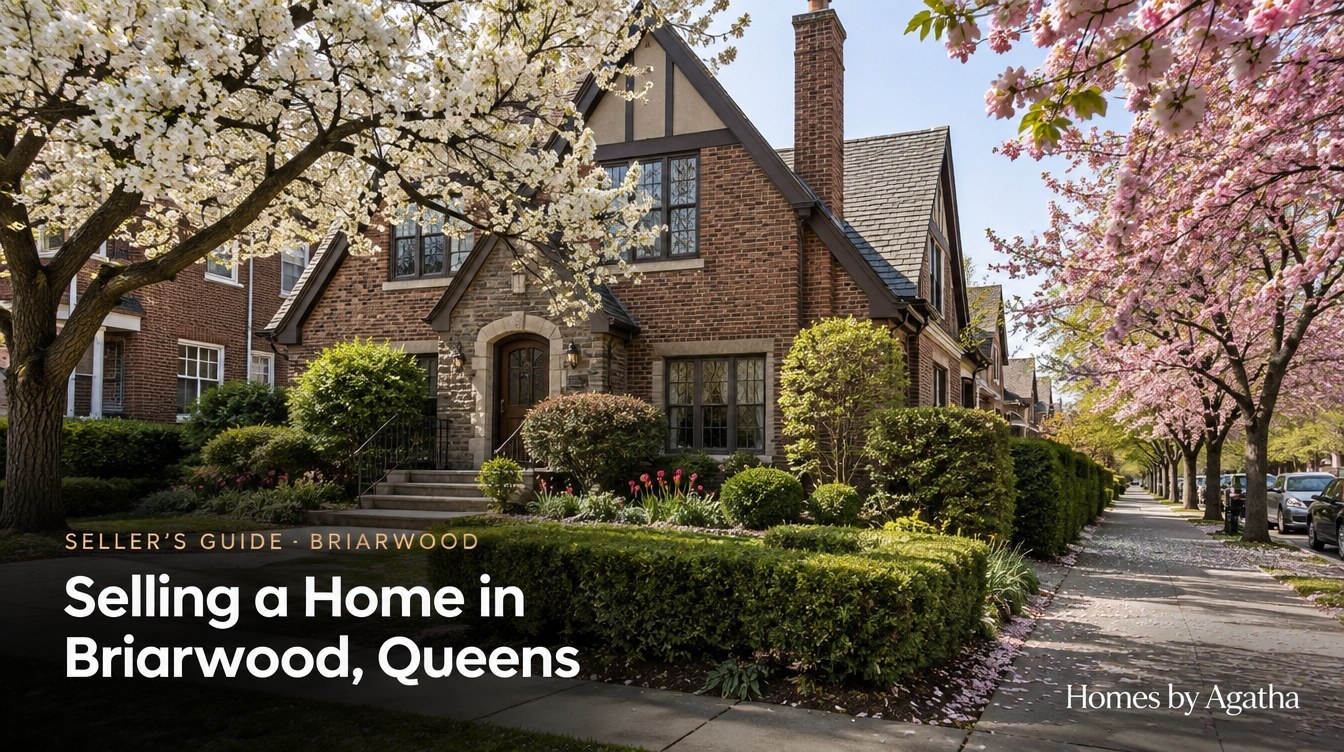
BRIARWOOD REAL ESTATE GUIDE
Selling a Home in Briarwood, Queens: A Seller’s Guide to Two Very Different Markets
Quick Answer
Selling a home in Briarwood, Queens starts with knowing your buyer pool: house buyers judge legal use, lot and condition, while co-op buyers judge maintenance, building finances and board rules. Price from a CMA built on same-type comparables, gather disclosures and building documents early, and budget for NYS transfer tax and NYC Real Property Transfer Tax.
Selling a home in Briarwood means selling into one of two markets that barely overlap. A brick house on an interior block and a one-bedroom co-op near Queens Boulevard attract different buyers, use different paperwork, close through different steps and carry different seller costs. Treating them the same is the fastest way to misprice a listing or lose weeks to a missing document.
This guide is for owners in Briarwood, Queens who are thinking about a sale in the next year — including people who inherited a property or are selling to buy elsewhere. It explains how buyers evaluate each property type here, how a comparative market analysis (CMA) supports a price, what to fix and what to leave, how a co-op sale moves through the managing agent and board, which New York disclosures apply, and what you will pay at closing. As a Licensed Associate Real Estate Broker based in Queens, I prepare pricing and listing plans for sellers across the borough, in English and Polish. When you want a plan for your own property, the Briarwood seller services page is the place to start.
Briarwood at a glance
| Item | Briarwood, Queens | Why it matters to a seller |
|---|---|---|
| Borough / county | Queens (Queens County), New York City; Queens Community Board 8 | NYC address, so the NYC Real Property Transfer Tax applies in addition to the NYS transfer tax |
| ZIP code | 11435 for most addresses; confirm the ZIP for the specific address with USPS | Buyers and portals search by ZIP and neighborhood name; use both accurately |
| Commonly described boundaries | Van Wyck Expressway, Parsons Boulevard, Union Turnpike and Hillside Avenue (informal) | Comparable sales near the edges may come from Kew Gardens, Kew Gardens Hills, Jamaica Hills or Jamaica |
| Subway | Briarwood station (IND Queens Boulevard Line) at Queens Boulevard and Main Street: F at all times; the E stops here only at certain times, so check the current MTA timetable before relying on it; F stations on Hillside Avenue; Kew Gardens–Union Turnpike (E, F) | Walking distance to a station is one of the first things apartment buyers check |
| Rail and roads | LIRR at Jamaica and Kew Gardens; AirTrain JFK from Jamaica; Van Wyck Expressway, Grand Central Parkway, Queens Boulevard, Hillside Avenue | Commuters and drivers both shop here; parking and noise both affect perception |
| Parks and landmarks | Hoover–Manton Playgrounds; Briarwood Promenade greenstreet on Queens Boulevard; Parkway Village; Captain Tilly Park in adjacent Jamaica Hills | Accurate nearby-amenity facts belong in listing copy |
| Property types | Co-op and rental apartment buildings; a garden-apartment co-op; detached and semi-detached one- and two-family houses | Each type has its own comparables, process and seller costs |
How do buyers evaluate homes in Briarwood?
Briarwood buyers evaluate houses and co-ops on different scorecards. House buyers look first at legal use, lot, parking and the age of the systems; co-op buyers look first at maintenance, the building’s finances and rules, and the walk to Briarwood station. Knowing which scorecard applies tells you what to fix, what to document and how to price.
What house buyers look for
Briarwood’s houses include Colonial and Tudor-style homes plus other detached and semi-detached one- and two-family houses; the year built for a specific house is in NYC Department of Finance and Department of Buildings records. Buyers of these houses typically weigh the following:
- Legal use. Whether the Certificate of Occupancy matches the way the house is being used — one-family or two-family — and whether any basement or attic living space is legal.
- Lot, driveway and garage. Off-street parking matters to buyers who drive the Van Wyck Expressway or Grand Central Parkway.
- Systems. Roof, boiler or furnace, electrical service, plumbing supply lines, sewer line and any oil tank in an older house.
- Original character versus updates. Tudor and Colonial details appeal to some buyers; others prioritize renovated kitchens and baths.
- Block position. Distance to Hillside Avenue or Queens Boulevard stations, and exposure to traffic from the highways and main roads.
What co-op buyers look for
Co-op buyers in Briarwood shop the building as much as the apartment. Their questions usually include these:
- Monthly maintenance and what it includes, compared with similar apartments nearby.
- Financing rules: the building’s minimum down payment, maximum financing and post-closing liquidity requirement, which vary from building to building.
- Building finances: reserves, the underlying mortgage, and any planned or current assessment.
- Policies: sublets, pets, washers and dryers, renovations.
- Transit: the walk to Briarwood station, Kew Gardens–Union Turnpike or the Hillside Avenue F stations.
Parkway Village, the 1947 garden-apartment complex near Union Turnpike and Main Street that became a co-op in 1983 and was listed on the National Register of Historic Places in 2012, draws its own comparison set: buyers compare apartments within the complex more than with elevator buildings elsewhere. Because it sits where Briarwood meets Kew Gardens Hills, listings and maps may use either name, so a listing can mention both to reach buyers searching each.
Why this matters before you list
A buyer who cannot answer a scorecard question tends to discount the price or walk away. If you are selling a house, a clear Certificate of Occupancy and service records answer the first questions. If you are selling a co-op, a current financial statement, the maintenance breakdown and the building’s policies answer them.
How should you price a home in Briarwood?
Price a Briarwood home from comparable sales of the same property type, adjusted for condition, size, legal use and location — and test that price against the active competition. A comparative market analysis (CMA) is a real estate broker’s professional opinion of value based on that market evidence. It is not an appraisal and does not guarantee a sale price.
Comparables for a co-op
The strongest co-op comparables are recent sales in the same building, followed by sales in similar buildings nearby. Within a building, adjust for floor, exposure, layout and renovation. Between buildings, adjust for maintenance and rules: two similar apartments can sell at noticeably different prices if one building’s maintenance is higher, its financing rules stricter or an assessment is pending. Co-op sales are not recorded as deeds, so your broker gathers them from OneKey MLS and from NYC Department of Finance sales records, checking what is available for your specific building.
Comparables for a house
House comparables in Briarwood should match on detached versus semi-detached, one-family versus legal two-family, lot size, parking and style. A legal two-family should not be compared with a one-family that has an unpermitted basement unit; lenders and appraisers will not treat them the same. Houses near the neighborhood’s edges may draw useful comparables from adjacent areas such as Kew Gardens, Jamaica Estates or Jamaica, adjusted for real differences in housing stock.
Pricing strategy and the appraisal
Most buyers search in price bands on the portals. A list price set just above a common search threshold can remove your property from many searches, while a price inside the right band reaches more buyers. If the buyer finances, the lender’s appraisal must support the contract price; a price far above the comparables can lead to an appraisal shortfall and a renegotiation. For a broader view of how valuation works across the borough, see what is my Queens home worth.
Current Briarwood prices change with interest rates and inventory, so any figure in a CMA should come from recent recorded sales and active listings, dated and sourced. Ask for comparables pulled from OneKey MLS and NYC Department of Finance records at the time you set the price, not from an older report.
Curious what your Briarwood property could sell for?
I can prepare a CMA built on same-type comparables for your house or co-op — a professional opinion of value, explained line by line, with no obligation to list.
What should you fix or prepare before selling a home in Briarwood?
Before selling a home in Briarwood, fix what a buyer’s inspector, lender or co-op board would flag, clean and declutter everything, and leave large remodels alone unless the numbers clearly support them. The paperwork — Certificate of Occupancy, permits, service records or co-op documents — deserves as much attention as the paint.
| Preparation item | Briarwood house | Briarwood co-op | Why it matters |
|---|---|---|---|
| Legal paperwork | Pull the Certificate of Occupancy, open permits and violations from NYC DOB records | Request the stock certificate, proprietary lease, recent financials and the building’s sale requirements from the managing agent | Gaps here delay contracts and financing |
| Systems and hazards | Service the boiler or furnace; fix active leaks; address obvious electrical issues; document any oil tank removal or abandonment | Fix leaks and faulty fixtures inside the apartment; confirm any past alterations were board-approved | Inspectors and boards flag these first |
| Cosmetic work | Neutral paint, refinished floors where worn, clean exterior and front yard | Neutral paint, light fixtures, clean windows and radiator covers | Photos and first impressions |
| Decluttering and staging | Show room purpose, including basements used for storage or recreation without overstating their legal use | Make storage visible and furniture scale fit the rooms | Helps buyers read space and layout |
| Major renovation | Usually not worth starting right before a sale; get pricing advice first | Usually not worth it; alterations need board approval and time | Return is uncertain; timing risk is high |
Older-house systems in Briarwood
Many Briarwood houses date from the 1930s and the decades after, so buyers’ inspectors commonly focus on aging electrical service, galvanized supply pipes, original sewer lines, roofs and chimneys, and the history of any oil tank. A pre-listing inspection can tell you which items to repair, which to disclose and which to price in. Repairing a known leak usually costs less than the discount a buyer will ask for after their inspection finds it.
Legal units and the Certificate of Occupancy
The Certificate of Occupancy is the NYC Department of Buildings document that states a building’s legal use and number of dwelling units. If your house is used as a two-family but the Certificate of Occupancy says one-family, market it accurately: a basement or attic apartment without the matching approvals cannot be advertised as a legal unit. Your attorney and an architect or expediter can explain whether legalization is realistic and how long it might take. That answer is specific to each property, so get it from an NYC-licensed architect before you promise anything to a buyer.
Staging a co-op apartment
In Briarwood’s mid-century apartment buildings, buyers look for light, storage and layout. Remove extra furniture, clear windowsills, open closets to show capacity, and make the kitchen and bath look maintained. Ask the managing agent about rules for open houses, lockboxes and contractor access before you schedule work or showings.
What is different about selling a Briarwood co-op?
A Briarwood co-op sale adds the building to the transaction. The buyer must be approved by the co-op board, the managing agent controls key documents and fees, and the co-op’s own documents decide whether a flip tax applies. The seller’s job is to make the building’s information available early so the buyer’s lender, attorney and board package can move.
What the seller provides
- The original stock certificate and proprietary lease (or an affidavit and replacement process if lost).
- A payoff letter if you have a share loan, so the lender’s lien can be released at closing.
- Access to the building’s financial statements, house rules, policies and, typically through the attorneys, board minutes.
- Information about any alterations you made and their board approvals.
- Contact details for the managing agent, who handles the building questionnaire for the buyer’s lender.
The board package and the seller
The board package is the buyer’s application to the co-op board, but a slow or incomplete package delays your closing too. Choosing a buyer whose finances clearly meet the building’s rules is the strongest protection a seller has against a board decline. That is why co-op offers should be compared on the strength of the board package, not only on price.
Flip tax and building fees
A flip tax is a transfer fee that a co-op may charge on a sale, set by that co-op’s own documents. There is no city-wide flip tax rate; some buildings charge one and others do not, and the method of calculation varies. Read your proprietary lease, bylaws and house rules, or ask the managing agent for the current transfer fees and processing charges before you set your net-proceeds expectations.
Timing around the board
Boards meet on their own schedules. Your contract should allow a realistic window for the board process, and your move-out plans should allow for the interview date. Ask the managing agent whether the building requires a move-out deposit or a scheduled elevator reservation.
Key Takeaways
- Price a Briarwood co-op from same-building sales first, adjusting for maintenance, rules and any pending assessment.
- Price a Briarwood house only against comparables with the same legal use, lot type and parking.
- Pull the Certificate of Occupancy and DOB records before listing; legal-unit problems surface at the lender’s desk.
- A co-op seller’s strongest protection against a board decline is a buyer whose finances clearly meet the building’s rules.
Need a preparation plan for your Briarwood property?
Together we can list what to repair, what to document and what to leave alone, with the paperwork your buyer’s attorney and lender will ask for already in hand.
How will buyers find your Briarwood listing?
Most buyers first see a Briarwood listing online. A listing entered in OneKey MLS reaches cooperating brokers and is typically distributed to major consumer portals, so the photos, floor plan and description become your first showing. Accurate, compliant copy and strong visuals do more work than any single open house.
Photography, floor plans and video
Professional photography matters for both property types, but for different reasons. For a house, exterior shots, the lot and the garage or driveway answer parking and space questions. For a co-op, a measured floor plan helps buyers compare layouts across buildings near Queens Boulevard, and photos of the building’s lobby, laundry room and grounds — where the building allows them — show what maintenance pays for.
OneKey MLS and online distribution
OneKey MLS is the multiple listing service used by brokers across Queens, Long Island and other parts of downstate New York. Listing data from the MLS typically feeds the major consumer search portals and brokerage websites, so accuracy in the MLS record — property type, maintenance, taxes, legal use — prevents confusion later. Under the post-2024 settlement rules, OneKey MLS removed its compensation fields in August 2024, so offers of compensation to buyers’ agents are not published in the MLS.
Writing compliant listing copy
Describe the property, not the people you imagine buying it. Fair Housing rules mean listing copy should focus on rooms, features, building amenities, parks, transit and commercial corridors — for example, “a short walk to Briarwood station (F)” or “near the Briarwood Promenade on Queens Boulevard” — and avoid language about who would “fit” the neighborhood. Accurate transit facts matter: confirm whether the E stops at Briarwood at the hours you describe before you mention it.
Showings and open houses
For houses, open houses and private showings can be scheduled freely. For co-ops, check building rules about open houses, sign-in requirements and lockboxes. A seller who works from home can set showing windows; a tenant-occupied apartment or two-family house needs advance notice and cooperation from the tenant.
Which disclosures do New York sellers have to make?
Most sellers of one- to four-family houses in New York must deliver the Property Condition Disclosure Statement (PCDS) before the buyer signs the contract; since March 20, 2024, the option of giving a $500 credit instead has been removed. Sellers also receive the NYS Disclosure Form for Buyer and Seller explaining agency relationships, and sellers of housing built before 1978 have federal lead-based paint disclosure duties.
The Property Condition Disclosure Statement
The PCDS is a form set by New York State law in which the seller answers questions about the property’s condition, systems, environmental issues and legal status based on actual knowledge. For a Briarwood house, expect questions that touch on items buyers care about locally: oil tanks, flooding or water in the basement, roof age, and whether the property’s use matches its Certificate of Occupancy. Co-op apartments and condo units are excluded from the PCDS requirement under the state law’s definition of residential real property. Fill out the form carefully with your attorney; an inaccurate answer can create liability.
Agency disclosure
The New York State Disclosure Form for Buyer and Seller, issued under the NYS Department of State’s regulations, explains whom a real estate agent represents. A seller receives it at the first substantive contact with an agent, before the relationship is formalized, and signs to acknowledge receipt.
Lead-based paint disclosure
Under federal rules, sellers of most housing built before 1978 must disclose known lead-based paint and lead-based paint hazards, provide any available reports, give buyers the federal lead-hazard pamphlet, and offer the buyer an opportunity to conduct a lead inspection or risk assessment before the contract becomes binding, unless the buyer waives it. Much of Briarwood’s housing stock appears to predate 1978, so many sellers here will have this duty. Confirm the year built for your specific property through NYC Department of Finance or Department of Buildings records.
Mapping out your Briarwood listing strategy?
I can help you decide on timing, presentation, MLS details and disclosure preparation before the listing goes live, so the launch matches the property you are selling.
What does it cost to sell a home in Briarwood?
A Briarwood seller’s main costs are brokerage compensation (negotiable), the New York State real estate transfer tax, the New York City Real Property Transfer Tax, the seller’s attorney fee, payoff of any loan, and — for co-ops — any flip tax and building fees. The NYC Real Property Transfer Tax applies because Briarwood is in New York City.
| Cost | Rule or amount | Applies to | Source / who sets it |
|---|---|---|---|
| NYS real estate transfer tax | $2 for each $500 of consideration (0.4%), customarily paid by the seller | Houses and co-op units | NYS Department of Taxation and Finance |
| NYC Real Property Transfer Tax (RPT) | 1% when the price is $500,000 or less; 1.425% when above $500,000 (residential 1–3 family homes, individual co-op units and condo units), customarily paid by the seller | Houses and co-op units in Briarwood | NYC Department of Finance |
| Brokerage compensation | Negotiable; not set by law | All sales | Listing agreement |
| Buyer-agent compensation | Negotiable; not automatically paid by the seller; may be offered or negotiated within an offer | All sales | Agreement between the parties |
| Seller’s attorney | Fee agreed with the attorney | All sales | Your attorney |
| Loan payoff | Per the lender’s payoff letter | Mortgages and share loans | Your lender |
| Flip tax | Only if the co-op’s documents impose one; no city-wide rate | Co-ops only | The co-op’s own documents |
| Managing-agent and transfer fees | Set by the building | Co-ops | Managing agent |
| Repairs, violations, credits | Negotiated; open violations may need to be cleared | Mostly houses | Contract / NYC DOB records |
Confirm current rates with the NYS Department of Taxation and Finance and NYC Department of Finance before closing.
The New York State “mansion tax” — 1% of the price on residential purchases of $1 million or more, graduated above $2 million in New York City — is paid by the buyer, not the seller. Likewise, the NYC mortgage recording tax is a buyer cost on mortgages for houses and condos, and it does not apply to co-op share loans. Your attorney prepares the transfer tax returns, including the NYS and NYC forms filed through ACRIS for New York City properties. Income-tax consequences of a sale vary by owner, so ask a CPA. For a side-by-side view of buyer and seller costs in the borough, see the guide to Queens closing costs explained.
Estimating your net proceeds
Net proceeds are the sale price minus the loan payoff, transfer taxes, compensation, attorney fees, building fees and any negotiated credits. Ask for a written net-sheet estimate with each line sourced before you choose a list price. It is easier to set expectations with a realistic net figure than to adjust them after an offer arrives.
How should you compare offers and negotiate?
Compare offers on price and on certainty. In Briarwood, a slightly lower offer with a large down payment, clean financing and a buyer who clearly meets a co-op’s rules can be worth more than a higher offer that depends on a tight appraisal or a borderline board application.
| Offer factor | What to look for | Briarwood-specific note |
|---|---|---|
| Price | Gross price and any requested credits | Compare against same-type comparables, not the neighborhood overall |
| Financing | Cash, conventional loan or share loan; loan amount; pre-approval quality | For co-ops, the loan must fit the building’s financing limit |
| Down payment and reserves | Size of down payment; proof of funds | Co-op boards often look at post-closing liquidity |
| Appraisal exposure | Gap between price and likely appraised value | Houses with unusual features or legal-use questions carry more risk |
| Contingencies | Financing, board approval, inspection terms | Board approval is standard for co-ops; ask how strong the package is |
| Closing timeline | Proposed closing window; flexibility | Co-op closings depend on board meeting schedules |
| Buyer-agent compensation request | Whether the offer asks the seller to contribute | Negotiable; evaluate on net proceeds, not only price |
Negotiating in an attorney state
In New York, an accepted offer is not a contract. After you accept, the attorneys negotiate and prepare the contract of sale, and the buyer typically pays a contract deposit held in escrow when both sides sign. Until then, either side can walk away, so keep backup interest alive and avoid treating an acceptance as final.
Handling inspection and appraisal results
For a house, the buyer’s inspection often happens before contract signing, and the buyer may ask for a credit. Weigh a credit against the time and risk of re-listing. If an appraisal comes in below the contract price, the options are usually to renegotiate, for the buyer to cover the difference, or to end the deal under the contract’s terms; your attorney advises on which applies.
Multiple offers
When several buyers bid, asking for “highest and best” offers by a set deadline gives every buyer the same opportunity. Compare the final offers with the table above, and ask your attorney to review any unusual terms before you choose.
Key Takeaways
- Briarwood sellers customarily pay the NYS transfer tax (0.4%) and the NYC RPT (1% or 1.425%, by price).
- The mansion tax and the mortgage recording tax are buyer costs; co-op share loans carry no mortgage recording tax.
- Brokerage and buyer-agent compensation are negotiable and should be evaluated on net proceeds.
- Rank offers by certainty — financing, board fit, appraisal risk and timeline — not by price alone.
Holding offers and unsure which is stronger?
I can help you compare net proceeds, financing strength and board fit side by side before you answer any buyer.
How long does it take to sell a home in Briarwood, from listing to closing?
The timeline depends on property type and preparation more than on the calendar. A Briarwood house closes after attorney contract work, the buyer’s financing and title work; a Briarwood co-op adds the board package, the interview and the board’s decision. The table below shows the stages and what controls each one.
| Stage | Briarwood house | Briarwood co-op | What usually slows it down |
|---|---|---|---|
| 1. Preparation | Repairs, CO and DOB records, PCDS draft | Managing-agent documents, sale requirements, flip tax check | Missing paperwork |
| 2. Pricing and launch | CMA, photos, OneKey MLS listing | CMA, photos, floor plan, building rules for showings | Pricing above the comparables |
| 3. Offer accepted | Inspection, attorney review | Attorney due diligence on building documents | Slow document delivery |
| 4. Contract signed | Deposit in escrow; buyer applies for mortgage | Deposit in escrow; buyer applies for share loan | Contract negotiation |
| 5. Financing and approvals | Appraisal, loan commitment, title search | Appraisal, building review, loan commitment, board package, interview | Appraisal gaps; board schedule |
| 6. Closing | Deed transfer; transfer taxes paid; loan paid off | Stock and lease assigned; transfer taxes and fees paid; loan paid off | Payoff letters, violations, coordination |
For the full borough-wide process from the seller’s side, the guide on how to sell your home in Queens walks through each step in more detail.
Selling to buy
Many Briarwood owners sell in order to buy, sometimes within the same neighborhood. If you plan to move from a co-op to a house, or the reverse, line up the sale contract and the purchase timeline with both attorneys, and decide early whether you need a rent-back period or a bridge solution. The companion guide on buying in Briarwood explains the other side of that move.
What mistakes cost Briarwood sellers time or money?
Most costly mistakes in selling a home in Briarwood come from pricing with the wrong comparables or listing before the paperwork is ready. Avoid these:
- Mixing property types in the CMA. A co-op priced against houses, or a one-family priced against legal two-families, misleads everyone.
- Advertising an unapproved unit. A basement apartment that is not on the Certificate of Occupancy cannot be marketed as a legal rental unit.
- Ignoring open DOB violations or permits. They can surface late and delay closing.
- Not checking the flip tax and building fees. Net proceeds can differ from your expectation if co-op charges are discovered at the end.
- Choosing the highest price over the strongest buyer. In a co-op, a board decline sends you back to the market.
- Treating disclosures casually. The PCDS and lead-paint disclosures carry legal weight.
- Overstating transit service. Describe Briarwood station service accurately for the hours you mention.
- Waiting on estate paperwork. An inherited Briarwood property usually needs court authority from the Queens County Surrogate’s Court before the executor or administrator can close; start that process early and review the guidance on selling probate real estate in New York.
Your Briarwood seller checklist
- Identify your property type and buyer pool: house or co-op.
- Gather the deed or stock certificate and proprietary lease, plus any loan information.
- Pull the Certificate of Occupancy, open permits and violations from NYC DOB records (houses), or the building’s financials, policies and sale requirements (co-ops).
- Confirm any flip tax and managing-agent fees in writing (co-ops).
- Request a CMA based on same-type comparables and active competition.
- Ask for a net-proceeds estimate including NYS transfer tax, NYC RPT, compensation and attorney fees.
- Choose a New York real estate attorney before you accept an offer.
- Complete repairs that inspectors or boards would flag; skip speculative remodels.
- Prepare the PCDS (houses) and lead-paint disclosure (pre-1978 housing) with your attorney.
- Schedule professional photos and a floor plan; confirm building showing rules.
- Compare offers for price and certainty; review terms with your attorney.
- Track the buyer’s financing and board timeline through closing.
Want a seller timeline built around your dates?
Whether you are moving, downsizing or settling an estate, we can work backward from your target closing to a step-by-step plan for your Briarwood property.
Frequently asked questions about selling a home in Briarwood
What documents do I need to sell a co-op in Briarwood?
To sell a Briarwood co-op, you typically need the original stock certificate and proprietary lease, a share-loan payoff letter if you borrowed, and access to the building’s financial statements, house rules and sale requirements through the managing agent. Records of board-approved alterations also help. Your attorney coordinates delivery to the buyer’s attorney and lender.
Do I have to give a Property Condition Disclosure Statement when selling a Briarwood house?
For most one- to four-family houses, yes. Since March 20, 2024, New York sellers can no longer give a $500 credit instead of delivering the Property Condition Disclosure Statement. Complete it with your attorney based on actual knowledge, covering systems, water, oil tanks and legal use. Co-op units are generally outside this requirement.
What transfer taxes does a Briarwood seller pay?
A Briarwood seller customarily pays the New York State real estate transfer tax of $2 per $500 of consideration (0.4%) and the New York City Real Property Transfer Tax: 1% when the price is $500,000 or less, 1.425% above $500,000. Both apply to houses and individual co-op units. Confirm current rates before closing.
Is there a flip tax when selling a co-op in Briarwood?
Only if your co-op’s own documents impose one. There is no city-wide flip tax rate in New York City; each building decides whether to charge a transfer fee and how to calculate it. Check your proprietary lease, bylaws and house rules, or ask the managing agent, before estimating your net proceeds.
Is a CMA the same as an appraisal?
No. A comparative market analysis is a real estate broker’s professional opinion of value based on comparable sales and active listings. It is not an appraisal and does not guarantee a sale price. If your buyer finances, the lender orders a separate appraisal, which must support the contract price for the loan.
Do I have to pay the buyer’s agent when I sell in Briarwood?
Not automatically. After the 2024 NAR settlement, buyer-agent compensation is negotiable and not set by law. A seller may agree to contribute, a buyer may pay their own agent, or the terms may be negotiated within an offer. Compare offers on net proceeds, including any compensation request, rather than on price alone.
Can I sell a Briarwood house that has a basement apartment?
Yes, but describe it accurately. If the Certificate of Occupancy does not show the basement as a legal dwelling unit, it cannot be marketed as a legal rental. Buyers’ lenders and appraisers rely on the legal use. An architect or attorney can advise whether legalization is realistic before you set the price.
Does being near Briarwood station affect a buyer’s decision?
For many apartment buyers, yes. The walk to Briarwood station, served by the F at all times and the E at certain times, is one of the first things co-op buyers check. A CMA reflects location through comparable sales in the same building or nearby, rather than through a fixed premium.
Can I sell an inherited house in Briarwood before probate is finished?
An executor or administrator generally needs authority from the Queens County Surrogate’s Court before closing a sale of estate property. Preparation, pricing and sometimes marketing can begin earlier. Work with an estate attorney on timing, and expect the buyer’s attorney and title company to require proof of that authority before closing.
Should I renovate my Briarwood home before selling?
Usually not. Fix leaks, hazards, open violations and items an inspector or co-op board would flag, then focus on cleaning, paint and presentation. Large remodels started just before a sale rarely return their cost and, in a co-op, need board approval and time. Get pricing advice before committing to major work.
Before you list your Briarwood home
The strongest Briarwood sales start by naming the property type and the buyer pool, then pricing from same-type comparables, clearing the paperwork that buyers’ attorneys, lenders and boards will request, and budgeting accurately for the NYS transfer tax, the NYC Real Property Transfer Tax and any co-op fees. With that groundwork, offers can be judged on certainty as well as price. When you are ready for a CMA and a listing plan for your own house or co-op, visit the Briarwood home selling page to start the conversation.
This article is for general informational purposes only and reflects conditions that may change. It is not legal, tax, or financial advice, an appraisal, or a guarantee of price or outcome; consult a licensed New York attorney, a CPA, and an NMLS-registered mortgage loan originator as appropriate. A CMA is an opinion of value, not an appraisal. Real estate brokerage services are offered by Agatha Lubas, Licensed Associate Real Estate Broker, NY License #10301213345, Keller Williams Realty Liberty, 96-10 101st Avenue, Ozone Park, NY 11416. The NYS Disclosure Form for Buyer and Seller, the NYS Housing and Anti-Discrimination Disclosure / Fair Housing Notice, and the brokerage’s Standard Operating Procedures are available on request. Equal Housing Opportunity.

Agatha Lubas helps sellers, buyers and investors across Queens, Brooklyn, Nassau County and Suffolk County prepare, price and close residential sales, from co-op apartments to multi-family houses. She works in English and Polish so clients can follow every document and decision comfortably.
Work with Agatha