

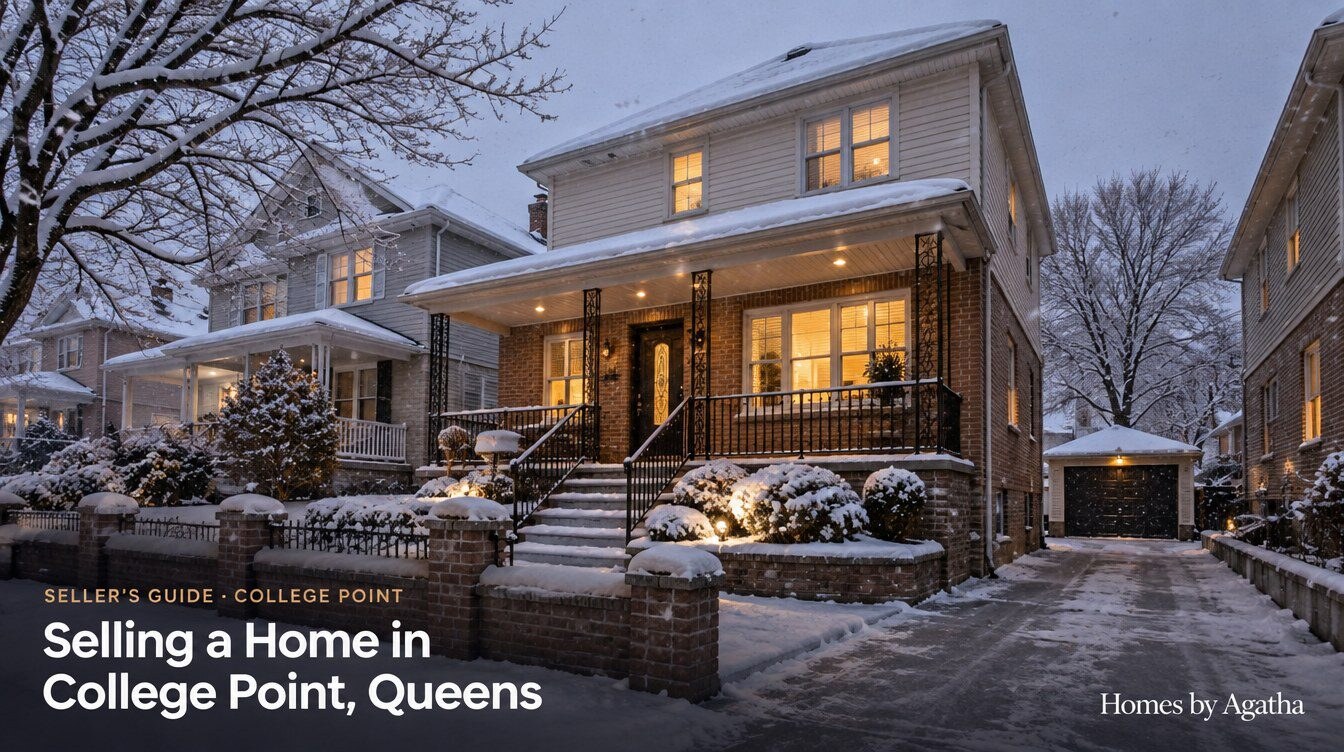
COLLEGE POINT HOME SELLER GUIDE
Selling a Home in College Point, Queens: Pricing, Preparation and Paperwork
Quick Answer
Selling a home in College Point, Queens (ZIP 11356) goes smoothly when you price from a CMA that matches your exact property type and flood status, then gather what buyers ask for: Certificate of Occupancy, permits, flood history and any HOA or condo papers. Budget for negotiable commission, NYS transfer tax, NYC Real Property Transfer Tax and attorney fees.
Selling a home in College Point raises questions that sellers in many other parts of Queens never hear. College Point is a peninsula in northern Queens, bordered by Flushing Bay, the East River and Powell’s Cove, with no subway line and a housing stock made up mostly of houses. Buyers who tour here arrive with a predictable set of questions: Is the house in a flood zone? Is the second apartment legal? How close is the bus? What does the HOA cost?
The sellers who do well are usually the ones who answer those questions before the first showing. This guide explains how buyers evaluate College Point homes, how a comparative market analysis is built for a peninsula with very different micro-markets, what to prepare, which New York disclosures apply, what a seller pays in New York City and how to compare offers.
As a Licensed Associate Real Estate Broker serving Queens and the surrounding New York markets, I help owners plan a sale from the first pricing conversation to the closing table, in English or Polish, whichever makes the conversation easier. Nothing here is a promise of price or timing; it is a framework to help you make decisions with clear information.
College Point at a glance for sellers
| Topic | What a College Point seller should know |
|---|---|
| Location | Northern Queens peninsula, New York City; Queens Community Board 7; ZIP code 11356 |
| Waterfront edges | Flushing Bay (west), East River (north), Powell’s Cove (east); Whitestone and Malba to the east, Flushing to the south |
| Transit buyers ask about | No subway; MTA local buses — the Q20, Q25 and Q26 serve College Point under the 2025 Queens Bus Network Redesign — to Flushing–Main Street (7 train and LIRR Port Washington Branch), plus express bus options to Manhattan; check mta.info for current routes and stops |
| Road access | Whitestone Expressway (I-678) toward the Bronx–Whitestone Bridge and the Van Wyck Expressway |
| Parks and landmarks near listings | MacNeil Park, Powell’s Cove Park, Frank Golden Memorial Park, College Point Park; the Poppenhusen Institute, a New York City Landmark on 14th Road |
| Commercial corridors | College Point Boulevard; the shopping center area along 20th Avenue |
| Typical property types sold | Detached and semi-detached one-family houses, two- and three-family houses, attached townhouses and low-rise condos (many near the northern shoreline), a limited number of co-ops |
| Seller taxes | NYS real estate transfer tax and NYC Real Property Transfer Tax (College Point is a New York City address) |
| Questions to answer before listing | Flood zone and flood history, legal units vs. actual use, open permits or violations, HOA or condo rules and fees, parking and driveway status |
How do buyers evaluate homes in College Point?
College Point buyers compare a home on five things: property type and legal use, flood status and insurance cost, condition of an older house or the finances of a newer development, parking and access, and price relative to the same property type nearby. A home that answers those questions clearly tends to draw stronger offers than one that leaves them open.
Legal use is the first filter for multi-family houses
Many College Point houses are two- or three-family homes, and buyers often plan to rent a unit or share the house with relatives. Their lender will usually count rent only from legal units. That makes the Certificate of Occupancy (CO) and NYC Department of Buildings records central to the sale. A CO is the Department of Buildings document stating a building’s legal use and number of units. If your house has more apartments than the records show, expect buyers and their attorneys to price that in or ask questions.
Flood status shapes the monthly budget
Homes on low-lying blocks near the shoreline may sit within or near a FEMA Special Flood Hazard Area, where a lender generally requires flood insurance. Look up your exact address on both the effective and the preliminary FEMA flood maps, because the answer can differ between nearby blocks. Buyers add that premium to their monthly cost, so it directly affects what they can pay. Interior blocks on higher ground may face fewer questions, but buyers will still check.
Condition and age for older houses
For older frame and brick houses, buyers look closely at the heating system, any past or present oil tank, electrical service, the roof, the basement and windows. Visible deferred maintenance tends to produce offers that discount more than the cost of the repair, because buyers price in uncertainty as well as the work itself.
Development finances for townhouses and condos
For shoreline townhouses and condos built since the 1980s, buyers focus on the development’s documents: common charges or HOA dues, reserve funds, planned assessments, insurance (including flood coverage on shared structures), parking rules and rental policies. A seller who can hand over a current budget and recent minutes removes a major source of delay.
Access and parking
Because College Point relies on buses and cars, buyers value a legal driveway, a garage or assigned parking, and they ask how far the nearest bus stop is. Describe these facts accurately in the listing; overstating access only creates friction at the showing.
How do you price a home when selling in College Point?
Price a College Point home from a comparative market analysis that uses the same property type, a similar location on the peninsula and similar flood and legal-unit status. A CMA, or comparative market analysis, is a real estate broker’s professional opinion of value based on relevant market evidence; it is not an appraisal and does not guarantee a sale price.
Why College Point comparables need careful selection
College Point is small, but its homes are not interchangeable. A legal two-family house and a one-family house on the same block appeal to different buyers and are financed differently. A shoreline townhouse in a development with high common charges competes with other townhouses, not with detached houses inland. A house in a Special Flood Hazard Area carries a cost that a house a few blocks away may not. A useful CMA separates these groups rather than averaging them together.
College Point pricing drivers
| Pricing driver | Why buyers care | What to prepare |
|---|---|---|
| Legal number of units | Determines rental income a lender will count | CO or DOB records, current leases |
| Flood zone and insurance | Adds to monthly cost; may be lender-required | Flood zone lookup, elevation certificate, current policy and premium |
| Lot, driveway and parking | Practical value in a bus-and-car neighborhood | Survey, records of curb cut, condo or HOA parking documents |
| Age and condition of systems | Buyers discount for uncertainty | Service records, permits, receipts for major work |
| HOA or condo costs | Common charges or dues reduce what buyers can borrow | Current budget, reserve information, any planned assessments |
| Location within the peninsula | Distance to bus routes, waterfront, commercial and manufacturing zones | Accurate listing description; zoning lookup on ZoLa |
The appraisal still matters after you accept
Most buyers finance, and the lender’s appraiser will look for comparable sales of the same property type. If your price stretches far beyond those comparables, the appraisal may come in lower, and you may face a renegotiation. Pricing with the appraisal in mind protects the deal you accept, not just the first number buyers see. For a broader view of valuation in the borough, read what is my Queens home worth.
When you are ready for a property-specific opinion of value, our College Point home selling page explains how Agatha prepares a CMA for the peninsula.
Curious how your College Point home compares?
Request a CMA built on your exact property type, legal units and flood status — a professional opinion of value, not an appraisal, with the reasoning shown.
How should you prepare and stage a College Point house before listing?
Prepare by fixing what a buyer’s inspector will flag, documenting what you have already fixed and presenting the space so buyers can see how they would use it. In College Point, the basement, the heating system and the paperwork for any second unit deserve extra attention, because those are the areas where buyers’ doubts usually start.
Preparation priorities
| Priority | What to do | Why it matters in College Point |
|---|---|---|
| 1. Water and basement | Fix leaks, clear gutters and leaders, address grading, document any waterproofing or backwater valve | Buyers near the shoreline look for signs of water entry first |
| 2. Records and permits | Have your attorney check open permits and violations; close out what you can | Unresolved items delay closings and weaken negotiating position |
| 3. Heating and oil tank | Service the boiler or furnace; gather any tank abandonment or removal paperwork | Older Queens houses often heated with oil |
| 4. Detectors and railings | Working smoke and carbon monoxide detectors, secure railings, functioning outlets | Small items that otherwise appear in every inspection report |
| 5. Exterior | Clean siding or masonry, repair steps, trim landscaping, clear the driveway | First photos and first impressions set the price conversation |
| 6. Interior presentation | Declutter, neutral repairs, good lighting, define each room’s use | Helps buyers compare your home with newer townhouses |
Pre-listing inspection: when it helps
A pre-listing inspection is a home inspection you order before going on the market. For an older College Point house, it can reveal surprises early, when you still control the response: repair, price accordingly or disclose. It is optional, and anything it reveals may affect what you need to disclose, so discuss the timing with your attorney.
Staging by property type
- One-family houses. Show the yard, the driveway and storage. Buyers moving from apartments respond to clearly usable space.
- Two- and three-family houses. Present each unit cleanly, and if a unit is tenant-occupied, coordinate showings in line with the lease and give tenants proper notice. Prepare a simple rent roll with the lease terms.
- Townhouses and condos. Emphasize light, layout and any outdoor space or water view, and keep development documents ready for buyers’ attorneys.
Tenant-occupied homes
If a tenant lives in your two-family house, the sale must respect the lease and New York tenant protections. Decide with your attorney whether you will sell with the tenant in place or deliver the unit vacant, because that choice changes your buyer pool and the contract terms. Security deposits held for tenants are transferred at closing under the contract terms.
Key Takeaways
- A College Point CMA should compare like with like: property type, legal units and flood status.
- The basement, heating system and second-unit paperwork are where buyer doubt usually begins.
- Open permits and violations are cheaper to resolve before listing than during a contract.
- Decide early whether a tenant-occupied unit will be delivered vacant or with the lease in place.
Want a preparation plan for your College Point house?
I can walk through the property with you, flag what buyers and inspectors will notice first and help you decide what to repair, what to document and what to leave.
How is selling a College Point condo, townhouse or co-op different?
Selling a condo, an HOA townhouse or a co-op in College Point adds a layer of building or association paperwork to the sale. Condo sellers deal with the board of managers and the condo questionnaire; HOA townhouse sellers supply association documents; co-op sellers need board approval of the buyer and must follow the building’s transfer rules, including any flip tax.
Condo units
A condo unit is real property with a deed. Many condominiums have a right of first refusal in their by-laws, which the board typically waives in writing before closing. The buyer’s lender usually sends a questionnaire to the managing agent about the building’s finances, insurance and owner-occupancy. Ask the managing agent early what they need and what they charge, so the paperwork does not hold up the closing.
Townhouses in a homeowners association
Some College Point shoreline townhouses are fee-simple houses whose owners belong to a homeowners association rather than a condominium; your attorney can confirm which structure applies from the offering plan or your deed. The buyer’s attorney will ask for the HOA’s governing documents, budget, dues history and any pending assessments. Having those ready helps buyers commit sooner.
Co-op apartments
Where a co-op apartment is being sold in College Point, the process follows co-op rules. The buyer submits a board package — financial statements, references and an application — and usually attends an interview. The board’s decision controls whether the sale can close.
A flip tax is a transfer fee some co-ops charge on a sale. There is no city-wide flip tax rate; it exists only if the co-op’s own documents provide for it, and those documents set the amount and who pays. Check the proprietary lease and house rules with your attorney before setting your price.
How is a College Point home marketed to buyers?
A College Point listing is marketed through OneKey MLS, which distributes listing data to brokerages and many consumer portals, supported by professional photography, accurate floor plans and a clear description of property type, parking and access. Strong marketing for a peninsula home also answers the practical questions — units, flood status, transit — in the listing materials rather than leaving them for the showing.
Photography and floor plans
Professional photography matters most for the first impression online. For two-family houses, separate photo sets and floor plans for each unit help buyers understand the layout. For townhouses and condos, show parking, storage and any outdoor or shared space accurately.
What to say — and not say — in the listing
Listing copy should describe the property by its features: bedrooms, units, lot, driveway, heating type, nearby parks such as MacNeil Park or Powell’s Cove Park, and transit options such as bus routes to Flushing–Main Street. Fair housing rules require the description to stay on the property and its surroundings, never on who lives nearby or any protected characteristic. Accurate, feature-based copy is both compliant and more useful to buyers.
Showings and open houses
Plan showings around daylight when possible, so buyers can see the lot, the street and any water views. For tenant-occupied units, schedule visits according to the lease and with notice. If buyers ask about flood history or legal use during a showing, refer them to the disclosure documents and your attorney rather than answering casually.
Marketing channels compared
| Channel | What it does | College Point note |
|---|---|---|
| OneKey MLS | Shares the listing with cooperating brokerages and distributes data to portals | Reaches buyers searching across northern Queens, including Whitestone and Flushing |
| Consumer portals | Where most buyers first see photos and price | Accurate unit count and parking details reduce wasted inquiries |
| Open houses | Lets buyers experience the street, lot and access | Weekend daylight shows the location and commute options clearly |
| Agent outreach | Direct contact with agents representing active buyers | Useful for two-family houses and townhouses with specific buyer pools |
| Bilingual communication | Lets the seller discuss the process in a preferred language | Agatha works in English and Polish for client comfort; marketing is open to every buyer |
Thinking about how to present your College Point home?
Let’s plan the listing together — photos, unit-by-unit floor plans, the facts buyers will ask for and a description that is accurate and compliant.
What documents and disclosures does a College Point seller need?
Most College Point sellers of one-to-four-family houses must deliver New York’s Property Condition Disclosure Statement, give the NYS agency disclosure at the first substantive contact and, for homes built before 1978, provide the federal lead-based paint disclosure. Beyond the legal minimum, gathering your CO, permits, flood records and any HOA or condo documents before listing makes the sale faster.
Property Condition Disclosure Statement
The Property Condition Disclosure Statement (PCDS) is a New York State form in which the seller answers questions about the property’s condition and history. Since March 20, 2024, a change in New York law removed the former option of giving the buyer a $500 credit instead of delivering the disclosure, so sellers of most one-to-four-family houses must provide the PCDS. The current form includes questions about flood zones, flood history, flood insurance and flood-related claims, which are especially relevant on the College Point shoreline. Condo units and co-op apartments are outside the PCDS requirement, because New York’s Real Property Law excludes them from the definition of residential real property covered by the disclosure law; a fee-simple townhouse in a homeowners association is a house, so ask your attorney how the rule applies to yours.
Answer honestly and based on what you actually know. Your attorney should review the completed form before it is delivered.
Agency disclosure
The NYS Disclosure Form for Buyer and Seller, required by the NYS Department of State, explains the different roles a real estate licensee can play. Sellers receive it at the first substantive contact with an agent. It does not create an obligation to list; it clarifies who represents whom.
Lead-based paint disclosure
Federal rules require sellers of housing built before 1978 to disclose known lead-based paint and hazards, provide available records and give buyers the opportunity for a lead inspection. Many older College Point houses fall within that age range.
Seller document checklist
| Document | Where it comes from | Why a College Point buyer asks for it |
|---|---|---|
| Certificate of Occupancy or DOB records | NYC Department of Buildings (attorney or expediter can help) | Confirms legal use and number of units |
| Permits and sign-offs for past work | Department of Buildings; your own contractor files | Shows additions, basements and system upgrades were legal |
| Flood zone, elevation certificate, flood policy | FEMA maps; your surveyor; your insurer | Lets buyers price insurance before they offer |
| Survey | Your closing file from the original purchase | Shows lot lines, driveway and any encroachments |
| Oil tank records | Removal or abandonment paperwork, if any | Older houses often had oil heat |
| Leases and security deposits | Your rental files | Required to transfer tenant-occupied units |
| HOA or condo documents | Managing agent or association | Budget, rules, assessments and parking terms |
| Property tax and utility history | NYC Department of Finance; utility accounts | Helps buyers estimate ownership costs |
Inherited homes and estates
Many College Point houses have been held for a long time, and some sales come from an estate. If the owner has died, the executor or administrator usually needs authority from the Queens County Surrogate’s Court before signing a contract. That affects timing and documents. Our page on selling a home through probate in New York explains the process in more detail.
What does it cost to sell a home in College Point?
When selling a home in College Point, a seller typically pays the listing brokerage’s negotiated compensation, the NYS real estate transfer tax, the NYC Real Property Transfer Tax, their own attorney’s fees, the mortgage payoff and related recording costs, plus any building fees for a condo or co-op and any repair credits agreed with the buyer. Every fee in that list except the taxes is negotiated or property-specific.
Transfer taxes
College Point is a New York City address, so two transfer taxes apply:
- NYS real estate transfer tax (NYS Department of Taxation and Finance): $2 for each $500 of consideration, which equals 0.4%, customarily paid by the seller. As simple arithmetic, that is $400 for every $100,000 of sale price.
- NYC Real Property Transfer Tax (NYC Department of Finance): for residential one-to-three-family houses, individual condo units and co-op units, 1% when the price is $500,000 or less and 1.425% when the price is above $500,000, customarily paid by the seller. As arithmetic, that is $1,000 per $100,000 at the 1% rate and $1,425 per $100,000 at the 1.425% rate.
Seller expenses at a glance
| Expense | Who sets it | Applies to |
|---|---|---|
| Listing brokerage compensation | Negotiated between seller and listing brokerage; not set by law | All sales with a listing agent |
| Contribution to buyer-agent compensation | Negotiable; not automatically paid by the seller | Only if the seller agrees in a given transaction |
| NYS real estate transfer tax | NYS Department of Taxation and Finance — 0.4% | All sales |
| NYC Real Property Transfer Tax | NYC Department of Finance — 1% up to $500,000; 1.425% above | All College Point residential sales |
| Seller’s attorney fees | Agreed with your attorney | All sales |
| Mortgage payoff and satisfaction costs | Your lender and recording fees | Homes with an existing mortgage |
| Managing agent or board fees | Building or association | Condos, co-ops, some HOAs |
| Flip tax | Co-op’s own documents only | Co-ops whose documents provide for it |
| Repairs, credits, violation cures | Negotiated with the buyer | Depends on inspection and records |
Confirm current rates with the NYS Department of Taxation and Finance and NYC Department of Finance before closing.
Brokerage compensation in 2026
Brokerage compensation is negotiable and is not set by law. Since the 2024 NAR settlement changes, sellers are not automatically responsible for paying the buyer’s agent; buyers sign their own written agreements with their agents. A seller may choose to offer a contribution as part of the marketing or the negotiation, and that is a business decision to discuss openly with your listing agent. For more on seller and buyer closing costs in the borough, see Queens closing costs explained.
Key Takeaways
- College Point sellers pay both the NYS transfer tax (0.4%) and the NYC Real Property Transfer Tax (1% or 1.425%).
- Brokerage compensation is negotiable, and the seller is not automatically responsible for the buyer’s agent.
- Most one-to-four-family sellers must deliver the PCDS; the $500 credit option ended March 20, 2024.
- A flip tax exists only if a co-op’s own documents provide for it.
Want to see your likely net before you list?
I can help you estimate the seller costs that apply to your College Point property — taxes, building fees and likely repairs — so you can review them with your attorney and plan with real numbers.
How do you compare offers and negotiate in College Point?
Compare offers on net proceeds and certainty, not price alone. In College Point, the details that most often change certainty are the buyer’s financing, how the buyer will handle flood insurance and the appraisal, whether a tenant stays or leaves, and how quickly the buyer’s attorney can move to contract.
Offer comparison framework
| Factor | Questions to ask | Why it matters here |
|---|---|---|
| Price and net | What remains after taxes, fees and any requested credits? | A higher price with large credits may net less |
| Financing | Cash or mortgage? Loan type? Strength of pre-approval? | Condo and multi-family loans involve extra review |
| Down payment | How much, and from verified funds? | Larger down payments can absorb an appraisal gap |
| Appraisal plan | Will the buyer cover a gap if the appraisal is low? | Few exact comparables for some property types |
| Flood insurance readiness | Has the buyer obtained a quote? | Avoids late surprises on shoreline blocks |
| Possession and tenants | Vacant delivery or tenant in place? | Changes timing and contract terms for two-family houses |
| Timing | Target contract date and closing date | Matches your own move or purchase |
Negotiating after inspection
In New York City, the buyer’s inspection usually happens before the contract is signed, so most negotiation over condition takes place in that window. Common outcomes are a price adjustment, a credit at closing or a specific repair. Having your records ready — permits, service history, flood documents — helps keep these conversations factual.
Why an accepted offer is not yet a sale
New York is an attorney state. An accepted offer becomes binding only when both sides sign a contract of sale that the attorneys negotiate. Until then, either party can walk away, which is why sellers sometimes keep showing the home until the contract is signed. Discuss that strategy with your agent and attorney.
What is the timeline for selling a home in College Point, and which mistakes slow it down?
Selling a home in College Point follows the standard New York City sequence: preparation, listing, offers, attorney due diligence, contract, buyer’s mortgage commitment and closing. The local factors that most often add time are missing legal-unit records, open permits, flood insurance questions and condo or HOA paperwork.
| Stage | Seller’s main tasks | College Point delays to prevent |
|---|---|---|
| 1. Planning | CMA, choose listing brokerage, sign agency disclosure | Pricing from the wrong property type |
| 2. Preparation | Repairs, records, document gathering, staging | Open permits and violations discovered late |
| 3. Listing and showings | Photography, OneKey MLS, open houses | Unclear unit count or parking in the listing |
| 4. Offers and negotiation | Compare offers, accept, memorandum of sale | Weak pre-approvals, unclear tenant plans |
| 5. Buyer due diligence | Provide access, documents, PCDS | Missing flood records or HOA documents |
| 6. Contract | Attorneys sign; deposit held in escrow | Negotiating credits without records |
| 7. Mortgage commitment | Cooperate with appraisal and condo questionnaire | Low appraisal; delayed building paperwork |
| 8. Closing | Clear title issues, final walk-through, transfer taxes paid | Violations that must be cured; tenant move-out timing |
Common seller mistakes
- Pricing from the wrong comparables. Averaging a two-family house against one-family houses or townhouses skews the price.
- Listing before checking records. An open permit or an undocumented basement unit discovered after an offer weakens your position.
- Leaving flood questions unanswered. Buyers near the shoreline will ask; a ready answer avoids lost momentum.
- Overstating the listing. Describing an illegal unit as an apartment or overstating transit access creates problems at contract.
- Choosing the highest number only. A weaker offer on paper may net more and close more reliably.
College Point seller checklist
- Request a CMA that matches your property type, legal units and flood status.
- Read the NYS Disclosure Form for Buyer and Seller and agree on brokerage compensation in writing.
- Engage a New York real estate attorney before listing.
- Pull your CO or Department of Buildings records and search open permits and violations.
- Look up your flood zone and gather any elevation certificate and flood policy.
- Collect surveys, oil tank paperwork, permits, receipts and leases.
- For a condo, HOA townhouse or co-op, request the documents and fees from the managing agent.
- Address water, heating, detector and railing items, then stage and photograph.
- Prepare the Property Condition Disclosure Statement with your attorney and, for pre-1978 homes, the lead-paint disclosure.
- Compare offers on net proceeds, financing strength and timing.
- Estimate NYS transfer tax and NYC Real Property Transfer Tax with your attorney.
Owners comparing nearby markets can also look at our pages for selling in Whitestone and selling a home in Flushing, and our general guide on how to sell your home in Queens. If your next step is buying on the peninsula again, our College Point buyer page covers the other side of the move.
Ready to map out your College Point sale?
Let’s set a realistic timeline from preparation to closing, line up your documents and decide how you will review offers when they arrive.
Frequently asked questions about selling a home in College Point
What taxes does a seller pay in College Point, Queens?
A College Point seller customarily pays the NYS real estate transfer tax, $2 per $500 of consideration (0.4%), and the NYC Real Property Transfer Tax, 1% for residential sales of $500,000 or less and 1.425% above $500,000. Confirm current rates on the NYS Department of Taxation and Finance and NYC Department of Finance websites.
Do I have to disclose that my College Point house is in a flood zone?
Sellers of most one-to-four-family houses must deliver New York’s Property Condition Disclosure Statement, which includes questions about flood zones, flood history, flood insurance and flood claims. Answer based on what you actually know, and have your attorney review the form. Buyers will also check the address on FEMA flood maps themselves.
Can I still give a $500 credit instead of the disclosure form?
No. Since March 20, 2024, New York law no longer lets sellers give a $500 credit instead of delivering the Property Condition Disclosure Statement. Sellers of most one-to-four-family houses in College Point must provide the completed form. Co-op and condo units are generally outside the requirement, so confirm your situation with a New York attorney.
How is a CMA different from an appraisal?
A CMA, or comparative market analysis, is a real estate broker’s professional opinion of value based on relevant market evidence. It is not an appraisal and does not guarantee a price. An appraisal is a licensed appraiser’s valuation ordered by the buyer’s lender. In College Point, both should compare homes of the same property type.
Will an illegal basement apartment affect my College Point sale?
Usually, yes. Lenders generally count rent only from legal units, so buyers may not be able to use income from an undocumented apartment, and insurers and attorneys will ask questions. Compare your actual units with NYC Department of Buildings records before listing, and describe the property accurately in marketing to avoid problems at contract.
Do I have to pay the buyer’s agent when I sell?
Not automatically. Brokerage compensation is negotiable and not set by law. Since the 2024 NAR settlement changes, buyers sign written agreements with their own agents, and sellers are not automatically responsible for that fee. A seller may choose to contribute in a particular transaction, which is a business decision to discuss with the listing agent.
How do I sell a College Point townhouse in a condo development?
Expect the board of managers to handle any right of first refusal waiver and the buyer’s lender to send a condo questionnaire to the managing agent. Request the budget, reserve information, rules and fees early. A condo unit is generally outside the PCDS requirement, but buyers’ attorneys will still review the building’s documents closely.
Is there a flip tax when selling a co-op in College Point?
Only if the co-op’s own documents provide for one. There is no city-wide flip tax rate in New York City; each co-op sets its own transfer fee, if any, in its proprietary lease or house rules. Ask your attorney to check the documents before you set your asking price, because the fee affects your net.
Can I sell my College Point two-family house with a tenant living there?
Yes. You can sell with the tenant in place under the existing lease or arrange vacant delivery, depending on the lease terms and New York tenant law. Each choice attracts different buyers and changes contract terms. Gather leases and security deposit records, give proper notice for showings and plan the approach with your attorney.
How do I sell an inherited house in College Point?
The executor or administrator generally needs authority from the Queens County Surrogate’s Court before signing a contract of sale. That step affects timing, documents and who signs. Work with a New York estate or real estate attorney, gather the deed and property records, and plan pricing and preparation as you would for any College Point house.
Next steps for College Point sellers
The strongest College Point sales start with answers, not just a price. Confirm your legal units, look up your flood status, gather permits and any HOA or condo documents, and price from comparables that match your property type and location on the peninsula. Then present the home honestly, deliver the required disclosures and judge offers on net proceeds and certainty. When you want a property-specific CMA and a listing plan, start with our page on selling your home in College Point.
This article is for general informational purposes only and reflects conditions that may change. It is not legal, tax, or financial advice, an appraisal, or a guarantee of price or outcome; consult a licensed New York attorney, a CPA, and an NMLS-registered mortgage loan originator as appropriate. A CMA is an opinion of value, not an appraisal. Real estate brokerage services are offered by Agatha Lubas, Licensed Associate Real Estate Broker, NY License #10301213345, Keller Williams Realty Liberty, 96-10 101st Avenue, Ozone Park, NY 11416. The NYS Disclosure Form for Buyer and Seller, the NYS Housing and Anti-Discrimination Disclosure / Fair Housing Notice, and the brokerage’s Standard Operating Procedures are available on request. Equal Housing Opportunity.

Agatha Lubas works with sellers, buyers and investors across Queens, Brooklyn, Nassau County and Suffolk County, from pricing and preparation through the closing table. She offers service in English and Polish, so every client can talk through the details in the language that feels most comfortable.
Work with Agatha