

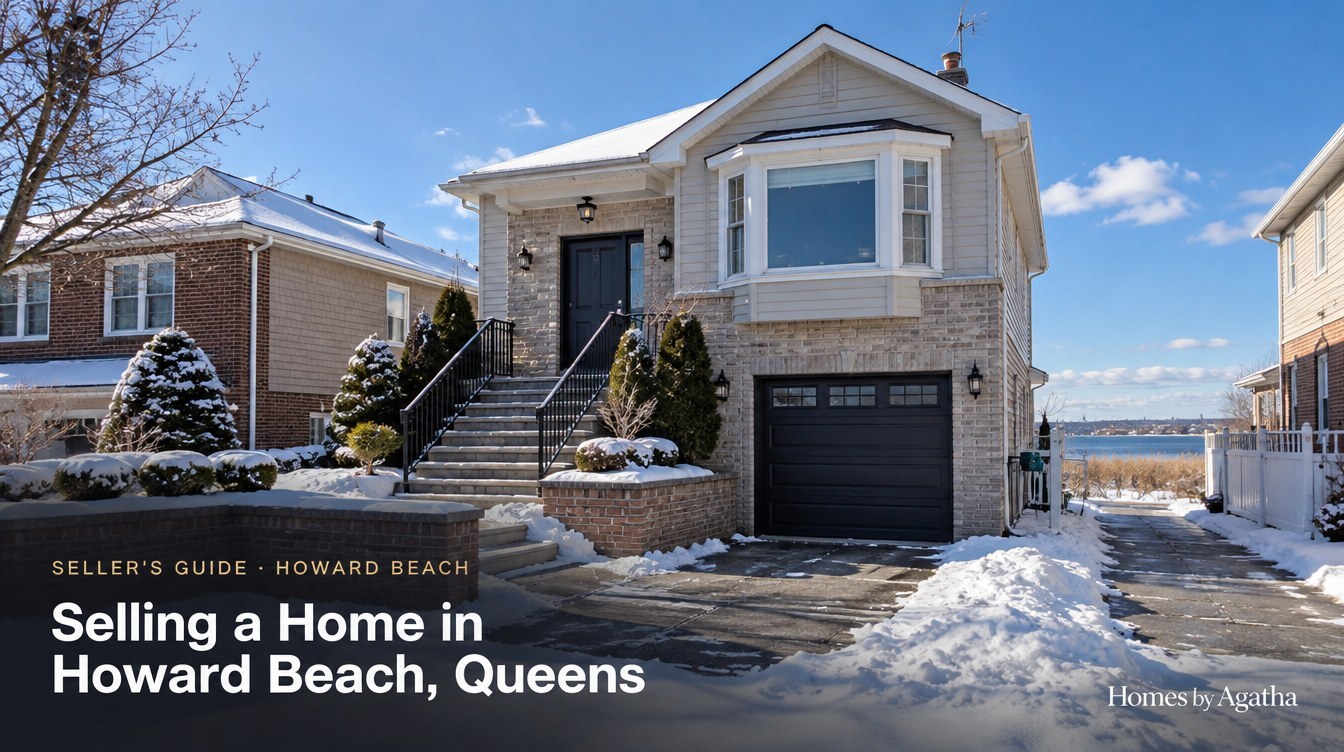
HOWARD BEACH SELLER GUIDE
Selling a Home in Howard Beach, Queens: Price, Records and Net Proceeds
Quick Answer
Selling a home in Howard Beach, Queens works well when you price against true sub-area comparables, gather flood records early (elevation certificate, flood policy, PCDS answers), confirm the Certificate of Occupancy and closed permits, and budget for the NYS transfer tax and NYC Real Property Transfer Tax. Lindenwood co-op sales also need board approval.
Selling a home in Howard Beach means answering a specific set of buyer questions before they are asked. Buyers who tour a house in Rockwood Park, a two-family in Old Howard Beach or a co-op in Lindenwood usually want to know three things quickly: is it in a flood zone, what will insurance cost, and is everything legal and signed off? Sellers who have those answers on paper tend to spend less time negotiating against uncertainty.
This guide is for owners in Howard Beach, Queens, who are planning a sale in the coming months and want to understand pricing, preparation, documents, costs and timing before they choose a strategy. It explains how a comparative market analysis is built for this neighborhood, which flood and permit records help most, how a Lindenwood co-op or condo sale differs from a house sale, and how to estimate what you will keep after the transfer taxes and other costs.
As a Licensed Associate Real Estate Broker with an office in Ozone Park, just north of Howard Beach, I help Queens owners plan their sales in English and Polish. This article explains the process; your attorney, CPA and lender remain the right people for legal, tax and financing advice.
Howard Beach at a glance
| Item | What it means for a Howard Beach seller |
|---|---|
| Location | Southwestern Queens on Jamaica Bay, south of the Belt Parkway and Conduit Avenue, with John F. Kennedy International Airport to the east and the Brooklyn line near Spring Creek to the west; boundaries are informal |
| Borough / ZIP | Queens, New York City; ZIP code 11414, which includes Lindenwood and Hamilton Beach. NYC transfer tax rules apply. |
| Sub-areas buyers search | Rockwood Park and New Howard Beach (mostly detached houses), Old Howard Beach (one- and two-family homes, canal-side lots), Lindenwood (co-ops, condos, two-family homes), Hamilton Beach and Ramblersville (small waterfront lots) |
| Transit buyers ask about | A train at Howard Beach–JFK Airport station with the AirTrain JFK connection; Aqueduct–North Conduit Av station just north; Q52 and Q53 Select Bus Service on Cross Bay Boulevard |
| Amenities buyers mention | Cross Bay Boulevard shopping, the Lindenwood Shopping Center, Frank M. Charles Memorial Park (Gateway National Recreation Area), Spring Creek Park, Jamaica Bay views and boating access |
| Questions that shape price | FEMA flood zone, elevation and flood insurance cost; rebuild or renovation history after Hurricane Sandy in 2012; legal unit count; bulkhead condition; co-op maintenance and building finances |
| Documents to gather | Deed, Certificate of Occupancy, DOB permit sign-offs, elevation certificate, flood policy declarations, Property Condition Disclosure Statement (houses), co-op or condo sale package |
What decides the price of a Howard Beach home?
The price of a Howard Beach home is driven mainly by its sub-area and property type, its elevation and flood insurance cost, whether it was rebuilt or raised with permits signed off, its legal unit count, and, on the water, the condition of the bulkhead. Interior finishes matter, but in this neighborhood buyers often weigh flood-related costs as heavily as kitchens and baths.
Understanding which of these drivers apply to your home helps you choose the right comparable sales and decide which documents to prepare. It also helps you anticipate where a buyer, an appraiser or an insurance quote may push back.
Sub-area and property type
A detached house in Rockwood Park competes with other detached houses on similar blocks, not with a Lindenwood co-op or a Hamilton Beach cottage. Buyers searching Howard Beach usually filter by property type first, so your home’s most relevant competition is the same type of home in the same part of the neighborhood.
Elevation and the flood insurance quote
Two similar houses on one block can carry very different flood premiums because FEMA’s current pricing method for the National Flood Insurance Program, Risk Rating 2.0, considers the individual building, including its foundation, its elevation and its replacement cost. A buyer who gets a lower quote on your house than on a comparable house may be able to pay more for it. A raised home with mechanicals above the expected flood level is often easier for buyers to evaluate.
Rebuild and renovation history
Many Howard Beach homes were repaired, rebuilt or elevated after Hurricane Sandy, which pushed storm surge from Jamaica Bay across much of the neighborhood in October 2012. A rebuilt home with closed permits and a clear record is a different product from an original house with partial repairs. Buyers and appraisers will look for that difference, so your records are part of your price.
Legal units and the waterfront
A two-family home is priced as a two-family only when the Certificate of Occupancy shows two legal units. On canal-side lots in Old Howard Beach and Hamilton Beach, water access can add appeal, while an aging bulkhead can become one of the largest items in a buyer’s repair estimate.
| Price driver | Why Howard Beach buyers care | Evidence to have ready |
|---|---|---|
| Sub-area and property type | Defines the competition and the buyer pool | Recent closed sales of the same type nearby |
| Flood zone and elevation | Affects lender requirements and monthly cost | FEMA zone printout, elevation certificate, current flood policy |
| Post-2012 rebuild or elevation | Signals condition and reduces uncertainty | DOB permits with sign-offs, contractor invoices, program close-out letters |
| Legal unit count | Decides financing and rental income | Certificate of Occupancy |
| Bulkhead and dock | Can be a major repair item | Repair records, permits, a recent marine contractor report |
| Mechanicals and water protection | Shows readiness for the next storm | Records of raised boiler or panel, backwater valve, sump pump, flood vents |
| Co-op or condo building health | Shapes buyer confidence and lender approval | Financial statements, budget, assessment history from the managing agent |
How does a CMA work when selling a home in Howard Beach?
A comparative market analysis, or CMA, is a real estate broker’s professional opinion of value based on recent comparable sales, current competition and the property’s features. It is not an appraisal and does not guarantee a sale price. In Howard Beach, a useful CMA compares your home only with sales from the same sub-area and property type, adjusted for elevation, flood exposure and rebuild history.
Choosing comparables that buyers will accept
The strongest comparables are recent closed sales, not asking prices. For a Rockwood Park detached house, they are other detached houses west of Cross Bay Boulevard; for a Lindenwood co-op, they are units of similar size in the same or similar buildings, ideally with similar maintenance. Active and pending listings show the competition your buyers will see the same week, which is why a CMA usually looks at both. For a broader explanation of how home value is estimated, see what is my Queens home worth.
Adjustments specific to this neighborhood
Adjustments in Howard Beach often include elevation and first-floor height, flood zone status on the effective map, whether the home was raised or rebuilt, the presence of a legal second unit, garage and driveway space, and, for waterfront lots, the bulkhead. A broker cannot know how a buyer’s insurance quote will come out, but can identify which comparables shared your home’s flood profile and which did not.
The appraisal still matters
If your buyer finances, the lender’s appraiser will form an independent opinion of value. A contract price well above what comparable sales support can lead to a low appraisal, which may reopen negotiation or delay closing. Pricing with the appraisal in mind is not pricing low; it is pricing so the deal you accept is likely to close.
Choosing a pricing approach
Sellers generally choose between pricing close to the CMA’s indicated range to attract the widest pool of buyers, or pricing above it and accepting a longer time on the market. Overpricing in a neighborhood where buyers already need extra time for flood quotes can cause a listing to sit while comparable homes sell. Discuss both approaches with your agent and decide how you will respond if the first weeks bring little activity. Ask for a CMA dated close to your listing date so it reflects current activity.
Curious what your Howard Beach home could sell for?
Ask Agatha for a CMA built on comparable homes from your own part of Howard Beach, with adjustments for elevation, flood status and rebuild history.
Can a flood zone lower your sale price, and what paperwork protects it?
A flood zone does not automatically lower a Howard Beach sale price, but uncertainty about flood cost and history does. The paperwork that protects your price is an elevation certificate, your current flood policy declarations, complete flood answers on the Property Condition Disclosure Statement, and records of any mitigation or rebuilding.
Buyers who can price flood insurance on day one can make a firm offer sooner. Buyers who cannot often build the unknown into a lower offer or a longer contingency.
Elevation certificate
An elevation certificate is a FEMA form completed by a licensed land surveyor or professional engineer that records a building’s elevations relative to the base flood elevation. If you already have one, make it available with the listing documents. If you do not, ask your agent and attorney whether ordering one before listing makes sense for your property, especially if the home was raised or rebuilt.
Your flood policy and whether a buyer can take it over
An existing National Flood Insurance Program policy can be assigned in writing to the buyer when title transfers, which some buyers value; their insurance agent can compare it with a new policy. Gather your declarations page and claims history so your attorney and the buyer’s insurance agent can evaluate it.
Federal disaster assistance and the duty to tell the buyer
If you received federal flood disaster assistance that was conditioned on keeping flood insurance on the property, federal law requires you to notify the buyer in writing of that requirement no later than the date of the transfer, in the documents that transfer ownership. A seller who fails to do so can be held responsible if the buyer later suffers flood damage without coverage and receives federal disaster aid. Ask your attorney whether this applies to your home, including any assistance received through post-Sandy programs.
Mitigation and rebuild records
Collect anything that shows how the home is protected: permits and sign-offs for elevation work, records of a relocated boiler, water heater or electrical panel, a backwater valve on the sewer line, flood vents, sump pumps and any program close-out letters from post-Sandy rebuilding. Organized records answer questions before the buyer’s inspector raises them.
| Document | Where to get it | How it helps your sale |
|---|---|---|
| FEMA flood zone printout | FEMA Flood Map Service Center; NYC Flood Hazard Mapper | Shows buyers the zone on the effective map and any preliminary change |
| Elevation certificate | Your files, a prior owner, or a licensed surveyor or engineer | Lets buyers’ insurance agents quote accurately |
| Flood policy declarations and claims history | Your insurance agent | Shows current coverage and supports a possible policy assignment |
| PCDS flood answers | You, with your attorney | Required disclosure for most 1–4 family homes |
| Permits and sign-offs | NYC Department of Buildings records | Proves rebuild, elevation and mechanical work was approved |
| Federal assistance records | Your files; program correspondence | Lets your attorney handle any notice obligation correctly |
Look up your own address on FEMA’s Flood Map Service Center and the NYC Department of City Planning’s Flood Hazard Mapper before you list, so the answers you give match what buyers will find. If the two sources show different flood information for your lot, ask your attorney how to describe its status.
Key Takeaways
- Price against comparable homes from the same Howard Beach sub-area and property type, adjusted for elevation and rebuild history.
- A CMA is a broker’s opinion of value, not an appraisal; the buyer’s appraisal still has to support the price.
- Flood uncertainty, not the flood zone alone, is what usually costs sellers money.
- An elevation certificate, flood policy records and closed permits help buyers make firm offers sooner.
What should you fix before listing a Howard Beach house, and what can wait?
Before listing a Howard Beach house, fix anything that suggests water entry, close open permits, and handle hazard items a buyer’s inspector will flag; leave major remodeling decisions to the buyer unless your agent shows they will pay for themselves. On waterfront lots, get the bulkhead assessed so you know whether to repair it or disclose it and price for it.
Water first
In a neighborhood with Howard Beach’s flood history, any sign of moisture draws attention. Address active leaks, damp basement walls, musty odors and stained ceilings, and keep receipts. If you remediated mold or replaced finishes after a storm, have the documentation ready. Fresh paint over an unresolved problem does not help; the PCDS asks about past conditions, and buyers’ inspectors look for them.
Open permits and paperwork
An open permit or unresolved Department of Buildings violation can delay a closing or force a price credit. Ask your attorney or an expediter to check the DOB record now. If the rebuild or renovation was completed but never signed off, closing that gap before listing usually costs less than negotiating it under contract pressure.
Presentation for Howard Beach housing types
Cape Cods and ranches in Rockwood Park often benefit from decluttered upper floors and bright, simple staging that shows how the space works. High-ranch and raised homes should show the main living level clearly and present the ground level honestly as storage, garage or permitted space. Two-family homes should present each unit as a separate, clean, functional home. In Lindenwood apartments, light, neutral finishes and clear closets help buyers focus on layout.
Selling with tenants in place
If you are selling a two-family with a tenant, gather the leases, rent amounts, security deposit records and any rent regulation status for your attorney. New York’s Real Property Law (§231-b) requires residential leases to include a flood disclosure about floodplain status and known flood history, so make sure your leases are in order before a buyer’s attorney asks. Plan showings with proper notice to tenants.
| Item | Fix before listing | Disclose and price | Usually leave to the buyer |
|---|---|---|---|
| Active leaks, damp basement, musty odor | Yes | Disclose past issues | — |
| Open DOB permits or violations | Yes, where feasible | If not resolved, discuss with attorney | — |
| Failing bulkhead | Repair if quotes and permits allow | Often, with a contractor estimate | Sometimes, priced accordingly |
| Dated kitchen or bath | Minor refresh only | — | Yes |
| Hazard items (smoke and CO detectors, loose railings) | Yes | — | — |
| Curb appeal, paint, lighting, decluttering | Yes | — | — |
| Major layout changes or additions | Rarely; flood rules may limit them | — | Yes |
Not sure which repairs are worth it?
Walk through your house with Agatha and get a prioritized preparation plan that separates must-fix items from money you do not need to spend.
How do you sell a Lindenwood co-op or condo?
Selling a Lindenwood co-op requires the buyer to be approved by the co-op board after a board package and, usually, an interview, so the sale takes longer than a house sale and depends on the building’s rules. Selling a Lindenwood condo requires the board to waive its right of first refusal, which is usually faster but still involves a building application.
The co-op sale process
A co-op owner sells shares in the corporation and assigns the proprietary lease. After the contract is signed, the buyer assembles a board package with financial statements, tax returns, reference letters and loan documents, and the managing agent forwards it to the board. The board can approve or decline the buyer, and the contract usually addresses what happens in each case. Because each Lindenwood building sets its own financing limits and requirements, share them with buyers early so you attract applicants who can be approved. Ask the managing agent for them in writing.
Flip taxes and building fees
A flip tax is a transfer fee that some co-ops charge when an apartment is sold. It is set by each co-op’s own documents; there is no city-wide rate. Ask your managing agent whether your building has one, how it is calculated and who customarily pays it in your building, and factor it into your net proceeds. Managing agents also commonly charge processing fees for the sale.
Information buyers will ask for
Buyers and their attorneys will request the building’s recent financial statements, budget, board minutes, house rules, sublet and pet policies, and information about past or planned assessments. In Howard Beach, they also often ask how the building handled storm damage in 2012, where its mechanical systems sit, and what flood coverage the building carries. Having the managing agent’s sale package ready before you list shortens attorney review.
Condo specifics
A condo owner conveys the unit by deed. The buyer’s lender reviews the condominium’s budget, insurance and owner-occupancy, and the board reviews an application before waiving its right of first refusal. The Property Condition Disclosure Statement does not apply to co-op and condo units, which New York’s Real Property Law excludes from its definition, but your attorney will still guide what you must disclose.
Which New York disclosures and forms will a Howard Beach seller sign?
Most Howard Beach sellers of one- to four-family homes must deliver the Property Condition Disclosure Statement before the buyer signs the contract, and every seller receives the NYS Disclosure Form for Buyer and Seller from their agent at the first substantive contact. Homes built before 1978 also require federal lead-based paint disclosures.
The Property Condition Disclosure Statement
The Property Condition Disclosure Statement (PCDS) is the New York form in which sellers of most 1–4 family homes answer questions about the property’s condition. Since March 20, 2024, New York law no longer allows sellers to give a $500 credit instead of delivering the form. The current form includes flood-related questions, such as whether the property is in a FEMA floodplain, whether flood insurance is in place, past flood damage and claims, and federal disaster assistance. In Howard Beach, answer those questions carefully with your attorney; a vague answer usually creates more questions than a precise one.
Agency disclosure
The NYS Disclosure Form for Buyer and Seller explains the different agency relationships, including seller’s agent, buyer’s agent, broker’s agent and dual agency, so you know whose interests each licensee represents. You will also receive the NYS Housing and Anti-Discrimination Disclosure. Read both before signing a listing agreement.
Lead-based paint and other items
Federal rules require sellers of most homes built before 1978 to disclose known lead-based paint and hazards, provide the EPA pamphlet and give the buyer an opportunity to test. Much of Howard Beach’s postwar housing falls into that age range. Your attorney will also handle closing items such as the smoke detector affidavit of compliance included in the NYC Department of Finance transfer tax filing, and will confirm any carbon monoxide detector requirements.
Inherited homes
If you are selling a Howard Beach house you inherited, the executor or administrator usually needs authority from the Surrogate’s Court before signing a contract, and the estate’s attorney handles the title side. The probate real estate guide explains how estate sales in New York typically work.
Want your documents organized before buyers ask?
Agatha can help you assemble the flood records, permit history and building documents that Howard Beach buyers and their attorneys look for, so attorney review moves faster.
Where will buyers find your listing, and what should the marketing say?
Most buyers will find a Howard Beach listing through OneKey MLS, the multiple listing service for the region, and the consumer portals that display its listings, supported by professional photography, a floor plan and clear property facts. Marketing should describe the home, the water access and the transit, never the people who live nearby.
Photography, floor plans and the water
Professional photography should show the main living level, natural light and, where relevant, the bulkhead, dock and bay or canal views. A floor plan helps buyers understand raised homes and two-family layouts. Aerial photos can show a waterfront lot well, but Howard Beach sits next to John F. Kennedy International Airport, so drone flights here are subject to federal airspace rules and local restrictions. Ask any photographer to confirm the required authorizations before flying.
Listing facts that build trust
List the legal unit count exactly as shown on the Certificate of Occupancy, state the flood zone accurately or leave it to the disclosure documents, and describe updates with years and permits where possible. Mention verified transit facts, such as the walk to the Howard Beach–JFK Airport A train station or access to Cross Bay Boulevard and the Belt Parkway, and nearby parks such as Frank M. Charles Memorial Park. Fair housing rules mean listing copy should describe the property and its features, not the kinds of people a seller expects to buy it.
Showings and timing
Plan showings at times that present the home well and are convenient for tenants, if any. Spring and early fall are often active seasons in Queens, but your personal timeline, your next purchase and the condition of the home matter more than the calendar. For a borough-wide overview of the selling sequence, see how to sell your home in Queens, and for the way Agatha prepares and launches listings locally, visit her Howard Beach home selling services page.
How much will you net after selling a home in Howard Beach?
Your net proceeds from selling a home in Howard Beach equal the sale price minus your mortgage payoff, the NYS real estate transfer tax, the NYC Real Property Transfer Tax, your attorney’s fee, any brokerage compensation you agree to, and building or closing charges such as a co-op flip tax. Estimating these early prevents surprises at the closing table.
| Seller cost | How it is set (source) | Howard Beach note |
|---|---|---|
| NYS real estate transfer tax | $2 for each $500 of consideration (0.4%), customarily paid by the seller (NYS Department of Taxation and Finance) | Applies to houses, condos and co-op transfers |
| NYC Real Property Transfer Tax (RPT) | Residential 1–3 family homes, individual co-op units and condo units: 1% at $500,000 or less; 1.425% above $500,000; customarily paid by the seller (NYC Department of Finance) | Applies because Howard Beach is in New York City |
| Brokerage compensation | Negotiable; not set by law | Agreed in your listing agreement |
| Buyer-agent compensation | Negotiable; not automatically paid by the seller | A seller may choose to offer or agree to a contribution |
| Seller’s attorney | Agreed with your attorney | Needed in every New York sale |
| Mortgage payoff and lien releases | Your lender’s payoff letter | Order early so the figure is current |
| Co-op flip tax and managing agent fees | Set by each co-op’s documents; no city-wide rate | Lindenwood co-ops only, where applicable |
| Repairs, credits and moving | Negotiated or quoted | Bulkhead or permit issues can become credits |
Confirm current rates with the NYS Department of Taxation and Finance and NYC Department of Finance before closing.
How the transfer taxes add up
For a Howard Beach sale, the NYS transfer tax and the NYC Real Property Transfer Tax are separate taxes, and both are customarily paid by the seller. The NYC rate depends on whether the price is at or below $500,000 or above it, so a sale price near that line is worth a careful conversation with your attorney. For a broader breakdown of transaction costs on both sides, see Queens closing costs explained.
Questions for your CPA
Federal and state income tax on a home sale depends on your ownership and use of the property, the cost basis including improvements such as elevation or rebuilding, and whether the home was a residence or a rental. Keep invoices for capital improvements and ask a CPA how they affect your situation before you sign a contract.
See your numbers before you sign a listing agreement
Get a seller net sheet from Agatha that applies New York State and New York City transfer taxes, your payoff and any building fees to a realistic price range.
Which Howard Beach offer is actually the strongest?
The strongest offer on a Howard Beach home is the one most likely to close on acceptable terms, not always the highest number. Weigh the price against the buyer’s financing, whether they already have a flood insurance quote, the appraisal risk, the contingencies, the proposed closing date and, for co-ops, the buyer’s fit with the building’s board requirements.
| Factor | What to look for | Why it matters in Howard Beach |
|---|---|---|
| Price | Compared with the CMA and recent comparables | A price far above comparables raises appraisal risk |
| Financing | Full pre-approval, down payment, loan type | Lender flood requirements and appraisal both affect financed buyers |
| Flood insurance readiness | Has the buyer obtained a quote? | A late, high quote can derail a buyer’s loan approval |
| Contingencies | Mortgage, inspection, sale of another home | More conditions mean more ways the deal can stall |
| Board readiness (co-ops) | Finances that meet the building’s requirements | A declined board package returns you to the market |
| Closing date and flexibility | Timing that fits your move | Matters if you are buying your next home or have tenants |
Negotiating after the inspection
Inspection findings in Howard Beach often involve moisture, mechanical placement, older systems and, on the water, the bulkhead. Decide in advance which items you would repair, which you would credit and which you would decline. A pre-listing inspection can reduce surprises, though the buyer will still order their own.
Accepted offer is not a contract
New York is an attorney state: an accepted offer starts the process, and the buyer’s and seller’s attorneys negotiate and prepare the contract of sale. Until both parties sign and the buyer delivers the contract deposit, either side can still walk away. Keep showing the home or keep backup interest in view until the contract is signed, as your attorney advises.
How long does a Howard Beach sale take from listing to closing?
A Howard Beach house sale commonly runs a few weeks of preparation, a marketing period that depends on price and condition, then several weeks to a few months from accepted offer to closing. A Lindenwood co-op sale usually takes longer because the board package and interview come after the contract is signed.
| Stage | House (Rockwood Park, Old Howard Beach, Hamilton Beach) | Lindenwood co-op or condo |
|---|---|---|
| 1. Preparation | CMA, repairs, permit check, flood records, PCDS draft | CMA, managing agent sale package, flip tax confirmation |
| 2. Listing launch | Photos, floor plan, OneKey MLS, showings | Same, plus building rules shared with buyers’ agents |
| 3. Offers | Compare price, financing, flood readiness | Compare price, financing, board fit |
| 4. Attorney review | Contract negotiated; buyer inspects | Contract negotiated; buyer reviews building documents |
| 5. Contract signed | Deposit held in escrow | Deposit held in escrow; board package begins |
| 6. Buyer financing | Appraisal, lender flood determination | Appraisal, lender building review |
| 7. Approvals | Clear to close | Board interview and approval, or condo waiver |
| 8. Closing | Deed transferred; transfer taxes paid | Shares and lease assigned, or deed transferred; transfer taxes and building fees paid |
Timing is never guaranteed; each buyer, lender, attorney and board moves at its own pace, so treat these stages as a planning range.
What do Howard Beach sellers commonly get wrong?
The most common mistakes Howard Beach sellers make are pricing against the wrong sub-area or property type, listing before flood and permit records are gathered, and describing a second unit that the Certificate of Occupancy does not support. Each one is avoidable with preparation before the listing goes live.
- Using neighborhood-wide averages. A Lindenwood co-op, a Rockwood Park house and a Hamilton Beach cottage are different markets.
- Waiting for the buyer to ask about flood. Have the zone, elevation certificate and policy ready from day one.
- Leaving permits open. Unsigned-off rebuild work can delay closing or become a credit.
- Overstating the unit count. Lenders and attorneys follow the Certificate of Occupancy.
- Forgetting building fees. Co-op flip taxes and managing agent charges affect net proceeds.
- Choosing the highest price over the surest close. Financing strength and board fit often matter more.
Howard Beach seller checklist
- Read the NYS Disclosure Form for Buyer and Seller and the Housing and Anti-Discrimination Disclosure.
- Request a CMA based on your sub-area and property type.
- Pull your Certificate of Occupancy and check DOB permits and violations.
- Gather your elevation certificate, flood policy declarations and claims history.
- Ask your attorney about any federal disaster assistance notice requirement.
- Draft the PCDS with your attorney if you are selling a 1–4 family home.
- Fix water-related issues and detector or hazard items; get a bulkhead assessment on waterfront lots.
- For co-ops and condos, get the managing agent’s sale package and confirm any flip tax.
- Order your mortgage payoff and estimate transfer taxes and other costs.
- Agree on listing terms, including how buyer-agent compensation will be handled.
- Launch with photography, a floor plan and accurate facts on OneKey MLS.
- Compare offers on certainty, not price alone, and let your attorney prepare the contract.
Key Takeaways
- Both the NYS transfer tax and the NYC Real Property Transfer Tax apply to a Howard Beach sale and are customarily paid by the seller.
- Brokerage compensation and any buyer-agent contribution are negotiable and not set by law.
- Lindenwood co-op sales add a board package and interview after contract, so plan for extra time.
- The strongest offer is the one most likely to close, so weigh financing, flood readiness and board fit with price.
Planning your Howard Beach sale for next season?
Sit down with Agatha, in English or Polish, to map the price range, preparation, documents and timeline that fit your home and your next move.
Frequently asked questions about selling a home in Howard Beach
Do I have to disclose that my Howard Beach home is in a flood zone?
If you are selling a 1–4 family home in Howard Beach, the Property Condition Disclosure Statement asks whether the property is in a FEMA floodplain, whether flood insurance is in place, and about past flood damage, claims and federal disaster assistance. Answer those questions accurately with your attorney before the buyer signs the contract.
Which transfer taxes does a seller pay in Howard Beach?
A Howard Beach seller customarily pays the NYS real estate transfer tax of $2 per $500 of consideration (0.4%) and the NYC Real Property Transfer Tax, which is 1% for residential sales of $500,000 or less and 1.425% above $500,000. Confirm current rates with the NYS Department of Taxation and Finance and NYC Department of Finance.
How is a CMA different from an appraisal?
A CMA, or comparative market analysis, is a broker’s professional opinion of value based on comparable sales and current competition. An appraisal is an independent valuation, usually ordered by the buyer’s lender. In Howard Beach, both should compare your home with similar properties from the same sub-area, with similar elevation and flood exposure.
Does an elevation certificate help sell a house in Howard Beach?
Often, yes. An elevation certificate records the building’s elevations relative to the base flood elevation, which helps a buyer’s insurance agent quote flood coverage accurately. When buyers in Howard Beach can price flood insurance early, they can usually make firmer offers and move through attorney review with fewer open questions.
Can my buyer take over my flood insurance policy?
An existing National Flood Insurance Program policy can often be assigned to the buyer when the property is sold. Gather your declarations page and claims history, and let your attorney and the buyer’s insurance agent decide whether an assignment makes sense. Private flood policies follow their own terms, so check with your insurer.
How long does it take to sell a Lindenwood co-op?
A Lindenwood co-op sale usually takes longer than a house sale because the buyer submits a board package after the contract is signed, and the board typically interviews the buyer before approving. Total timing depends on the building, the managing agent and the buyer’s financing, so plan for extra weeks beyond a typical house closing.
Do Lindenwood co-ops charge a flip tax?
Some co-ops charge a flip tax, which is a transfer fee paid when an apartment is sold, but it is set by each building’s own documents and there is no city-wide rate. Ask your managing agent whether your Lindenwood building has one, how it is calculated and who pays it.
Do I have to pay the buyer’s agent when I sell in New York?
No rule requires it. In 2026, buyer-agent compensation in New York is negotiable, is not set by law and is not automatically paid by the seller. A Howard Beach seller may choose to offer or agree to a contribution as part of the negotiation, and your listing agreement should explain how this is handled.
What if my Howard Beach home has open permits from post-Sandy repairs?
Open permits or unresolved Department of Buildings violations can delay a closing or lead the buyer to ask for a credit. Ask your attorney or an expediter to review the DOB record before listing, and close out completed rebuild, elevation or mechanical work where possible so the buyer’s title review goes smoothly.
Can I sell an inherited house in Howard Beach?
Yes, but the executor or administrator usually needs authority from the Queens County Surrogate’s Court before signing a contract of sale. The estate’s attorney handles court filings and title issues, while the agent prepares pricing and marketing. Gathering the deed, flood records and permit history early helps the sale move once authority is granted.
Your next step as a Howard Beach seller
A Howard Beach sale goes most smoothly when the price is anchored to the right sub-area, the flood and permit records are ready before the first showing, and the net proceeds are estimated with both transfer taxes in mind. Co-op owners in Lindenwood should add the board timeline to that plan. When you are ready to turn this into a listing strategy, the page to sell your home in Howard Beach with Agatha explains how she works with local owners. If your next move is staying in the area, the companion guide on buying a home in Howard Beach covers the purchase side, and owners comparing nearby markets can review selling in South Ozone Park, selling in Woodhaven or selling in Arverne.
This article is for general informational purposes only and reflects conditions that may change. It is not legal, tax, or financial advice, an appraisal, or a guarantee of price or outcome; consult a licensed New York attorney, a CPA, and an NMLS-registered mortgage loan originator as appropriate. A CMA is an opinion of value, not an appraisal. Real estate brokerage services are offered by Agatha Lubas, Licensed Associate Real Estate Broker, NY License #10301213345, Keller Williams Realty Liberty, 96-10 101st Avenue, Ozone Park, NY 11416. The NYS Disclosure Form for Buyer and Seller, the NYS Housing and Anti-Discrimination Disclosure / Fair Housing Notice, and the brokerage’s Standard Operating Procedures are available on request. Equal Housing Opportunity.

Agatha Lubas helps sellers, buyers and investors across Queens, Brooklyn, Nassau County and Suffolk County plan and complete their transactions. She works in English and Polish, so clients can review pricing, documents and offers in the language they prefer.
Work with Agatha