
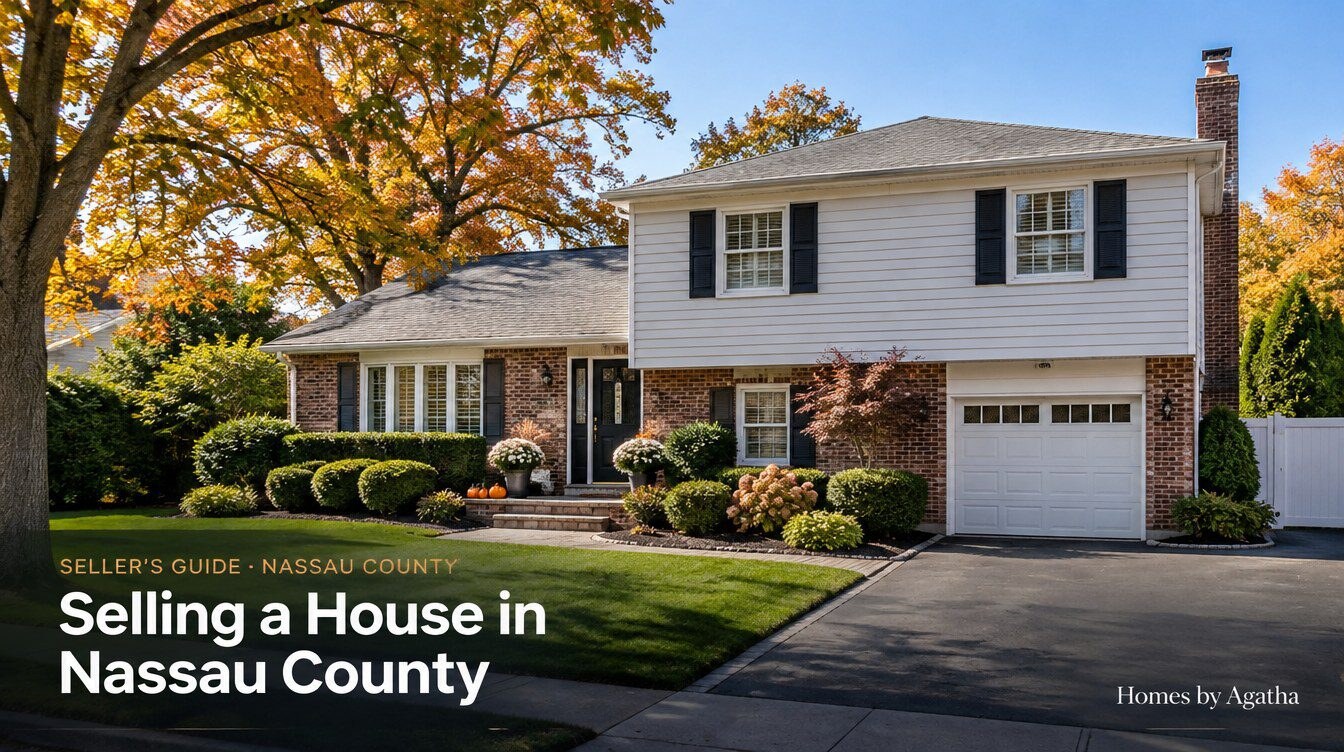
NASSAU COUNTY HOME SELLER GUIDE
Selling a House in Nassau County: Permits, Pricing and What You Will Net
Quick Answer
Selling a house in Nassau County, Long Island, goes smoothest when the seller clears town, village or city permits for past additions before listing, prices from a CMA built on same-municipality sales, completes the Property Condition Disclosure Statement, including its flood questions, and budgets the 0.4% NYS transfer tax. The NYC transfer tax does not apply.
Most Nassau County sales that stall do not stall over price. They stall over paperwork: a deck, dormer or finished basement built years ago without a final sign-off, a tax grievance nobody mentioned, or flood answers the buyer’s lender questions. This guide is about selling a house in Nassau County with those issues handled before the first showing.
It is written for owners planning a sale in the next few months or the next year, including people who inherited a house, owners moving up or down, and sellers relocating out of state. You will find how buyers judge Nassau houses, how a comparative market analysis is built here, which permits to clear, what to disclose, what the sale costs and how to compare offers.
As a Licensed Associate Real Estate Broker serving Queens, Brooklyn, Nassau County and Suffolk County, I help sellers prepare both the house and the transaction, in English and Polish. Nothing below replaces your attorney or accountant. It is meant to help you start early on the items that take the longest.
Nassau County at a glance for sellers
| Item | What it means for a Nassau County seller |
|---|---|
| Local government | Three towns (Hempstead, North Hempstead, Oyster Bay), two cities (Glen Cove, Long Beach) and 64 incorporated villages, plus many unincorporated hamlets, according to Nassau County |
| Where your building file is | The town building department for a hamlet; the village or city building department otherwise |
| Property tax | Assessed by the Nassau County Department of Assessment; grievances go to the Assessment Review Commission (ARC); bills include county, town, school district and special-district lines, with village taxes billed separately |
| Seller transfer tax | NYS real estate transfer tax, 0.4%; the NYC Real Property Transfer Tax does not apply |
| Required disclosure | Property Condition Disclosure Statement for most one-to-four-family houses, including flood questions; lead-based paint disclosure for pre-1978 homes |
| Listing service | OneKey MLS, used across Long Island and much of the New York metro area |
| Typical housing | Mostly detached one-family houses (Cape Cods, ranches, split-levels, high-ranches, colonials); co-ops and condos in several village downtowns and Long Beach |
| Location features buyers ask about | Nearest LIRR station and branch, sewer or cesspool, FEMA flood zone, parkway access |
What does selling a house in Nassau County involve that a city sale does not?
Selling a house in Nassau County differs from a New York City sale in four ways: building records sit with a town, village or city rather than the NYC Department of Buildings; the property tax bill combines several districts and is scrutinized by buyers; only the NYS transfer tax applies at closing; and many South Shore houses carry flood questions that shape financing and insurance.
The legal framework is the same statewide. New York is an attorney state, the PCDS rules apply, and brokerage compensation is negotiable. What changes is where your documents live and which local offices your buyer’s attorney and title company will contact.
Why the municipality matters to your sale
A house in an unincorporated hamlet, such as Levittown, Elmont or East Meadow, follows its town’s permit and zoning rules. A house in an incorporated village, such as Garden City, Rockville Centre, Mineola or Lynbrook, follows the village’s own building department and code. The cities of Glen Cove and Long Beach run their own departments. When the buyer’s title company orders municipal searches, it orders them from that office, so the records there need to match your house.
Why the tax bill becomes a sales document
Buyers coming from the city often compare monthly costs line by line. Your current bill, including any separate village bill, will be requested early. Exemptions you receive, such as STAR, veterans or senior exemptions, belong to you and generally do not transfer, so a buyer’s lender will estimate taxes without them. Sellers who explain this upfront avoid surprises late in underwriting.
How do buyers judge a house in Nassau County?
Nassau buyers weigh the same basics as anywhere, which are condition, layout, lot and location, plus several local checks: whether every addition is permitted, how large the full tax bill is, whether the house is on sewer or a cesspool, its FEMA flood status, and how it connects to an LIRR branch or parkway. Each check can raise or lower what a buyer is willing to pay.
Paperwork that matches the house
Many Nassau houses were expanded over decades. A buyer’s attorney will compare the town, village or city building file with the house as it stands. A finished basement, enclosed porch, second-story addition, in-ground pool or detached garage with no final approval becomes a negotiation point, and some lenders will not close until it is resolved.
Systems and site
- Sewer or cesspool. Most of Nassau County is sewered, but parts of the North Shore rely on cesspools or septic systems. Confirm your sewer status with the town, village or Nassau County Department of Public Works. Buyers will ask for pumping and repair records.
- Heating and oil tanks. Buyers ask whether a buried or basement oil tank exists, and whether a removed or abandoned tank has paperwork. If you have removal or abandonment records, put them in your listing file now.
- Roof, windows and electrical. On postwar houses, these are the items inspectors most often price into requests.
- Bulkheads and elevation. On canal-front South Shore houses, the bulkhead’s condition and any post-Sandy elevation work are central to value.
Location as buyers measure it
Buyers describe location in terms of commute and convenience: which LIRR branch serves the closest station (for example, the Babylon Branch along the South Shore, the Port Washington Branch on the North Shore or the Hempstead Branch through Garden City), whether station parking is accessible, and how quickly the house reaches the Long Island Expressway or the Southern State Parkway. Present those facts accurately; they matter more to buyers than adjectives.
How will buyers see your house?
I can walk through your Nassau County house the way a buyer’s attorney and inspector will, so you know which questions are coming before they are asked.
How should you price a house in Nassau County using a CMA?
Start with a comparative market analysis built from recent sales in the same municipality that share your house’s key traits: style and size, legal room count, lot, sewer status, flood-zone status and a similar tax bill. A comparative market analysis, or CMA, is a broker’s professional opinion of value based on relevant market evidence. It is not an appraisal and does not guarantee a sale price.
What makes a Nassau comparable truly comparable
- Same municipality. A sale across a village line can carry a different tax bill and different rules, so it is context, not a direct comparison.
- Same legal size. Square footage or rooms without permits may not be credited by an appraiser, so compare legal space with legal space.
- Same flood exposure. A house in a Special Flood Hazard Area carries an insurance requirement that a house outside it does not.
- Same infrastructure. A sewered house and a house on a cesspool in an unsewered area are valued differently by buyers.
- Similar condition. A renovated split-level and an original one on the same block are different products.
Thresholds that change buyer math
New York State’s “mansion tax,” 1% of the price on residential purchases of $1 million or more, is paid by the buyer. Outside New York City it is a flat 1% rather than graduated. For houses priced near $1 million, a buyer’s cost changes noticeably at that line, which can influence where offers cluster. Your CMA should consider which side of that threshold the evidence supports.
Appraisal also matters. Most buyers finance, and the lender’s appraisal must support the contract price. Pricing well above what comparable sales support can lead to an appraisal shortfall that the buyer may not be able or willing to cover.
Choosing a list-price strategy
A list price is a marketing decision informed by the CMA. Pricing within the range the evidence supports tends to attract the broadest pool of qualified buyers; pricing far above it tends to lengthen time on market and invite price reductions. For a deeper explanation of how valuation works, see what is my home worth, which explains CMA logic that applies on both sides of the city line.
Want a CMA built for your municipality?
I will prepare a comparative market analysis using sales that match your house’s legal size, sewer and flood status, and walk you through the reasoning.
Which permits and certificates should you clear before selling a house in Nassau County?
Before listing, request your building file from the town, village or city building department and compare it with the house as it stands today. Close out open permits and legalize unpermitted work that a buyer, appraiser or title search will find. In Nassau County, this is the step most likely to delay a closing, and the earliest one to start.
A Certificate of Occupancy, or CO, confirms that a building or the work on it complies with approved plans. Outside New York City, COs and related approvals (some municipalities issue certificates of completion for smaller work) come from the local building department. Ask that department what certificates it issues and how to request your file, since names and procedures differ between municipalities.
| Common item | Typical issue found | How it is usually resolved | When to start |
|---|---|---|---|
| Finished basement or attic | No permit or no final inspection | Permit filing, plans if required, inspection | Before listing |
| Rear extension, dormer or second story | Permit opened but never closed, or never filed | Final inspection, as-built plans, possibly a zoning variance | As early as possible |
| Deck, porch enclosure, pool or shed | Built without a permit, or setback concerns | Permit, survey, inspection; variance if a setback is not met | Before listing |
| Accessory apartment | No approval or rental permit | Apply under local rules, or restore single-family use | Before listing |
| Central air, boiler or oil tank work | Missing permit or tank paperwork | Permit sign-off; tank documentation | Before listing |
| Elevation or Sandy rebuild | Final approvals or Elevation Certificate missing | Request final approvals; obtain an Elevation Certificate | Before listing |
When a zoning variance is needed
If an addition sits closer to a lot line than the zoning code allows, or exceeds lot coverage, legalizing it may require relief from the town’s or village’s board of zoning appeals. That process includes applications, notice and a hearing, so it can take months. Ask the specific town or village, or a local land-use attorney, about the current process and timing. Sellers who learn about it after accepting an offer often face a delayed closing or a price credit.
Accessory apartments
Several Nassau municipalities regulate accessory apartments and require rental permits, and the rules differ by town, village and city. Never market an apartment as legal unless the local building department has approved it. If it is not approved, discuss with your attorney whether to seek approval or present the house as a one-family home.
Village pre-sale requirements
Some incorporated villages have their own requirements before a transfer, which can include an inspection or a certificate from the village. Ask your attorney early so the requirement does not surface the week of closing.
Key Takeaways
- In Nassau County, your permits and Certificate of Occupancy are kept by the town, village or city, not the NYC Department of Buildings.
- Pull the building file before listing; unpermitted additions are the most common cause of delayed Nassau closings.
- Setback or lot-coverage problems can require a zoning variance, which takes months.
- Build your CMA from same-municipality sales with similar legal size, sewer and flood status.
How should you prepare and stage a Nassau County house for sale?
Prepare in this order: paperwork first, then code items and systems, then condition items buyers see, then presentation. On Nassau’s postwar housing stock, buyers and inspectors focus on roofs, heating, electrical service, drainage and the condition of past additions, so money spent there usually matters more than cosmetic upgrades.
| Priority | What to do | Why Nassau buyers care |
|---|---|---|
| 1. Documents | Building file, permits, Elevation Certificate, cesspool pumping records, oil-tank paperwork, recent tax bills | Attorneys and lenders ask for these early |
| 2. Code items | Working smoke and carbon monoxide detectors, handrails, GFCI outlets where expected | Inspectors flag them; some villages require detector certification |
| 3. Systems | Service the boiler or furnace; document roof age; fix active leaks | Postwar houses are judged on system age |
| 4. Water management | Clean gutters and drywells; address grading and basement dampness | Basement water is a common inspection finding |
| 5. Exterior | Lawn, walkway, driveway, paint touch-ups, front door | Most buyers first see the house online, then from the curb |
| 6. Interior presentation | Declutter, neutralize, light every room, stage key rooms | Helps buyers read layout, especially on split levels |
Staging for Nassau layouts
Split-levels and high-ranches can confuse buyers in photos because rooms sit on different half-floors. Stage each level with a clear purpose and photograph the flow between them. In Cape Cods with dormered upper floors, show the full usable space and keep ceilings and stair areas bright. On ranches, emphasize the single-level layout and the yard connection.
Pre-listing inspection: when it helps
A pre-listing inspection can reveal issues before a buyer’s inspector does, giving you time to repair, document or price them in. It is most useful on older houses, unsewered properties and waterfront houses with bulkheads. Anything you learn may need to be reflected in your PCDS answers, so discuss timing with your attorney.
Need a preparation plan that fits your budget?
Let’s rank the paperwork, repairs and staging steps for your specific house, so your money goes where Nassau buyers will notice it.
What must a Nassau County seller disclose?
Sellers of most one-to-four-family houses in New York must deliver the Property Condition Disclosure Statement, or PCDS, before the buyer signs the contract. Since March 20, 2024, the option of giving a $500 credit instead of the form is gone, and the form includes flood-related questions. Sellers of pre-1978 homes must also give the federal lead-based paint disclosure.
The PCDS and its flood questions
The PCDS asks what you know about the property’s condition, including the structure, systems, water and environmental matters. The flood questions ask, among other things, whether the property is in a FEMA-designated flood zone, whether flood insurance is required, and whether flood insurance claims or federal disaster assistance for flood damage were received. For South Shore sellers in communities such as Long Beach, Island Park, Oceanside, Freeport or Massapequa, those answers are central to the buyer’s financing.
Answer accurately and from your actual knowledge. Check your address on the FEMA Flood Map Service Center, gather your flood insurance declarations and any claim history, and ask your attorney about anything you are unsure of. Condo units and co-op apartments are excluded from the law’s definition of residential real property, so the PCDS requirement does not apply to them.
Agency and fair housing disclosures
The New York State Disclosure Form for Buyer and Seller explains agency relationships and is presented at the first substantive contact with a licensee. The NYS Housing and Anti-Discrimination Disclosure Form is also provided. Listing descriptions and showings must follow fair housing law, which means describing the house and its features, not the people a seller expects to buy it.
Inherited houses and estates
Many Nassau houses are sold by heirs or estates. Who can sign the contract depends on the will, the probate or administration proceeding in the Surrogate’s Court and the executor’s or administrator’s authority. Start the legal process early and coordinate the listing with the estate attorney. The guide to probate real estate in New York explains how an estate sale usually proceeds.
How do co-op and condo sales work in Nassau County?
Selling a co-op or condo in Nassau County adds the building to the transaction. Co-op buyers must be approved by the board through an application package and interview, and condo boards may hold a right of first refusal. Buildings in places such as Great Neck, Mineola, Garden City, Rockville Centre and Long Beach each set their own rules.
- Gather building documents early. Recent financial statements, house rules, the offering plan for a condo, and any planned assessments.
- Check fees in your own documents. A flip tax, transfer fee or move-out deposit is set by each building; there is no county-wide rate. Confirm the flip tax, transfer fees and board-package requirements with the managing agent.
- Pre-screen buyers’ finances. Boards set their own down-payment and debt guidelines, so an offer that works for a lender may still not suit the board.
- Plan for board timing. The building, not the seller, controls how quickly the package is reviewed and the interview scheduled.
Selling an apartment instead of a house?
I can help you organize the board package requirements and review buyer finances against your building’s guidelines before you accept an offer.
How is a Nassau County listing marketed?
A Nassau County listing is typically entered on OneKey MLS, the multiple listing service used across Long Island and much of the New York metro area, from which it reaches cooperating brokers and many consumer portals. Professional photography, an accurate floor plan, a careful description and a showing plan complete the launch.
What the listing should say, and what it should not
- State legal facts accurately. Describe bedrooms and units as the building file supports. “Legal two-family” or “legal accessory apartment” should appear only if approved.
- Give commute facts. Name the nearest LIRR station and branch, and parkway access, without exaggerating distances.
- Describe the property, not the people. Fair housing rules prohibit describing a house by who should live there. Avoid references to schools, safety or demographics; describe rooms, lot, systems, upgrades and nearby parks or commercial corridors instead.
- Be clear on taxes. Many listings show the tax figure; make sure it reflects the full bill and note that owner exemptions do not transfer.
Photography, floor plans and showings
Photograph each level of a split-level clearly, include the yard and driveway, and show updated systems where they are a selling point. A floor plan helps buyers understand expanded houses. Coordinate open houses and private showings so that buyers who commute by LIRR can see the house on weekends and evenings. Sellers who prefer to discuss strategy in Polish can do so with me; it is simply a matter of communication comfort.
What does it cost to sell a house in Nassau County?
The main costs of selling a house in Nassau County are brokerage compensation, which is negotiable, the New York State real estate transfer tax of 0.4%, your attorney’s fee, your mortgage payoff and recording of its satisfaction, closing adjustments for property taxes, and any repair or permit costs. The NYC Real Property Transfer Tax does not apply in Nassau County.
| Seller cost | Who sets it | How it works in Nassau County |
|---|---|---|
| NYS real estate transfer tax | NYS Department of Taxation and Finance | $2 for each $500 of consideration (0.4%), customarily paid by the seller and reported on Form TP-584 |
| NYC Real Property Transfer Tax | NYC Department of Finance | Does not apply; NYC addresses only |
| “Mansion tax” | New York State | Paid by the buyer (1% at $1 million or more), not the seller |
| Brokerage compensation | Negotiated in the listing agreement | Not set by law; any contribution toward the buyer’s agent is a separate, negotiable decision |
| Seller’s attorney | Negotiated with the attorney | Contract, title issues, closing |
| Mortgage payoff and satisfaction | Your lender; Nassau County Clerk recording | Payoff amount plus recording-related charges; your attorney or title company quotes current amounts |
| Property tax adjustments | School and general tax calendars | Prepaid or unpaid halves are prorated between seller and buyer at closing |
| Permit and repair costs | Contractors, architects, municipal fees | Legalizing past work, repairs or credits negotiated after inspection |
| Co-op or condo charges | The building’s own documents | Flip tax or transfer fees only if the documents require them |
Confirm current rates with the NYS Department of Taxation and Finance before closing.
An illustration of the transfer tax
On a hypothetical $800,000 sale, the NYS transfer tax at $2 per $500 of consideration would be $3,200. The same house inside New York City would also owe the NYC Real Property Transfer Tax, which is why sellers comparing Nassau and city net proceeds should not use one estimate for both. Your attorney prepares the actual figures for the closing statement.
Property tax adjustments and pending grievances
Nassau County taxes are billed in halves on two calendars. School tax halves are typically payable without penalty through November 10 and May 10, and general tax halves through February 10 and August 10; confirm the current dates with the Receiver of Taxes for your address. Depending on the closing date, you may receive a credit for taxes you prepaid or owe a credit for taxes not yet paid.
If you filed a grievance with the Assessment Review Commission, it may still be pending at closing; ARC’s statutory filing deadline is March 1, and ARC has extended it in recent years, so check the current window on the ARC website. Because a refund can arrive after the sale, the contract should state who receives it. Tell your attorney about any grievance or tax certiorari proceeding at the start.
Brokerage compensation after the 2024 settlement
Brokerage compensation is negotiable and not set by law. After the 2024 NAR settlement, buyers sign their own written agreements with their agents, and a seller is not automatically responsible for paying the buyer’s agent. A seller may still choose to offer a contribution or agree to one in negotiation. Discuss these choices when you sign the listing agreement, and consult a CPA about capital gains or other tax effects of your sale.
Estimate your net before you list
I can help you line up the likely costs, tax adjustments and permit items for your house, so your pricing decision starts from a realistic net figure.
How do you compare offers and negotiate when selling a house in Nassau County?
Compare offers on certainty and net proceeds, not price alone. In Nassau County, the strongest offer usually combines a price the appraisal can support, solid financing, a realistic closing date and a buyer who understands the house’s permits, tax bill and flood status. A higher price with weak financing can produce a lower result than a slightly lower, cleaner offer.
| Offer factor | What to look at | Nassau-specific angle |
|---|---|---|
| Price vs. comparables | Does the CMA support it? | Same-municipality sales with similar sewer and flood status |
| Financing | Cash, conventional, FHA or other; pre-approval quality | Flood insurance requirement in an SFHA; appraisal treatment of additions |
| Down payment and appraisal gap | Can the buyer cover a shortfall? | Matters most near the $1 million mansion-tax line |
| Contingencies | Mortgage contingency; sale of the buyer’s home | A buyer selling a city apartment adds a second timeline |
| Closing date | Fits your move? | Tax adjustments shift with the half-year billing dates |
| Inspection posture | Reasonable requests vs. renegotiation risk | Cesspool, oil tank, bulkhead and permit findings |
Negotiating after the inspection
In New York, most buyers inspect before signing the contract, so negotiation over findings happens before anything is binding. Respond to material items such as a failing roof, a cesspool problem or an open permit with a repair, a credit or documentation, and resist cosmetic wish lists. Having your paperwork ready shortens this stage considerably.
Multiple offers
When several buyers are interested, ask each for final terms by a stated deadline, compare them with the table above, and let your attorney weigh contract-level differences. Treat every buyer the same way and evaluate offers only on financial terms and certainty. An accepted offer is not a contract; until both sides sign, either party can still walk away, so keep backup interest warm until the contract is signed.
What is the timeline, and what mistakes should Nassau County sellers avoid?
A typical financed sale moves from preparation to listing, accepted offer, contract signing, mortgage commitment, title clearance and closing. In Nassau County, the preparation stage is where time is won or lost, because permit legalization, variances and village requirements can take longer than the sale itself.
| Stage | Seller’s main tasks | Typical range (varies) | Nassau watch point |
|---|---|---|---|
| 1. Preparation | Building file, permits, repairs, staging, CMA | Weeks to months | Open permits, variances, Elevation Certificate |
| 2. Listing and showings | OneKey MLS launch, showings, open houses | Depends on pricing and demand | Accurate legal room count and tax figure |
| 3. Accepted offer and inspection | Deal sheet, buyer inspection, negotiation | About one to two weeks | Cesspool, oil tank, bulkhead findings |
| 4. Contract signing | PCDS delivered, contract negotiated, deposit | About one to three weeks | Grievance refund clause; permit riders |
| 5. Buyer financing and title | Appraisal, commitment, municipal searches | Several weeks | Searches from the correct town, village or city |
| 6. Closing | Deed signed, payoff, transfer tax filed | One meeting | Tax half-year adjustments |
These ranges are general. Confirm the expected timeframe for each stage with your attorney and the buyer’s lender for the specific deal.
Mistakes to avoid
- Listing before pulling the building file. Unpermitted work found after an accepted offer costs time and leverage.
- Advertising an unapproved apartment as legal. It creates disclosure and liability problems.
- Pricing from cross-municipality sales. Different tax bills and rules make them weak comparables.
- Guessing on the PCDS flood questions. Check FEMA maps and your records; ask your attorney.
- Forgetting a pending grievance. The refund belongs in the contract discussion.
- Assuming the seller pays the buyer’s agent. Compensation is negotiable and not automatic.
Nassau County seller checklist
- Choose a New York real estate attorney and tell them about any grievance, estate or tenant.
- Request your building file and compare it with the house.
- Start legalization or variance work for any unpermitted additions.
- Gather tax bills, Elevation Certificate, cesspool and oil-tank records.
- Ask for a CMA built on same-municipality comparables.
- Complete the PCDS carefully, including the flood questions, and the lead paint disclosure if applicable.
- Prepare, repair and stage in priority order.
- Agree on brokerage compensation and marketing in the listing agreement.
- Compare offers on net proceeds and certainty.
Key Takeaways
- Nassau sellers pay the 0.4% NYS transfer tax; the NYC Real Property Transfer Tax does not apply.
- Since March 20, 2024, the PCDS is required for most one-to-four-family houses, with flood questions and no $500 credit option.
- A pending grievance refund and the half-year tax adjustments belong in the contract discussion.
- Compare offers on certainty and net proceeds; an accepted offer is not a signed contract.
Ready to map out your sale?
Tell me your timing and goals, and I will help you build a step-by-step plan from building file to closing for your Nassau County house.
Frequently asked questions about selling a house in Nassau County
Do Nassau County sellers pay the NYC Real Property Transfer Tax?
No. The NYC Real Property Transfer Tax applies only to properties inside New York City. A Nassau County seller customarily pays the New York State real estate transfer tax of $2 for each $500 of consideration, or 0.4%, reported on Form TP-584. The buyer, not the seller, pays the mansion tax at $1 million or more.
What happens if my Nassau County house has an addition without a permit?
A buyer’s attorney, appraiser or title search will likely find it. The usual fix is to file for a permit and final inspection with the town, village or city building department, sometimes with plans or a zoning variance. Starting before listing avoids delays, price credits or a lender refusing to close.
Who keeps building permits for a house in Nassau County?
The local building department. For houses in unincorporated hamlets, that is the Town of Hempstead, Town of North Hempstead or Town of Oyster Bay. Incorporated villages and the cities of Glen Cove and Long Beach keep their own records. The NYC Department of Buildings has no role in Nassau County.
Do I have to fill out the PCDS to sell my Nassau County house?
Sellers of most one-to-four-family houses must deliver the Property Condition Disclosure Statement before the buyer signs the contract. Since March 20, 2024, the $500 credit alternative is no longer available. The form includes flood questions, which matter especially for South Shore houses. Co-op and condo units are generally outside the requirement.
How is a Nassau County house priced for sale?
Pricing usually starts with a comparative market analysis, a broker’s opinion of value based on recent comparable sales. In Nassau County, the most useful comparables share the municipality, legal size, sewer status and flood-zone status. A CMA is not an appraisal and does not guarantee a price; the buyer’s lender will order its own appraisal.
What happens to my tax grievance if I sell my Nassau County house?
A grievance filed with the Nassau County Assessment Review Commission can still be pending at closing, and any refund may arrive after the sale. Tell your attorney about it early so the contract states whether you or the buyer receives the refund. Grievances affect a future tax year, not the current bill.
Does the seller pay the buyer’s agent in Nassau County?
Not automatically. After the 2024 NAR settlement, buyers sign written agreements with their own agents, and compensation is negotiable and not set by law. A seller may choose to offer or agree to a contribution toward the buyer’s agent, but it is a negotiated decision, discussed when you sign your listing agreement.
Where are Nassau County homes listed for sale?
Most Nassau County listings are entered on OneKey MLS, the multiple listing service used across Long Island and much of the New York metro area. From there, listings reach cooperating brokers and many consumer real estate portals. Accurate photos, a floor plan and correct legal room counts help buyers evaluate the house.
Can I sell an inherited house in Nassau County before probate is finished?
It depends on the will and on the executor’s or administrator’s authority from the Surrogate’s Court. Often the estate representative can list the house, but signing and closing require proper authority. An estate attorney should confirm the steps. Starting the legal process early keeps the sale timeline realistic for buyers and lenders.
How long does it take to sell a house in Nassau County?
Timing depends on preparation, pricing, buyer financing and title. A financed sale moves through listing, inspection, contract signing, mortgage commitment, title searches and closing. In Nassau County, permit legalization or a zoning variance can add weeks or months before listing, so pulling the building file early is the biggest time saver.
Next steps for selling a house in Nassau County
A smooth Nassau County sale is mostly decided before the listing goes live. Pull the building file and close out permits, gather tax, flood, cesspool and oil-tank records, price from a CMA built on truly comparable sales, and complete the PCDS with care. Then compare offers on certainty and net proceeds, with your attorney handling grievance refunds and tax adjustments. To see how a listing would come together for your house, start with the Nassau County home selling page. If you will buy again nearby, the Nassau County buying page covers the purchase side, and owners east of the county line can compare with selling in Suffolk County. Sellers with property on both sides of the city line may also find selling in Douglaston, Queens, selling in Cambria Heights, Queens and the borough-wide guide on how to sell your home in Queens useful for comparison. When you are ready, plan your Nassau County sale with Homes by Agatha.
This article is for general informational purposes only and reflects conditions that may change. It is not legal, tax, or financial advice, an appraisal, or a guarantee of price or outcome; consult a licensed New York attorney, a CPA, and an NMLS-registered mortgage loan originator as appropriate. A CMA is an opinion of value, not an appraisal. Real estate brokerage services are offered by Agatha Lubas, Licensed Associate Real Estate Broker, NY License #10301213345, Keller Williams Realty Liberty, 96-10 101st Avenue, Ozone Park, NY 11416. The NYS Disclosure Form for Buyer and Seller, the NYS Housing and Anti-Discrimination Disclosure / Fair Housing Notice, and the brokerage’s Standard Operating Procedures are available on request. Equal Housing Opportunity.

Agatha Lubas helps buyers, sellers and investors across Queens, Brooklyn, Nassau County and Suffolk County prepare for each step of a New York sale or purchase. She works with clients in English and Polish, so every conversation can happen in the language that feels most comfortable.
Work with Agatha