
SAINT ALBANS HOME SELLER GUIDE
Selling a House in Saint Albans Queens: Pricing, Landmark Records, Water Disclosure and Your Net
Quick Answer
Selling a house in Saint Albans Queens works best when you price against truly comparable houses — detached or semi-detached, inside or outside the Addisleigh Park Historic District, legal one- or two-family — then gather Department of Buildings and LPC records, disclose any basement water history honestly, and budget for the NYS and NYC transfer taxes.
This guide is for owners thinking about selling a house in Saint Albans Queens, the southeast Queens neighborhood of pre-war detached and semi-detached houses that most maps spell “St. Albans.” Many owners here have held their houses for a long time, inherited them or added space over the years. That history is exactly what a buyer’s attorney, lender and inspector will examine, so preparation should start with the paperwork, not the paint.
You will learn how buyers and appraisers sort Saint Albans comparables, how to read a comparative market analysis, which records to pull before listing, what changes inside the Addisleigh Park Historic District, how to handle a basement with a water history, which repairs make sense, what New York requires you to disclose, what selling costs, and how to compare offers.
As a Licensed Associate Real Estate Broker based in Queens, I help sellers plan pricing, preparation and the attorney-based closing process, in English or Polish, whichever is more comfortable. When you want a plan for your own house, the Saint Albans home selling services page explains how we would work together.
Saint Albans at a glance for home sellers
| Item | What it means for a Saint Albans seller |
|---|---|
| Location | Southeast Queens, New York City; Queens Community District 12; ZIP code 11412 for most addresses; confirm the ZIP code for a specific address with USPS |
| Tax jurisdiction | New York City: NYS real estate transfer tax and NYC Real Property Transfer Tax apply; property tax administered by the NYC Department of Finance |
| Typical houses | Detached and semi-detached one- and two-family houses, many pre-war, in Tudor Revival, Colonial Revival, Arts and Crafts and Cape Cod styles; mixed-use buildings on Linden, Merrick and Farmers Boulevards |
| Landmark status | The Addisleigh Park Historic District (NYC Landmarks Preservation Commission, designated February 1, 2011) covers more than 400 houses in the western part of the neighborhood |
| Zoning | 2007 St. Albans/Hollis rezoning: mostly R3A (one- and two-family detached) and R2 (one-family detached) on residential blocks |
| Transit points buyers ask about | LIRR St. Albans station at Linden Boulevard (West Hempstead Branch); buses to downtown Jamaica for the E, J, Z and F trains; no subway station in the neighborhood |
| Nearby open space | Roy Wilkins Park, more than 50 acres between Merrick and Baisley Boulevards |
| Common seller issues | Legal unit count, unpermitted basement or attic work, LPC permit history, basement water history, older heating systems and oil tanks |
What do buyers compare when they look at a Saint Albans house?
Buyers compare five things before they compare kitchens: the house type, its legal use, whether it sits in the historic district, the condition of the basement and systems, and the distance to the LIRR or the bus corridors. A seller who can answer those five questions clearly, with documents, makes the buyer’s decision easier and the negotiation shorter.
House type and lot
A detached house with a private driveway and a rear garage is a different product from a semi-detached house with a shared driveway, even on the same block. Buyers notice lot width, the driveway arrangement and whether the garage is usable. If your driveway is shared, have the survey and any recorded easement ready.
Legal use
Buyers who want a two-family house, often to offset the mortgage with rent, will ask whether the second unit is legal. The answer comes from the Certificate of Occupancy (CO) or, for older houses, NYC Department of Buildings records. Lenders generally count rent only from legal units, so a buyer’s maximum price often depends on your paperwork.
District status, basement and systems
Buyers increasingly check whether a house is inside the Addisleigh Park Historic District, because exterior work there needs LPC approval. They also ask early about basement water, because Southeast Queens has a documented groundwater history. And they look hard at the boiler or furnace, any oil tank, the electrical service and the roof.
Commute and corridors
Walking distance to the LIRR St. Albans station or to bus stops on Linden, Merrick and Farmers Boulevards matters to buyers who commute by transit. Describe it factually in the listing, and let buyers judge it for themselves.
How do you price a house when selling a house in Saint Albans Queens?
Start with a comparative market analysis built from sales of houses that match yours on the factors buyers and appraisers actually use. A comparative market analysis, or CMA, is a real estate broker’s professional opinion of value based on recent comparable sales, pending deals and competing listings. It is not an appraisal and does not guarantee a sale price.
In Saint Albans, the hardest part of a CMA is choosing the right comparables. Houses vary in style, size, lot, condition and legal status, and the wrong comparison can push a price too high or leave money on the table. The table below shows the factors that most often separate one Saint Albans sale from another.
| Pricing factor | Why it matters in Saint Albans | How a careful CMA handles it |
|---|---|---|
| Detached vs semi-detached | Privacy, driveway and maintenance differ | Compare detached with detached and semi-detached with semi-detached wherever possible |
| Legal one-family vs legal two-family | Changes the buyer pool and what lenders will finance | Uses only legal unit counts; treats an undocumented unit as extra space, not income |
| Inside vs outside Addisleigh Park | District houses have protected streetscapes and an extra approval step for exterior work | Looks for sales inside the district first; explains any adjustment rather than assuming one |
| Condition of systems | Boilers, oil tanks, wiring and roofs drive inspection credits | Adjusts for updated versus original systems and recent roof work |
| Basement condition and water history | A dry, documented basement and a wet one are valued differently | Notes the history and any remediation; does not price a finished basement as legal living space unless records allow |
| Lot, garage and parking | Driveways and usable garages matter where most buyers drive | Adjusts for lot size, driveway type and garage condition |
| Location within the neighborhood | Distance to the LIRR station, corridors and Roy Wilkins Park varies | Favors comparables from nearby blocks with similar access |
Turning the CMA into a list price
A CMA usually produces a range rather than a single number. Where you list inside that range depends on condition, how many similar houses are competing for buyers, and your timeline. Pricing above the supported range tends to lengthen the time on market and can lead to price reductions that buyers notice. Pricing within the range invites serious offers and gives the appraisal a better chance of supporting the contract price.
Remember that the buyer’s appraiser will run a separate analysis for the lender. If the appraisal comes in below the contract price, the buyer may ask for a reduction, bring more cash or, under some contracts, cancel. A list price grounded in truly comparable sales is the strongest protection you have. For more on how value is estimated, see what is my Queens home worth.
Key Takeaways
- A CMA is a broker’s opinion of value, not an appraisal and not a guarantee.
- In Saint Albans, the comparables must match on house type, legal unit count and historic-district status.
- An undocumented apartment adds space, not legal rental income, in a buyer’s and lender’s eyes.
- A price supported by true comparables protects you when the buyer’s appraisal arrives.
Want to know where your house fits?
I can prepare a CMA that compares your house with the right Saint Albans sales and explains every adjustment in plain language.
Which records should you pull before listing a Saint Albans house?
Pull the building’s legal records before you list, not after a buyer’s attorney finds a problem. The documents below answer the questions every buyer’s attorney and lender will ask, and gathering them early turns surprises into items you can fix, explain or price.
| Record | Where to get it | Why it matters for a Saint Albans sale |
|---|---|---|
| Certificate of Occupancy or equivalent | NYC Department of Buildings records | Confirms legal use and unit count; houses built before 1938 may show legal use through other DOB records or a Letter of No Objection |
| Open permits and violations | DOB and OATH/ECB records, through your attorney | Old open permits for basements, extensions or boiler work can delay a closing |
| LPC permits and violations | NYC Landmarks Preservation Commission | Inside Addisleigh Park, buyers’ attorneys check whether exterior work after 2011 was approved |
| Deed and recorded documents | NYC Department of Finance ACRIS | Confirms ownership, easements and any liens to be cleared at closing |
| Property tax bill and exemptions | NYC Department of Finance | Buyers budget from the actual Class 1 tax bill; some owner exemptions end at a sale, so ask NYC DOF how your specific exemptions, such as STAR or senior exemptions, are handled at transfer |
| Water and sewer account | NYC Department of Environmental Protection | Charges are adjusted at closing; open balances can become liens |
| Oil tank documentation | Your records; a tank sweep or abandonment certificate | Buyers often ask whether an old tank was removed or properly abandoned |
| Survey | Your closing file or a licensed surveyor | Shows driveways, fences, garages and encroachments |
| Repair and remediation receipts | Your files and contractors | Roof, boiler, waterproofing and sewer-line work support your price and your disclosure |
When the records do not match the house
Gaps are common in older Queens houses: a basement finished decades ago without a permit, an enclosed porch, a garage turned into a room. Your options generally include legalizing the work with permits and inspections, removing it, or disclosing it and pricing the house accordingly. An architect or expediter can estimate time and cost; your attorney can explain how each choice affects the contract. The decision is easier before the listing goes live than in the middle of a negotiation.
What changes when the house is in the Addisleigh Park Historic District?
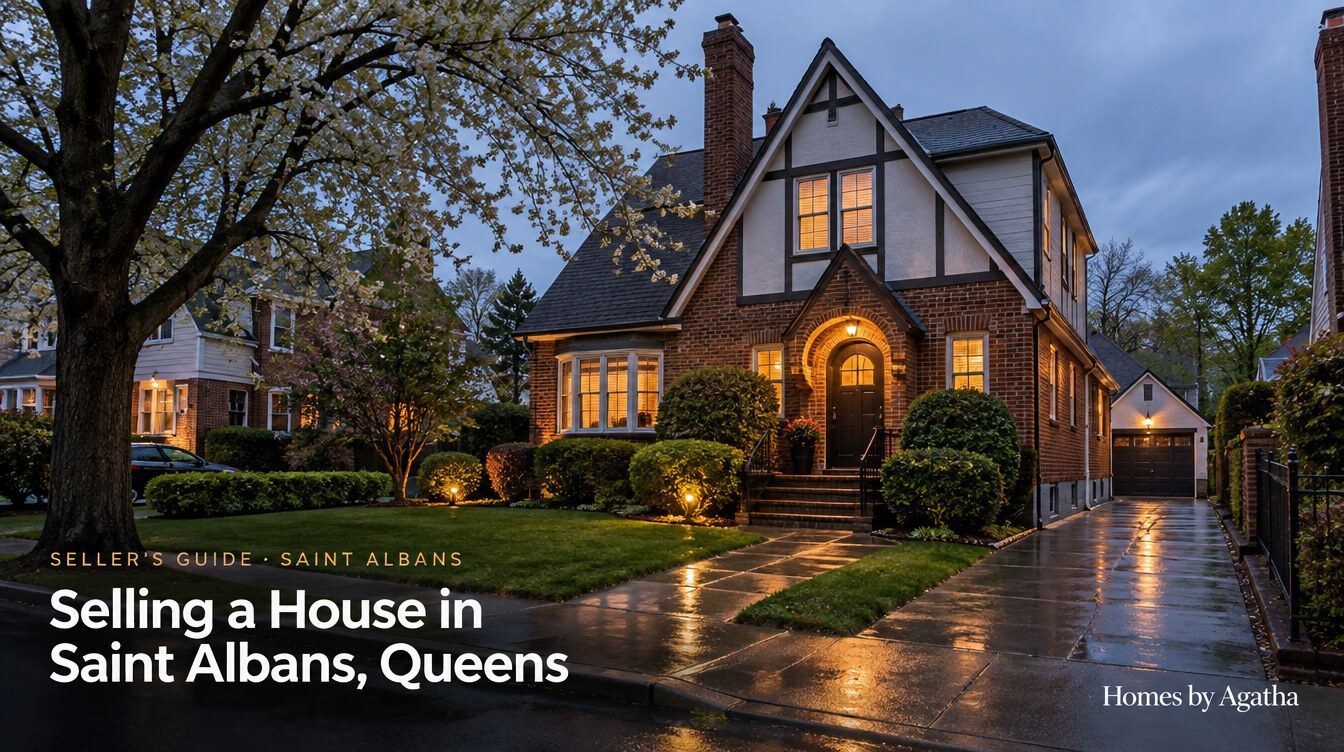
Selling inside the district adds one more set of records — the LPC’s — and gives you a distinctive story to tell about the house’s architecture. The NYC Landmarks Preservation Commission designated the Addisleigh Park Historic District on February 1, 2011; it covers more than 400 houses built mostly between the 1910s and the 1930s in Tudor Revival, Colonial Revival and Arts and Crafts styles.
First, confirm that your lot is actually in the district on the LPC’s official Addisleigh Park Historic District map. The boundary follows individual lots, and a house across the street may be outside it.
LPC permit history
Gather any LPC permits for exterior work done since designation — windows, doors, roofing, fences, masonry, stucco, additions. Buyers’ attorneys may ask for them, and buyers planning their own projects will want to know what has already been approved. If exterior work was done without LPC approval, ask a land-use attorney or the LPC about your options before listing; in some cases work can be legalized through an application, and in others the earlier condition may need to be restored. The LPC or a land-use attorney can also explain how an open LPC violation would affect your sale.
Presenting a landmark house
Describe the architecture accurately and specifically: the style, the materials, original details such as leaded windows, slate or tile roofs, decorative half-timbering and fireplaces. Explain landmark status as a fact, not as a promise; avoid suggesting what the LPC will or will not approve for a future owner. Buyers who value a protected streetscape will read the details closely, and buyers with renovation plans will want the facts early.
Get the paperwork in order first
I can help you build a pre-listing records plan — DOB, LPC, tax and survey — so buyers’ attorneys find answers instead of questions.
How should you handle a basement with a water history?
Disclose it accurately, document what you did about it, and price the house with the history in mind. Buyers in Saint Albans expect to ask about basement water, and an honest, documented answer is far easier to negotiate than a problem a buyer’s inspector discovers on their own.
The context is regional. Southeast Queens has a documented history of high groundwater after private well pumping by the Jamaica Water Supply Company stopped in 1996, and heavy rain can also overwhelm local drainage. Conditions differ from house to house, so speak only about your own house.
What to gather
- History. When water entered, how much, after what kind of weather, and what changed since.
- Remediation records. Invoices for waterproofing, interior drains, sump pumps, backflow valves or foundation repairs, with any warranties.
- Equipment details. The sump pump’s age, whether it has a backup, and where it discharges.
- Insurance claims. Any flood or water-damage claims, which a buyer’s insurer may see anyway.
- Map status. The address’s status on the FEMA Flood Map Service Center and the NYC Stormwater Flood Maps.
Presentation without concealment
Clean, dry and well-lit basements show better, and fixing an active problem before listing is usually worth considering. What you should not do is paint over stains, hide damage behind new paneling or describe a basement as “dry” if it has taken water. The Property Condition Disclosure Statement asks about flooding and water problems, and inaccurate answers can create liability after closing, so review the current form’s flood-related questions with your attorney. A pre-listing inspection can tell you where you stand before buyers’ inspectors do.
Which repairs and staging choices make sense for an older Saint Albans house?
Fix what a buyer’s inspector or lender will flag, clean and clear everything, and leave large renovations to the next owner unless your agent and attorney see a clear reason. The goal is to remove reasons for a buyer to discount the price, not to remodel to your own taste.
| Item | Usually do before listing? | Why, for this housing stock |
|---|---|---|
| Resolve open permits and violations | Yes, or plan with your attorney | Open items can delay or derail a closing |
| Service the boiler or furnace; document the oil tank | Yes | Heating questions are among the first in a pre-war house |
| Stop active roof, chimney or basement leaks | Yes | Active water invites large credit requests |
| Repair loose slate, tile or flashing | Often | Specialty roofs worry buyers who do not know the material; inside Addisleigh Park, use LPC-compliant materials and approvals |
| Fresh neutral interior paint, minor fixes | Often | Inexpensive and visible in photos |
| Clear the garage, basement and attic | Yes | Buyers need to see foundations, framing and storage space |
| Front yard, walk and driveway cleanup | Yes | Detached houses are judged from the curb first |
| Full kitchen or bath renovation | Rarely | Hard to recover in price; many buyers prefer their own choices |
| Replace original windows or doors | Rarely; check LPC first in the district | Originals can be a selling point; in the district, replacement needs approval |
Staging a Tudor or Colonial interior
Many Saint Albans interiors have strong original details: archways, plaster walls, fireplaces, built-ins, wood floors. Staging should frame those details rather than hide them. Remove bulky furniture to show room proportions, open window treatments for light, and make the fireplace or archway the focus of the main room photo. In a two-family house, present each unit separately and make sure both look ready to occupy.
Spend on what buyers will actually value
Let’s walk through your house together and sort repairs into “now,” “disclose” and “leave for the buyer” before you spend anything.
How is a Saint Albans house marketed to buyers today?
Marketing starts with accurate, professional presentation and wide distribution. Most buyers first see a house online, so photographs, a floor plan and a precise description of the house and its records do most of the work before anyone books a showing.
- Professional photography and a floor plan. Wide, well-lit images of each room, the facade, the lot and the garage; a floor plan helps buyers understand older layouts and two-family configurations.
- OneKey MLS. OneKey MLS is the multiple listing service used by brokers across Queens, Long Island and other parts of the New York region; a listing there reaches cooperating brokers and syndicates to major home-search portals.
- Accurate facts. Legal unit count as recorded, historic-district status, heating type, parking and the distance to the LIRR St. Albans station or bus corridors, stated as facts.
- Showings and open houses. Scheduled showings with the basement, garage and mechanical areas accessible; buyers will ask to see them.
Fair Housing law applies to every listing. Describe the house, the lot, the architecture, the transit and the parks — never the people who live nearby or who the house would “suit.” That keeps the marketing compliant and keeps the focus on what you are actually selling. For a broader overview of the Queens selling process, see how to sell your home in Queens.
Which disclosures does a New York seller have to give?
Most sellers of one- to four-family houses in New York must deliver the Property Condition Disclosure Statement before the buyer signs the contract. Since March 20, 2024, the option of giving the buyer a $500 credit instead of the disclosure is no longer available. Sellers of houses built before 1978 also have federal lead-based paint disclosure duties.
The Property Condition Disclosure Statement
The Property Condition Disclosure Statement (PCDS) is a New York form in which the seller answers questions about the property’s condition based on actual knowledge — including the structure, systems, water and flooding history, and environmental matters. Answer each question accurately and completely, and review the form with your attorney before delivering it. For a Saint Albans house, the basement, heating, oil tank and any unpermitted work are the answers buyers will read most closely.
Lead-based paint and other disclosures
For housing built before 1978, federal law requires sellers to disclose known lead-based paint hazards, provide available reports and the EPA pamphlet, and give buyers an opportunity to test. Most Saint Albans houses predate 1978. If a unit is rented, your attorney will also address leases, security deposits and whether the unit will be delivered vacant, including how New York tenant laws such as the 2024 Good Cause Eviction law apply to the specific building.
Agency disclosure
You will receive the NYS Disclosure Form for Buyer and Seller at the first substantive contact with a real estate agent. It explains the different agency relationships, so you know whom each agent represents before you share confidential information about price or timing.
Key Takeaways
- Pull DOB, LPC, ACRIS and tax records before listing so gaps can be fixed, explained or priced.
- Inside Addisleigh Park, gather LPC permits for exterior work done since 2011.
- Disclose basement water history accurately on the PCDS; the $500 credit option ended March 20, 2024.
- Fix what inspectors and lenders flag; leave major remodeling to the buyer in most cases.
Talk through disclosures before you list
A short conversation about your house’s history can help you and your attorney prepare clear, complete answers for buyers.
What does it cost to sell a house in Saint Albans, and what will you net?
Your net proceeds are the sale price minus your mortgage payoff, the brokerage commission you negotiated, two transfer taxes, attorney fees and any credits or adjustments. Because Saint Albans is in New York City, the NYC Real Property Transfer Tax applies in addition to the New York State transfer tax.
| Seller cost | How it works for a Saint Albans house | Source / who sets it |
|---|---|---|
| NYS real estate transfer tax | $2 for each $500 of consideration (0.4%), customarily paid by the seller | NYS Department of Taxation and Finance |
| NYC Real Property Transfer Tax | For one- to three-family houses: 1% when the price is $500,000 or less; 1.425% when the price is above $500,000; customarily paid by the seller | NYC Department of Finance |
| Brokerage commission | Negotiable and set in your listing agreement; any contribution toward a buyer’s agent is also negotiable, not required by law | Your agreement with your broker |
| Seller’s attorney fee | Contract negotiation and closing representation | Quoted by your attorney |
| Mortgage payoff and satisfaction | Remaining loan balance plus the lender’s payoff and recording charges | Your lender and the county recording process |
| Adjustments and credits | Property tax, water and sewer, and fuel-oil adjustments; any negotiated repair credits | Contract terms and closing date |
| Open-item resolution | Clearing violations, liens or old permits, if any | Depends on the item |
Confirm current rates with the NYS Department of Taxation and Finance and NYC Department of Finance before closing.
Reading the transfer-tax threshold
The NYC Real Property Transfer Tax rate depends on whether the price is $500,000 or less or above $500,000, and the higher rate applies to the whole consideration once the threshold is crossed. Ask your attorney to calculate both transfer taxes on your expected price range so you see the effect before you set a list price or accept an offer. For a fuller breakdown of who pays what, see the Queens closing costs guide.
Taxes on your gain
Federal and state income tax on your gain depends on how long you owned and lived in the house, your basis, improvements and exemptions. Inherited houses follow different basis rules. A CPA can estimate the tax before you sign, which often affects timing decisions.
How do you compare offers and get from contract to closing?
Compare offers by how likely they are to close and what they will net you, not only by price. In New York, an accepted offer is not binding; the deal becomes binding only when both parties sign the contract of sale prepared and negotiated by the attorneys, and the buyer delivers the contract deposit.
| Offer element | What to look at | Why it matters for a Saint Albans house |
|---|---|---|
| Price | Gross price and any requested credits | Credits reduce your net just as a lower price does |
| Financing | Cash or mortgage; loan type; down payment; pre-approval quality | Older houses can face appraisal and condition requirements |
| Appraisal gap | Whether the buyer can cover a low appraisal | Fewer close comparables for distinctive houses |
| Contingencies | Mortgage contingency length; other conditions | Long contingencies keep the house off the market longer |
| Two-family plans | Whether the buyer’s financing depends on rental income | Rent counts only from legal units |
| Closing date | Fit with your move or your next purchase | A flexible date can be worth more than a small price difference |
The path to closing
| Stage | What happens | Common range (varies) |
|---|---|---|
| Preparation | CMA, records search, repairs, disclosures, photography | 2–6 weeks |
| Listing and offers | OneKey MLS listing, showings, offers, acceptance | Varies with price, condition and competing inventory |
| Contract | Buyer’s inspection; attorneys negotiate and sign; deposit held in escrow | Often 1–3 weeks |
| Buyer financing | Appraisal, underwriting, mortgage commitment | Often 3–6 weeks after contract |
| Title clearance | Title report items, violations, liens and payoffs cleared | Runs in parallel |
| Closing | Final walk-through; deed signed; transfer taxes and payoffs paid; keys delivered | Closing day |
Negotiation does not end at acceptance. After the buyer’s inspection, expect requests about the basement, roof, heating or permits. A credit is often simpler than a repair you must complete before closing. If you inherited the house, an estate may need court authority or specific documents before the sale; the probate real estate guide explains how estate sales in New York typically work.
Have more than one offer to weigh?
I can help you lay offers side by side — price, financing, appraisal risk, contingencies and timing — so you choose with your net and your schedule in view.
What mistakes do Saint Albans sellers make, and what belongs on the checklist?
The costliest mistakes come from pricing against the wrong houses and from paperwork discovered late. Both are avoidable with preparation that starts weeks before the listing.
Mistakes to avoid
- Pricing a one-family as a two-family. An undocumented unit is not legal rental income to a lender.
- Using the wrong comparables. A detached house inside Addisleigh Park and a semi-detached house on an R3A block are different products.
- Hiding water history. Fresh paint over stains invites distrust and potential liability.
- Ignoring LPC history. Unapproved exterior work in the district can surface during the buyer’s due diligence.
- Over-renovating. A full remodel rarely returns its cost; targeted repairs usually do more.
- Forgetting the RPT threshold. NYC transfer-tax rates change at $500,000; know your numbers before you counter.
Saint Albans seller checklist
- Review the NYS Disclosure Form for Buyer and Seller and choose your listing broker and attorney.
- Get a CMA built from comparables that match your house type, legal use and district status.
- Pull DOB, LPC, ACRIS, tax, and water and sewer records; list any gaps.
- Decide with your attorney how to handle each gap: legalize, remove or disclose.
- Gather receipts for roof, boiler, waterproofing, sewer and oil-tank work.
- Complete the PCDS accurately with your attorney’s review.
- Make the repairs inspectors will flag, clean thoroughly, and clear the basement, attic and garage.
- Schedule professional photography and a floor plan; list on OneKey MLS.
- Compare offers on net proceeds, financing strength and timing.
- Ask your attorney and CPA to estimate transfer taxes and income tax before you sign.
If you are comparing your plans with nearby markets, the seller pages for selling in Hollis, selling in Cambria Heights and selling in Springfield Gardens cover neighboring house markets. If you plan to buy again locally, the companion page on how to buy a home in Saint Albans covers the purchase side.
Map your Saint Albans sale from start to closing
We can turn your price range, records, repairs and timing into one clear selling timeline that fits your next move.
Frequently asked questions about selling a house in Saint Albans Queens
How do I find out what my Saint Albans house is worth?
Start with a comparative market analysis from a licensed broker, built from recent sales of houses like yours: same house type, legal unit count and historic-district status. A CMA is a professional opinion of value, not an appraisal or a guarantee. The buyer’s lender will order its own appraisal later.
Does being in the Addisleigh Park Historic District affect selling my house?
It adds records to prepare. Inside the district, designated by the NYC Landmarks Preservation Commission in 2011, exterior work generally needs LPC approval, so buyers’ attorneys may ask for permits covering work done since designation. Confirm your lot on the LPC map and resolve any unapproved exterior work before listing.
Do I have to disclose basement water when selling in Saint Albans?
Yes, if you know about it. The New York Property Condition Disclosure Statement asks about flooding and water problems, and sellers must answer accurately based on actual knowledge. Southeast Queens has a documented groundwater history, so buyers will ask. Provide repair and waterproofing records, and review your answers with your attorney.
Can I still give a $500 credit instead of the disclosure form?
No. Since March 20, 2024, New York sellers of most one- to four-family houses can no longer give a $500 credit in place of the Property Condition Disclosure Statement. The completed form must be delivered to the buyer before the contract is signed. Your attorney can confirm whether any exemption applies to your sale.
What transfer taxes does a Saint Albans seller pay?
Saint Albans is in New York City, so sellers customarily pay two transfer taxes: the NYS real estate transfer tax of $2 per $500 of price (0.4%), and the NYC Real Property Transfer Tax of 1% at $500,000 or less or 1.425% above $500,000 for one- to three-family houses.
Is the real estate commission fixed when selling a house in Queens?
No. Brokerage commissions are negotiable and are set in your listing agreement. Under rules in effect in 2026, a seller is not required to pay the buyer’s agent; any contribution toward buyer-agent compensation is a separate, negotiable decision. Ask for every fee in writing before you sign a listing agreement.
What if my house has an unpermitted basement apartment?
Check NYC Department of Buildings records first. If the apartment is not legal, buyers’ lenders generally will not count its rent, and attorneys will flag it. Your options include legalizing it where zoning and code allow, removing it, or disclosing it and pricing the house as a legal one-family with extra space.
How long does it take to sell a house in Saint Albans?
Preparation often takes two to six weeks. After an accepted offer, a financed sale commonly takes about two to three months to close, depending on the buyer’s lender, title clearance and how complete your records are. Open permits, violations or legal-use questions are the most common causes of delay.
Can I sell an inherited house in Saint Albans before probate is finished?
Usually the estate’s representative needs legal authority, such as letters testamentary or letters of administration from the Queens County Surrogate’s Court, before signing a contract or deed. Requirements depend on the will and the estate. Speak with an estate attorney early, because court timing affects your listing and closing dates.
Should I renovate my Saint Albans house before listing?
Usually not fully. Fix what inspectors and lenders will flag, such as active leaks, heating problems and open permits, then clean, paint and stage. Large kitchen or bath remodels rarely return their cost. Inside Addisleigh Park, exterior replacements also need LPC approval, so plan any exterior work well ahead.
Summary and your next step
Selling a house in Saint Albans Queens rewards preparation in a specific order: price against comparables that truly match, pull the DOB and LPC records before buyers do, document and disclose the basement’s history, and understand your transfer taxes and negotiated costs before you set a price. Owners who settle those items first tend to negotiate from strength and close with fewer surprises. When you are ready for a personalized plan, the guide to selling your home in Saint Albans with Agatha explains how we can start.
This article is for general informational purposes only and reflects conditions that may change. It is not legal, tax, or financial advice, an appraisal, or a guarantee of price or outcome; consult a licensed New York attorney, a CPA, and an NMLS-registered mortgage loan originator as appropriate. A CMA is an opinion of value, not an appraisal. Real estate brokerage services are offered by Agatha Lubas, Licensed Associate Real Estate Broker, NY License #10301213345, Keller Williams Realty Liberty, 96-10 101st Avenue, Ozone Park, NY 11416. The NYS Disclosure Form for Buyer and Seller, the NYS Housing and Anti-Discrimination Disclosure / Fair Housing Notice, and the brokerage’s Standard Operating Procedures are available on request. Equal Housing Opportunity.

Agatha Lubas helps sellers, buyers and investors across Queens, Brooklyn, Nassau County and Suffolk County with pricing, preparation and the New York attorney-based closing process. She works in English and Polish so clients can discuss every detail in the language they prefer.
Work with Agatha