

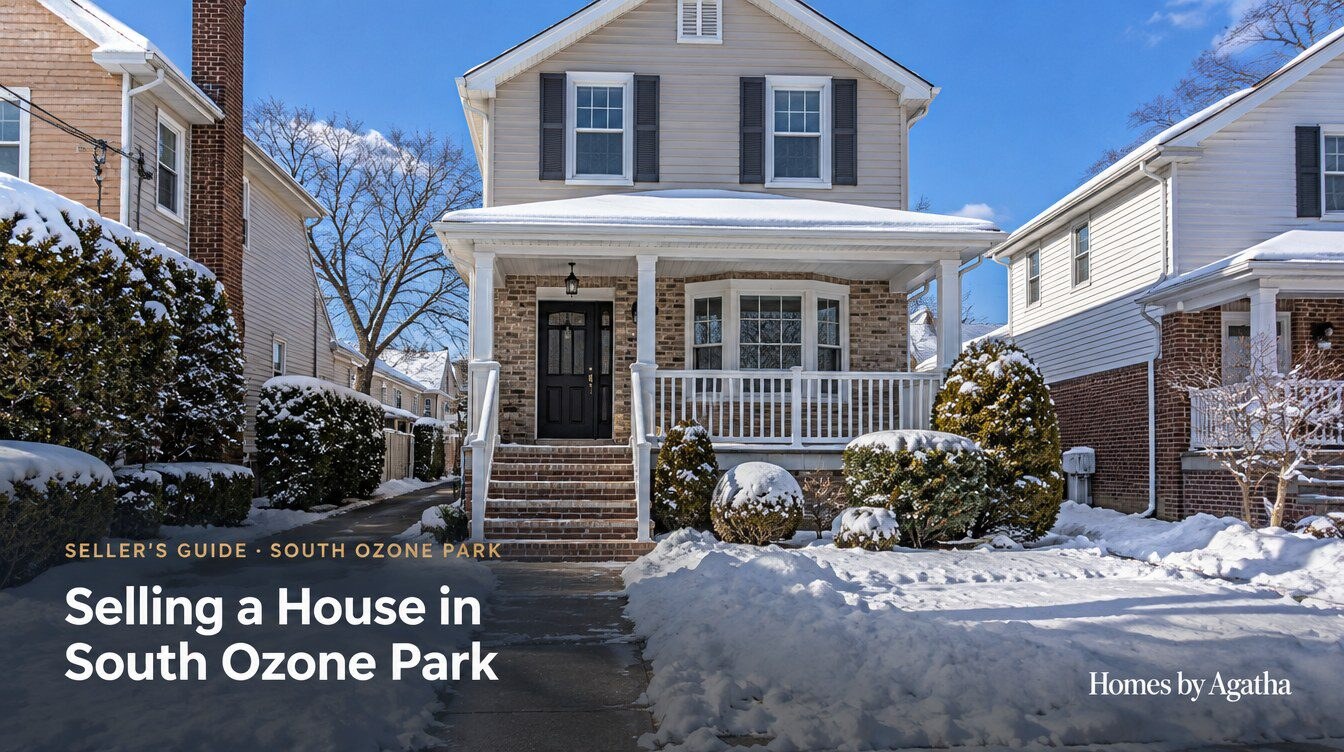
SOUTH OZONE PARK SELLER GUIDE
Selling a House in South Ozone Park: Price It Right, Document It Fully, Present It Well
Quick Answer
To sell a house in South Ozone Park, Queens, price it by its legal configuration with a CMA, gather the Certificate of Occupancy, permits and repair records before listing, fix items lenders flag, deliver the Property Condition Disclosure Statement, market it on OneKey MLS with each unit photographed, and compare offers by financing strength, not price alone.
This guide is for owners who are thinking about selling a house in South Ozone Park and want to understand what drives the price, what buyers will check, and what the process costs before they choose a listing date. Most homes here are detached or semi-detached one- and two-family houses, so the buyer’s attorney, lender and inspector will look closely at legal unit counts, basements, driveways, water history and the condition of older frame construction.
Owners who prepare for that scrutiny usually have fewer surprises after an offer is accepted. Owners who do not often renegotiate after the inspection, the appraisal or the title search.
As a Licensed Associate Real Estate Broker with an office in nearby Ozone Park, I help sellers plan pricing, preparation and paperwork, in English or Polish. Below: how buyers evaluate local houses, how a CMA works, which records to gather, what to fix, how New York disclosure and seller taxes apply, and a checklist from pricing to closing. When you want to discuss your own house, the page on how to sell your home in South Ozone Park with Agatha explains the listing process.
South Ozone Park at a glance for sellers
| Topic | Why it matters to a seller |
|---|---|
| Location | Southern Queens, between Ozone Park and Richmond Hill to the north, the Van Wyck Expressway to the east, JFK Airport to the south and Aqueduct Racetrack to the west; ZIP code 11420 for most addresses; part of Queens Community District 10. Edges are informal, so confirm the ZIP code with USPS and the district with NYC Planning for a specific address |
| Typical housing | Detached and semi-detached one- and two-family houses, many wood-frame with later siding, some newer two-family construction; buyers compare configuration first |
| Transit buyers ask about | A train at Ozone Park–Lefferts Blvd, Aqueduct–North Conduit Av and Aqueduct Racetrack (northbound only); buses toward Jamaica and JFK; AirTrain JFK via Howard Beach or Jamaica |
| Roads and corridors | Van Wyck Expressway, Belt Parkway and Conduit Avenues; Rockaway Boulevard, Lefferts Boulevard, Liberty Avenue and Linden Boulevard |
| Nearby landmarks | JFK International Airport, Aqueduct Racetrack and Resorts World New York City, Police Officer Edward Byrne Park on 135th Avenue |
| Questions buyers raise | Legal unit count and basement use, curb cut and driveway, flood and sewer history, aircraft noise, age of roof, boiler and siding |
| Seller taxes | NYS real estate transfer tax plus the NYC Real Property Transfer Tax, because South Ozone Park is in New York City |
What do buyers check first when they look at a South Ozone Park house?
Buyers of South Ozone Park houses check four things before they get attached: how many units are legal, whether the basement is dry and lawfully used, how the block feels at commuting hours and under the flight paths, and whether the big systems of an older frame house have been maintained. Each item can move the price, so each deserves a prepared answer.
Legal configuration
A two-family buyer often plans to rent one unit and needs the rent to help qualify for a mortgage. The lender will count only rent from a legal unit. If your Certificate of Occupancy shows one family while the house is used as two, the buyer pool shrinks and the appraisal may not support a two-family price. Knowing your legal configuration before pricing is the single most useful step you can take.
Water and the basement
Southern Queens buyers have heard about basement flooding after the remnants of Hurricane Ida in 2021 and about local sewer backups, so they look for staining, ask about a backwater valve and pull FEMA and NYC stormwater maps. A seller who can show waterproofing invoices, a backwater valve installation or a sewer line inspection answers those questions before they become price objections.
The block and the commute
Buyers time the walk or bus ride to the A train, drive the Van Wyck or Belt Parkway, and many visit at different hours to judge aircraft noise from JFK. You cannot change your block, but accurate information about transit options and parking, including a legal driveway, helps buyers evaluate it fairly.
Condition of an older frame house
Inspectors look at siding, sills, porches, the roof, the heating plant, any old oil tank, the electrical service and the plumbing. Receipts and permits for recent work give buyers confidence that improvements were done properly.
How do you price a house in South Ozone Park?
You price a South Ozone Park house by comparing it with recent sales of houses that share its legal configuration, construction type, lot features and condition, adjusted for location factors such as distance to the A train and exposure to major roads or flight paths. A comparative market analysis organizes that evidence.
What a CMA is, and what it is not
A comparative market analysis, or CMA, is a real estate broker’s professional opinion of value based on recent comparable sales, active competition and the property’s features. A CMA is not an appraisal and does not guarantee a sale price. The buyer’s lender will order its own appraisal, and that appraisal can limit what a financed buyer is able to pay. For a broader explanation, see what is my Queens home worth.
Pricing drivers specific to this housing stock
| Factor | How it can affect value | What to document |
|---|---|---|
| Legal unit count | A legal two-family can support rental-income financing; an informal second unit generally cannot | Certificate of Occupancy or Letter of No Objection; DOB building class |
| Detached vs. semi-detached | Buyers compare free-standing houses with free-standing houses; shared walls change the comparison | Survey; any party-wall or driveway agreements |
| Driveway, garage and lot | Off-street parking and yard space are frequent buyer priorities | Curb cut approval; garage permits; survey |
| Construction and condition | Updated roof, siding, boiler and electrical reduce buyer risk | Invoices, warranties, permits and sign-offs |
| Basement | A dry, lawfully used basement adds usable space; an illegal apartment adds risk, not value | Waterproofing and backwater valve records; CO showing permitted use |
| Location within the neighborhood | Walk time to the A train, proximity to Rockaway Boulevard or the Conduit, and noise exposure all influence buyer demand | Transit facts and, where relevant, official noise-map information |
Pricing a two-family
Two-family buyers weigh both the house and its income. The appraiser for a financed buyer typically considers comparable two-family sales and an estimate of market rent. If the upstairs or downstairs unit is rented, the lease amount, its term and whether the tenant will stay all affect how buyers value the property. A unit delivered vacant can appeal to an owner-occupant who wants to move in or choose a tenant; a unit with a documented lease can appeal to a buyer who wants income from day one.
Pricing for how buyers search
Buyers filter listings by price ranges, number of units and bedrooms. A list price set just above a common search boundary can hide your house from buyers who would have paid it. Your CMA should show where the evidence sits and where buyers’ searches break, so the list price reaches the right audience. Overpricing can lead to a long listing period, price reductions and an appraisal that does not support the contract price.
Curious what your South Ozone Park house could list for?
I can prepare a CMA based on your legal configuration, condition and location, an opinion of value you can plan around, not a guarantee.
What records should you gather before selling a house in South Ozone Park?
Before selling a house in South Ozone Park, gather the documents that prove what the house legally is and how it has been maintained: the Certificate of Occupancy or equivalent, DOB permits and violations, property tax and water bills, repair and replacement invoices, oil-tank closure papers, a survey and, for a two-family, every lease.
| Document | Where to get it | Why buyers and attorneys ask for it |
|---|---|---|
| Certificate of Occupancy / Letter of No Objection | NYC Department of Buildings (BIS, DOB NOW) | Confirms the legal unit count and permitted use of each floor |
| Permits, sign-offs and open violations | NYC Department of Buildings; OATH / ECB records | Open items surface in the title search and can delay closing |
| Property tax bill and exemptions | NYC Department of Finance | Buyers budget from it; your exemptions do not transfer to them |
| Water and sewer account | NYC Department of Environmental Protection | Final readings and balances are settled at closing |
| Deed, survey and easements | Your closing binder; ACRIS (NYC Department of Finance) | Shows lot lines, driveway rights and recorded agreements |
| Repair and improvement invoices | Your records; contractors | Supports pricing and answers inspection questions |
| Oil-tank removal or abandonment papers | Your records; the contractor who did the work | Buyers and lenders ask about tanks in converted houses |
| Leases, rent records and deposits | Your records | Required for a tenant-occupied sale and for income financing |
Assembling this package before listing gives your attorney a head start on the contract and lets your agent answer buyer questions accurately from the first showing.
Key Takeaways
- Your legal configuration, not the way the house is used, sets the comparable sales and the buyer pool.
- A CMA is a broker’s opinion of value; the buyer’s appraisal can still limit a financed price.
- Records of waterproofing, a backwater valve and sewer work answer the water questions buyers here ask first.
- Gather the CO, permits, invoices, tank papers, survey and leases before you list.
Should you legalize, remove or disclose an extra unit before you list?
If your house has a unit, kitchen or basement apartment that the Certificate of Occupancy does not allow, you have three options: legalize it, restore the house to its legal configuration, or sell as-is with full disclosure and a price that reflects the legal unit count. Never market an illegal unit as legal income.
Option 1: legalize
Legalizing an extra unit usually means an architect’s filing with the NYC Department of Buildings, construction to meet code requirements for height, light, ventilation and exits, and inspections before a new or amended Certificate of Occupancy is issued. It can add value, but it takes time and may not be possible for a cellar or a basement that cannot meet the rules. New York City’s basement and cellar legalization pilot, created by Local Law 126 of 2024, covers only listed community districts (in Queens, only Community District 2) and excludes properties in flood-prone areas, so it does not reach South Ozone Park, which is in Community District 10. Here, legalization means the full DOB filing and Certificate of Occupancy process described above.
Option 2: restore the legal configuration
Restoring the legal configuration might mean removing an unpermitted kitchen and returning a basement to recreation or storage use, with any required permits. This often makes the house easier to finance and inspect, at the cost of advertised rental income.
Option 3: sell as-is, priced to the legal count
Some sellers choose to sell as-is to a buyer, often a cash or investor buyer, who will resolve the issue after closing. Price and contract terms must reflect the legal configuration, and your attorney should decide how the condition is disclosed and allocated in the contract.
Newer two-family houses with a temporary CO
If your house is newer construction and the DOB record shows only a temporary Certificate of Occupancy or open permits, work with your architect or expediter to finish the sign-offs before listing. Many lenders want a final CO, and buyers’ attorneys will raise the issue in contract.
Not sure what your CO says about your house?
We can pull the public building records together and outline which questions to bring to your attorney before you set a price.
Which repairs and preparation pay off for a South Ozone Park house?
The preparation that pays off here addresses what inspectors and lenders flag in older frame houses (water, roof, siding, heating, electrical and items lenders flag) and makes the driveway, yard and each unit easy to photograph and show. Cosmetic upgrades matter less than removing reasons for a buyer to renegotiate.
| Priority | Item | Why it matters here |
|---|---|---|
| High | Basement dryness, gutters, grading, backwater valve records | Water is the first question buyers in southern Queens ask |
| High | Peeling paint, missing handrails, broken steps, inoperable systems | FHA and VA appraisals can require repairs before closing |
| High | Roof, flashing and siding at the base of walls | Frame houses hide rot behind siding; inspectors probe here |
| Medium | Boiler or furnace service record; oil-tank paperwork | Answers mechanical and environmental questions early |
| Medium | Driveway, curb, porch and front yard | The first photo and first impression of a detached house |
| Medium | Smoke and carbon monoxide detectors in every unit | Required items that buyers and inspectors check |
| Lower | Interior paint, lighting, decluttering | Improves photos and showings at modest cost |
Presenting a two-family
Show each unit as a separate home. Clean, well-lit rooms in both apartments, clear separate entrances and labeled meters help buyers understand the configuration. If a tenant lives in one unit, coordinate showings with proper notice under the lease and New York law, and agree in advance on how the tenant’s space will be photographed, if at all.
Staging a detached house
For a free-standing house, staging extends outside: a swept driveway, trimmed hedges, a usable-looking backyard and a clean porch. Inside, remove excess furniture so rooms read at their true size, and leave the basement bright and dry, with storage organized and any dehumidifier running quietly.
How should you handle flood history, sewer backups and aircraft noise in disclosure?
Answer the Property Condition Disclosure Statement accurately, including any flood or water history you know about, and let buyers rely on official maps and their own visits for location factors such as aircraft noise. Accurate disclosure protects you; optimistic omissions invite disputes.
The Property Condition Disclosure Statement
The Property Condition Disclosure Statement (PCDS) is a New York State form in which the seller answers questions about the property’s condition, including structure, systems, environmental items and flood history. Since March 20, 2024, the law no longer allows sellers to give a $500 credit instead of delivering the disclosure; sellers of most one-to-four-family homes must provide the PCDS. Co-op and condo units are generally outside the PCDS requirement. Ask your attorney to confirm that the PCDS applies to your sale and to walk you through the current version of the form, including its flood-related questions. Answer from your actual knowledge and ask your attorney about anything uncertain.
Water and sewer history
If your basement took water during a storm, or your house was affected by a sewer backup, describe what happened and what was done afterward. Repair invoices, insurance claim outcomes and a backwater valve installation turn a disclosure into a record of responsible ownership.
Aircraft noise and the Aqueduct area
South Ozone Park lies just north of JFK, and buyers can review the Port Authority’s Noise Exposure Maps, prepared under FAA Part 150 rules, for any address; the FAA found JFK’s maps compliant in 2017 and approved the airport’s Noise Compatibility Program in 2023. Questions about sound-insulation eligibility for a particular house belong with the Port Authority, not in your listing description. Do not describe a house as “quiet” or make claims about noise you cannot support. If you had windows or insulation upgraded, document that work factually. Buyers near Rockaway Boulevard may also ask about Resorts World New York City, which the NYS Gaming Commission voted to license as a commercial casino in December 2025, converting its existing video lottery facility at Aqueduct; point buyers to the Commission and the operator for current construction schedules rather than predicting them. Live racing at neighboring Aqueduct Racetrack ended in June 2026, when the New York Racing Association consolidated downstate racing at the rebuilt Belmont Park.
Lead paint, agency and fair housing disclosures
Federal law requires sellers of housing built before 1978 to disclose known lead-based paint hazards and provide available records. The NYS Disclosure Form for Buyer and Seller, given at the first substantive contact, explains whom a real estate licensee represents, and the NYS Housing and Anti-Discrimination Disclosure Form explains fair housing protections. Every buyer must be treated equally; offers are evaluated on their terms, not on who the buyer is.
Want a preparation plan before photos?
Let’s walk through your house and rank repairs, staging and documents by what buyers and lenders here actually look at.
How is a South Ozone Park house marketed to buyers?
A South Ozone Park house is marketed through OneKey MLS and the real estate portals that draw from it, supported by professional photography, a floor plan, an accurate description of the legal configuration and a showing plan that works around any tenant.
OneKey MLS and online distribution
OneKey MLS is the multiple listing service serving the New York City metro and Long Island region, through which participating brokers share listings and which feeds many consumer real estate websites. Being on the MLS means buyers’ agents across Queens, Brooklyn and Long Island can find and show your house.
Describe the house exactly as the records show
Write “legal two-family” only if the Certificate of Occupancy says so. Describe features (driveway, garage, yard, updated systems, distance to the A train), never the people a buyer expects to live nearby. Fair housing rules apply to advertising, and accurate descriptions also protect you from disputes after contract.
| Channel | What it does | Notes for this neighborhood |
|---|---|---|
| OneKey MLS | Shares the listing with participating brokers and feeds portals | Enter the legal unit count and building type precisely |
| Major real estate portals | Reach buyers searching on their own | Lead photo of the full house and driveway; show each unit |
| Professional photography and floor plan | Shows layout and room sizes | Separate plans for each unit of a two-family help buyers understand it |
| Open houses and private showings | Let buyers test the block in person | Schedule some at commuting hours; follow lease notice rules for tenant units |
| Agent-to-agent outreach | Reaches buyers already working with agents | Useful for two-family buyers with pre-reviewed financing |
For a borough-wide overview of the listing process, see how to sell your home in Queens.
What does it cost to sell a house in South Ozone Park?
A South Ozone Park seller typically pays the New York State real estate transfer tax, the NYC Real Property Transfer Tax, brokerage compensation as negotiated, attorney fees and the payoff of any mortgage or liens, plus any cost to resolve violations. Exact amounts depend on the price, the property type and the contract.
Transfer taxes
The NYS real estate transfer tax, administered by the New York State Department of Taxation and Finance, is $2 for each $500 of consideration (0.4%) and is customarily paid by the seller. The NYC Real Property Transfer Tax, administered by the NYC Department of Finance, applies because South Ozone Park is in New York City: for residential one-to-three-family homes, individual co-op units and condo units, the rate is 1% when the price is $500,000 or less and 1.425% when it is above $500,000, customarily paid by the seller. Confirm current rates with the NYS Department of Taxation and Finance and NYC Department of Finance before closing.
| Expense | Who sets it | Notes for a South Ozone Park sale |
|---|---|---|
| Listing brokerage compensation | Negotiated between seller and listing broker | Not set by law; agreed in writing in the listing agreement |
| Buyer-agent compensation | Negotiated; the seller may or may not agree to contribute | Not automatically paid by the seller under the post-2024 settlement rules |
| NYS real estate transfer tax | NYS Department of Taxation and Finance | 0.4% of the consideration, customarily paid by the seller |
| NYC Real Property Transfer Tax | NYC Department of Finance | 1% up to $500,000, 1.425% above, for one-to-three-family homes |
| Seller’s attorney | Agreed with your attorney | Contract, title objections, violations and lease transfers |
| Mortgage payoff and lien releases | Your lender and any lienholders | Request a payoff letter early |
| Violation and permit cleanup | Depends on the issue | May require an architect, expediter or contractor |
| Pre-listing repairs and preparation | Your choice | Focus on water, roof, siding and lender-flagged items |
Under the rules in effect in 2026, brokerage compensation is negotiable and not set by law, and you decide whether to offer any contribution toward a buyer’s agent’s compensation. Taxes on any gain depend on your situation, so ask a CPA before you list, especially for a rental or inherited property. If you inherited the house and the estate is still open, the probate real estate guide explains how a sale through the Queens County Surrogate’s Court process works. For a side-by-side view of buyer and seller costs, see Queens closing costs explained.
Key Takeaways
- South Ozone Park sellers pay both the NYS transfer tax and the NYC Real Property Transfer Tax.
- Brokerage compensation, including any contribution to a buyer’s agent, is negotiable and agreed in writing.
- Disclose water and sewer history accurately and support it with repair records.
- Describe the house and its legal configuration exactly; never market an illegal unit as income.
Want to estimate what you would net?
We can map the transfer taxes, brokerage terms and payoff items against a realistic price range so you can decide when to list.
How do you compare offers on a South Ozone Park house?
Compare offers on price, financing type, down payment, appraisal risk, contingencies, closing date and tenant terms together. The highest price is the strongest offer only if the buyer can close at that price on your timeline.
| Offer element | What to look for | Local consideration |
|---|---|---|
| Price | Net amount after concessions and credits | Compare with the CMA range, not just other offers |
| Financing type | Cash, conventional, FHA or VA | FHA and VA appraisals can require repairs in older frame houses |
| Down payment and funds | Size of down payment; proof of funds | Larger down payments can absorb a lower appraisal |
| Pre-approval quality | Was the property type and any rental income reviewed? | A letter that covers a two-family is stronger than a generic one |
| Contingencies | Mortgage contingency length and terms | Shorter, well-defined contingencies reduce uncertainty |
| Closing date and possession | Fits your move or purchase | Coordinate with your next home and any tenant timeline |
| Tenant terms | Will the buyer take the tenant or require vacancy? | Vacancy promises need your attorney’s review under New York law |
An accepted offer is not a contract
In New York, an accepted offer is not binding. The attorneys negotiate the contract of sale, and the deal binds both sides only when both sign and the buyer’s deposit is delivered. Until then, a buyer can walk away and you can still receive other offers, which is why many sellers continue to accept showings until contracts are signed.
Appraisal and inspection renegotiation
Buyers in New York City usually inspect before signing, so most condition renegotiation happens before contract. After contract, a low appraisal is the most common pressure point for financed buyers. Pricing from solid comparable sales and having documents ready reduces both risks.
What is the timeline from listing to closing in South Ozone Park?
Selling a house in South Ozone Park moves through preparation, listing, offers, contract, the buyer’s mortgage and title work, and closing. Records issues and tenant arrangements are the stages most likely to add time.
| Stage | What happens | Who leads | Local delay risk |
|---|---|---|---|
| 1. Preparation | CMA, records package, repairs, photography | Seller and listing agent | Discovering an open permit or CO mismatch late |
| 2. Listing and showings | OneKey MLS, portals, open houses | Listing agent | Tenant access and notice for showings |
| 3. Offers and acceptance | Offer comparison and negotiation | Seller and listing agent | Vague tenant or closing-date terms |
| 4. Contract | Buyer inspection, attorney negotiation, signatures, deposit | Attorneys | Inspection findings on water, roof or siding |
| 5. Mortgage and title | Appraisal, underwriting, title and municipal searches | Buyer’s lender, title company, attorneys | Appraisal on a two-family; open violations in the title report |
| 6. Closing | Final walkthrough, payoff, deed recorded | Attorneys and title closer | Lease and deposit transfers; vacancy delivery |
A cash buyer can shorten the mortgage stage. An estate sale, an open violation or a missing final CO can lengthen any stage, however motivated everyone is.
Have offers in hand, or expect them soon?
Bring them to me and we can compare financing strength, appraisal risk and tenant terms side by side before you respond.
What mistakes do sellers make, and what belongs on your checklist?
The most expensive seller mistakes in South Ozone Park are pricing an informal extra unit as legal income, listing before the records are checked, and leaving water or roof questions unanswered until the buyer’s inspector raises them.
Mistakes to avoid
- Pricing from the wrong comparables. A one-family on the CO should be priced against one-family sales, whatever the current use.
- Listing before pulling DOB records. Open permits and violations surface in the title search anyway.
- Hiding water history. Buyers check flood maps and basements; disclose accurately and show the repairs.
- Making noise or location claims. Describe the house; let buyers judge the block with official maps and visits.
- Treating an accepted offer as sold. Nothing binds until contracts are signed.
- Ignoring nearby competition. Buyers often compare with houses for sale in Richmond Hill, Howard Beach and Jamaica; price with that in mind.
South Ozone Park seller checklist
- Confirm your legal configuration on the Certificate of Occupancy or Letter of No Objection.
- Pull DOB permits and violations and resolve what you can before listing.
- Ask for a CMA based on legal configuration, condition and location.
- Gather tax and water bills, invoices, warranties, tank papers, survey and leases.
- Address water, roof, siding and lender-flagged items first; then cosmetics.
- Decide with your attorney whether any tenant stays or the unit is delivered vacant.
- Complete the Property Condition Disclosure Statement accurately.
- Photograph the full exterior, driveway, yard and each unit; prepare floor plans.
- List on OneKey MLS with the legal unit count stated precisely.
- Compare offers on financing strength, appraisal risk and terms, not price alone.
- Keep the house show-ready until contracts are signed.
- Request your mortgage payoff letter and final water reading ahead of closing.
If you plan to buy again after the sale, the companion page on how to buy your home in South Ozone Park covers the purchase side of the same market.
Frequently asked questions about selling a house in South Ozone Park, Queens
How do I find out what my South Ozone Park house is worth?
Ask a local broker for a comparative market analysis, a professional opinion of value based on recent sales of houses with the same legal configuration, construction type, lot features and condition. A CMA is not an appraisal or a guarantee; the buyer’s lender will order its own appraisal before approving a mortgage.
Can I sell my South Ozone Park house as a two-family if the CO says one family?
You can sell the house, but you should not market it as a legal two-family. Price it against one-family sales, disclose the condition, and let your attorney handle the contract terms. Alternatively, legalize the second unit through the NYC Department of Buildings or restore the legal configuration before listing.
What taxes does a seller pay in South Ozone Park?
Sellers in South Ozone Park customarily pay the New York State real estate transfer tax of 0.4% and the NYC Real Property Transfer Tax, which for one-to-three-family homes is 1% at $500,000 or less and 1.425% above. Confirm current rates with NYS Taxation and Finance and the NYC Department of Finance.
Do I have to give buyers a Property Condition Disclosure Statement in New York?
Yes, for most one-to-four-family houses. Since March 20, 2024, New York sellers can no longer give a $500 credit instead of delivering the Property Condition Disclosure Statement. Answer every question accurately, including known water or flood history, and ask your attorney about anything you are unsure of.
Should I disclose past basement flooding when selling in South Ozone Park?
Yes. Answer the Property Condition Disclosure Statement’s water and flood questions from your actual knowledge, then support the answer with records of what was fixed, such as waterproofing, a backwater valve or sewer line repairs. Buyers here routinely check FEMA and NYC stormwater maps, so accurate disclosure prevents later disputes.
How does JFK aircraft noise affect selling a house in South Ozone Park?
Some buyers weigh aircraft noise when choosing a block, and many review the Port Authority’s JFK Noise Exposure Maps or visit at different hours. Sellers should avoid unsupported claims such as calling a house quiet, and should document factual upgrades like replacement windows or added insulation.
Can I sell a South Ozone Park two-family with a tenant in place?
Yes. Existing leases generally continue after a sale, and some buyers want the income. Provide leases, rent records and deposit details, and give proper notice for showings. If a buyer requires the unit vacant, your attorney should confirm what is realistic under the lease and New York tenant law before you agree.
Is the seller required to pay the buyer’s agent in New York in 2026?
No. Under the rules in effect in 2026, buyer-agent compensation is negotiable, not set by law and not automatically paid by the seller. A seller may choose to contribute toward it or offer a credit, and any arrangement must be agreed in writing. Your listing agreement should state your own brokerage terms.
Which offer is strongest when selling a two-family in South Ozone Park?
The strongest offer combines a solid price with financing reviewed for a two-family, a down payment that can absorb appraisal risk, clear contingencies and workable tenant terms. A cash or large-down-payment offer may net more certainty than a slightly higher offer with weak financing or open repair conditions.
What repairs should I make before selling an older South Ozone Park house?
Prioritize water management, the roof and flashing, siding at the base of walls, heating service records and items FHA or VA appraisals flag, such as peeling paint, missing handrails and broken steps. Cosmetic paint and decluttering come next. The goal is to remove reasons for a buyer to renegotiate after inspection.
Your next step as a South Ozone Park seller
Selling a house in South Ozone Park rewards owners who know their legal configuration, price from the right comparable sales, and answer the water, condition and noise questions with records instead of reassurances. Gather your documents, fix what lenders and inspectors will flag, disclose accurately and compare offers on certainty as well as price. When you are ready to plan the listing, the page on how to sell your home in South Ozone Park, Queens explains how we can price, prepare and market it together.
Map out your South Ozone Park sale timeline
One conversation about your house, your records and your next move can set a realistic listing date and plan. English or Polish, whichever you prefer.
This article is for general informational purposes only and reflects conditions that may change. It is not legal, tax, or financial advice, an appraisal, or a guarantee of price or outcome; consult a licensed New York attorney, a CPA, and an NMLS-registered mortgage loan originator as appropriate. A CMA is an opinion of value, not an appraisal. Real estate brokerage services are offered by Agatha Lubas, Licensed Associate Real Estate Broker, NY License #10301213345, Keller Williams Realty Liberty, 96-10 101st Avenue, Ozone Park, NY 11416. The NYS Disclosure Form for Buyer and Seller, the NYS Housing and Anti-Discrimination Disclosure / Fair Housing Notice, and the brokerage’s Standard Operating Procedures are available on request. Equal Housing Opportunity.

Agatha Lubas helps buyers, sellers and investors across Queens, Brooklyn, Nassau County and Suffolk County plan transactions around accurate pricing, complete paperwork and clear communication. She works in English and Polish so clients can discuss every step in the language they find most comfortable.
Work with Agatha